We released version 184 on Steam on Friday, but it happened so late that we simply didn't have the time and the energy to finish writing these release notes until now ;-). This week, we're already knee-deep in work on version 185, which bring similar improvements to the encounter flow.
Detailed release notes for version 184: on the game's forum, as well as below.
CONCEPT
This week we continued to work on the way that we display the encounter mechanics. The user interface of the game is catching up with the game's logic as we learn to show to players everything that happens. There is still a way to go, but we've already managed to upgrade the way that the token combinations. On top of this, we made a few improvements in the overall user interface, and worked hard on larger issues that will ship with the forthcoming updates – such as mood and personal traits. And, as usual, the game received another batch of new sound effects, and another batch of translated texts (Japanese, Simplified Chinese and Korean).
MOVE POINT INDICATOR IN TRAVEL MODE
This has been on our todo list for a while. Now there is a move point indicator in the travel mode, which shows how many move points are left in the current day. Why do we need it? Because in the future, player party may have more or less than the current standard of 3 points per day. Thus we need to get the interface ready to inform you about the changes.
COMBINATIONS OF TOKENS NOW HAVE UNIQUE ANIMATIONS
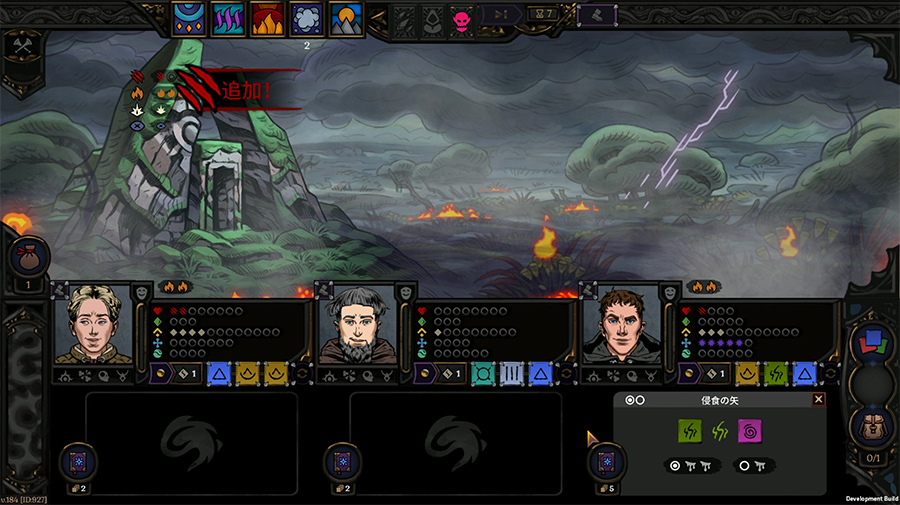
This is the main feature of this week's update: now, when tokens combine, they have relevant animations (for example, Damage clashing with Protection in) and the description of the result (the result of this combination would be "Absorbed!"). This makes the encounter much easier to understand, and will allow us to shorten some of the timers since things became more obvious with this change.
INVENTORY COUNTER FOR ENCOUNTER USE
A quality of life improvement: there's now an indicator next to the inventory button in encounters, which shows how many items you have already used in the current round (by default, you can use only 1 item in 1 round).
LOOT ICON GOT UPGRADED, NOW HAS A COUNTER
Another quality of life improvement: we changed the loot icon (earlier, we just re-used a sack from the 2019 version) and added a counter next to it, so that you can see how many items have dropped there at any given time.
"VICTORY OVER A STRONGER OPPONENT" ICON UPGRADED
And yet another small improvement: we updated the icon that indicates, whether or not your party is eligible to the reward for victory against a stronger opponent, to match the overall style of the user interface.
"MORALE BOOST" INDICATOR UPGRADED
Finally, the indicator used to show the progress of the Morale Boost mechanics (cast 3 spells in 3 rounds or less) got a facelift. It also flips over once the 3 rounds have passed or the boost has been deployed.
WHAT'S NEXT?
With version 185, we will continue working on the visualisation of encounter mechanics as well as prepare the ground for a few new features: the mood (you'll see Character Sheet change to accommodate the mood scale initially, and the mechanic itself is scheduled for versions 186-187) as well as the transition from biome effects to encounter conditions (currently: Forest has a condition that applying Fire there runs a chance of triggering Burning ground; in the future: Forest will have an encounter condition "Flammable environment", and that condition starts Burning ground when enough Fire accumulates) and the groundwork for game log and the notification system.
We have to restrain ourselves from adding new content right now, as we want to first of all ship all the tasks that are already open. Nothing is as fun as creating new creatures! But we must be cook cooks, and clean the kitchen table before starting on the next recipe =).
Stay well, and see you in a few days!
V183: Character mulligan & Improved encounters
This week we focused on improving encounter flow and encounter UI. We were also able to throw in one new feature outside of the encounter: character mulligan at the start of the game.
In parallel, we worked on the game design for a few crucial features: mood (which will replace such lasting effects as stress and euphoria), personal traits (such as 'jumpy', for example) and foraging, cooking and consuming cooked food (which covers the whole cycle from obtaining the food resources, such as 'locust buds', to preparing and consuming the resulting rations). These things are now ready for production, and we'll start putting them into the build in one of the following updates.
When you start a new campaign in Spire of Sorcery, there's 2 things you'll have to do at the very beginning of the campaign: define your mage character (not in the game yet) and choose your initial party, which we call 'character mulligan'.
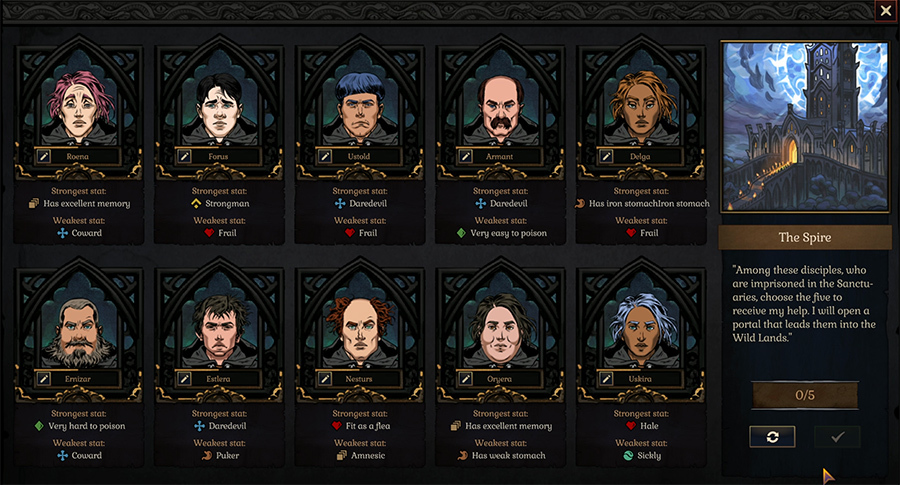
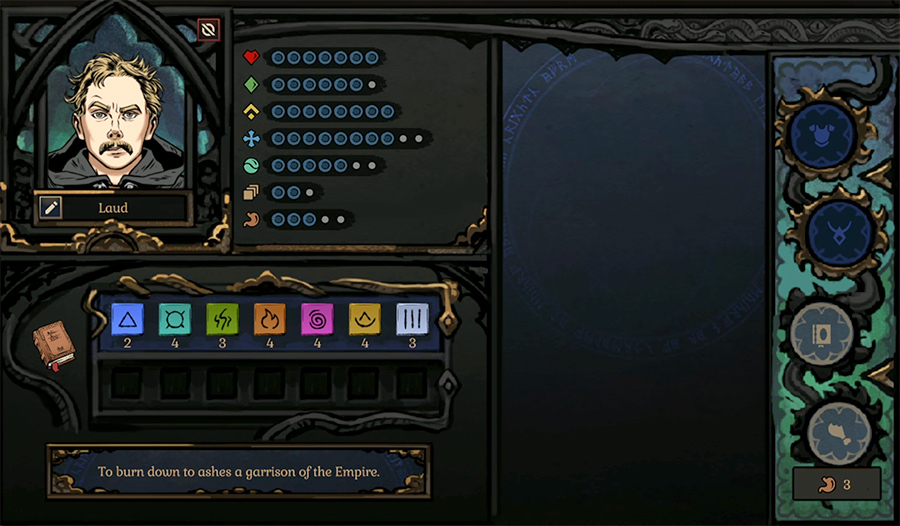
In this week's version 183, you see 10 characters and must select 5 to proceed to Prologue –
Rather than displaying all the stats for each character, we show the descriptive value of the strongest and the weakest stat of each person:
These are determined by seeing how much up or down the stats are, from the neutral value. And if several stats have the same modification (for example, the character has both Health and Digestive system that rolled "base -2"), we look at the potential of the stat (in the same example, if Health rolled +1 potential and Digestive system rolled +3, Health will be the "weakest" among the two).
Coming up in the following versions:
ability to edit character names right on this screen
information about the dreams of each of these characters (which is important for long-term play)
information about the personal inventory that each may bring to the initial party
UPDATED STAT TOOLTIPS IN CHARACTER PROFILE
A small thing that's been bothering us in the previous builds, is how tooltips were shown for modified stats. These tooltips were updated to look like this:
"Frail" – description of the current stat value
7 – potential (how far this stat can be improved)
5 – nominal value (what's the value of this stat right now)
–1 (stress) – currently active modifiers
4 – current value, which is the result of nominal being offset by modifiers
One thing that's coming with the future updates is that we'll remove all the alchemic effects that temporarily increase any stats. Such effects are replaced by mood, and mood works in a different way, which makes managing character stats easier.
UPDATED USER INTERFACE FOR THE ENCOUNTER MODE
There's a number of updates in encounter UI.
Let's go through these step by step:
Environmental and Biome effects have moved to the top of the screen (here, you can see Hail and Ruins icons)
"Victory over a stronger opponent" icon got an upgrade (two trumpets on the left side)
Instead of banners which displayed whose turn it is, within the round, we now use the same stone tablets that we use in the travel mode – at the top of the screen
"Next round" button is now next to the turn indicators
Turn counter is right next to it
"Retreat the whole party" button is also there, in the same group
"Force this party member to retreat" button moved to the other side of character portrait
On the right side of each portrait, there's now a new device (not functional yet) which is responsible for personal achievements that will positively impact character's mood (e.g. someone is excited about casting fire spells, and someone else is excited about scoring awesome loot)
In the line under the character portrait, we now can see the icons of lasting effects, injuries and diseases which we earlier already saw in the travel mode. Tooltips show all the details.
Additionally, this element now also shows the equipment icon – when some item is equipped, this icon will light up and offer details of the effect (not functional yet)
Concentration button became smaller, and when it's disabled, it's dimmed down and has the same "claws" locking it as all elements have, when you cannot move them
"Discard hand" button became round, but stayed in the same place as before
Spellbook's icon got upgraded. Current placement is not final, though – as we will change the way spell formulas look, and only then will integrate it there (we have some pretty crazy concept for this part!)
Inventory and Show deck and discard buttons got the same round treatment as we use for all new windows opening up
Finally, while we haven't updated the Loot icon yet, it got a round treatment
"Morale boost" indicator did not get a proper icon yet, either, but at least it got a more fitting progress bar – on the left side
We hope that these updates will make completing encounters more convenient for you, and we'll continue to update this screen as we work on the consistency of all kinds of buttons, as well as the way we show spell formula and Spellbook.
ENCOUNTER FLOW
The most important thing for this week's update is the hardest to describe, because it's nearly invisible: it's the flow of the process itself.
First of all, each round and each turn are now announced with proper plaques in the middle of the screen:
Secondly, when a creature starts its turn, we now highlight it with a "ray of god" – but we removed the "red sun" device as too distracting:
Third, whenever your party members or opponents intend to attack someone, the initiator and the intended action are shown next to the target. Here's the intended consequences of a spell –
and here's the intended action of the opponent –
Next, we started to clearly display some of the mechanics of how tokens combine, and will continue making these more transparent in the next versions:
TRANSLATIONS
A number of texts are now available in the game in Japanese, Simplified Chinese and Korean. We're catching up, slowly but surely, on the localisation. Know issue: some line breaks are broken. We'll have a fix for this next week.
WHAT'S NEXT?
There's still work left to upgrade the UI of the encounter, as well as the Recipe Book and the Cauldron.
We also want to finish with the proof of concept for the animation of how specific tokens affect characters (shown over their faces).
Finally, we need to get started on the mood system, which will replace stress and euphoria, and which currently blocks the hunger mechanics. We don't know if we'll be able to ship it within the same week, but at least we'll do the best that we can.
See you next Friday!
V182: Improved encounters
This week we've been working on a few features which we don't ship today as they're too big to complete them within one week's sprint. The same relates to the upgrades in user interface: we're still updating Alchemic Cauldron and Encounter screens, which will get a total makeover with one of the upcoming builds. But this is not to say that we're not shipping any improvements with this week's build ;). We finally started untangling the sequence encounter flow, and made progress there.
UPDATED INDICATION OF ACTIVE OPPONENT, INDICATION OF INTENDED TARGET
The flow of the encounter is extremely important to us. While the code works as intended already for a few weeks by now, a lot of things are still happening too fast to keep track of them – and in different parts of the screen, which poses an additional challenge. Moreover, some of the complex mechanics are not exposed enough.
Two steps we made this week towards a better flow:
the opponent that is going to act, is now highlighted with the red device (shown on the screen below)
the intended targets are now indicated, as well as the intended actions (below, you can see the Shadow is dealing Fear)
We also slowed down the visualisation of all token interactions, as a temporary measure that somewhat helps to keep track of the complex events.
As an example of what we still have to improve in the coming weeks, consider the following:
player party issues Damage to Corpse that already has Fear
the corpse receives Damage as well as additional Fear (such is the combination of these tokens)
the corpse is then destroyed, and issues a token of Infection to a party member
The current build lacks the description of why exactly the bonus Fear is issued, as well as the indication of the outcome ("destroyed"), and the reason for the Infection token that's dealt (it is dealt from the corpse, as the consequence of its destruction).
This is the sort of things that we'll continue to visualise with the coming updates, until all is loud and clear.
UPDATED TOKEN INTERACTION
Another improvement in the encounter flow: when two tokens clash and absorb each other, there's now the actual animation of them clashing, followed by the name of the mechanic ("Absorbed!"). See below for what happens when Acid is dealt to the character that has Protection.
PROOF OF CONCEPT FOR MULTI-STAGE ENVIRONMENT EFFECTS
Yet another improvement in the encounter flow that required a proof of concept is the separation of "passive" and "active" states of environmental effects. Shown here is the "passive" Burning ground, followed by its "active" visualisation. You can also see on the second screenshot that Burning ground indicates its intended targets, and previews the intended action (1 Fire to each of the three characters).
We think this change makes it easier to grasp, how exactly the environmental effects work (and when do they kick in), so we'll scale up this solution to other effects just as well.
GETTING READY TO BRING A FEW MORE CONTROLS TO TRAVEL MODE
Three more buttons made it into the travel mode:
center the map on player party
open party's profile
display party's sustenance level and its food supplies
All of these buttons are not yet functional, as we're still busy with the underlying code, but we already wanted to push them out to test their placement during the coming week.
TOOLTIPS FOR INJURIES, DISEASES, LASTING EFFECTS ARE NOW FUNCTIONAL
Meanwhile, the indicators of lasting effects, injuries and diseases shown under character portraits on the party panel are finally functional! If there's anything to show, the icon lights up – displaying the details as a tooltip. This makes it easier to see, if any of your "point men" need a replacement before you jump into another encounter.
WHAT'S NEXT?
Next week, we'll keep biting into the larger mechanics (hunger, cooked food and travel magic as well as game log) while aiming for steady progress with the improvements of encounter flow and user interface. We also re-started sending in-game texts to translators (Japanese, Simplified Chinese, Korean), since a number of areas in the game is now stable enough to allow us to proceed with the localization.
While we won't enter general Early Access this month, we're getting closer to that moment with every week. And we already started working on the design of the chapters that preceded and follow the currently available Prologue.
Stay warm and have a great weekend, we'll see you in a week's time!
V181: Point men, forced retreat & drafting
This week we ship a feature that will change the way you play the campaign as well as introduce three significant upgrades of the user interface. It's been a productive week for our team, and we're really happy to see the various mechanics of the game come together!
While the game doesn't have a tutorial yet and we know that it might still be too difficult to grasp at the first launch, we're getting there – just please have some patience =). We'll add a few more key features like hunger, cooking, travel magic, upgrades and sieges first, and once these are safely in place, we'll finally start on the introduction to the game so that it's ready for the general Early Access.
If you've been reading modern military memoirs, you may be familiar with the terms "to walk the point" and "point men". These terms refer to the soldiers that are at the front of the party that moves through the hostile territory.
With version 181, we make the transition to using the top party panel for managing the team that goes into any new encounter while saying goodbye to the dedicated pre-encounter screen
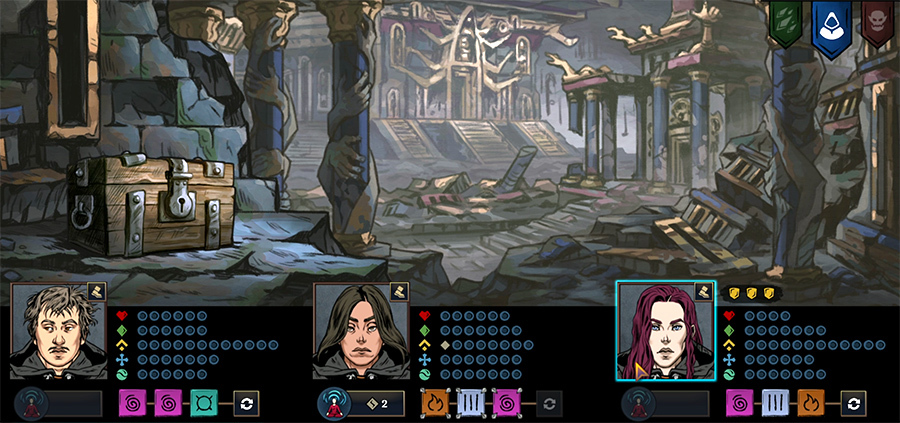
Here's how the party panel looks –>
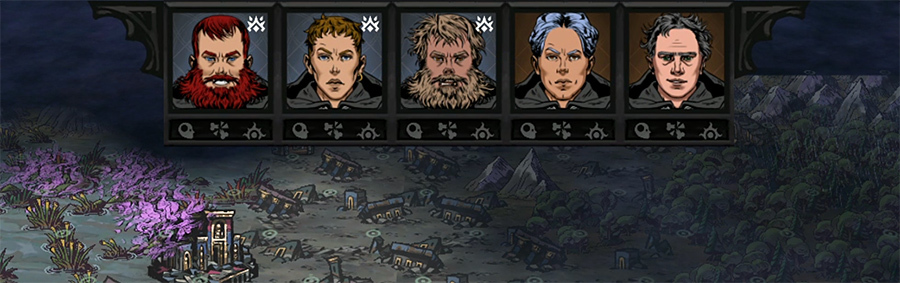
Note that the three characters on the left side have different portrait backgrounds, as well as feature encounter icons in the top right corners of their portraits. They are the party's "point men" –>
You can assign specific characters to this role by clicking on their portraits, to have them swap places. In the example below, I first click on the disciple on the right side (a frame appears), and then on the disciple on the left side (the exchange is complete: they swap places).
Following the exchange, I initiate an encounter, and sure enough I get the three characters that I've just appointed to walk the point, in the same sequence as they are displayed in the party panel –>
Overall, this new feature streamlines the preparation for any encounters, and lays further ground for introducing further personal traits that can be related to certain characters taking the risk (or being afraid to do so).
FORCED RETREAT & DRAFTING
Forced retreat and drafting are an extremely important addition to how encounters play out in the game, even though the actual user interface elements are small and blend into the existing controls.
First, let's remember the rules for retreating from combat:
player party may retreat at any time, if opponents are not challenging it
aggressive opponents (e.g. gigglers) generally prevent party from retreating in the first 3 rounds of the encounter
a character who retreated, receives 5 days of stress condition (which lowers their memory, courage and endurance)
With version 181, we now also allow individual retreat (check the icon in the top right corner of the character's portrait) – and it obeys the same rule, in terms of availability. You can force a party member to retreat as long as retreat is available to the whole party –>
In this example, I had the misfortune of stumbling upon 3 opposing parties that merged together before attacking me.
I managed to survive for 3 rounds, though my leftmost character took a lot of damage and was about to die – which is when I pushed him to retreat –>
Once a character has retreated or died, a spot in the party is vacant, and drafting becomes available –>
When you hit "draft another member", a panel appears that lists those in the party who are available for drafting –>
You can preview their stats by using right mouse button to open their character profiles. Once you made your choice, and confirmed it, the new party member arrives to the frontline, and is able to act, immediately.
What this feature brings is the incredibly important ability to use all of your party members to challenge a larger opposing party, and to prevent deaths and injuries by forcing characters with a lot of damage or fear to retreat before it is too late. Moreover, it also allows you to force retreat characters that have, for example, accumulated too much paralysis, or fire, or acid.
In other words, more control – more flexibility – and more combinations. See if you can now challenge larger and more dangerous parties of opponents, and win those encounters despite unfavourable weather conditions!
FROST: UPDATED MECHANICS
If you ever fought a battle under the hail against a group of Shadows who dealt additional Frost tokens on top of what the weather was dealing, you would be glad to know that we changed the mechanics of this token a little:
now 3 or more tokens of Frost deal 1 Damage per round (was: Paralysis)
now 6 tokens of Frost deal 1 Paralysis per round (was: Damage)
NEW SEASON DEVICE, NEW SEASON RULES
As a part of the overhaul of the travel mode user interface, we upgraded the device that displays the current season: it displays the current season (including the detailed tooltip, which as always is available by pressing "SHIFT" as you hover over the element) and its progress.
New feature: due to unpredictable trajectories of Rund's three moons, seasons now no longer last 10 days each, but instead vary between 6 and 16 days. The exact length is determined at the start of each season, and is reflected in the season's progress bar.
TURNS DEVICE
More improvements on the travel mode: not only do we now show the total number of days since you started the Prologue, but also the current turn. The icon of the currently active turn lights up, and each icon has a tooltip and its detailed ("SHIFT") version that detail the rules (for example, do you know at which turn creatures get spawned? at environment's!).
ANIMATED CREATURE STATES
Once we added the sound effects of opposing parties changing their states from "idle" to "alert" and from "alert" to "in pursuit", we felt like this helped a lot I identifying the threats to player party. But sometimes it wasn't really obvious, where did the sound come from. With version 181, we introduce the animated creature states that address this issue –>
In the plans for one of the future updates: to actually center the screen on the specific opposing party that makes the move during its turn.
CHANGE IN CONTROLS
This change may make some of our early players cringe (and we understand you!): we swapped mouse controls in the travel mode.
Now, to move, you will use the Left Mouse Button –
And to access information (e.g. Character Profile, Hex Info, Discovery Cards, etc.), you will use the Right Mouse Button –
This is a part of our general push to harmonise the controls in the game.
UPDATE: ALCHEMIC CAULDRON
As a small step towards the upgraded user interface of Alchemic Cauldron, we already introduce a new middle section with this week's version. Nothing changes much, it's just a process of a larger update that we expect to finalise in version 182.
WHAT'S NEXT?
Next week, our team will split into two parts: one part will be fixing the small outstanding issues, of which we accumulated a good devil's dozen (cleaning up the Encyclopaedia, setting up a separate Rulebook and so forth); while another part will be busy with the prep work for a few larger features that we'll ship in versions 183-185 (including travel magic with its first real spell).
If you're a part of the Limited Early Access, please give the current version a go and share your comments on the Steam forums, on the Discord server or on the YouTube channel – we love getting feedback.
Thanks, and see you next week! Team CO
Version 180: Books of Elements, Clothing & updates in user interface
This week's update is already available and brings Books of Elements (which allow deck management), clothing items and updated user interface.
Attention, new players! While the game still doesn't have a tutorial yet, we recorded this video that highlights the core mechanics – we hope you will find it useful:
[previewyoutube="oU3_CyKS1WU;full"]
And now on to version 180 –
CONCEPT
We've managed to do some quality work this week, as you will see in the release notes below! A new Character Profile, a way to manage the decks of your party members through the Books of Elements, equippable clothing items that change the visual appearance of party members, editable character names and a bunch of new sound effects are just the things that we shipped with today's build. There's more that will arrive with the next updates as we also did a lot of work on the issues that take longer to wrap. As always, though, we wish that we had double the time to do even more :-).
UPDATED CHARACTER PROFILE
The updated Character Profile is what we want to whole game to look like!
progress bar (including potential) of Memory
progress bar (including potential) of Digestive system
slots on the right side: clothing, equipment, books, consumable items
The empty area right below the Deck of Elements is already prepared for "blocked elements", which is the consequence of using travel magic – it's coming with one of the future updates.
Next on our concept artist's todo list: the updated window of Alchemic Cauldron and Recipe Book.
CHARACTER NAMES CAN NOW BE EDITED
Nothing fancy, but it's now way easier to keep track of your favourite party members!
LASTING EFFECTS, INJURIES, DISEASES GOT AN UPLIFT
We continue to improve how we display such information, and the updated Character Profile is another step in that direction.
BOOKS OF ELEMENTS ARE IN THE GAME
Books of Elements are in the game now, coming in three levels: uncommon, rare and very rare.
These books contain 3, 5 and 7 elements (respectively), and you can swap one such element with one element from the deck of one of your party members. To start the process, drop the book into the Reading slot of any character.
Books of Elements are available as loot from Abandoned Palace, where you get 3 random books per each event.
CLOTHING IS IN THE GAME
There's now a dedicated Clothing slot in Character Profile, and it affects how the character looks (the outfits are currently missing hats, which will arrive with the next update; they were too big for the current frame =)).
At the moment, there are 3 sets of clothing that are available as loot from Dead bodies – you must destroy the body with Damage, as if you burn it down with Fire then the clothing will turn to ashes.
THE INVENTORY SCREENS GOT UPDATED
The inventory that opens in the travel mode has a new look, as well as the inventory that's a part of Character Profile. There are filters, too (they'll start working with one of the later updates).
OPPONENTS NOW DISPLAY THEIR ATACKS MORE CLEARLY
There's still a long way to improving the encounter flow, but we're getting there!
Two new things: first, there's now a clear symbol above the opponent that is performing the action; second, there's now an indication of the exact action that the opponent will perform, next to its targets.
NEW SOUND EFFECTS
Protection from poison (token) – token issued
Reflection (token) – activation
Blindness (token) – activation
New season: Broken moon
New season: Maiden moon
New season: Phantom moon
Start of the Prologue ("player party arrives")
Player party moves across forest
Player party moves across wetlands
Player party moves across ruins
WHAT'S NEXT?
We'll plan the week on Monday, as usual. On top of the list is the travel magic; the mechanics of hunting, fishing and gathering; improved encounter flow; and the updated Encyclopaedia (we'd like to split it into Rulebook and Encyclopaedia, moving out all the descriptions of game mechanics to a separate place). We'll probably choose one feature, and one user interface improvement, as the priority, and then go from there. How many weeks are left until we can progress to the general Early Access? Hard to say! It feels like we keep a really nice tempo, with no distractions, so step by step, we're sure to get there. See you next week!
Version 179: diseases & injuries + victory against a stronger opponent
Hello, dear friends:
We continue with our weekly updates of the game, and try to keep you up to date on how it's going – and how the game is progressing.
This week's update is already available on the Limited Early Access branch, and brings a re-worked system of diseases & injuries, as well as a few updates in user interface and game mechanics.
Full illustrated release notes are under the video link below.
[previewyoutube="gVuZQ_OoSPs;full"]
CONCEPT
With version 179, we aimed to ship a few cool things, including the travel magic functionality, but most of them got moved to the next update because life got in a way ;). And so the scope of this week's update is a bit less ambitious: arriving today is the re-worked system of injuries and diseases, a few changes in how various game mechanics work, and a few visual updates for the user interface.
VICTORY AGAINST A STRONGER OPPONENT
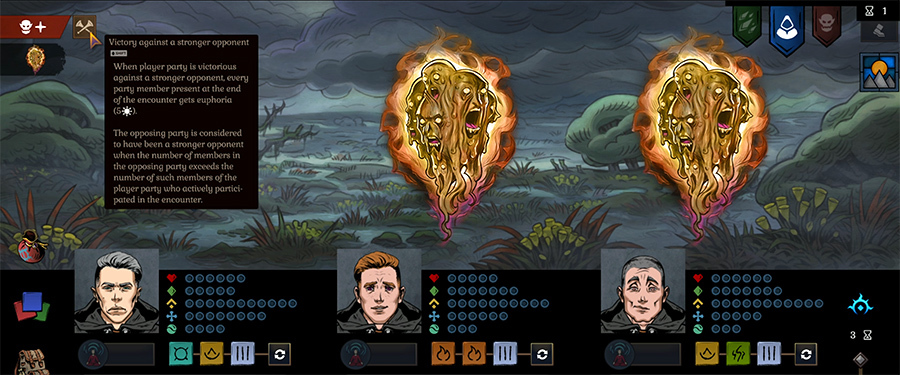
For a few weeks now, this feature was stuck in the queue. But now it's finally in the game: when player party wins an encounter against a stronger opponent, every character present at the end of the encounter gets Euphoria (for 5 days).
What does it mean, "a stronger opponent"?
This means that the number of creatures in the opposing party (on the screenshot above: 4) is larger than the number of player party members who participate in the event (here: 3).
With one of the future updates, we'll bring a possibility to "retire" a player party member during encounter, and draft a replacement from the rest of the team. Any such replacements will affect this counter, i.e. if I would draft 2 extra characters for this specific encounter, I would lose the mechanic.
And what is euphoria, you may ask?
It's a lasting condition, like stress, which temporarily gives:
+2 to Courage
+2 to Endurance
+1 to Memory
The inspiration for this mechanics, just like with Stress, lies in the chemistry of primates, where a monkey that challenges another monkey wins the fight, it gets a hormone input that makes it braver and more alert; while a monkey that loses the fight, gets a hormone input that motivates it to stop fighting, and recover.
INJURIES & DISEASES: BOTH SYSTEMS GOT REWORKED
Some weeks ago, there was a comment in the community that the then-current diseases (diarrhoea, for example) sounded way too boring. Around the same time, we also posted a note internally that both diseases and injuries need to be reviewed for how they work. And finally this week, as we've been working on an updated character profile (which ship only next week, by the way), we hit the same issue from another angle: no matter how we tried, we couldn't explain, intuitively, that injuries self-heal while diseases get worse on their own.
It was a high time to rework both systems, and so now we have totally new sets in the game –
Current groups of injuries:
Concussion
Dislocated shoulders
Ruptured lung
Fractured skull
Broken ribs
Acid burns
Gut trauma
Injuries come in 4 levels (minor, moderate, severe and permanent) and have static effects (loss of Memory, a chance to miss the target, and so on). The higher the severity of the injury, the more averse the effects. Every type of injury, except for permanent ones, gets easier in 10 days. And every injury can be removed by applying Bloodplaster.
Once you get an injury, its discovery card becomes available in the Encyclopaedia.
Current groups of diseases:
Bloody tremors
Fear of light
Whispering voices
Blinding hallucinations
Demonic visions
Red strangler
Daytime nightmares
Like injuries, diseases come in 4 levels (minor, moderate, severe and chronic). Unlike injuries, diseases do not progress – they neither get worse, nor do they get better, until they are healed (use Foul drops). All of the diseases have dynamic effects, and all affect characters in the encounter mode.
Once you get a disease, its discovery card becomes available in the Encyclopaedia.
We hope that you find the updated systems a bit more intuitive!
"WRONG TARGET!" MECHANIC UPDATED
As we worked on the new sets of injuries, we felt it's time to update the "Wrong target!" mechanic: now it chooses a new random target, instead of the intended, on the same side as the original target. In other words, if you place Protection on one of your own mages, having "Wrong target!" will randomise the recipient – but won't send the spell to the opposing side, and vice versa.
CONVERSION OF DAMAGE & FEAR UPDATED
Another "housecleaning" task that we solved this week is the update for the formulas of how Damage and Fear convert after the encounter.
Previously: each token that remained on the character, increased the chances (by about 5%) of getting an injury or a stress condition.
Now: we look at the proportion of each stat. So in the screenshot below, the lass has a 50% damaged Health, and it is this value – rather than the absolute number "3" – that will be used to determine, if she scores an injury (full disclosure: it's % of stat multiplied by 50%; thus here, she currently runs a 25% chance of scoring an injury).
UPDATES IN THE TRAVEL MODE UI
A small update this week on the travel mode: the buttons for Alchemic cauldron, Party inventory and Travel Spellbooks got a facelift. This is a tiny change for you guys, but a bigger conceptual decision for us, as we finally settle on all similar buttons in the game being done in the same style of "painted glass that lights up".
We also slightly updated the character panel, which is now a bit less ornate (the portraits retained their sizes from version 178):
This is all a part of the preparation for being able to re-arrange the characters here, so that we can finally get rid of the pre-encounter drafting screen. It's progressing nicely in terms of visuals – you can see a bunch of test framing we tried on the game's Discord server – but we haven't been able to ship this feature with version 179. I have high hopes for version 180, though.
OPPONENTS NOW USE SPLASH DAMAGE WITH MORE IMPACT
Another small quality of life (or quality of death, in this case) improvement: now opponents who use attacks with splash damage, consider the position of their target, and will prefer to hit player party in the middle – or at least in a way that maximises the damage inflicted.
This makes multi-turn attacks more dangerous, obviously.
CHARACTER NAMES ARE NOW SHOWN IN CHARACTER PROFILE
Certainly not groundbreaking, but pleasant nonetheless: character names have returned to the character profile. Next in the plan: the ability to edit these names (this is all connected to the Character Mulligan screen at the start of the campaign, which is still in the works; we want you to be able to both select the characters that you like the most, and then edit their names as you please).
"THE LAST WISH OF THE DEPARTED" IS NO LONGER CONCOCTABLE
I know that a lot of you, myself included, loved this great potion, but we decided to remove it from the list of concoctable items because it was the only recipe that used 2 items of the same type. So for the moment, the only way to get "The last wish" is by looting the barrows. In the future, though, we may bring it back into the recipe book, when we add a few more resources that can be used as ingredients for the new formula.
WHAT'S NEXT?
Next week, we're going to do our best to ship as many "long haul" features as we can.
While we don't have a definite release date set for the general Early Access version of the game, we're pretty eager to get there as soon as we can – which means that we need to focus on the big stuff, and let the small stuff take care of itself later on.
Travel magic, deck management, the Spire and its upgrades and sieges, and non-humans with the first boss battle – this are the exciting things that we're itching to complete! And once it's in the game, it will be finally the time to hit that PUBLISH button =).
Stay warm, and stay healthy out there!
Version 178: spell combos, morale boost, character potential
ːnotebookː Hey guys! Starting this week, we're going to publish the weekly release notes for the Limited Early Access version on this page as well – so that you can follow the progress of the game for a few months before it releases in the general Early Access.
We do this as a part of our pledge to keeping the development process transparent. Below you will find the release notes for version 178 that we released last week; for those interested in how we spent the last seven weeks, here are release notes for version 177 (January 28), version 176 (January 22), version 175 (January 15), version 174 (January 7), version 173 (December 30), version 172 (December 23) and version 171 (December 18)..
---
This week's update is already available and introduces a few cool features: spell combinations, morale boost and character potential, as well as the first sketches of the new user interface.
This week we focused on features that improve different parts of player experience: introducing combo spells, getting every character inspired when the party casts 3 spells in the first 3 rounds of the encounter, introducing character potential and bringing in the first few sketches of the new interface (we start with the travel mode).
ATTENTION: SAVED GAMES
Because we changed the way that we generate characters (see "character potential" below), saves from earlier builds are no longer compatible with version 178.
SPELL COMBINATIONS
A few weeks ago we had a vision of seeing one mage build up a fire spell, and another build up a frost spell, which then got combined into what looked like a first of water – and dealt damage. Since then, we've been waiting for the chance to add spell combinations into the game, and finally they are here!
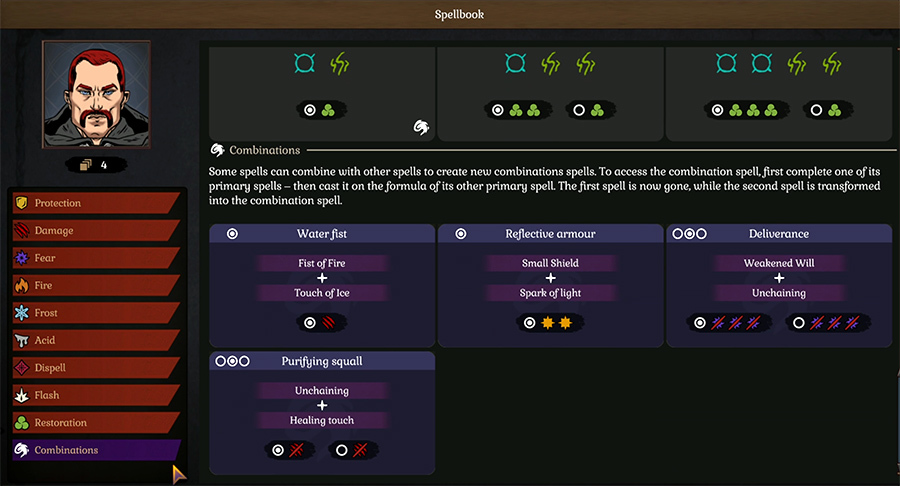
You can see them in their own separate section it the Spellbook:
Each combo spell requires 2 primary spells. Complete one, cast it on the other, and it gets transformed.
Some of the combo spells offer new effects (such as removing damage or adding reflection tokens) while others are just a way to overcome the limitations of low memory (for example, "Water fist" needs two primary spells, each with just 2 elements, and issues a Damage token – which normally needs a spell that requires 3 elements).
"INSPIRED!" / MORALE BOOST
The mechanic of "Inspired!" (which removes Fatigue from the character) has been designed a few months ago, and originally came from the mechanics of relationships and charisma. While we still haven't shipped these two mechanics, the inspiration came handy for another situation: now when player party casts 3 spells in the first 3 rounds of an encounter, every party member gets "Inspired!" and loses 2 Fatigue.
The feature is called "Morale boost" and is meant to allow you to use some extra concentration early on, knowing that you will be rewarded for your efforts if you succeed.
At some point in the future, we think that individual characters can have their own little "perks" that, when satisfied, could lead to additional inspiration – someone is motivated when they use fire, someone is motivated when they kill opponents, and someone is motivated when, say, the party gets to use a bunch of alchemic substances during one battle. We'll see!
CHARACTER POTENTIAL
We used to generate characters as "roll a base value for each stat plus add a few traits that modify a particular stat". Character stats were also not limited by any cap, and could have been boosted until forever.
Version 178 introduces the new system:
each character is generated with their current stat values as a dice roll +/–2 of the base value
each character also has their "potential", i.e. how much the character can increase the specific stat the potential varies between 0 and +3 for each stat
the descriptions ("Weakling", "Amnesic", etc.) are now linked to the actual values (e.g. everyone with Memory 2 is described as "Amnesic")
the descriptions will come handy in the situations where you can choose one of several characters to join your party – you won't see full stats there, but you will see the top stat and the top potential stat there
NB: this part of UI currently lacks tooltips, we hope to roll them in with tomorrow's hotfix.
UPDATED INTERFACE
While we still work on the concept of the new user interface, we already wanted to start introducing it into the game – because some things take a bit of time to playtest them. In this version, you will notice:
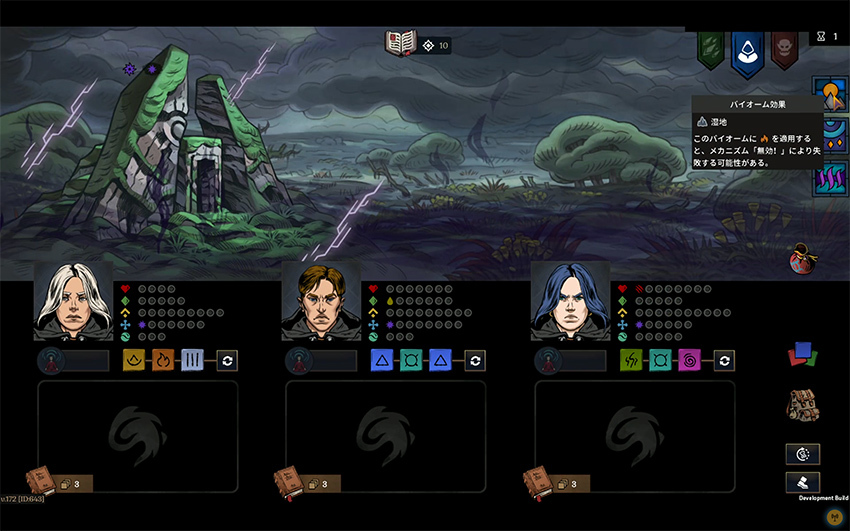
Characters from player party are now shown on top of the screen. We're going to see if the size of the portraits is good enough, or should be adjusted. Each character now also has 3 icons underneath (Diseases, Injuries and Lasting effects; later, Curses will join the range) – they are not yet functional in 178, but with future updates will display the details of each active effect as a tooltip.
Icons for Concoction, Inventory and Travel Spellbook received their own device that unites them, in the left corner. The icons will change, but the placement is final.
Quest interface (top right corner) got an update, we'll keep developing its functionality (how to show several quests and the ones that are already available to be completed). In this build, we just wanted to map out the size and the placement of the device.
The actual images we used are just work in progress, of course. Below you can see a sketch of the updated Character Sheet, as a pointer to where we're moving with the update.
GETTING READY FOR TRAVEL MAGIC
Spellbook now has an updated detailed tooltip (hover over the icon, then hit SHIFT): we're getting ready to introduce travel magic, which means that there will be actually two different Spellbooks once that happens: one for encounters, and one for use when traveling. The icons will change to reflect this. The Spellbook icon on the travel mode is now already disabled, with the tooltip explaining how it will work.
SOUND EFFECTS
Please welcome the new SFX:
there's now an effect now when element is dealt in character's hand
there's now an effect now when character gets a new disease
Wetlands biome now has an awesome ambient soundscape
Ruins biome now has an ambient soundscape that is no less awesome!
SMALLER CHANGES
Applying 3 or more Damage in one round in Ruins now creates environmental effect "Cloud of smoke" that lasts 1 round. The description of this effect comes to the game tomorrow, with the hotfix.
In version 177 we started to show on the left side of the encounter screen only the creatures that are waiting for their turn in the encounter queue, rather than everyone in the opposing party. Now this list has an icon, and a tooltip describing it.
The tooltips for Inventory got updated to reflect the fact that you can only use a limited range of items during the encounter.
The counter for multi-turn opponent actions got a facelift, and a tooltip.
When one opponent attacks during the encounter, other creatures in the party are slightly faded to focus the attention on the attacker (but this needs adjustment as for now the change is not big enough to be obviously noticeable).
WHAT'S NEXT?
Next week we're going to continue improving the flow of the encounter (there are still many moments when it's easy to lose the track of what's happening and it's crucial that we address this!), we'll also start with the mockup of "game log" (we really need a place where we can see every action that happened in the game) as well as continue updating the interface. And it's time to bring in travel magic – though whether we can ship something already in the coming week, is hard to tell yet, since it's a pretty big mechanic that may need more time to implement. Somewhere in the list is also "Character Mulligan" – a way to choose characters at the start of the chapter.
Stay safe, stay healthy – and cast some spells!
We're back to regular updates
This announcement has been originally published on December 23, 2020. In the seven weeks since then, we have released seven updates for the game, and currently continue to update the game weekly.
---
Dear community:
It’s been a few months since we stopped with the regular news updates, while we focused all of our attention on implementing the long-overdue changes in our development process.
We sincerely apologize if you felt let down because of this and wondered about what has happened. The reality is that we’re a small team that strives to spend its time in the most efficient way, which we decided is best invested into “doing what we need to get a good game done” rather than “talking about how we’re going to do this”.
Today, we bring back a new build of the game to Steam under the Limited Early Access program. If you own the app, you will see an update scheduled for the public branch. But before you launch it, please allow us a few words on how we arrived to this build in the first place.
SPIRE OF SORCERY IN 2018-2019
We started working on the concept art for with Spire of Sorcery in the summer of 2017, first with two people and later with more of our team members joining the project from Gremlins, Inc. We spent all of 2018 and 2019 working on the game that was “just around the corner”, even though the goalpost kept moving as the time progressed.
At some point, we honestly expected that we might enter Early Access in the summer of 2018. When we didn’t enter Early Access by the summer of the following year, we crunched for several months to launch it before the end of 2019.
Our main mistake was that having successfully released and operated Gremlins, Inc. for a number of years, we never prototyped the new project, or even documented our game design: we simply relied on our game designer’s “vision”, which we would follow until the game is ready for release.
Unfortunately, only while crunching for release, have we discovered that the “vision” was too vague and undefined and could not be completed in any predictable timeframe, because it was never properly defined. In the games industry, people call such projects “ghost ships” – it looks like a ship, but you can never board it. Ultimately, we ended up working on a game that was “fun to develop” – as opposed to creating a game that is “fun to play”.
In November 2019, we entered the Limited Early Access program with the first version of Spire of Sorcery. If you played the game around that time, you would probably remember that it looked like this:
WHY WE DID NOT PURSUE THE 2019 VERSION
On the face of it, the version of Spire of Sorcery from 2019, was what players have expected: indirect control, survival mechanics, and an open world to explore.
Gradually, though, some serious underlying problems started to become clear:
A game about a dying mage and his disciples had no magic in the game.
The early survival mechanics were pretty knee-jerk: get lots of food now or die.
The lack of control over quests lead to passive spectator experience, where it didn’t matter what happened on the quest; people just clicked through to see the loot of the returning party.
For sure, certain aspects of the game were fun: some weird diseases, and the choice of party behavior that was based on personal preferences. But mostly these were fun in a “cool to talk about” way, not in the “cool to play with” way. And our game events were so very mundane and so boring…
The game displayed three tendencies that ultimately broke player experience for us:
Everything was random to the point of becoming meaningless. For example, randomly seeded resources contained randomly assigned alchemic properties. Thus, you were never certain, what exactly did you need – you just hoovered up everything in sight, and then mass-produced whatever you could manufacture.
Magic played little, if any, role in the game about mages. You hunted, gathered minerals, and read books in ancient tongue, but you didn’t do a single thing that a mage would be expected to do. “Spire of Sorcery” was, more than anything else, “Spire of Foraging”.
The existing player experience naturally lead to automation, and then to more automation. The fact that every character could teach every other character resulted in constant multi-scheduling of classes. The fact that reading books upgraded skills resulted in lining up every single book for reading by every single disciple. And the never-ending foraging and crafting of consumables turned the game into “Spire of Mass Production”.
After 6 weeks of development sprint, during which we updated the game with new features and content on a weekly basis, we understood that no amount of patching will solve the core problems of that version, and so we took a break for a few months to change the direction of the project.
SPIRE OF SORCERY IN 2020, PART 1
From an indirect control game happening in real-time mode with pause, we went towards a direct control turn-based system – breaking the world map into hexes and introducing turns, or days.
The visual style changed from “you read a book” to “you play a book”, thanks to the community suggestions of trying 2.5D format for the map that changed the camera’s angle with the mouse wheel.
We spent January, February and March of 2020 in a soft crunch – working whenever each of us could, sometimes at 4 in the morning and sometimes during the weekend nights – looking for the magic solution to the game’s core challenges.
You may remember that the game started to look like this:
We started to take seriously the need to document, and structure, our game design, which lead to some conflicting emotions internally. After weeks of discussions, we finally let go of our game designer, who couldn’t see himself working in the “new” way, which required documenting every mechanic before it was actually put into production.
Looking back from today’s perspective, at that time we still did not recognize the fact that the game lacked the very main thing: a concept.
Sure, we had tons of beautiful content, and dozens of mechanics (my favorite was character’s mood, which changed because of so many other mechanics that is almost always remained neutral, going through ups and downs with every turn to settle at zero: a pointless exercise). But we lacked the definition of what “playing Spire of Sorcery” should feel like.
WHAT WE KEPT FROM THE TURN-BASED VERSION
A bit later, we will go through another crisis, but in the meantime, we’d like to highlight the things that worked well in the turn-based version:
Everyone loved the 2.5D map;
The algorithm-generated open world made of hexes where opponents chase you to push you into aggressive encounters, and where you explore different locations by discovering them as you travel, felt intuitive;
It was becoming obvious that managing multiple player parties simultaneously was more of a chore than real fun; it was a “we can do this” feature that didn’t really translate into “this is fun to do” experience.
Nevertheless, the version from April 2020 retained huge problems:
The game about a mage and their disciples still had almost no magic: we got to making 4 spells, but all of them were copies of actions that you could do without magic anyway. Come to think of it, it seems unbelievable how any developer would spend 3 years to produce a game about a mage – but didn’t add any magic there!
Alchemy was still meant to be mass-produced. We didn’t design “one item”, we designed series of them – ranges of antidotes, lines of consumables, and sets of amulets. It was a design that I call “filler-style”, and that we’re not proud of. We fell into this trap like a tired horse trotting along a well-worn road, which doesn’t ask itself where it goes – it just places one leg in front of the other.
Most importantly, the skill system of the game – the key to competing any of the in-game events – was boring as hell. Essentially, it was a grind: scout around to level up, then venture further to level up some more. Even after transition to skill checks with risks and dice rolls, it felt automated to the point of yawning.
We had a moment of revelation when we found ourselves writing the texts for dozens of game events that felt flat and weak even as we wrote them. They’ve been designed to “fill the space”: we had N skills, and we needed N x Z events that would rely on these skills. This felt very mechanical and seemed to be the opposite of what making fun feels like.
I mean, seriously: perhaps this is how pulp fiction is written, but certainly this is not how we saw ourselves creating Spire of Sorcery.
SPIRE OF SORCERY IN 2020, PART 2
By the summer of 2020, our studio has spent a bit over $1 million on the production of Spire of Sorcery – and the stress from still being stuck with something that we didn’t want to ship to players was palpable.
People talk about crunch being bad when it’s applied externally: say, when you need some art, and you push your artists like the horses that you don’t care about, as long as they carry you fast enough to reach the destination in time. That kind of crunch is physical, you feel it in your bones.
It’s less common to talk about mental crunch which comes from the realization that you’re working on a game that doesn’t have a reliable roadmap, and where what you do today can become meaningless tomorrow.
During the summer months of 2020, pretty much everyone in the team – with the lucky exception of the two of us who worked exclusively on Gremlins, Inc. – was under terrible mental pressure. How the hell do you take a project where we lost our way already twice, and make it into a fun game?
Against the background of the pandemic, and working from home, a couple of people on the team came up with the idea of replacing the skill system with a card-based event system. Forget the skills, it’s all about decks: each character would receive their own deck, which would be upgradeable, and each encounter would be played out as “opponents VS player party”.
In one way, this moved the game closer towards Gremlins, Inc., which is a familiar ground for all of us. In another way, this moved the game away from what we dreamt of, towards “yet another card battler” – a cliché of the modern games market which didn’t offer anything that the other games wouldn’t offer.
Most importantly, with that proposal we lost the feelings of exploration, open world, and individuality of characters. While the earlier versions of Spire of Sorcery had major problems, at least they offered the glimpses of what Spire of Sorcery could be… and if we decided to instead turn the game into a card battler, it would kill these hopes entirely.
SPIRE OF SORCERY IN 2020, PART 3
If you are one of the 2.000 players who supported us by purchasing Spire of Sorcery in Limited Early Access, and after several month of updates that changed the game from one thing into another you felt unhappy… consider for a moment what we felt internally at that time:
Like soldiers at war, who first storm one hill and then another, only to discover that the goal of the current military operation has changed, at times we just wanted to lay down the arms and go home. Which would have meant either cancelling the project or shipping “something”, and then closing the chapter with it.
At one point we’ve been in a team meeting where the probability of Spire of Sorcery being cancelled exceeded 50%, for the lack of vision and leadership.
And as stressed as we’ve been, we still had a few more lessons to learn:
We still thought in large swathes of time, such as “we’ll need six months to do this”. This is the approach that probably wouldn’t work even in a large company, as long as that company tries to invent something new. Innovation requires rapid experimenting.
We still theorized a lot: what if we take mechanic A, add it to mechanic B, and then have player do Z? However, theories of why something is “fun” are normally made by people who cannot ship a product. Pretending to understand how a game will function in theory is like pretending to understand how a dish will taste, without cooking.
We lacked one vision and we relied too much on group discussions, which are a great tool to fine-tune and polish – but when everything is up for a discussion and people don’t have a hard budget constraint, the talks can be endless, and fruitless.
Eventually, after a couple of months, we broke through the fog and found new footing as a new concept got assembled, from scratch, incorporating what was valuable from the earlier prototypes and going forward step by step, based on actual player experience.
SPIRE OF SORCERY 2021
The version that we bring to you today has the following key highlights:
Open world for you to explore
Turn-based mode to give you control
Spellcasting as the core activity, with alchemy playing a supportive role
Events that are only partially designed around killing and destruction
A player experience where some things are made “just for the fun of it”, no big theories behind why you can lick a skull or chew on ashes
Decks of magic elements and spell formulas as the mechanic of completing encounters, which combines luck and planning
We aim for a game where:
It’s easy to die for a character, and it’s possible for the whole party to lose the campaign due to taking a wrong turn; losing is actually a part of the fun.
It’s fun to discover how things work in the world: to try exotic fruits, to drink strange potions, and to meet new creatures.
And this is our pledge to not screwing up with the development process anymore:
We update the game every week; nothing is developed for months on end, because everything that is developed is directly related to some already existing mechanic. Forget the theories. Focus on the actual experience.
We design the UI and content for what already exists in the game right now. If we don’t have diseases yet, we don’t design user interface for diseases. We spend time making things, and shipping them, rather than trying to harmonize the two things that we have, and then throwing it out the window when a third thing is added.
We move in parallel with the tooltips, user interface and the mechanics. We’re sick of having buttons that have no explanations, or items in the game that don’t have descriptions – all of which are the signs of a team where people don’t sync, but just do their stuff, and let it burn.
WHAT NEXT?
Starting from next week, we’re back to updating the Limited Early Access build on a weekly basis.
The English and Russian-language texts will appear in the game first, with the Japanese, Simplified Chinese and Korean translations following the lead. We’re not sure yet about French and German texts, which may have to wait.
You will see us taking small steps with every new build, balancing things and adding more content. Each new item is there to connect with the existing loop. We’ll be closely following player feedback on the Discord server to understand what the community finds appealing or burdensome, and in a few months, we intend to arrive at the version that, finally, we’ll be proud of – which we will then release under the general Early Access.
We thank you for your patience through the difficult year of 2020, and we hope that your wait would be worthwhile.
It sucks when a game is delayed, but it sucks so much more, when a boring game is released and quickly forgotten.
We’re throwing in our last money on the bet that this time around, we’ll deliver a fun experience that will keep improving – just like we keep improving Gremlins, Inc. that recently celebrated five years on Steam.
Earlier, we showed you how we design characters as well as how we create visuals for the game’s biomes. And today we’ll show you how we bring these images to life through creating custom sound effects.
MEET ANNA
Since 2015, all of our sound effects are created by Anna, who goes by the stage name of “A.Fruit”. She has created over 300 custom sound effects for our previous game Gremlins, Inc. as well as wrote all the songs for the game’s soundtrack (here on Spotify and here on Steam), and since 2017 she’s in charge of both sound effects and music for Spire of Sorcery.
Even though Anna is an independent musician and DJ, playing sets around the world, she fits our studio really well because, like us, she gives a lot of attention to details, and she shares the ambition of bringing our game designer’s vision to life.
THE PROCESS
When creating a new creature or a biome, we start with the brief written by our game designer. Such brief serves as the basis for our concept artists, who then create the first black and white sketches. Once we settle on the black and white sketch that we like, they proceed to preparing the first color sketch. And once we have the color sketch approved by everyone in the team, two things happen:
our artist, Rita, starts working on the final art, which may take a few more versions due to tweaks and improvements in colors and composition;
our sound designer, Anna, already starts working on the custom sound effect.
Normally, we don’t wait for the final art to be finished before starting with the sound effect – because “the feeling” of new creature or new biome is already present in the color sketch.
THE DISTORTED LANDS
Let’s take a look at one of the biomes from the game: The Distorted Lands.
This is what the brief says:
“These lands are the result of the Cataclysm, which in places tore the fabric of the world. The landscape is distorted, the vegetation is extremely unusual. The ground is crisscrossed with multiple ravines, some of which emit light.
There are plots of land that float above the ground, ranging from small (stones) to huge (whole islands). Some of these floating objects are connected to the ground with stalagmites. Occasionally, there are electrical discharges in the air, between two or more floating pieces.
Most trees and bushes are covered with thorns, with little or no leaves. Some of the vegetation produces its own light, which may have a pulsing rhythm. The flora and fauna of this biome has little or no connection to the regular world of Rund.”
And this is what the first black and white sketch looked like:
Following that, we settled on the color sketch that everyone liked, which then went to Anna as the basis for her work designing the sound effects:
BRINGING THE DISTORTED LANDS TO LIFE
Here’s the very first version of how this biome sounded like:
https://youtu.be/nKirMgnFtd4
We made the following comments:
we hear a lot of sounds from Fluters, but they are not the only creatures who inhabit this biome; we need more animal/event sounds in the background;
we need sounds of electrical discharges;
we need more wind;
perhaps some rustling sounds from dry branches rubbing against each other?
A few days later, a revised version arrived:
https://youtu.be/-aMz4YTcLtE
It seemed like we went a bit away in the wrong direction:
the location is now too peaceful, while this is the most dangerous biome in Rund!
birds now appear in the background, however ordinary birds don’t survive in the Distorted Lands;
we still need the sounds of electrical discharges and currents;
we miss the sounds of larger creatures that inhabit this biome.
Then the third version arrived:
https://youtu.be/iTdoK-qzZlc
This version made everyone happy: the electrical currents were included, the vibrations of the ravines were included, and there was finally enough activity of insects and small animals in the background. The only thing that was missing: the sounds of larger animals.
The next revision became the final sound of the Distorted Lands:
https://youtu.be/QnuhFIGbQFY
It took us less than a month to get here!
THE FLUTER
Once we’ve dealt with the Distorted Lands, we wanted to check on how some of the animals and creatures of this biome will integrate there – sound-wise.
Meet Fluter:
“Fluters are a new type of animals that evolved in the eco-system of the Distorted Lands. Most likely, they used to be small animals or birds, that found a way of surviving in the new environment.
The main food source of fluters is all kinds of large flowers that are quite common in their habitat. They are also able to directly consume magic energy whenever they come across a thick flow: some travellers mention seeing whole swarms of fluters in the range of thousands, whenever a burst of magic energy is released in the Distorted Lands.
Fluters emit sounds similar to high flute notes, hence their name. Their wings are a valuable ingredient used for a number of magic potions and remedies. It is rather expensive since to obtain those, one needs to enter the dangerous and unpredictable region of the Distorted Lands.”
BRINGING THE FLUTER TO LIFE
Here’s the first version of Fluter that Anna sent over:
https://youtu.be/fi19SwhSyeA
We liked the emotion, but we felt that the flapping wings sound too much like it’s a bird, whereas Fluters are closer to hummingbirds. We also wanted to play with the sound of the “flute” a little.
https://youtu.be/hlrTlzDbfiw
The next delivery has exactly the “flute” that we wanted. As to the flapping wings, it was now too much like it’s an insect. So we asked Anna to make a small step back.
https://youtu.be/XQ6uNhVAh3M
The third version ticked all the boxes! Everyone was happy.
And here’s how the Fluter sounds against its biome, the Distorted Lands:
https://youtu.be/mFq6tKyzKPw
With this, we end this week's dev blog, and as always, thank you for your interest in the game! Please join us on Discord if you would like to participate in the weekly Q&A sessions with our game designer, as well as to see work-in-progress materials that we regularly share there!
Last week, we showed you how we create characters for the game. Many thanks for all your comments here and on Discord! It feels great to know that you also appreciate smaller details that are so important for us. And this week, we’d like to share our process behind creating the art for biomes.
BIOMES
When you play Spire of Sorcery, the whole world of Rund is yours to explore. You can send your parties to any point on the map, though some points will prove hard to reach (for example, Catacombs surrounded by Swamps) and some will prove too dangerous to explore (for example, Castles controlled by the Empire).
Once you explore a certain area, you can always hover over any of its parts to access basic information about the biome. Knowing biome types is useful when planning expeditions: cutting through Ancient Forests or Battlefields may take a lot of time, and also presents risks specific to these areas – so maybe traveling by road over Plains or crossing Hills on foot is a better solution, as even if such route will be longer, it still will be faster and safer.
We currently have 20 biome types, ranging from Forests to Waterfronts, and from Caves of Eternal Darkness to Black Pools. Each type must have its own artwork that communicates the atmosphere as well as delivers additional details of the lore.
Since Rund is an original world, for us it is extremely important to make sure that the biome art transports you to the right universe: for example, something as simple as a village can look rich or poor, idyllic or beaten up, relaxed or on the defensive, depending on how the villagers in Rund generally feel about their life and the threats of the world outside. And it falls to our concept artist Rita to express our game designer’s vision with each such piece. Let’s take a look at how we created artwork for one of these biomes – The Rusted Forest.
THE BRIEF
The work begins with a brief that our game designer writes. Some biomes prove more difficult to describe than others, especially those that are common to many worlds (forests, hills, caves), because with Rund, we’re looking for a very specific interpretation of these concepts. Other biomes are much easier – because they are unique to Rund (such as Distorted Lands) and have a wealth of specific details that we can fall back on.
With the Rusted Forest, the brief went like this:
Rusted Forest is an area inside the Distorted Lands. It’s a zone that used to surround the citadel of an ancient mage who developed sophisticated magic machines and mechanisms. This zone used to be full of traps, including huge metal spears that shot up from below the ground.
Currently, almost all of the traps lost their power, and the area is covered in rusted spears, often covered in remains of gigantic monsters who attacked the citadel before the Cataclysm. With time, these spears got covered in moss, while the ground became tinted orange with rust. Wherever cracks appear on the surface, one can glimpse parts of old mechanisms – gears, levers and other parts of once powerful machinery that powered the traps.
THE REFERENCE BOARD
Based on the designer’s brief, Rita came up with this set of references:
A reference board is a quick way to align an artist’s vision to that of game designer: we keep looking at different pictures until everyone agrees that some of these are “relevant” to the new work that’s about to be created, at which point we lock down the reference board and proceed to preparing the first sketch.
BLACK & WHITE SKETCHES
The first sketch is equally useful for showing what we want to create, and for showing what we do not want to create: we try to eliminate unwanted elements from early on, as well as to identify that “something is missing here”. Here’s how the first sketch of the Rusted Forest looked like –
We liked the menacing feeling, but we found it lacking a few things:
Not enough overgrowth
Missing the remains of the gigantic monsters
The next sketch addressed these issues:
The team agreed that Rita was on the right track, and she moved to creating the first sketch in color.
COLOR SKETCHES
Color is important to any art, and for Spire of Sorcery’s art style colors do carry an additional meaning: all of our locations have their “key colors” that help to differentiate one biome from another. Why? Because the global map shows all of these biome types to help you plan your expeditions, thus it’s important that you are able to immediately distinguish, say, Ancient Forest from a regular Forest, and Plains from Hills.
The first color sketch of the Rusted Forest looked like this:
We felt that it works well for the overall atmosphere: clearly, the place is abandoned, and bears signs of past attacks where monsters were confronted by mechanical traps. At the same time, we also felt that it would be hard to distinguish the Rusted Forest on a global map from other biome types that relied on blue as their key color: namely, the Ancient Forest and the Distorted Lands. And so, Rita went on to create another color sketch –
We liked it much more.
CREATING THE FINAL ARTWORK
Following the color sketch that we all liked, Rita started to develop the final artwork. This involves adding many more details as well as balancing the overall colors. Here’s one of the versions, which we thought to be a bit too much on the red side:
One thing that you might notice, is that at this stage Rita also increased the exposure of the parts of trap mechanisms, which were less visible in the color sketch. After several revisions, we’ve got even more details:
With this version, everyone in the team was pretty happy – except for one thing: the horizon. In the game, the Rusted Forest covers a pretty big area, but here it looked like it ends pretty soon in the distance, and the empty horizon suggests a desert stretching behind. Thus, we made a minor (yet important to us!) change, making sure that the image represents the actual in-game area –
MAKING ART GAME-READY
After creating the final version of the Rusted Forest, we had one more task left: making the artwork game-ready, which in this case means preparing this art to be used in combination with other assets.
In Spire of Sorcery, a major part of gameplay is about reading the reports of disciples who return from their expeditions. And whenever something happens – a meeting with another party, a discovery, or a battle – quest log shows the biome where it happened, the object that is present there, and the characters or creatures who interact with your party.
Rita had to prepare the Rusted Forest for a possible combination with other objects that could appear in the foreground. Here’s the first test that showed how objects may possibly fit on this background:
Picture 1 shows the Rusted Forest split into 3 areas: background, and two foreground parts. Pictures 2 and 3 show how the Ruins and the Death Altar may possibly fit (we used these to run the test, even though in the world of Rund, neither can be found in the Rusted Forest since it’s so deep in the Distorted Lands).
To make the art ready for being used in combination with other assets, artists often have to prepare versions that look like this (in our case) –
And here’s a combination of background and object that you may actually meet in the game: The Anomaly (something similar to our world’s black holes) tested against the Rusted Forest.
ART MEETS SOUND
Lastly, what happens next is that we have one more issues to tackle: creating sound effects for each piece of art. All of the sound effects for Spire of Sorcery are created by our long-time professional partner Anna Fruit. Perhaps in one of the upcoming blogs, we can talk about the specifics of her work (she’s set to produce several hundred original sound effects for the game, after all!) – in the meantime, here’s how the Rusted Forest came to life:
https://www.youtube.com/watch?v=kA1H3rXDflA
With this, we end this week's dev blog, and as always, thank you for your interest in the game! Please join us on Discord if you would like to participate in the weekly Q&A sessions with our game designer, as well as to see work-in-progress materials that we regularly share there!