Today we’d like to give you an overview of a day at the Spire. Or to be more precise, a snapshot, as when we tried to cover the whole “day”, we realized that it requires a real deep dive into the user interface across the whole game.
For now, let’s imagine that we’re already running the campaign for 10 hours… but wait, this is not the reference that we can use, since different people will play with different pacing: some strive for complete control, while others just let the flow go.
So let’s just agree that we’re looking at the Spire in a somewhat advanced state. It’s not yet a late game. Not even a mid-game. But it’s the sort of a transition spot from “just setting up, folks” to “really digging it”.
LEVEL OF CONTROL
One of the major differences in how people play Spire of Sorcery lies in the level of detail they want to go into. For every type of event, the game offers 3 notification options:
a notification that shows up as a small icon, which you can open up whenever you want;
a notification that shows up in the log with the header of the event, then transforms into a small icon– without pausing the game;
a full event window that is displayed right in the middle of the screen, and auto-pauses the game.
The first option is useful for routine events that are common. For example, you assigned a disciple to go to the nearby forest, and bring back wood. He keeps going there and coming back with the resources. The reports are simple: a disciple arrived from the quest, spending 2 food rations and bringing back 20 units of wood for the Warehouse.
The second option is useful for events that are informative but not very important at the current stage. For example, you assigned a disciple to read books dedicated to Monstrology in the Library, every day for 2 hours. At the end of each period of reading, you’ll see a small notice reporting that she’s finished her reading for today.
The third option is normally used for events that require decisions, or contain a lot of details. For example, a party returns from a long quest, with wounded; sick; and new artefacts. This is probably something that you want to read up in as much detail as possible, as such report also contains hints about the personalities of your disciples and expands your understanding of the global map.
You are free to set up these notification options as you want, and it’s quite likely that early on in the game, every event will be of interest – while later in the game, you’ll focus just on the events where your decisions have substantial impact on the results.
The other way of managing the level of control you want to have over the game, is the depth of reading quest and task reports. Someone comes home with an artefact and a wound. What’s essential? Sending the wounded to be treated, and starting the research on the artefact in the Lab. As to the actual story – where does the artefact come from, and how was the disciple wounded – perhaps you have more pressing matters to attend to, and don’t need these details.
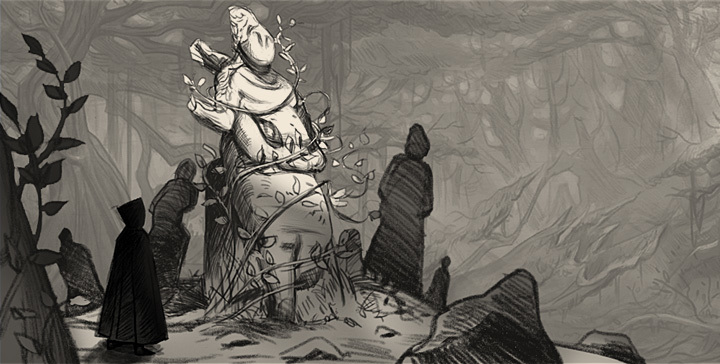
Illustration 1: Concepts for the mid-level members of the Inquisition.
YOUR DISCIPLES
Going back to our campaign, let’s assume that by this time, you have 12 disciples under your authority:
2 “old friends”
5 “advanced” disciples
5 “new” disciples
The details on each disciple (their stats, skills, traits and current states) are available through the character menu. We cannot underline enough the fact that only very rarely, until late-game, will you have the complete and accurate information about your disciples! The game is about exploring the world outside just as much as it is about exploring the personalities of the disciples in your Spire.
Let’s look closer at the “old friends” group:
Some months ago, you started the campaign with 3 disciples who followed you to the Spire from the Guild. Since they are a part of your back story, at the start of the campaign you already have a very good insight into who they are. And yet in the time since then, one of them has – Mizegul – died as the result of a routine quest. How is this even possible? Let’s take a detour to talk about managing danger levels and success rates.
MANAGING LEVELS OF DANGER AND SUCCESS RATES
One day, you sent Mizegul to harvest mandragora roots from the swamp nearby, which is nothing special. However, when he came back, he fell sick, and after a few days, died. A major loss for you, since Mizegul had great skills in Battle Magic as well as in Geology (however, your campaign hasn’t progressed yet to the point where he could use them; and so you used him for simple harvesting quests for the moment).
Now, you may recall that whenever you assign a task or a quest (tasks being in-house projects like baking a pie, or growing herbs; and quests being projects in the outside world, like harvesting roots – or enslaving non-human settlements), you get an automatic indication of two things:
Expected Danger Expected Success Rate
So why would a routine quest that did not show you much of a warning, result in the death of your disciple? Let’s break this down: first of all, the expected level of danger it comes in 4 levels:
ːthe_red_boxː High Danger
ːorange_boxː Moderate Danger
ːlolypopː Low Danger
ːthe_green_boxː No Danger
Sending an unprepared party to cross the dessert or venture into Distorted Lands, for example, will show High Danger as one or more characters in the party is very likely to die.
As to the success rates, these also come in 4 levels:
ːthe_red_boxː Very Low Success Rate
ːorange_boxː Low Success Rate
ːlolypopː Moderate Success Rate
ːthe_green_boxː High Success Rate
Let’s say you send someone with a gift, across rough terrain – and without much equipment. The chances of success are high: as long as at least one person makes it there, the gift will be handed over. But the level of danger is also high, to the point where the party may be unable to return at all.
Now, going back to our disciple Mizegul who went to harvest mandragora roots: the quest showed a prognosis with High Success Rate – because harvesting this root is fairly simple; and Moderate Danger – because swamps in general have a location-specific danger: mosquitoes that may (or may not) cause Lowland Fever with their bites. But since this fever (a) is not guaranteed to happen (b) does not affect healthy people (c) is curable, even if contracted –the danger level is not High.
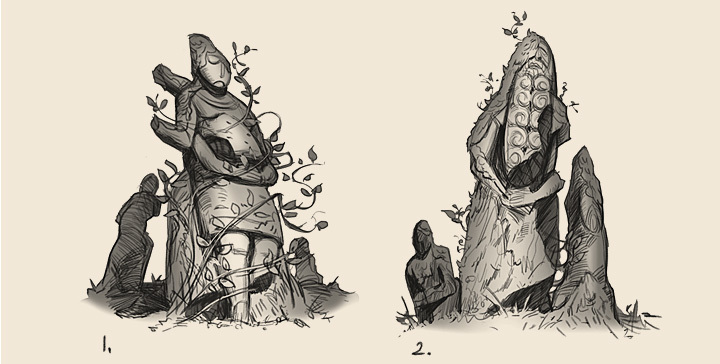
Illustration 2: Concepts for the high-ranking members of the Inquisition.
YOUR DISCIPLES, CONTINUED
There are two critical factors that contributed to the death of Mizegul:
(1) At the time of his return from the quest, the Spire did not have a Hospital Room – and neither did it have anyone skilled in Healing. This is a major strategic mistake, since as you start exploring the world, your disciples are bound to all sick and get wounded; which, when left untreated, escalates into a loss of life.
(2) You sent Mizegul to the swamps without knowing that one of his core stats – HEALTH – is very low, so that where other characters who would be bitted by a mosquito with Lowland Fever, would recover – his own chances of recovery were nearly zero. And indeed, you sent other disciples to the swamps before, and what you saw was them reporting insect bites, a few days of fever, and then a complete recovery. The escalation of the sickness with Mizegul was a bad surprise!
While the first issue can be addressed with the construction of the Spire (adding the Hospital Room – or having another room re-purposed into it) and with the hiring process (making it a priority to bring in characters who claim that they are skilled in Healing), the second issue is more complicated: yes, you spent months of game time alongside this disciple; and yes, you still were unaware of what his actual HEALTH stats are.
If you recall, every character in the game has:
stats
traits
skills
current states
Whenever a new recruit shows up, you only know this:
what the character tells you
what you can obviously see from their outside appearance
The way to discover some stats, and all of the skills, is through examination: examine the person in the specific area, and you will be certain of their standing there.
The way to discover other stats, like WILLPOWER and INTUITION, is through events: assign a task that the character clearly does not like, and see them succeed, displaying high willpower; or send them on a long quest and read in the report that this person’s intuition served the party right.
The way to discover HEALTH is through a medical examination or by high-skilled magic.
As to traits, the traits that the character is born with, are discoverable via Horoscope. The traits that the character accumulated (such as, for example, a burning dislike towards the Inquisition prompting sudden attacks whenever she sees its members), are discoverable via Fate Reading (another knowledge in the Astrology skill set) or through high-level magic like Mind Reading. And all traits are also naturally discoverable based on events and quests.
Now, in the case of Mizegul, you simply had no chance to perform a medical check on him (as you don’t have anyone with high Healing skills); and your mage’s magic skill is not yet so advanced as to get a comprehensive portrait of your disciple. Hence, when sending him to the swamps, you were looking at “HEALTH: –––“, simply hoping that this turns out to mean “Regular” or even “Exceptional” once you discover the trait.
Illustration 3: Concepts for various chests (located in different locations, originally owned by different types of creatures).
USING ASTROLOGY TO KNOW YOUR DISCIPLES BETTER
Looking at the “A disciple has died!” event window, you probably had a thought or two about how to avoid this in the future. It would be helpful, for example, to know every disciple’s traits so that you’re more efficient in sending the right person for the right quest. And a good shortcut for this Horoscopes: it’s one of the special knowledge items based on the Astrology Skill.
A throwback to the skill structure: each skill has a progression line, and along that line there are several points where “special knowledge” items become attainable. Let’s take Astrology as a reference. Across the skill line, you have the following special knowledge items marked:
Star Navigation
Item Knowledge
People Knowledge
Horoscopes
Fate Reading
Seeing the Future; and similar.
Normally, you don’t know what these items are, until you come across them in a book. So if your skill already allows for Star Navigation, and you read a book that covers it – this special knowledge will unlock for your character. And if your skill is still inferior for this item, then this item will be marked out on the skill line, so that you at least know of its existence.
Now, the most efficient way of progressing on special knowledge is by reading books. Books are available from booksellers in towns and villages, though these are limited only to the subjects allowed by the Inquisition: farming, forging and such. As to the books about magic, you will have to find undercover booksellers trading in such goods, which means you’ll need a larger town; and probably some help from the Guild of Thieves (or having a person with high Streetwise skill in the party).
Earlier on, we mentioned that the runaway mages are treated like criminals by both the Empire and the Inquisition. So how can you send one of the disciples to town? Firstly, unless they explicitly tell others that they are mages, they could be safe (and as long as there’s not a chatterbox in the party). Secondly, with some simple Social Magic they can disguise their identities, make the guards look the other way, and so on.
The other ways of obtaining books are finding them during exploration (for example, in ruins); trading them from humans and non-humans who may possess them (for example, the Many-handed is nothing else but the guardian of a huge library that has an excellent selection); or receiving books as gifts from the enslaved non-human settlements or followers of the Cult of the Spire (since these creatures remember that the “gods”, in this case you, really love the things called “books”).
And if you fail to find the book required for the particular item of special knowledge, then you can still unlock it by performing research in the Lab – see below.
Illustration 4: Concepts for the mid-level members of the Inquisition.
RESEARCHING ASTROLOGY
Finally, we come to the end of this snapshot. You lost a valuable disciple. You’d like to avoid running similar situations in the future. Astrology offers a solution: learning how to make Horoscopes. And how do you get there? By finding a specific book to read, or by performing research in the Lab.
To carry out either of these, you will need to access the schedule of your mage, and to assign a number of hours to this activity. When studying books, you’ll choose the place of study (as it affects the results) and the specific book from those available in the Spire. When performing a research, you’ll choose the Lab and then a dialogue will guide your efforts:
Do you want to research the application of Astrology to the past? (this leads to learning the coordinates of special locations on the global map, based on what the stars will tell you about the past events)
Do you want to research the application of Astrology to the future? (this leads to learning about the global events that will happen to the world in the future, so you may start getting reminders about, say, an exodus of a specific tribe of non-humans, or a flood)
Do you want to learn about the application of Astrology to gaining insight into other people? (this leads to learning to make Horoscopes, which uncovers the traits that characters were born with)
Once you assign the task, the process will become a part of your mage’s routine – or you can also set it as a one-time only event, in which case you’ll be prompted for the next action once this comes trough.
ːgreengemstoneːːgreengemstoneːːgreengemstoneː
With this, the current issue of the blog comes to an end. We started with the ambition of describing one day, but ended with the description of just one specific decision... well, sometimes it happens =).
In the next issue, we’ll focus on the world: the Empire, the Inquisition and the type of lands where the Spire is likely to be set up. Meanwhile, some big news: since last week, we introduced ːnotebookː Weekly Q&A sessions on the official Discord server of the game.
How this works: throughout the week, you can post questions about the game in #questions_en. And every Saturday, our dev team (including Alexey Bokulev) sits down spends an hour answering them. The answers are posted in #answers_en in real time, and then are systemized in this thread.
You can already find there 21 questions and answers from the last weekend, including on whether you can torture prisoners, whether you can send trained monsters on a quest, and in which ways may disciples become a threat to your rule of the Spire!
The Spire is your home, and the way it looks reflects your strategy chosen to complete the main campaign. Between two different campaigns of the same player, the Spires may very much differ: one may boast expansive underground caves while another may be crowned with a ring of levitating gardens. There's no plan for "the perfect" Spire, as every time you will start the main campaign, you'll be making decisions unique to your own situation: the disciples at your command, the resources available within reach, and the unique events that may have happened on the global map of the world.
THE SPIRE AT THE START OF THE CAMPAIGN
At the start of the campaign, your Spire looks pretty much like any other player's Spire – the differences in the starting setup, if any, will depend on the character generation quest at the start of the game, and as such will be minor (if any).
Every Spire will have MAGE'S QUARTERS – the place where your mage character resides, where he or she sleeps and receives guests. By type, it's a combination of a living room and a small warehouse (to store the most dear / valuable items). It is important to note that this room provides [I]comfort[/I] for the mage and lends [I]prestige[/I] to the mage's office (you will read more about purposes of rooms later in this blog).
Imagine coming to see your master as one of the disciples, and finding yourself in a room full of ancient artefacts, with a ball of fire suspended in mid-air as a sort of a fireplace. Wouldn’t you pay a little more attention to the mage’s instruction? Or it could work the other way, of course, where a disciple with ascetic traits would actually sneer at a lush office, while a small bare room would impress her the most.
The other room (or rooms, in this case) present in every Spire at start, are LIVING QUARTERS – this is where your disciples will rest after their day’s labor. At the start of the main campaign, you will already have enough Living Quarters to accommodate all of the disciples that join you in your campaign.
Then there’s CLASSROOM, a place of study where you (or another teacher) will work with the disciples to increase their theoretical experience across a whole range of disciplines.
Finally, every Spire at the start of the campaign will also already have a small WAREHOUSE used to house resources, items, ingredients and whatever else you’ll possess at that point (we’re covered the topic of resources in the previous blog post).
EXPANDING THE SPIRE
The Spire is made of rooms, with one room being the minimal unit. You can expand the Spire by adding rooms and floors (see below). Smaller rooms can be merged, to make larger rooms; and larger rooms can be split into smaller rooms – it all depends on your needs, and nothing here will prevent your progress by becoming impossible to change; since the Spire is a creation of magic, changes are always possible (though they’ll come at a cost).
When adding rooms, you will be building these to the left or to the right of the central staircase on the selected floor. There is a limit of having 5 rooms maximum in each direction. The further the room from the central staircase, the higher the cost of its construction. And if you don’t like the currently available floors, you can build new floors, which at minimum consist of a central staircase with one room to the left plus one to the right.
When adding floors, you can build either upwards or downwards. The further the floor from the ground (either up or down), the higher the cost of its construction. There is no limit to how much the Spire may expand upwards or downwards, except for the cost – however, do keep in mind that the higher the Spire becomes, the higher visibility it attains in its surrounding area, increasing the chance of attracting attention of the travelers passing by.
The cost of adding a new room (or a whole new floor) consists of resources (stone, wood, clay, iron) and magic energy of your mage. If you lack a specific resource, you can make up the difference by spending more magic energy. As such, you are always able to expand the Spire, the only question is – how taxing this will be, for the pool of your magic energy, which is by far the most valuable resource in the game.
One more thing: while regular rooms can be built by a mage of any skill, there are certain special types of rooms (such as levitating, or rotating ones) that require an advanced skill of Astral Carpentry and some research done before becoming available for construction.
ROOMS AND THEIR PURPOSES
Once a room is constructed, it will need its purpose set. Is this a warehouse, a lab, or a prison cell? The good news is, the purpose of each room can be re-assigned at a later stage, so if you ran out of space to keep your prisoners, you can always convert your greenhouses into more cells – if this is what you’re after, in the current campaign.
There’s no limit on having multiple rooms of the same type, so that architecturally, rather than having a huge warehouse that will keep on expanding, you may end up having 5 smaller warehouses spread across different floors, which will serve your purpose equally well.
There are certain limitations to consider when assigning a room’s purpose: some types need to be strictly above the ground (for example, a GREENHOUSE); some – strictly below (for example, a CAVE). In other cases, the relative position of the room towards the ground floor will not prevent you from assigning the chosen purpose, but would rather add a positive or a negative modifier to its effectiveness (for example, the higher up the greenhouse is, the more natural light it receives – the more effective it is for growing plants).
Now, once you’ve built a room and set its purpose (from what’s available at your current skill level), you will want to make it active, and here each purpose has its own set of requirements in terms of what furniture you’ll need to install there, before it can start functioning as intended.
To start functioning, LIVING QUARTERS will need beds; a LIBRARY will need shelves; a WAREHOUSE will need cupboards; and so on.
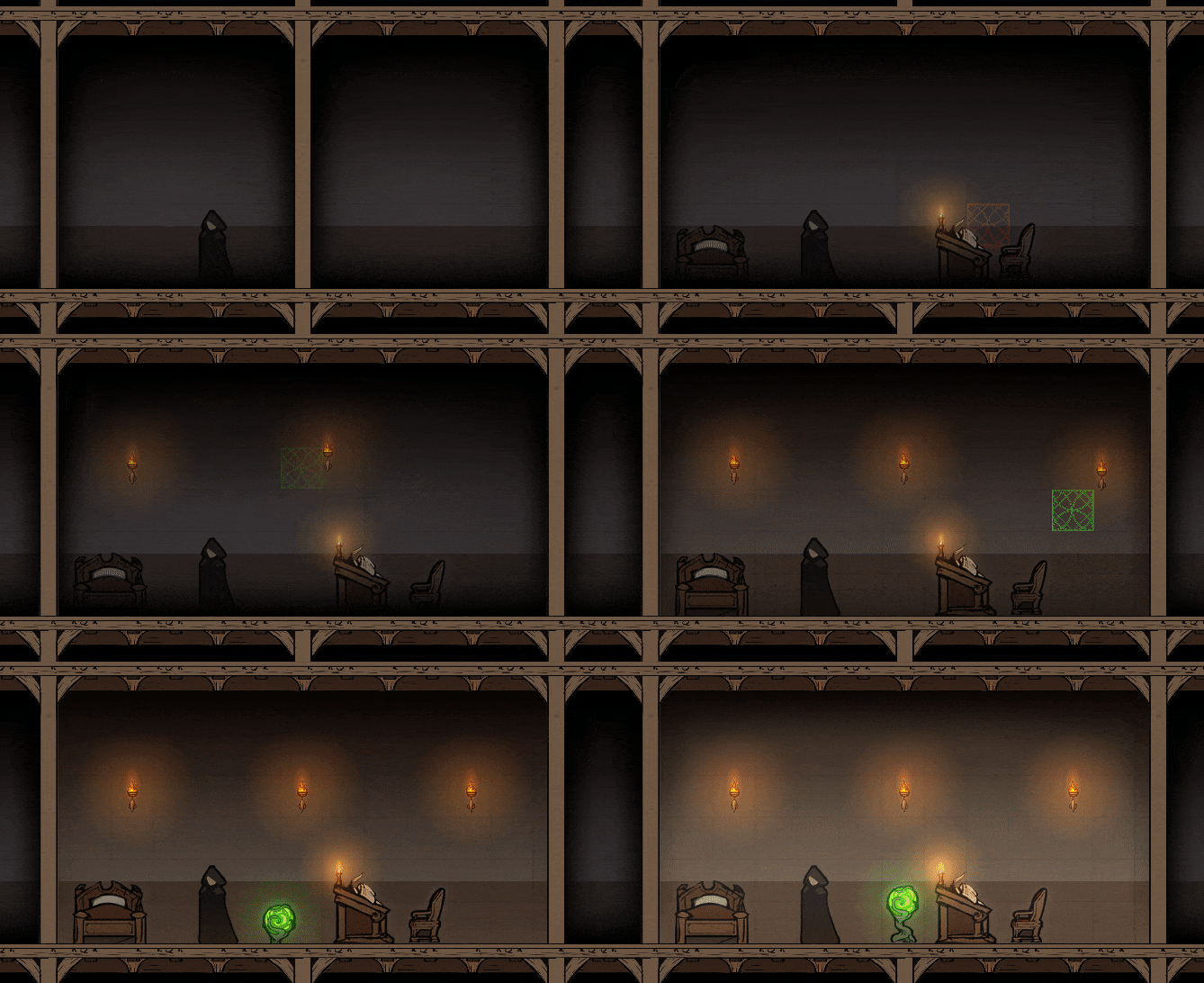
This furniture can be either crafted or traded (as well as simply found somewhere and brought back; or received as a gift), but if you lack a chance to get it the “physical” way, you can always cast it, spending your magic energy. Initially, casting furniture instead of crafting it will be less efficient. But with time, as the Astral Carpentry skill of your mage and/or your disciples increases, you may be able to use your magic energy to cast such items that are simply impossible to craft in a regular way.
PRESTIGE AND EFFECTIVENESS
Each room has two main characteristics that determine how well it serves its purpose: the room’s effectiveness and the room’s prestige.
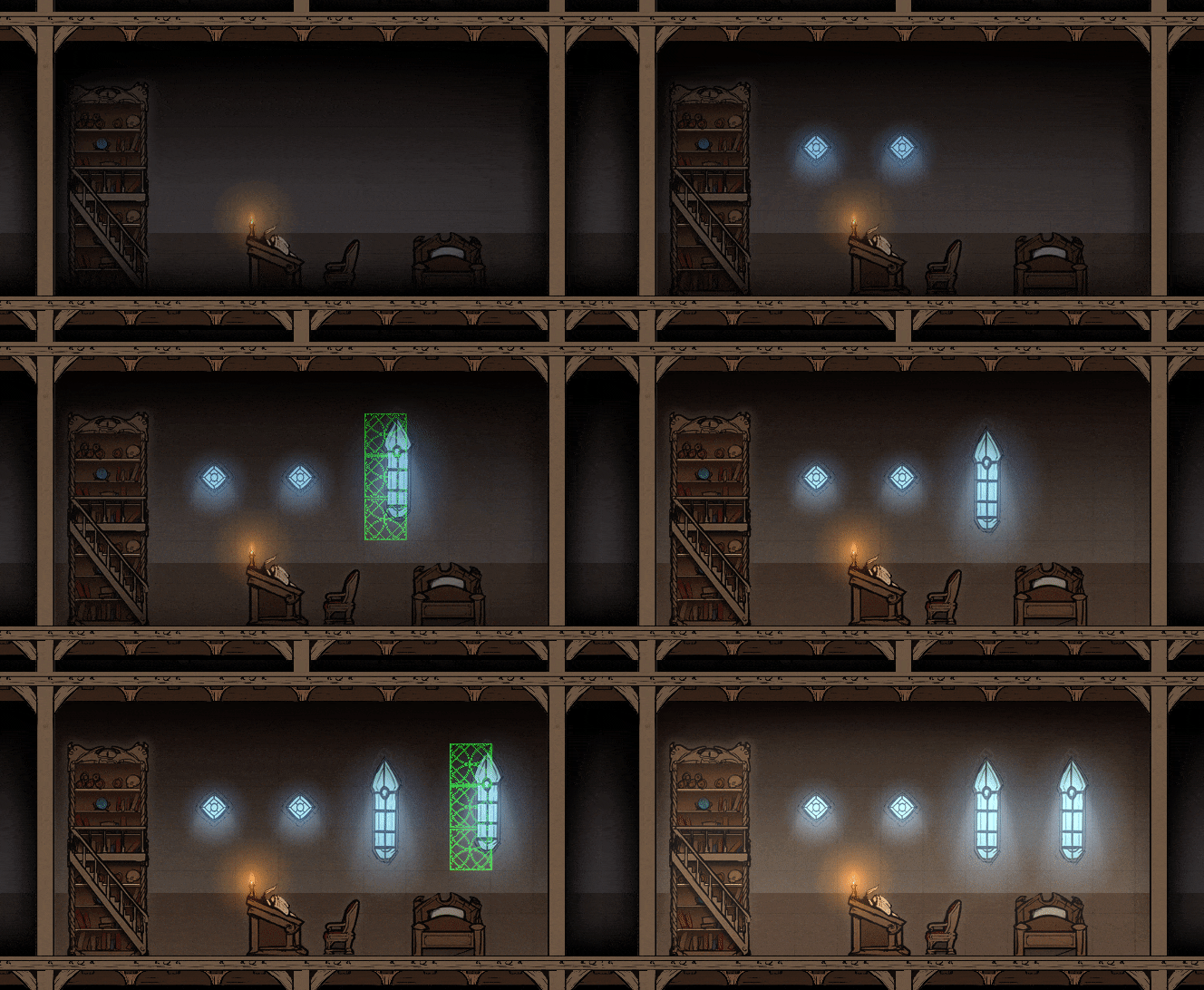
The effectiveness defines the direct function of the room, and can be increased by adding optional furniture or fixtures. For example, adding a glass roof to a GREENHOUSE significantly boosts up its production due to increased natural light; while adding candleholders to a CLASSROOM allows to study around the clock, whether it’s night-time or not; other things that increase the effectiveness of a CLASSROOM are learning tools, mounted exhibits and blackboards – all of these are optional items that make the room more efficient at serving its purpose.
As to the prestige of the room, this influences the motivation of disciples to spend time there. Items like portraits of famous mages of the ancient times will make a CLASSROOM more special. Items like elaborate candle-stands will have a similar effect on a WORKSHOP, or a MESS HALL.
It must be noted here, that some of the furniture and fixtures will come in the form of artefacts. For example, you may locate and bring back to the Spire something like a Magic Shelf, which would take the space of just 1 slot, but will provide 5 slots worth of storage; or, perhaps, you’ll receive as a gift a Candle of Concentration – a regular-sized candle that speeds up any sort of process happening in the room where it’s placed, be it study or mediation.
FURNITURE SLOTS
Each piece of furniture and fixtures requires special placement. For example, you cannot add daylight windows to a room that’s located underground; similarly, you cannot fit a huge Grand Alchemist Table into a small, basic Lab.
Each such item takes a number of slots and bears certain requirements as to where it can be placed – on the floor, on the walls, or on the ceiling; correspondingly, each room has a present number of slots that it allows to use for furniture. In this respect, smaller things offering the same effect / prestige are always better, as they leave more space for other decorations.
COMMON ROOM PURPOSES
Below is a list of some of the purposes that can be assigned to a room. Please note that this list is neither final, nor complete:
MAGE’S QUARTERS – this is where your mage lives.
LIVING QUARTERS – this is where your disciples live.
CLASSROOM – a place of study, where characters gain theoretical experience from being taught by another person.
LIBRARY – a place of study, where characters gain theoretical experience from reading books available in the Library.
LAB – a place of research (theoretical experience in multiple fields) and crafting of potions and elixirs (practical Alchemy), where characters produce new items, gain practical and theoretical experience and advance in research.
PRACTICE HALL – a place of experimentation, duels and battle magic where characters gain practical experience.
WORKSHOP – a place where things are crafted (everything except potions/elixirs, which are produced in a Lab).
WAREHOUSE – a place where you keep resources, items, ingredients and artefacts.
TREASURY – a version of a Warehouse that is more secure (so that valuable artefacts, for example, can be less of a temptation for some greedy disciples – or visiting thieves).
GLASSHOUSE – a place where herbs and plants grow, whether for use as food of as ingredients in creating potions.
KENNELS – a place where monsters are kept/raised.
PRISON CELLS – a place where characters (disciples or captives/prisoners) are kept.
HOSPITAL – a place where characters are healed, whether with the help of someone with medical skills or not (though without a medic, this is going to only stop the outbreak but not address the cause).
OBSERVATORY – a place where characters can observe the sky, read star signs, foretell the future, discover special spots on global map, and prepare horoscopes.
WATCHTOWER – a room that increases the zone of directly visible part of the global map surrounding the Spire.
MEDITATION ROOM – a room that allows to increase / use the skill of concentration, improving mood, health and restoring energy (mage’s or that of disciples).
KITCHEN – a place where food items are crafted (e.g. field rations).
MESS HALL – a place where disciples and mage consume food and socialize; without a Mess Hall, characters can still eat in their quarters, but without the social aspect and with less control of mage over the mood of disciples. As this is a room that every character visits daily, the level of prestige of this room carries a big impact over everyone in the Spire.
GAME ROOM – a place where characters relax and socialize.
DISTORTED ROOM – a room that cannot be constructed; this room may appear as a result of an accident during one of the experiments.
PORTAL ROOM – we’ll talk about Portals, and Portal Room, a bit later in the blog, as this is a late-game feature that’s still being designed.
MAGIC ENERGY ROOM – possibly, a room that may store and release magic energy; it’s not 100% confirmed yet that this room will be present at the launch of the game in Early Access.
FARMING AND DEFENSE OF THE SPIRE
These topics are together because both of these things deal with the space outside of the Spire. We’re not yet certain how the actual farming will happen, except that it will be through a special type of quest, where you’ll command a party to go out and, say, plant, care for, and later harvest a specific crop.
As to the defense of the Spire, our current plan is to allow construction of a separate section outside (“the barrier”), which will include such things as:
traps (physical and magical)
moats and similar defensive constructs;
monsters and animals planted to live in the space surrounding the Spire (i.e. between the moat and the actual walls of the Spire).
Whenever a party is detected outside of the Spire (having a good WATCHTOWER greatly helps with early detection), a quest marker appears, which allows you to send a party to confront the guests. Perhaps your disciples may prevent the attack by using magic to scare them away. Perhaps they may overpower the intruders, using battle magic. Or perhaps they may bribe them with gifts, and convince them that attempting to enter the Spire is really a pointless undertaking.
If prevention fails (or you don’t even want to try sending a “meet & greet” party), the incoming party has to best the barrier before they can set foot into the Spire. Maybe some of them will be wounded by the traps. Maybe some won’t be able to cross the moat. And maybe some will fall prey to the monsters and animals living by the gates.
Once the party (or the surviving part of it) crosses into the Spire, something called Close Encounter. Close Encounter is an obligatory quest that you cannot reject. If you fail at this quest, the campaign is over, as your mage will be imprisoned and burnt by the Inquisition – or simply killed on the spot (unless the intruders are thieves, in which case they’ll plunder but won’t kill, unless attacked). This is also the only combat quest where your mage may become a part of the party.
As this part of the game is still a work in progress, we’re certain that we’ll cover it in more detail in a few months, once our working prototype includes these areas.
With this, we wish you all the best – and see you next week! (or sooner, if you join the official Discord server of the game ːgreengemstoneː).
Welcome back! Thanks to the discussion on the project's Discord server as well as on Steam forums, there's no lack of topics to address. Which is great news! Spire of Sorcery is many things at once: it is an RPG, it is a survival game, and it is also very much a strategy. So today we would like to address one of the issues that are directly relevant to the strategic component: ːgreengemstoneː resources.
RESOURCES
Whenever we say [I]resources[/I] in Spire of Sorcery, we mean something at this level:
wood;
stone;
iron;
clay;
food; – and similar
These are the resources that you can source (for example, by sending a disciple into the forest to cut down a few trees); or trade (with one of the settlements, human or non-human); or receive as a gift (if you enslave a settlement or if you successfully promote Cult of the Spire).
These resources occupy certain space in your Spire's warehouse, and as such, as your ambitions grow, you will need to either expand your warehouse, or take a certain risk by storing the resources outside of the Spire (where they might get stolen by passersby or damaged by weather).
Important: if you're taking an action that requires certain resources, you may use your magic energy to fill in the gap of any of the missing resources. It is a pretty expensive way, and to be honest – a real waste of the precious magic energy, but still, it is possible. For example, if you're constructing a new room, let's say, a cave to grow crystals, and you don't have enough stone in your warehouse... you can still carry out the action by spending more magic energy to make it happen.
ITEMS
Whenever we say [I]items[/I] in Spire of Sorcery, we mean something at this level:
chairs, candles – and furniture in general;
potions, field rations – and ready-made consumables in general;
cloaks, boots – and equipment in general.
These are the things that are produced by humans, or non-humans, from resources, and can be consumable/expendable (e.g. a potion) or lasting (e.g. a dagger). You can craft them, trade them, receive/give them as gifts, or find them (for example, going into the ruins of abandoned town to bring back whatever your party can salvage).
The items that belong to the class of furnitureare used in the Spire. This is what you will decorate your rooms with. And why do you need this? Because the function of each room is affected by its quality and prestige. Let's take a Library as an example. If you add more light, you increase its [I]effectiveness[/I], allowing the disciples to study faster as they have such an easy time reading all the books even during the night-time. If you add beautiful paintings on the wall, and decorate the windows with crimson curtains, you increase its [I]prestige[/I], improving motivation of disciples to go and study there.
By the way, in one of the later blogs we will talk about the Spire itself, but for now let's just note that in addition to decorations and light, your library will also need two kinds of spaces: space to keep the books; and space to study (i.e. chairs and tables). So you can have a small but very effective library, that will drive disciples like a magnet; or you can have a huge and bland library that would allow a dozen of disciples to study at the same time, but might so lack anything special, that the process of study will be rather taxing.
INGREDIENTS
Whenever we say [I]ingredients[/I] in Spire of Sorcery, we mean something at this level:
special roots, rare mushrooms and plants;
crystals, gems and precious minerals;
animal products like horns, beaks, hair, skins and such.
These ingredients are used for Alchemy and [I]cannot be replaced by magic energy[/I]. In other words, while you can still build a cave even if you lack stone, you absolutely cannot prepare a painkiller potion if you lack the specific mushroom that is required by the recipe.
The way to source the ingredients is to trade, to harvest – or to grow. To grow animals, you can construct a farm, or cages; to grow plants, you can construct a herbal garden; to grow crystals, you can construct caves; and to grow monsters, you can construct kennels.
Important: while the recipes in the game remain the same across all the campaigns, the specific properties of each item (e.g. mushroom, root, flower, etc.) are generated anew each time you start a campaign. It is highly unlikely, that the same mushroom, for example, will have the same properties in two different campaigns. The way it works is that a recipe for poison, for example, requires 2 different ingredients with the property "poison". And dried & crushed wings of fluter have 1 rare and 1 common properties. So in one campaign, the "rare" property will be "poisonous", and it can be used to make poison; while in another, the "rare" property of the same wings will be, for example, "energy boost", and thus, while this ingredient will be useful elsewhere, it won't fit the recipe for poison anymore.
As you probably understood by now, the availability of specific resources and ingredients close to the Spire at the start of the campaign will be one of the major influences on the strategy you choose in the game: it makes little sense to spend time and effort looking for a specific ingredient that you need for potion X, when you can already have potion Y made from ingredients safely harvested nearby.
ARTEFACTS
Whenever we say [I]artefacts[/I] in Spire of Sorcery, we mean unique items that may be obtained (found, traded, stolen) or constructed (requires advanced skill of Arteficing), that may affect ːnotebookː STATS, ːnotebookː TRAITS, ːnotebookː SKILLS, and otherwise cause permanent effect on the owner.
In the world of Spire of Sorcery, there are hundreds of artefacts. Oftentimes these will lend advantage in one field and disadvantage in another. Some remain from the times before the mage wars. Some belong to non-human creatures. Some are owned by lords in the region close to the Distorted Lands, where the need for their use is stronger than the fear of the Inquisition.
Important: whenever you come across a new artefact, you won't really know what it is and what are its effects – until you properly research it, using qualified disciple/your mage, and sufficient time. Of course, you may always just start using the artefact... with unpredictable consequences.
INVENTORY
There's the inventory of the Spire – what you own and control, and what is accessible to the disciples (e.g. books in the library, or potions in the pantry); and the private inventories of each of the disciples – what they own and control, and what lies beyond your reach.
Depending on the traditions that you install in the Spire, and the traits of individual disciples, you may see outcomes where a party sent to look for treasure brings back an amazing loot and freely gives it to you upon return; or where the same party comes back with their private pockets full of gems, and reluctantly gives you only a small share of the finds, because they are greedy – or because this is what you promised to them, or for some other reason, based on how you reached this point in the campaign.
The inventory generally is split between equipment (clothing, weapons and such) and consumables (food, drink and potions). A sidetone on potions: there are no "healing potions" in the world of Spire of Sorcery. A potion may sustain a character's energy, or improve their mood, or take away the pain symptoms, but a magic may never truly heal a broken bone – for this, you will need someone with a Healing skill, spending substantial time to mend things.
It's also worth noting that most potions do have side-effects. A bout of energy may lead to exhaustion; a painkiller may slow a person down to a crawl, and so on.
Finally, one last note: each item in the equipment range can generally be in one of the three states:
good
damaged
broken
A skilled character may repair or mend items, given enough time and resources for fixing it up.
–––
That's it for this week – and thanks for being a part of the community! Our official Discord server now has over 400 members, and we look forward to seeing you join the conversation there! We'll be back in a few days with a look at another part of the game.
Welcome back to the dev blog of Spire of Sorcery! It's been an intense week and a half for us here at Charlie Oscar (moving forward on a lot of different fronts at the same time, from global map to the way the Spire will look like). Today we will talk about something that is very likely to make you win – or lose – the campaign: the skills of your mage, as well as the skills of your disciples.
MAJOR & MINOR SKILLS
All the skills in the game are split into two groups: :turnon_lightning: Major and :turnon_lightning: Minor. An example of a Major Skill would be Alchemy. It is a big area and once a character reaches advanced stages, it will make many things possible. An example of a Minor Skill would be Lockpicking. It's a fairly specialised activity that doesn't branch out much even when it's at a very high level.
There are three ways to increase character's skills in Spire of Sorcery:
THROUGH TEACHING
THROUGH THE ACTUAL USE OF SKILL
THROUGH READING BOOKS
Important note: Major Skills can be increased in all of these three ways; Minor Skills can only be increased through the use of skill and through reading books – but they [I]cannot be taught[/I]. Generally speaking, Minor Skills are the skills that your disciples already possess by the time when they arrive to the Spire, they are a sort of a bonus (which, nevertheless, can become crucial at certain times in the campaign).
Like in other areas of the game, a character may have a specific ːnotebookː TRAIT that would make her more or less interested in working on a specific skill, which would boost or decrease their motivation and speed of their progress. Someone who loves animals will progress fast with the farming, while pushing an honest, justice-seeking disciple to practice thievery is only going to get him or her depressed.
From early on in the campaign, you'll face a tough choice: your mage's teaching impact on the disciples is limited by his or her own skills; so it's essential to invest time and efforts into increasing them.
On the other hand, any time that your mage spends learning... is the time that the mage does not spend teaching the disciples! ːF1timeː
Another key point: in the game, there are no "levels" that characters may attain. Each Major Skill has its own specific experience axis that consists of Theory and Practice, while each Minor Skill has a single Experience value that will increase throughout the game.
THEORY & PRACTICE
Characters gain theoretical experience by:
ATTENDING CLASSES
READING BOOKS
CONDUCTING RESEARCH
Characters gain practical experience by:
USING THE ACTUAL SKILL
STAGING EXPERIMENTS
It is possible to have more theoretical experience than practical experience – the exact gap that is possible, is limited by the character's ːnotebookː MEMORY stat.
It is [I]not[/I] possible to have more practical experience than theoretical experience, and if your Theory and Practice values are equal, then by accumulating more practical experience, you will be pushing both values up, but doing it very, very slowly.
Each quest that you assign to a disciple (or undertake through your own mage) has different skill requirements. You cannot assign someone a quest that requires a higher theoretical skill level than they currently have, simply because the character wouldn't event know what to do and where to start (for example, what if someone asked you to prepare some fresh うに ("uni"), but you had no clue where to get it and how to cook it? You'll gain nothing by sitting and staring at the wall :locked:).
Following the quest, the character's experience grows [I]regardless of whether the action was successful or not[/I]. The lower the required skill compared to the character's practical experience, the more certain is the success of the undertaking – but there is less experience to be gained, right down to the situation where a simple candle-holder made by a master blacksmith would yield [I]no experience at all[/I].
The higher the required skill level compared to the character's actual practical experience, the more likely the action is to result in a failure – especially when the required skill level matches the character's theoretical experience, but falls behind the practical experience.
Does this mean that attempting actions at the edge of character's current skill level is the best way to progress? Sure, but please be aware of the drawbacks: firstly, you are likely not to receive what you wanted, e.g. making a long sword above your blacksmith's practical experience may result in waste of good metal and nothing to arm your disciples with; secondly, most failures carry a chance of accident, and in the case of blacksmith shooting above her skill, you may end up with the Spire's whole wing burning down to ashes in the process.
MAJOR SKILLS
Below are some of the Major Skills. In the brackets are the stats (major, minor influence) that affect the pace of improving the skill.
ːnotebookː LITERACY (MEMORY, INTELLECT) – how fast and how effectively a character studies books; how well a character writes books and manuscripts; how good are character's foreign language skills.
ːnotebookː CONCENTRATION (WILLPOWER, INTELLECT) – minimizes loss of progress when a character is distracted in the middle of current action; increases the efficiency of sleep and meditation. Decreases magic energy costs for all Rituals. Makes learning from other characters more effective. Opens access to advanced meditation techniques, increases speed of recovery for magic energy, allows to store more magic energy.
ːnotebookː HERBOLOGY (INTELLECT, MEMORY) – defines the effectiveness of gathering herbs and mushrooms in the wild, of growing herbs and mushrooms in the Spire (in the garden and in the mushroom cave). Defines knowledge of recipes of potions made from herbs and mushrooms. Allows to be better at seeking paths in the forests.
ːnotebookː MONSTROLOGY (CHARISMA, WILLPOWER) – training animals and monsters, taking care of captive animals and monsters. Knowledge of behaviour and anatomy of animals and monsters. Hunting for game and effectively processing and preparing killed game, capturing live animals.
ːnotebookː GEOLOGY (INTELLECT, INTUITION) – knowledge of Stones and minerals, ability to find rare stones. Knowledge of precious stones and gems, and their effects. Knowledge of special liquids (mercury, acids, etc.). Allows to be better at seeking paths in the caves.
ːnotebookː ALCHEMY (INTELLECT, MEMORY) – preparing potions and elixirs, effectiveness of using potions and elixirs. Cooking.
ːnotebookː ASTROLOGY (INTUITION, MEMORY) – forecasting future events based on the star alignment in the sky, being able to reveal the coordinates of special locations on the global map. Preparing horoscopes for disciples that reveal their character traits. Being able to find one's way based on the stars in the sky.
ːnotebookː HEALING (INTELLECT, INTUITION) – healing wounds and taking care of wounded.
ːnotebookː ARTIFICING (INTELLECT, MEMORY) – ability to recognise and create magic items.
ːnotebookː ASTRAL CARPENTRY (WILLPOWER, INTELLECT) – being able to create furniture in the Spire, building new rooms and floors.
ːnotebookː COMMON MAGIC (MEMORY, INTELLECT) – spells used in everyday life.
ːnotebookː SOCIAL MAGIC (CHARISMA, INTELLECT) – spells that affect minds and feelings of humans and non-humans.
ːnotebookː BATTLE MAGIC (WILLPOWER, INTELLECT) – spells used in battles.
ːnotebookː ADVENTURE MAGIC (INTUITION, MEMORY) – spells used for adventures and travel.
ːnotebookː RITUALS (MEMORY, INTELLECT) – the rituals that allow for control of energies and living creatures.
ːnotebookː RESEARCH (INTUITION, INTELLECT) – determines the speed and efficiency of discovering new spells and alchemic formulas. Also determines the ability to discover characteristics of unknown items by study and experiments.
MINOR SKILLS
Minor skills cannot be taught, but are obtainable and upgradeable through experience and through books. Unlike Major Skills, they don't have separate Theory and Practice experience values, but have just one general Experience value.
The most important Minor Skill is Teaching –
ːnotebookː TEACHING (CHARISMA, INTELLECT) – this skill defines how effective is the teaching when undertaken by this character; a high skill not only allows for more effectiveness, but may also kindle in the student an interest to the subject being taught.
Some of the other Minor Skills are:
Culinary Arts
Farming
Woodcutting
Reading footprints (of any creatures)
Streetwise
Thievery
Lockpicking
Survival
Archery
Melee
Carpentry
Blacksmith
SPECIAL KNOWLEDGE
Finally, there's one last piece of information about skills that we would like to share with you in this edition of the blog: every Major Skill includes a set of "special knowledge", which character gains once they accumulate a certain experience.
For example, for all magic-related skills, these are specific spells; for Herbology, these are specific types of plants; and so on.
At the start of the campaign, most special knowledge items are unavailable and need to be researched by reading books or performing research. All of the disciples in the Spire have access to the special knowledge accumulated in the Spire once their skills pass the required experience level.
–––
With this, we wish you a great week, and look forward to seeing you in our Discord community – or here on the forums!
Earlier in this blog, we discussed the stats and the traits, mentioned the skills – and went over the current states of human characters (the mage and his/her disciples). Today, we'd like to take a closer look at the traits they affect almost every aspect of the game, and are an extremely important part of its mechanics.
Let’s start with the summary of what we already know:
Your mage character (and every disciple in the game) is generated with certain ːnotebookː STATS. These [I]do not change[/I] through the course of the game, and define the character at the structural level:
HEALTH
INTELLECT
MEMORY
WILLPOWER
CHARISMA
INTUITION
Is your mage smart? Does he have an exceptionally good memory? Is she healthy, with an immune system that will withstand most of the viruses? The same applies to every disciple in the game: they arrive to the Spire with the stats in place, and this is something that will significantly influence your decisions as to whom to accept and whom to reject.
Your mage character is also generated with certain ːnotebookː SKILLS. These [I]will develop[/I] over the course of the game, increasing as character gains theoretical and practical experience.
There are multiple skills, ranging from Healing to Monstrology, and we will talk about them in detail in one of the future blogs. Meanwhile let's just note that screening your disciples for skills and teaching them selected topics to increase the skills that you consider essential to the survival and growth of the Spire, is a key part of the game.
When a wounded party returns from a quest, it’s whether or not you have the required medical skills in the Spire, that determines if you keep those valuable characters as a part of your Spire team – or add new tombstones to the Spire's graveyard.
The next group that affects your human characters is the ːnotebookː STATES: things like mood (happy or depressed), current health (sick or full of energy) and loyalty (abandoning the Spire at the first sign of trouble or sticking with you through their last breaths). Character states [I]change all the time[/I].
Current character states are influenced by character traits (what the character likes or hates), game events (a discovery of a horrible undead creature, for example) and your own actions (which to the character actually seem like events, for example arresting someone, or giving them a wonderful gift to keep).
And now, the ːnotebookː TRAITS: these fall with the same group as the stats. They [I]do not change[/I] through the game and represent a part of what makes each character special. If you know the Stats and the Traits of a person, you know how to use them most efficiently. Skills and States are the layer that is based on such foundation, and something that you can influence to a great degree over the course of the whole campaign.
TRAITS – HIDDEN AND REVEALED
There's a pretty large number of possible character traits. On average, in Spire of Sorcery a human has from 3 to 5 traits (but of course, "average" is just that, some will have fewer and some will have substantially more).
Below are some of the possible traits, grouped in pairs:
Lucky – Unlucky
Cruel – Kind
Inventive – Conservative
Greedy – Generous
Lively – Gloomy
Attractive – Repulsive
A character can also be Talkative, Attentive, and so on.
It is important to note that character traits can be Hidden and Revealed, depending on your mage's knowledge of that person.
Some traits, like Handsome or Ugly, are revealed from day one – whenever a disciple with such traits knocks on your door, you will immediately notice them. Some traits will take some time, and effort, to become revealed.
In modern life, banks have a rule that's abbreviated as KYC – "[I]know your customer[/I]". In Spire of Sorcery, a similar rule – "[I]know your disciple[/I]" – is essential to success: if you send a greedy disciple to extract treasure from ruins, you may lose both the disciple and the treasure, with which he will run away; whereas if you send a lucky disciple to attempt diplomacy with one of the (rare and powerful) supreme magic creatures, your chances of success will be rather high.
There are three ways to reveal character traits of your disciples:
through events
For example, someone might steal a valuable item in the Spire, and when caught, this will reveal his/her trait that lead to the theft.
through horoscope
By building the complete horoscope of a character, you are able to access full knowledge of his/her traits.
through a special ritual called Mind Reading
This ritual is the fastest way to reveal character's traits, however it requires advanced skills and consumes valuable resources. So it's more of a late-game tool.
Generally, it is the stats of your mage that determine how fast you can reveal hidden traits (it depends on your Intellect and Intuition values).
RECRUITING DISCIPLES
At the start of the campaign, your mage already has a few disciples. The exact number of followers depends on the way that you complete the character generation quest. You are very likely to know all of the traits of these initial disciples, since they would have a story of personal relationship with you that goes a long way back.
There are three ways in which new disciples may join the Spire:
by joining your existing party when out on a quest
This is a rare occasion, and happens only when everything aligns in the right way.
through the [I]Seek Recruits[/I] type of quest
This is more common: you will be sending your disciples predisposed to such quests (e.g. charismatic, beautiful, convincing, lucky negotiators) to settlements (villages, towns) in order to specifically seek out potential recruits and convince them to come back to the Spire with the party.
through the [I]Call of the Spire[/I] ritual
This is another common tool to gain more recruits: you will be performing a magic ritual, that consumes energy on a daily basis, spread across the world the call that only the magically talented will hear. Think of it as sending "radio waves" through the world, that only the potential disciples can hear.
Once the potential recruit reaches the Spire, you have the option to Accept or Reject the character. If you don't have enough living or teaching space, you can Accept via Exchange, expelling one of the existing disciples and taking in the new person. Or you can just immediately add living space (and extra food supplies, if necessary) and accept the additional person (though adding food by magic is a pretty costly endeavour, and it makes more sense to find a disciple who would become a good gardener, and will supply the Spire's food in a regular way).
Before you decide to accept or reject the recruit, you will want to know as much as possible about that character – from stats to traits, and to skills. There are four solutions for this:
through observation
Certain things will be obvious from the start, for example if the potential disciple is a great-looking tall woman with a strong build, you will already see all of that in revealed stats and traits. Or take a cripple – there, certain things will be immediately clear after initial observation.
by looking at the character portrait
The generator that we use to create disciple portraits, associates certain facial features with certain traits. It is not a 100% reliable way to understand the character, however it would be enough to give you a certain "hunch" as to what traits the recruit may possess – and knowing ahead could be really advantageous.
by reading character's auto-biography
Sometimes, this is a helpful tool. But bear in mind that characters can, and will, lie about themselves, and so someone who describes his/her great adventures and achievements may have in fact spent all of their life sitting at home.
by interviewing the recruit
Conducting an interview takes time, but it's a good way to reveal more about the recruit. Especially if your mage's intellect and intuition are high enough so that you get a lot out of such interview.
MANAGING YOUR DISCIPLES
If at the start of the campaign you're likely to have 3-4 disciples, in the late game this number will be closer to 30-40 (depending on your strategy, of course).
One of the features that we plan to actively test during the Early Access phase is how much of a hierarchy there will be in the Spire.
While initially, your primary focus is in teaching disciples and advancing their skills, later on there will be major events that require your full focus. For the late game, we currently expect to create a hierarchy of disciples, where you are able to appoint several advanced characters to the Council of the Spire, and to delegate to them day-to-day management of activities like teaching and supplies.
In terms of user interface, the settings for such delegated operations will require actual live tests to find the level of automation that allows full control over the major events – while taking off your hands the minutae. In just a few months, we'll see how it goes! We'll start with the closed beta, and then progress to Early Access as we confirm more and more of the UI solutions.
–––
With this, we wrap this week's blog – and welcome you to join the game's official Discord server, which already has a population of 300+!
Today we're going to talk about a number of things, including sleep deprivation, stress and euphoria, viruses and curses, locking disciples in their rooms (or jail cells), and the way that laws and discipline work in the Spire.
SLEEP
Let's start with the sleep: among other things that you define for your mage, is his (or her) sleep schedule. The more you sleep, the less time is left to use on moving forward in your research and exploration. But the less you sleep, the higher the toll on your character's current state.
"Current states" is a group of values that affects every human character in the game. A schedule that cuts short your mage's dozing hours will lead to the temporary effect "[I]lack of sleep[/I]", which in turn will start to affect your character's mood.
Generally, it is advisable to provide your mage with enough sleep – whenever possible. However, in some cases it might prove very challenging: for example, when there are sick and dying in the Spire's hospital, who may expire if your mage takes some time off; or when there's an army knocking on your doors, and you need your mage's superior powers to repel it.
MOOD
The concept of ːnotebookːMOOD is central to managing your characters. Mood reflects the current state of a person, and can fluctuate from depression (low end) to euphoria (high point).
What defines a person's mood? Do something that your character likes, and the mood improves. Do something that your character hates, and the mood plummets.
Mood changes based on two things:
events that happen to the character
actions that the character undertakes
But what does a character like or hate? This depends on their ːnotebookːTRAITS, which we covered in one of the previous blogs.
Here's an example of a Spire event that you will decide on:
[I]ːfire_fire_fireː A disciple is caught stealing a book from the Spire's library, and is brought to you for your judgment. Your actions:[/I]
[I]Forgive this disciple.[/I]
[I]Explain to this disciple why this is wrong.[/I]
[I]Publicly criticise this disciple in front of all other disciples.[/I]
[I]Order a punishment of 20 leashes.[/I]
[I]Place this disciple in the Spire's jail for a week.[/I]
[I]Expel this disciple from the Spire.[/I]
If one of your mage's traits is "[I]Cruel[/I]", and your mage's willpower is low, the list of choices will look like this:
[I]Forgive this disciple.[/I]
[I]Explain to this disciple why this is wrong.[/I]
[I]Publicly criticise this disciple in front of all other disciples.[/I]
[I]Order a punishment of 20 leashes.[/I]
[I]Place this disciple in the Spire's jail for a week.[/I]
[I]Expel this disciple from the Spire.[/I]
The first two options are unavailable because forgiveness goes against the grain of your character, and his willpower is low enough not to allow to force him to take actions that he clearly does not agree with.
The fourth option is underlined because this is actually what will please your character the most. Follow this suggestion, and his mood will improve. Follow the opposite, and the character's spirits will go down.
Important! In the example above, your decision will affect not only your mage's mood, but also the mood of your other disciples. Cruel characters will rejoice at the "right" decision, while characters that despise violence will get depressed.
LAWS OF THE SPIRE
Whenever you have a decision to take, like in the event above, you will have an option to "codify" it, making your current choice into a law.
Generally speaking, laws are good for keeping disciples organised and in check. Laws prevent abuse by informing potential abusers of the consequences.
However, this only happens when you actually follow your laws. If you declare, for example, that the punishment for theft is 20 leashes, but then in another case go for arrest instead (because 20 leashes may kill that character outright), you will be sending a message to your disciples – a message that the laws are not really meant to be followed, which will harm your Spire's ːnotebookː[B]DISCIPLINE.
DISCIPLINE
The two extremes of running your Spire are what we call "Rule of Fear" and "Rule of Love". If you follow the latter path, then you don't really care about your Spire's current discipline since the motivation of your disciples is that of deep affection and loyalty to your mage personally. So no matter what the law says, they will follow what's best for your mage.
If you follow the "fear" strategy, though, a strong discipline is a must to keep your little "army" under control. The level of discipline shows how strictly your disciples follow your orders – inside and outside of the Spire. Having a strong discipline has its own drawbacks, though: your disciples will stop acting on their own, stop inventing and trying new things, and may miss some excellent chances of improving their lots when out on a quest.
CURRENT HEALTH
When we spoke about sleep and mood a bit earlier, we mentioned that lack of sleep may lead to [I]stress[/I] and then to [I]depression[/I], which will have serious effects on several levels. One of the consequences will be a decrease in ːnotebookːCURRENT HEALTH.
What is current health? There's your basic character stat, called HEALTH, which ranges from 1 to 20, and will not change once a character (mage or disciple) is generated. Think of it as character's constitution, and his or her immune system. This is what the character is born with.
On top of this, there's the current state of your character. For example, he can be wounded and very weak. Or she can be sick with a cough. Or, following some romantic interlude and a walk in the forest, the character may in fact rank a bonus in this department, being so healthy as to improve on the expected default result.
The common causes of weak current health are:
sickness
curse
poisoning
combat wound
stress
Let's review some of these in more detail.
FALLING SICK
A disciple went out to the nearby village on a regular trading quest, caught a cold while there, and came back coughing. Within a few hours, several other disciples are falling sick around the Spire. What's your response?
Generally, a good strategy is the early detection. Anyone coming back to the Spire may be a source of danger to the others, so it makes sense to be cautious – especially when people return from afar.
If you have a hospital already built in the Spire, you'll place the sick character there, and assign a Spire quest HEAL SICK to someone with good medical skills.
if you do not have a hospital yet, you can still try to prevent the spread of the virus by isolating the sick person in their room; or even losing them up in the Spire's jail.
Dealing with viruses is easier than dealing with curses, though.
CATCHING A CURSE
Several disciples traveled through an ancient forest. In the middle of the wilderness, there was an overgrown ruin of a house, next to the miraculously clean and welcoming drinking well.
Everyone in the party was careful enough not to touch it, except for one person who went and drank his full. Since that day, this disciple started to behave in a strange way. When he returned back to the Spire, you could see that his stats are affected: IQ is substantially lower than expected, and memory is real bad.
If you have a hospital, a good strategy would be to isolate this disciple there, and assign someone skilled to a Spire quest called OBSERVATION.
Through such observation, you will learn that the character got cursed after he drank from the forest well. That house, and that well, were created by an old mage, who placed a spell on them: anyone who drank from the well or stayed at the house, became obsessed with becoming that mage's slave. Since the mage is long-dead, the curse results simply in manic behaviour.
Following the completion of the OBSERVATION quest, a HEAL SICK quest becomes available, and you're finally able to restore that character's health to its default state.
By the way, any Spire quest can be assigned to your disciples or be handled by your own mage. So if your mage is great at healing, then most likely you will be spending some time in the hospital, dealing with the restoration of your returning parties to their best states.
LOVE, HATE AND FRIENDSHIP
This is a topic that our game designer does not like to elaborate much on, but which is definitely confirmed as one of the game mechanics in Spire of Sorcery.
Disciples may have relationships with each other. Doing something together with a person you like (like going on a quest, or studying) boosts your mood. Being stuck with someone you dislike, does the opposite – to the level where two enemies sent on a quest together may end up trying to kill each other father than following your original orders.
Sometimes, friendship and love is good: two friends in a fight will defend each other with a higher commitment. Sometimes this is not so good: if one of these friends will be mortally wounded, the other may not leave her but stay there, and get killed just as well.
A BIT OF Q&A
As we write these weekly dev blogs, we typically share their topics a few days in advance on the game's official Discord server. If there are any specific questions there, we try to answer them with the next blog. This week's Q&A is below:
ːQuestionsː [I]Are all disciples human, or there could be also non-human disciples?[/I]
All disciples are human. Since non-humans were created by mages, the mages did not see any good reasons to also share with them their magic skills. The only exceptions are the "super-creatures" like the Many-handed, who possess certain magic skills, but strictly as something they were created with, and not something that they can learn or develop.
ːQuestionsː [I]Do disciples sent on a quest have their own inventories?[/I]
Yes. You can equip your disciples with things like protect them, and facilitate their travel. You will also deal with expendable supplies like food and drink (in some cases)
ːQuestionsː [I]Can characters be wounded to the degree that they cannot recover (e.g. become handicapped)?[/I]
Since potentially, your mage's power is unlimited (provided that you reach your potential), putting back a limb or an eye is a possible feat. However, the harsher the wound, the higher skill and knowledge will be required to put it right.
ːQuestionsː [I]Are there any mind-altering substances like narcotics or hallucination-inducing food in the game?[/I]
Yes, there are all sorts of things in the game, a lot of which can be dangerous when used by unskilled persons or consumed without the proper recipe. Especially so on the edge of the Distorted Lands.
–––
With this, we wrap today's blog – and we look forward to welcoming you on our forums or on the game's official Discord server! See you next week, when we will talk more about events in the game.
Welcome to this week's dev blog of Spire of Sorcery! We've discussed ːsummer_magicː the concept of the game and how it's connected to our previous releases, as well as ːsummer_magicː the main character of the game and how you can shape him (or her). Today, we'll talk about the world around the Spire, and the different kinds of quests that you can set up for your disciples.
[B]A BRAND NEW WORLD – EACH TIME![/B]
When you start a new campaign in Spire of Sorcery, the map is each time generated from scratch. During the game, you will see a specific name that's given to this world (in the in-game settings menu), and if you enter that name when you start another new campaign, then you will be able to access the same world again (this option is not available in [I]Ironman[/I] or [I]Artefact Hunter[/I] modes, of course).
What exactly changes from one campaign's map to another?
ːnotebookː the whole geography (for example, how many major rivers there are, and where they flow into the sea);
ːnotebookː the spread of dwellings, and dweller types, across the map (in one campaign you may start next to a war-hungry lord; in another, you may start next to the peaceful village of mushroom-eaters);
ːnotebookː the location of the artefacts and other points of interests (certain old books may be stashed away or in possession of different tribes);
ːnotebookː the exact location of your Spire in relevance to the Empire and the Distorted Lands.
Some things will remain constant, though:
ːsummer_magicː all the way to the West, there is the big sea, and the capital of Empire, the largest seaport on the coast;
ːsummer_magicː all the way to the East, there are the Distorted Lands – the unmapped region that is a highly dangerous place to explore;
ːsummer_magicː all the way to the North, there are huge mountains that are not really mapped either, as the passes are snowed in and hard to come through;
ːsummer_magicː all the way to the South, there's the same big sea, as it's going around the continent from north-west to south-east.
ːsummer_magicː your Spire is roughly mid-way between where the Distorted Lands begin in the East, and where the border of the Empire lays in the West.
[B]THE SPIRE AND ITS SURROUNDINGS[/B]
While your Spire is always located between the Empire and the Distorted Lands, the actual placement may vary depending on the text quest that you will complete during the character generation phase early on.
ːMapOfEdenEmoticonː [I]How long will it take for a party sent off from the Spire to reach the borders of the Empire?[/I]
About a week or two, one way. As to the capital of the Empire... it is going to take much, much longer. You ran away from the Guild of Mages in one of the satellite cities. If you were practicing in the capital itself, it's highly doubtful that (a) you would be able to arrange such escape; and (b) you would remain uncaught by the Inquisition on your trek to the Distorted Lands.
Generally, you are likely to start the campaign with a sequence of simple exploration and resource-gathering quests around your Spire. Such quests will mostly be safe and quick, and will not require any preparation beforehand.
ːMapOfEdenEmoticonː [I]Should you expect to uncover the complete map of the world late in the campaign?[/I]
That would be quite unlikely, because certain regions are just too hard to explore (for example, old swamps that take weeks to cross) while other regions are simply too dangerous to venture into (for example, the territory of the Empire has decent roads that allow fast travel, but it is also extremely dangerous for your disciples as they might run into the Inquisition and fail to mask their true identities).
Whenever you're about to set a new quest for a party of your disciples, there are two indicators that will help you to gauge its possible results even before you dispatch that party on the quest:
ːfireappleː [I]How likely the party is to complete the intended goal?[/I]
ːcursedskullː [I]How dangerous is this quest expected to be?[/I]
For example, if you're sending a couple of blind disciples to gather mushrooms in the nearby forest, then they are very unlikely to succeed in its goal (gathering mushrooms) – even though they have a 99% chance of getting back without any risk to their lives.
On the other hand, if you're sending another couple of disciples into one of Empire's border towns to sell rare minerals, they might be expected to have one hundred percent chance of success – since the minerals are rare, and in demand everywhere – while their lives will be in grave danger, because of their exposure (they are still young and cannot hide their magic talents well enough).
[B]THE GLOBAL MAP AND ITS LAYERS[/B]
In terms of exploration, the map carries several informational layers:
ːMapOfEdenEmoticonː geographical layer: rivers, roads, lakes, mountains, forests... once any of your parties walk through these regions, the geographical data is added to the global map that always remains at your fingertips.
ːMapOfEdenEmoticonː points of interest layer: known dwellings, possible quest markers, special places like altars of death, catacombs, ruins of the ancients, and such. This layer has some depth to it, for example you may already know the location of certain caves – but you will need a party to get there and explore them, in order to utilise the full exploration potential of the spot.
ːMapOfEdenEmoticonː observation layer, i.e. the area that you can observe in real-time: firstly, around your own Spire – this is the zone where you see other parties coming and going as they move over the map (for example, adventurers or regular armies); this zone can be expanded with certain spells and/or upgrades to the Spire; and then, once you learn the corresponding far-seeing spells, you are also able to open such 'observation zones' in other places on the map by performing certain [I]rituals[/I] (see below).
We currently intend to allow players to toggle these layers on and off as they see fit, and the general idea is to create such a default view of the global map that will provide all the important information for the decision-making without overly cluttering its space with tons and tons of symbols.
[B]THE QUESTS[/B]
And now, about the quests. Think of Spire of Sorcery as a "reverse RPG": rather than following the preset quests, you are the person that sets the quests for your disciples, and you succeed – or fail – through the balance of their skills and traits, and the sort of goals that you set for them.
ːsummer_magicː [I]What kind of quests are possible?[/I]
There's a lot of different options, some of which start with a specific Quest Marker (as a part of the game, you learned from someone or somewhere that in this specific place, there's something to do/explore/gain); and some of which start just with your own decision and pre-existing knowledge (for example, you already know of a certain dwelling, and you send a party to this specific dwelling to enslave its population).
Some of the quest types that are already a part of the game:
[I]CORE[/I]
ːsunnyemoː EXPLORE – a core quest where your party travels to a certain place on the map, to confirm if there are any points of interest along the route / in the destination area.
ːsunnyemoː GATHER RESOURCES – collect minerals; or berries; or mushrooms; hunt for specific animals – or capture and bring back live animals.
[I]MILITARY[/I]
ːsunnyemoː ATTACK – travel to a certain destination and fight with a specific opponent.
ːsunnyemoː DEFEND – provide military assistance to an ally or a neutral dwelling/being against specified or unspecified opponents.
ːsunnyemoː RESCUE – free (and possibly bring back) a captive character / being.
ːsunnyemoː EXTRACT – extract (by force) a certain item currently in possession of an opponent / neutral party.
[I]MAGIC[/I]
ːsunnyemoː PERFORM RITUAL – carry out an active magic action, for example – perform a possession ritual on a Source of Power so that the Spire owns it, and grows its mana; or perform a raise dead ritual on a cemetery of an aggressive town, so that its citizens get busy solving that new problem instead of creating problems for the Spire.
[I]DIPLOMATIC[/I]
ːsunnyemoː TRADE | NEGOTIATE A DEAL | ESTABLISH RELATIONS – there's a wide variety of diplomatic actions available, for different strategies.
[I]QUESTS SPECIFIC TO DWELLINGS / BEINGS[/I]
ːsunnyemoː RECON – observe everyday life of the dwelling, to gain further insight into its dwellers (same can be applied to animals or monsters).
ːsunnyemoː ENSLAVE – attempt to forcefully place the dwelling under the control of the Spire; sometimes this results in fighting. Once enslaved, the dwelling starts paying the Spire a tribute in resources.
ːsunnyemoː CREATE A NEW CULT – establish a following of the mage / the Spire, as a religious cult of the dwelling.
ːsunnyemoː PERFORM RELIGIOUS AGITATION – if a Cult of the Spire already exists in this dwelling, then this action comes possible and may motivate the majority of the dwellers to join the Cult, which results in the dwelling starting to take your orders and sending you voluntary gifts.
ːsunnyemoː GIVE ORDERS – if the dwelling is already enslaved or is a follower of the Cult of Spire, you can order its dwellers to attack or defend certain points, or to mine specific resources, or to send troops as bodyguards to the Spire.
[I]SPIRE-BASED QUESTS[/I]
ːsunnyemoː GROW – grow crops or herbs, or even crystals.
ːsunnyemoː ANIMAL / MONSTER CARE – take care of captive animals or monsters, for breeding or harvesting purposes.
ːsunnyemoː CRAFT – create new items using skills, spells and resources of the Spire and specific disciples who perform this task.
ːsunnyemoː PERFORM ALCHEMY – attempt one of the transmutations that are known to the specific group of disciples.
ːsunnyemoː STUDY – study books, or attend classes of more senior mages (you or other disciples), to advance disciple's theoretical knowledge.
[I]EVENT-CAUSED QUESTS[/I]
Finally, a whole other type of quests are born out of events, where you have a choice to react with this or that action. These happen based on how the world revolves, and vary from laughable (a fight in the class) to life-threatening (an invasion of undead brought to the Spire by careless disciple from a trip to the burial grounds).
–––
[B]AND ONE MORE THING...[/B]
As far as game features are concerned, that's pretty much it for today! But there's one more thing that we'd like to share: we recently produced a limited number of patches that carry the Spire's sign (you can see these on the photos below), as well as a bunch of stickers.
In the coming week, we'll be running a giveaway on the game's official Discord server, with the bot drawing a number of random winners among everyone who is registered in the community. These will then have the patches, and stickers, mailed to them from our studio in Vilnius. The game may not be available yet, but the Spire is already here, reaching out to the mages hiding out there in the world... ːsummer_magicː
It was great to see your response to the first issue of the blog – here on Steam and on the game's official Discord server. All those comments definitely makes us feel more responsible about sticking to the weekly schedule =). In today's blog, we talk about the very start of the game: what exactly happens when you push the :turnon_lightning: START NEW CAMPAIGN :turnon_lightning: button?
THE THINGS THAT YOU [I]CANNOT[/I] CHANGE
There's a few things that are a given for this game, at least if you'll be playing the core game and not one of the mods:
you are a practicing mage with years of work and study with the Guild
you already know some secret magic
you are quite old (i.e. "[I]fewer days left to live than days you've already lived[/I]")
you just ran away from the Guild
you just erected your very own magic Spire
you are pursued by the Inquisition (not on the heels... but they are looking for you!)
No matter how you start the game, these things will always stay true. You will always be an old mage. You will always be a runaway mage. And you will always have the Inquisition looking into your whereabouts.
THE THINGS THAT YOU [I]CAN[/I] CHANGE
Let's start with one of the most frequently requested issues:
you get to choose your mage's gender! yes!!
you get to choose your mage's character portrait!
Following the choice of gender and portrait, you'll be set on a text quest that will determine:
the exact age of your mage
the exact state of health of your mage at the start of the campaign
the circumstances surrounding his/her escape from the Guild
some of the major events in the world that happen prior to your escape
all of your mage's stats and skills
all of your mage's possessions at the time of escape
GENERATING YOUR CHARACTER THROUGH THE TEXT QUEST
The campaign begins with the generation of your character, which takes the form of a text quest. If we put two players next to each other, and have them generate their characters – they will end up with 2 really different mages, reflecting their personalities and the roles they choose to play.
Important: this phase determines both [I]your mage[/I] and [I]the world around[/I], as your answers will define both personal and global events that would have happened before your campaign begins.
Each question during this phase describes a situation followed by several possible choices of actions, one of which you must choose as the decision of your own mage character. We expect a total of 10-15 questions during the generation phase. The questions come from a fairly large base, and it is unlikely that you will be presented with the same questions when starting your next campaign, or the one thereafter.
A common question is: so what if someone keeps re-starting the campaign, and writes down [I]all[/I] the possible choices and their consequences? To address this: firstly, it will be a hell of a job, since certain answers kick in new branches of events during the generation phase; and secondly, yes, it is possible that someone will eventually establish a link between what you have to choose, and what sort of character you'll get at the end.
But does this approach offer any tangible advantage? Not really!
Until you play the game, and figure out your personal strategy that you'll decide to pursue as the most effective one, it will be impossible for you to say what kind of character is better: with a higher Charisma, but older and more frail; or with an extra progress in Monstrology, but short on Intuition and having no possessions from her Guild days.
Our advice? We suggest to just follow your heart, and choose the actions that reflect the role that you're willing to play in this game during the current campaign!
WHAT SORT OF QUESTIONS MAY YOU EXPECT?
Let's look at a possible question from this stage:
The Guild instructs every mage to undertake an additional study of Botanics.
YOUR ACTIONS:
ːsummer_magicː Follow the order and put additional time into studying the subject, as is expected from any obedient member of the Guild.
ːsummer_magicː [I]Ignore the order and instead hole up in the Guild's Library to continue your search for the prohibited knowledge.[/I]
ːsummer_magicː [I]Ignore the order and instead spend more time hanging out with your friends from the Guild, visiting pubs and brothels.[/I]
The first option will increase your character's Willpower (since you demonstrate the capacity to follow orders, regardless of personal likes or dislikes), as well as increase the skill of Herbalism at the start of the campaign.
The second option may generate a new pre-campaign event (such as: "a guard found you reading a prohibited book in the Library"). It will also increase the chances of gaining a perk of Bravery, plus will increase your mage's magic skills in some specific areas. Finally, choosing this option will lead you to escape the Guild earlier than usual – since you would accelerate the study of the secret spells – so that you'll start the campaign at a relatively younger age, with a few extra years of life as a bonus.
The third option will increase your Health stat (fresh air and, uhm, pubs!), but will decrease your Willpower – since you're "going with the flow" here. It will also provide you with some friends early on, who may be involved later in the character generation process (for example, helping you escape the Guild) or even early on in the campaign (for example, these could be your students who will come with you to the Spire to become your disciples).
The other thing that is affected by the character generation quest, is your mage's starting possessions: what exactly did you manage to bring with you, when you ran away from the Guild. This is the subject of the last part of the character generation questions, that specifically deal with the event of you preparing your escape.
CHARACTER STATS
The stats of your mage are the same as the stats of your disciples: it is the same system for everyone dweller of the Spire.
On a scale from 1 to 20, your mage will have:
HEALTH
INTELLECT
MEMORY
WILLPOWER
CHARISMA
INTUITION
Every stat is shown as a value (e.g. "3/20") as well as a descriptive ("e.g. "frail").
While HEALTH and INTELLECT are pretty obvious stats, let's talk more about MEMORY: Memory is something that affects learning. When you learn, you combine Theory and Practice. For example, you could know all about casting swords, but never have cast a sword in your life... so your skill will not progress with further theoretical knowledge until you actually engage in some real-life practice.
Having a great Memory allows your characters to progress further on the Theory scale while Practice may still be lagging behind.
Now, the WILLPOWER: this is your character's ability to do unwanted things. It's great when it means that your disciples, or your own mage, will pursue the order – no matter what their personal preference... but it also has the other side: it leads to stubbornness. And so in a critical situation during an expedition, for example, a disciple with high Willpower may refuse to listen to his colleagues who would be suggesting (rightfully so!) to change the course.
As to CHARISMA, it defines how attractive your character appears to the others, which is essential for negotiation, trading and deceit. If you need to establish good relationship with a faraway dwelling, you'll be best served by dispatching there a likeable disciple – regardless of her other skills. High Charisma can also be dangerous: if a disciple at the Spire will stage a rebellion against you, and his Charisma will be higher than your mage's... he is so much more likely to attract followers.
Finally, INTUITION: this is the ability to make correct decisions without having the necessary background information. For example, a party is sent to bring back a certain treasure. As the party enters the underground caves, there is a fork in the path. A character with high Intuition value will suggest to the group the correct decision, tapping into the global knowledge of the world that his character doesn't really have.
CHARACTER SKILLS
In the conclusion of this week's blog, let's talk about the skills of your mage (just briefly; we will focus on them in more detail in one of the later blog posts). The skills come in addition to stats, and they develop as the game progresses; they are measured on a scale from 1 to 300.
Different character actions require different skill levels to perform them. For example, to turn tosljuk's horns into silver powder, you'll need Alchemy to be at least at 120. The higher your skill value, the more the chances of successful action – if your skill only just meets the required level, then it's not much likely that you will succeed at the action at the first try.
Here's how skills are connected to character stats: The progression of each skill is influenced by –
INTELLECT INTUITION
Intellect and Intuition determine how your character's experience translates into increase of your skill.
And for your disciples, there is a third value that will affect their skills:
INTEREST
It can be a bonus (someone's not really talented in magic, but they are very interested, and thus will progress faster) or a penalty (someone's real talented, but... they simply don't care about the particular discipline).
***
That's it for today, and we wish you a very happy weekend ahead! We look forward to hearing your questions and comments here on Steam forums, or on the official Discord server.
It took us a while to agree on the topic for the very first blog post here: should we talk about the weird creatures that we're designing? Or about the team, and everyone's mixed roles? Perhaps we should start with the atmosphere and why it took us so many revisions, to finalise the very first track. But then we looked through the forums and spotted the same basic questions being asked about this game, and decided to go for them. To cover this, I (Sergei Klimov) sat down with Alexey Bokulev, our game designer, and asked him these questions for the record.
[B]WHO'S OUR GAME DESIGNER?[/B]
Our game designer, Alexey Bokulev, started in the games industry in his mid-twenties, working at the Kyiv-based GSC studio. Following a strategy game that got released, and another project that got cancelled, he decided to fly his own flag, and holed up at home to design and develop his first independent project: Eador. Genesis.
[B]WHAT "EADOR. GENESIS" REVEALS ABOUT SPIRE OF SORCERY?[/B]
The development of Eador. Genesis started in 2007 and the game shipped in 2009. The team consisted of just one person: Alexey. He was the designer, the writer and the programmer. Graphics and sounds were contributed by freelancers who agreed to get paid only after the game releases.
This, by the way, is also how I met Alexey for the first time: back in those days, I ran a publishing label, and we signed up Eador as soon as we got our hands on the build. It was hardcore, for sure. But hardcore in a good way ːmaliceː.
With 82% approval on Steam and 90% approval on GOG, there's little doubt that the game – a mix of strategy and RPG – does [I]something[/I] right. I asked Alexey about his own shortlist:
replayability – if you check Eador's player stats, there's a bunch of people with 100, 200 or 300 hours in-game on the record. This is one of the points that we'd like to highlight about the upcoming Spire of Sorcery: the product is built by the designer with a track record of bringing you [I]hundreds of hours[/I] of engaging gameplay.
turn-based tactics – the tactics in Eador is multi-factor, and includes such variables as stamina and morale; wounded units have weaker attack, and the whole system is pretty complex. Which is another point for Spire of Sorcery: we intend to have a whole bunch of factors affecting the game mechanics, and we're not afraid of the complexity because our designer can balance it out.
possibility to create your own races – lots of choices is something that Alexey really loves, and in Eador, for example, you have 12 buildings that you can construct, with the space for just 4 of them; which means that your choice will shape your game from early on. In the same way, in Spire of Sorcery we build in a lot of opportunities, from how you can upgrade your Spire to how you can train your disciples, but they will never be used in their entirety in just one campaign.
[B]2010-2013[/B]
Once Eador. Genesis shipped, a separate production company licensed the rights to build a 3D remake of the game. Alexey got signed as a consultant and spent almost three years advising the dev team, even though his input was rather limited as he wasn't making neither technical nor design decisions. The resulting game shipped in 2013 as Eador. Masters of the Broken World and is currently down to 66% approval rating on Steam, mostly thanks to tech bugs – the sales, though, exceed 200,000 copies.
In the summer of 2013, Alexey was looking for a way to develop his next game where, like with Eador. Genesis, he would have 100% control over design and development choices; while I was looking for the first game that Charlie Oscar, my brand new indie studio, could produce. And so in July 2013, we started with the pre-production of Alexey Bokulev's Gremlins, Inc ːsteampunkː.
[B]WHAT "GREMLINS, INC." REVEALS ABOUT SPIRE OF SORCERY?[/B]
We started Gremlins, Inc as a "simple" project that needed up taking over two years to release, but we learned a lot – and it's been crucial in forming the existing development team. From the sales of just 700 copies when we launched in Early Access, we went to sell over 125,000 copies of the game by now, all that – in a very niche genre of digital board games.
Here's the few things about Gremlins, Inc. that both Alexey and I find relevant to Spire of Sorcery just as well:
Early Access and LiveOps experience – a lot of our friends ship products that are "final", and do not require any major future updates. You build the best game you can, and you release it. With Gremlins, Inc. this was never an option. From its Early Access release in late 2015 and up to now, we treat every feature as "good [I]for now[/I]", as often data shows clear need to make a change, or to revert a change. This experience of operating a "live" product we will bring with us to Spire of Sorcery's Early Access period.
replayability – we have dozens of players with over 1,000 hours logged into Gremlins, Inc., which stands for something. The high replayability, in my opinion, is one of the core signs of Alexey's game design, and we expect the same to happen with Spire of Sorcery as already at this stage we can see how he puts in place solutions that will make us all go back and replay the main campaign because of the multiple choices that beg to be explored.
game balance focused on decision-making – even though Gremlins, Inc. is a turn-based game, the flow is very dynamic; the situation on the board keeps changing, which keeps the player engaged at all times. Making decisions is what the strategy genre is all about, and it's something that Spire of Sorcery will be all about.
longevity – we released Gremlins, Inc. in October 2015; six months later, in March 2016, we went ahead with the full release; since then, we launched 6 major updates – introducing new content, new game modes, and changing balance according to the data that we accumulate. You can expect the same with Spire of Sorcery: the road from Early Access to full release will be real intense, and yet once we'll launch, we'll keep adding to the game because this ambition is supported by our business model ːfirstplaceː. Free updates make players happy. Happy players recommend the game to their friends. New people buy the game, giving us revenue to keep developing the game further – and so on.
[B]AND NOW, WHAT IS SPIRE OF SORCERY ALL ABOUT?[/B]
Below are some of the key points that we discussed with Alexey, listed in no particular order:
First of all, Spire of Sorcery is an open-world survival project. The map is generated from scratch every time you start a new campaign.
The game will offer more content than you will be able to discover in one campaign.
Sometimes you will have a certain race close to your Spire, and you'll meet them and will trade with them. Other times, you won't even discover that race, because they'll be up near the mountains and you'll solve the main quest before even making your way there.
Secondly, Spire of Sorcery has a big RPG part. It's all about you and your disciples, as well as their relationship with each other.
The disciples are independent actors, not units.
Each disciple has a personality, and traits. Many will have their secrets. Some may pose a threat to you, and some may bring great advantages. When you meet new disciples, you will only know what they will tell you themselves. You'll need to figure them out to be efficient. Perhaps someone is secretly in love with another disciple. If you cast one off, the other will run away, too... but if you send both on a dangerous expedition, their love will make their team fight better, with a higher chance of success.
Will there be tactical battles in the game? Most likely, no. In Eador. Genesis, in the late game tactical battles became routine, while strategic aspect remained engaging. We currently feel that the game won't need tactics, and will launch in Early Access without that mode. If the actual data proves that there is some space for it, though, then we'll bring it to the game without hesitation.
In Spire of Sorcery, you should expect high level of personal attachment to your disciples.
There's only that many disciples that your Spire can support, in terms of food and accommodation. You will have to make a choice, who gets in – and who is left on the cold. The in-fighting, the usual magic school troubles, and the everyday hassle of trying to train mages, makes your disciples more like a family than an army. Sending someone on a life-threatening quest is not going to be easy, once you've trained them and go to know their real stories!
Your main resource is your mage's time.
Every day in the game, your choice is about how you can achieve more by smarter strategy. You'll start with small quests, such as sending some newly arrived students to a swamp nearby, or to a village that may offer some trading opportunities. As your Spire gets stronger, and your disciples gain knowledge and experience, your focus will shift to the quests relevant to the main goal – seeking out the elixir of youth. At some point, you'll have to focus on just a few strong disciples, appointing them to manage your Spire's everyday operations –so that you can immerse in your own studies of monstrology or alchemy.
Finally, here's what Alexey told me about the expected high point of the game, the part of the flow that will make our hearts beat faster:
[I]Once you discover "red zones" on the map – dangerous areas that carry high risk for any explorers – and send there a daring expedition, you'll wait impatiently for their return. Will they come back at all? Will they unearth and bring back the valuable treasure that will make you one step closer to the ultimate goal? Will some of them die on the way, and if yes, then will these be your favourites? All through the game, seeing the scroll icon that says "an expedition has returned!" is going to be the hight point for sure.[/I]
The only things to add to the list above is that (a) the game will have modding, which we support at the very core level; and (b) the game will have meta-game AKA tradable in-game – we think that this sort of optional meta adds a lot of fun to the community.
Thanks for reading this far –and we'll be back in a week, with the look at the concept art, and an explanation of the relationship between "human" and "non-human" races in the world of Spire of Sorcery!
A sincere welcome to everyone who already follows this game!! ːhypnoheartː
The goal of this blog is to regularly share with you our work in progress, so that you can already start giving us your feedback on certain look & feel aspects of the game – even ahead of the Early Access release. ːnotebookː
We will post weekly updates here, in the announcement section, with a copy on Steam forums (where it's easier to discuss, using features like quotes and search). But more than that, we're already sharing bits and pieces through the official Discord channel of the game!
You can join the ːsummer_magicː Spire of Sorcery ːsummer_magicː community by following this link.


Illustration 1: Concepts for the mid-level members of the Inquisition.
Illustration 2: Concepts for the high-ranking members of the Inquisition.
Illustration 3: Concepts for various chests (located in different locations, originally owned by different types of creatures).
Illustration 4: Concepts for the mid-level members of the Inquisition.