

Split
Playtests are open!
We are proud and happy to announce that playtests of Split are now OPEN!
Playtests are our way of making sure we can provide you with the gameplay as bug-free and improved as possible. It is also a good opportunity to give you a hint of what is yet about to come...
We will be happy to hear from you on our Discord and Steam channels. Tell us about your
impressions and ideas so we can make the final version of the game even better!
https://store.steampowered.com/app/743380/Split/
Let's play streaming from Peaches and Q&A
Devlog #15 - The difference between a puzzle and a bookmark
The difference between a puzzle and a bookmark
Hello Players,
There are 1 day left of the Steam Festival where you will have the opportunity to play the free demo version of our game!
ATTENTION this post contains spoilers for puzzles, and there is nothing worse than a riddle solved for you. So if this is a problem for you, stop reading. However, if you are interested in their design, I invite you to read.
There is a type of puzzle where you have a certain number of squares and the same number of pieces to be placed on them. The difficulty is that we have to discover their final arrangement. As a player, we have some knowledge of the position, shape, or color of some of them.
In one of the later levels, we come across several puzzles of this type. The basic problem is how to remap the controls from this puzzle to our game. We had to choose some way for the player to interact with the items to be collected and the board on which to place them.
1) We thought there would be two arrays, one from which you shoot to select an element and the other one where you position yourself. However, the bullet flight time was so annoying that we abandoned this way.
2) Another suggestion was to change the shape of the bullet and the color with the laser. It was so problematic that you had to make carousels all the time and the player had to make sure that the elements could not repeat. Again, there was also the problem that in some cases it was necessary to fire the projectile three times and another two with the laser.
3) There were buttons on the floor with the right color and shape and shots for the panels.
[previewyoutube="5SPYWbAzX4E;full"]
This type of puzzle usually begins with arranging the most certain elements, in this case boxes that have a specific shape and color. Then the arrangement of less certain elements is checked and at the end there is a single element that we put in the only place that is left.
[previewyoutube="h3Pblr9OXYE;full"]
When we want to go more towards the puzzle, we try not to put everything on a tray. We can start with some confusion in the schematic, e.g. randomly arranging the fields on which you have to stand to select an item. This will expand to turn a purely puzzle task into one that also requires some movement and encourages you to explore the space and view the views.
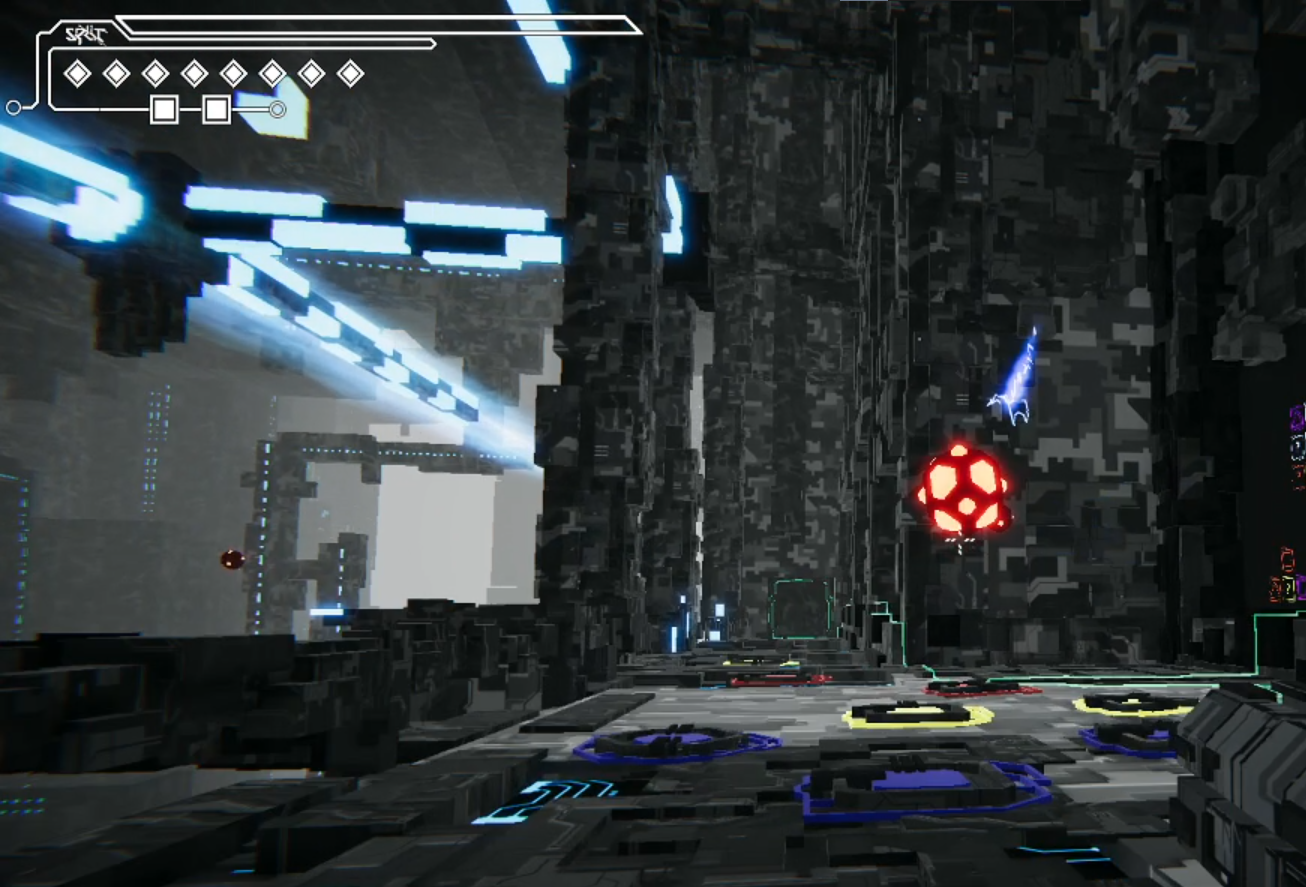
The last puzzle on the level after completing all the previous ones, despite the large scattering of hints, is relatively simple. However, there is a moment when we have all the tiles laid out but one. Why, apart from one block, one place, what can be difficult in this? First of all, the last field is covered with a large boulder.
[previewyoutube="U3XoKslVhq4;full"]
The first thing that comes to mind is to stand the clone on the button and shoot the field on the wall yourself. Just imagine if you have a lot of clones and each one has a button that would be active and set with a shotgun? Some people may have practiced this before and tried to put clones in other puzzles and noticed that the buttons with the clones did not light up.
[previewyoutube="w8vVrQA372g;full"]
Due to the way the levels are constructed, you might think that we might have hidden something under the bridge or behind some platform element. Unfortunately, there is also no hidden button that will move the obstacle.
[previewyoutube="ph4yifld0b8;full"]
Others might think that game developers are some kind of sadists, and we now have you go back half the map to such a single protruding button that shows the last puzzle. Despite the red color of the button, it is not the shape. ; -;
[previewyoutube="cEeRgMx4Wts;full"]
There are 2 ways to solve this puzzle that at least came to my mind when I was designing it. The solution with the use of a clone is that you tell the clone to shoot and run on the button ourselves. This small change to the solution to putting the clone on the button can often be harder to come up with.
[previewyoutube="veT3YXA3C9o;full"]
The solution without using a clone is to take advantage of the fact that the projectile takes time to reach the right place. We can climb onto the obstacle and fall off it right after firing it, or stand next to it and run onto the element.
[previewyoutube="JIhdvYYQ0Mo;full"]
Finally, I will give you a riddle. The comments section and the artwork tab are yours.

Come to our discord where you can talk to us about the game - LINK!
Devlog #14 - Robot is man's best friend!
There are 2 days left of the Steam Festival where you will have the opportunity to play the free demo version of our game!
Robot is man's best friend!
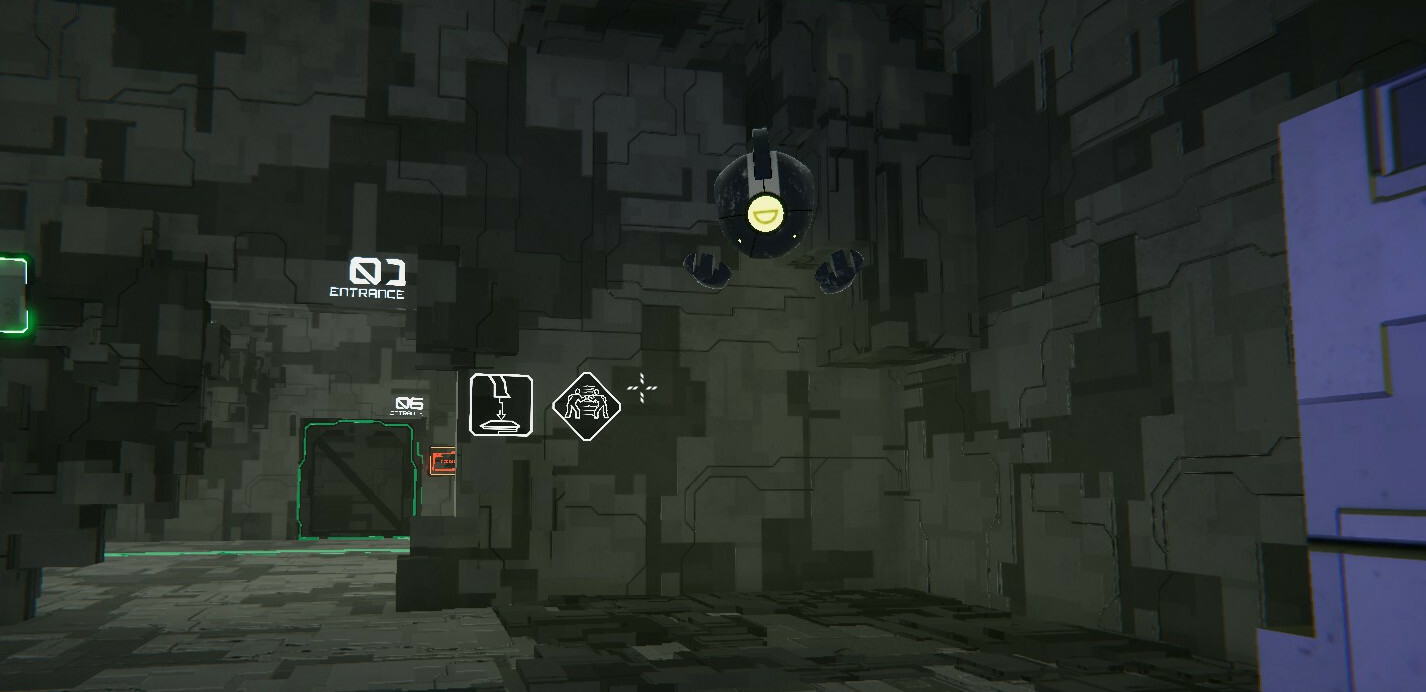
Nozzle
Do you know why I'm glad I'm not a proteinaceous protein? Especially now that we're hooked up to the simulation.
Pirx
I don't know, but you'll probably enlighten me right now, right?
Nozzle
I read an article recently about your generation's diseases, Pirx.
Pirx
Spit it out, tin! Are you trying to scare me?
Nozzle
Are you scaring? I want to help you, and you want to help me? Staying in the virtual network too long and too often can overload your brain. In short, you are at risk of having a stroke.
Nozzle
Not that your brain runs too much, but that's what I recall for the future.
Pirx
You irritate me.
Nozzle
Of course, you can always recreate the self.
Pirx
Which copy you don't have ...
Nozzle
I will, I promise, as soon as we get out of here.
Pirx
If we go out. If, Nozzle.
With a robot from birth!
Many years ago, scientists stated that children should not grow up with a dog, but a robot that is able to meet all the needs of adolescents. That is why, on the day of their birth, everyone is taken from their parents and placed under the care of a robot. Thanks to this, parents can immediately start working for the city. Depending on his social status and level of development, his robot tenants can upgrade it with more specialized modules. To diversify the interests of society, each robot has its own artificial personality produced straight from the factory, after all, we do not want all people to want to do one and the same job. Nozzle was given a large dose of irony, sarcasm and verbal attack in the package to encourage the development of an introvert with not too high ambitions who could deal with simple things.

Come to our discord where you can talk to us about the game - LINK!
Devlog #13 - Unveiling the veil of mystery
There are 3 days left of the Steam Festival where you will have the opportunity to play the free version of our game!
After the recent war, Epsilon Energy engineers created a system of indestructible Split shields. It was supposed to protect the planet by shielding gigantic cities covering almost the entire planet from armed conflicts. Different cities have different policies towards their citizens. In West Ulrage, everyone is given a robot after birth to look after them. In Hal'Tor, pairs of robots raise several children. In Dievez, on the other hand, people are brought up in large centers. Most jobs have been driven out by machines. People mainly work as mechanics, programmers and operators.
But you can read this on the steam page, and it's more for those who missed it.

We play the role of Pirx, one of the rank and file employees of one of the world's largest Epsilon Energy corporations. Pirx deals with small mechanical repairs ordered by superiors on a daily basis. He doesn't go anywhere without his robot Nozzle, which we'll talk about later. Besides, he is interested in comics and video games. Like most city dwellers, she doesn't like excessive human interaction.

Let's go to the studio for a moment, where the evening talk show is about to start.
Piece Oknolok
Good evening, Oknolok Piece. Today, we invited Dr. Fran Risk, the manager of the security department at Epsilon Energy, to the studio.
Fran Risk
Good evening
Piece Oknolok
And professor Edge Ficklea, head of the HR department at Cyber Force.
Edge Fickle
Hello guys.
Piece Oknolok
Our listeners are interested in the increased activity of the New Hand - a terrorist group that has been bombing the covers of various cities for several years.
Edge Fickle
As long as the group stays away from even Hal'Tor, there's nothing to fear.
Frana Risk
I agree with the previous speaker. As you put it, terrorists only attack small and insignificant cities, which are also located far from West Ulrage.
Piece Oknolok
So you are saying, gentlemen, there is no risk of being attacked as long as we are under the care of the Split system.
Edge Fickle
If they dare to come closer, our troops will deal with them and the system will protect us.
New trailer and playtests!
Hello Players!
At first we wanted to thank you for supporting us for so long and we can finally invite you to play Split!
You can apply for participation in Playtests here - LINK!
Another big news is a brand new trailer!
[previewyoutube="3bGXv1Pbx9s;full"]
But this is not the end, because on October 1st you will be able to play our demo as part of the Steam Festival!


We also invite you to watch our Developer Stream at the festival!

We would also like to invite everyone to our Discord where we will be happy to answer all your questions about the current work - DISCORD
Devlog #12 - Arachnophobia
Hello guys!
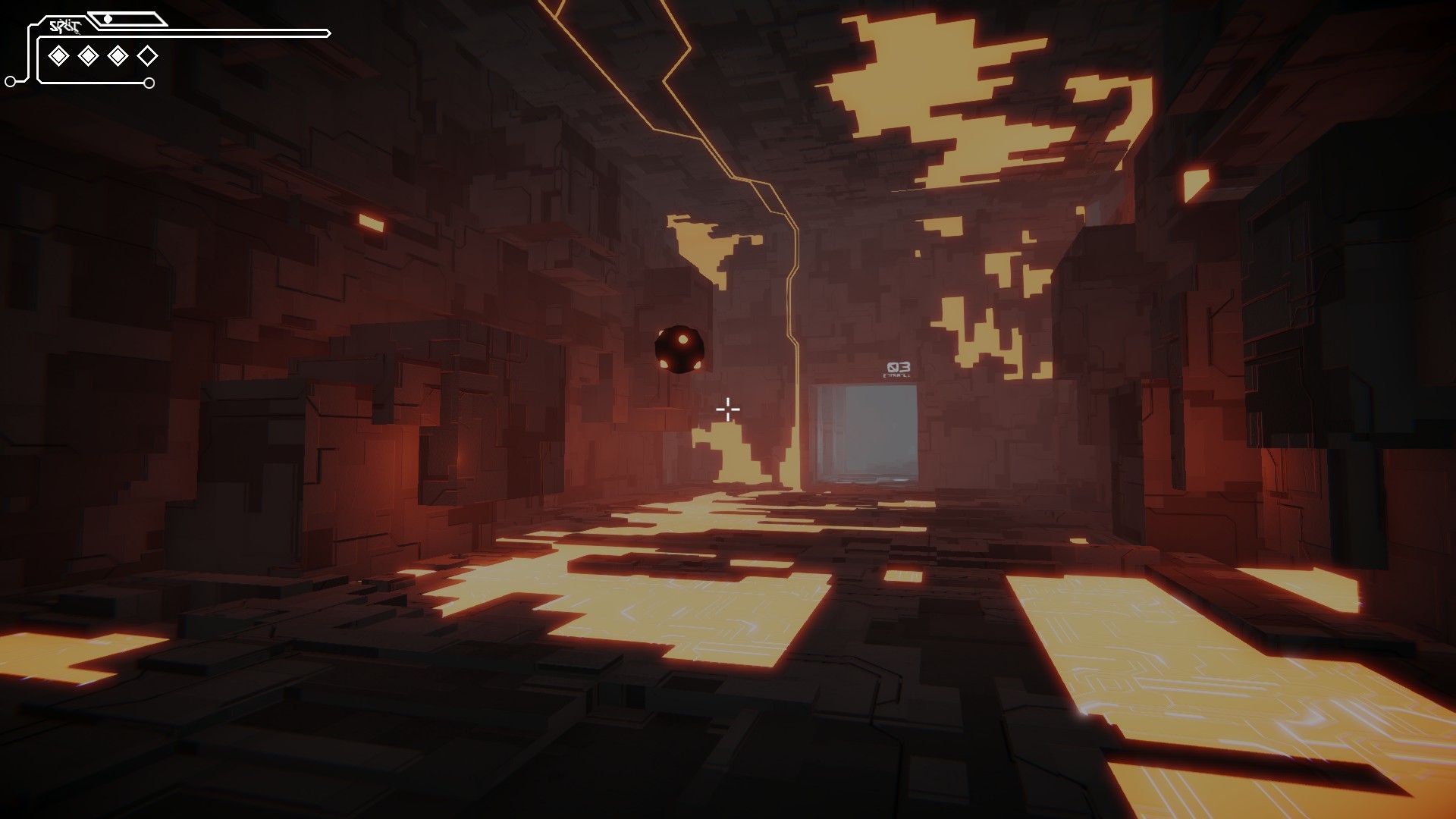
In order not to be boring, it is good to have a bit of different opponents in your game. We started with the simplest form, the sphere. What's more, it hangs in the air, so a lazy programmer does not even have to program its movement, and the animator has no legs to prepare. All this flying mine does is play with kamikaze when we get too close to it.

The second opponent is still a static model. However, this time you still need to do some movement and a shooting system. The opponent himself also has a big, clear red beam of light to show nicely where you shouldn't stand if you don't want to get in.

The third enemy, the turret, does not seem to move, but it is pointing its cannon at us. This time, instead of a sheaf, there is a warning laser, which is better not to enter.

There were several suggestions on how the fourth opponent should look and behave. After a long deliberation, we wanted to do something moving. Originally it was supposed to be some kind of spider, but animating 8 legs is not a very good idea and many more people don't like spiders than they like them. So we made something more reptile-like with a short body :)

Inherent in such opponents is the need to animate. We can create an animation that we will play sequentially, or use mathematical algorithms to move objects.
Inverse kinematics
It is an animation method based on the hierarchical movement of interconnected elements. We call the parent the parent and the child the child (there are a lot of jokes about removing children in programming). The baby's movements are always relative to the parent's movement. In inverse kinematics, the limitations that we place on individual bones play an important role.

In our game, the model is composed of the main body and limbs. Each limb is divided into two fragments. This allows you to obtain the effect of bending the leg while maintaining its geometry.

Moving the legs to the points produces what looks like a walking effect, but is a bit stiff.

Instead of having to bandit everything to a specific position, it is nicely smoothed with an appropriate mathematical function.

To enrich the robot's movements, we have added more points to which the legs can move.
Generally about opponents
When a challenge is designed, it consists of 4 aspects.
- How can you go through them?
- What does it look like?
- How is it sounded?
- What's cool about it?
For physical opponents, this first bullet breaks down into several smaller issues:
1.Moving because the opponents can be:
- static
- patrolling
- charging
- followers
- and other...
2.The method of attacking can be:
- raycastowe
- physical projectiles
- close combat
- poisoning
- and other...
3.Disposal method:
- the entire area takes damage
- only specific points get damaged
- some points are more sensitive
- you have to do some swing to break the covers
- and other…
Do you know opponents that act differently?
Devlog #11
In today's devlog, we'll cover the topic of inspiration!
➡️In puzzle games, about 60-80% of all work is creating levels. In addition, an important aspect is to properly arrange the difficulty curve and create a tutorial that is not annoying.
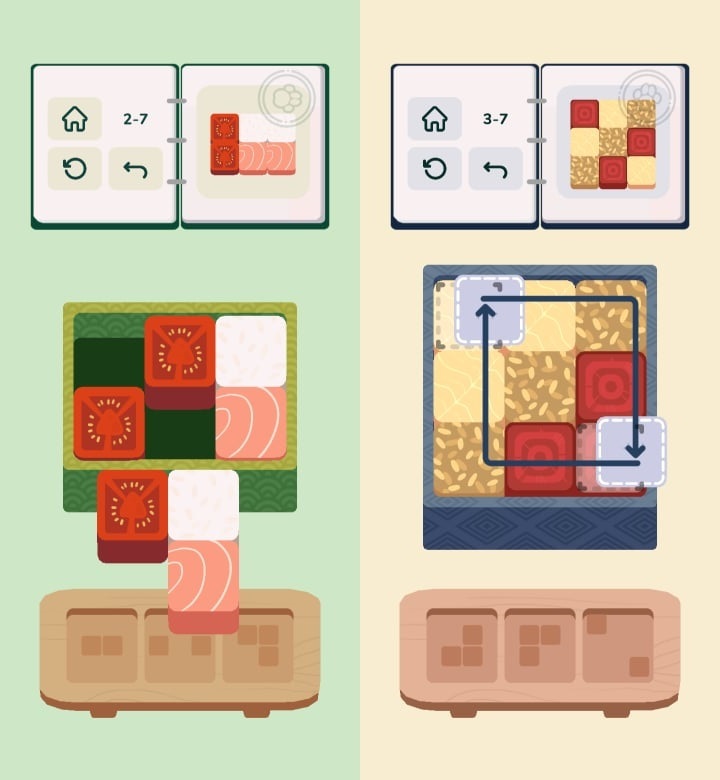
➡️Many games are based on very specific mechanics, to which new mechanics are added. Once I had the pleasure of working on the game "inbento", the basic principle of which was to arrange the blocks of food in a specific pattern. The game starts with covering other pieces of food with food, and then evolves with new mechanics such as swapping food places.
➡️The second type of puzzle game is one that changes the mechanics of the game every level or several levels. For example, in the game "Quantum Conundrum", we start with the puzzles related to the change of weight. We get the ability to make things very light. So we can lift a safe that is normally too heavy. In the next stages, we get the ability to slow down time, for example, to pass through a propeller that is usually rotating too fast. The games with changing mechanics also include "Split".


➡️At best, the mechanics and the appearance of the level match, but most of the time it doesn't matter. The puzzles themselves are selected on the basis of the need for more open spaces or small corridors. Riddles usually take one of two forms. The first one is a puzzle to be completed in a given place. The player has a very specific task, it can be to play a specific sequence of "buttons", just like that or at a specific time (because, for example, platforms collapse). The second type is search puzzles, most often they take the shape of small labyrinths in which the elements to complete the puzzle have yet to be found.
➡️The basis for creating games is collecting inspiration. As Split is inspired by a brutalist architectural style and electronics, i.e. all types of cables and PCBs. The individual levels have cards in the project management system where we paste appropriate photos and links. We try to make the levels diverse in terms of geometry and colors. Some levels are a complex of narrow corridors, while others consist of large open areas with enormous structures connected by ducts. https://www.pinterest.at/vxd555/split-brutalizm-si-fi/

➡️For example, one of the levels is based on the theme of hanging cities. The whole thing looks like we are traversing bizarre constructions. We move on the sidewalks attached to the building, and we are protected from the abyss by a railing. We have created a separate table for this level https://www.pinterest.at/vxd555/wisz%C4%85ce-miasto/


➡️In addition to pinterest boards, we browsed reddit, twitter, instagram, artstation and websites presenting various cities, specific objects or even tourist trips.
https://www.reddit.com/r/brutalism
https://twitter.com/search?q=%23Brutalist
https://www.instagram.com/explore/tags/brutalism
https://www.artstation.com/search?q=brutalist
➡️One of the visual elements we have transferred are long columns that intersect at an angle. It is not the whole idea of a level, but a single visual element that can then be placed on several levels. https://www.pinterest.at/pin/749638300473558900/


➡️The appearance of the levels can also be borrowed from other games. For example, the layout of rooms in a fragment of one of the levels was moved from the game "Timelie" for the needs of "Split". The room where the Pirx protagonist of "Split" is located is the middle room in the photo from "Timelie". You can tell by the door layout, and when you enter the respective rooms, you will be able to recognize the corresponding walls.


Where do you get inspiration for your projects from?
We would also like to invite everyone to our Discord where we will be happy to answer all your questions about the current work - DISCORD
Devlog #10
Why game developers hate crouching?
There are 2 types of games, the ones you can crouch and the ones you can't.
Paulo Coelho
One of the things in the game, next to elements such as stairs, elevators, ladders, doors and jumping, which cause many problems for the game developer, is the title crouching. This terse activity in the real world can be problematic at most for the elderly in the game, it is elevated to one of the first things to cut to save time and money.
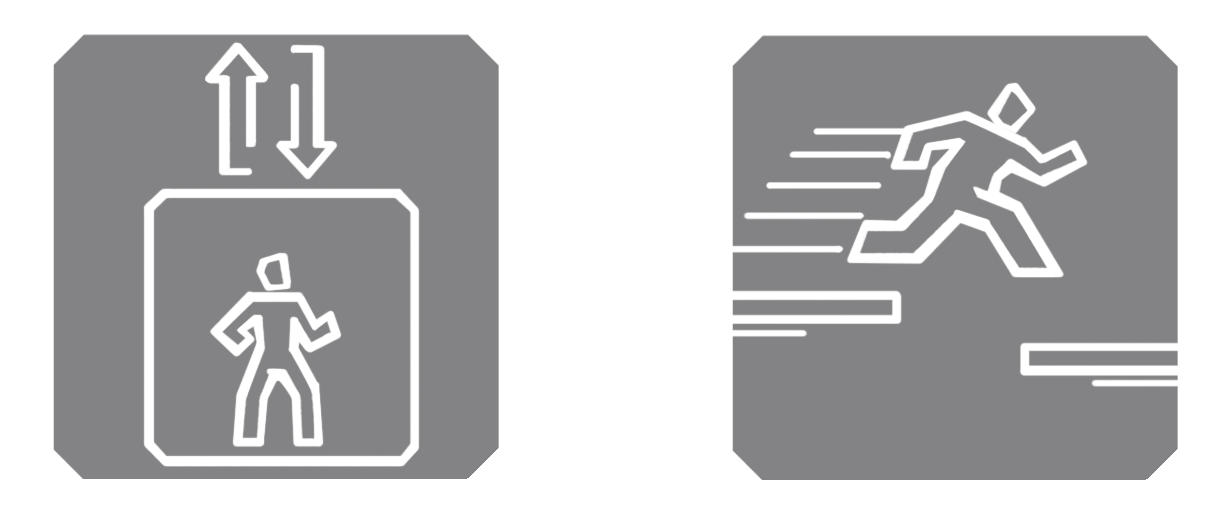
To look at why this is causing problems, it is first necessary to mention what it might allow. Only 3D games will be considered because the two-dimensional games are a different story and different rules. First, crouching reduces height so they can avoid enemies or projectiles, be less visible, or enter tight spaces. These are quite easy to see benefits that work for specific types of games. Secondly, which is more problematic, getting up from a crouch increases the character. Games and their physics are often unreliable and stop working when you least expect them.
Shooters, especially first-person shooters and stealth games, must be able to crouch, but they often work on simplifications that reduce the openings to two levels. Standard openings must be the size of a door, and those smaller than the character must allow the player to crouch. Otherwise they would be considered poorly designed and frustrating the player. The standard size of the obstacle should reveal a standing person, but cover a crouching person.
How is crouching done in games? There are several approaches to this, and there is a difference between first and third person games. In the case of the view from the eyes, it is of course important to lower the camera. After all, what the camera does not see, the opponents should not notice. The transition of such a camera must be smooth so as not to cause nausea. In third person, a similar effect is often achieved by bringing the camera closer to the player's character. The perspective from behind the character, of course, requires an appropriate animation of transition between states of motion. Here, the mere movement of the camera so that no models are caught in it can be a certain gymnastics for the programmer. The second more problematic element is the change of the collision area.

What is the collision area? In short, it is a lump around the player that prevents him from falling under the floor, going through walls or punching his head through the ceiling. All those elements that are supposed to block the player's passage are the collision areas. When something is broken in them, due to the inattention of designers who forgot to insert such an area in a given place, or due to a wrong calculation made by the game engine, the character may fall under the map or be launched into the air. If the computer had to operate on a large number of more complicated bodies than capsules and prisms, its performance would drop significantly, and 60 FPS can be forgotten.
A lot of the events in the game are based on triggers. A trigger is an area where when a player or other object (which is up to the developers) appears, the game does something. That something could be, for example, a dialogue sequence. You can imagine such a situation, the player is thrown into the air to the full height. When it reaches a certain level, it bumps its head into the appropriate trigger, and a conversation starts. What if it is quite high, and our character crouches when he reaches the maximum height. Dialogue will never come on and it is hardly possible if it is only a dialogue, and not, for example, the sequence of opening the door or moving the platform, which was supposed to prevent us from falling into the abyss.

Since you know what collisions are and what problems they can cause, you can move on to what and how to do with them.
One approach is to create 2 separate collisions, one for a standing person and one for a crouch, and switching them alternately. The second way is to hold one collision and change the altitude. The problem with changing the height is that it is scaled to the center. So it is not that the height is taken from the top, but from the bottom and the top at the same time. Then the figure seems to drop a little.

The next problems are the places where the character can stand up. You have to make sure that you cannot get up when you have something over your head. Each time the character wants to get up, check if any fragment of the collision has any obstacle directly above it. What, as you can guess, can often cause various kinds of sticking into elements that should not be hammered into.
Multiplayer games have even developed a certain language with the use of simple interactions
Crouching - getting attention
Crouching on the face of a dead figure - contempt and disrespect
Jumping around - Hello, friend of the player
Shooting at you - urgent attention
Shooting at you then shooting in some direction - Go there
Punch with a fist - Move it *****
Fast turning - I'm bored
In games with no clear faction breakdowns, a few squats can mean you want an alliance
We would also like to invite everyone to our Discord where we will be happy to answer all your questions about the current work - DISCORD
Devlog #9
Hello guys!
If you are interested in the essence and pretty pictures, you can skip the introduction, we will not be offended;)
When you think about who makes games, the first thing that comes to mind is the programmer and graphic designer, in the second wave, perhaps we will consider sound or music. Designers will be mentioned much less frequently, and even less frequently individual specialties. In this article, let's take a look at what is meant by the concept of graphics.
There are people responsible for three-dimensional graphics. And these are the people who make the models, but the models can be modeled by hand or carved. A graphic designer may specialize in creating elements of the environment, characters, or animals. Another person may be responsible for creating the character's skeleton, and another for the animation. Yet another one may create textures, someone may be responsible for the hairstyles. As you can see, there is a lot of it, and that's still not all. Moving from textures to more two-dimensional elements, we deal, just like in 3d, with cartoonists of characters, surroundings, or animators. We can divide 2d creators into interface designers, concept artists, or people creating details on levels.
It's hard to get closer to everything at once, so this time we will focus on one very specific person - an illustrator, and more specifically this special case of an illustrator who creates frames for fictional scenes.
How does work on an illustration look like?
Technical
The first stage of work on an illustration is technical details, i.e. all requirements that an illustration must meet. First, you need to know what you want to draw. Thank you goodnight. But seriously, it is a question of where a given illustration is to be used. In our case, these are fictional scenes, but they could be, for example, character portraits, conceptual graphics of an item or location, which will then be modeled.
The basis of the graphics that will be used in the game is, among other things, its size.
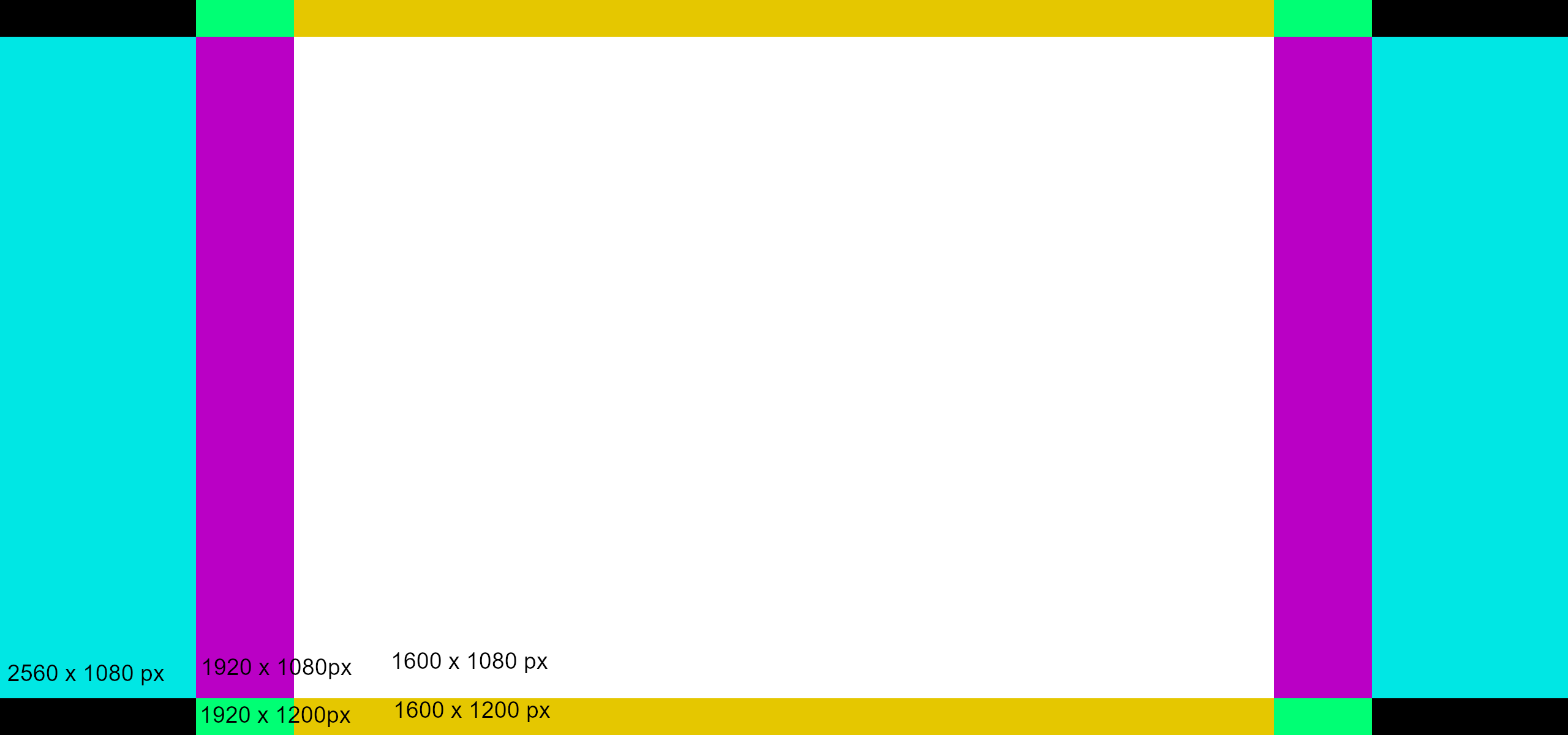
This extremely colorful graphic defines the most popular screen resolutions. Turquoise until 21: 9, pink is 16: 9, green is 16:10 and yellow is 4: 3. On the other hand, white is the common part that will be visible regardless of what screen you have. This is especially important in terms of the arrangement of significant elements. We cannot put the face of the character speaking on the turquoise field because it will be invisible to some players playing at a different resolution.
Before drawing an illustration as it was written before, you need to know what you want to draw. An example of a room description looks like this: Shield System control room. Huge Bed - Exposed (the covers are on the sides of the bed, when activated, they cover the figure lying on top of it so that only its face is visible - like a sarcophagus). Walls full of monitors and indications, one door. In addition to what is to be in the photo, it is important to know how the camera should be positioned. For this frame it is a complete set, you can see the characters from the side, the shot at the door.
Now defining the character and climate. First, Split is a cyberpunk game. Big corporations, not that far future, lots of glowing billboards, huge spaces, and omnipresent electronics and robots. Everything is a bit dark, cool, bathed in blue fog and glow, highlighted with neon lights and wires.
Crafts and arts


Starting from the earlier colors, it is advisable to divide the frame by marking auxiliary lines taking into account different screen proportions. Yes, just to make things easier. At this stage, the main color theme from which the frame will be created is also determined.

The next step is to give the location a simple outline. In this case, it is a room, so it is important to mark the walls, entrances of all kinds of bends. At this stage, it is also determined how the perspective will unfold. When you look closely, you can see that what is at the back of the picture converges to the center, and thus the observer of the scene is in the center of the room.

In the next stage, the outline of light and shadows as well as the contours of characteristic elements on the stage, such as an armchair, are created, which will be a key part of the stage.

When the individual shadows are selected, the main light point is added. Light spots and basic shadows in the direction of its incidence are painted.

After the first few smears of dark spots, it's time to deepen the shadows. Making them smoother.

The next step is texturing. But where to get textures?

The basis for interesting-looking elements is this strange-looking texture. This texture is a mix of architectural elements enriched with noise and dirt. Something like a collage. By using the proper opacity and masking function, the illustration gains depth and looks more realistic.

The formula was created on the basis of reference photos of integrated circuits. The geometric form gives the elements a mechanical character and thickens the compositions.

Cardboard created on the basis of the first, repeatedly mixed in order to obtain a new, geometric pattern that will affect the final effect by selecting the appropriate method of covering.

The previously shown textures are mixed with the color of the wall and the details are sanded down in detail. The easiest way to start is from the surfaces facing the player.

When everything that is flat and in front of your eyes has all the details, it's time to focus on the details that are at a certain angle.


The next steps involve the application of individual details such as wires or gloss. Additional lights and shadows are added, as well as details such as texture on the walls or lamps.


Now we leave the background drawing and add the main color theme of the scene. The light that gives the atmosphere and expression to the scene comes from two points. One of the light sources is behind the open door, while the other is the glare of the central monitor.
We would also like to invite everyone to our Discord where we will be happy to answer all your questions about the current work - DISCORD