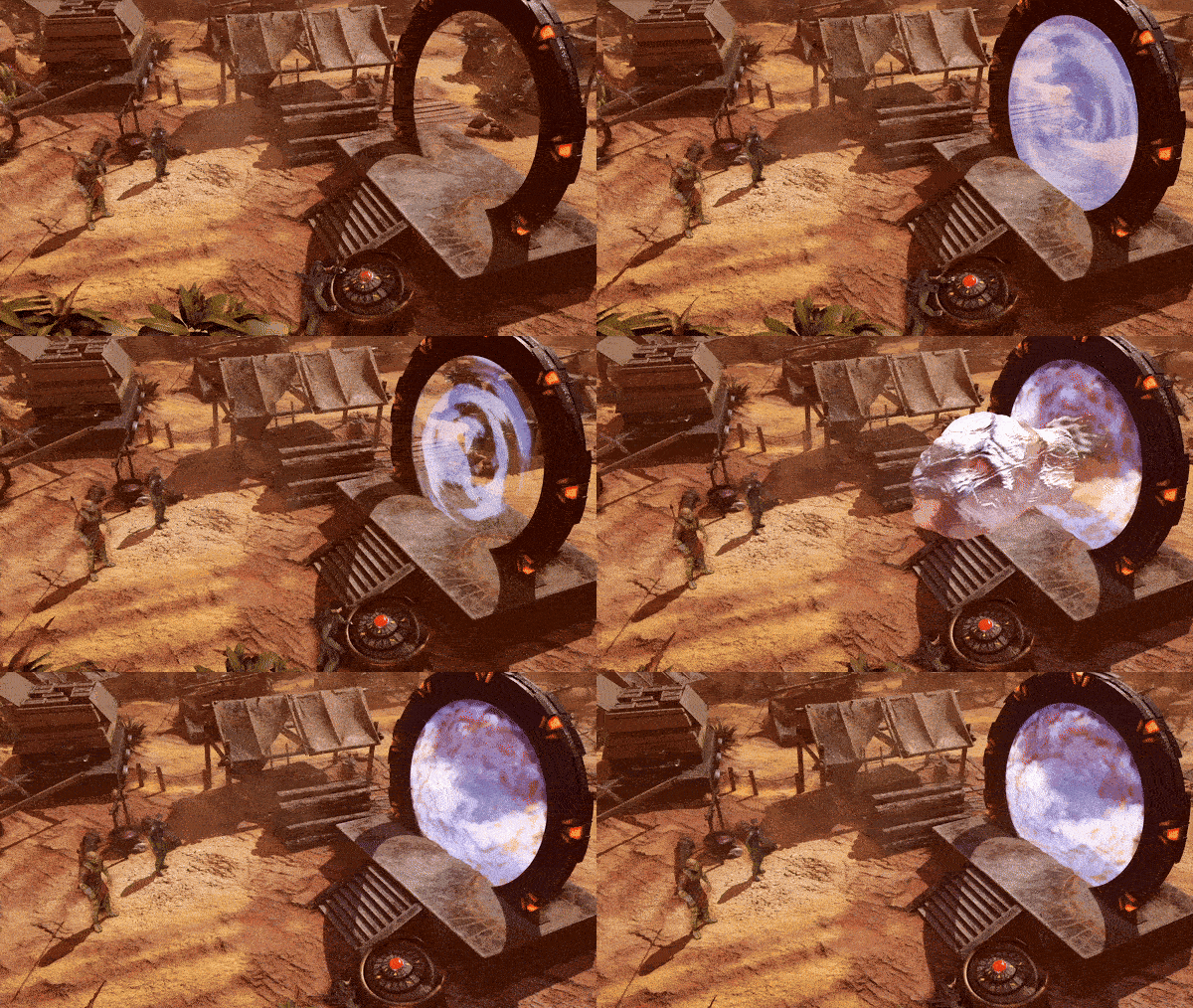
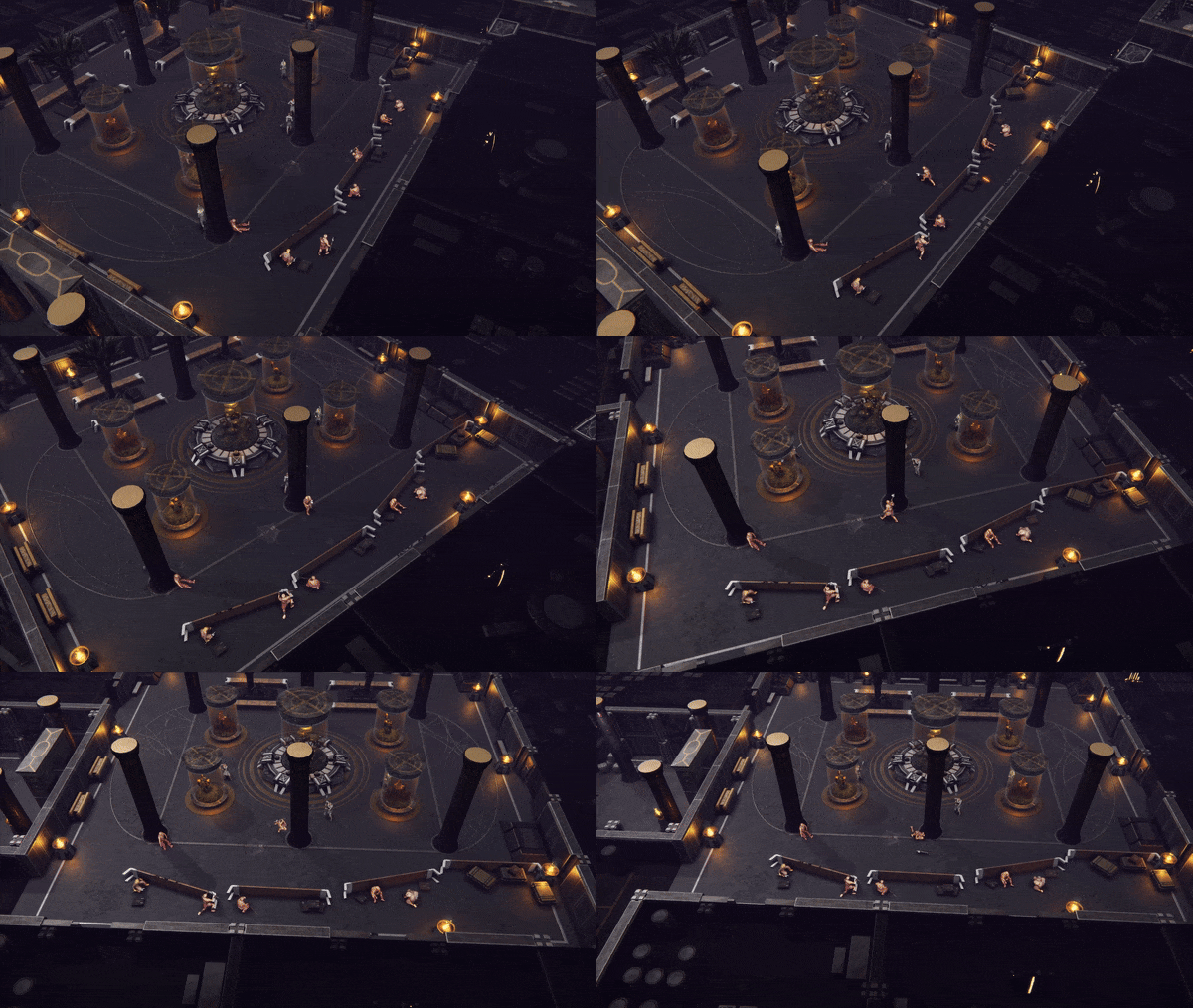
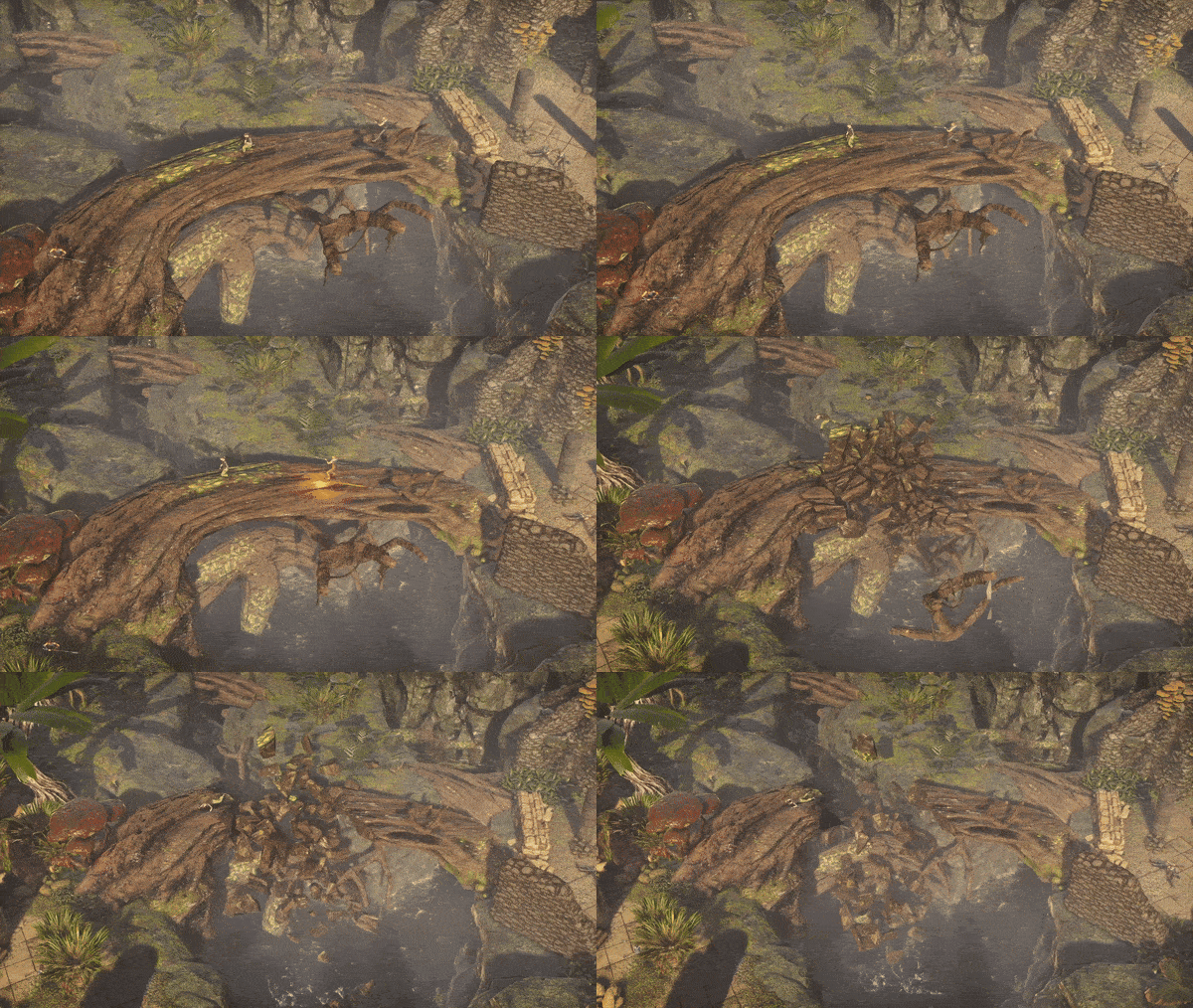
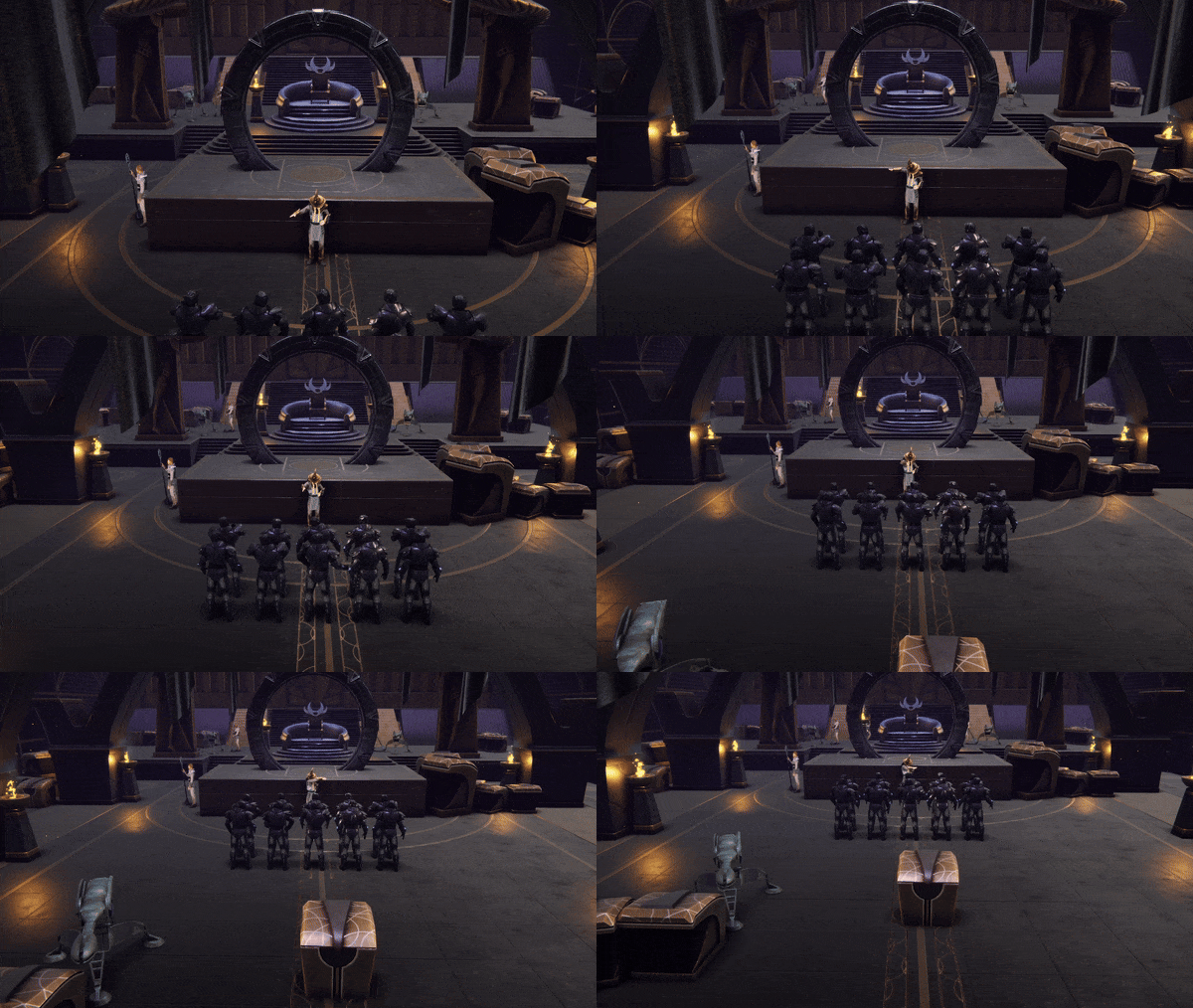
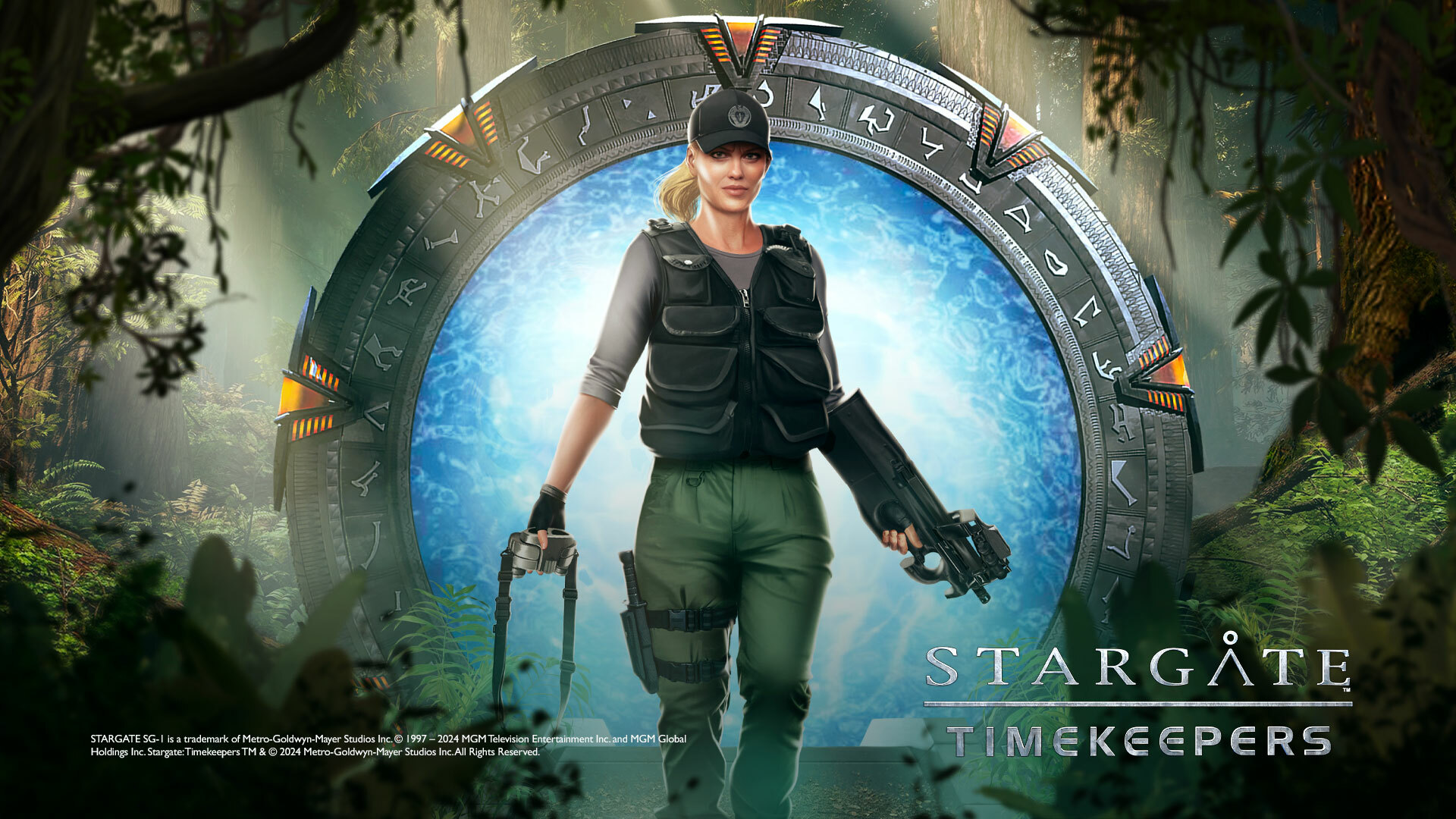
We are very excited to announce that Stargate: Timekeepers - Part 2 is out now.
The wait is finally over, as Season One Part Two has officially launched, adding seven new episodes that are full single player missions to the story-driven campaign. Players who already own Season One, Part One will receive this major update at no additional cost, with the new episodes automatically unlocked in their game.
For newcomers, Stargate: Timekeepers is available for $29.99, which includes access to both Part One and Part Two of Season One. To celebrate the launch, a 25% discount is being offered to newcomers from 5.00pm GMT on 23rd October until 30th October.
Part Two introduces fresh content, including new locations and an exciting new character, Xugga, who will join the team and add new tactical options to the game. These new episodes sets new challenges for players, offering deeper exploration and more strategic opportunities in the Stargate SG-1 universe.
Stargate: Timekeepers is a real-time tactics game where players lead a team of specialists through a story-driven campaign set in the Stargate SG-1 universe. The game begins with the Battle of Antarctica where Season Seven of the SG-1 television series ends, unfolding across 14 narrative-rich missions.
Stargate: Timekeepers was created by strategy publisher Slitherine in collaboration with Amazon MGM Studios Consumer Products and Interactive Licensing.
Stargate: Timekeepers - Face 2 Face with Eva McCain
Discover the story behind the characters of Stargate: Timekeepers with the new series "Face 2 Face". Here the first episode about Eva McCain, the Team Commander.
Name: Eva McCain
Role: Team Commander
Personality: Perfectionist, strong moral code, leader.
Background: Graduated the officer school with excellent scores. After years of service, she was promoted to lead one of the SG teams. She had a short romance with Max Bolton. She finds it very difficult to believe in the timeloop. She would be willing to sacrifice anything to save as many lives as possible. Her redemption story is only possible due to the timeloop, where Max Bolton finally develops enough leadership skills to convince her that the timeloop is real and he can handle it with her help.
Hello! I’m Robert Brown, narrative designer of Stargate: Timekeepers. I wanted to take a break from our hard work on Part 2 to share some of my reflections on helping craft the game’s narrative.
Writing for a beloved franchise like Stargate – which we devs also love – is a privilege that comes with opportunities and challenges. In creating Stargate: Timekeepers, we wanted to tell a Stargate story that would delight fans and newcomers alike; this meant making something that felt true to the spirit and legacy of the franchise, drawing upon its vast lore in a fun and respectful way.
For my part, I can say that working on Stargate: Timekeepers has been a blast. It was important for us and for MGM that the narrative matched the tone and canon of the franchise, and trying to write in a way that honors Stargate SG-1 – with its thrills, its humor, and its warmth – has never been dull.
I had particular fun exploring the show’s fictional languages. This process included watching umpteen episodes of SG-1 to find little-known Goa’uld phrases for our Jaffa NPCs. How many people get to watch TV for their day job?
I never thought that I’d be writing prayers to the Goa’uld when I grew up, but here we are.
That said, narrative design for games isn’t without its peculiar challenges. One such challenge for this project was trying to deliver TV-like characterization without some aspects of TV pacing.
Gameplay-wise, Stargate: Timekeepers provides a fresh and faithful Stargate experience by focusing on missions inspired by those of SG-1 – sneaking behind enemy lines on alien worlds. Anyone who’s watched the show knows that these missions lend themselves well to compelling storylines. But on TV, we also got to know characters in quieter moments, during their off-hours on Earth or exploring other worlds; Stargate: Timekeepers gives players space and time to strategize, but this isn’t the place for lengthy chit-chat.
So that you get to know your squad, our solution was to find moments for short, mid-mission interactions that (hopefully) complement the game’s mood and reveal more about our characters’ personalities and back stories. That was tricky at times – especially when we’ve also got mission- and lore-related info to provide – but we hope that we’ve struck the right balance.
It’s nice to shoot the breeze, but sometimes you’ve just got to focus on the mission.
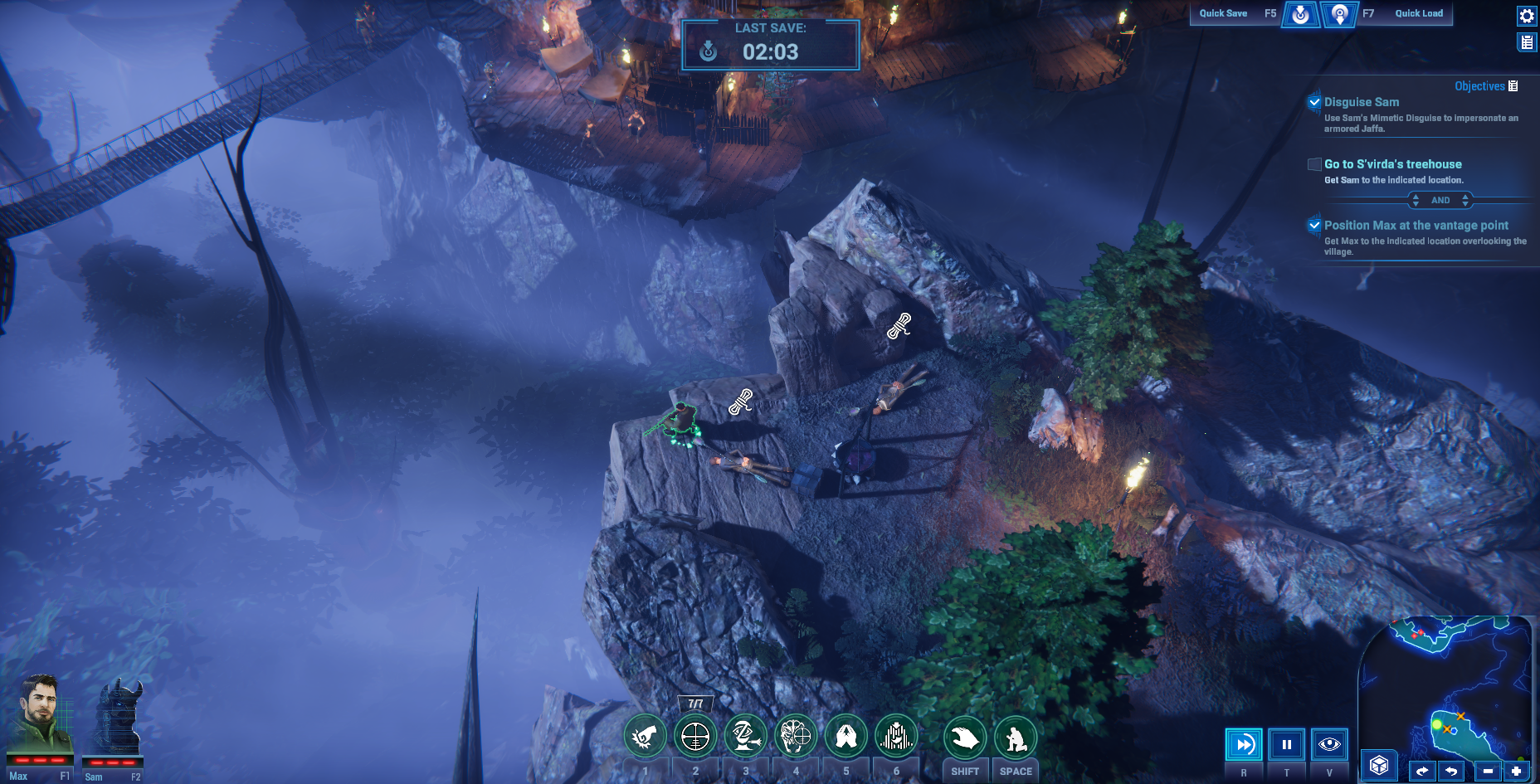
Another challenge was our responsibility to the canon. When we implemented anything from Stargate lore, we had to think carefully about how we depicted it. Players have been naturally curious about some of our choices – for example, why does A’ta use her staff weapon differently to the Jaffa in the TV series, and why does Sam’s mimetic device seem to have broader capabilities than the devices we’ve seen before?
When we built upon this lore, and showed familiar things in new ways, we strove to do so respectfully and believably, using our game’s narrative to help explain our decisions. You’ll find little drops of lore strewn throughout the game’s script that should answer some of your questions.
An element of Stargate lore that is crucial to the story of Timekeepers was featured at the end of mission 7. You’ll be hearing more about that in Part 2!
We hope that you’re looking forward to Part 2 of Stargate: Timekeepers! Not only does the second part contain more missions than the first, but you’ll also get more opportunities to pick the team members you want to deploy. Different team compositions mean different narrative situations, so you might hear different dialogue when you replay certain missions. I hope you’ll enjoy returning to these adventures and seeing them in a new light.
Stargate: Timekeepers - Part 2 beta sign-up
Welcome back time travellers,
We are very excited to announce that the beta for Stargate: Timekeepers - Season 1 Part 2 is now open for sign-ups. Do not miss the chance to jump through the Stargate and help us test the new episodes of the second part of the game.
If you're ready to fight the Goa'uld threat, sign up now.
Hello, my name is Eryk Przepiórzyński, I work as a Level Designer for Stargate: Timekeepers. Today I wanted to tell you about the Level Design in Stargate: Timekeepers, and more specifically about the two main topics. The process of prototyping levels and designing the puzzle arenas.
Before we start building a new episode, we analyze what it will be about, what its goals will be, its course, and what additional content it might contain. Afterwards we are gathering the references of the environment, objects and events from the series or the real world.
Knowing what the goals of the mission will be, and the overall flow of the mission, I can proceed to what is most important, and most rewarding for me in Stargate, as well as in the work of a Level Designer, which is level blockmeshing.
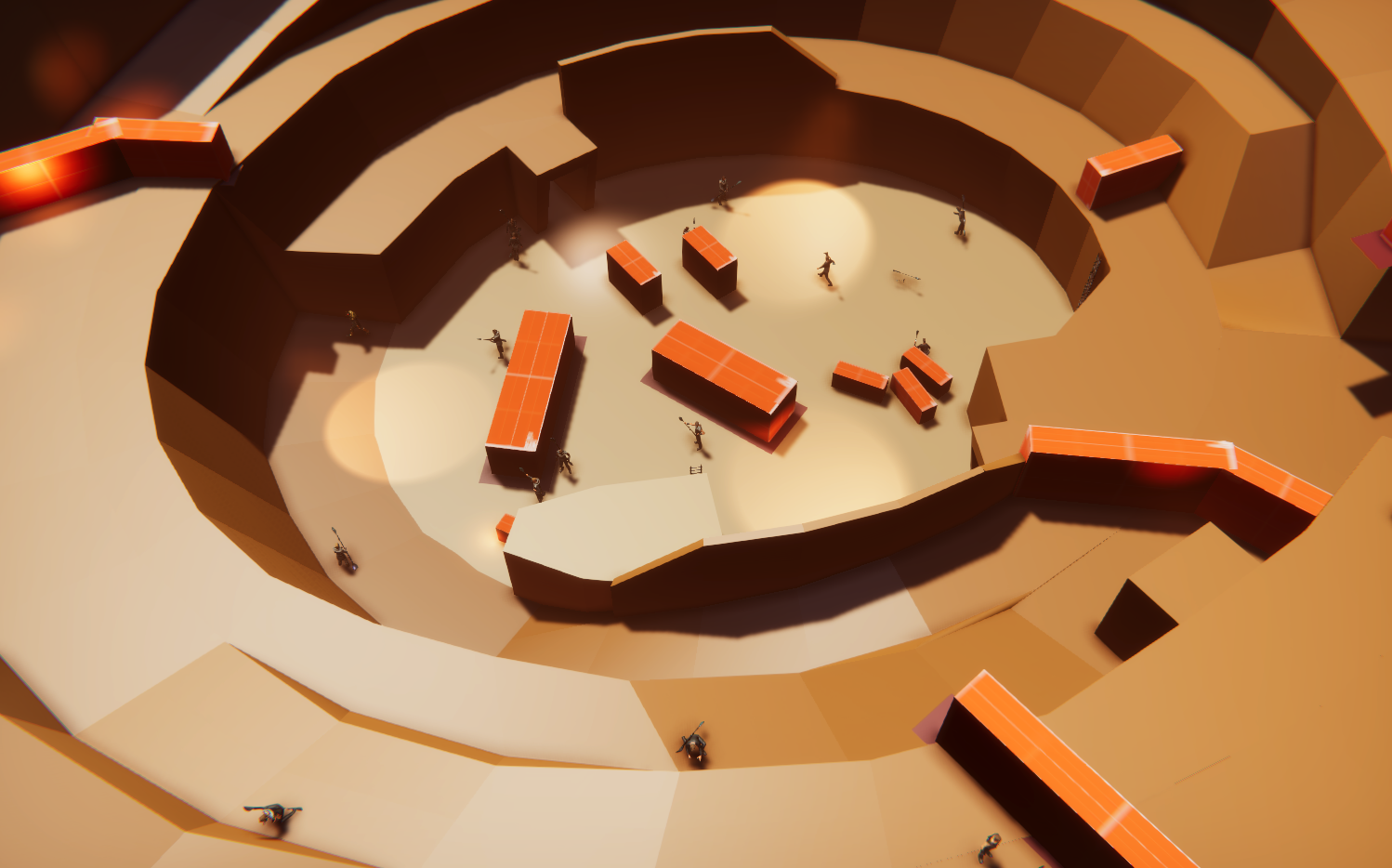
There is no clear term for the process of creating the map, it can be blockout, blockmeshing, whiteboxing or greyboxing. In each situation it will mean the same thing, that is, a level built from simple blocks, so that as soon as possible we can start testing the mechanics, the difficulty level or, most importantly for our game, the puzzles.
When starting the level construction stage, I plan how many arenas must be included in it. An arena is a location on the map, which is a component of the whole and contains enemies and puzzles. Depending on the complexity and specifications of the episode, the map may consist of 5, 10 or even more arenas. The most common structure of our arenas is a situation in which there are two puzzles to solve per arena.
Having a plan of the whole level and knowing how many arenas will be in it, I proceed to build the first arena and lay out all the environmental objects such as walls, rocks, vehicles. As aforementioned, all the environment objects are composed of primitive blocks, however, sometimes I like to dedicate slightly more time to build more complex blockmesh to present my vision of the location or the object more precisely and facilitate the work of other departments.
I don't limit myself to finalizing only one process at the time, rather I try to make the blockmeshing and the puzzle design go hand in hand, so once I have the initial blockmesh of the environment done, I proceed to lay out the objects that serve as cover for our characters.
These are the objects that have a direct impact on gameplay because they are the ones that allow the player to progress through the arena and effectively hide from enemies' viewcones.
While designing the puzzles we do not want to make it with only one solution, hence, in order to deliver the arena to the initial testing stage, we must have at least two interesting and engaging completion ways. During this stage of work we get the help from our hard-working programmers, through whom we have access to very useful tools which significantly accelerate the process.
One of these tools is the Skill Visibility Tool, which allows us to have a visualization of the ranges and noises of each skill and each character in a few quick clicks. Placing the pointer of this tool on the terrain, we can check for example if our character can be spotted in this location while using this skill, or if the character can simply use this skill from that spot.
Once the blockmesh and puzzles are designed I accede to setting up the placeholder lights. These are the most ordinary lights that allow sufficient visibility on the map when testing an episode, or that have a specific purpose, such as when I want to direct the player to a certain place in some way.
When finishing the design of each arena, we begin the early process of iterations. Early process of iterations means nothing more than tests of another Level Designer. After the initial testing, I proceed to review the feedback and based on it, make changes or improvements. If all the arenas have passed the internal testing and iteration process, the initial effect is satisfactory and gameplay of the episode is interesting; the level can be delivered to the main testing pass.
After the main testing pass begins, Level Design focus is directed towards the iteration and bug fixing. In some cases, after a few iterations of the map, some of the areas may be completely different from the initial state. This can be due to all sorts of things, from changing the environment, the idea of the arena itself, noticing something we didn't see before, changing the positioning of one opponent, which will entail changing more, bugs, all the way to completely changing the mission course.
Once the blockmesh on the map is completed, all the arenas are designed and tested, another departments take care of the map. However, the Level Designer's work is not over until the release and even after that, support continues.
Stargate: Timekeepers - Team Interview
Welcome back time travellers,
Do not miss the chance to meet the team behind Stargate: Timekeepers and discover all the details of the creation of the stealth video game of one of the most loved tv series.
We would like to thank all the fans who have been supporting Stargate: Timekeepers since its launch.
The team has been working relentlessy to deliver you the best possible gaming experience and please let us know what you think of the game. Your feedback is essential to keep improving the game.
First of all we would like to thank all the fans who have been supporting Stargate: Timekeepers Season 1 Part 1 since its launch.
The team has been working relentlessy to deliver you the best possible gaming experience and please let us know what you think of the list of changes. Your feedback is essential to keep improving the game.
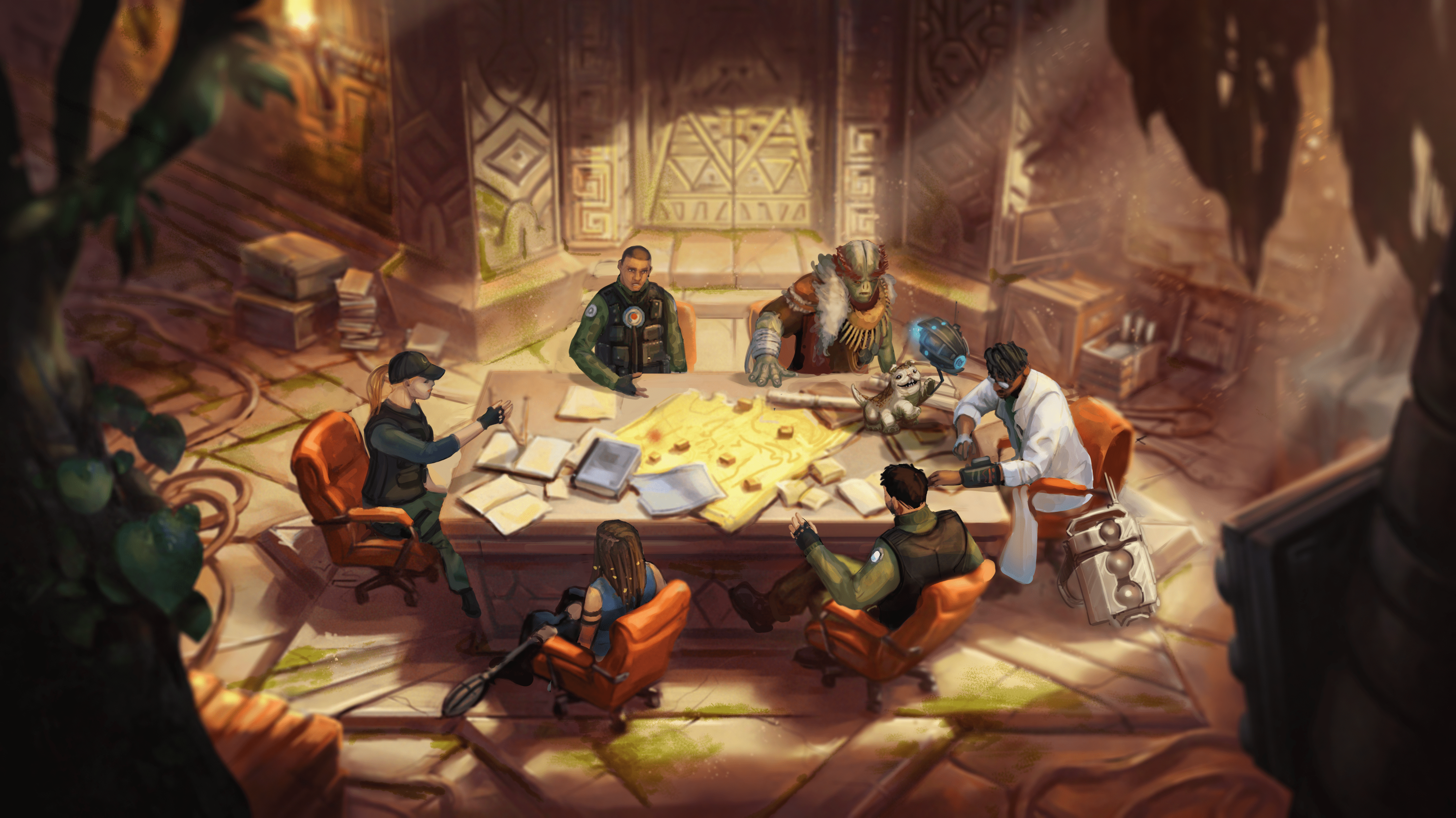
(Pre-production concept image)
Here below the detailed changelog is available for you:
Fixing an issue related to achievements that some users might have experienced.
Hi! I’m Patryk Nosek, Game Director for Stargate: Timekeepers. Today I wanted to share with you our approach about Stargate: Timekeepers skills and characters.
In the development, one of our core design philosophies was to ensure flexibility in how missions can be approached and completed. We wanted to avoid dictating a 'correct' way to play, instead empowering players to utilize the diverse skill sets of their team members in ways that suit their personal play style. To achieve this, we crafted each character with a unique set of abilities that could be effective in various situations. Whether players prefer stealth or a more direct confrontation, they can find characters whose skills align with these strategies. For example, if a player favors a stealthy approach, they might lean heavily on Ata's climbing skills to bypass enemy lines, or use Derek’s gadgets to create distractions and avoid direct combat.
The first time the level designers presented Episode 3 to me, I completely forgot during the mission that I had Max in the sniper position. According to them, it was crucial to utilize him to complete the mission, but I managed to do it without him. That's when the idea of an open approach to mission completion convinced us, and we decided to keep it that way.
Alternatively, for those who prefer a more aggressive approach, characters like Max, with his expertise in handling powerful weaponry, can take center stage, breaking through enemy defenses with force. Eva’s proficiency with her P90 allows her to do more frontal assaults too.
We spent considerable time ensuring that the skills of each character in Stargate Timekeepers are not only useful but also deeply tied to their personalities and backstories. This connection between character traits and their abilities enhances the narrative immersion and encourages you to think as the character would, making strategic decisions that reflect their specialties and temperaments.
Take Ata, for instance. Her prowess in climbing and navigating through difficult terrains is not just a handy skill—it's a fundamental part of her identity. Growing up in a harsh environment, she learned to move silently and efficiently, skills that are invaluable in stealth missions. When you play as Ata, you’re not just using a skill; you’re tapping into her life’s experiences, which dictate her approach to problem-solving in the field.
Sneak peek from Season 2 - who we take with us on the mission will influence the course of future events. Just don't tell our Marketing Department that I've revealed this to you.
In Stargate Timekeepers, while the core of our gameplay emphasizes stealth, we actively encourage players to experiment with different tactics, including frontal assaults. The game is designed to reward creativity and flexibility, allowing for numerous paths to success in each mission.
Which characters do you find most useful or enjoyable? Are there any skills you feel are missing from the game? We're here to listen and make improvements based on your feedback. Also, do you remember the new character we announced for season 2? What abilities do you think they will have? Let us know your thoughts!
First of all we would like to thank all the fans who have been supporting Stargate: Timekeepers Season 1 Part 1 since its launch.
The team has been working relentlessy to deliver you the best possible gaming experience and please let us know what you think of the list of changes. Your feedback is essential to keep improving the game.
(Pre-production concept image)
Here below the detailed changelog is available for you:
QoL features:
We have added a feature that, when enabled in the settings, causes the character to approach the nearest possible location if the target of the skill is out of range at the time of selection, in order to place themselves within range.
By holding down the LMB button for an extended period, you can now place an Enemy Vision marker to check which of the opponents is observing the designated location in real-time.
Voice overs:
We have added new voiceover lines for enemies.
General fixes:
Player characters and enemies should utilize ladders in a more organized manner now.
Fixes to player character animations.
Reducing the duration of alarms.
Fixes for enemy drone VFX.
Disabling Unity Analytics.
Fixed achievements bug on GOG
Stargate: Timekeepers - Stealth Talks: Episode 2 "Trial and error"
Hi! I’m Patryk Nosek, Game Director for Stargate: Timekeepers. Today I wanted to share with you our approach about Stargate: Timekeepers trial and error mechanics.
Achieving a sense of fun in a game that heavily relies on a trial and error approach presents a unique set of challenges. This game design philosophy, while engaging, runs the risk of frustrating players if not carefully balanced. The key lies in designing a gameplay experience that encourages experimentation and learning without leading to excessive repetition or discouragement.
To mitigate potential frustrations in our game, we aimed to encourage experimentation within the gameplay. We understood that providing players with multiple solutions to problems and equipping them with a variety of tools and techniques to tackle challenges was essential. We wanted players to feel they had the agency to try different strategies and eventually succeed. From a technical perspective, we knew that the game's loading times had to be lightning-fast to keep the trial and error approach engaging. We put a lot of effort into optimizing the game's performance to achieve this, hoping to ensure that the process becomes more about exploration and learning through each attempt rather than about repetitive failure. We sincerely hope we've managed to accomplish this goal.
This technical pursuit, our dedication to perfecting the game's loading system to ensure it was as swift as possible, became one of the reasons why we were unable to release the game on schedule. In our effort to make experimentation a core part of the gameplay experience without the frustration of long loading times, we encountered unforeseen challenges that led to bugs. We want to take this opportunity to sincerely apologize to our players for these delays.
One of the primary goals we set for ourselves in creating this game was to maintain a delicate balance between challenge and frustration. We aimed for the game to be challenging enough to provide a sense of achievement upon overcoming obstacles, but not so difficult as to lead to repeated failures and frustration. Finding this balance required meticulous tuning of game mechanics and difficulty levels on our part.
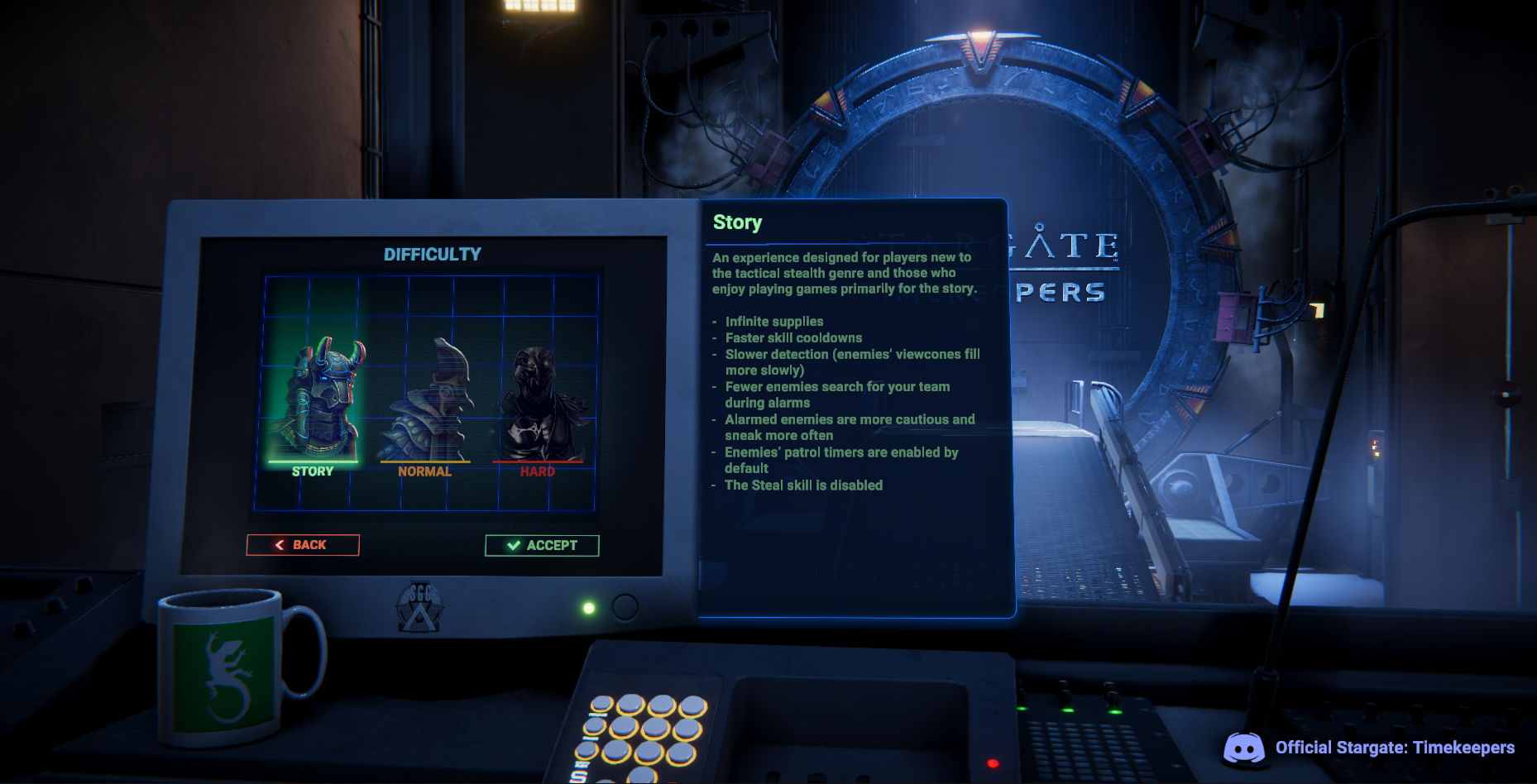
Fun fact from player psychology: players don't like to play on "easy" difficulty levels, so surprisingly, it took us a long time to choose the right word to name our lowest difficulty setting, ensuring it didn't sound discouraging in all the languages into which we translated the game.
Finally, the rewards for overcoming challenges must be meaningful and satisfying. Whether it's advancing the story, unlocking new abilities, or simply providing a display of visuals and sound, the reward must feel worth the effort. This positive reinforcement encourages players to persist through challenges and contributes significantly to the overall fun of the game.
We believe we've successfully delivered rewards to players in the right manner, providing them with satisfaction and a sense of achievement that are crucial for a positive gameplay experience. However, we've noticed that the penalties awaiting players who failed were too severe. The duration of alarms and the enemy's firepower are aspects we are currently examining. We want to implement adjustments that will allow players to more easily and quickly recover from troublesome situations in case of failure, rather than solely relying on reloading. This approach is part of our commitment to enhancing the gameplay experience and ensuring that it remains challenging yet fair and enjoyable.
Nobody likes waiting in the bushes, we hear you, we see you, and we're on it! Expect changes in the alarm duration in the upcoming patch.
In conclusion, designing a game that relies on trial and error while remaining fun and engaging is a complex task. It requires a deep understanding of player psychology and a careful calibration of game mechanics. When done right, it can lead to a deeply rewarding and memorable gaming experience that players will cherish and return to. Despite the fact that, of course, Stargate is not a game without flaws, we believe that we've succeeded in many of these aspects, and it can only get better from here.