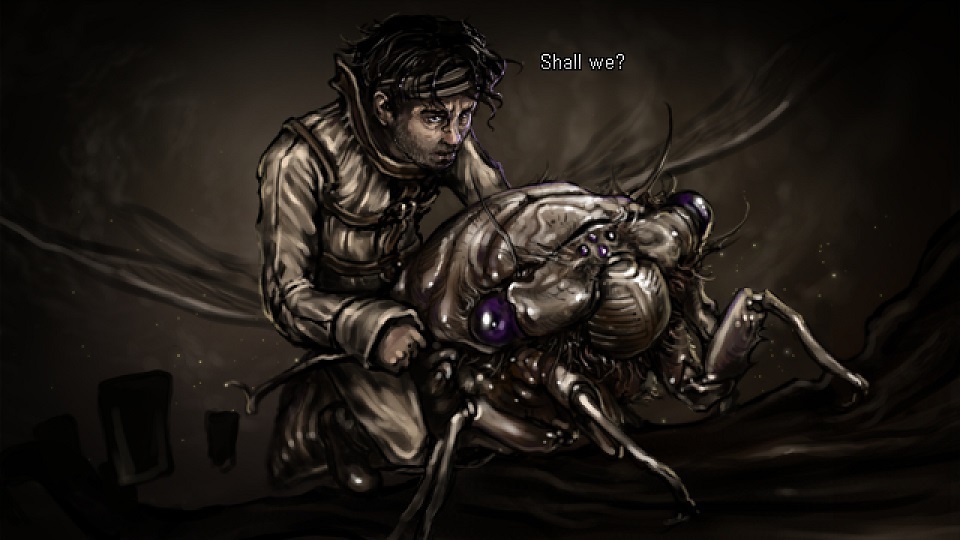
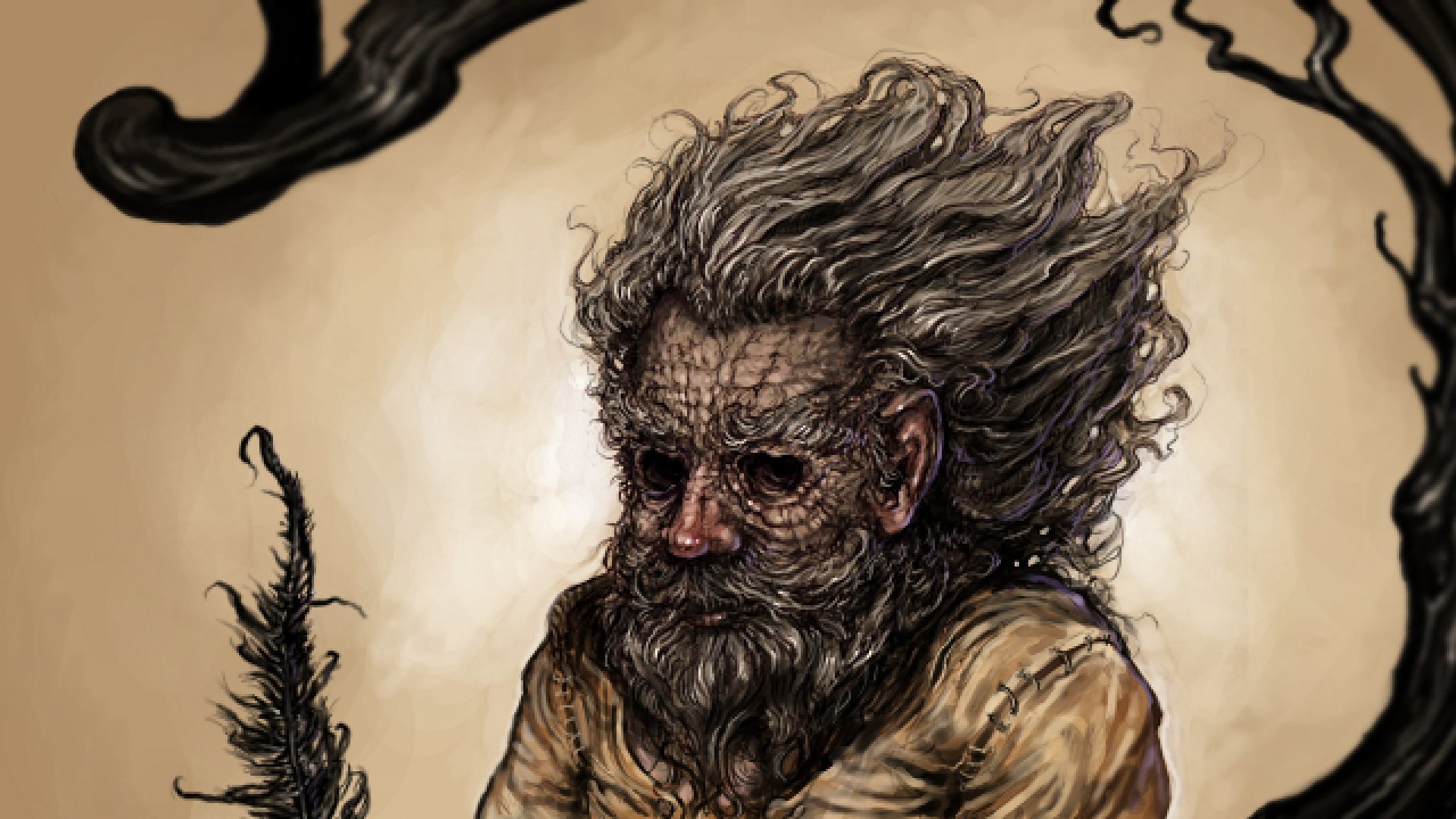
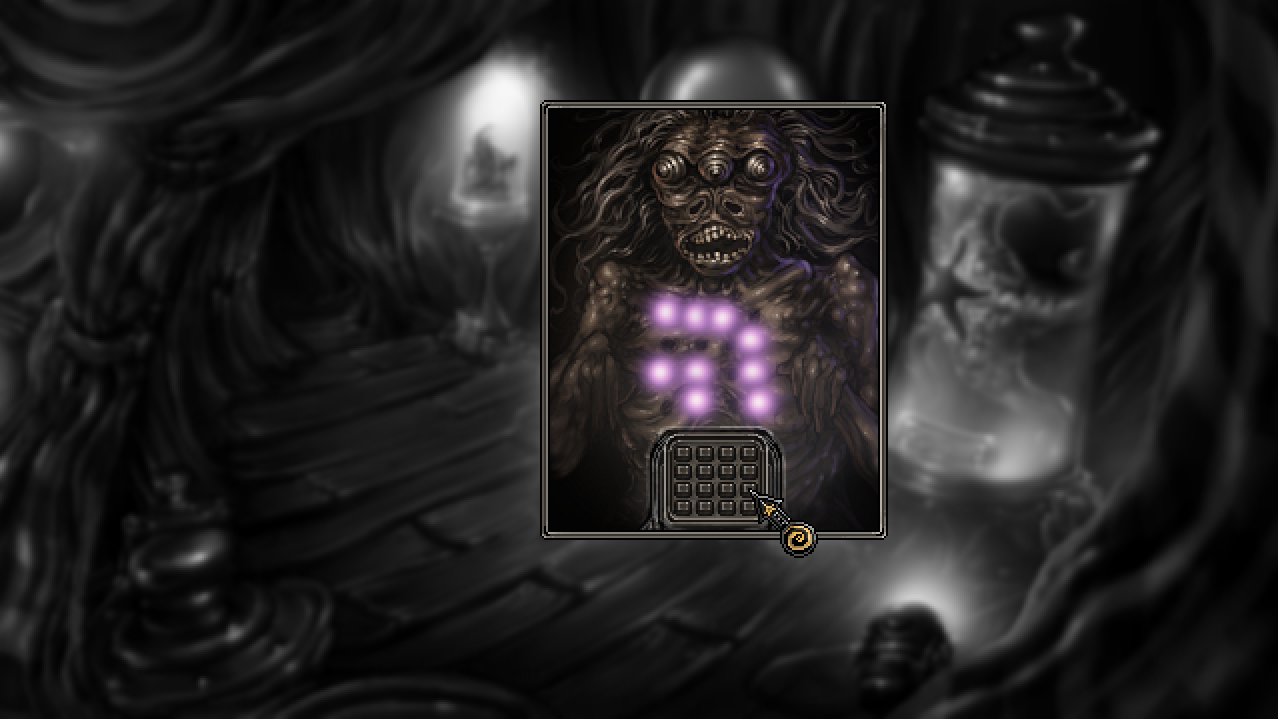
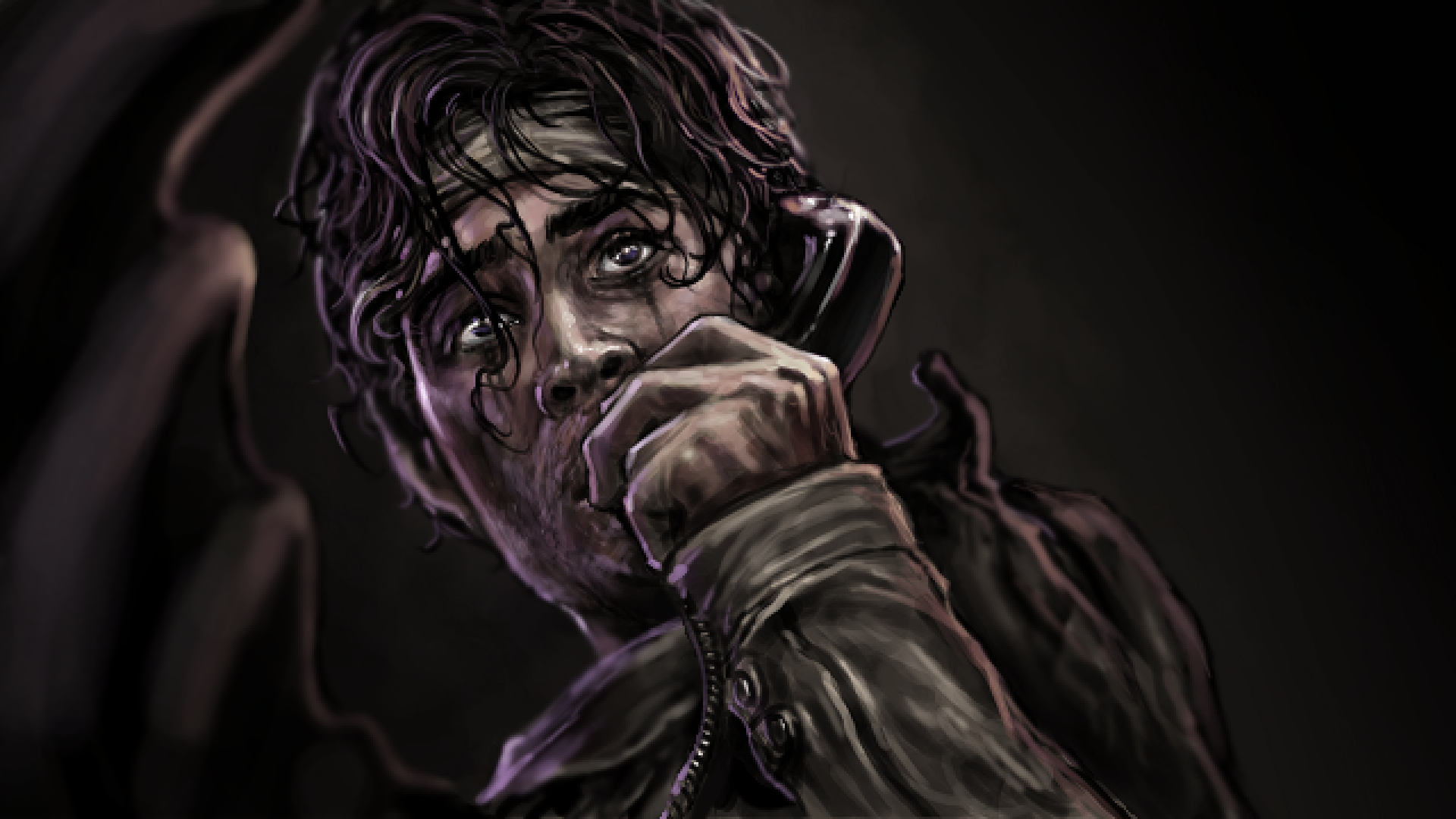
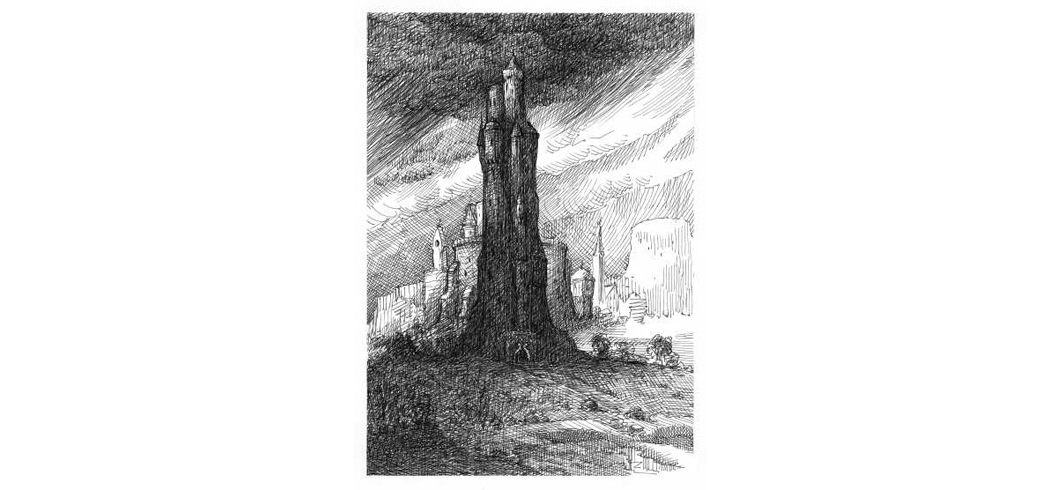
With the first couple launch weeks behind us, the whole team can look back with immense gratitude for everyone who has played Strangeland and supported our work. That support came in many forms: Twitch streams (a novelty since Primordia’s launch); social media chatter; reviews with generous praise and others with thoughtful criticism and most with some of both; detailed bug reports; and, most of all, your mere presence. To know that Strangeland has found an audience means the world to us. So, thank you, thank you, thank you to each and every one of you—and to those who were disappointed, our apologies on top of our thanks.
If you ever have any issues with Strangeland, or want to contact us for other reasons (even just to say hi), feel free to shoot an email to mark@wormwoodstudios.com (except that key requests are handled by the PR person hired by Wadjet Eye Games, so we cannot help on that). We try to respond to everything we get because, as the prior development diary said, the relationship between player and developer is an extremely important one to us.
With that said, though we’re all a little bleary-eyed with lack of sleep and frazzled from the stress of the game’s launch, we are now able to look ahead to the next steps for Strangeland and Wormwood Studios.
Translations
Strangeland has been blessed with a bunch of volunteer, passionate, brilliant translators who want to tackle the challenges of localizing its wordplay, metaphors, allusions, bad jokes, and tricky riddles. We were lucky enough to work with fan translators on Primordia too, and with them we were able to shepherd official Spanish, French, and German translations (and applaud an unofficial Russian translation). The translations for Strangeland are actually much more ambitious.
Currently on the table, in order of progress, are: Hungarian; German; Russian; French; Spanish; Vietnamese; and Japanese. Translating a game is a complicated process, however, and our experience with Primordia is that most translations that got started did not get finished. We are hopeful about these, but some of the languages involved (in particular Japanese) pose new technical challenges that we haven’t handled before. And, regardless, Strangeland’s script is a tricky one to translate. Thus, we can’t predict any release date(s), but we will keep you apprised as these move along.
Translations are incredibly important to me personally. I think it is fair to say that whatever is “lost in translation,” I found myself in translations—of books, games, movies, music, poems, and more, at every age of my life, from Babar to “The Nose,” from Dragon Warrior to The Lives of Others, from Los Ángeles Azules to The Divine Comedy, translated works are inseparable from my identity. So we are committed to helping those who want to translate our own games, even if it takes a ton of work and isn’t necessarily a money-making proposition.
Ports
While we will always be PC developers first and foremost, we want our games to reach the widest audience possible, so where it is possible to develop a faithful, enjoyable port of the game, we would like to do so. These ports also take time—not just to create, but to carefully test. Right now, we have an initial working Linux build of Strangeland, and we are looking at other ports as well. We hope to be able to announce these soon.
Future Projects
I’m not sure whether Fallen Gods, the RPG I’ve been developing for about a decade, constitutes a “past project” or a “future project.” But it continues to move forward, and now has a Steam page.
James Spanos, the coder of Primordia and Strangeland (“coder” really understates his integral role and leadership) and developer of Until I Have You, is working on a project called Carbon Flesh. Nothing to show on it yet.
Finally, Vic, James, and I also hope to collaborate on another project, but it is much earlier in the process.
Conclusion
None of this would be possible without you, the players. Strangeland was created through a partnership among Vic, James, and me; but its meaning comes from a partnership between us and you. So we’d like to end where we started: with thanks.
The Developer-Player Relationship
The right relationship between a developer and a game can be painful. However beautiful the vision a developer begins with, however ecstatic the momentum of its conception might be, the process of bringing it into some releasable state is one that entails hardening your heart and sharpening your critical eye. The developer must see what is wrong with the game and cut it away. Fault-finding is the ruin of any relationship, and so it goes with the relationship between a developer and a game. Ovid tells us that Pygmalion loved his sculpture; I doubt it, but even if he did, he brought her into being by setting a cutting edge to beautiful ivory, and the poem tells us that he began not with love but loathing. In the end, the game as released is the best you can make of it, and everywhere you look are the phantoms of the features you dreamed of but couldn’t incorporate and the ghosts of the flaws you fought against for so long. With Strangeland, I am very proud of what we are about to release—more proud and pleased than I was with Primordia at launch—but “complicated” is a generous word for the relationship.
The right relationship between a developer and a player, however, is sublime. Let me explain why. A game by its nature makes demands on players. I don’t mean in terms of the difficulty of its obstacles (though, as mentioned in a prior post, I think it is important that an adventure game challenge a player with puzzles). I mean something more basic. A commercial release demands a player’s: (1) attention; (2) hope; (3) time; and (4) money. Which of these resources is most valuable depends on the player; which of these prices is steepest depends on the game. With Strangeland, we are asking that out of a sea of beautiful games full of novel features and clever mechanics, you pay attention to our retro adventure game. We are asking that, despite having been burned by games that have bored you, frustrated you, even disgusted you, you push past your reservations and look for something beautiful and engaging in Strangeland. We are asking you to spend several hours searching for that beauty and engagement. And we want you to pay us, to the tune of $15 (no doubt from time to time with various discounts) for this work.
That is quite a list of demands! Who would ever accede to them? And why would they accede to them given the “complicated” way in which the developers themselves view the game they developed?
One approach to answering these questions is a contemptuous one that arises when business predominates over the creative spirit. One can engage in marketing psychoanalysis and decide that a player can be parted from great quantities of attention, hope, time, and money by, say, such-and-such advertising hook to reel them in (appealing to the will to domination or lust or whatever) followed by a Skinner-box design, micro-transactions, and the like. This is a literally obscene way of viewing the player-developer relationship—one in which contempt and commercial interests override love and passion.
So let me offer another, more hopeful answer, born from having read literally thousands of player reviews (overwhelmingly positive but sometimes negative, sometimes very negative) for Primordia and other games I’ve worked on. Players love games. They are passionate about games. That is so in substantial part because gaming has always been about community: communities among players, and communities between players, developers, and critics—categories that are extremely fluid. Players want to incorporate new games into those communities, and create new communities around those games.
Players love games so much that they are shockingly willing to forgive flaws, forget disappointments, and look with hope and generosity upon the very same product that developers have spent years looking at with a critical eye. Of course, players also love games so much that they will rail at developers for breaches of trust (real or merely perceived); and at its worst, this beautiful love of games deforms into intolerable abuse, exclusion, and ugliness. But, on balance, it is a passion that has created a gigantic medium; entire subcultures; and countless opportunity for countless developers to pursue their dreams knowing that there is someone (indeed, many someones) waiting hopefully at the end of the long development road.
So what does the developer owe to the players who offer their attention, hope, time, and money so that the developer can pursue his dream?
Fundamentally, the answer is respect and reciprocity. A developer should always strive to offer back more than what the player puts in. Fun, joy, memories, beauty, engagement… there are many ways a game can repay a player, and it’s incumbent on us as developers to find those ways. For Wormwood Studios, the question is never how do you get more from the player and always how do you give more to the player. Of course, there are limits to the time, energy, resources, and skill that we can put into our products; but we always strive to do the best we can by our players. Players will likely never have the better of the bargain because to make a game and have it enthusiastically played by someone is such an extraordinary gift. But the goal of reciprocity means acknowledging that gift and trying to repay it as best you can. With Strangeland, wherever we could add some extra touch—an animation, an amusing interaction, an extra commentary track, another layer of polish—we’ve tried to do so. And whenever a player asks us for technical support or a hint or for some trivia about the game, we try to respond as quickly and as helpfully as we can.
Respect and reciprocity also mean designing the game’s systems with the player in mind, while staying true to the essential vision of the game. I don’t believe a game should pander to a player. But I do believe that a game should never exploit a player. With Strangeland, we have done our best to create game systems that minimize tedium like backtracking, repetition, and brute-force solutions, and maximize players’ ability to engage with the game meaningfully and easily. From the inventory to save systems to the layout of rooms to multiple puzzle solutions to an optional integrated hint system, we’ve tried to focus the game on the fun and challenge of puzzle-solving, exploration, and discovery, while eliminating frustrations and grind.
Next, respect and reciprocity mean acknowledging when you fall short as a developer. It was my view with Primordia, and it is my view with Strangeland, that a player disappointed by the game has been failed by the game and thus by the developer. We did not make Strangeland because someone asked us to make it. We made it for ourselves, and then asked you, the players, to play it. Having asked the players to trek to our game, we damned well better make it worth your while. For some players, unfortunately, it won’t be. When that happens, the fault is ours: we persuaded someone to spend that attention, hope, time, and money on us, and it turned out to be a raw deal. So when a player is unsatisfied, the least thing owed is an apology. It is certainly not the player’s fault that he or she didn’t like the game. Even if a developer thinks a player is playing a game “the wrong way” and is thus not getting it, that itself is a sign that the designer failed to reach the player. So, let us apologize in advance for the flaws we didn’t spot or couldn’t fix.
Finally, respect and reciprocity mean gratitude. There has been no greater joy for us as developers than to see Primordia not with our own eyes—grown bleary and jaded with fault-finding—but with your eyes, the eyes of hopeful, attentive, loving players who, irrationally and exuberantly, threw themselves into a post-apocalyptic wasteland devoid of life. Behind those eyes was the whole beautiful range of human backgrounds from all around the world and all walks of life, each player seeing with a unique and valuable perspective that somehow found something worthwhile in our project. You made a community around Primordia, and made us a part of it.
Now, after many, many years, we are two weeks away from being able to see Strangeland through your eyes. Whether or not you like what you see, we are grateful for you entering its nightmarish carnival and spending your precious time on our dream.
Fondly, respectfully,
Mark, Vic, and James
The Power of Puzzles
An adventure game mixes story and puzzles. There are puzzle games that don’t have stories, and interactive stories that don’t have puzzles, and such games can be masterful and beloved. But they aren’t, in my usage, adventure games.
Puzzles in adventures have gotten something of a bad rap over the years, in part because they are seen as obstructing the story. This image of adventure games is one in which there are story segments (dialogues and cutscenes) and puzzle segments (exploring, collecting and combining items, solving riddles, cracking codes, etc.), and they trade off in sequence. If the story is engaging and the puzzles are frustrating, this is a little bit like the experience of web browsing where before you can read the article you’re looking for, you first have to prove you’re not a robot by clicking on stoplights or parsing a hard-to-read CAPTCHA, or like playing some “free” mobile game in which interactive advertisements routinely interrupt your experience.
But in an ideal adventure game, puzzles and stories are not separate segments at all; they are marbled or melded—the puzzles reveal both the setting and the protagonist to the player. Of each puzzle, you can say: “Because such-and-such is true of this setting, this puzzle is here.” And of each solution, you can say: “Because the protagonist has this quality, he can overcome the puzzle this way.” Unavailable solutions can also reveal the protagonist, the way that negative space can reveal a subject’s form: “Because the protagonist has this quality (or lacks that quality), he cannot overcome the puzzle that way.” If nothing else, an adventure game story should be a story about a protagonist who solves puzzles—otherwise, there will be an inevitable incongruity (“ludonarrative dissonance” in the jargon) between what the player is being told about his character (say, a hard-bitten solider) and what the game is actually revealing about the character (that he scavenges garbage, serves as a gofer for strangers, and favors eccentric, indirect solutions).
In Primordia, our protagonist was a scavenger robot aspiring to pacifism, and the world was a crumbling dystopia. Horatio viewed any salvageable piece of machinery as worth saving because his survival depended on cobbling those pieces together into a home, a companion, and a means of escape. The world’s treasures were locked away because anything not locked away had long since been plundered or destroyed; the world’s inhabitants were eccentric, reclusive, and wary of strangers because a post-apocalyptic world is not conducive to normalcy or trust. While some of Primordia’s puzzles are not well-integrated—they violate the consistency of the world or its characters for the sake of presenting the player another obstacle—I think by and large we did a good job of revealing Horatio and his environment through the gameplay and not merely through exposition. Strangeland is a psychological horror game. The obstacles the Stranger faces are expressions of fear, regret, and remorse. As I mentioned in a prior development diary entry, the game’s genesis was the death of my grandparents—in particular, processing the way my engineer grandfather had tried to “solve” the puzzle of my grandmother’s dementia. The Stranger’s attempts to solve the carnival’s puzzles reflect that same desperate belief that tragedy is a riddle with an answer, that grief is a cage to be escaped with the right key. The unnatural obstacles in the game can be solved by means that express both naivety and guilt: memory, pain, and metamorphosis are the means the Stranger will use to advance, though those methods will be embodied in particular tools (a dagger; a noose; a note; etc.) with symbolic significance.
Most of what the player will learn about the Stranger and Strangeland (and about the underlying tragedy that is the impetus for this nightmare) is revealed through the puzzles and their solutions. Because the puzzles generally have multiple solutions, the player’s course through the game will not only reveal but define the Stranger in subtle ways.
If adventure game puzzles only conveyed the game’s story, that would be enough. But I firmly believe that the puzzles have a second great significance: permitting the moment of kinship between player and designer, and between one player and another, that comes from solving those puzzles. It is customary to praise sensible puzzles as “logical” and to criticize inscrutable puzzles as suffering from “moon logic.” I think this is a bit off. Very few puzzles adhere to formal logic. When we say a puzzle is “logical,” what we really mean is that we understood the rules that governed it, and were able to figure out how to employ those rules to solve it. That means puzzles are really about communication: the designer is speaking to the player (through visual cues, quips, failure messages, etc.) and trying to explain the rules. Such communication requires a shared language. But even a shared language doesn’t ensure communication—as any number of spats attest.
As a kid growing up in Washington, D.C., I had a lot of international classmates whose parents had immigrated or worked at the various embassies. My family became good friends with an Australian family whose three sons were particularly bright. But one spelling test, the youngest son missed what the teacher felt was an obvious word: he had, inexplicably, written “urb” in lieu of “herb.” The teacher demanded an explanation. “I thought it was some kind of slang for a city,” he answered. The teacher wrote the correct spelling on the blackboard. “But that’s herb!” Davie protested, pronouncing the H.
So too with puzzle “logic.” Every designer has his or her own dialect and accent, not to mention idioms and tics. Every player has the same. Even when we share a language, even when we’ve learned that language from the same canonical works, we all speak it in our own way. Part of game development is figuring out how to account for this. We’ve had a months-long iterative dialogue with dozens of testers, broadening the ways we communicate to the player and expanding the number of possible solutions and the means by which the player can be nudged along. But still! The poor designer asks: “I’m thinking of an animal that is gray, has big ears, and a short tail; it lives in dry climates and can move at over 20 miles an hour.” The poor player answers: “A jackrabbit!” The poor elephant hangs his head.
For all these potential miscommunications, however, there is the sublime moment when the player and designer at last develop a common tongue. The player reads the game’s cues in the manner the developer intended; the game parses the player’s inputs in the way the player intended; and suddenly, “moon logic” gives way to a moon landing. We have bridged that gulf between two minds and received the greatest of validations: We are understood!
That eureka moment has always drawn me to adventure games as a player: the feeling of an earned kinship with the designer and other players alike. And it matters even more to me as a developer. As I’ve said before, the core value that I hope to convey in the games I design is humanism, and part of the humanistic project is building bridges. More than any other success, the most gratifying part of game development is when we forge a connection with a player, whether through the game’s themes, its art, or its puzzles. And the very best connections combine all of that: a puzzle expressing the game’s theme is solved in a manner that reveals the protagonist’s character and is understood by the player because we’ve achieved a common language. In that moment, there is a unity between player, designer, and character, one that is peculiar to the enduring genre of adventure games.
Why Horror?
Like many kids, I devoured Greek mythology—starting with a children’s Odyssey and D’Aulaires’ Greek Myths, and slowly working my way up to Edith Hamilton. Somewhere along the way (probably Hamilton), I came across various divine epithets, and I remember puzzling over “Phoebus Apollo.” Was this an alternate spelling of “phobos”? Of course it was not. It just happened that “bright” and “fear” were near lookalikes. And why shouldn’t they be? Was that not the nature of divinity: awful and awesome brilliance, memorably captured at the end of Indiana Jones and the Raiders of the Lost Ark?
We’re hardwired to fear the dark, of course, not the light. H.P. Lovecraft famously wrote that the oldest feeling is fear and the oldest fear is fear of the unknown—and primordial night was one vast unknown. That kind of absolute unbounded darkness is very hard to find now because of the bright lights of civilization. But I’ve come across it, and it’s deeply unsettling.
Once, driving on a country road in the night, I pulled onto the shoulder to look up at the stars. I turned off the engine and the headlights. For an instant, the beauty of the Milky Way and the clarity of the constellations were breathtaking. And then, suddenly, as I drowned in the darkness, there was a different kind of breathlessness. I became utterly convinced that a car would emerge from nowhere, swerve off the road, and run me over. Madness. I hadn’t seen another car in hours. I was convinced my own car wouldn’t start. Madness. That walking back to it, I would fall off a cliff. Madness. As I sank further into the darkness a thousand deaths swam up from the depths. Finally, trembling so hard I could barely manage the ignition, I got the car started and pulled back onto the road, safe under the blanket with the flashlight on, safe on a narrow spit of solid ground in the roiling sea of shadows. But as terrifying as the dark is, there is a horror in light, too—not for nothing do will-o-wisps and eerie phosphorescence and glowing eyes and colors out of space haunt so many scary stories. And more horrifying still, I think, is that unnatural blue light of the airplane bathroom mirror, the light beneath which all our ugly flaws are revealed. Phoebus. Phobos.
There are plenty of scary experiences that are not, strictly speaking, horror. We have perfectly rational fears, and even irrational fears that are nevertheless responsive to some external stimulus (“phobia,” again). For me, horror is not that. It entails a looking inward: shining that blue light into the darkest recesses of our minds. The story, the film, the painting, the poem, the game—whatever the medium of horror—serves as the guide. We’re not losing ourselves in the tale; rather, the tale is leading us, Virgil-like, on a journey into the hell of our own psyche. In Stephen King’s IT, what terrifies me is not Pennywise (there are plenty of things to worry about in life, but alien spider clowns are not among them), but my own memories of childhood vulnerability and isolation onto which King shines his “deadlights.” King holds up a carnivalesque airplane mirror and compels us to look. Strangeland’s themes can be developed best through the medium of horror. Other genres are certainly well suited to depicting loss (losing another; losing oneself) and rediscovery. But they come at the problem more obliquely. For my dollar, fantastical horror has the benefit of letting you come at those feelings head-on, to give them their full enormity. Grief can have a quiet dignity, but when I have grieved, any such quiet dignity is purely external, like an inverted eye of a storm. Whatever the outward calm, hurricane winds of annihilating force are blowing inside. Horror permits those internal states to be given external expression.
No one can express those states with more awful and awesome brilliance than Victor Pflug. His works are steeped in allusion and imagery, and every organic and inorganic form he depicts oozes suffering. From a decade of working together, I don’t know any longer where my symbols stop and his begin; our once-separate imageries have emulsified. Vic is an excellent guide in the journey through horror because he knows its landscape so well; he’s like a mountain man of the mountains of madness. But that horrific journey, at least in the case of Strangeland, is not one where you are left stranded in some slough of despond. For me, there is a different kind of light that is as emblematic of horror as the harsh blue light, and that is the warm glow of the campfire, the living room, and the sunrise. To be sure, there are some horrors that do not end—in life as in literature. But my favorites are those that do; the tales that lead you on a journey down into darkness only to emerge in the end into the light, less afraid and with more self-knowledge. Both Vic and James Spanos have brought that warm light to Strangeland, visually and aurally.
I hope you let us guide you on that journey. We have found Strangeland a rewarding place to explore as we created it, and perhaps you will find it the same when you visit.
Wadjet Eye Games Publishing Strangeland
We are delighted to announce that Wadjet Eye Games is publishing Strangeland. Many years in the making, Strangeland is a “cabinet of curiosities” comprising the striking memories and bizarre visions that Victor Pflug (artist) and I (Mark Yohalem, writer/designer) have gathered over our lives. That cabinet has been built with thousands of hours of care by Dimitrios Thanasias-Spanos (coder).
Put otherwise, and as our last update probably indicated, Strangeland is as personal a game as I can imagine making. I spent the last weeks annotating its more obscure references, and realized it really is a map from my childhood wonders and fears to adulthood’s responsibility, regret, and recognition. I know Vic drew deeply from the well of his own personal experiences. Further, Dimitrios has achieved things with the engine (Adventure Game Studio) that no one has ever done before, allowing Vic’s surreal imagery to come to life in smooth and seamless way, and he has done through by throwing all of himself into the game’s development.
Given all the toil and anguish that went into making it, there’s no one we’d be more comfortable entrusting the game’s publication to than WEG. Our collaboration on Primordia was not just a business relationship, but a friendship and creative partnership. Dave Gilbert is second to none in directing voice acting, and WEG has earned a well-deserved reputation for releasing thoughtful games that hearken back to the classics while presenting innovations in setting, design, and narrative. We are proud that Primordia is a part of that legacy, and we are excited that Strangeland will be part of it, too.
Bradbury, Goya, and Peake
The seed of Strangeland’s narrative was sadness, and the soil in which it fell included the works of Mervyn Peake, Francisco Goya, and Ray Bradbury.
In the fall of 2016, my grandmother—who had been an anthropologist and in retirement became a genealogist—died after many years of suffering from dementia. Two weeks later, her husband, my step-grandfather, died as well. He had been a NASA engineer; it was he who got me my first computer in the early 1980s and taught me to program on it. The last years of their lives together were consumed by her illness and his vain attempts to design or divine some solution for it.
They had asked that I see that their belongings were properly distributed among the family, so after their funeral, I spent the rest of the day going through their small apartment, figuring out what should be sent to whom. Dementia deletes the world from the self and the self from the world. And a parallel physical deletion had happened as my grandparents had grown old and had moved into smaller and smaller lodgings, culminating in a little one-bedroom apartment and a tiny hospice room. The objects that remained were physical tokens of their most treasured memories: a box of slides from a trip to the Shetland Islands; a flag that had orbited the earth aboard the space shuttle; a family tree stretching back hundreds of years; a Western Union telegram calling my grandfather up for service in the Korean War; the beloved books of an anthropologist and an engineer; a bronzed baby shoe—dozens of such souvenirs of their trip through life. And of course all the pills, schedules, instructions, and plans that were the debris of the long defeats they both had suffered at the hands of illness.
Strangeland began as a way for me to process the sadness I felt about the whole situation. What it means to watch the slow-motion destruction of someone you love, thinking you can save her, but not being able to. The danger of seeing life as a series of puzzles to be solved. The way love can drag you down as well as lift you up. And also just the odd truth that if you dissected any one of us, you would find so many marvelous things. It’s not like my grandparents were more special than everyone else. Their adventures, quirks, relics—everyone has an allotment of those, a lifetime of eccentric knowledge and unique experiences. What would it be like to navigate those facets of another person? What would it be like to be burgled of those treasures by time and disease?
For me, the development of a game depends upon raiding my own stock of treasures and finding the right pieces, kept from other beloved games, books, movies, art, and experiences, that can be put together into the shape I’m imagining. The loss of my grandparents was a piece with particularly jagged edges, but I found they fit well with three sets of works that had long been important to me.
“In the presence of real tragedy you feel neither pain nor joy nor hatred, only a sense of enormous space and time suspended, the great doors open to black eternity, the rising across the terrible field of that last enormous, unanswerable question.” - Mervyn Peake, Titus Groan
As Victor, James, and I began discussing Strangeland, the first piece I took was from Mervyn Peake’s Gormenghast series. Anyone who has read it knows that the titular castle is as much the central “character” as its nominal protagonist Titus. (Consider the first of its features encountered by the reader: the Tower of Flint, “patched unevenly with black ivy, arising like a mutilated finger from among the fists of knuckled masonry and pointed blasphemously at heaven. At night the owls made of it an echoing throat; by day it stood voiceless and cast its long shadow.”) I wanted our setting, like Gormenghast, to have a personality, so that in exploring the place, players will feel—as I did in exploring my grandparents’ apartment—that they are exploring the imprint of its inhabitants.
“The world is a masquerade. Faces, costumes, voices—all pretend. We all wish to appear as we are not, we deceive ourselves, and in the end, we do not even recognize ourselves.” - Francisco José de Goya y Lucientes, Los Caprichos (6)
The next treasure from my trove came from Francisco Goya, whose art I studied while living in Madrid 20 years ago. In college, I wrote (though never released) a mid-length work of interactive fiction in which the player visited a gallery of a pseudo-Goya’s works and discovered he could (and indeed must) enter those works and engage in various adventures within them. The force Goya exerted on me has, if anything, grown over the intervening time. It is not just specific paintings (such as the famous image of Saturn devouring his child), but the overall mood and mentality of his work as a whole. The distillation is, for me, Los Caprichos—a series of captioned etchings that convey the way in which supernatural horror springs from the everyday misery that is all around us. The characters of Strangeland are a blend of Gormenghast’s eccentric weirdos and Los Caprichos’s grotesque “ordinary folk.”
“He expected me to stay with the family to mourn, but I got out of the car anyway and I ran down the hill toward the carnival. It didn’t occur to me at the time, but I was running away from death, wasn’t I?” - Ray Bradbury, as interviewed in “Mr. Electrico”
Finally, when Victor suggested a carnival for the setting, my mind naturally turned to Ray Bradbury, the great humanist of science fiction, who came time and again to the theme of carnivals (most famously in Something Wicked This Way Comes). With Bradbury, uncanniness and horror are used in service of a fundamental decency: to show us the humanity in what seems “freakish” and the freakish inhumanity that can fester inside anyone, no matter how outwardly conforming. That moral compass (albeit in the hands of a much less able navigator than Bradbury!) was something for me to use here, too.
To be clear, these aren’t the only influences or even the main influences on Strangeland. We found inspiration in games like Sanitarium and Weird Dreams, shows and movies like The Prisoner and Eraserhead, religious and mythological works, etc. The work of creating Strangeland is weaving all these disparate strands into something that holds together—and more important, is satisfying, fun, and fresh as a game.
The seed of Strangeland was sadness, but it blossomed into hopes, among which is the hope that we will find a way to share the souvenirs the three of us have treasured from our own trips through life.
I’ll end with a poem from my great-aunt, whose “Inheritors” was such an inspiration for Primordia. A lifelong beachcomber (literally and metaphorically), she describes a similar hope... that the collector might herself undergo a sea-change and yield a treasure for someone else to collect:
Last Will
Sea, sky and sand, Remember me, Beloved three, Be kind to me; I loved you defenselessly. Eternal, primeval, Holy trinity, Wash, shrive and use me, Tenderly; I was your creature when I was alive. Master makers of jeweled toys, Shape me and shine me into a sea prize Found by a boy’s Quick eyes in glad surprise. Sea, sky and sand, Let me one day A small child’s happy summer memory.