It’s no secret we take inspiration from the classic era of survival horror, developed mostly in the PS1 and PS2 days. Even then, that’s still a very broad range of games.
Both Resident Evil and Silent Hill are survival horror games after all, while being very different experiences. That’s not to mention games like Obscure, Fatal Frame, Rule of Rose, Haunting Ground and many others which all added their own spin on the genre during those formative years.
So, perhaps a better question is: What does survival horror mean to Summerford?
[previewyoutube="PL1jNyJUqjA;full"]
Fixed Perspective Cameras (With some updates)
While the triple-A world has moved on, this classic visual identity of older survival horror is a large part of Summerford. Using fixed perspective cameras affects the design of Summerford at every level, from combat to controls, but even this linchpin of classic survival horror isn’t quite as simple as using one single method.
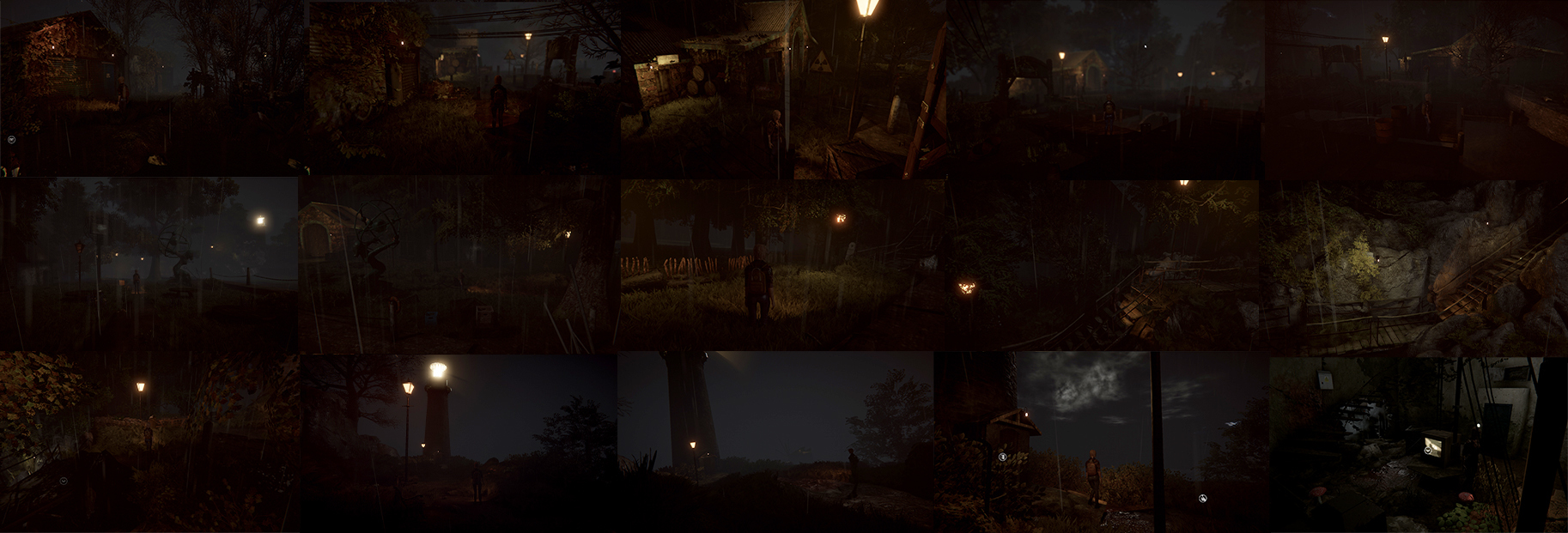
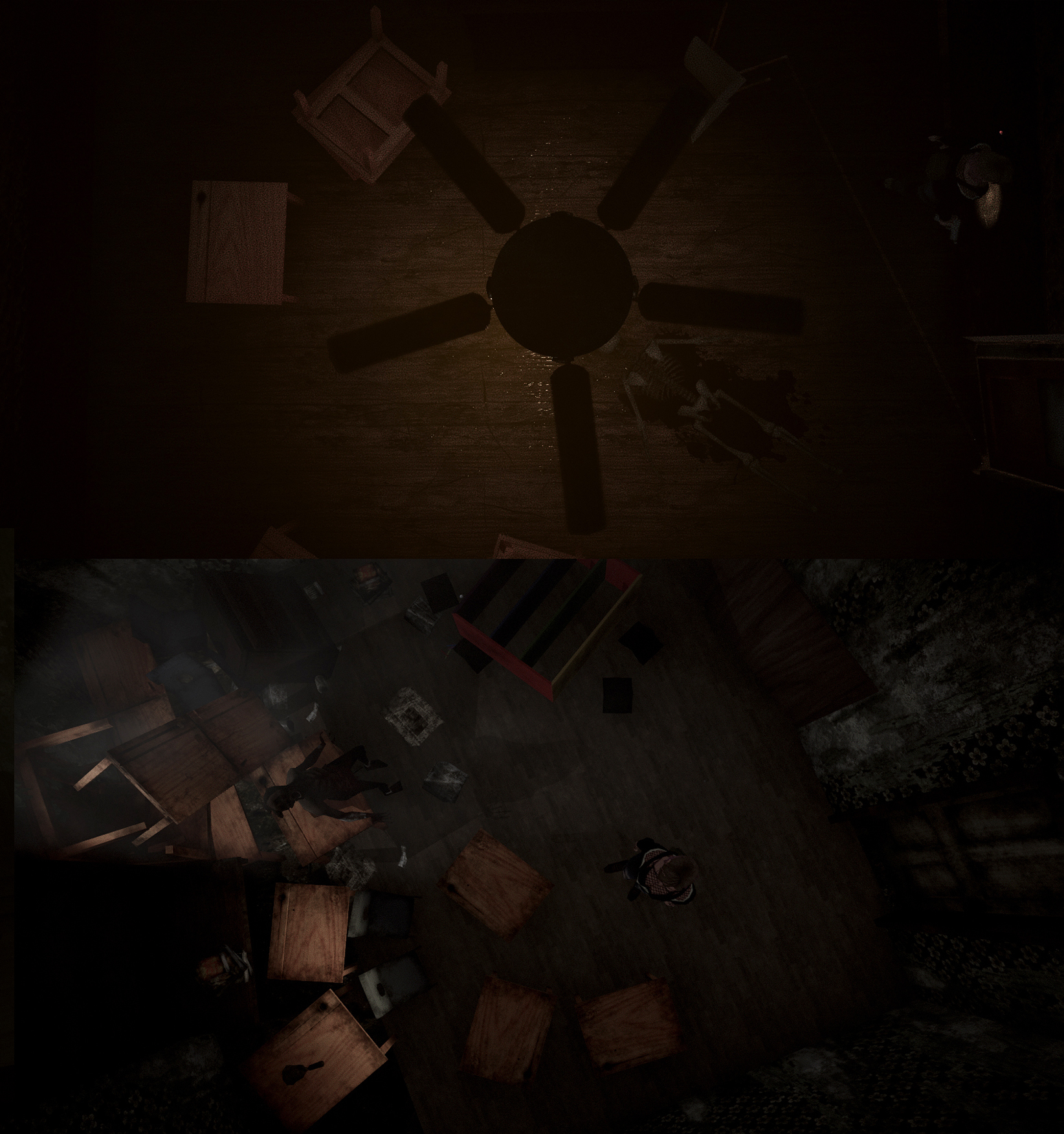
Here's an example of some of the shots we use in the earliest area of the game. Not all of these are static!
The classic Resident Evil games used fixed perspective cameras throughout, but even the earliest Silent Hill games used a mixture of different cameras, tracking shots and a variety of other effects to both aid and disorientate the player.
Summerford definitely leans closer to Silent Hill in this regard - it’s one of the advantages of making a game in full 3D, rather than using pre-rendered backgrounds. Not only does it add some life to the world, it means that larger outdoors areas and long, tighter indoor spaces can flow more naturally without needing to change cameras (and often, player direction) too quickly.
It gives you a great deal of flexibility in using cameras for tension too. A good example of this is how Silent Hill moves from an almost over the shoulder, wider perspective in the town itself, where the player needs to move and navigate faster, to closer and often static shots while indoors.
We’re constantly looking at ways to use our cameras like this; not just as ‘rooms’ to point players to an objective, but also as instruments of adding or relieving tension, and providing a different perspective on already visited environments.
We can approach our areas not just in terms of graphics and mechanics, but cinematography, too. It may have started as a technical limitation in the original Resi games, but it can produce a filmic look that’s really quite unique to this particular method.
A Combat Philosophy
Combat is possibly the biggest balancing act for Summerford. Put too much emphasis on combat, and continually escalate that combat throughout the game, and you can make the player feel invincible, removing threat and tension.
Put in too little or avoid combat entirely, and you either risk removing threat and tension completely. Of course, you can supplement with other mechanics, such as the stealth and sanity of games like Soma and Amnesia, but Summerford was never going to be a stealth game, so we’re looking for a middle ground.
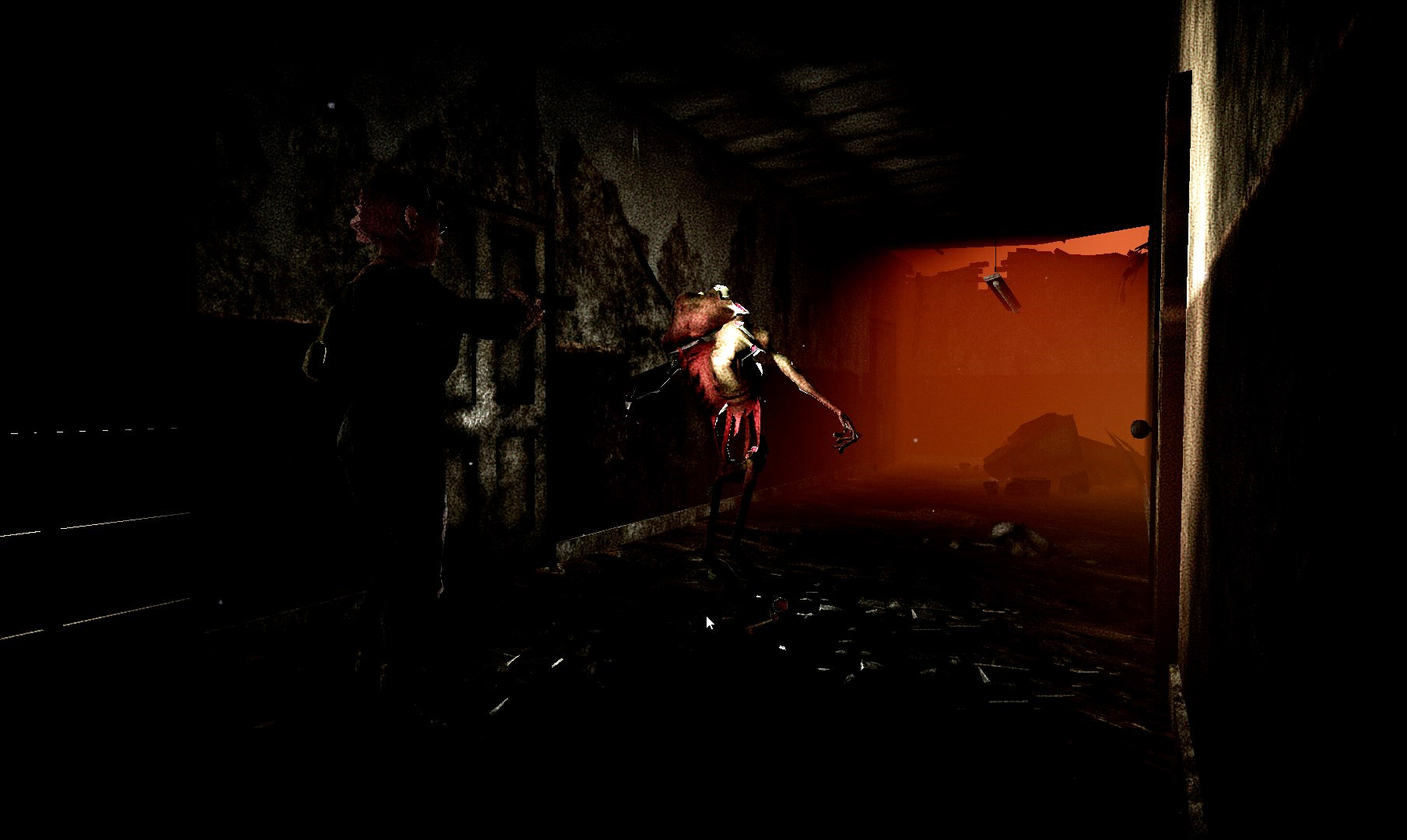
Not much to show off here yet, though we have been working on a more grown-up and darker version of the original basic enemy:
We want to treat combat like an elaborate, game-long puzzle. For us, combat in a survival horror game needs to always present difficult decisions and always focus on risk and reward.
Another way of looking at is to say it’s about ‘surviving’ odds rather than ‘overcoming’ them. To do this, we want to place more emphasis on preparation than action.
In that sense, our combat is more likely to ask questions like “Is taking this shortcut going to be worth the risk to my health?” or “When is it going to be worth using this item, and do I know where to find more?”
Moving the emphasis to preparation and resource management and away from the actual moment-to-moment fights of any given encounter gives the player more agency, without making the player seem overpowered or too capable of facing the horror in the game.
Thanks for reading!
Next time we’ll talk a bit more about some of the things we’re not going to be borrowing from the classics, and why we think some classic design mechanics are best left in the past.
Summerford Dev Log #8 - We're back!
We’re alive! It’s been five (!) months since our last post but we have been working, I swear.
Well, we’ve been mostly working, I did have three weeks off to get married and go on my honeymoon, and Dan and Sarah have moved house into the English countryside, literally in the middle of the woods. This, along with the shorter and colder days, has certainly lent a more Summerford vibe to our surroundings!
Also on a side note the dev blogs are a bit messy on Steam. Steam refuses to let us delete duplicates or rename anything right now, but hopefully that will be fixed soon. Rest assured, this is definitely dev blog #8.
Lighting and Atmosphere Overhaul
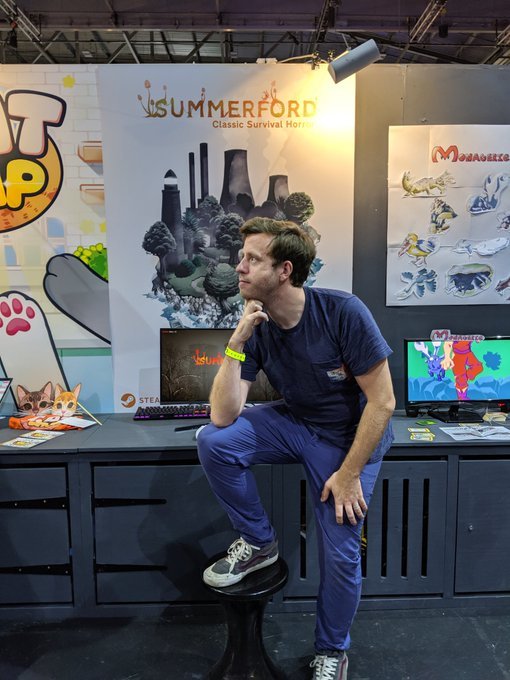
Rather than jump into exactly what we’re working on now, I thought a quick catch up on our last blog would make more sense. We’ve spent a long time polishing the early areas of the game, partly for our own sanity, but mostly for our trip to EGX in October. Here’s a picture of me looking cool that Dan took on the third day:
The biggest change is really a complete visual overhaul in those areas in terms of cameras, lighting and atmosphere. As far as outside areas are concerned at least, I’m really pleased by how everything is coming together. The game now has a more consistent, muted colour palette, and we’ve managed to get things like fog where we want them. We’ve now got a more oppressive atmosphere that feels a little more "unique".
UI Overhaul
One of things about making a game inspired by older titles like the original Silent Hill, Resident Evil and Alone in the Dark is that you have to decide where you want to adhere to retro design philosophies and where it’s best to modernise in order to make a game that's more playable in 2020.
One of those decisions was made during EGX this year, as we watched people play the game: we don’t really want people having to ‘search’ for things they can interact with. In most older survival horror games you’d be running around pressing X on everything to find out if you could pick it up, or get clues, or open doors.
This really isn’t that enjoyable for most players, and hunting for missing objects is never great for the pacing of a horror title. We’ve taken some cues from more modern adventure games like the Telltale series, and the Resident Evil 2 Remake, to come up with a UI system that highlights interactable objects. It looks like this:
[previewyoutube="WoTlUbkQIaE;full"]
In order to achieve a good balance of accessibility and not clutter up the UI, we fade icons out as the player moves away from them. Different items can be faded at different ranges, so we can keep critical items on the screen for a little longer, while more obvious things like doors won't show up until you're closer to them. The goal is to make this whole system optional, too, so if you do want to play without any hints, it'll be possible!
That's it for this week - we're currently working on one of the the main Summerford village areas, but I'll talk more about those next time.
Thanks for reading!
Summerford Dev Log - Week 8
Hello. It’s been a few weeks, including a pretty disastrous week last week where between sickness, funerals and business stuff getting in the way, we managed to get something close to two days to sit down and actually work on the game.
Third Person Camera and Outside Lighting
After much messing around with third person cameras and the open world areas of the game, we’ve made another big decision to return to fixed perspective for the entire game, and instead focus on making our fixed cameras more ‘dynamic’ feeling and varied.
This means things like slightly tracking the player or moving to a follow position for small sections. This is the style used in the Resident Evil 1 Remake, and in many PS2 era survival horrors.
We’ve made this decision because it allows us to deliver a more focused and polished final game. It’s not too hard to make small, confined third person sections, but making larger areas that all fully connect is a a big challenge.
It doesn’t just mean more assets and development time, it means we start to lose the ‘feel’ of a survival horror game and have to start working in more mechanics to fix design problems.
We’ve also been looking at what sort of ‘feel’ we’re going for outside areas in terms of lighting. The easiest genre solution is, of course, horrors best friend: fog.
However, simply adding a bunch of fog to an environment is as likely to make it washed out and confusing to navigate as it it is to make it creepy.
We also don’t want the game to simply end up looking like a Silent Hill copy. Those classics are our inspiration but we don't simply want to copy them, especially when it comes to setting.
We’ve found a fairly simple solution to this - we’ll be setting the game at night, and during heavy rain. It’s still a genre trope, for sure, but it’s one that’s a lot more fitting to our own setting.
While it’s a myth that it’s always raining in England (We’re actually only the 72nd wettest country in the world), it does let us present a darker, bleaker environment while still allowing for easier navigation.
Spoiler Gap!
Spoiler Gap!
Spoilers: Dock and Church
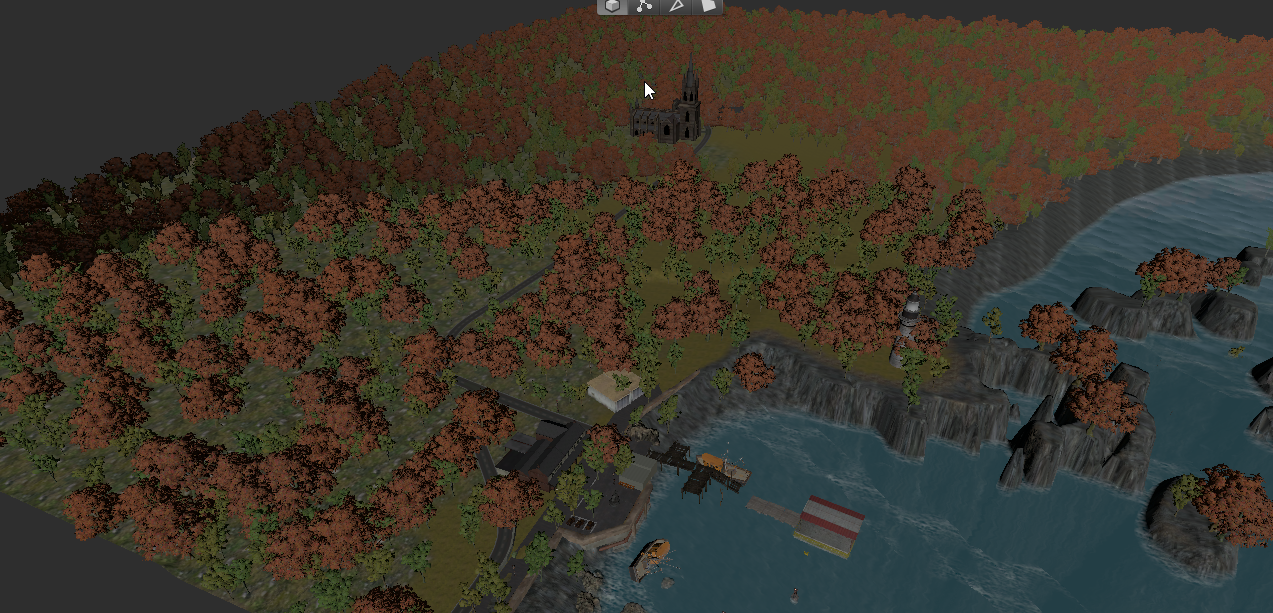
We’ve had to backtrack on some of the work on these areas due the above, though luckily we didn’t get too far along with third person work, and the main layout of the areas aren’t changing:
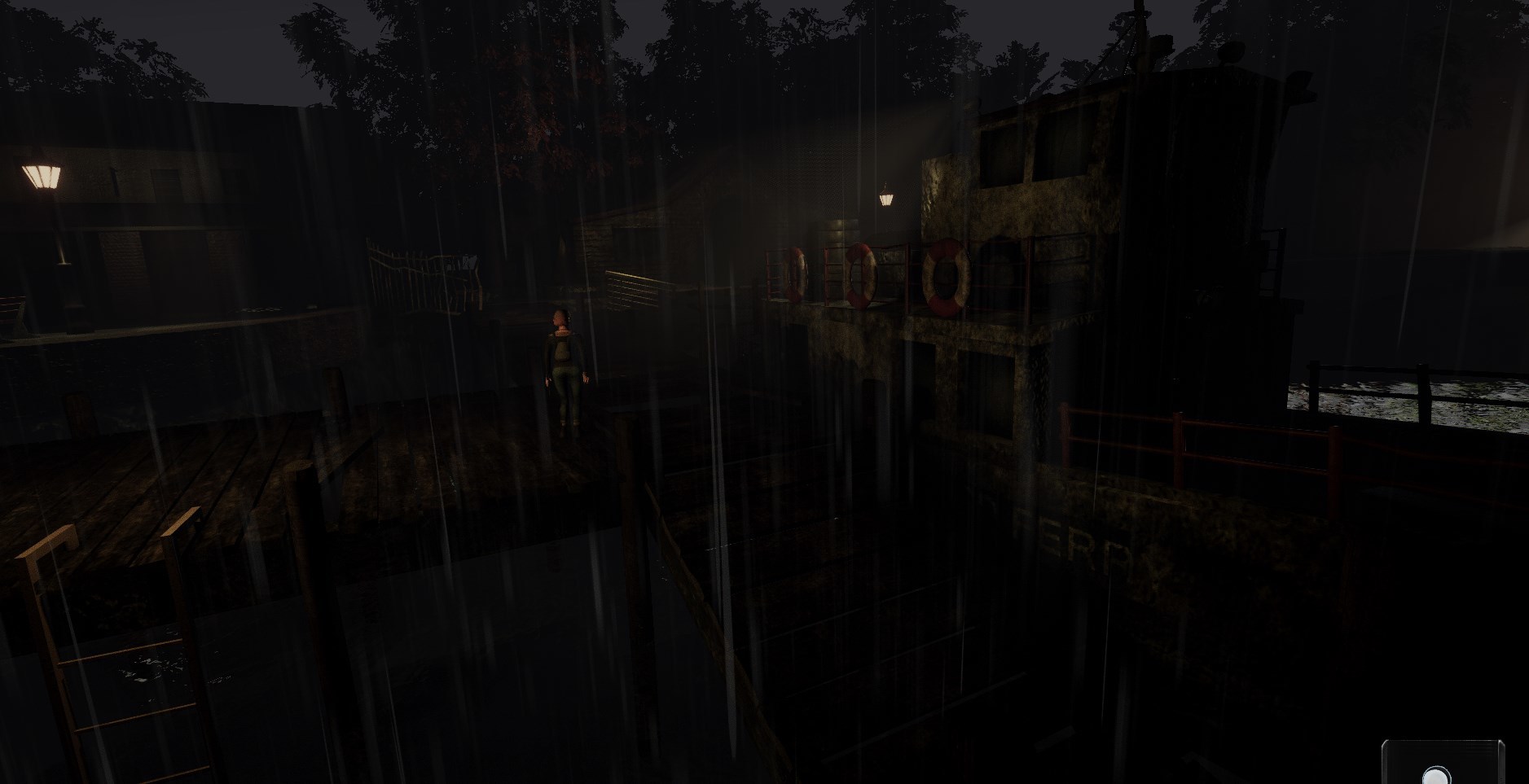
We’ve also spent a lot of time on the dock trying to make small things like having the water work right, and we’re now in the process of putting the final shots in while Sarah works on replacing asset store placeholders with our own assets:
Dan has been finishing building the outside of the church, which is a little more complete than the dock in that it has several puzzles that have already finished:
Next (this) Week:
We’ll almost certainly be ‘finished’ with most of the church area, and hopefully the dock as well, so we’ll be moving on to more act one areas if we do get those done, as well as doing some testing and continuing to tweak those areas.
Summerford Dev Log - Week 8
Hello. It’s been a few weeks, including a pretty disastrous week last week where between sickness, funerals and business stuff getting in the way, we managed to get something close to two days to sit down and actually work on the game.
Third Person Camera and Outside Lighting
After much messing around with third person cameras and the open world areas of the game, we’ve made another big decision to return to fixed perspective for the entire game, and instead focus on making our fixed cameras more ‘dynamic’ feeling and varied.
This means things like slightly tracking the player or moving to a follow position for small sections. This is the style used in the Resident Evil 1 Remake, and in many PS2 era survival horrors.
We’ve made this decision because it allows us to deliver a more focused and polished final game. It’s not too hard to make small, confined third person sections, but making larger areas that all fully connect is a a big challenge.
It doesn’t just mean more assets and development time, it means we start to lose the ‘feel’ of a survival horror game and have to start working in more mechanics to fix design problems.
We’ve also been looking at what sort of ‘feel’ we’re going for outside areas in terms of lighting. The easiest genre solution is, of course, horrors best friend: fog.
However, simply adding a bunch of fog to an environment is as likely to make it washed out and confusing to navigate as it it is to make it creepy.
We also don’t want the game to simply end up looking like a Silent Hill copy. Those classics are our inspiration but we don't simply want to copy them, especially when it comes to setting.
We’ve found a fairly simple solution to this - we’ll be setting the game at night, and during heavy rain. It’s still a genre trope, for sure, but it’s one that’s a lot more fitting to our own setting.
While it’s a myth that it’s always raining in England (We’re actually only the 72nd wettest country in the world), it does let us present a darker, bleaker environment while still allowing for easier navigation.
Spoilers: Dock and Church
We’ve had to backtrack on some of the work on these areas due the above, though luckily we didn’t get too far along with third person work, and the main layout of the areas aren’t changing:
We’ve also spent a lot of time on the dock trying to make small things like having the water work right, and we’re now in the process of putting the final shots in while Sarah works on replacing asset store placeholders with our own assets:
Dan has been finishing building the outside of the church, which is a little more complete than the dock in that it has several puzzles that have already finished:
Next (this) Week:
We’ll almost certainly be ‘finished’ with most of the church area, and hopefully the dock as well, so we’ll be moving on to more act one areas if we do get those done, as well as doing some testing and continuing to tweak those areas.
Summerford Dev Log - Week 6
From now I'll be trying to do a spoiler-free update in this top section of each dev log, and I'll mark out a section around mid-way for spoilers, such as new areas and such. Any really big spoilers will use the spoiler tag, so you can decide if you want to go in completely blind or not.
School’s Out (For Now)
Following submitting the INDIE MEGABOOTH build, we spent some time testing and tweaking that so it works a little better. There are some things that aren’t perfect, mostly to do with the way the outside camera works and the way the enemies move / attack, but we believe now that it’s a good enough representation of the game, considering we’re not planning to release for another 12 months!
This has finally meant we’re moving on from the school a bit. Sure, we could spend more time now polishing every aspect of that area and it certainly isn’t 100% completed - but there’s a couple of good reasons to move on. Firstly, none of what’s left in the school is now ‘new’ to us so it’s unlikely to present a real challenge, where the wider game still has some major technical areas that we need to work on from scratch.
Secondly, and perhaps more importantly for our own sanity and sense of progress, we’ve been working on the school since we first started prototyping the game back in March, and while the game has improved in literally every way since then, the layout and puzzles haven’t actually changed too much, and we’ve been googling “UK Primary school classrooms” a little more frequently than we’d like.
** Spoilers from here - if you want to play the game completely blind, we recommend you avoid reading the more detailed notes below **
We're finally working on the main village. It's not much of a village yet, but it's a start!
Exact timings and size of areas is going to change massively, I think, but right now we’re aiming for act I to be the largest act. It will cover the school, the church which we mention below, the actual village of Summerford including its pubs and shops, and some out of the way rural areas such as farms, quarries and a dock.
A lot of the “work” here is more trying to get our heads around the size of the area, walking distances, and of course the overall puzzles and how/if they interlock. The school was a single, isolated area with one main aim, so in that sense it was both a good test for our game but not so helpful for the sort of design we want to do here.
It’s very early days for puzzle creation yet - we’ve basically worked out the end goal for the area, and the general order in which some of the earliest things happen: for example, you’ll visit a dock area, a farm and the school before the main village. Specific puzzles we’re likely to start tackling more over the next couple of weeks.
Our process right now is that Daniel and I are taking an area each and working on it in isolation. We certainly wouldn’t work well by doing too much planning early on, so we’re coming up with ideas as we design the areas, and then we’ll likely take a look at each others areas and then make changes from there. This way, we can provide more valuable feedback as we’re not so involved in area and puzzle design.
New Areas: Dock and Church
Alongside mapping out roughly where Summerford is and what it’s main locations will be in the first act, we’ve also started building two we knew we would need early on. A church and dock area. Of the two the church is further along, but we’ve got some screenshots of both to share below.
Here’s the dock, which will actually be the starting area of the game. It’s only a small area and will serve mostly as a quick tutorial and introduction to the game’s story before the players leave in search of the main village:
And here’s the church: A more critical area of act 1 with some meatier puzzles and a story that focuses on how religion itself might get a little corrupted in the face of the infection facing Summerford among those left behind:
Keep in mind these are still very early areas and we’re using a lot of asset store stuff as placeholders while Sarah works on the key pieces of art for each area, so these are subject to a lot of changes!
Next Week:
Well, this week, as we’re a day late on the dev log… but our plan is simple enough. Polish the church and the dock for as long as we will feel they need, then potentially move onto the next areas.
Our thinking right now is that we may be better off having the whole act ‘roughly’ created and then doing 2/3/4 more passes to add better quality assets / story / enemies / etc. each time is probably a more solid plan than trying to 100% finish each area. This is what we did with the school, and it worked out well.
Summerford Dev Log - Week 5
A build is built!
We just about submitted to indie MEGABOOTH, in the last few hours of the submission being open.
The nature of getting a build ready means there's not too much exciting to talk about this week, as most of what we've been doing has been either making small tweaks to existing systems, or fixing problems with large but boring systems like scene loading.
We did manage to pull all our existing mechanics together, including combat! Combat isn't finished - enemies can't hurt you and have a tendency to get confused / slide around wildly - but it's at least integrated into the school for the first time, and a part of the main gameplay for the first time, including reloading and ammo pickups, which are obviously a big part of any survival horror!
Here's a picture of our zombies finally in the game:
Next Week
We don't have a solid plan as we've been so focused on getting this build out, but it's likely that we'll begin working on the next section of the game - the center of Summerford, as well as working on combat as it's the one "unfinished" system we've integrated so far.
We may also be tweaking and fixing things in the MEGABOOTH build as even though it's been submitted, we're allowed to update the build, still.
Summerford Dev Log - Week 4
Indie MEGABOOTH build
We're still hoping to submit a build for Indie MEGABOOTH late deadline. Having only noticed we could submit mid last week, it's a bit tight, but we've managed to make a lot of progress with major systems this week.
For example, combat, including reloading, and animations is well on it’s way - and this time programmed from scratch to be buildable upon for the rest of the game. As a result of adding ammo to the game, we now have stackable inventory done, too!
While we already had some basic combat in the EGX demo for a placeholder boss fight, this is all paving the way to be putting regular enemies in the school itself.
Alongside combat, we've also added a far more functional and attractive map system in place for the new build. We’ve taken some queues from Silent Hill and some from Resident Evil with the map also functioning as an objective tracker, of sorts.
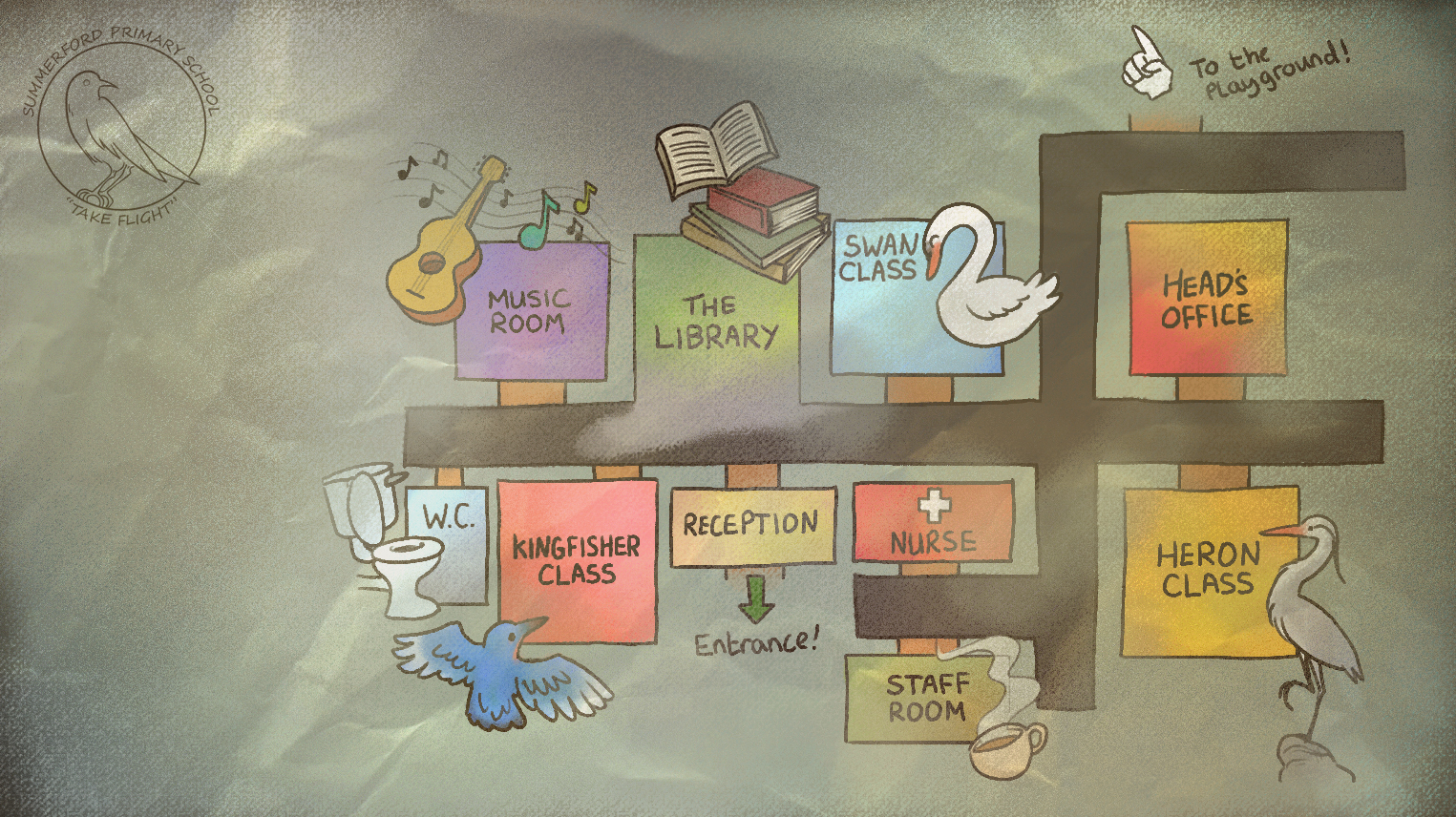
Here’s the original, unmarked map you can pick up from school reception:
Over time, you’ll be scribbling notes and paths to yourself all over it.
Ghosts
Here's a new little feature that wasn't in any old builds - ghostly echos of the events in Summerford during the disaster:
We mentioned last week that part of the work being put into the MEGABOOTH build is reworking the school area, not just to improve the systems, but to fit into the wider plan for the game.
Part of that has been an effort to incorporate a little “show don’t tell” in our narrative. They should separate out some of the story that was previously told entirely in written notes into short, voice acted scenes of events happening before the disaster.
Admittedly they are voice acted by us, right now, but one thing at a time.
Outdoors
Here’s a quick before and after of the front of the school from maybe 5 days into development compared to now - quite a bit has changed!
]
Although the camera still needs a lot of work, it feels like our third person, more open environments outside are progressing well. We’ve spent some time increasing the size of the area around the school, adding some realistic elements like a car park and football field, and working on lighting.
And let’s finish off with a few more shots of the school area:
Next Week
Hopefully a build will come together! Or, we'll submit whatever we have and pray.... Summerford Primary School is a Church of England school after all.
Still, with nearly all the systems from the EGX demo not only back in the game but vastly cleaned and improved, we just have to tie everything together and clean things up - hopefully possible in 3 days!
We’ll also be trying to plan out the very basics of the next area, and some of the wider environment of Summerford now we’re a bit more confident in the third person outside section being the way forward.
Summerford Dev Log - Week 3
Road Trip
This week we went to on a bit of a research mission to two of the nicest looking places in the UK, the Cotswolds and Wales.
We grew up in the English countryside for the most part, so it’s not like we had a lack of experience to draw on when making Summerford, but we thought it would helpful to take a look at different types of villages a bit further from home.
We managed to visit some very pretty looking villages, a few less pretty but more functional ones, some countryside and farm areas, and a ruined cathedral.
We capped the trip off with a quick visit to an abandoned boys summer camp in the absolute middle of nowhere.
It’s a huge area with an abandoned basketball court, pool, church and apartments and a great reference for making Summerford seem realistic in its decay.
We weren’t there completely legally though, and got a bit scared by a truck parked at the front gates, but we still got some great material, both in terms of reference pictures and textures we’ll use directly in the game.
Back in the office
Back at work, we’ve been compiling and testing out some of those textures we’ve picked up, and also had a few days to work on some basic features.
The school interiors are mostly finished now save for a bit of detailing, though we’re still testing out the larger, third person outside area we mentioned last week as that's a larger departure from the original design we had for the school. Here's a quick preview of the new dining hall:
We’re also tweaking some puzzle and design stuff in the school. For example, we had a boss in our EGX demo, which made sense as a nice conclusion to a standalone demo, but feels badly placed in the context of a larger game.
Instead, we’re keeping the key areas and puzzles but moving certain things around so that the end of the school is a bit less intense and sudden, and fits better with the pace of the full game.
We’ve also managed to add back loading between areas, and we’ve also created a basic save/load system which will obviously be very important moving forwards, even if it's not the most exciting thing to talk about in a dev log.
Indie MEGABOOTH
We’re hoping to do a submission to the Indie MEGABOOTH for Pax West, which means we need to have a build of some sort by, at the very, very latest, the 7th May.
Whether or not this will end up happening will depend on exactly how far we can get next week with both level design of the outside area and the programming on hitherto under developed features, but we thought it would be cool to submit.
Next Week
With a full, normal week with no holidays and Wales trips to content with, we're hoping to finally get that school behind us. Obviously our main goal is the MEGABOOTH demo.
Unlike the EGX though, this is all work that needs to be done and we won’t be rushing to put together something we later won’t use in the game. We’ll simply submit what we’ve got before the deadline and see how we go.
By very early next week the main gameplay loop should be back up and working with our new systems, so that should hopefully give us plenty of time to work on the key areas that still need more development, such as basic combat and the game’s map and objective system.
Summerford Dev Log - Week 2
Thanks to religion and history, England has a way of putting many of it’s national holidays very near each other, and we totally forgot that Friday and Monday are such days, so both this week and next week are only four days long.
So we’ve not quite finished our goal of recreating the school - though for hopefully a good reason: In working on the outside we’ve been testing out exactly how we want to the outside areas of Summerford to look and play like.
An Open Environment
From the very start of development, we’ve been changing our minds about exactly how to create the village of Summerford.
One idea was to limit the locations to mostly indoor and small outside areas, using a map to travel between them. The other was to actually create an outside that you actually play through, like the original Silent Hill games.
Obviously the latter adds a lot more atmosphere, but it’s also a lot more development time. Beyond that, it also raises many design decisions. How do we guide players to the correct locations?
How do we balance making an environment feel open with the fact that a horror game needs to provide good pacing and tension?
I wouldn’t say we’ve solved any of those problems yet, but we’ve made the first step by working out if we can technically do it with the people and time we have available to make the game.
Here’s an early test:
https://youtu.be/P8O9giMvquU
We also need to work out a camera system, as while we will be staying with mostly fixed perspective cameras indoors, outside will need a more traditional camera (again, Silent Hill is a good reference here).
There’s a ton of testing and building to do before I’m comfortable saying this will definitely be in the game, but it’s what we’re working towards right now.
Updated School Interiors
Meanwhile we have made plenty of progress on the non-outside areas of the school.
Some rooms have had more changes than others. While we’ve kept our nursery area similar, we’ve added a lot more variety to the main school building. A lot of the work has gone into improving the lighting and colour grading of each area, as well.
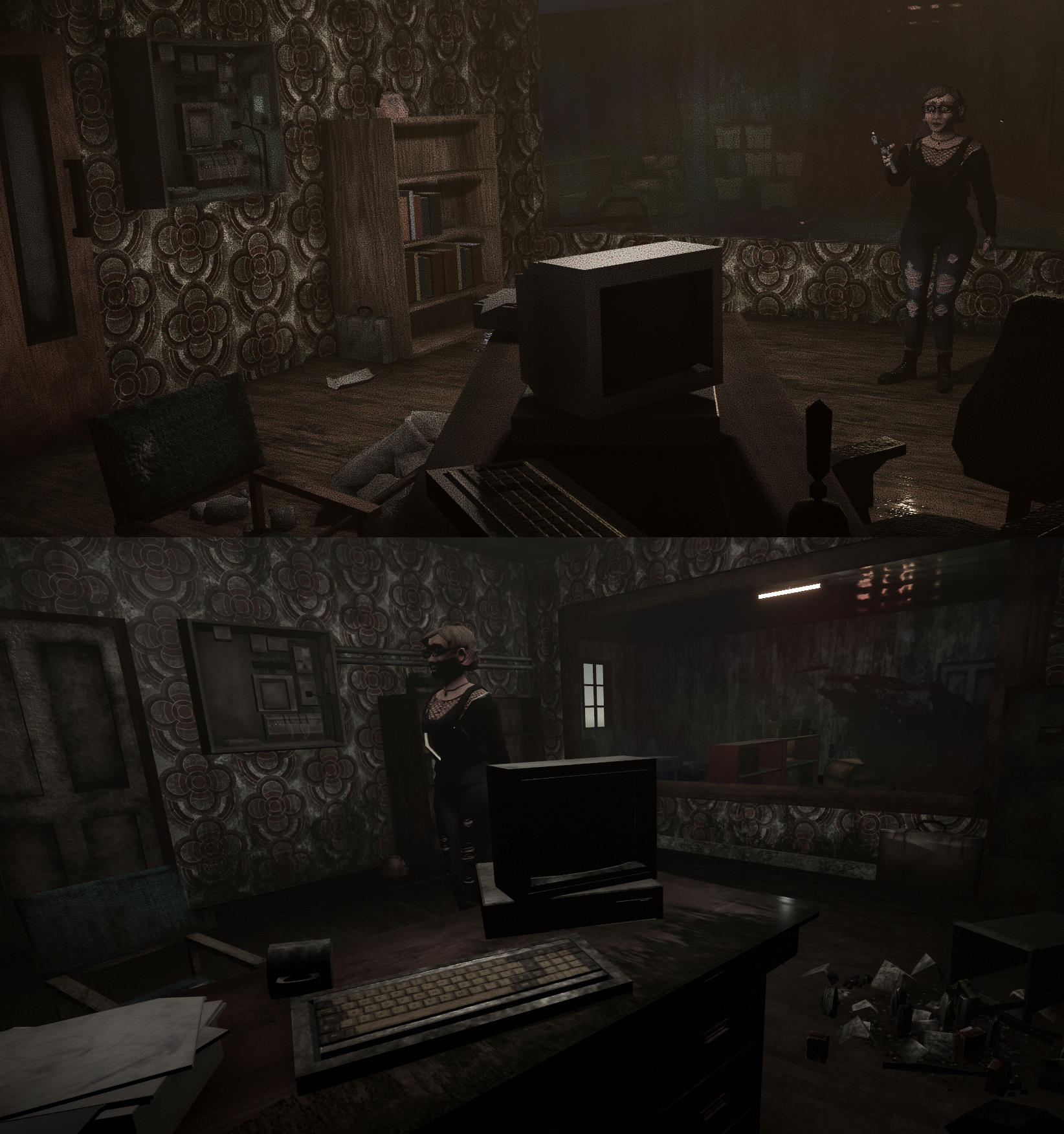
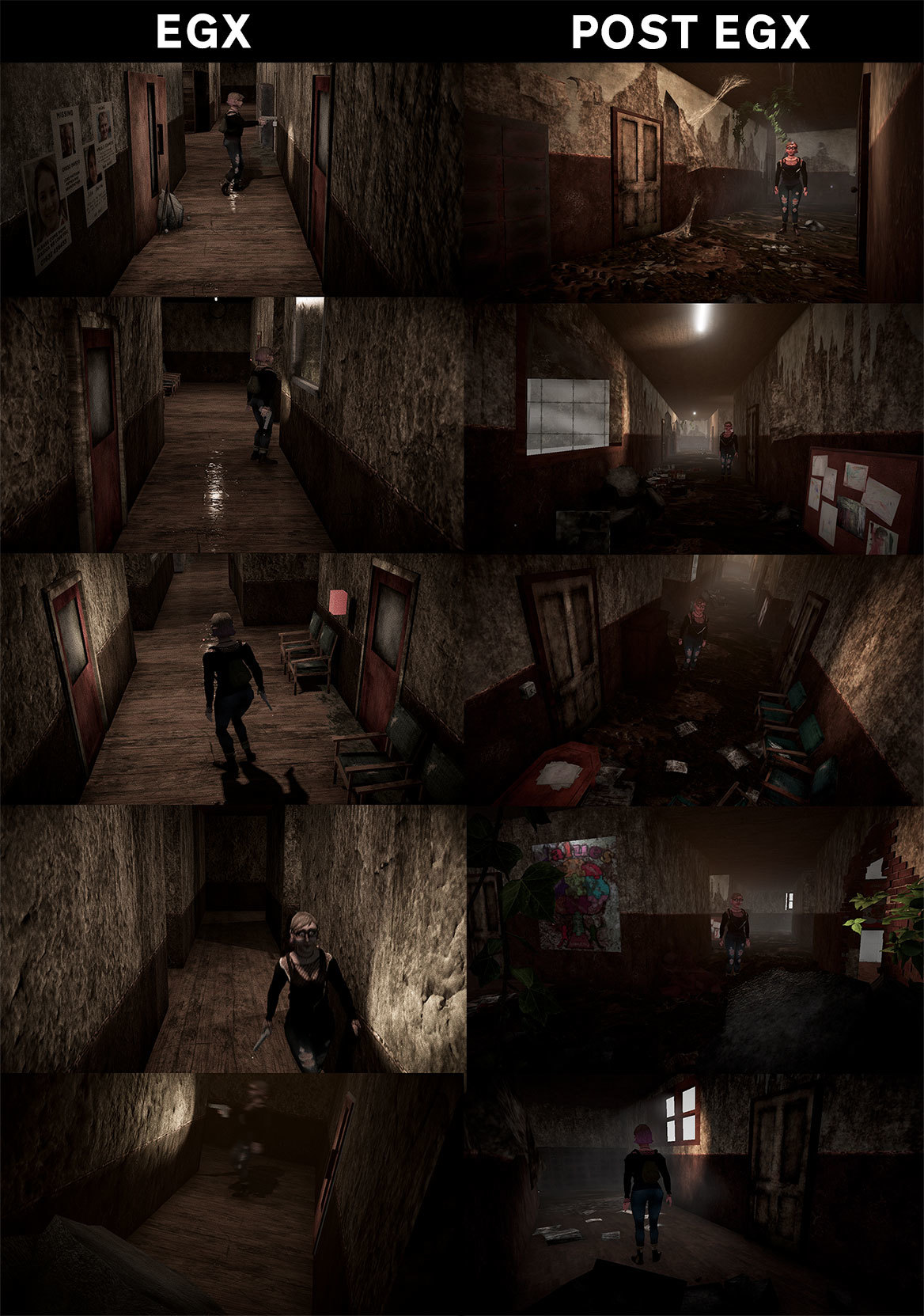
Here’s a few examples, our EGX build on the left, and our new work on the right:
Classroom 1:
Classroom 2:
Nursery Office:
We’ve also been adding lots of little touches this week - things like skirting boards around the bottom of rooms, light switches, plug sockets, and other little things to make the school seem a bit more real.
Next Week
Next week is a bit of a weird one: We’ll be driving out into the Cotswolds and Wales to find some reference materials for the building of Summerford, which we’re going to need if we do end up making a fully created village.
We don’t live near that area, but it’s where some of the most picturesque villages happen to be, so that trip will take two days.
For the the remaining two days, we’ll be doing more tests on the environment, putting the finishing touches to the school interiors and, if we’re lucky, hopefully working on adding back more of our systems to the main project.
Summerford Dev Log - Week 1
Hello, welcome, we've decided to move our dev log over to Steam while we continue work on the game.
My name is Rob, I am 1/3 of the team working at NV on Summerford along with Daniel (programming) and Sarah (art). I'll be posting here once a week with whatever we end up getting done by the end of the week.
You can find our previous dev log over on our site, for now. For continuity purposes with that blog, it's now day 82 since we started working on the game.
EGX
We did manage to show Summerford for one day at Rezzed! Unfortunately the build wasn't really where we wanted it to be, and as we got the space for free as part of running the tabletop area with our other company, we decided it was best to just do a quick demo and get back to working on making the game.
It was always going to be difficult taking even a vertical slice demo of Summerford to a show with only two months in development. The problem with a vertical slice of a game like Summerford is that it's very programming heavy early on.
Still, we DID show Summerford for the first time, and we got some good feedback on things to improve. Also, I think the threat of EGX certainly meant we're further along with many of the game systems than we were before.
We have a vague plan to go to PAX West, now...
School "Version 3"
Our goal this past week and for all of next week is to take our school area that was part of our EGX demo and the first area of the game, and basically strip everything out, and put it back together again.
Sarah has been taking the time to go back through all our old models and textures and giving them a very thorough clean, we've removed a huge amount of old asset store stuff we didn't need, and Dan and I have been rebuilding the school visually, too, with wider corridors and an overall more abandoned look:
UI Changes
This isn't just about visual changes though - even more important is taking this time to sort out all the many systems that need to work in the game, such as combat, puzzles, UI, and so on.
Taking the game apart and rebuilding it isn't something we'll be able to do more than once, but two months in this seems a really good time to put all those systems back in after giving them a thorough rewrite.
UI is the first system to get added back in. Along with a lot of back end changes, there's a few visual ones to show as well.
Firstly, we now use our phone UI to pick up objects as well as interact with them:
And secondly our text now has a paint stroke effect in the background which should make it easier to read no matter what's going on in the game itself:
Next Week's Plan
Ideally, we want our entire school area, including the out buildings, and both our primary and secondary puzzles all in the game and working - however, as we're rebuilding systems we're trying to improve and expand them as well, so it's a higher priority to simply make sure that each system is fit for purpose.
Either way, no new areas until we're comfortable with the school working exactly how we want it. Good news is, once we get there, new areas should be much faster and easier to make!