When there's beautiful weather outside you should... stay home, hide from the burning sun and play some video games. Especially now, when there's a Steam Summer Sale!
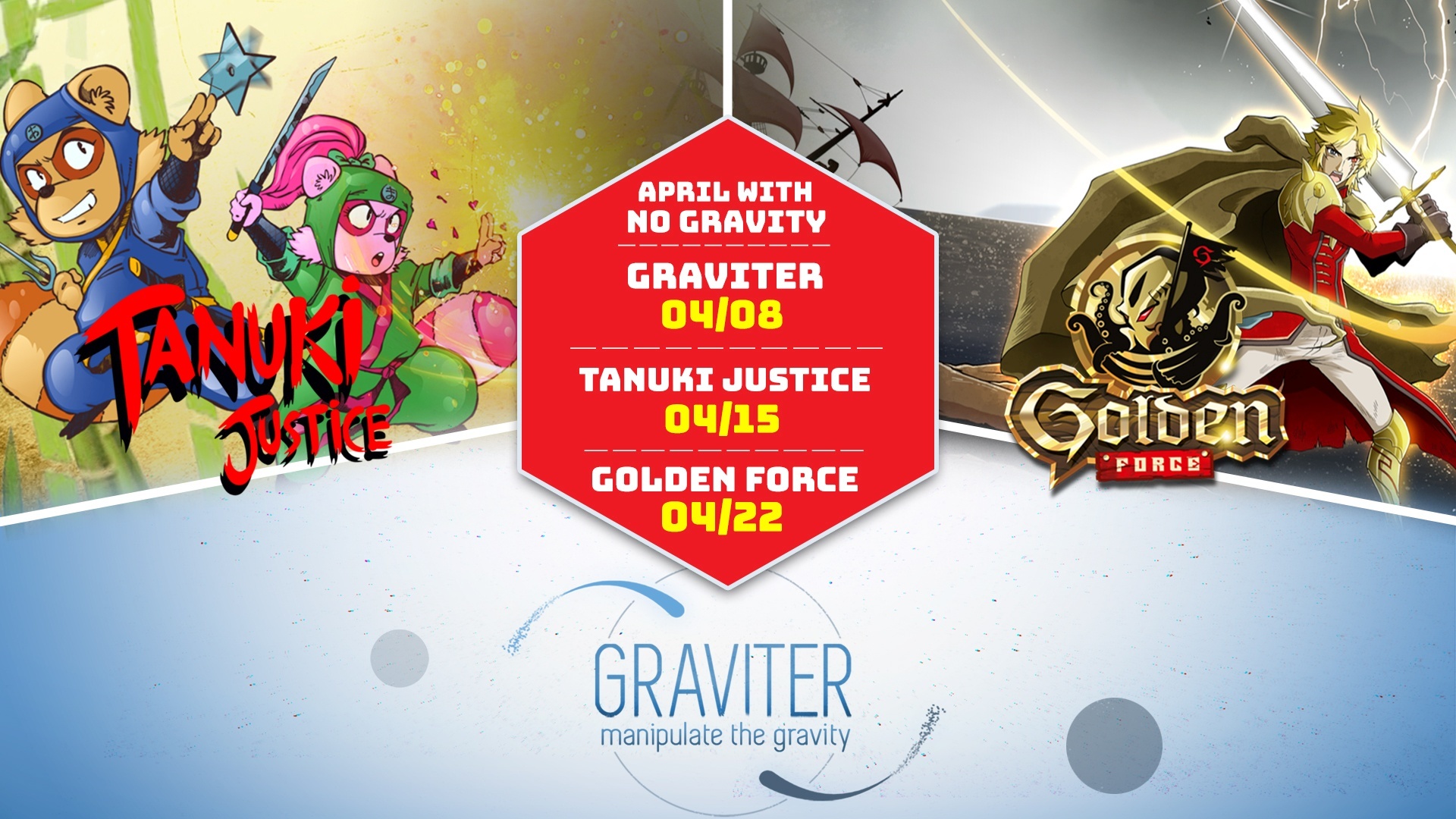
Whether you are a fan of puzzle games or retro-style platformers, you will definitely find something for yourself! April With No Gravity is something more than just launches! Contests, devlogs, giveaways and more - just stay tuned!
Be sure to wishlist Graviter, Tanuki Justice and Golden Force, so you won’t miss any new announcements!
Cheers,
No Gravity Games Team
Good Night, Knight is ON! ⚔️ Save 20% OFF NOW!
⚔️ Welcome to the fray, Knights! ⚔️
We are very excited to announce that Good Night, Knight is now available in Early Access!
A dynamic sneak-and-slash RPG that mixes procedural generation with hand-made scenarios and a darkly humorous story. Created almost entirely by just one developer (!) game features heavy-hitting deliberate combat, robust stealth mechanics, threatening enemies with unique movesets and a vast array of game-changing items to discover.
Good Night, Knight is now 20% OFF!
Of course, it’s just the beginning of the adventure. Even though Good Night, Knight is already packed with features, we have new areas and challenges planned for players. Today we're revealing our roadmap with an overview of some of the planned major updates!
The journey goes on, here's our roadmap for Good Night, Knight (please click to enlarge):
Play, experience crazy adventures, loot, sneak, slash, and don’t forget to share your opinion with us on the Steam forum, and if possible leave a review after! At this point of development every voice matters, help us make Good Night, Knight even better!
Cheers,
No Gravity Games
❄️ Even 90% OFF on Steam Winter Sale ❄️
🛒❄️ No time to waste! Get ready for a shopping madness! ❄️🛒
Do crazy flips! REKT: High Octane Stunts is OUT on Steam!
We are extremely happy to announce that REKT: High Octane Stunts has been just released on Steam.
REKT! High Octane Stunts is an action-packed driving game inspired by the eternal classics like Rush and Tony Hawk's Pro Skater series.
Perform difficult backflips, do amazing drifts, spin around, and master all the tricks to become an ultimate stunter!
Feel the nostalgic Micro Machines vibe but covered with new retro neon graphics. Invite your friends to double, triple, or even quadruple the fun!
All in smooth 60 frames per second performance.
The game is available 10 languages.
REKT! High Octane Stunts is 5,99 USD / 4,99 EUR.
It is 20% OFF for the launch week!
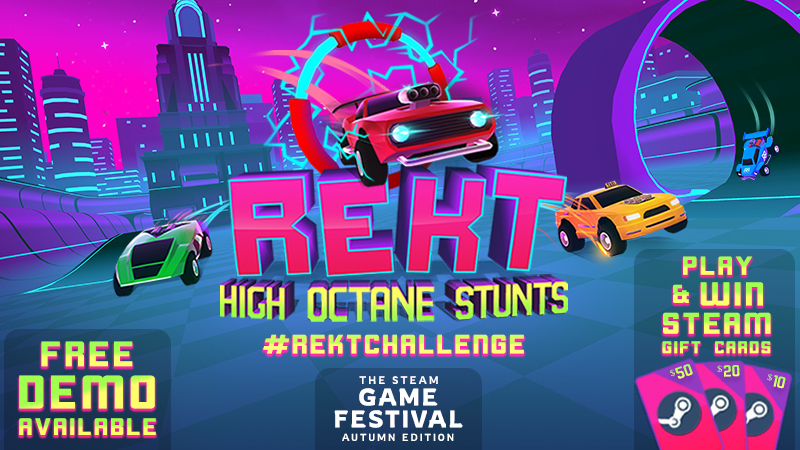
Get the demo! Perform crazy stunts! Win Steam Gift Cards (50$/20$/10$)!
The Steam Game Festival Autumn Edition has started and so REKT! High Octane Stunts demo is released.
We have a very crazy contest for you!
Join @REKTChallenge to win $50, $20, and $10 worth Steam Gift Cards!
Grab the steering wheel of nitro-powered racing cars and perform the most incredible of freestyle stunts.
Take part in #REKTChallenge, a competition in which you gain points by performing car stunts (tricks, spirals, spins, perfect landings, flying through special circles).
In the demo, there is a time limit set to 1:00 except that during the ride players can collect objects that expand and add a few seconds, so they can play for a bit longer.
The event starts on October 7th and ends on October 13th.
The 6 participants with the highest scores documented on the Leaderboard will receive Steam Gift Cards worth:
1st place - $50
2nd and 3rd place - $25
4th, 5th, and 6th place - $10
Winners will be announced on Rekt! High Octane Stunts store page no later than 19th October.
The Agent has encountered an error and will be shut down
1. The feature, the bug and the crash
Computers are complicated, as well as software that is written for them. We’ve lived through multiple generations of hardware, and used various programs on our consoles, home computers, cellphones, smart TVs and smart socks with build in Wi-Fi, gsm, GPS, and 12 types of massage programs. Over the years scale of computer projects skyrocketed, as well as amount of features in both, hardware and software, which in other hand took bigger and bigger teams of people working on them, in tighter time spans.
This kind of pressure, ever raising wanted features amount, fuzzy development and amounts of things to do by the end user causes bugs to appear in the product.
What are those bugs? If you are a gamer you might have already heard of them, as they are quite popular in the games. They are unexpected things that happened, but shouldn’t. You’re playing a mission, and your target suddenly clips through the ground and you can’t kill him any more to progress? A bug. You’ve started a new game, found some dirt on the floor, and sold it to a shop NPC for 2,147,483,647 coins, even though its value was 1? Yup, that’s a bug too. Playing an FPS, and suddenly instead of bullets you are shooting rockets with your pistol? That’s a fun bug!
Still next to the inconvenient and fun bugs, which might be avoided by reloading the last save state, we have critical ones. Those can wreck your quiet evening enjoying a game, by either crashing it, without a save available, breaking your save, making it impossible to play through a certain point, or even run the game. Lets talk about some, which we’ve encountered during the Synther development.
https://youtu.be/PvBisSAFifM
2. SuperAgent
Our agent, who is controllable by the player, went through couple of hard phrases for him. He lives in a cyberpunk world, where you can posses various augmentations, yet he starts completely augmentation-naked, trusts the player to purchase those for him, and chose an appropriate appointment with a clinic worker (or an underground unlicensed doctor, but I haven’t told you that, ok?) to install those augmentations for him. Since the world is real time, he could get bored at periods of time where everyone in the team worked instead of playing the game, controlling him, thus using the free time of his the SuperAgent has been born, and his powers had to be reckon with.
Superpower no. 1 – Super grip Durning one trip over the roofs of the skyscrapers, I took a step too far over the ledge. We both knew that it meant a certain death, but the agent had something up his sleeve. While trying to land on any ledge to avoid avoid dieing, Agent happily grabbed the wall, and started to slow down the fall speed, until completely stopping in mid air, still couple of levels above the ground.
https://youtu.be/Gmp30qvPgWY
After seeing the brake smoke coming out of the hand fingers stop, and processing what just happened a strong experimentation desire appeared.
What could we do together! Walk on walls like it’s nothing, jump from wall to wall, get down from any roof without a need of puny flying cars, elevators, stairs or ladders.
Sadly we both knew that this augmentation is highly illegal in Vesser. To this day I’m wondering where the agent got it from. Probably from some shady import action.
https://youtu.be/n2q_p5lpKUA
Superpower no. 2 – Disregard for the rules of the game Synther, like other games, has some basic rules, that are expected to exist in a game. For instance, opening a main menu. Still we are a little different, as the main menu is actually part of the experience, and is included as one of the programs of the Agent’s pocket computer. Throwing the computer away is a no-no, as then we are literally loosing the possibility to save the game, change settings, view our current tasks, talk to others, translate the SGA texts found in adverts, graffiti and posters, and more. Yet our agent had a phrase, where he happily threw the computer away, causing you to be unable to do any of the above. Talk about being a rebel!
Superpower no. 3 – Parkour In addition with the superpower no. 1 the Agent was a beast in regards to city locomotion. Not only could he use the super grip to get down from buildings and slide on the walls, but also he could use angles of cars, walls and even other NPCs to bounce higher during jumping.
The recipe for reaching highest heights was as follows: first squat, then acquire an appropriate angled object in front of you. Start sprinting, while still squatting, stand up, then jump to hit the angled surface, and off you go to the moon.
NPCs didn’t seem to mind you using their heads to bounce!
https://youtu.be/9yJjfIZtqy0
3. Could you kindly stop doing that?
AI, the artificial intelligence to some, hundreds of IF conditions to others. There are times when you wonder if the intelligence term is even appropriate for the artificial behaviour that happens. In Synther every single NPC lives his day, is in one particular spot, and has his own personality, stats and plans. NPCs can then either like or dislike the Agent, depending on his actions, but with this bug it seems that whole city hates the player.
They just love it. There’s a door in the room? Oh boy! Are there two? Great, lets call a friend to help jerk the handles. It just happened that NPCs, just like in the legend about the goldfishes, had 3 seconds memory of using a locked door. After this time they still stayed locked, but there’s no harm at trying to open them again, right? Wrong.
Every year a lot of people go to the hospital because of having their eardrums perforated. Only we can lower the casualties.
https://youtu.be/9oD4y7eXHnM
4. AI driver 2000
Player has access to an AI controller flying car, and it is a handy way of getting around the city, but sometimes the AI decided that it would take too much time to simply rotate the car when starting off from the landzone. So what would it do? Fly backwards of course! Luckily even though the player could only see what he’s passing, there was no need for manual control and the vehicle almost always got to the target. Almost.
Since getting to the target is only half of the battle, the AI also has to do it quickly enough, so the player doesn’t fall asleep durning the flight, but he still has some time to plan ahead, organize the tasks on the personal computer or check the minimap. Just teleporting to the target doesn’t work, as the game is real time, so it would little sense to have an info of something happening in the other part of the town, just to teleport there in an instant.
5. Roadmap
Like with any serious project, as we work on the last milestones before the game release we aim to reach the optimal balance of features and polish, reducing the amount of bugs to possible minimum, even though it’s not that easy, as we had so many ideas to put into the game, but only so much time, and man power, to do so.
Still some of the bugs were so fun, that instead of applying a fix, we’ve just slightly tweaked them, so they are not game-breaking. Now they are supervised features of the game mechanics.
We are very happy to annouce that Synther with yours help is in top 100 on IndieDB: Indie of The year 2018 award! But our fight is just began. We still need your votes. Now with additional 9 days we are voting for best of the best, so what you can do to help us with this? go to this link:IndieDB Indie Of the Year 2018 Top 100 or this one: Synther IndieDB page find us under: upcoming games / First Person Shoter and smash that red vote button
(there is no need to sign in or register)
Interview with the Mind behind Synther
Interview conducted by Łukasz Burdziński about the creation process, inspirations and future plans of Michał Jaworski - the Mind behind Synther
The important role of colours palette, shadows, lights and image effects and how they stimulate the player's imagination
Ł.B.: Synther, previously known as the Agent: First Person Hardcore Detective Simulator, is coming along quite slowly. Tell me more about it - when did you start working on the project?
M.J: Technically it was 2013. Mentally probably since forever. It might be perceived as weird but I’m suffering from an imagined illness that to some degree is based on hatred for reality. Soon it will be 2019 and we still don’t have megastructures, flying cars or something even resembling self-lacing shoes (at least not like in the Back to the Future). For some unknown reason, I’m experiencing longing for such a place. It is actually scary to me that we are both young yet we probably won’t see any of it - it is vital for people like us to stay positive though. Anyway, I’m feeling a longing for such a place. It’s like when you miss a place you’ve been to and you want to return to it. The thing is I can’t come back to a place that I’m thinking about because it doesn’t exist yet.
Getting back to your question: in 2013 I experimented and prototyped a lot. I was more interested in checking out new mechanics that came into my head rather than finishing games. I imposed a regime on myself that a project can last for a week at most, then I either finish it or delete it. Agent was the last one in that category of projects. The main assumptions back then were to make a small project as possible that would have a maximum possible number of interactions (ranging from light switches like in Duke Nukem 3D to “conversations” with NPCs) as well as a project that will help me understand colours. If you look at indie games and AAA games it is noticeable that colour plays a significant role. On one hand indie game style is often based on 2 colours or there is a single colour enveloping the whole game. AAA titles, on the other hand, filter the colours to create a certain atmosphere. Back then I didn’t think this project would guide me to the point where I am now.
Ł.B.: The game has a very distinctive visual style drawing on early 3D from the 90s. Was it difficult to achieve such an effect?
M.J.: A lot of people accuse me of jumping on the pixel art and retrogaming train but it is not entirely true. To some extent understand that it is not the gamers fault. I think creators are more to blame here, at least partially. In the past when engines were difficult to grasp and inaccessible, making games was more like magic and such trends didn’t exist and at least were present on a smaller scale. To give an example: try to play some of the mini-games that were added to magazines as bonuses. These games were sometimes good, sometimes bad but they were always unique. In the current situation, you can just go to a website, download a free engine with all its documentation written in a language a first grader can understand and suddenly everyone can be a creator. The obvious result is that everyone wants to achieve success and if there is a niche, it will be filled for sure. The problem is that niches are created by someone else. Minecraft did that, Brutal Doom did that too and Kojima with his new title is doing it right now. It’s like when you’re eating sandwiches, each one is different but they are all the same in the basic sense. What will a statistical gamer think when he sees the 30th game in a row about exactly the same thing. On the other side of the argument is a question: what will its creator think and feel?
We are approaching the problem from an entirely different angle. The game’s look is a combination of 3 elements, all of them equally important: colour palette, graphical effects and the story. Why we have that particular graphical style can be explained like this: imagine I have a highly detailed dice in my hand. You can observe it from every single side, you can get closer and get every single detail, see its craft and sometimes even the mistakes of the creator. In the end, you may conclude that it is a marvellous piece of work and that’s it - but there is another way to see it. Imagine I’m holding the same dice but it’s covered in half and it is underexposed. It is identical to the previous one but due to the things that are not shown your mind is not focused on marvelling over the visual aspect but rather on creating your own story. That’s how Synther works, it sets the framework but everything that is untold is left open to interpretation for the player. That’s how we invite people to be creative together in terms of Synther’s meaning.
The same goes for colour. It is not a coincidence that black and white are described as artificial. Snow is not white, it just reflects the sun rays very well. If snow would be white it wouldn’t blind us during a sunny day. It’s the same with blue light as well. At its core, it can be white but after a moment it transforms into its rightful colour. When you walk during the night, lamp’s light hitting a blue car doesn’t change the car’s colour but our perception of it. It works the same in our game. Colour is not modified with a filter but through the environment.
Ł.B.: Where did the idea for DOS-age/Amiga-like graphics come from?
M.J.: It’s another 3-point explanation. Synther in a way has its own “bible” just like Fallout or Doom. Even though it has a multitude of elements that suggest connections with other worlds it also introduces many of its own. That “bible” makes the world more cohesive and real. There is no “just because” in our game. We constantly show tiny, humble preview “cutouts” of the game and we do it deliberately so we don’t show everything beforehand - we want the players to experience some things for themselves. If you ask me personally why DOS and Amiga… I come from a home where parents prioritized our education over game consoles and computers. That’s why for a long time my and my brothers’ best friend was a Commodore 64. I don’t know when it appeared at our house really. Maybe around the time when I was born or sometime before that. I was lucky that apart from a cassette deck we also had a 5.25’ station, dedicated monitor, many cartridges and floppy disks. It can be said that C64 was our best friend for everyone at home as my dad had another work during the after-hours, working as a videographer. He was constantly ripping camera videos to tapes and then using another tape for Commodore effects - after that, he smartly used 2 tapes and 2 video players to combine everything into one. During the day the computer was occupied by me and my brothers. Most of the floppy disks didn’t have any descriptions and the names alone didn’t tell us much. You only knew that something was an application and that something wasn’t. As a result, every gaming session was like an Indiana Jones adventure and now that I think of it - it was glorious. PC arrived in our life very late. Mind that I don’t say it arrived in our house because our first PC was at our aunt’s. She bought it to do accounting and “play games in Excel”. She was very restrictive in terms of how much and who could play on it going as far as taking away the keyboard. That’s how we finished Fallout and how I got to know Commander Keen 4, Hexagon, Hocus Pocus, Colgate and many other DOS games. Why Amiga? I loved demoscene. I’m not a god so I couldn’t participate in it but I could see what others were doing and absolutely adored it.
Ł.B.: Watching the trailer I drew connections with a forgotten production from the 90s called TekWar. Do you know that game?
M.J.: Synther will always be similar to X when you substitute X for any sort of game. What we are similar to is a response to what we publish. Right now only one game gave a small inspiration. The rest is sometimes a complete surprise to us. Truth be told, we are willing to believe that after the release many will want to recreate what we are currently making and their projects will be the ones described as “Synther-like”. I’d like to remind you that TekWar was based on the movie. It gets associated with Synther because the game included public transport in form of a metro network and that’s it. Build and every other engine had better or worse games that got old in a good or bad way. TekWar from today’s perspective is ugly and the gameplay is mediocre. However, if Mr. Shatner would like to he can find an interesting role with us.
Ł.B.: Tell me more about the gameplay. The description gives an impression of an open world exploration but will it be a classic FPS with mission progression based on shooting everything that moves or will it have various options for game completion like a stealth one, with no killing required?
M.J.: I don’t want to be a stuck-up individual that creates fake promotion to sell a product. The truth is that Synther is a different game than others in many of its aspects. That sentence is hard to swallow for me but our game is more of a simulation. However, for some, it might be a walking simulator, for others a typical adventure game and for some, it can just be “go and kill everything that moves”. The world is small and the amount of interactions with it is huge. Smaller area allowed us to enhance many of its elements. Do you like to hack? Then hack. Do you like to be stealth? Use the vents. You like to act and influence the world? Help others. Ultimately if you don’t want to do the main story of the game you don’t have to. Everything here depends on what you like to do and how you want to do it. The main motif is based on finding 3 fugitives and eliminating them.
The core gameplay is pretty simple - we arrive at a city where we are supposed to find them and eliminate them. Everything else depends on the player. We can even die at the very beginning or completely ignore the opening and never accomplish the main goal. We have a weapon and a personal computer, which is an Omni-tool giving you access to everything - from processing the dialogues to game settings. At some point in the development if you didn’t want to ever quit the game you had the ability to simply unequip it and throw it out. After the prologue player receives an information where the first fugitive tracks can be found, then after conducting their own investigation it can be deduced where the rest of them are.
The magic begins when you look at it from a technical perspective. The game world is static but the heroes are not - that’s why I prefer to call them actors. They can take the role of a police officer in one game session and the same individual can be one of the wanted fugitives in another one. As a result, even though the main task of the game is the same, the path, the process is completely different. Another element is that the game time is tied to the real-time of the device you’re playing on. Thanks to that all sorts of activities are happening without you being present. We don’t treat it as a flaw. If you’ve arranged to meet an informant at 12:40 but you’re physically at work you won’t be able to meet him - once he appears at the spot at 12:40 and you’re not there the event fails. You enter the game after 4PM and you can see that your reputation dropped for some but might have elevated for other factions and perhaps some entirely different NPCs are more willing to help you out now.
Synther is a soft permadeath game, Agent has a set lifecycle after which death or something else occurs. Agent can die even when you’re not playing but we have a mechanic allowing you to avoid it, which in itself is quite interesting and can possibly refresh the real-time gaming trend. At the same time, we try to introduce small educational values like hacking being based on logic gates, learning of the Standard Galactic Alphabet assisted with translator, vehicle and player modifications. In the end, it forces the player to think like a “detective”. I think many will find it useful to have a pen and paper at their side while playing the game.
Ł.B.: Is Synther a single player campaign only or do you want to implement additional game modes?
M.J.: There are two modes planned: “Endless” and “Story Mode”. Both have similar features but they are not connected. In “Story Mode” there is the main story arc and depending on our style of play it is governed by different rulesets. In “Endless” mode we are someone entirely different and the possibilities for the player are not the same as well. We will talk more about that mode in the future.
Ł.B.: Game’s atmosphere seems to be heavily influenced by the 80s and 90s cinema. What inspired you to create Synther?
M.J.: One of the main factors was Blade Runner but at some point other inspirations came in as well: B.A.T. and the ability to code the player; Half-Life and microelements that were not visible but present; Ghost in the Shell and the theme of cyberspace; definitely Micon: Noman Soul and its breaking of the 4th wall; a bit of Armitage III; a lot of Neuromancer and the whole trilogy. At some point, after reading the Blade Runner-based book I listened to the Polish audiobook version on repeat. Listening to it so many times gave me a unique way of thinking about its heroes and their motivations. Each and every one was focused on their own goals, which could have been noticed only after a couple of repeated sessions. It inspired me to create my own citizens.
Here, similarly to Ultima, every NPC has their own needs, it’s not a Zerg swarm. If you do something and only one NPC sees it, you kill it and nobody else will know about it. On the flip side if you kill someone in the middle of the city with many witnesses then you have a certain amount of time to prove that your activity was righteous. You can (you don’t have to) gain reputation in certain circles.
Ł.B.: What were the biggest challenges you encountered during the making of Synther? Did you make any major mistakes that were hard to overcome?
M.J.: Main problem is that we are in the no-mans land. Every engine has its own community that stirs the pot but when you’re outside of it and you need to find a solution, no one can help you properly. Sometimes even the engine creators make mistakes. That was exactly the case with our in-game translator solution. At some point of that specific function creation it turned out to work but not how we anticipated - or certain preconditions were stopping us from achieving particular goals. We generally aim to make everything very modular. This way we avoid many serious problems, we just correct the whole module if there is an issue. Thanks to that we don’t have many significant obstacles. The heaviest burden is, in fact, the time as it is a quite extensive project, there’s a lot of work to do. At the same time, we respect our own limits and approach our publisher in a healthy way just as they approach our workload. If we need more time for something, we communicate it clearly with the publisher and vice-versa. Seeing how much we put into the project and how big it actually is they don’t pressure us - we all try to stick to the deadlines as much as possible anyway. Delays are always possible and healthy atmosphere is the only thing that can reinforce the mutual effort.
Ł.B.: How many people currently work on the project? Tell us something more about Neofuturism team.
M.J.: It’s the 3 of us. Marcin Maślanka created the whole audio layer of the game and takes care of the soundtrack. Arkadiusz Kalinowski tackles the code. Then there is me - I take care of everything else so it all works well together. We also have several trusted friends who can help us if a need arises and we are incredibly thankful to them but the main team consists of 3 people.
Ł.B.: Do you have any future plans for your game development? Do you have any ideas for other projects or do you want to keep developing Synther after its release?
M.J.: Currently our main assignment is Synther. We have some plans for another title but Synther is the most important. It doesn’t matter how many people work on the project and what it has to offer. It is the level of polish and whether the whole thing is solid. In the end, I would like Neofuturism to be associated with a “new” level of execution in all its fields: from graphics promoting the game to the gameplay itself.
After the release we will definitely spend some time with other Agents, giving them support and asking for feedback. We already have our own Discord server and you’re all invited. We will announce a couple other cool things there.
“You’re welcome to join the Neofuturism Discord at Discord.gg”
Original Polish version of Zin you can download here: Stare.e-gry.net