
And don’t forget to keep an eye on our social media to get the latest news and be a part of our community on Discord.

Tennis Manager 2022
Make your comeback in the all-new season of Tennis Manager, coming out soon!!
And don’t forget to keep an eye on our social media to get the latest news and be a part of our community on Discord.
TENNIS MANAGER 2023 Launches May 25, Prior to Roland Garros
Are you Ready for a new season in the heart of the Tennis World?
We sincerely hope that you will enjoy this new edition! Don’t forget to add Tennis Manager 2023 to your wishlist on steam to become the first manager of TM23 😉
New feature
This year Tennis Manager puts team spirit first.
In a couple of weeks, new features & game upgrades will be unveiled, so stay focus on our social platforms and particularly on Discord!
Thanks for your support and talk to you soon!
Patch 2.3.5
We were focused on some technical bug fixes.
The update should download and install automatically. If it does not, we recommend restarting Store launcher.
Modifications :
- In the settings, you can now choose to limit FPS to 30 or 60, even in windowed mode. This could avoid some performance and/or heating problems.
Fixes:
- Sound settings can now be saved even if there is no save
- Updating sound settings during match will no longer block the settings window
Patch 2.3.4
We were focused on some bug fixes and an optimization of the memory usage.
The update should download and install automatically. If it does not, we recommend restarting Store launcher.
Modifications :
- Asset management optimization (should improve memory management on some devices)
Fixes:
- 19 years old still appears in junior rankings
- Seeds rules on some WTL tournaments*
* requires to start a new career
Tutorial "Match" - Episode 3
1.Which game plan for which type of player?
As mentioned in the previous tutorials, the basis of your match strategy should be an accurate analysis of your player's profile.
First, look at his natural attributes: weight and height. This is really just a matter of physics. Some significant advantages will be given to each player depending on his morphology. But, let's face it, being tall in a sport like tennis gives you an extra range on the volley and, more importantly, a much greater potential for strength on the serve. However, it should be noted that smaller players will have the advantage of velocity on their moves.
These attributes (technical, physical and mental) determine your player's ability to execute the game plan. The more a player executes a game plan that matches his personal capacities, the better he will tend to perform. Send a player, mediocre at volleying, on a serve-and-volley game plan and you will see the damage!
As a reminder, all of these attributes will be impacted in a match by his mental state and form (see another previous tutorial).
2.Game plans vs. tactical instructions
Mastering the game plan
The game plan is the overall style that your player will have on the field and that will determine the decisions he will take according to certain situations.
The parameter to take into account when choosing a game plan, apart from the attributes of the player, is the level of control of the game plan.
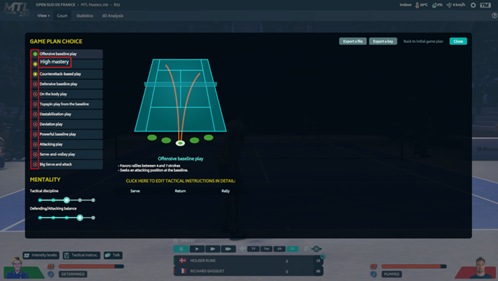
According to the color indicated (red/yellow/green), the game plan is presented as: mastered; moderately mastered; no mastery.
Choosing a mastered game plan means to bring serenity to the player who will be able to optimize his performance in a strategy he knows. However, it only takes a few tactical changes for the game plan to be out of control and disturb your player.
Therefore, if you want to change the strategy during a match, you should do it sparingly or choose another game plan that your player already knows.
Note also that a change of game plan during a match, while your player is winning, can disturb him. Indeed, your player may not understand the reason for this change and this could affect his morale. However, some cases (your opponent is getting tired so you want to lengthen the exchanges / your player is tired so you want to shorten the exchanges) may justify this change because of other factors like fatigue or mental state.
In general, we recommend to our managers to plan at least 3 fully mastered game plans. This will allow you to cover a maximum of situations and to go directly to a more defensive or offensive game plan without going through the details of tactical instructions each time.
The mentality

The mentality of your player will be represented here in the form of 2 gauges that will evaluate:
- Respect for tactics:
Evaluates here the freedom that we will give to our player in relation to the game plan in place. Note that this also impacts the chances to make dropshots.
- Defense/attack balance:
Measures the tendency of your player to take control of the point. Example: If he is totally attacking, then he will tend to attack in situations that he might have considered neutral or defensive.

Thanks to this gauge you can decide in which way, in which perspective, your rookie should approach each ball / each point. The set of scenarios (defense; neutral; attack) are represented as above.
Tactical instructions

Here we come to the favorite part of the sport's experts, tactical strategy enthusiasts and analysts of all kinds. Indeed, tactical instructions represent the score on which your player will rely on to make the most of his strengths.
The tactical instructions are divided into 3 main areas of the game:
- Serve
- Return
- Rally
The service

Here you can set a multitude of instructions on each side related to the execution of the service: power, risk, spin, target zone, second ball... It is up to you to decide the strategy you wish to implement.
It will then be easy for you, through the dedicated 3D analysis (as below), to evaluate the relevance of your choices and, if necessary, to rectify the shot by bringing the most appropriate instructions to the quality of the return delivered by your opponent.

The return

Here you can set a multitude of return instructions on each side: power, risk, target zone, depth... It is up to you to decide which return strategy you want to implement.
Here again, it is recommended to use the 3D analysis to easily evaluate if your strategy is relevant to your opponent's quality of service.

Rally

Rallies are of course the heart of the game. They are divided here into 3 types of scenarios (as explained previously): normal / attack / defense.
You will be able to set the way you want your player to manage these 3 types of points depending on whether he is on his forehand or his backhand: counterpunch, approach to the net, attack on the backhand, spin, ball power...
Here again, it's up to you to find the right recipe, the right balance, so that your player has the best chance to win the rallies. Various 3D analysis approaches, available throughout the match, provide you with a multitude of useful information to understand your strategy and its immediate results.


Finally, as explained earlier, we advise not to change the instructions too much because they can change your player's knowledge of the game plan... So, it is better to change the game plan than to change the existing tactical instructions too much.
Intensities
As you can see below, it is possible to modify the level of intensity that your player can put on 3 different aspects of the game:
- The serve
- The return
- The key points

Note that this parameter must be carefully measured since it has an impact on the state of fatigue of your player as well as on his mental state. Indeed, it is important to know that the intensity levels also impact the events of the match. That is to say that the loss of a tie-break, the fact of making a double fault when the player is giving everything on the court, will have a more important impact on his mental. On the contrary, if the intensity level is low, negative events will have less impact.
Patch 2.3.3
We were focused on bug fixes!
The update should download and install automatically. If it does not, we recommend restarting Store launcher.
Fixes:
- Grand slam goal for equipment contract not working if ranking goal was achieved
- Equipment goal from expired contract are still giving rewards
- BIllboard not well displayed at the back of the match court
- Player's contract end not properly saved in some cases
- Date turned pro not updated properly when winning a tournament on last week of season (could cause a crash in some rare cases)
Tutorial "Mental State" - Episode 2
How does the Mental State Work?
There are four main factors to a player’s mental state: their confidence, motivation, relaxation, and emotion. Every player is unique, and will react differently to their surroundings and their situation. In certain situations they can have no confidence, be perfectly sure of themselves, or are even far enough in the other direction that they get cocky. They can be really motivated or otherwise, and may need a budge in the right direction. These could affect, for example, their accuracy and power of their shots.
Your player could be relaxed or they could be heavily stressed. Then again, they could be far too relaxed and that too can have its pitfalls. What mood they are in will also determine their quality of play for a match. Stress also has a big effect on the big play moves, and whether your player can pull them off when it really matters.
These four main factors (now indicated in the pre-game talk) will change constantly due to a huge number of factors in-built into the game. Some of these will be plainly obvious, and others you will have to work out for yourself. What matters is not necessarily where these factors come from, but instead how you as a tennis manager can adapt to these difficulties and keep your player at the top of their mental game.
Finally, note that your Manager attribute "Ability to motivate" now boosts the impact of your talks on your player in TM22.
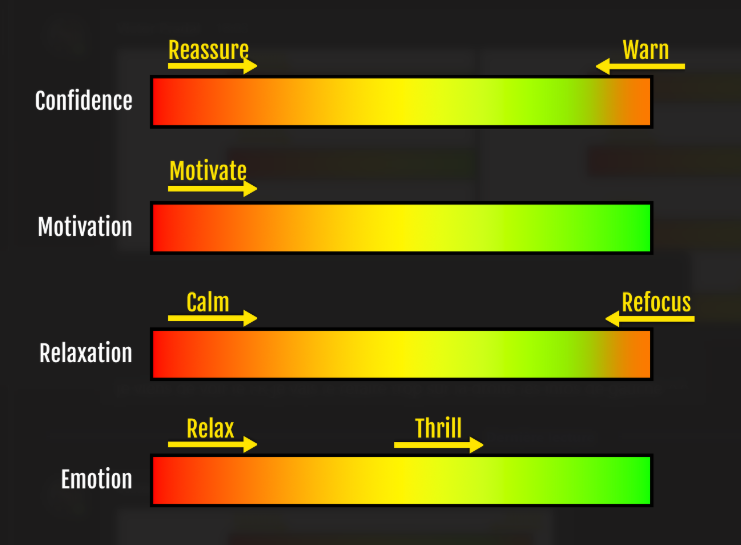
As you can see on the diagram above, in addition to these 4 psychological factors, there are other triggers that you should know how to use at the right time. It is up to you to analyze the mental state of your player and to bring a relevant response and action to it.
As you can see on the diagram above, you can use different psychological drivers that are hidden behind each sentence of your talk. It is up to you to analyze the mental state of your player and to provide the answer that will impact the right mental gauge, or at least the one you want to target.
Finally, note that mental factors can accumulate and thus generate a particular psychological state. Indeed, when your player has some of his or her gauges at their maximum, he or she may find him or herself "on fire" or even "on cloud nine". It is in fact the addition, or average, of the mental gauges that creates this new status. On the other hand, when several data tend towards the negative, the "cumulative" mental state of the player may lead to a "frustrated", "devastated" or even "down in the dumps" status.
Impacts of the mental state on the quality of play
Each gauge impacts differently the attributes of the player in match. Positively or negatively...
Confidence mainly affects the concentration, the power of the shots and the tactical clairvoyance of the player...
Motivation acts on the player's willingness to try to play all the balls or rather to let them go, it is also very impactful on the key points of the match.
The stress plays essentially on the service and the shots which require a strong concentration, volley, drop shot, lob, passing shot...
Emotion plays essentially on the reliability of the shots, on the key moments and on the capacity of the player to absorb the negative events of the match.
Before a Match
The easiest way to separate the main factors on mental state is before and during match play. Now, in TM22, these 4 psychological indicators are displayed during the pre-game talk, which is an opportunity for you to assess your player's mental state and to try to rebalance the situation, which could prove decisive for the upcoming game.

Before even going into a match, events come into play that affect how your player is feeling. Is this their home crowd, or a hostile audience? Such things will greatly affect their confidence and their ability to withstand stress.
How far into the tournament is the player? Is this their first time getting this far? How old are they? Such environmental and age factors can make it very difficult for young players, in real-life and in the game alike, to do well at a grand slam (Emma Raducanu notwithstanding!).
Do your player and their opponent have a history? If there are any head-to-head results, these will weigh emotionally in favour of the advantageous player. How do the combatting players rank against one another? A big difference in ability isn’t just about physical skill, but also about the confidence drain your player could experience if they are facing a player of a much higher calibre.
Outside of all these things, how is your player doing in general? How is their morale? If your player is feeling bad for whatever reason (perhaps they haven’t had a holiday in too long), they will already go into each match at a natural disadvantage. Taking care of your player mentally can go a long way to seeing them victorious when the real tennis comes into play.
You will have understood that, as in real life, a multitude of different reasons can affect your player and influence his/her potential level of play during his/her next match. As a coach, it is your responsibility to analyze the general mental state of your champion, to identify the possible weaknesses of the moment and, thus, to choose the psychological triggers to be used to find the right words and thus optimize his/her performances.
During a Match
General indications

When the match starts, the mental state of your player is indicated right next to his/her avatar. Note that the psychological factor whose gauge is furthest from its average level is displayed compared to the other 3 factors.

As you can see below, it is possible to display the mental state level of each gauge by hovering over the mental data.
Talks during the set
The changes that come into effect during a match are a little different, but equally important. Here, things are likewise mostly out of your control except for the ability to do side-line coaching. Aside from the occasional mid-match interventions (more on that below), you need to have everything sorted before your player steps out on court to have the best chance of their mental state being at its best.
The way the game is going to be handled will obviously have an impact on how your player feels. Is he/she winning easily? Or, on the opposite, does he/she have to struggle to keep his/her serve? Has he/she missed many opportunities to break his/her opponent? All these circumstances will influence the mental state of your player.
The personality traits of the player will also play an important role in the match management. Indeed, the events of the match described above can be either temporized by the player, who will be able to manage his frustration and/or his irritation or, on the contrary, be accentuated and thus potentially prejudice him.
To conclude, I would advise you not to underestimate the interest of these injunctions in live because they can really bring a light mental boost to your player. It's up to you now to use them at the right time depending on the game conditions.
End-of-set talk
It is possible to ask for a talk at the end of each set in order to put your player in the right direction (at least the one you want 😊). To do this, remember to validate this option in the "talk" tab.

The ins and outs of this end-of-set talk are the same as the pre-game talk, but obviously the most important decision criterion becomes this time the score of the match and the way it is going... Who is winning? Who is losing? Is the match close or not?

A little mental/tactical subtlety: the 2 choices that will have both a mental impact on your player and a tactical one: "stall" versus "show off": it's a bit of a double-edged sword on the impact that the events of the match will have on your player.
Post-match talk

The post-match talk is an opportunity to review the overall mental state of your player. Even if this post-match mental report does not have a significant impact on the player, do not underestimate this debriefing, which can have a (slight) effect on the player depending on the quality of your analysis. Indeed, commenting to your rookie that he/she didn't go far from victory when he/she just lost 6/0 6/0 could offend him/her for example!
Get to know your players, analyze the content of the match and know how to adapt your speech and your recommendations accordingly!
Tutorial "Mental State" - Episode 2
How does the Mental State Work?
There are four main factors to a player’s mental state: their confidence, motivation, relaxation, and emotion. Every player is unique, and will react differently to their surroundings and their situation. In certain situations they can have no confidence, be perfectly sure of themselves, or are even far enough in the other direction that they get cocky. They can be really motivated or otherwise, and may need a budge in the right direction. These could affect, for example, their accuracy and power of their shots.
Your player could be relaxed or they could be heavily stressed. Then again, they could be far too relaxed and that too can have its pitfalls. What mood they are in will also determine their quality of play for a match. Stress also has a big effect on the big play moves, and whether your player can pull them off when it really matters.
These four main factors (now indicated in the pre-game talk) will change constantly due to a huge number of factors in-built into the game. Some of these will be plainly obvious, and others you will have to work out for yourself. What matters is not necessarily where these factors come from, but instead how you as a tennis manager can adapt to these difficulties and keep your player at the top of their mental game.
Finally, note that your Manager attribute "Ability to motivate" now boosts the impact of your talks on your player in TM22.
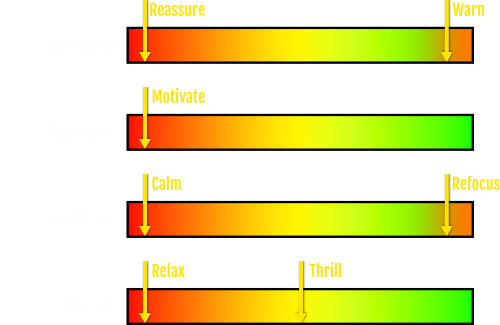
As you can see on the diagram above, in addition to these 4 psychological factors, there are other triggers that you should know how to use at the right time. It is up to you to analyze the mental state of your player and to bring a relevant response and action to it.
As you can see on the diagram above, you can use different psychological drivers that are hidden behind each sentence of your talk. It is up to you to analyze the mental state of your player and to provide the answer that will impact the right mental gauge, or at least the one you want to target.
Finally, note that mental factors can accumulate and thus generate a particular psychological state. Indeed, when your player has some of his or her gauges at their maximum, he or she may find him or herself "on fire" or even "on cloud nine". It is in fact the addition, or average, of the mental gauges that creates this new status. On the other hand, when several data tend towards the negative, the "cumulative" mental state of the player may lead to a "frustrated", "devastated" or even "down in the dumps" status.
Impacts of the mental state on the quality of play
Each gauge impacts differently the attributes of the player in match. Positively or negatively...
Confidence mainly affects the concentration, the power of the shots and the tactical clairvoyance of the player...
Motivation acts on the player's willingness to try to play all the balls or rather to let them go, it is also very impactful on the key points of the match.
The stress plays essentially on the service and the shots which require a strong concentration, volley, drop shot, lob, passing shot...
Emotion plays essentially on the reliability of the shots, on the key moments and on the capacity of the player to absorb the negative events of the match.
Before a Match
The easiest way to separate the main factors on mental state is before and during match play. Now, in TM22, these 4 psychological indicators are displayed during the pre-game talk, which is an opportunity for you to assess your player's mental state and to try to rebalance the situation, which could prove decisive for the upcoming game.
Before even going into a match, events come into play that affect how your player is feeling. Is this their home crowd, or a hostile audience? Such things will greatly affect their confidence and their ability to withstand stress.
How far into the tournament is the player? Is this their first time getting this far? How old are they? Such environmental and age factors can make it very difficult for young players, in real-life and in the game alike, to do well at a grand slam (Emma Raducanu notwithstanding!).
Do your player and their opponent have a history? If there are any head-to-head results, these will weigh emotionally in favour of the advantageous player. How do the combatting players rank against one another? A big difference in ability isn’t just about physical skill, but also about the confidence drain your player could experience if they are facing a player of a much higher calibre.
Outside of all these things, how is your player doing in general? How is their morale? If your player is feeling bad for whatever reason (perhaps they haven’t had a holiday in too long), they will already go into each match at a natural disadvantage. Taking care of your player mentally can go a long way to seeing them victorious when the real tennis comes into play.
You will have understood that, as in real life, a multitude of different reasons can affect your player and influence his/her potential level of play during his/her next match. As a coach, it is your responsibility to analyze the general mental state of your champion, to identify the possible weaknesses of the moment and, thus, to choose the psychological triggers to be used to find the right words and thus optimize his/her performances.
During a Match
General indications
When the match starts, the mental state of your player is indicated right next to his/her avatar. Note that the psychological factor whose gauge is furthest from its average level is displayed compared to the other 3 factors.
As you can see below, it is possible to display the mental state level of each gauge by hovering over the mental data.
Talks during the set
The changes that come into effect during a match are a little different, but equally important. Here, things are likewise mostly out of your control except for the ability to do side-line coaching. Aside from the occasional mid-match interventions (more on that below), you need to have everything sorted before your player steps out on court to have the best chance of their mental state being at its best.
The way the game is going to be handled will obviously have an impact on how your player feels. Is he/she winning easily? Or, on the opposite, does he/she have to struggle to keep his/her serve? Has he/she missed many opportunities to break his/her opponent? All these circumstances will influence the mental state of your player.
The personality traits of the player will also play an important role in the match management. Indeed, the events of the match described above can be either temporized by the player, who will be able to manage his frustration and/or his irritation or, on the contrary, be accentuated and thus potentially prejudice him.
To conclude, I would advise you not to underestimate the interest of these injunctions in live because they can really bring a light mental boost to your player. It's up to you now to use them at the right time depending on the game conditions.
End-of-set talk
It is possible to ask for a talk at the end of each set in order to put your player in the right direction (at least the one you want 😊). To do this, remember to validate this option in the "talk" tab.
The ins and outs of this end-of-set talk are the same as the pre-game talk, but obviously the most important decision criterion becomes this time the score of the match and the way it is going... Who is winning? Who is losing? Is the match close or not?
A little mental/tactical subtlety: the 2 choices that will have both a mental impact on your player and a tactical one: "stall" versus "show off": it's a bit of a double-edged sword on the impact that the events of the match will have on your player.
Post-match talk
The post-match talk is an opportunity to review the overall mental state of your player. Even if this post-match mental report does not have a significant impact on the player, do not underestimate this debriefing, which can have a (slight) effect on the player depending on the quality of your analysis. Indeed, commenting to your rookie that he/she didn't go far from victory when he/she just lost 6/0 6/0 could offend him/her for example!
Get to know your players, analyze the content of the match and know how to adapt your speech and your recommendations accordingly!
Patch 2.3.1
This is a new minor update for Tennis Manager 2022.
We were focused on bug fixes and some optimizations!
The update should download and install automatically. If it does not, we recommend restarting Store launcher.
Adds:
- New animation in match "low shot (FH/BH) forward"
Modifications & Balancing:
- Better timing for animations in match
- Textures optimizations so the game is now lighter
- Add brand logos on many equipments
Fixes:
- A crash could happen if a player tried to play 2 match in the same day slot
- Some inconsistencies have been fixed in the 3D statistics
- Accepting wild card does not remove previously accepted tournament
- Some minor injuries were triggered when they should not have been
- A crash could occur when a player did not have a primary game plan set up
- Fix some records in the database*
- Fix memory leak that could cause a crash
- Player's reaction were not always coherent with the context
* requires to start a new career
Training Management Tutorial - Episode 1
Every academy manager pays special attention to the optimization of his staff's skills. However, as in real life, their progression will depend on a set of intrinsic factors of the player (personality, physical attributes) but also on the balance of his training schedule.
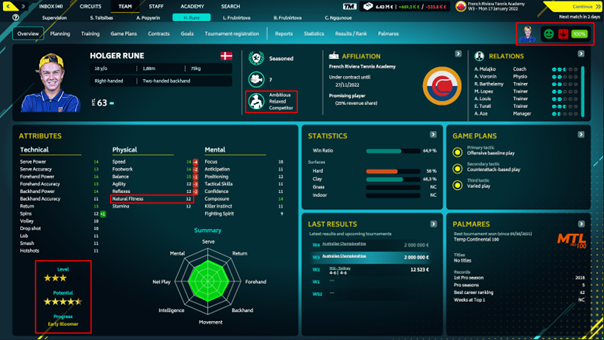
1.Analyze the player's profile
In order to program the training of a player in the best possible way, and thus to get the best out of him/her, it is first fundamental to get to know him/her. It is therefore recommended to study his/her profile sheet, which contains a lot of important information.

- Level: evaluation of the current level
- Potential: evaluation of the achievable level
- Progression: evaluation of the precocity of development
Note that, as in real life, not all players have the same type of progression. We have therefore integrated 3 different profiles involving periods of progression of the player varying according to his age:
- Early bloomer: maximum potential reached at 21 years old
- Standard: maximum potential reached at 24 years old
- Late bloomer: maximum potential reached at 28 years old
Your player's attributes are an important indicator since they represent all of his strengths and weaknesses. It is now up to you to decide what your development priorities will be through training or through experience. Most of the attributes can be boosted by setting up a training schedule. However, some of them (confidence, composure, killer instinct and fighting spirit) are qualities that can be improved by the experience that your player will develop through the games and seasons.
The attribute "natural fitness" is a fundamental element of the athlete's profile since it directly impacts the way he will be able to absorb and integrate the training sessions. Indeed, the more a player will be able to repeat the physical efforts, the more he will be able to repeat the matches and the trainings to see his progression increase.

The player's DNA, i.e. his/her main personality traits, will have an impact on his/her life as a high-level athlete and therefore on his/her ability to manage certain issues.
Negotiating contracts, managing emotions during a match, listening to the staff or even respecting a healthy lifestyle, there are as many situations as there are ways to manage them. Thus, get to know your player and you will know how to optimize his/her natural attributes.
Finally, it should be mentioned that the size of the player also evolves naturally over the years:
- Up to 17 years old for girls
- Up to 18 years old for boys

All the actions taken or events around the player will have direct consequences on 3 key criteria that will be a crucial benchmark for the manager:
- Morale: psychological state
- Form: level of rhythm
- Physical condition: physical state
2. How to influence these 3 factors?
Morale
The level of morale can vary according to 5 levels: mediocre / weak / medium / good / excellent.
As in real life, various elements can affect the morale of your player:
• Intensity of training
The way you will elaborate the training schedule of your athlete will be fundamental since the more the player will train and the less he will have free time which will lower his morale level. (Little tip: 3 consecutive rest slots will boost your player's morale).
- Evolution of the ranking
- Series of victories
- Private life stability (example: new relationship)
Also, the player's DNA, his level of self-confidence, as well as his relationship with his coach, will affect this psychological dimension.
Shape
The level of form represents the rhythm and the sensations of your player: it directly impacts certain physical attributes, but it also impacts the progression in training as well as the apprehension of the upcoming match.
5 levels of form exist: red / orange / yellow / dark green / light green
To improve the form (up to the medium level) of your team:
- Prioritize physical training
- And to a minor extent, technical training
To bring the player to the top of his form, it will be necessary for you to make a series of matches and performances.
But there is also a part of randomness (who doesn't know a day with or a day without?), difficult to predict and anticipate... A slight evolution of the level of form which changes each week, up or down.
Physical condition
The last key factor is obviously the player's physical condition which should be checked before each match/training session in order to maximize his performance and avoid injuries.
The physical condition also affects the quality of training but to a smaller extent than shape.

Your player has a poor physical condition and you can't improve it? Then give him/her some free time! As in real life, it will be necessary to give him/her some rest time through rest slots to be integrated in his/her schedule. Also note that, each night, the level of physical condition will improve slightly.

The other solution is to integrate treatment sessions into his/her training schedule. These will improve the physical condition level according to their number of stars. Note however that these sessions will have an impact on the player's morale (because less free time / time to rest).

The main source of fatigue affecting the physical condition level of your player comes from the training sessions you will plan for them. Their impact will be different depending on their level of intensity: low/moderate/high.
Finally, there are 4 levels of weekly training (workload):

- Low: 7 sessions or less
- Moderate: 7/8 or 9 sessions per week
- Strong: 10 or 11 training sessions
- Very strong: 12, 13 or 14 training sessions
Depending on the physical condition of your player, his/her capacity to train will be more or less important.
Finally, the choice of the type of game plan, as well as its DNA, will have a direct impact on his or her attributes and progression. Indeed, the player will tend to improve more easily the attributes corresponding to the game plan chosen in match as well as to his natural qualities.
You will have understood it, all is thus a question of balance of workload and personalization of the training program according to the profile of your champion. You are the manager, so you are the one who will have to make the right decisions to optimize his/her skills and thus help him/her to win titles!