Genre: Strategy, Turn-based strategy (TBS), Card & Board Game
The Elder Scrolls: Legends
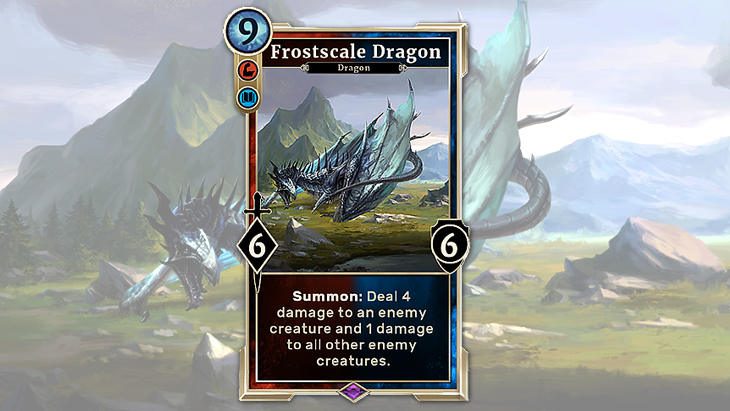
March 2018 Monthly Card - Frostscale Dragon!
This month’s card has origins dating back as far as the Merethic Era. Back then dragons were rulers of Skyrim - god-kings worshipped by the powerful Dragon Priests.
Eventually, the men they had ruled over hunted these winged terrors to extinction and entombed them in the many Dragon Mounds throughout Skyrim. However, the return of the World-Eater Alduin has given new life to these winged menaces, and their great shadows once more darken Tamriel’s skies.
Truly a fearsome beast, Frostscale Dragon doesn’t require a lot of work to be awesome as the top end of a Battlemage deck. It has a very strong Summon ability that will often kill an enemy creature while softening up the rest of your opponent’s board for your other creatures. Add to that a robust 6/6 body and your opponent will be wishing that the dragons had just stayed dead in the first place!
There are also plenty of ways to get more than the sum of its scales out of Frostscale Dragon. You can play with the Lookouts for some bonus dragon synergies that will make Frostscaling your opponent even more appealing or play Frostscale with Alduin himself as a powerful dragon for him to return to play. Midnight Snack also pairs quite well with Frostscale by giving you some early guards to help you survive until you’re able to get enough magicka to start deploying your massive winged threats.
Regardless of if you choose to build around Frostscale Dragon in a Battlemage Dragon deck, or just use it as a strong finisher, fly over to the ranked queue to earn your copies!
Announcing The Elder Scrolls: Legends - Houses of Morrowind!
You have no idea what you’ve wandered into.
From the moment you stepped off the docks in Seyda Neen, you became a potential pawn in a grand power struggle between the Great Houses that govern this land and even between the living gods themselves and their terrible ancient enemies. But of course, if it maneuvers correctly, a pawn can become a queen. Who will you trust? Who will you fight for? Can you control the Houses of Morrowind?
The Elder Scrolls: Legends is going to Vvardenfell with Houses of Morrowind, releasing March 29 on PC, mobile and tablet devices. The set introduces 149 new cards to the game, featuring creatures, characters and many other familiar sights from both The Elder Scrolls III: Morrowind and The Elder Scrolls: Online.
You’ll find the Great Houses and their machinations.
You’ll find strange creatures like netches and hear the chilling cry of descending cliff racers.
You’ll find the living gods themselves.
And of course, you’ll find their nemesis - the mighty Dagoth Ur.
Dagoth Ur is a Strength, Intelligence and Agility card, which means you can only play him in a deck of those attributes. But in that deck-
What’s that? You can only play two attributes in a Legends deck, you say? Not anymore!
It Takes Three
Normally, a deck in Legends can only contain up to two attributes (or as they’re sometimes colloquially referred to, “colors”). But Houses of Morrowind contains a handful of powerful new three-attribute cards that let you break that fundamental rule.
Here’s how it works: When you put a three-attribute card like Dagoth Ur in your deck, you unlock the ability to use cards from all three of its attributes in that deck. Ever wanted to equip Tazkad with a Sentinel Battlemace? How about using Laaneth to fetch a timely Allena Benoch? In a Dagoth deck, you can. In exchange, you must include at least 75 cards in your deck. You may not play with cards of any other attributes.
“But I thought the maximum deck size was 70?” Well, this is Morrowind - where new things are always possible! With the release of Houses of Morrowind, the maximum deck size is being raised to 100 for not just three-attribute one, but all decks.
Houses of Morrowind includes cards for five of the ten possible three-attribute sets, each representing one of the major Houses, or factions, in Vvardenfell. Here’s what each of those factions are up to:
House Redoran (STRENGTH/WILLPOWER/ENDURANCE)
House Redoran prides itself on martial prowess. Its warriors are disciplined, honorable and fearsome in battle.
House Redoran reigns over Strength, Willpower and Endurance. To represent its military might, those attributes get the new keyword Rally. Whenever a Rally creature attacks, it gives a random creature in your hand +1/+1.
There’s a lot of creatures that can benefit greatly from being rallied to your cause, from guards like the one Knight of Gnisis gives you, to charge creatures like Nord Firebrand. Who will you bring into the Redoran ranks?
House Telvanni (INTELLIGENCE/AGILITY/ENDURANCE)
House Telvanni is home to some of the greatest mages in Tamriel. But, as you might have heard, their ambition knows no bounds. A Telvanni mage will happily put a few knives in a few backs if it will get them the power they crave.
That’s why the Telvanni mechanic is Betray. Betray means “After you play this action, you may sacrifice a creature to play it again.” (Sadly, you can only do this once per action, even if you have a whole army of creatures you would happily double-cross.)
This ability is right at home in the Telvanni colors of Intelligence, Agility, and Endurance, all of which have access to creatures with powerful Last Gasp effects. Go ahead and backstab Balmora Spymaster, he can take it. Haunting Spirit will understand your betrayal – after all, she’s dead already!
House Hlaalu (STRENGTH/WILLPOWER/AGILITY)
House Hlaalu is always up to something. This House has enterprises across Morrowind, and if it takes a little thievery, bribery, or strong-arming to make them succeed – hey, that’s business.
The Hlaalu mechanic is Plot. Plot abilities trigger if you’ve played another card that turn. Hlaalu Sharpshooter here, for example, offers a better rate than Earthbone Spinner – but only if you can manage to play something else in the same turn.
Luckily all three of Hlaalu’s attributes – Strength, Willpower and Agility – have lots of inexpensive cards that will help your plots come to fruition.
The Tribunal Temple enacts the will of Morrowind’s living gods. This faction reveres the intelligence of Sotha Sil, the willpower of Vivec, and the endurance of Almalexia. In exchange, the gods bestow great power on the followers they deem most worthy.
In Houses of Morrowind, that power is represented by Exalt. Exalt offers a creature a bonus if you pay more magicka for it. In Vivec City Pilgrim’s case, you could play her early – a 2-cost 2/2 Drain isn’t half bad – or you could wait, and make her a 4/4 for 5.
If you do pay the Exalt cost, the creature will be considered “Exalted.” That will matter in case one of the gods makes an appearance. Like, for example, Vivec himself:
House Dagoth (STRENGTH/INTELLIGENCE/AGILITY)
Which brings us to our last faction – House Dagoth. The Tribunal attempted to destroy this house centuries ago, ensuring it was all but forgotten. But deep within the Red Mountain, Dagoth Ur has plotted his revenge and rebuilt his house – in the form of frightening beings known as Ash Creatures.
As an outcast house of monsters, House Dagoth wants no part in the Great Houses’ political dance. Instead, it seeks raw power. Dagoth cards, which you can find in Strength, Intelligence and Agility, reward you for having creatures with 5 or more power. Of course, that could be Dagoth Ur himself or one of his top lieutenants – but it could also be something like good old Blighted Alit.
And So Much More
Rest assured, this is just the proverbial first step off the boat. Houses of Morrowind is packed with cool cards that promise to shake up Legends in a big way. Even if you decide not to swear allegiance to one of the houses by playing a tri-attribute deck, we think you’ll find plenty to explore and some new favorite cards for your existing decks. Stay tuned to your favorite content creators in the coming weeks for more reveals!
#TESLegends
Announcing TESL Champion Series
In an effort to expand the competitive play efforts of Legends, we’re excited to announce our new series of tournaments we’re working on in tandem with the community: TESL Champion Series.
If the name sounds familiar… it should. The Champion Series has been a fantastic community-driven effort that we’re excited to work with in a more official capacity as we look to expand Legends growing competitive scene.
To get things started, over the past weekend, we ran the first qualifier – a beta of sorts for the remainder of the program. We’re happy with how the tournament played out, but we’ll be evolving the program in the coming weeks.
So what’s to come in the Champion Series? Here’s a quick overview of the schedule and additional details participating players will want to be aware of.
Tournament structure Our current season for Champion Series will feature will feature three Championship Events, each preceded by two qualifying events. The season will also culminate with a Grand Final comprised of top players from each of the Championship events.
Qualifier Details Each Qualifier is a 64-person single elimination tournament with the following rule sets:
3 Deck Last Man Standing - This format has players bring three decks to a tournament. Each round is a Best of 5 where when a player loses with a deck, they are unable to use it again. Once a player is out of decks, they lose the match
Deck Submission —This will occur at least two hours before tournament start. Participating players will submit their decks to one of our favorite sites, Legends Decks.
How to Qualify for a Championship Event – From each Qualifier, the Top 8 Players will qualify for the next Championship Event.
Streaming -- We encourage players to stream their matches during the qualifying matches with the hashtag #TESLCS. Working directly with the tournament organizers, streams will be able to feature code giveaways for viewers.
Championship Details The season features three Championship Events featuring 16 players in a single elimination tournament with the following rule sets:
3 Deck Last Man Standing - This format has players bring three decks to a tournament. Each round is a Best of 5 where when a player loses with a deck, they are unable to use it again. Once a player is out of decks, they lose the match
Deck Submission —This will occur at least two hours before tournament start. Participating players will submit their decks to one of our favorite sites, Legends Decks.
Streaming – Our organizers for the TESLCS will broadcast the semi-finals & finals on the series’ Twitch channel. Streamers are encouraged to broadcast the first two rounds on their own channel using the #TESLCS hashtag. Note: Streaming of the semi-finals and finals will be broadcast with a 15-minute delay to discourage any foul play.
Grand Final Details
The grand final will feature a winner-take-all format consisting of 4 competitors, 3 of which being the 1st place finishers from each of the preceding Championships.
The fourth competitor will be decided by Champion Points, which will be distributed at all three Championship events! At the end of the third Championship, the player with the highest cumulative Championship Point total will be automatically invited to the Grand Final.
Championship Points will be awarded as follows:
1st Place - Automatic invitation to the Grand Final
2nd Place - 7 Championship Points
3rd/4th Place - 4 Championship Points
5th-8th Place - 2 Championship Points
9th-16th Place - 1 Championship Point
Schedule The full schedule for this season of the TESL Champion Series – including registration dates – is listed below.
Registration opens the Wednesday prior to the upcoming qualifier and closes on Saturday afternoon at 1:00pm ET.
Grand Final: Event Date: Currently slated for 5/13
IMPORTANT: Making the top 8 of a qualifier and qualifying for a Championship will prevent you from playing in the other qualifier for that Championship, although you are welcome to play in qualifiers for the next Championship! Winning a Championship and locking your place in the Grand Final will prevent you from playing in future qualifiers and Championships. This is to ensure that the maximum amount of players are able to participate in and attempt to qualify for these events.
How to Register Check out the community’s Google Form to join the action. beth.games/2HBpf5N
Prize Details The prizing will be under a winner-take-all format. With the winners of each championship having the opportunity to join the official Bethesda Stream Team!
Qualifier Prize: $250
Championship Prize: A. $1500 cash or B.Gaming PC package worth $2500 + An official Bethesda Stream Team invitation!
Stream Team members will be streaming 2x a week with promotion, collaboration, and support across all official Legends community outlets!
Never streamed before? No problem! Aside from the hardware, our teams will set your channel up with everything you will need- so you can hit the ground running. Custom banners, graphics, cover art and much more to be provided.
We hope you enjoy TESL Champion Series. We’ll be actively looking at feedback from the players, viewers, and fans to see how we can improve the series over time. For the latest on the Champion Series, follow the tournament scene on Twitter and Twitch. See you on the battlefield!
Grand Melee: March 3 - 5
It’s time for the first Grand Melee of the year! In this extra-special event, players clash with their best decks for a piece of one of the biggest reward pools in The Elder Scrolls: Legends – to include the chance to earn up to a whopping 75 Heroes of Skyrim packs and 2,000 Soul Gems!
As a bonus, all Grand Melee entrants will receive a complementary promotional playset of Piercing Javelin – complete with animated premium alternative art! This playset was originally featured in our first Grand Melee, giving players another shot at grabbing these exclusive cards. Players who already own this set of promo Javelins will also be able to Soul Trap their extras in a future update.
Entry into the Grand Melee begins Saturday, March 3, at 3:00 am EST and closes Sunday, March 4, at 3:00 am EST. We have extended the event entry time to 24 hours to better accommodate players from Eastern time zones. The cost to enter the Grand Melee is 1,000 Gold or 6 Event Tickets. Good luck, and may your favorite deck carry you to victory!
Game Update 70.2: Patch Notes
A small update for TES Legends is live. Here are the details:
Premium Legendary Packs
For a limited time, you can purchase a Premium Legendary Pack from the Core set or the Heroes of Skyrim set for 1,000 gold each. Each pack includes one random Premium Legendary Card from that set. Begin completing your set by purchasing the Premium Legendary Packs within the Packs department of the Store.
Card Changes
Journey to Sovngarde has been changed. Any Soul Summoned copies of this card can be Soul Trapped for full value until March 14th.
Journey to Sovngarde is a card that encourages the player using it to drastically extend the length of the game. While decks containing Journey were winning less than half of their games, those games were significantly drawn out compared to an average game. Combined with its recent spike in popularity, this was concerning to us. In addition, Journey has been used in combo decks that try to exploit the cost reduction element of the card. Removing the cost reduction element should reduce the regularity with which it extends games and avoid some combo cases, while still retaining its appeal as a tool to combat slower decks.
The Importance of Being Organized
Humans like to categorize and organize things. Our brains are wired to be really good at it. We experience a ton of information every day, and our brains process and organize a lot of it passively and instantaneously. At a basic level, there are categories of “don’t care about this right now” to “this is something I want to pay attention to.” This allows us to focus on the things we want or need to do without feeling overwhelmed by all the noise. For example, if we drive to work, we see thousands of objects but we automatically put some things into the “pay attention” category -- things like traffic signals, pedestrians, and other cars.
Perhaps as a natural extension of our desire and aptitude for organizing things, humans seem to like to rate and rank things within categories. For example, a cinephile might not just have a list of her top 10 movies of all time, she might use categorization to come up with numerous lists. “Here’s my top 5 cerebral Scandinavian tearjerkers!” One does wonder how much the internet and modern data collections have contributed to this inclination.
But hey, wait. How the heck does this relate to the Elder Scrolls: Legends? Actually, in a number of ways. Let’s walk through a few ways in which organization is a core part of the design of Elder Scrolls: Legends, and why that’s a good thing.
Organization allows for mechanical distribution, leading to asymmetric gameplay and player agency.
Distributing themes and mechanics across five attributes is perhaps the most critical form of organization in Legends. This method of categorizing cards coupled with the primary deck building rule spreads the game’s mechanics across the game so that no one deck can have access to all the mechanics. Thus, as a player, you have a really important decision to make in terms of which attributes to dip into when building a deck. What do you want to utilize and what can you live without?
Asymmetric collections also present fun ranking opportunities, and Legends is rich enough to present fun thought experiments even when you’re not playing. While your cinephile friend is listing her top 5 cerebral Scandinavian tearjerkers, you might be considering how you’d rank your top 5 Intelligence actions.
Organization helps players remember concepts and mechanics and leads to skillful play.
Once a game begins, the benefits of the mechanical organization mentioned above aren’t done. One of the first things you might do is look at your opponent’s attributes. Once you’ve played a fair number of Legends games, this visual cue can be quickly processed by your brain into some possible deck archetypes (another useful form of organization!) that your opponent might be playing, and you might even begin to form a plan to play well against those decks. Some players talk about “playing around” certain cards, meaning their decisions are sometimes driven based on the risk of the opponent having a particular card. This type of planning and reacting can begin immediately, with your mulligan decision!
Something to stress is here is that the card file itself must be organized well in order for players to feel these benefits. If designers throw mechanics around too liberally, these benefits can dissipate. Imagine if all attributes had some Charge creatures, or if all attributes had efficient support removal. While some amount of unpredictability is important for card games, that’s a world where games would feel too chaotic and unpredictable.
Organization of themes and mechanics can support lore and world-building, while also helping players remember concepts.
When Legends launched, the design team decided to allocate the ten playable Elder Scrolls races across the five attributes, each race to an attribute pair. For example, Nords were assigned to the Strength-Willpower pair, so each Nord was either Strength or Willpower (or in Tyr’s case, both). We knew this organization wouldn’t last forever, because we felt certain famous characters wouldn’t feel right in the initial pairing. But we knew that, as a new game, Legends was going to throw a lot of complexity at players, so we wanted to take advantage of organization to present some information in a clean and memorable way. As mentioned, humans are capable of processing a lot of information; but one of our jobs was to present game information so that players were spending less brainpower decoding information about the game, allowing them to focus on the more fun, strategic decisions.
Organization allows exceptions to create memorable cards and/or interesting flavor.
While organization creates standard rules to go by, designers are not always slavish to those rules. Breaking an organizational rule can be a powerful tool to call attention to something, especially as it relates to the story of a card. If all previous Orcs hadn’t been assigned to the Strength and Endurance attributes, Arcanaeum Librarian’s arrival in Clockwork City wouldn’t have been particularly interesting. The fact that he represents the first Orc card to veer outside of the normal Orc attributes is part of his charm. It also clearly is a call-out to Urag gro-Shub from Skyrim, who was quite at home amidst a library full of books. Neither Strength nor Endurance felt right for a card representing that character.
Another example of breaking the rules for a purpose can be found in Heroes of Skyrim. Because this set was based on the home of the Nords, the designers chose to allow Nords to bust out of their standard attributes in a big way, as a nod to the diversity of the Nord people as experienced in TES V: Skyrim. So, Nords were purposefully placed into all five attributes.
Organization of card sets leads to mastery and delight.
This one is a bit harder to talk about concretely, but when Legends designers create card sets, some of their discussions relate to how much of a particular mechanic to include and how to spread those mechanics across cards. It’s almost like making a soup or a sauce, where simple building blocks are the base and fancier cards are spice. If a soup doesn’t have enough spice, it might taste bland and boring; the same goes for a card set. But too much spice can be a turn-off, as well. Finding the sweet spot and figuring out a way of organizing the set’s information across cards so that players experience mastery and delight while playing with the cards is a mix of art and science.
Here are some examples of organizational decisions that we had to make when designing various Legends card sets:
How many Slay creatures should be in the Dark Brotherhood set, and what attributes should get Slay? What do the other attributes get?
Would naming a cycle of dual-attribute actions for Heroes of Skyrim help players remember the names of classes? We had observed a fair number of new players struggle to remember class names, so this naming convention was an attempt to introduce a mnemonic device.
How many neutral cards should a set have? In the case of Clockwork City, we cranked up the number to reflect the nature of the setting. This presented us with discussions about how to design neutral cards and mechanics in a synergistic way so that they wouldn’t appear in too many decks.
Thanks for reading along on our journey through how design thinks about organization and its impact on the Legends play experience. By the way, we’ve got another organizational lens in store for our next expansion. Stay tuned… we think you’ll be excited!
Update 70.2 Tomorrow Morning @ 9am ET
Tomorrow the Legends servers will be down for a scheduled game update at 9am ET. Stay tuned for more information and patch notes.
Monthly Card Reveal: Steam Constructor
This month’s card is a throwback from the long-lost Dwemer civilization. While the Dwemer are nowhere to be seen, their ingenious machines live on throughout Tamriel and have proven time and time again to be incomparable fighters. Many overconfident adventurers have met their end at the hands of a Dwemer machine. The Steam Constructor is one such foe. This piece of Dwemer machinery seems to have been designed with the goal of helping to fabricate an entire army of robots.
Steam Constructor needs some help to get up and running, but the payoff is significant. If players are holding any neutral cards in hand, Steam Constructor summons a free 1/1 Reconstructed Spider. Without considering any other synergies, a 2/2 and a 1/1 for two magicka is a fantastic bargain that can find a place in most decks, but Steam Constructor has even more to offer.
Both creatures are neutral Dwemer, which can be quite important in the right deck. Two neutral bodies in a single card is going to be very helpful for ensuring that you still have a neutral creature in play in a turn or two when you start playing your Fabricants or Dwarven Dynamos, and when you play this with a Halls of the Dwemer in play, you get a whopping nine power for just two magicka! Talk about a great value! Of course, the Steam Constructor will also play very well with any card that likes Tokens. It can be combined with Fifth Legion Trainer or Divine Fervor to boost up its power, or Lion Guard Strategist to spread wards around to a ton of guys.
Regardless of how you plan to use Steam Constructor, be sure to hop into the ranked queue today to earn your copies!
A New Gauntlet Mode: Magicka Surge!
We’re trying out something special for this weekend’s Gauntlet – something we think all of you fans of high-cost cards will really enjoy!
Introducing the Magicka Surge Gauntlet! In this event, players start out each match already at 5 max magicka. With that kind of headstart, expect to see plenty of the biggest, baddest cards The Elder Scrolls: Legends has to offer!
As usual, each Gauntlet run goes until you hit either seven wins or three losses, after which you can claim your prize based on your final standings.
For the full prize run down, visit our forums.
https://bethesda.net/community/topic/192258/a-new-gauntlet-mode-magicka-surge




 In an effort to expand the competitive play efforts of Legends, we’re excited to announce our new series of tournaments we’re working on in tandem with the community: TESL Champion Series.


