The Endless Mission and the History of Racing Games, Part 2
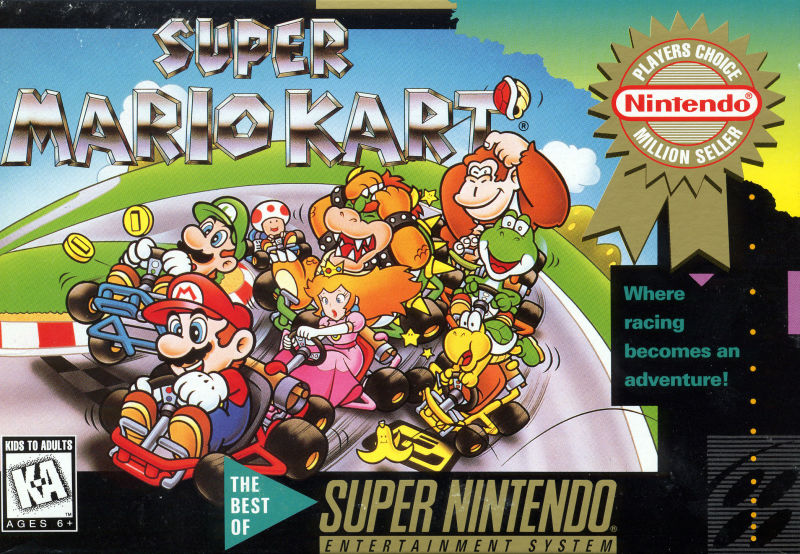
Welcome back, racers! When we last left off in our overview of racing games, Nintendo had just released Super Mario Kart, changing the landscape of racing games forever.
And seascape. And skyscape. And…
Racing games had been finding ways to vary themselves to stand out from the crowd long before Mario Kart came onto the scene, whether it was via unique vehicles (spaceships, snowboarding, roller skating) or gameplay elements (vehicle combat, non-linear tracks, platformer mechanics), but they were all generally content to just share the label of “racing game”. After Super Mario Kart, however, it became abundantly clear that the racing genre was splitting up into several distinct sub-genres, each starting to be championed by franchises rather than single games. For this article, we’ll be looking at each sub-genre independently, explaining what makes them unique and what games best exemplify their playstyles. Let’s ride!
Racing Simulators: Everything Except the Traffic Jams and Gas Prices
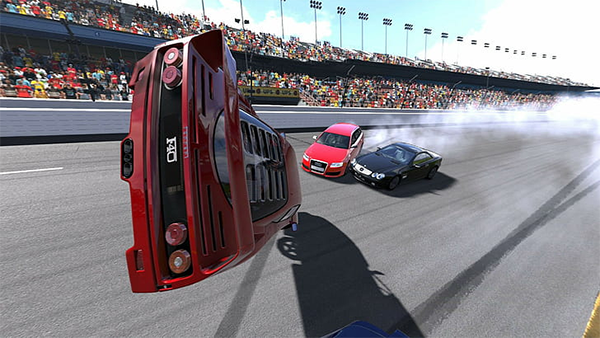
By the early 90s, video game technology had gotten advanced enough that developers could focus on not just making racing games, but realistic racing games. These games will take factors like friction, aerodynamics, and weather into consideration to make sure the vehicles behave as realistically as possible. They can even require you to keep track of things such as fuel levels or tire condition, with dire consequences if you don’t pull over to the pit stop to tend to these in time. As a general rule of thumb: In most other racing games, it’s usually assumed that you’ll keep your foot on the gas at all times and rarely, if ever, use the brakes. Try that in a racing sim, and expect to see your car flip over five seconds in and slam into a barrier in lovingly-rendered detail.
Which, to be fair, probably IS the appeal to some people.
These games, far more than the other racing sub-genres, also take pride in how how realistic they look as well, taking great pains to create photorealistic recreations of real world racetracks and working with automotive manufacturers directly to make sure that their cars are portrayed accurately in game. Because the focus on realism usually results in a notoriously high difficulty curve (and you often need quite a beefy PC to even run these kinds of games to begin with), racing sims tend to have a pretty niche audience compared to the other two major sub-genres, with one notable exception that we’ll get to in a moment.
We already discussed the first true racing simulation game last week with Geoff Crammond’s REVS, released in 1984. The first game to popularize it, however, was 1989’s Indianapolis 500: The Simulation, created by Papyrus Design Group. This game strived to be as accurate a recreation of the 1989 Indianapolis 500 race as possible at the time (right down to the same qualifying order as the real race), and any changes the player made to their car would noticeably alter its performance. This was the first game to really establish racing sims as being wholly unique from other kinds of racing games before Mario Kart would necessitate the need for sub-genres.
In 1991, the first racing sim on a console would appear in the form of Human Entertainment’s Fastest 1 for the Sega Genesis, while 1992 (the same year as good ol’ Super Mario Kart) saw Geoff Crammond back in the driver’s seat to create Formula One Grand Prix, which became popular enough that entire racing leagues emerged where people would compare their race times to other drivers. Meanwhile, Papyrus Design Group showed no signs of slowing down, releasing several additional racing sims during this time. Their biggest contribution would undoubtedly be NASCAR Racing in 1994, the first online racing game (of any sub-genre). The ability to actually race others across the globe ushered racing sims into a whole new era.
Any rumors regarding the true owner of Papyrus Design Group are, of course, completely unfounded.
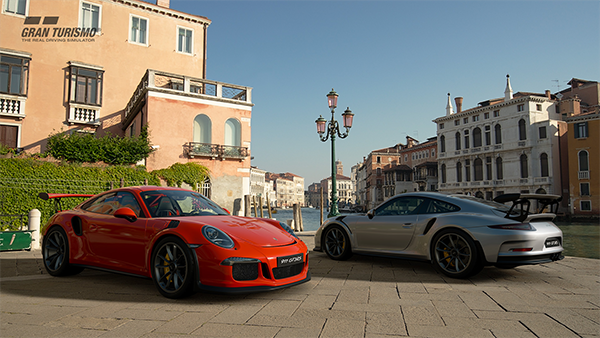
In 1997, the Racing Sim world would be taken completely by storm with the arrival of Gran Turismo. Designed by Kazunori Yamauchi exclusively for the PlayStation console, it went on to become the best-selling game on the console and is still the highest-rated racing game of all time. Gran Turismo didn’t just prove that racing simulations could succeed on consoles, it proved that they could become mainstream, household names despite their notorious difficulty. Gran Turismo would go on to become a flagship franchise for the PlayStation, having a major release on almost every console they’ve made since and becoming PlayStation’s highest-selling exclusive franchise. It even managed to secure a Guinness World Record for the largest number of cars in a single racing game with 2013’s Gran Turismo 6 (1,237 total, for those curious).
No, that’s not a photograph. I was NOT joking when I said these games take pride in their realism.
There have been many other racing sims created since Gran Turismo, of course - the franchise is a PlayStation exclusive, after all, so folks on other platforms need to get their fix elsewhere. Notable examples include Papyrus’ (yes, them again) Grand Prix Legends in 1998, ISI’s rFactor in 2005, Kunos Simulazioni’s Assetto Corsa in 2010, and Slightly Mad Studios’ Project CARS in 2015.
Kart Racing: Where Road Rage is Encouraged
When Super Mario Kart launched, it inspired countless other games that sought to copy its unique formula. Most of these games were written off as “Mario Kart Clones” at first, but much in the same way that “Doom Clone” eventually gave way to the creation of the First-Person Shooter genre, these games too eventually inspired the less-dismissive label of the Kart Racer.
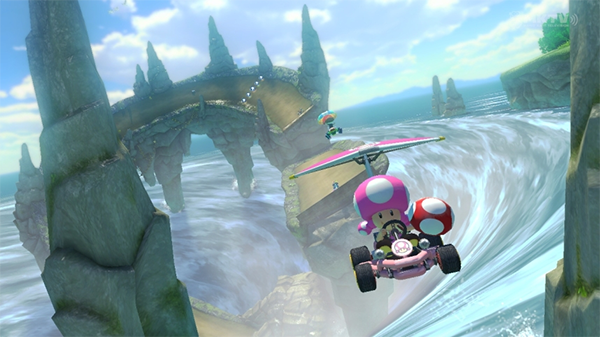
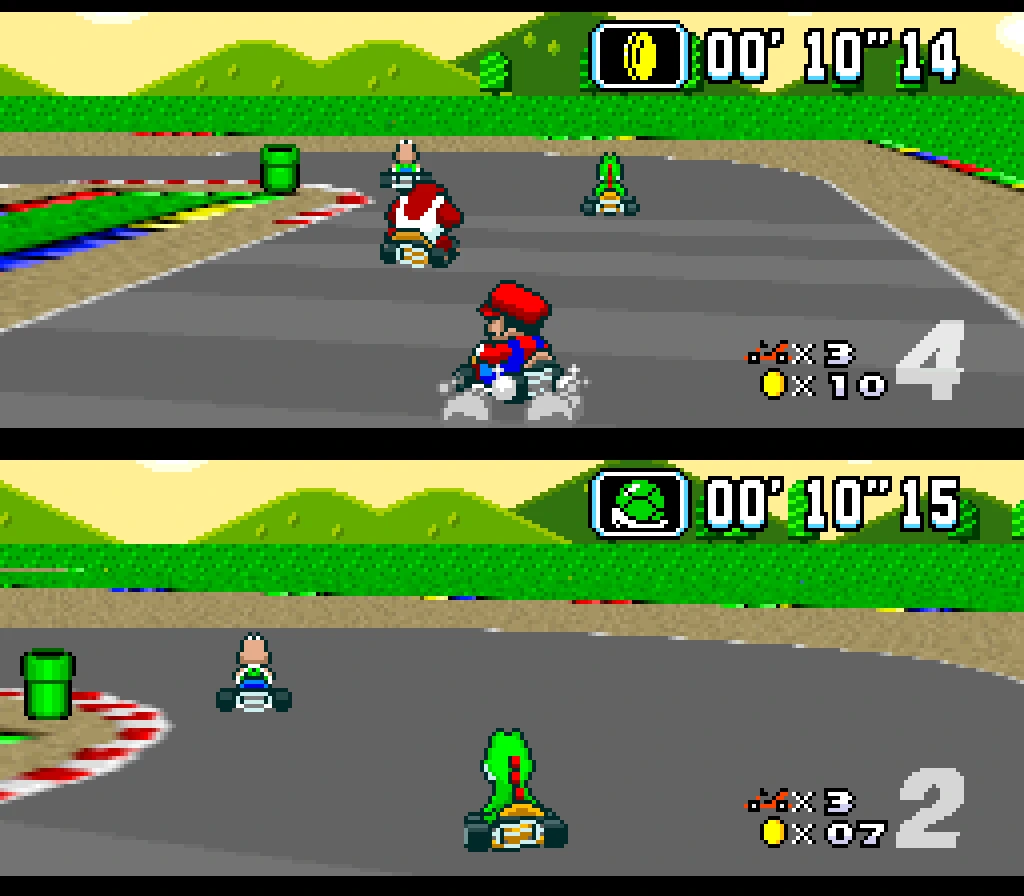
Now to be fair, even the new label of Kart Racer was a bit of a misnomer. These games don’t always have go-karts as their primary vehicles - even Mario Kart itself has since started including other options such as motorbikes and ATVs! The real key distinction for this sub-genre is the gameplay and presentation: Tracks are more akin to roller coasters than race courses, with obstacles far beyond the barriers on the sides of the track peppered throughout. Physics take a back seat to spectacle, and players get over-the-top items or weapons that they can use to actively hinder opponents rather than just trying to outrace them. Controls are usually simplified to gas/brakes, steering, using items, and some form of drifting for tight corners. In this genre, the in-game drivers are typically highlighted far more than the cars - you’re not racing in a Ferrari or a Porsche, you’re racing as Mario or Crash Bandicoot or Spongebob Squarepants (it probably goes without saying that this is a very popular genre for licensed properties). In short, kart racing focuses on chaotic fun, not realism or pure skill. This makes them very popular among both younger and casual gamers, as even the worst player is just one power-up away from pulling off a come-from-behind victory.
“Now I am become Death, the destroyer of worlds.” - Your Little Brother in 8th Place
As has been repeatedly established at this point, this specific sub-genre was officially kicked off by the release of Super Mario Kart in 1992, and the Mario Kart franchise has remained the reigning king of this kind of racing game ever since. Consistency and polish are their keys to success in this department: While each Mario Kart game brings something new to the table - 1996’s Mario Kart 64 was in full 3D, 2003’s Mario Kart: Double Dash!! put two characters in a single kart, 2008’s Mario Kart Wii introduced bikes and motion controls, etc. - at the end of the day, it’s still the same Mario Kart experience people come to expect, just with new characters, karts, and tracks. However, by keeping each release tied to a specific console (you’ll never see two new Mario Kart games on the same Nintendo system) as well as being… well… just that good, people are always more than happy to welcome the franchise like an old friend when it returns. This has resulted in every new entry in the franchise becoming one of, if not the, top-selling games on that system.
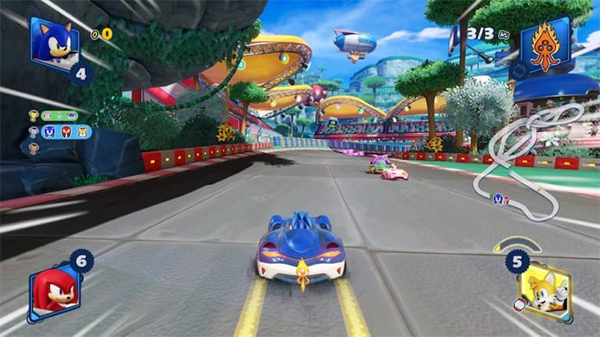
Many companies were quick to jump on the bandwagon after Nintendo’s success, and while none of them have ever matched Mario Kart in critical or commercial success, there’s nonetheless plenty of notable examples among them. Perhaps unsurprisingly, the first franchise to follow Mario’s footsteps was his old rival, Sonic the Hedgehog. Sonic Drift was released on the Game Gear in 1994, less than two years after Super Mario Kart. Sonic would go on to have probably the most varied kart racing history, dabbling with all sorts of different vehicles in a racing career almost as long as Mario’s: He’d race on foot in 1997’s Sonic R, use a hoverboard in 2006’s Sonic Riders, and swap between land, sea, and air vehicles on the fly in 2012’s Sonic & All-Stars Racing Transformed.
And to answer the question asked by every. Single. Reviewer: He races in a car as a handicap. If he raced on foot, it’d be unfair to everyone else.
Other fondly remembered games in this sub-genre include Diddy Kong Racing in 1997, and Crash Team Racing in 1999. Both of these games included a single-player adventure mode where, in between races, you could drive around an open world, interacting with other characters, partaking in side missions, and collecting various doo-dads to unlock new content. 1999 also saw the release of Lego Racers, while 2010 gave us ModNation Racers. Both of these games combined kart racing with something very near and dear to our hearts: User Generated Content. We’ll be coming back to these games in more detail next week, but they’re definitely worth noting now.
Arcade Racing: Don’t Call it a Comeback, We’ve Been Here the Whole Time
With racing sims focusing on realism at the expense of simplicity, and Mario Kart and its ilk fully embracing chaos and randomness, the racing games that had been here all along suddenly found themselves in a strange middle ground. They wanted to replicate the thrill of racing, but not worry about the minute details. They wanted to award skill over luck, but not have a high barrier of entry. These games opted to simply continue doing what they’ve always been doing and, thanks to their origins in the arcade, were given the moniker Arcade Racers.
Arcade Racers combine the pick-up-and-play nature of Kart Racers with the overall presentation of Racing Sims. The driving controls are usually a bit more involved than in Kart Racers (manual transmissions will almost always be an option, for instance), but the physics are far more forgiving than they would be in a Racing Sim - you’ll rarely ever spin out of control from taking a turn too hard, and concerns like tire wear or weather conditions are a non-issue. Courses tend to be set in more exotic locations than real-world racetracks, but never as wild as the ones seen in Kart Racers. The vehicles can be cars, both licensed or fictional, or something more fantastical such as motorboats (Midway’s Hydro Thunder) or spacecraft (Nintendo’s F-Zero). Power-ups that can assist you or hinder opponents can exist, but are almost never randomized, allowing for far more strategy and skill when using them.
As you might have gathered by now, there can be a lot of overlap between Arcade Racers and Kart Racers, meaning it can sometimes be hard to tell if a racing game qualifies for one sub-genre or another (Racing Sims adhering to reality so hard makes them far more self-contained). A good question to ask when trying to figure this out: How much luck is involved? In Arcade Racers, skill is highly favored, with the best overall driver usually being the winner, and randomness is rarely a factor. If weapons or power-ups are involved at all, they are accessible by the same players at the same time, meaning they can be planned ahead for and their threat minimized. Thus, if the answer to that question of randomness is “there’s very little”, then you’re probably looking at an Arcade Racer, regardless of presentation or platform.
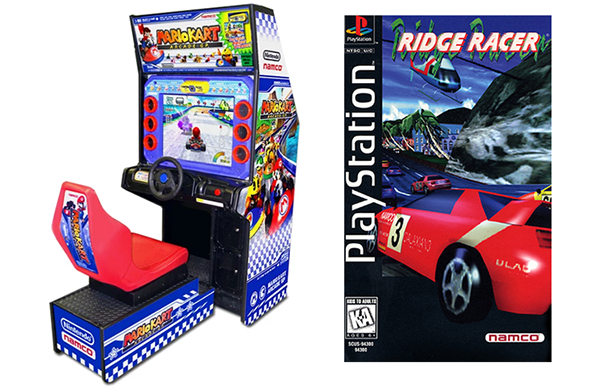
The one on the left is an arcade game, but is actually a Kart Racer. The one on the right is a console game, but it’s really an Arcade Racer. Got it?
After the release of Super Mario Kart 1992, one of the first major Arcade Racers to come out was Sega’s Virtua Racing, released later in the same year. It wasn’t the first racing game to use 3D graphics (in addition to Plazmaline mentioned last week, there was also Namco’s Winning Run in 1998 and Atari’s Hard Drivin’ in 1989), but Virtua Racing was the first to really show what they could do for the racing genre, laying the foundations for future 3D racers.
In 1993, Namco would release Ridge Racer as a direct competitor to Virtua Racing, and 1994 would see the start of two more major Arcade Racer franchises: EA’s The Need for Speed and Midway’s Crusin’ USA. The former would even go on to become one of the top ten most successful video game series of all time, spawning over 20 games and even getting a film adaptation, of all things.
Which was also the source of this reaction image. Yes, really.
The late 90s and early 2000s saw many games of this sub-genre move to consoles. In the process, they also began experimenting with “free form” gameplay, where players weren’t confined to a single track but instead tasked with navigating an open world and hitting waypoints in a specific order faster than anyone else. Angel Studios’ Midtown Madness was the first game to introduce this concept on PCs in 1999, while they would eventually bring the same kind of gameplay to consoles in 2000 with Midnight Club: Street Racing. Microsoft would throw their hat in the ring with the Forza series starting in 2005. Forza is unique in that the franchise regularly alternates between both kinds of Arcade Racing styles: Forza Motorsport for track racing, and Forza Horizon for open-world racing.
Conclusion
And with that, our overview of the history of racing games is complete! From its origins as a surprisingly unsuccessful Atari game to the creation of three major sub-genres all with massive franchises, it’s certainly come a long way. However, we’re not quite done yet! There are a number of racing games that have experimented with user-generated content, a topic quite relevant to The Endless Mission. Next week, we’ll be looking at those specific games in far more detail to see how they directly inspired us when incorporating racing into our editor! Keep those engines revving - we’ll see you next week!
The Endless Mission and the History of Racing Games, Part 1
Hello, everyone! Guess who’s back! Did you all miss me?
… Eh, I’m used to it. I get the same response when I go home for the holidays.
With the Early Access release of The Endless Mission out in the wild, we’ve been hard at work getting ready for the first major content update we’re bringing to the game later this month: The Racer! To that end, your favorite video game historian, responsible for the award-winning (citation needed) series on the history of UGC, has returned to provide another blog series, this time focused on the history of racing games! When did they start? What kinds of racing games exist? Have any racing games taken advantage of UGC in the past? Well, get in, buckle up, and plug in the AUX cord so you can start blasting the soundtrack from your favorite Mario Kart course at full volume, ‘cuz we’re about to rev up and find out!
https://www.youtube.com/watch?v=vMyFkraDzyY Hot Take: This is the best Mario Kart song. Miss me with that Coconut Mall nonsense.
Space Race: The First Racing Game
This advertising flyer for the game is so 70s, my cargo pants turned into bellbottoms just looking at it.
So, just how much of a cornerstone are racing games to gaming as a whole? Try this fact on for size: Racing games are almost as old as the Video Game Industry itself. The very first racing game was Atari’s Space Race, released in 1973. This was only one year after their first release - and the first commercial video game, period - Pong. The gameplay was very simple: Two players raced to get from the bottom of the screen to the top first, all while avoiding asteroids along the way. Still, all the elements needed to constitute a racing game were there. Now, what with this being a brand new genre from the company that basically invented commercial video games, it was totally a smash hit, right?
Well… Er… No, actually. It bombed. It bombed hard.
Artist’s Rendition
As it turns out, people were still perfectly happy with just Pong. In addition to the original Pong, the market at the time was dominated by other companies just making Pong clones. No one felt the need to move onto the next big thing quite yet.
Still, even with things not going quite according to plan, Space Race’s impact on gaming cannot be denied - any and all racing games can trace their lineage back to this game. And for Atari’s part, they didn’t let this failure deter them from the genre at all: A year later, they would release Gran Trak 10, which was the first car racing game, along with being the first game to use a steering wheel controller.
The ad was still hilariously 70s, though. Don’t worry about that.
A Marathon of Firsts
With racing games having gotten their start so early in the history of video games, many early entries in the genre introduced new concepts that would become not just mainstays in racing games, but in video games as a whole. Let’s try to cover as many of those as we can, shall we?
In the same year that Atari put out Gran Trak 10 (1974), Taito put out Speed Race (not to be confused with Space Race). It was created by one Tomohiro Nishikado, the man who would go on to create one of the most famous arcade games of all time, Space Invaders. In fact, Nishikado has said in interviews that it’s this game, not Space Invaders, that he considers his favorite work! Like Gran Trak 10, Speed Race used a steering wheel controller, but it also brought its own firsts to the table: It was the first game ever to feature a scrolling background, and it was the first Japanese video game to get brought over to North America.
In 1975, Electra Games gave us Pace Car Pro, one of the very first video games with color graphics. It also allowed up to four players to compete at the same time, a step up from the two-player multiplayer that Space Race offered. 1976, meanwhile, brought in a lot of firsts. Taito was back at it again with Crashing Race, the first “racing” game that instead focused on vehicular combat rather than straight up racing. Sega gave us two racing games this year that broke ground: First was Road Race, which introduced a three-dimensional, third-person perspective to racing games, and second was Moto-Cross, a bike racing game that was the first game to have haptic feedback - the handlebar controls vibrated whenever you crashed. When it was brought to America it was rebranded as Fonz… Yes, as in Happy Days Fonz. Go figure.
Eeeeeeey…
1976 would also see the release of Atari’s Night Driver, the first racing game that used a first-person perspective. However, all of this would pale in comparison to one of the more… infamous legacies that was established that year, courtesy of Exidy’s Death Race. Death Race had gameplay much like Crashing Race, but instead of trying to slam into other cars, you were instead tasked with running down monsters to score points. Very humanoid looking monsters that let out a painful screech when hit and left behind a tombstone. This made Death Race the first video game to spark media controversy… Which, naturally, resulted in it becoming far more popular than it would’ve probably been otherwise. D’oh.
The first controversial video game, and certainly not the last.
Racing games entered the 80s in a big way with Namco’s Rally-X, the very first game to feature background music. It also had scrolling in multiple directions (although Atari’s Super Bug did that first in 1977) and an on-screen radar for keeping track of opponents. Meanwhile, 1982 would bring us “The Big One”: Pole Position. In addition to being the first racing game to feature a real-life track (Japan’s Fuji Speedway), this Namco classic was the highest-grossing arcade game in 1983 and would go on to be a massive influence on all racing games that would come after.
If Space Race invented racing games, this vibrantly colored classic defined it.
1984 was a BIG year for racing games (and dystopian novels, but that’s neither here nor there). This year saw the release of Plazmaline by Technosoft, a space racing game that’s considered the first game to use 3D polygon graphics, as well as Nintendo’s Excitebike, the first racing game with a track editor (yes, we’ll be getting back to this one and how it ties into UGC as a whole in a later article, don’t you worry). Additionally, up until this point, most racing games were not particularly realistic due to system limitations at the time. However, this would change with the release of Geoff Crammond’s REVS, the first racing simulation game that focused on providing a racing experience similar to real life. This would be the beginning of racing games branching off and settling into specific sub-genres, something that we’ll get into more next time.
And Now, For The Most Obvious Entry In This Article
It’s-a me! The game you were all thinking of when you first started reading this!
By the mid-80s, most of the major conventions of the racing genre had been established, with new games simply using better technology to improve on the concepts that came before. However, in 1992, those crazy folks over at Nintendo would completely revolutionize racing games with the release of Super Mario Kart. Until this point, most racing games were either “arcade” racing that focused on fun, or “simulation” racing that focused on realism. Furthermore, very few, if any, racing games put much thought into the people actually doing the racing - it was just you the player and a bunch of generic racing dudes.
Well, Super Mario Kart would say “Phooey!” to all that. In this game, you could play as one of eight different Mario characters, each with their own unique playstyle and personality on full display. While arcade racers already put being fun over being realistic, Super Mario Kart rejected any semblance of realism and instead fully embraced an overtly cartoony style of racing, with hopping, drifting, and dodging all sorts of obstacles across many fantastical tracks. It also introduced a heavy amount of randomness and emergent gameplay unseen in racing games previously. Before in racing games, victory would almost always go to whoever was the most skilled at the game. Now, with the help of randomized power-ups, anyone could pull off an underdog victory and come out on top.
I swear to Miyamoto, if you even so much as LOOK at me with that Red Shell…
Super Mario Kart would go on to achieve massive critical and commercial success, becoming the 4th best selling Super Nintendo Entertainment System game and appearing on countless “Greatest Games of All Time” lists. Mario Kart would quickly become a flagship series for Nintendo, seeing a major release on virtually every Nintendo system that has come since. Even beyond that, however, Super Mario Kart would kickstart one of the biggest subgenres of racing games - The Kart Racer - with many, many other companies jumping on board making their own takes on the concept. Most would fade to obscurity, but a few would rise through the ranks and become equally memorable in their own right. Even so, the Mario Kart series remains one of the best examples of this kind of racing game thanks to its high-quality polish and charming personality.
And hilarious memes. Can’t forget those.
Conclusion
We’ve only made it to the early 90s in our overview of the racing genre, but with how much Super Mario Kart changed the game, this is as good a spot as any for an intermission. Now that all the groundwork and genre conventions have been laid, racing games from here on out become less about innovation and more about perfecting what’s already there. Come back next week for lap 2 of our series, where the sub-genres get solidified and major franchises start coming out in full force. See you then!
For our first update in Early Access, we've included fixes and additions for Adventure Mode, the Editor and more.
Adventure Mode Fixed: Bug with player not dying after failing a side mission Fixed: Bug where action/hacking toggle being present before it is unlocked Fixed: Fearn should no longer disappear during wall destruction cutscene
Editor Fixed: Objects lose references when duplicating an object Fixed: Window fails to scroll when using the arrow keys with Auto-Complete Fixed: Game light fails to update until playing the game Added: Smart UI feature upgrades, including button transition support for smart buttons, mask support for images, and improvements to the display of nested classes in the inspector Fixed/Added: Quality of Life updates to address small issues in Editor
Auto-versioning incrementing and smart UI for smart conditions
Added simple sequence script to allow players to more easily make their own starting UI
Removed "Reset" function from several objects keeping legacy support)
Improvements to Smart UI and Simple Inventory
Global Fixed: Video Quality Menu's Confirm and Revert buttons are now outside scrollable window Fixed: Notification of invalid email upon account creation
----------
Got a feature request or need to report a bug? Use the pause menu's Send Feedback button and include as much detail as possible.
Join the conversation on our official Discord: http://discord.theendlessmission.com
We're In Early Access!
Good news, everyone: The Endless Mission is available now on Steam Early Access. Now, how about a Launch Trailer?
https://www.youtube.com/watch?v=8Vq-CSXDZLg
Thank you for your continued support and we'll see you in-game!
~ Batcat and The Endless Mission Team
p.s. If you haven't already, be sure to join our official Discord: http://discord.theendlessmission.com
Introducing the Voice Cast of The Endless Mission!
We're excited to introduce the voice actors for The Endless Mission, a sandbox style creation game where a rich narrative leads players through a world unlike any other. Having previously made their mark on iconic franchises like Mass Effect, Halo, Dragon Age, Assassin’s Creed, Diablo, and Fallout, the talents of Laura Bailey, Jennifer Hale, Alix Wilton Regan, Sara Amini, and Courtenay Taylor will all now be setting off on The Endless Mission later this year.
See them in action and get a glimpse of the story here:
https://www.youtube.com/watch?v=xVNZ4s38Awg&feature=youtu.be
The Endless Mission and the History of UGC, Part 7
Well, here we are. The final article of this series. It’s been quite a journey - we laughed, we cried, we had a heartfelt montage set to a song by Phil Collins. Over the past few weeks, we’ve been looking at the history of User Generated Content and all the myriad ways that it presents itself in video games, from level editors to full-blown game creation kits. UGC has come a long way since 1983’s Pinball Construction Set, with each game and piece of software building on everything that came before it. For our final article in this series, however, we will be looking forward instead of back. It’s time to see what kind of changes and innovations are in store for UGC in the future.
… And by “the future” we, of course, mean “The Endless Mission”.
Pictured: Our Marketing Team, excited that we’re finally talking about OUR game for a change
You Gotta Walk Before You Can Run (And The Endless Mission Lets You Do Both)
A lot of games with UGC features in the past came with limitations: In Super Mario Maker, you’re making levels specifically in the Super Mario template. Whatever you create in Halo 3’s Forge will always be used in the context of a multiplayer FPS. This is great for folks who are just starting out, as all the framework has been laid out for them, so they can focus solely on one or two aspects. You don’t have to know how to code up a fighting game just to make stages in Super Smash Bros. However, this also means that you can never expand beyond these limitations - no amount of creativity or ingenuity will let you make a racing game in Rollercoaster Tycoon (no, the go-kart track doesn’t count). Meanwhile, other UGC-heavy software goes in the complete opposite direction, tossing you into the deep end with no way to scale back. Sure, RPG Maker will let you build an RPG from the ground-up, but you always start with a blank canvas. Want to just add an extra dungeon onto a preexisting RPG, with all the pre-established mechanics in place? Sorry, no can do. Better start learning code. And math.
The only appropriate reaction to realizing you’ll have to use math
One of the goals of The Endless Mission is to break down these barriers and have every level of UGC complexity available in one game. You can start out loading up prebuilt games and making minor changes - adjusting some variables here, placing an extra power-up there, and so forth. Or maybe you start by doing a simple find-and-replace mod where you take out all of Enemy A and replace them with Enemy B. One you’ve mastered that, you can move onto crafting entire levels from scratch. All the behind-the-scenes code necessary for the game to behave the way it should is already there without you having to write it up, but everything about the level itself, from geometry to enemies to mechanics used, is up to you. The ultimate goal, of course, is to not have to rely on any prebuilt code at all. If you want to build a game entirely from the ground up, writing your own code and using your own assets, The Endless Mission will let you do that.
This sense of progression -- this pipeline from minor edits to crafting entirely original games -- is the crux of The Endless Mission. Our hope is that someone with absolutely zero experience in coding or game editing can pick up The Endless Mission and, after spending enough time with the game, can create something that is completely, uniquely theirs. The Endless Mission will turn players into creators in ways that no other game has done before.
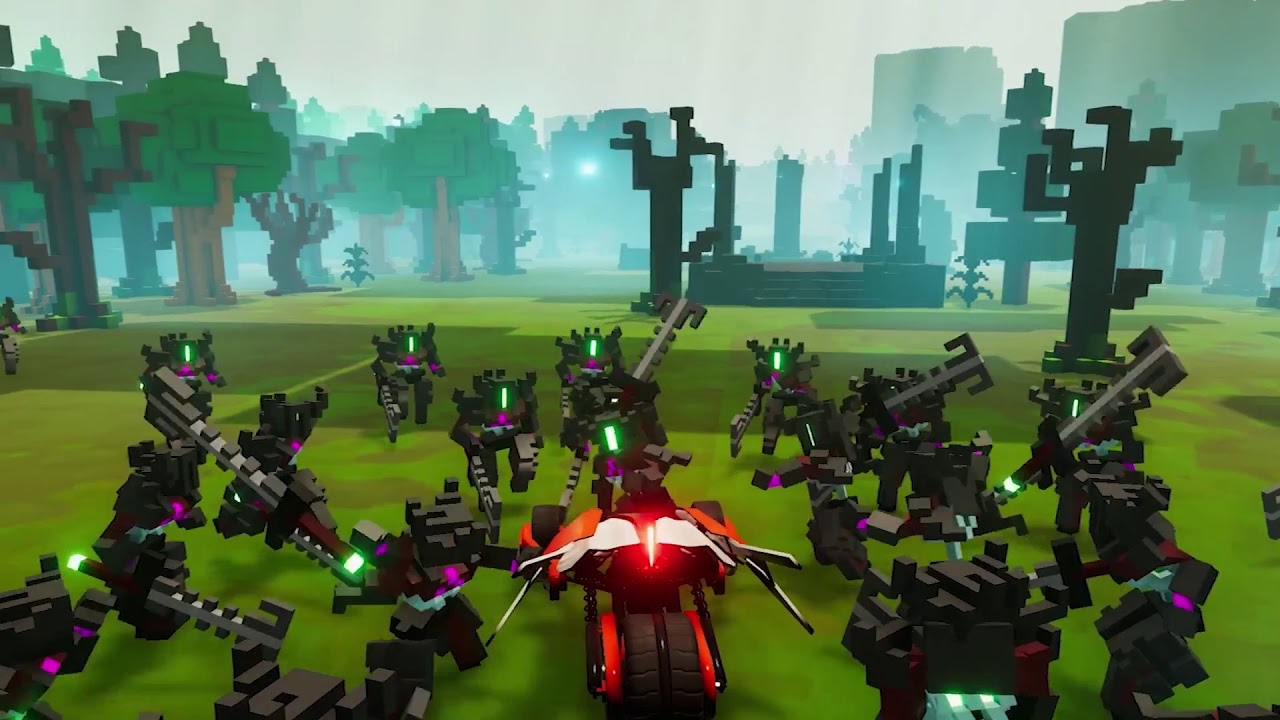
Today, you’re putting a fully-controllable race car in an otherwise-standard RTS just for a laugh. Tomorrow, you’ll be making a car-based RTS from scratch because that joke ended up being actually fun. That’s the power of The Endless Mission (and cars).
An Endless Unity of Games and Engines
… Yeah, we might’ve forced that title a bit, sorry.
One of the biggest roadblocks with games that have UGC features has always been the fact that not all the skills one learns while using those features are transferable to other platforms. Sure, conceptual lessons like “treat the player fairly”, “playtest and iterate”, and “please stop using the editor to make naughty images” can and should apply across multiple games (especially that last one), but knowledge regarding specific toolsets and their strengths and weaknesses do not. It doesn’t matter how much you know about using Dreams or the insanely awesome content you’re able to craft in it (and you can indeed craft some insanely awesome things) - the moment you move onto another game, you’re back to square one. Not even game making tools are immune to this - move from Adventure Game Studio over to M.U.G.E.N, and you have to learn an entirely new interface and non-standard coding language just to get up to speed.
The pineapple symbolizes a new UGC Tool. Captain Blackclaw symbolizes the huge leap that’s required whenever you want to learn a new tool. Our High School Lit teachers would be proud.
Again, making the skills you learn be transferable to other applications was a major goal for us when creating The Endless Mission. We wanted it to be so that anyone who mastered The Endless Mission’s full editor (after working their way up to it - see the previous section) would be able to move onto other, professional game-making tools without missing a beat. How do we plan to accomplish this? Well, The Endless Mission is created in Unity, one of the biggest and most-used game engines in the world. Why not simply base our in-game editor on what we used to create it?
If The Endless Mission’s editor looks familiar to you, congratulations! That was totally the point.
When creating the editor for The Endless Mission, we based many of its features on what Unity already uses. Concepts such as dividing the game up into scenes, having a game-wide hierarchy, tools like the library or inspector, and even the decision to use C# as the editor’s default programming language are all based on what Unity uses. In short, The Endless Mission’s editor is essentially a “shell” around Unity - a Unity editor inside a Unity game.
The end result of all this? We believe The Endless Mission is the perfect on-ramp to learning Unity, as well as other similar professional game engines. Everything in our editor has a direct counterpart in Unity, simply streamlined to function within our game. Whatever lessons and concepts you learn while using our tools will be directly applicable should you choose to move onto Unity. This is called having a transferable skill set, and it’s what sets The Endless Mission apart from the UGC-focused games that came before it: If you can master The Endless Mission at its most complex, you will already have everything you need to master Unity, and the learning skill to pick up other engines.
In Conclusion…
User Generated Content has come a long, long way since the days of Pinball Construction Set, Lode Runner, and Castle Smurfenstein. What once was just unofficial mods and basic level editors has paved the way to creating full games and other experiences, and it is our hope that The Endless Mission will continue this proud tradition. For us, it’s not just about giving players the power to create whatever they want, but the resources to learn content creation at their own pace and the ability to use that knowledge, both conceptual and technical, outside of the game. We want The Endless Mission to not just be the next generation of UGC-focused games, but the first one to provide a means - not just the desire - for players to turn their creativity into a career, with a community that will help and support them every step of the way.
What will you make in our game? The possibilities are simply... endless (... yes, we’ve been sitting on that pun until just the right moment)
Thank you for joining us on this journey through the history of UGC. We will be starting a closed beta very soon for those of you who signed up for it, and we will officially launch into Early Access not long after. Here’s to the future of User Generated Content, and we hope to see you all soon in The Endless Mission!
The Endless Mission and the History of UGC, Part 6
Hey there, folks! We’re in the home stretch now! Yes, sadly it’s true: While we’ve all been having fun these past few weeks getting our learn on, next week’s article will be the last in this series. We know, we’re inconsolable, too.
We haven’t been this upset since paying full price for a game right before the Steam Summer Sale
We’ve covered a lot of ground these past weeks looking at the history of UGC. We’ve seen games about making games (and more!). Software that lets you make fully-featured games from the code on up. Fans taking matters into their own hands and modding games that otherwise had no UGC to speak of. What could possibly be left to go over in this penultimate article?
Literally Everything Else
… Oh. Uh… Yeah, there’s that.
To be a bit more specific about it: We’ve been spending most of our time discussing games and software where UGC - specifically, the kind of UGC that involves game making - is the “main” objective. However, there are many, many games out there that have other kinds of UGC as well. Character creators, level editors, simulation games with a “sandbox mode”... Any game with any sort of editor or creation system in place totally counts as UGC! This is especially true in the modern era, where platforms like Steam Workshop allow users to share their creations with players the world over.
Now, it probably goes without saying that we can’t cover every single game with UGC elements like this, and even trimming it down to a “Greatest Hits” selection would still be quite large. Thus, we’ll be going through examples much more quickly here than in previous articles, highlighting what high quality or unique UGC each game brought to the table before moving on. Now hold on tight - the UGC Train has no brakes!
Though maybe it should
Utopia (1982)
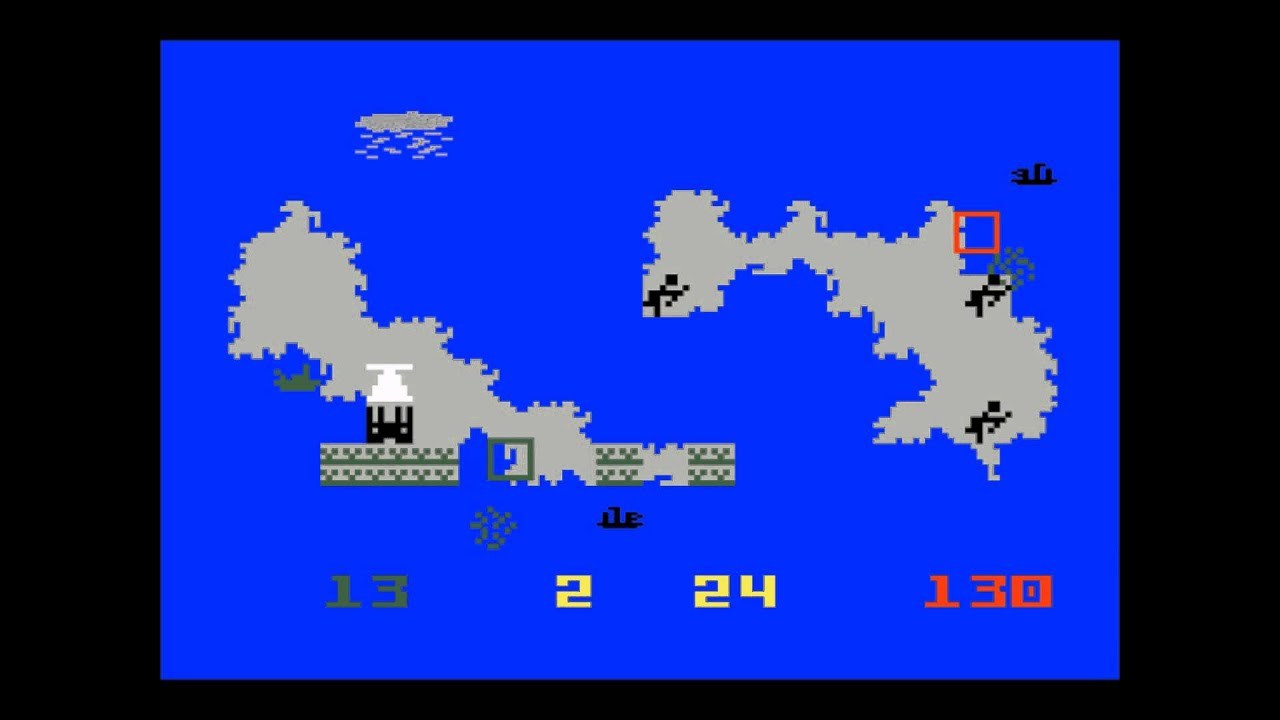
Simulation and construction games fill a weird niche in UGC-focused titles: sure, you have a lot of freedom to build stuff, but only if you have the resources to do so and follow the rules. Does this make them “real” UGC games, since you can’t just build whatever you want? If we assume they at least get an honorable mention, then the first game in this genre would be Utopia, released on the Intellivision back in 1982 (yes, even before the first “true” UGC title, Pinball Construction Set). This multiplayer game had two players build up cities on adjacent islands to see who can be more successful.
What do you do when you literally run out of room on the cartridge before implementing any sort of opponent AI? Just claim the game is multiplayer-only! Yes, really.
Lode Runner (1983)
Released the same year as Pinball Construction Set (and Castle Smurfenstein), this puzzle-platformer game contained 150 levels in addition to a full-blown level editor. While not devoted solely to creation like PCS was, this marked one of the first times a game contained a separate level editor mode.
Excitebike (1984)
In this NES classic, players could design their own tracks to race on, making this not only one of the first Nintendo games with UGC (a tradition they’d proudly continue, as we have already seen in previous articles and will continue to see in this one), but also one of the first editors available on a console platform, proving that UGC would not only be a “PC thing.”
Wrecking Crew (1985)
Another Nintendo classic, this puzzle game starring Mario also contained a level editor, beating out Super Mario Maker by a whopping 30 years.
Plumber, Doctor, Demolitionist… That deadbeat Mario can’t hold down a job for more than five minutes, can he?
SimCity (1989)
If Utopia was the first construction/simulation game, SimCity is the game that made the genre popular, spawning a metric ton of spin-offs. Like Utopia, there was no “sandbox” mode where you could build whatever you want with no restrictions, but it was still fun seeing what you could create even while following the rules and restrictions the game had in place.
The Incredible Machine (1993)
This cult-classic puzzle game tasks you with fixing broken contraptions clearly inspired by the works of cartoonist Rube Goldburg. In addition to the puzzles, there was a “freeform” mode where players could build whatever you wanted, whether they were complete machines or even more puzzles for others to solve.
Lego Racers (1999)
Given that Lego is all about building things, it’s only natural that numerous Lego video games would have some level of UGC in them. The most famous of these would probably be Lego Racers - in this game, not only was your avatar fully customizable, but you could build your car brick by brick, with unique physics based on how many pieces you used and where they were placed. Just be prepared to have that menu music stuck in your head forever.
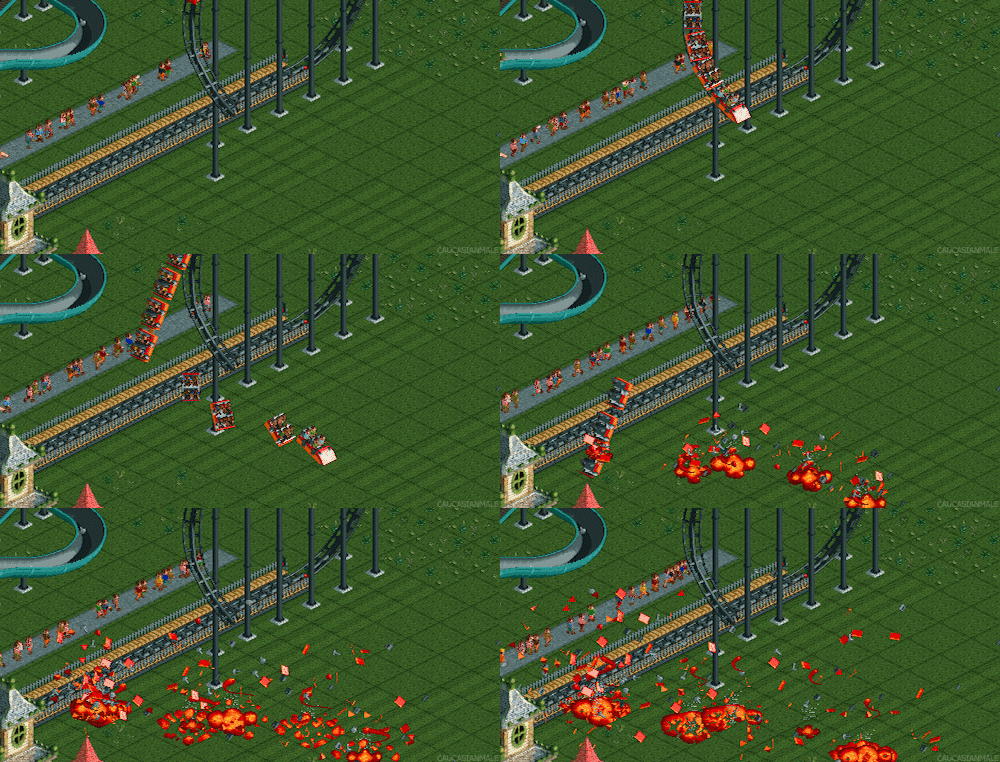
Well, we couldn’t use that gif above and not tip our hat to the game that provided it, now can we? RollerCoaster Tycoon was all about making and managing your own amusement park, with emphasis on the fact that you could lay out the track for certain attractions (like roller coasters, naturally) however you wanted, rather than just plopping down a static building. And yes, this absolutely included just letting your coasters fly off the rails and slam into populated areas. You monster.
The Sims (2000)
Out of all the spin-offs SimCity created, The Sims was far-and-away the most successful. This game essentially “scaled down” the scope of SimCity by having you manage a household of people (called Sims) rather than an entire city. You had lots of control over your Sims’ appearances and how they developed, but if you ever got tired of having them pass out in their own filth taking care of them, you could simply load up an empty lot and build your dream home with unlimited funds instead. You could also take pictures and save them in a family scrapbook, which many players used to tell epic stories about them passing out in their own filth.
Animal Crossing (2001)
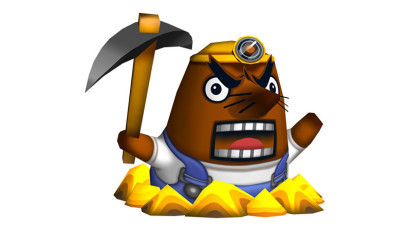
Not entirely unlike The Sims mentioned above, this charming little life simulator is all about living in a small town and making friends with all your animal neighbors. The ability to customize both your avatar and your home have existed since the original game, but due to the massive popularity of these elements, they’ve been expanded on in every entry. It’s gotten to the point they’ve even made a spin-off title, Animal Crossing: Happy Home Designer, that’s all about making your own homes!
We were going to write a hilarious, in-character rant for Mr. Resetti that would be longer than the rest of this article, but then we remembered we aren’t paid by the word for this
Ultimate Ride (2001)
Loved building roller coasters in RollerCoaster Tycoon, but hated all that pesky management stuff? Ultimate Ride is the game for you! This Disney(!) game let you build and ride any coaster that you wanted in full 3D (hey, this was impressive back in 2001), with no monetary restrictions. There was a mission mode, but rather than managing funds or keeping parkgoers happy, you were tasked with making coasters that not only met certain requirements, but also remained safe enough that people could actually ride them, using the game’s surprisingly detailed physics simulation system to track G-Forces and the like. This game was a great example of UGC being used for educational purposes - in this case, physics and structural engineering.
City of Heroes (2004)
Character customization has been a thing in Massively Multiplayer Online games since the very beginning - after all, how else are you going to make your avatar unique compared to everyone else’s? City of Heroes, however, decided to take it one step further and introduced the Mission Architect. This feature allowed you to create custom quests in the game that other players could then play through and even earn EXP and items from. It was pretty ambitious for an MMO… and hey, it beats doing the same “kill 20 sewer rats” mission over and over to level grind.
Miis (2006)
Here’s a weird, not-quite-a-game-exactly entry for ya: when the Nintendo Wii launched, it came with the ability to create system-wide avatars called Miis. What made Miis unique compared to other avatar features in the past is how they interacted with games - many multiplayer games gave you the option to play as your Mii in addition to the usual cast of characters, giving your Mii a lot more prominence and importance than usual for this kind of avatar. Even if playing as your Mii wasn’t an option, there was a good chance that any and all Miis you created on the system would pop up in cameo roles in any given game (usually in crowd shots). This clever integration of UGC into all sorts of games is still used by Nintendo today, and there are even a few games (Tomodachi Life, Miitopia, etc.) that are based entirely on these little guys.
Halo 3 (2007)
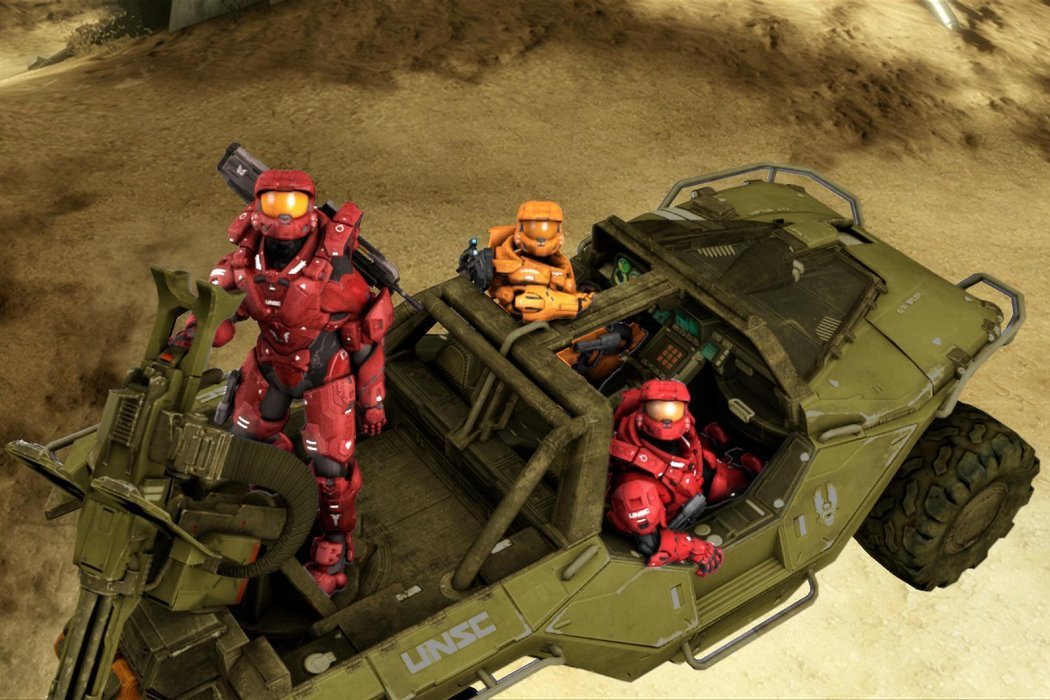
The third entry of this gobsmackingly successful franchise introduced The Forge, a game mode where players could edit multiplayer maps and create custom games. While this mode would be included in many future Halo games as well, this technically isn’t the first time the franchise dipped its toe in the UGC pool - users were already using previous games in the franchise to create machinima, such as the ever-popular Red vs. Blue series that started in 2003 using the original Halo: Combat Evolved.
The office is still taking bets on which will end first: the Halo franchise or Red vs. Blue
Spore (2008)
Also jokingly referred to as “SimEverything”, Spore was a simulation game about tending to the evolutionary rise of lifeforms on a planet, from primordial ooze to space-traveling races. In addition to having your species evolve naturally through gameplay choices, you could also use the Spore Creature Creator to just jump right in and handcraft the perfect specimen. Additionally, the creatures you created didn’t just change your game - as you traveled to other planets, the creatures you encountered there were ones that other players had brought up, meaning every player’s creation had an impact on the game as a whole.
Super Smash Bros. Brawl (2008)
In addition to finally making the dream fight of Mario vs. Sonic a reality (look, this was a big deal for 90s kids, okay?), Super Smash Bros. Brawl brought a Stage Builder mode to the franchise. The one in Brawl was very basic, but subsequent games would improve on it more and more. Also, those Miis we talked about earlier? Starting in the next game, they’d become playable fighters, too, and both them and stages could be shared with others online. Time to go make a Mii of [YouTube Influencer you disagree with] and beat the stuffing out of them!
Overwatch (2016)
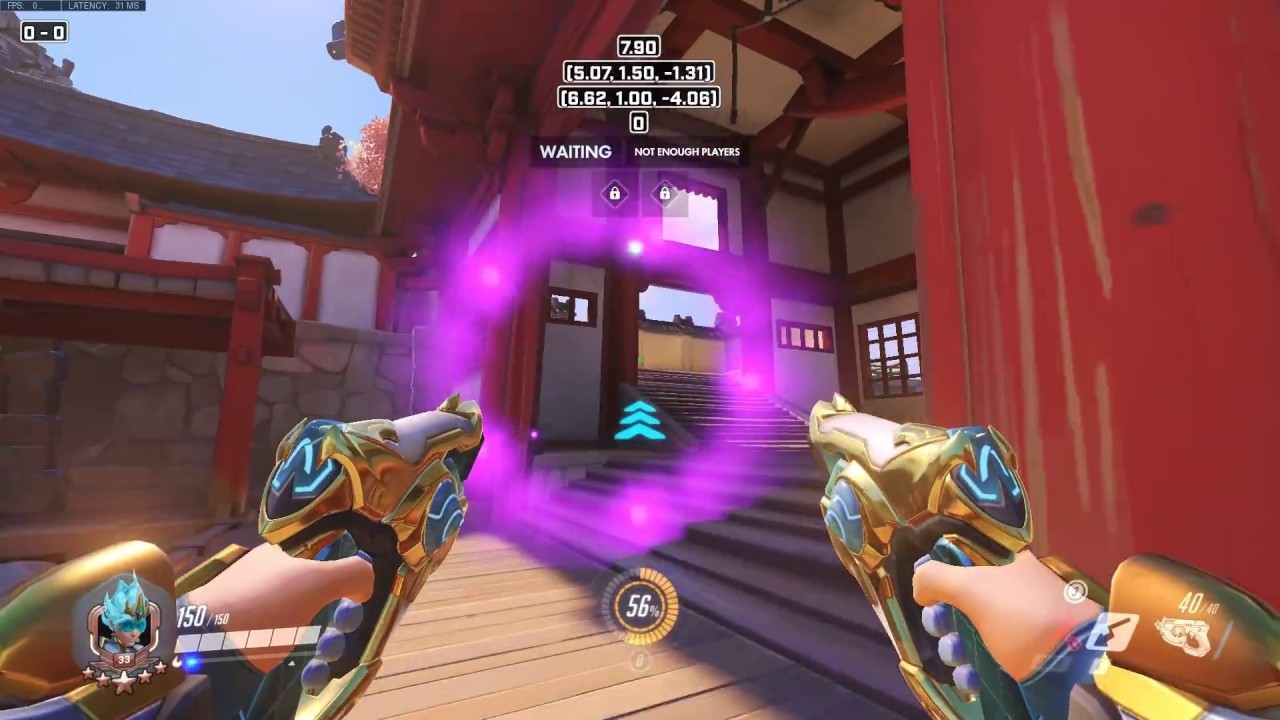
Most games that have a built-in editor will let you do things like build levels or customize characters. When Overwatch debuted its Workshop mode, however, it went the extra mile, letting players straight-up write scripts and edit the code directly to create drastically new and different game modes. It can be pretty surreal booting up a team-based FPS and then playing a 2.5D beat-em-up instead, but you do you.
And then someone found a way to recreate Portal in it, because of course they did
Planet Coaster (2016)
Okay, one more roller coaster game for the road: Planet Coaster brings all the best aspects of previous theme park simulators together, having both a robust career mode where you have to manage funds and research as well as a sandbox mode where you can go nuts. It also features full freeform building for all structures, allowing players to create some truly unique designs and setpieces. You can even import your own 3D models into the game if the items that are already there aren’t enough!
In Conclusion…
Phew! That was a lot of games. They may not have fully embraced UGC as their “main” component (or had it thrust upon them by modders) like some of the games we discussed in previous weeks did, but their impact and influence should not be denied. Any one of these games could be the first step on someone’s journey from player to designer, and indeed, more often than not, it is. After all, someone enjoying a game and then deciding to check out its side-mode devoted to UGC is far more likely than them, say, downloading Garry’s Mod out of the blue and building a new game from scratch.
Be sure to check back next week for the epic series finale of The Endless Mission and the History of UGC! Don’t worry, there won’t be any arbitrary, character-wrecking plot twists that exist solely to “subvert expectations” - instead, we’ll be looking at where we go from here, and what the future of UGC will contain (spoiler alert: the answer may involve The Endless Mission). See you then!
We want to connect with you and begin testing the various features, tools, stories, and elements throughout the game. Some times we'll ask what you think about certain sections, while other times we'll be looking at the entire game from top to bottom. We'll explain more about that as the process goes on.
For right now, we need to learn a bit more about you so our testing can be as complete as possible. If you've been selected for the first round, you'll be getting more updates from us soon! If you're not, don't worry! We're going to be steadily increasing the size of the closed beta as we get closer and closer to our Early Access Launch (the number of beta participants will be determined by the number of eligible respondents).
Thanks again and we can't wait to share what we've been working on with you!
~ The Endless Mission Team
p.s. We encourage you to share this survey with friends that might be interested as well. You can do so with this link.
To request a spot in the Closed Beta, please complete the following steps:
Fill out the Sign Up Form completely and accurately by Thursday, June 27th @ 11:59p PST
If accepted, you'll hear from us with further instructions at the email address you provided during the sign up process
The Endless Mission and the History of UGC, Part 5
Hey there, creators! Who’s hungry for some Mods?
Our investors didn’t appreciate it when we told them our plan to “get more dough” was to start a pizza business
Wait… That’s not the kind of Mod we’re talking about today? Uh… hold on a sec…
Mod Pizza
MOD Pizza is a fast casual pizza restaurant chain based in the United States. Founded in Seattle, Washington, in 2008, MOD has more than 400 locations in the United States and United Kingdom. MOD is a company that is claimed by its owners to be "more about the people than the pizza" and to focus on paying living wages and providing employees with opportunities to give back to the community.
Game Mods
We’ve been looking at a lot of games (and software) that are entirely focused on letting users create new content, but not every game is like that, of course. Many games are all about playing through a perfectly crafted experience, and thus don’t have room to allow users to create whatever absurd things they can think of. There’s nothing wrong with this approach, but it can lead to players wanting… more.
And thus mods are born.
As the old saying goes: Lack of Thomas the Tank Engine in Skyrim is the Mother of Invention
Game mods are any sort of alteration created by users that change how a game plays. As such, game mods can easily be seen as a variation on the more traditional styles of UGC we’ve been discussing in previous weeks. There are many, many different kinds of mods out there, and to try and cover them all would be an exercise in futility. Some merely exist to patch bugs or make gameplay fixes that the original developers did not do. Others add new content to preexisting games, from new weapons and items to entire campaigns. Others still simply replace assets in the game with different ones, either to upgrade the graphics of the game piece by piece or to allow for completely absurd scenarios, like the infamous “Really Useful Dragons” mod pictured above. There are even mods that dig into the game’s code to find and restore content that was removed by the original developers… sometimes for good reason.
Pic Unrelated
Some companies don’t like it when users mod their games - adding a new overpowered weapon that only you have to an online multiplayer game, for instance, is generally frowned upon - but many others, such as Valve and Bethesda, embrace the modding community with open arms. Needless to say, this has resulted in mods becoming an indisputable and massively influential part of the gaming community.
For the purposes of this article, we are only going to look at a handful of examples. There is a large number of massively popular games with equally large modding communities - Grand Theft Auto, The Elder Scrolls, Fallout, etc. - and we simply cannot cover them all. Instead, we’ll be focusing most of our energy on games that had mods that themselves have made a large impact on the industry. But enough talk, let’s get to it!
Castle Wolfenstein (1981)
“This is how a normal person walks, right?” - Castle Wolfenstein’s Cover Artist, presumably
Trivia Time: What is generally accepted as the first video game mod ever created? The original game (as you might have guessed given… ya know… the title of this section) was Castle Wolfenstein, released in 1981, but the first mod created for it wouldn’t come out until two years later in 1983. That’s right, the same year as Pinball Construction Set! Man, 1983 was a big year for UGC of all stripes, wasn’t it?
In any case, back in the early 80s, teenagers Andrew Johnson and Preston Nevins were huge fans of the original Castle Wolfenstein. However, they felt as though the Nazi antagonists weren’t particularly threatening (again: it was the 80s), so they decided to go into the game and replace them with something much more threatening.
Naturally, they choose Smurfs.
Rumors that Gargamel was their third programming buddy are unconfirmed
Using only a paint program, sector editor, and Muse Software’s “Voice”, Andrew and Preston created Castle Smurfenstein, a full-game conversion of Castle Wolfenstein. All the Nazi guards were replaced with Smurfs, complete with new Smurf audio in place of German. They also created new title and closing screens, and even composed a new opening theme. In doing so, they created what is considered the first game mod, opening the door for all others.
The duo would go on to create another mod in the form of Dino Smurf, a parody of the game Dino Eggs, before college would put an end to their anti-Smurf propaganda days. However, their impact on gaming cannot be overstated, as it is because of them that mods thrive to this very day.
And so do Smurfs. Unfortunately.
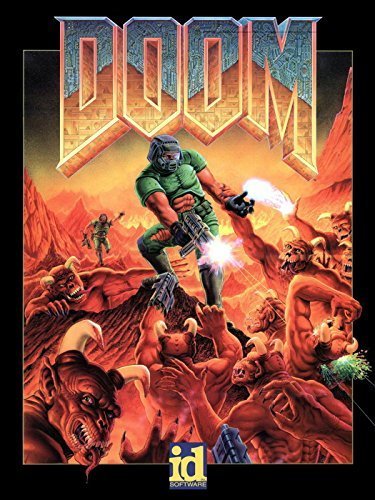
Doom (1993)
It’s been 26 years, and they still haven’t explained what’s up with that second Space Marine in the background
Doom is a game that needs no introduction - it’s theclassic first-person shooter that put the genre on the map. It proved the effectiveness of shareware as a marketing tactic. It crashed university servers across the country due to so many college kids wanting to do multiplayer deathmatches. It generated a firestorm of controversy over its violence and satanic imagery (despite the fact that said violence was directed at said satanic imagery… go figure). But we’re not here to talk about all that; we’re here to talk about the mods.
Doom was created by id Software, and its founders, Tom Hall and John Carmack, recalled how their previous title, Wolfenstein 3D, received a good number of mods from fans (no word on how much Smurf killing was involved this time). Thus, they decided to go out of their way and make sure that Doom would be simple for anyone to go in and mod. All of Doom’s assets, such as maps, sprites, textures, and so forth, were stored in a file completely separate from the game’s engine. This made it a simple affair for novice coders to go in and create their own levels without having to mess with the game’s code directly. By 1994, they would release more user-friendly tools to make modding their game even easier.
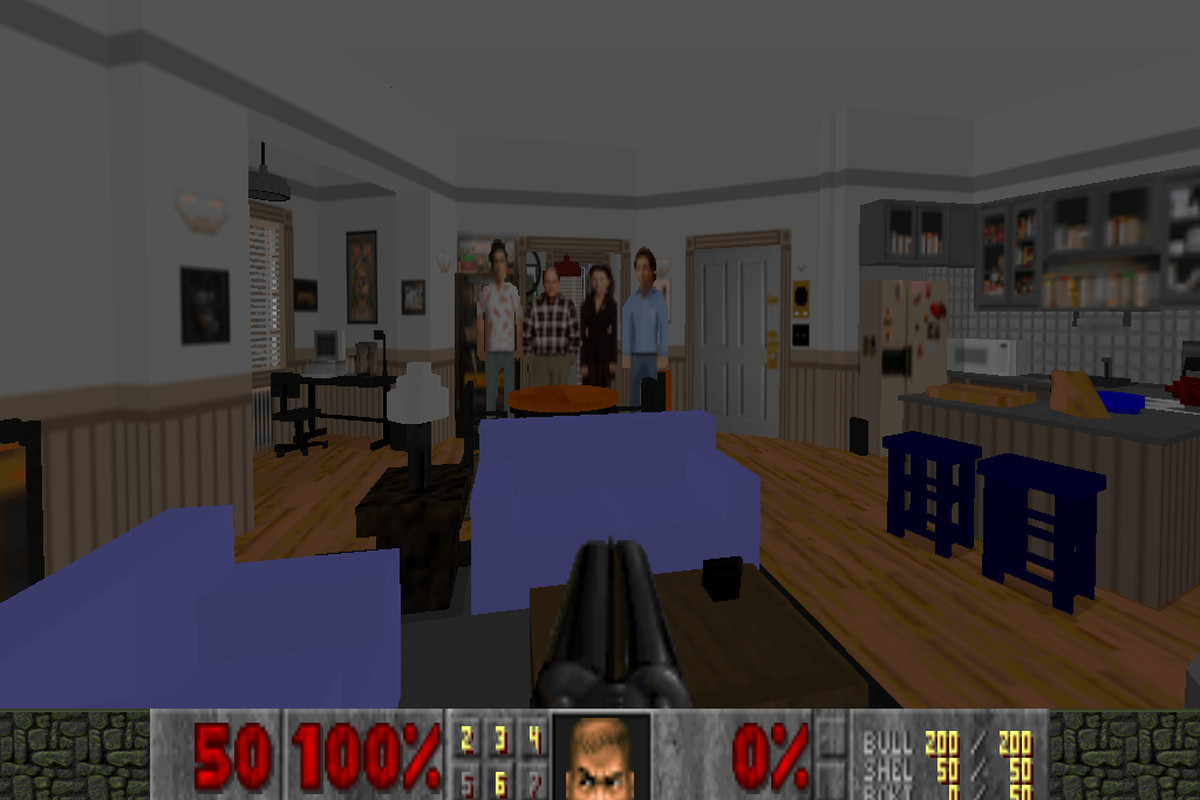
Besides custom levels, swapping out art assets was another popular mod choice, facilitating some… pretty surreal crossovers
Doom would mark the first time that the developer of a game would offer so much support for its own modding community, rather than simply leaving them to their own devices. This resulted in the game reaching even further heights in popularity, and the concept of game mods breaking fully into the public conscious of the gaming community. Many a game developer’s career would begin by making Doom mods, including id Software’s very own Tim Willits. If Castle Wolfenstein was the first game to feature mods, Doom was the game that made sure they were here to stay.
The Doom modding community is still alive and well, by the way - not just for later games in the franchise, but for the 1993 classic as well. As recently as last year, one of the original designers on the game, John Romero, released a large level pack for the original game in celebration of its 25th anniversary. This game, it seems, is as unstoppable as Doomguy himself.
Half-Life (1998)
We won’t make the easy joke here because 1) It’s not funny, 2) It’s not original, and 3) …
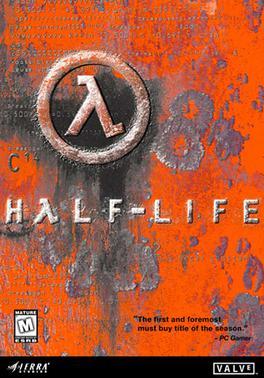
It may have been id Software that was the first to establish a relationship between a developer and the fans who mod their games, but Valve was the one who proved just how successful such a relationship could be. When Half-Life came out in 1998, Valve made the software development kit for the game’s engine, GoldSrc, available for users to mess around in. A year later in 1999, college student Minh Le, with help from his friend Jess Cliffe, released a mod for the game called Counter-Strike. While Half-Life was a single-player experience, Counter-Strike was a team-based multiplayer game where you played as either a terrorist or counter-terrorist while trying to complete various objectives.
Ah, 1999... The Glory Days of the “Real is Brown” mentality in video game graphics
By 2000, the mod had gotten so popular that Valve came to Minh and Jess with an offer - they wanted to not only buy the rights to Counter-Strike, but hire the duo to continue working on updates for the game. They agreed, and Counter-Strike went from fan mod to commercial release to, eventually, a multi-million dollar franchise that has hundreds of thousands of players to this very day.
Counter-Strike was one of the first games to bridge the fan mod to official release gap, and in doing so proved once and for all that mods weren’t just a hobby or even a “stepping stone” to bigger things, but a genuine means of entering the game industry proper. Valve, for their part, would continue this practice of scouting out modders to hire to turn their creations into commercial products, as we will see in the very next entry…
Warcraft III: Reign of Chaos (2002)
Wanna make a gamer feel old? Act like you’re surprised that Warcraft was anything other than an MMO.
Now, wait a second here: How is Valve associated with Warcraft? That’s a Blizzard game! It says so right there on the box! Well, hunker down, ‘cuz it’s gonna get a little crazy.
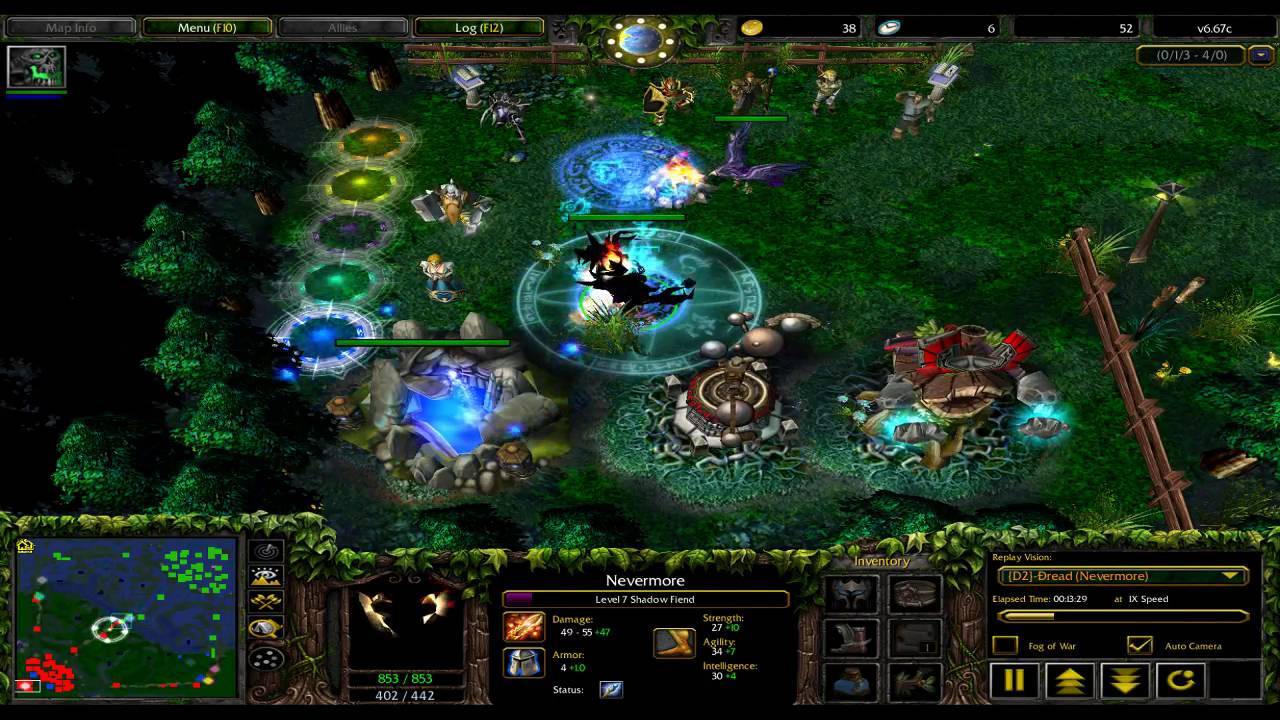
Back when Blizzard Entertainment released Warcraft II, they included a free “world editor” in the game that let players create custom scenarios and maps for the game, which could then be shared online (or, if it was a multiplayer set-up, play it with others) via their Battle.net service. Once Warcraft III came out in 2002, it was only natural that they’d bring this feature back and expand on it. Within the year, a guy by the name of Eul (real name: Kyle Sommer), inspired by the custom StarCraft map known as “Aeon of Strife”, would release a brand new scenario called Defense of the Ancients, or DotA.
Yup, that’s right: the entire Multiplayer Online Battle Arena (MOBA) genre started as a game mod.
MOBAs: Putting a new twist on the phrase “Stay in your Lane”
While Eul wouldn’t continue to update DotA after the original release, several other modders would take over, including Steve “Guinsoo” Feak and IceFrog (real name unknown… yes, really). Now, this is when things start getting wild, so try to keep up: Guinsoo would eventually stop working on DotA and join Riot Games, using his knowledge from working on DotA to help create the MOBA mega-hit, League of Legends. Valve, meanwhile, knowing a good idea when they saw one, swooped in and hired IceFrog to make DotA 2 from the ground up for them as, despite originally being a mod for a Blizzard game, Blizzard did not ever try to claim a copyright on the name or concept. Not to be outdone, Blizzard would respond to this by creating their own MOBA in the form of Heroes of the Storm. So in summary - The original DotA was a mod of a Blizzard game, one dev on that team would go on to help make LoL with Riot Games, Valve would get the rights to make DotA 2 with the help of another dev from the same team, and Blizzard would make HotS all on their own. Got all that?
We’ll take your stunned silence as a “Yes”
DotA perhaps represents the peak of what game mods can do. It was a fan-made mod, made possible by the support of devs for their modding communities, that not only went on to become a commercial success, but in the process create an entire new game genre that would sky-rocket in popularity soon after. If there was ever a question as to whether or not UGC could make a wide-scale impact on the gaming industry, DotA is proof that it absolutely can.
… And if you’re ever getting ticked off over that little brat Teemo ganking you yet again, at least now you know exactly who to blame.
The face of pure, unadulterated evil
Minecraft (2009)
Look who’s back, back again…
… Hey, we told you we’d come back around to Minecraft eventually, didn’t we? Just took us like two whole articles to get there.
As we mentioned at the beginning of this article, mods are a very popular feature for many modern games, bolstered no doubt by success stories like those in the previous entries in this article. There’s no way we could possibly cover all of them here, so we figured that singling out one to highlight would suffice. Thus, it’s time to bring back Minecraft!
Modding in Minecraft is almost as old as Minecraft itself, and is indeed one of the major factors in the game’s astronomical success. Mods took off so fast because the original version of Minecraft was programmed using Java, a coding language that’s very easy to pick apart and edit. In fact, even though a new version of Minecraft that is coded in C++ rather than Java was later released by Mojang, they are still keeping the Java version up-to-date alongside the C++ version, specifically because they didn’t want to abandon all the modders who had done their projects in Java. And yes, there have been a number of Minecraft modders who have since been hired by Mojang to work on the game proper as well. Talk about a strong relationship between the developers and the modders, huh?
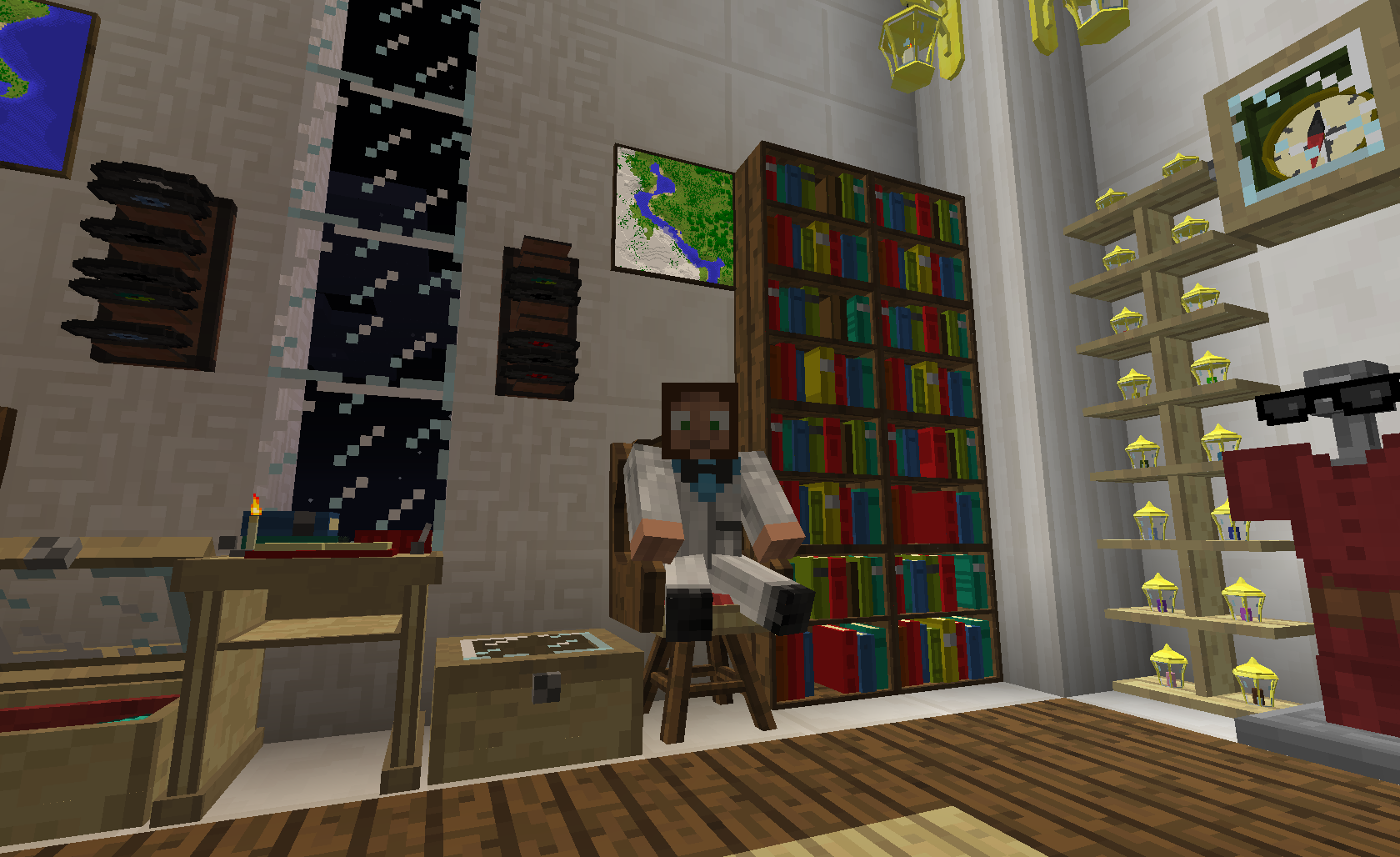
Bibliocraft is just one of the many, many mods that adds new items for you to build… And is also one of the many, many mods whose name is just [Something]craft. Hey, no one said modders had to be good with titles.
Of course, it’s easy to see why Mojang would want to keep the modders happy, as some of the things they’ve created are insanely impressive. Many mods have added features that would go on to be included in official updates due to their popularity - the Mo’ Creatures mod, for instance, had horses long before they were put in the game proper. Others focus on optimization, UI improvements, or plain making the game prettier. Additionally, since you can host servers in Minecraft that others can join, you and your online buddies can even experience the changes these mods offer together! It was this kind of multiplayer-focused modding that lead to the creation of MinecraftEdu, which some of us here at E-Line had a hand in developing with Mojang’s full support.
A Creeper blew up my--- Wait, we used that joke last time, never mind
However, as much as we’d like to toot our own horn when it comes to multiplayer Minecraft mods, our work isn’t the biggest success story in that regard. That honor would have to go to the Survival Games mod first released in 2012, just three years after Minecraft’s initial release. Inspired by the Hunger Games novels and film adaptations, this mod turns a Minecraft server into a brutal free-for-all where dozens of players must search for resources and battle each other to be the last blocky person standing. The map starts out huge but, as time goes on, it gets smaller and smaller to force confrontations between players. Sound familiar?
… Well, okay, yes, but if you’re citing THIS, you’re an even bigger nerd than we thought
Yup. Much like DotA before it, the Survival Games mod in Minecraft would go on to inspire an entire game genre, in this case Battle Royale. Before Fortnite, before PlayerUnknown’s Battlegrounds, there was this humble Minecraft mod.
Minecraft is perhaps the ultimate summation of all mod-heavy games that came before it. It is a game that thrived as much as it did because of its mod support. The company behind it recognized this, and fostered a healthy relationship with their modding community. And ultimately, the work of these modders would wind up making a huge impact on the gaming industry as a whole. All of this, and even at ten years old, there are no signs of Minecraft slowing down. Who knows what these modders will do next? Guess we’ll just have to wait and see.
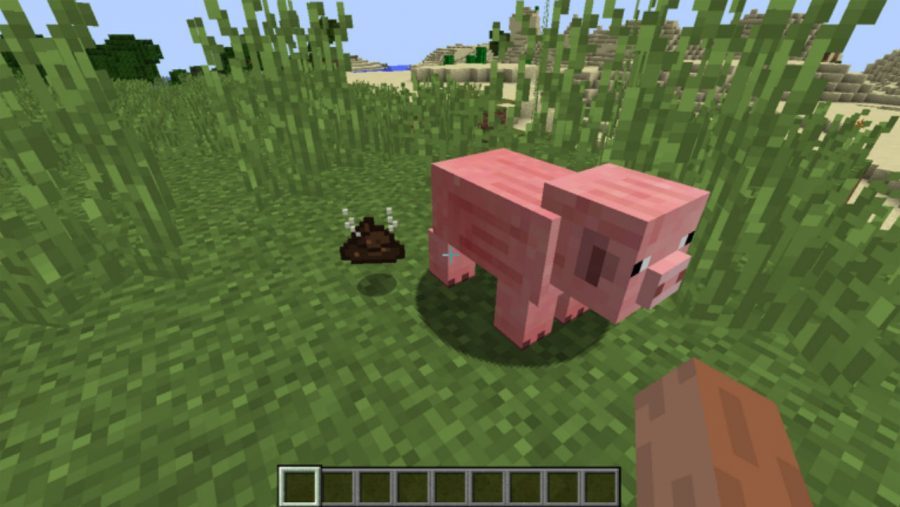
Until then, there’s always the pig poop mod
In Conclusion…
Mods may not be a fully-intended feature of all games, but they nonetheless provide an opportunity for some truly unique cases of UGC. They have opened the door for people looking to get into the game industry in a multitude of ways, and in the greatest cases have made an impact on the industry itself. Those of us working on The Endless Mission are well aware of just how powerful and transformative mods can be, and you can rest assured that the game will cater to that in many, many ways. As for next week, we’ll be going through “the rest of the best” when it comes to games with UGC - games that provided plenty of opportunities for users to create even when it wasn’t the focus. See you then!
Image Sources:
Mod Pizza, Eurogamer, bhatpsych.com, wikipedia.org, uic.edu, hollywoodreporter.com, id software, polygon.com, techspot.com, youtube.com/ggwp, spauldinggrp.com, mobafire.com, microsoft.com, bibliocraftmod.com, jasonwilmot.com, pcgamesn.com
The Endless Mission and the History of UGC, Part 4
Still with us? Excellent! That means we still have a job. Over the past couple of weeks have been all about UGC creation tools that can still generally be considered “games,” but that’s all about to change - today’s the day that we start crossing the line from games to software. Hold onto your pocket protectors, it’s about to get nerdy.
… Well, more nerdy than it’s already been, anyway.
Game Making Tools
Over the past two weeks, we’ve looked at creation tools that can still be very much considered games, from their interfaces to the ability to boot the game up solely to check out what other people have made without doing any creating yourself. Game Making Tools, on the other hand, forgo all the fancy bells and whistles and devote themselves entirely to being a tool for creation. Their UIs have far more in common with editing tools such as Microsoft Visual Studio or Photoshop, and their communities exist online on websites, blogs, and message boards, as opposed to inside the software itself. Likewise, the games that people make with these tools are exported from the software and can be uploaded independently - you don’t even need the software to play their creations. The end result is that users have far more versatility in what they can create using these tools, as being able to manipulate the code itself and use your own custom-built assets are a given. What separates Game Making Tools from straight-up Game Engines like Unreal or Unity is the fact that they usually will be optimized with a specific game genre in mind (RPG, Fighting, etc.). However, that hasn’t stopped some developers from using these tools to create unique experiences as well.
RPG Maker (1992)
They’ve made a lot of iterations of this particular Game Making Tool… and like any true JRPG, the sequel numbering is completely ridiculous
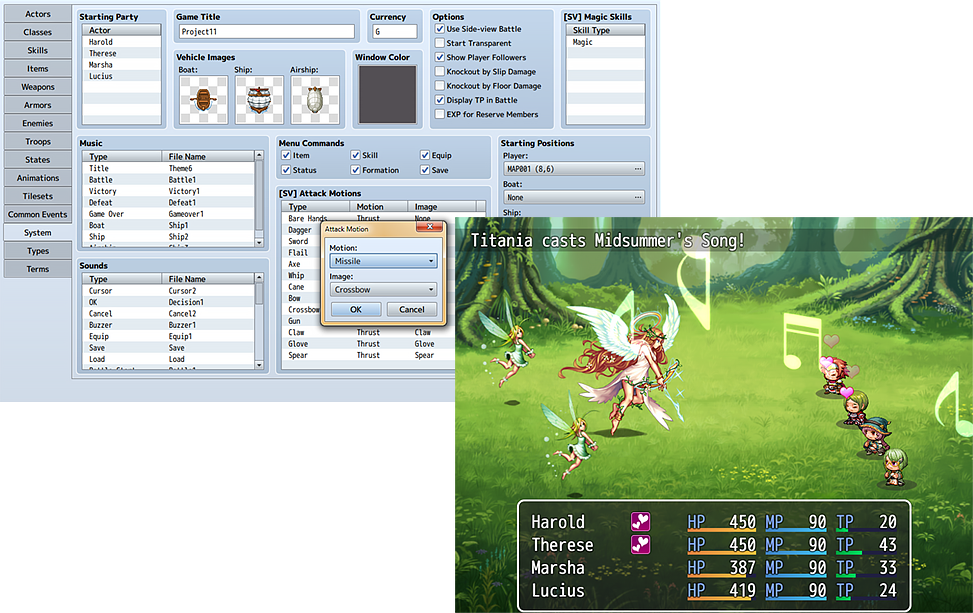
RPG Maker is a line of software that allows users to - big surprise here - create their own Role-Playing Games. The first one came out in Japan all the way back in 1992, but it was never localized for the US; that wouldn’t officially happen until RPG Maker XP, 13 years later in 2005. Whatever version you get and/or struggle to translate, it usually comes with the same batch of items and tools: A tile set based map editor, a battle editor, and a scripting language (formerly Ruby, but now JavaScript) so you can set up custom events or alter the gameplay entirely. They also come with a large amount of premade assets for you to get started, but you can create and import your own at any time.
Spoony Bards not Included
RPG Maker has always been a popular tool for game making. The way it’s set up makes it easy for anyone to get started, while still being powerful enough to create professional-level games. Once you’re done, it’s easy to package games up and make them available to download and play on computers, smartphones, and other platforms. Additionally, the scripting language is very versatile. Don’t let the name fool you: RPG Maker isn’t good for just making RPGs, but adventure, survival horror, and even action games as well.
Sure, that editor menu looks intimidating, but let’s be honest: The ones you have to browse through while PLAYING an RPG are usually just as bad.
If you want to see some excellent examples of the kinds of games (RPG or otherwise) you can create in RPG Maker, we’d recommend checking out LISA: The Painful RPG, OFF, To the Moon, and Yume Nikki. And when you’re ready to dive in and start using the software itself, you can get it the latest version, RPG Maker MV, on PC now or wait for it to come out on all current-gen consoles later this year.
Adventure Game Studio (1997)
What’s the coffee cup for? Well, if our knowledge of Adventure Games is any good, probably something really, really convoluted
Do you remember the good ol’ days of Adventure Games? Your Zorks and Space Quests and Monkey Islands? Where quirky characters, absurd storylines, and completely illogical puzzles were king? Well, good news! They never went away, they’re just being made in Adventure Game Studio now!
Now you too can create games like the Sierra and Infocom classics!... Though ideally with less nearly impossible puzzles that can render the game unwinnable without warning? Please?
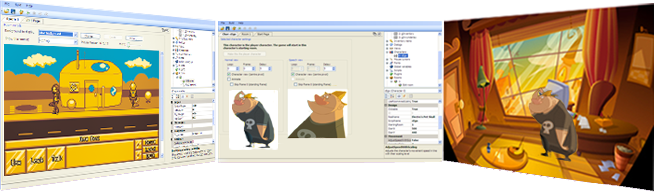
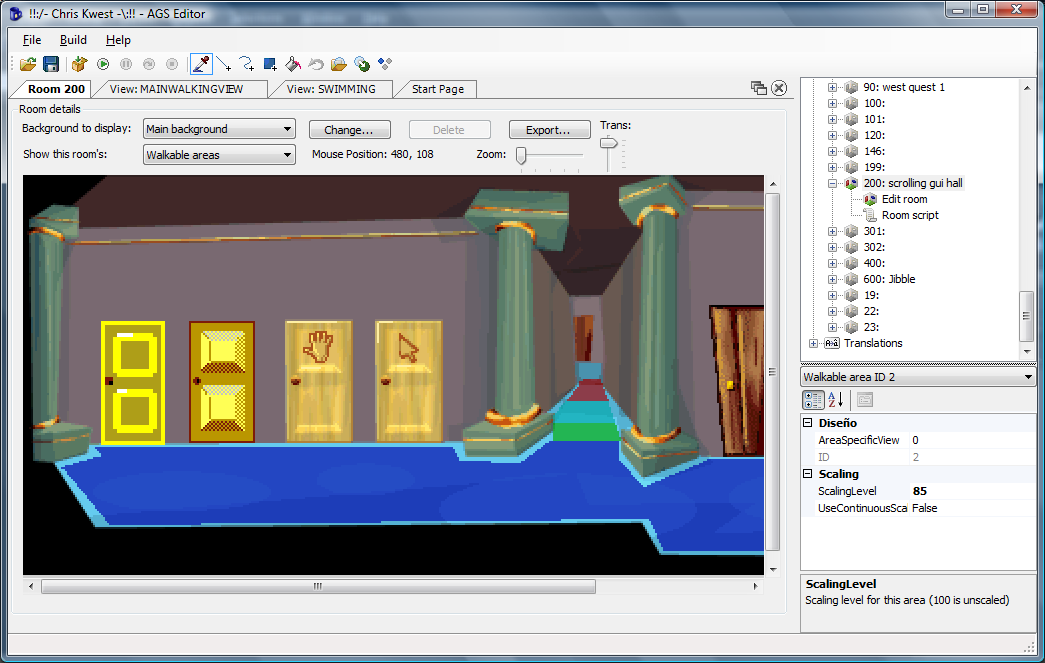
Created by British programmer Chris Jones in 1997, Adventure Game Studio is a free(!) and open source(!!) software tool that anyone can use to create their own point-and-click Adventure Games. You bring the art and story, and AGS can handle the rest. Creating full animations for characters, making background environments possible to navigate and interact with by the player, custom code scripting, and even debugging and testing can all be handled entirely within the software. Once you’re done, package it up and share it online with the incredibly active AGS community. They even run a “AGS Awards” every year, giving quite a popularity boost to whichever games walk away with honors.
The real puzzle in this game is who built the world’s most structurally inconsistent pillars there
As it is a free and open source software, AGS has been used by many developers to make high-quality titles, both free fangames and commercial releases. Some good examples that are worth playing include the Rob Blanc Trilogy (created by none other than Ben “Yahtzee” Croshaw… yes, the Zero Puncuation guy), the Blackwell series, and Gemini Rue. And if you wanna give Adventure Game making a shot yourself, you can download the software on their official website: https://www.adventuregamestudio.co.uk/
M.U.G.E.N (1999)
Super Smash Bros. ain’t got NOTHIN’ on this…
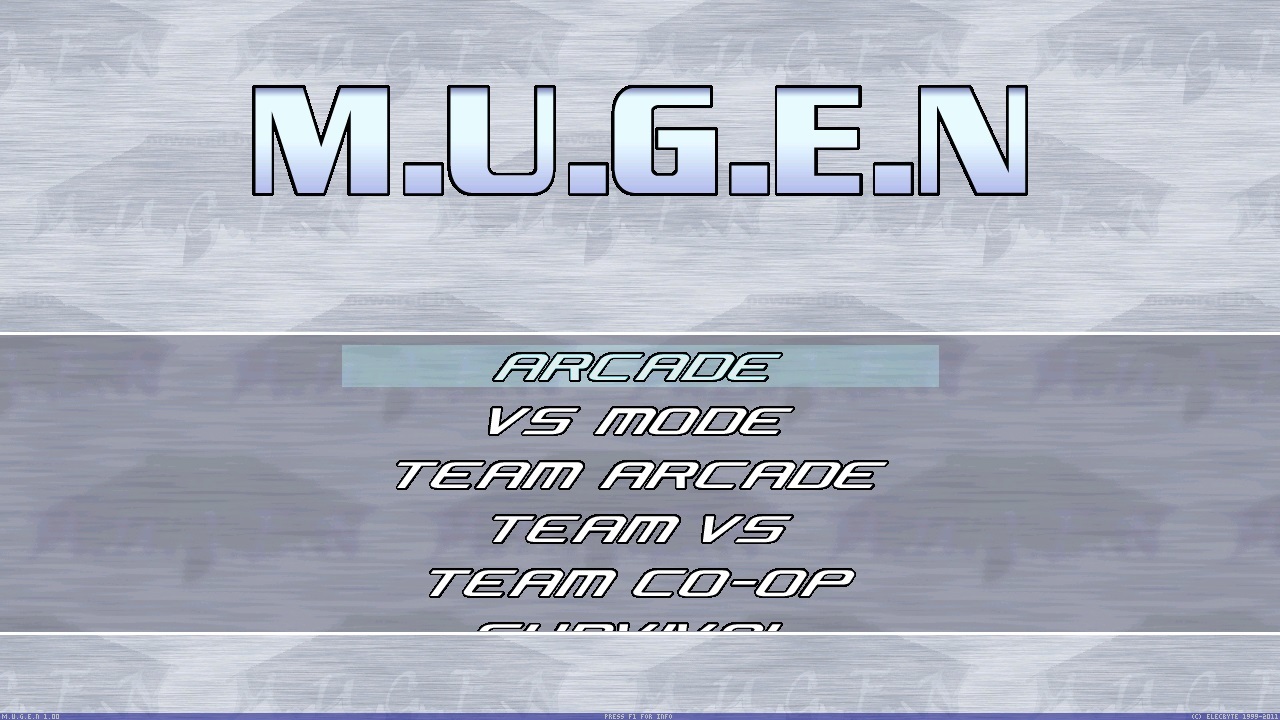
The fighting game genre is no stranger to weird and wild crossovers: You have Marvel vs. Capcom, Mortal Kombat vs. DC Universe, the myriad of guest characters in Soul Calibur, and of course Super Smash Bros. M.U.G.E.N takes this tendency and extrapolates on it to its most extreme conclusion. First released in 1999, M.U.G.E.N (Japanese for “dream”, “fantasy”, and “infinite”, for the nerds in the crowd wondering) is a Game Making Tool for fighting games. There have been a good number of fighting games built from the ground up using M.U.G.E.N, but the main draw is that a prebuilt fighting game framework is already included, with the only thing missing being any fighters. Thus, for budding designers who aren’t ready to tackle a full game, they can instead focus on creating individual fighters and uploading them for others to use.
Needless to say, people leaped at this opportunity.
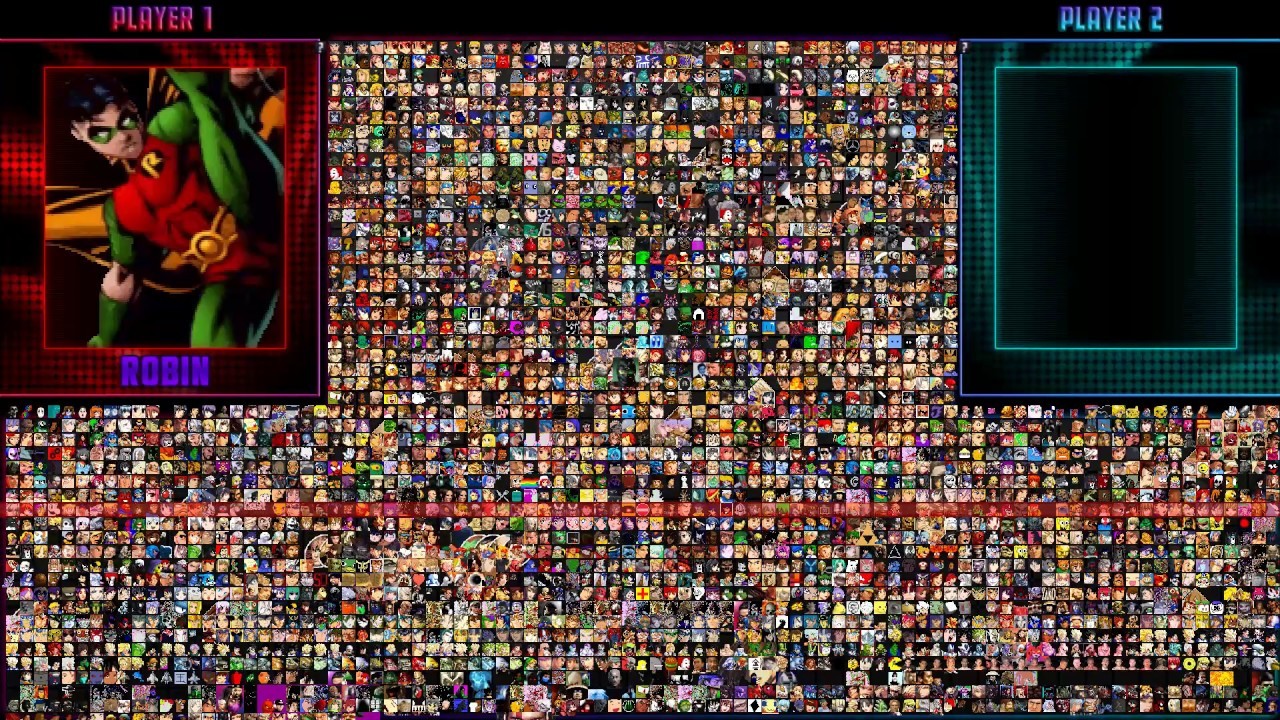
You need an 8K resolution monitor just to see who the heck you’re about to pick
M.U.G.E.N uses C for all of its scripting, so anyone with the art assets and a little bit of coding knowledge can put whoever they want in the game, complete with their own unique fighting mechanics and gimmicks. People began by recreating characters from all different fighting games and porting them over to M.U.G.E.N so they could all face each other (while keeping whatever mechanics they had from their original games intact) for the first time ever, but why stop there? At this point, virtually every character in pop culture has been recreated as a fighter in M.U.G.E.N, not to mention countless original characters as well. There are multiple databases online where these characters are uploaded, and you can pick and choose which ones you want to download into your own game to play with, resulting in a near-infinite number of possible mashups... Most of them completely ridiculous.
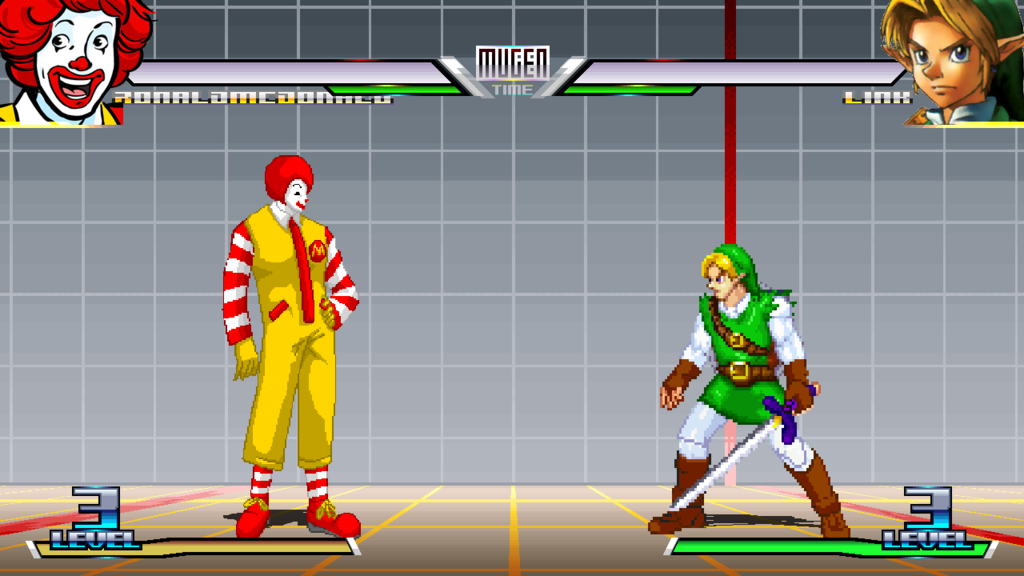
Tragedy struck when Ronald McDonald misunderstood what they meant by combos and tried to offer Link a Big Mac with fries and a Coke
M.U.G.E.N is unique among Game Making Tools due the framework it provides - You can go through all the steps of creating a game (design, art, programming, testing, etc.) condensed into a single fighter. This makes the software perfect for people looking for bite-sized design exercises that don’t require a massive commitment of time or resources just to reach a playable state. Unfortunately, while the M.U.G.E.N community is still alive and kicking today, the software itself hasn’t been updated in years, with the original site hosting having gone offline long ago. Thankfully, it’s still possible to download it if you know where to look, so if you ever wanted to finally settle the classic argument of who would win in a fight between Agent Scully and Hermey the Dentist Elf, you know what to do!
… Wait, that’s just us who had that debate? Man, maybe our office culture is weirder than we thought…
In Conclusion…
Game Making Tools sacrifice a simplified interface in favor of giving users far more control over the details of what they create, often with very impressive results. Whether you’re just tinkering with a personal project or are planning your first commercial release, software like this is the perfect place to start. Come back next week as we shift gears and enter the weird and wild world of mods!