The Lord of the Rings: Living Card Game scheduled for release in Q2
Since we announced The Lord of the Rings: Living Card Game back in December, we’ve been thrilled by the reception. We’ve received great preview coverage from outlets like PC Gamer, PCGamesN, VentureBeat, and Polygon, and we’ve received a lot of feedback from interested fans and players.
Most important to us, however, is that we’ve built a community of game players who have joined us both here on the Steam forums and on our biweekly streams. Fantasy Flight Interactive was always built with a community-first mission in mind—we believe that transparency in development is an essential part of producing a game for an informed audience. Our transparency, through the developer streams and the articles here on Steam, has given us room to experiment and build The Lord of the Rings: Living Card Game into something great.
That’s why we want to inform you now that we’ve made the decision to delay the game. Though we recently announced that we’d miss the Q1 mark on our Twitch stream, we felt it was important to post this officially to anyone following us on Steam. We are now officially looking at a release during the second quarter.
This wasn’t an easy call for us to make, but we feel it is the right one. While we feel the game we’ve created thus far is strong, we have a few more ideas we want to try out before we take the game public. For that reason, we’re experimenting with some new ideas we think you’ll enjoy behind-the-scenes that we feel will make the game even stronger.
Our original plan had been to use the Early Access period for this type of experimentation with a game that was a bit less finished, but we only get one shot at making our first game public. We want to make sure that we are confident that impression will be a great one. For this reason, we’re going to be a bit later than we originally announced.
However, that delay won’t happen in a vacuum, and we want to keep you up on development. Here’s what we have planned:
The Early Access period for The Lord of the Rings™: Living Card Game™ is going to be more polished than we had originally planned. The game still won’t be feature complete in Early Access, but what is there will be more refined. We’ll also be able to prepare more content than we’d originally planned for rollout during that Early Access period and to a higher level of refinement.
Expect a development roadmap to get posted soon. Since we’re releasing later than we had expected, we want to give players a better idea of what we’ll be adding to the game and what they can expect at release and beyond.
Our video streams will continue. A lot of the experimentation we have planned will be a little too messy to show publicly, but as we continue to develop the game, we want to bring in-progress streams to you at the same rate as before. The streams may include more developer interviews, in-depth discussions, and other related content, as well. Let us know what you’re interested in seeing.
We also want to thank you for being along for the ride so far. We’re very blessed with a fantastic community of potential players. As much as everyone at our offices are excited to get the game in your hands as soon as possible, we need to temper that enthusiasm to make sure that the game is well and truly ready.
We look forward to sharing more with you in the coming weeks.
Fantasy Flight Interactive
Developer's Diary: Card Spotlight—Bilbo's Cloak
Hey everyone! I’m your Community Manager, Luke.
We’ve had a few cards change drastically from their initial inception up until now, and we expect cards to keep changing well into Early Access. But how do we decide when a card needs to change? We wanted to give you some behind the scenes insight into how sometimes decisions are made and the cards evolve.
Bilbo’s Cloak has a particularly interesting development story. The card, part of the Faithful Servant Hero Pack, featuring Sam Gamgee, was created to solve a specific gameplay problem.
We have something called a soft mechanic tied to our two Hobbit heroes in the Core Set. A soft mechanic is an ability or theme that occurs across multiple cards without a keyword tied to it. Soft mechanics are a great way of building unity across a certain characteristic. When players recognize a theme across multiple cards, they’ll search for other similarities or tie-ins. It makes them feel more engaged with the setting and lore and allows us to communicate ideas about the game’s thematic world using the game’s mechanics.
Both Frodo and Sam Gamgee have abilities that hinge on Sauron’s depleted resources. They rise to greater power when Sauron’s attention is elsewhere. Thus, their abilities only trigger if Sauron’s resource count is at 0. This mechanic also communicates the nature of Hobbits as burglars—the little thieves take resources away from The Dark Lord.
But this mechanic didn’t give players a lot of dimensions for control. We found in testing that there were just too few ways for players to interact with Sauron’s resources. As a result, the Hobbit soft mechanic kind of felt more like a slot machine. You were at the mercy of the AI, and Sauron usually was too smart to go down to 0 resources. While the mechanic was thematic, it didn’t create the dynamic play space that we wanted.
Instead of choosing to rework the mechanic completely, we decided to re-contextualize it. We came up with some ideas for cards that could potentially disrupt Sauron’s resources, including a modification to the previously textless Wandering Took and an innocuous-looking attachment called Hobbit Cloak.
The design for Hobbit Cloak was simple, but it served a few valuable purposes: One, it helped trigger Sam and Frodo. Being that it was included in Sam’s Hero Pack and part of Frodo’s sphere, we felt the synergy would be immediately communicated to players. Two, it solidified the identity for Hobbits as burglars. Of course, not all Hobbits are thieves. But we felt that Bilbo’s legacy was strong enough to build into the game mechanically. Furthermore, the idea of a cloak communicates something sneaky, something stealthy, so we thought that tying it into resource control was something of a flavor win regardless.
Finally, it was an attachment that played with some of the dimensions of the game outside of combat. We had plenty of swords and shields within the Core Set design file, but we didn’t have quite as many ways to alter the game outside of fighting. Hobbit Cloak let us experiment with the strength of attachments that didn’t focus on altering combat stats.
Overall, Hobbit Cloak felt like a compelling design. We weren’t immediately sure about its cost or strength relative to other attachments, but we were ready to answer those questions through testing. We put it in the file, loaded it in the game, and moved on to other cards.
This design remained the same for quite some time. In fact, we even first spoiled Hobbit Cloak in its original, untested inception on our video stream. While we didn’t get a chance to play the card on stream, viewers immediately had the same reactions we did: The card looked interesting and cool, but was it costed correctly? And could it be too powerful?
The biggest concern, of course, came from the idea of having multiple Hobbit Cloaks. In a single-player game, players could easily get two copies of the card in play, attached to two separate characters. That would take away 2 of Sauron’s resources every turn, leaving him with only 1 and effectively grinding his plays almost to a halt. It seemed like a fairly easy way to lock down the game.
What about cooperative play? If, by some chance, both players had 3 or more copies of Hobbit Cloak out on the field at the same time, they would be taking away all of Sauron’s resources, locking him out of the game!
What had started life as a fairly innocuous design had become an oppressive tool of control. In our quest to design an enabler for the Hobbit soft mechanic, we had accidentally stumbled on a way to break the game.
Now, there’s something to be said for leaving in combos and powerful tools for players to discover. But the Hobbit Cloak exploit was just too simple to assemble. It wasn’t a combo that made players feel smart—instead, it was obvious enough that it felt like it punished those who chose not to take advantage of it. Good combos open deckbuilding up. Bad combos make deckbuilding feel narrower. Plus, it limited possible card design space. If we put a powerful combo into the game, we have to make sure our future designs don’t strengthen that combo or make it easier to assemble. If we wanted to create a way for players to search their deck for an attachment, for example, we’d have to think twice about the Hobbit Cloak.
We threw around a few possible solutions, but most of them damaged the purpose of the card. We still wanted to give players a way to mess with Sauron’s resources, and we wanted the card to feel thematic. Changing the cost on the Cloak wasn’t enough, as it didn’t quite limit the card in the way we needed it to.
To recap, we couldn’t change the card’s cost, adjust its numbers, or tinker with its text box. So we approached the problem from a different angle—how about playing with its name?
What if the card was Unique? Then, players could only have one copy of it in play at any time. Sure, in cooperative play, two players could still have one copy each, reducing Sauron’s resources by two every turn, but we were ok with that relative power for that amount of work.
With its new designation as a Unique card, Hobbit Cloak needed a fresh identity, one that made it feel thematically special. Since we were already channeling his spirit in the card’s design, we named it Bilbo’s cloak, imagining it as a sort of old family heirloom passed down to Frodo, a cape that was something of a good-luck-charm, having been on a series of adventures itself.
Since the adjustment, we’ve found that Bilbo’s Cloak is behaving the way it was intended. It’s a nice way to enable both Sam and Frodo, and while it doesn’t affect combat stats, it does affect the board in a tangible, ongoing way. While it may change between now and Early Access or now and full release, Bilbo’s Cloak is proof that quite often in game design, the simplest solution is the right one.
This is just one of the decisions we have to make across the hundreds of cards that will appear in Early Access, but gives you an idea of how testing, play and revision are part of the game design process.
Oh, and the Hobbit Cloak name is gone, but only temporarily. We’ve reworked a new Hobbit Cloak design that will be making its way back into the game in a future expansion— but that’s a story for another day.
Announcing The Lord of the Rings: Living Card Game Founder's Packs
During Early Access, The Lord of the Rings: Living Card Game will be available with three tiers of Founder’s Packs. Each of these packs will include bonus Valor points, additional cards, exclusive cosmetics, and more. They’re designed to give Early Access players a head-start on their journey through Middle-earth. Today, we’re going to take a look at the details and contents of each of these Early Access packs.
A quick reminder: The Lord of the Rings: Living Card Game is still in development. Card design may change between now and Early Access. This includes both the cards’ mechanical and visual designs.
That being said, on to the announcement!
Every player, regardless of which Founder’s Pack they purchase, will gain access to the Core Starter Set. It includes the 4 main Hero cards as well as the 42 player cards, 5 pairs of cards from each Sphere of Influence and 2 copies of the neutral ally Gandalf. (You can take a look at the entire Core Set as a work-in-progress here: http://www.fantasyflightinteractive.com/go-now-with-good-hearts.html )
We’ve talked about this Core Set before. What we haven’t talked about, however, is the bonus Valor Points that will be included with the Core Set. Every player will receive 3,000 Valor Points to get their journeys through Middle-earth started. They can use this Valor however they want— to unlock new cards, new quests, or to gain more Palantír Views.
Every player will also receive four total card backs, two for their own deck and two for Sauron’s deck. The Classic card backs are a nod to the tabletop game’s graphic design, while the Digital card backs are original to LOTR:LCG.
This Core Starter set is the free-to-play content that every player will receive once they complete the opening tutorial. That includes players who wait until after the Early Access period is over and the game goes full free-to-play.
For those who would like to join us during Early Access, you’ll have three Founder’s Pack options to choose from.
The Shire Pack ($7.99)
The Shire Founder’s Pack includes an assortment of cards, cosmetics and Valor to prepare any hero for their journey through Middle-earth. In addition to the standard core starter pack, players who unlock The Shire Founder’s Pack will receive 5,000 additional Valor points (for a total of 8,000 Valor points) and a bonus Palantír View.
Additionally, Shire Pack purchasers will receive bonus content unlocked for them as part of the content package. These items include an uncommon Valor Card- A Friend in Need and the Frodo avatar, which can otherwise be obtained only via the Palantír. This content is not exclusive, but unlocked and ready to play for people who purchase the Shire pack.
The Shire Pack also includes some exclusive cosmetics. We wanted a way to make early adopters stand out, to thank you for buying into the game before full release. In the Shire Pack, you’ll get the Shire Avatar, depicting a hobbit armed with only his pipe, cloak, hat and an iron will. You’ll also get the Shire player tag and avatar frame. Finally, you’ll get the Shire player card back, displaying a pipe and branch of leaves.
Overall, the Shire pack is the perfect option for someone who wants to try the game out in Early Access, but would like to unlock a majority of their content through gameplay.
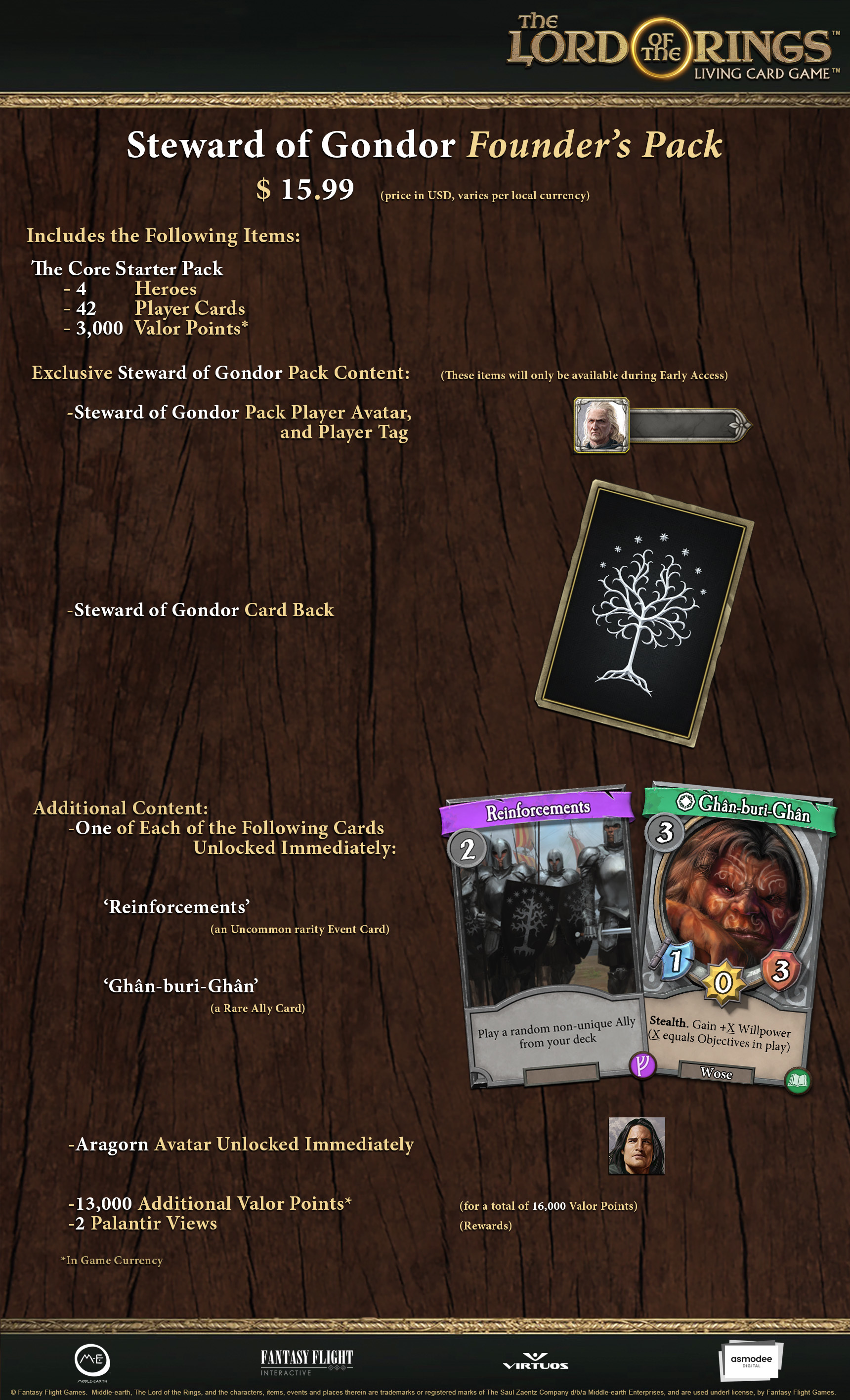
The Steward of Gondor Pack ($15.99)
The Steward of Gondor Pack is a step up from the Shire Pack. This pack comes with some extra cosmetics, cards, and Valor, as well as the standard core starter pack. Players who purchase the Steward of Gondor Pack will receive 13,000 additional Valor points (for a total of 16,000 Valor points) as well as two bonus Palantír views.
They’ll also get access to two cards, Reinforcements, an uncommon Leadership event card, and Ghân-buri-Ghán, a rare Lore ally, as well as the Aragorn avatar. Again, like the cards and avatar included in the Shire Pack, these items aren’t exclusive to the Steward of Gondor pack, they come pre-unlocked and ready to play.
Cosmetics-wise, the Steward of Gondor Pack features its own exclusive card back, player tag and avatar, designed to let early adopters stand out.
The Steward of Gondor Pack is built for players who want deeper access to the game from the start, but who aren’t necessarily opposed to playing to earn extra cards or quests.
The Istari Pack ($29.99)
Finally, the Istari Pack is designed for players who want the greatest level of flexibility and freedom in their play. It comes with an additional 27,000 Valor points, which, when combined with the Valor in the Core Set, comes out to a total of 30,000 VP. Additionally, players who buy in at this level will get a bonus 4 Palantír Views.
They’ll also get three cards unlocked right out of the gate: Star Brooch, an uncommon Spirit attachment card, Beorn, a rare Tactics ally, and Tom Bombadil, a Legendary Neutral ally. Like the cards in the other packs, these won’t be exclusive to the Istari Pack, but they’ll be unlocked the first time Istari Pack owners play the game. They’ll also have access to two bonus avatars, Gimli and Aragorn.
Just like the two packs above, the Istari Pack also includes exclusive cosmetics: A player avatar, player tag, and a card back.
The Istari Pack includes enough Valor to unlock much of the Early Access content. Some things will still need to be unlocked, but players who purchase this pack will have enough Valor to get their collection really rolling.
Finally, for superfans: These packs will be cumulative. If you’d like access to all the exclusive cosmetics and extra Valor, you can purchase all three packs. You can even mix-and-match the included exclusive cosmetics!
The Founder’s Packs will be available during Early Access, and the game will be free-to-play once we go into full release later.
Thanks!
FFI
Previewing the Core Set Cards
Hello!
If you've been keeping up with the streams, you're probably well-acquainted with the cards in the Core Set. But in case you've missed some, we've just published a preview article on our site, detailing each card!
Check it out here:
http://www.fantasyflightinteractive.com/go-now-with-good-hearts.html
Remember, you can check out our streams at twitch.tv/ffigames for developer updates, gameplay footage, and more. And please, don't forget to add us to your Steam Wishlist!
Thanks!
Planned Languages
Hello everyone,
We've had a lot of questions about language support for The Lord of the Rings, so we wanted to lay out our plans as they stand. At Early Access, we plan to have the game available in:
English
French
Italian
Spanish
German
Simplified Chinese
Portuguese
Please note: These are just our plans at the moment. We will update localization based on testing and feedback. The best way to show that there is some demand for the game in a certain language is to have a high volume of users who speak that language wishlisting it.