“If you know the enemy and know yourself, you need not fear the result of a hundred battles. If you know yourself but not the enemy, for every victory gained you will also suffer a defeat. If you know neither the enemy nor yourself, you will succumb in every battle.” ― Sun Tzu, The Art of War
ENEMIES ‘Mobs’. ‘Bogeys’. ‘Creeps’. ‘Monsters’. ‘Baddies’. Without them, we don’t have games! – Well maybe we’d have Tetris… though I suppose that damn S-shape piece counts as a baddie now I think about it. Regardless, the humble enemy character is the force that drives many, many games, and Tiny Troopers is no different. To try and provide diverse challenges from mission to mission, encounter to encounter, we have tried to create a large variation set of enemies with different weapons, abilities, armor, outfits and more. These enemies are mostly broken down into several basic categories:
Gunmen
Insurgents
Militia
Soldiers
Drones
GUNMEN Very basic enemies that are present in every chapter, and used primarily as a sort of ‘cannon fodder’. They are dressed in simple clothes and armed with a basic gun and have no other abilities. The gun they use depends on which chapter they are encountered in.
INSURGENTS A step up from the Gunmen. Typically dressed in more civilian-looking outfits and gear, like cowboy hats, berets, robes, pants, and shirts, they are mostly seen in a few different types:
Shooters: Specializing in firing assault rifles from the hip, these enemies are typically dressed in red and will use their rifle to spray fire in broad snaking arcs. Sometimes they may even employ secondary abilities like dodge-rolling, or even flinging the odd grenade.
Technicians: Armed with shorter range weapons, usually SMGs and equipped with explosives; like mines, grenades, or the ingenious ‘Chicken Mines’ – which are small robotic explosive drones shaped like chickens which chase after enemy targets and explode when near.
Leaders: Tougher, better equipped and employing abilities like ‘Rally’, which improves the toughness and combat ability of allies around them, Leaders make those around them even tougher to battle, so taking a leader out first is usually a good idea.
MILITIA
A step up again; generally dressed in more military-looking outfits, camouflage and solider helmets. They are a little tougher, a little better-armed, equipped and tend to have more secondary abilities. Just like the insurgents, they are generally seen in three different types:
Operative: Focused more on combat skills and weaponry along with speed-related secondary abilities. Operatives are tough and hard to pin down adversaries.
Demolitions: Similar to Insurgent Technicians, this type of Militia focuses more on explosives and little tricks, while also being just that little bit tougher to take down.
Chief: Also similar to the Leader Insurgent, Militia Chiefs focus their abilities around making those around them tougher and more deadly, while also being very formidable enemies in their own right.
SOLDIERS The toughest basic enemy type. Very well armed with high-damage weapons, heavy armor and a huge amount of health. Soldiers don’t appear too often, but are highly formidable when they do! Always dressed in typical military camo gear, they are fairly easy to recognize, and almost always operate in small but deadly teams. As with other enemy categories, they also tend to appear in a few types:
Private: Basic Troop-type, armed with a powerful assault rifle, grenades, and some basic evasive manoeuvres.
Sergeant: Tougher than the Private, with abilities that improve allies around them as an addition.
Captain: Extremely tough and armored. Armed with an extremely powerful LMG, in addition to a few other secondary abilities. Captains are almost as tough as the Bosses themselves.
DRONES Flying/hovering robotic enemies that come in a few types, often appearing in much larger numbers than other enemy categories. As with other enemies they tend to come in three different types (Starting to see a pattern here?):
Alpha: small, lightly armed and armored, they tend to employ a sheer weight of numbers to try and overwhelm the squad.
Beta: Larger and tougher than Alpha Drones, these are also equipped with a powerful LMG.
Omega: The biggest, toughest and rarest type of Drone. They are equipped with both an LMG as well as a Rocket Launcher!
GUARD TOWERS Tall, extremely heavily armored structures which appear throughout the game. Almost impervious to damage from bullets, Troopers will need to employ explosives or fire to bring these fearsome structures down… or, simply just evade them entirely and keep on running past! Structures aren’t too good at moving after all!
‘TOUGHGUYS’
In Co-Op games, special enemies will spawn to increase the challenge of the levels. These enemies are based on the above types but with more health, armor, better weapons with more damage and more abilities… so just generally a whole lot tougher… hence: Toughguys.
Alright, At ease everyone - that's gonna do it for this weeks update, go get some R and R and keep your eyes peeled for the next intel drop.
Which enemies are you looking forward to taking down the most? Let us know in the comments.
If you want to catch more Global Ops content across the internet, then hit the links at the bottom of the blog! And as always, make sure Global Ops is on your wishlists - and tell your friends!
Listen up troopers, it's been a hot minute since we last spoke and gave you a tiny update on some of the visual work going into the troopers and other characters.
We have some brand new intel for you today, this time Anitta Smith - Lead Artist from Epiphany Games gives you a brief on the environments your operations will take place in, as well as what goes into their design and implementation, enjoy!
All Terrain Action
The major key topic for us in developing the levels and especially their environments in Tiny Troopers Global Ops, is, to put it simply… Diversity!
In order to provide a significant degree of variety in our levels, we begin from a pretty basic foundation by firstly choosing 3 key asset sets:
• Desert
• Forest
• Winter
We then support these major sets with some additional urban and special assets to help provide a number of options.
Each of these asset sets are created to be flexible and easily reused. A significant constraint and consideration for any indie studio is cost, so we have to be very careful and (hopefully) clever with how we approach these sets. This constraint can then cascade into a set of other smaller issues - meaning we have to follow the classic 'Do more with less' approach. We do this in order to derive a decent amount of diversity in backgrounds and general environmental 'feel', so our players won't be looking at the same tiled background, which would be essentially slipping identical tiles past them like a cartoon from the '60s.
Location, Location, Location
Once we work out our sets, we then look at how we would use those across our chapters, following a basic chapter progression of Desert > Forest > Winter. Accordingly, we followed these general approaches:
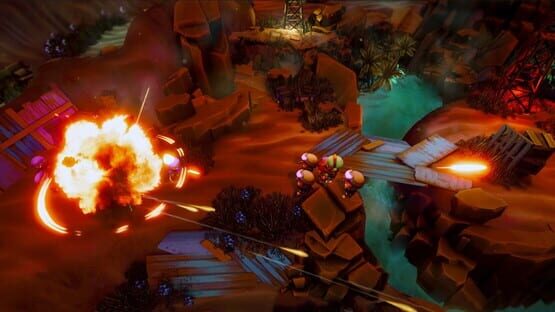
• Chapter 1, 2, 3 are mostly Desert, Forest, and Snow, respectively. • Chapters 4, 5 and 6 are created using a mix of the tile sets, as well as modified versions of each to create new, unique environments visually distinct from the base sets. To illustrate: Chapter 4 combines the original desert and forest assets, as well as modified versions of these assets to create a environments that are visually distinct from the previous chapters. • Creating differences between similar biomes that are in geographically distinct locations was important. For example, while both chapter 1 and 4 are set in ‘desert-like’ areas, they are based and inspired by two geographically distinct locations. • While we want to be somewhat ambiguous about the exact location of where missions are set, having visual elements inspired by real-world locations is important. To illustrate, Chapter 4 is based around the 'Gulf War' and its associated regions. As a result, one of the reoccurring references from this is oil well fires and oil spills.
To further explain this, Chapter 6 is somewhat different, in that nearly every mission is set in a visually distinct location. We still wanted to tie these locations together with repeated visual elements, that also reference the real world location that this is based chapter upon, so there are repeated public announcement/speaker systems in each level. Chapter 6 is also purposefully surreal as it explores stories that are clearly outrageous lies and a deeply troubling location.
• Each Chapter follows a general theme. For example, several missions in Chapter 4 are loosely styled after 80s/90s action archeologic movies, with areas of ruins and ‘dig sites’ in several missions. This reference to the questionable actions of archaeologists and exploration of historical sites also ties back into the real world locations and events. The overall colour palette and atmosphere of these levels also references this. Lots of cinematic and somewhat artificial lighting, over the top ‘smoke machine’ fog and missions that almost look like 'B'-movie film sets.
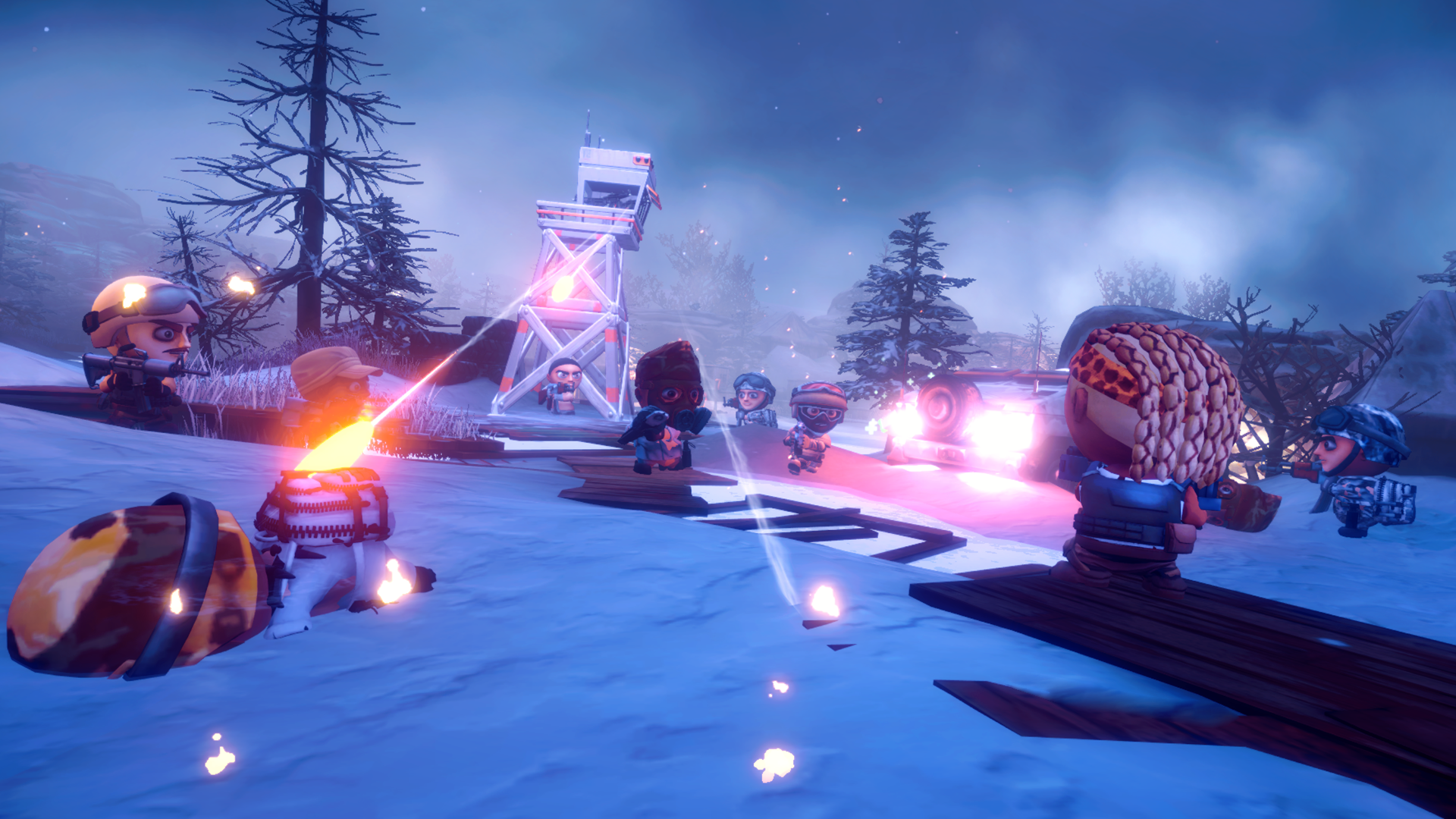
• In terms of our Winter environments, Chapter 3 is based around Eastern Europe and some of the particularly troubled times that region has faced in the past. Of course, being a 'Winter' theme, there are lots of whites and greys in the base colour palette. As there is not a great deal of colour to work with, it accordingly presents its own set of challenges as it’s difficult to provide points of visual interest beyond the base set. With that in mind, the colour palette, lighting and general set dressing in a lot of the Chapter 3 levels aim to evoke a very oppressive and war-torn atmosphere. As a result, these colours are very cold and muted, with pops of bright red. Urban areas are made to look very organized, while wilderness areas reflect the vast and inhospitable nature of the Eastern European wilderness during deep winter.
So, through a careful use of lighting and colour, additional assets and even mixing-and-matching the base sets themselves, we are creating a diverse set of environments and areas that provide as much visual interest and diversity for players as we possibly can. Over the course of dozens and dozens of missions throughout the chapters of Tiny Troopers Global Ops, this is clear to see!
Alright, At ease everyone - that's gonna do it for this weeks update, go get some R and R and keep your eyes peeled for the next intel drop.
If you want to catch more Global Ops content across the internet, then hit the links at the bottom of the blog! And as always, make sure Global Ops is on your wishlists - and tell your friends!