

Titan Saga: Chains of Kronos
New Game - Old Salt
OLD SALT
A gateway naval strategy game with no reinforcements on the way. Players take the helm of a fleet they construct at the beginning of the game to sail around the map, seize islands, and loose cannons on the enemy. First to control 6 islands or be the last ship sailing is claimed to be the newest Old Salt and is the winner of the game.
Players can opt to play with or without faction abilities but will construct a fleet in a draft selection at the start of the game. There are 5 ship types players can choose from with limited coins to purchase ships with. On a player's turn, they have the option to sail, fire cannons, seize islands, and if playing with faction abilities will have access to 3 more unique abilities. Players can do these actions in any order as long as they don't exceed maximum sail distance (3 tiles unless sailing over tradewinds), don't fire more times than their ship's health points and have the gold to pay for what they want to do.
Players are allowed to sail up to three ships on their turn a distance of 3 tiles unless assisted by a known trade wind that grants a bonus of 2 tiles of movement. Position your ships carefully as the broadside of a ship and stern/bow impact game play and firing options on and off turn.
Players fire at the enemy by counting the tiles to the enemy ship and rolling that amount or more. On the die is a blank side which if rolled, results in an automatic miss. Cannons aren't perfect weapons so sometimes it's best to use faction abilities to finish off an enemy ship. When a player destroys a ship, they will take the mast off the ship they destroyed and use it in a future transaction to seize an island or turn in at the top of their turn for a bounty reward.
In order to seize an island, a players ship must be adjacent to the island in question. The transfer of ownership costs 2 gold plus 1 gold for each enemy ship that occupies that island within the area (two tiles of the island). The player must also turn in a mast belonging to the island's current faction owner. If all costs are met and paid for, the transfer of ownership is immediate and the first to 6 islands is pronounced the Old Salt and the winner of the battle.
The faction abilities add a new level of replayability and strategy to the game as each faction has 3 abilities that are unique to them and their theme. Players can construct their fleet to offset a particular weakness of the faction or to enhance a strength of theirs. New players are encouraged to play their first 3 rounds without factions in order to gauge their comfortability before adding in the additional abilities and layer of depth this game can reach while still being excellent for those unfamiliar with the wargaming genre.
Titan Saga's take on the D&D Alignment system
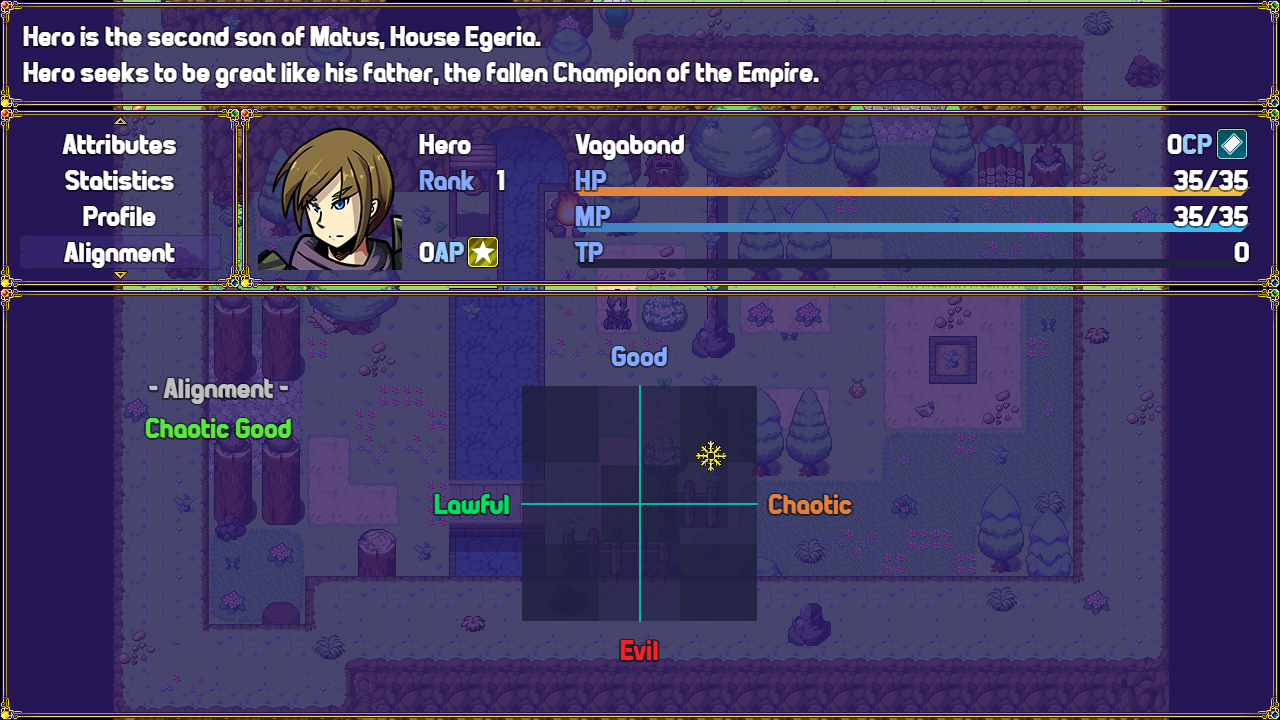
Alignment System
The major goal of Titan Saga is to create a story that the players can actually impact. In the previous D&D focus sneak peak, we discussed the Skill system that adds chance and proficiency into a player ability to succeed in an action. In Titan Saga, this helps balance rewards and allows players to play the game differently throughout and have different outcomes. By adding realistic constraints (in a fantasy setting), We are able to develop many more options while still making the game fun and dynamic. The Alignment System builds onto this idea by adding consistency to the storytelling. This keeps player from jumping from lawful to chaotic just to maximize rewards. This could be done but the alignment system would measure this a keep the player in a neutral alignment. Your alignment will directly impact how characters talk to you and what types of quests are available to you. This is meant to promotion role-playing within the game. By picking a roguish character you with have longer and deep conversations with the same type of NPCs and different quests will be available.
In Titan Saga, the Alignment system will have a large role in who your character becomes and the types of people, quests and opportunities your town get to grow. As Act 2 opens open to 3 large cities, many different types of group and character are available to fit your characters personality.
Titan Saga's take on the D&D Skill system
In Titan Saga, the new Talent system will accomplish this. From trade skills like Crafting and Mining to Social skills like Deception and History, and even skills like Lockpicking and Perception. Every playable character will have Talents and by specializing characters into certain Talents, you will be more likely to successfully affect the world of Titan Saga. This allows the story to have many branching options and also give realistic outcomes. Your character who has spent most social interactions being deceptive will be able to trick a guard in Act 2 while another player, who used other skills, will need to sneak into the Keep. They can still certainly try to lie to the guard but a failure is likely to lead to battle and a critical failure is likely to lead to an overwhelming battle.
See more Screenshots at https://kneeshaw.dev/2020/04/28/talent-system/
Content Update 0.4.1
Chapter 1 has been polished with a large amount of bug fixes and a story extension by adding one main story quest.
Battle System has seen a lot of balancing in this update with a deep change in the equipment and dual equip core.
The next update will focus on the player town, dungeoneer guild and broken shores. This is meant to add more depth to Chapter 1 and give the player more options.
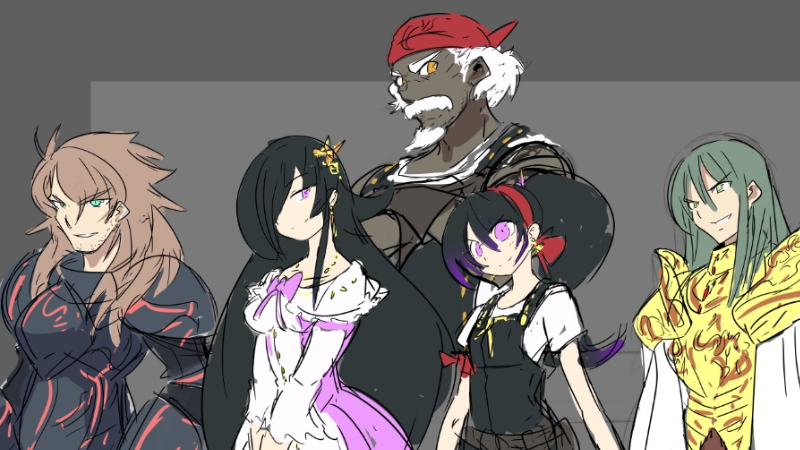
More art is being added each update!
New Content:
-New Achievement system
-New system – Dual wield
-New system – Parry/Block
-New system – one/two hand switch weapons
-New system – Equipment Set Bonus
-New system – Achievements
-New system – class specific guards
-New system – Skill mastery
-New void tileset artwork
-Enabled text skipping
-New Tooltip for States
-New background music
Balance:
–Ability to skip Prologue cut scenes
-Many skills and item stats changed
-Autosave added to world map
Mechanic:
-Steam work integration
-Steam Cloud saves
-Steam Achievement integration
-Controller Support
-Diagonal Movement added
Bug Fixes:
-Fixed jumping of map bug
-Corrected equipment scene push
-fixes battle camera zoom bug
-Multiple quest fixes
-Plugin overwrite bug fixed