Devlog #32-#33 | Manual Save - Hunting and Foraging (Game Design Posts)
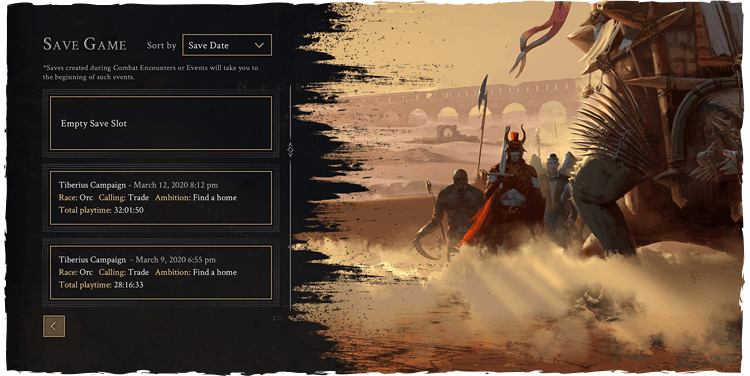
Manual Save
We have thought long and hard about how to deal with manual saves in Vagrus, because there are a lot of complications stemming from certain game elements. Do we let players choose mid-combat? Do we let them save mid-Event? Is there a point to Event tests if manual saves scumming works? These are just a few of the many questions that have arisen.
Eventually though, we could not imagine Vagrus without being able to save manually. We never set out to make a rogue-like and the Riven Realms can often slay even the best vagri quickly and cruelly. You might also want to replay certain quests differently and you should be able to load your game in such cases. So now that so many things are changing before the release of the Open World campaign, the time has come to implement manual saves and so you will see it pretty soon. That said, we will later add an Achievement to those crazy folks who can play through the game without ever saving manually.
Hunting and Foraging
Keeping your comitatus well-supplied - or in some cases even keeping it from starving - has always been intended to be challenging in Vagrus, and it makes sense: you are the leader of a daring traveling company in a post-apocalyptic fantasy world where resources are often scarce and terrible encounters can turn a simple trip into a living nightmare.
But we also hear you, dear players, when you say that sometimes it is a bit too difficult to keep your crew from starving, and so we are working on a couple of small features that we have planned to include from the start and that would make life easier for you when it comes to supplies. Let's take a quick look at what these are.
Foraging
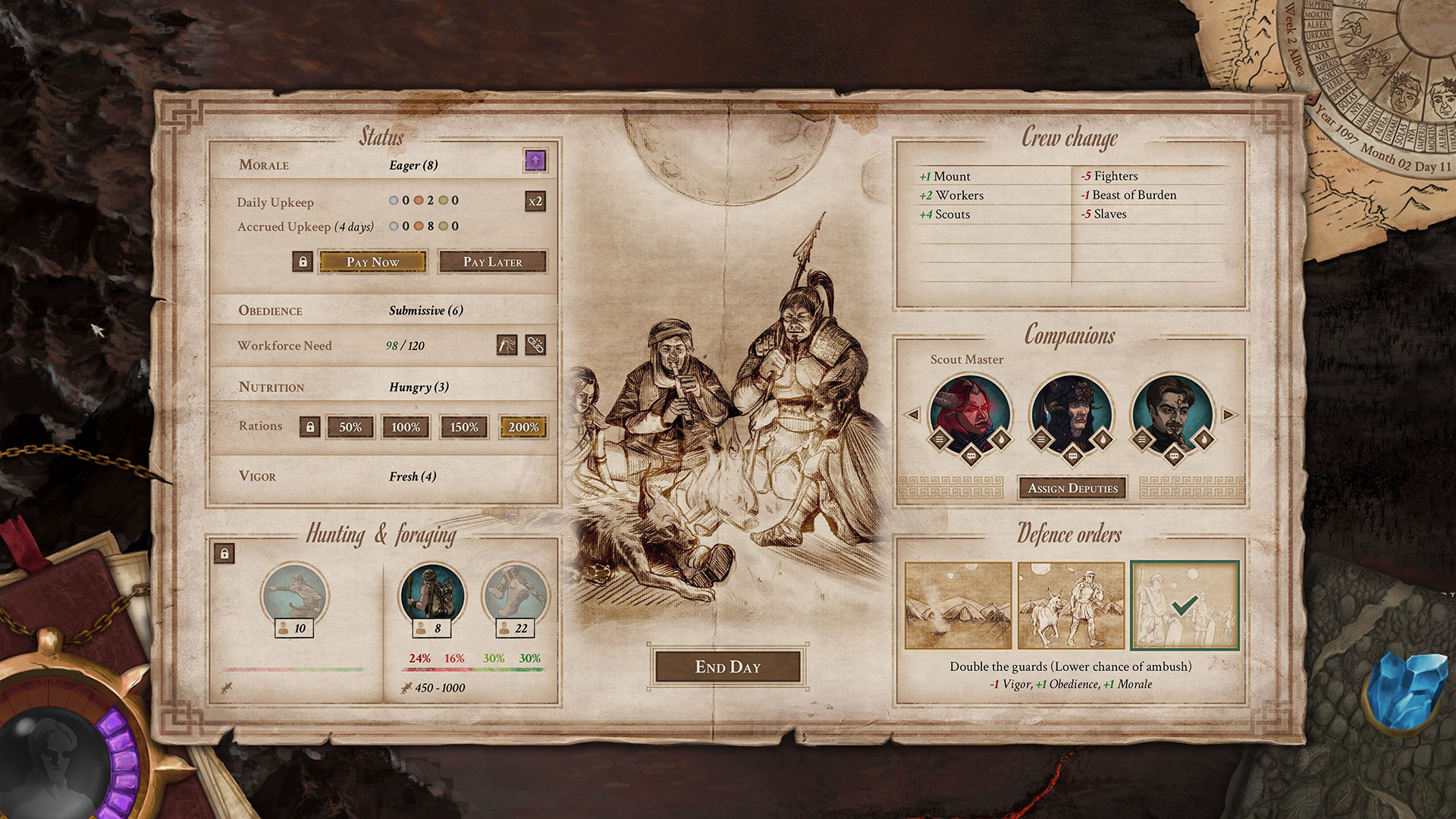
Foraging is a camp mechanic and you can use it to send out workers or slaves (or both) to gather supplies in the camp's vicinity. This yields supplies when the day is ended, albeit not a lot. Its role is to provide a relatively steady stream of supplies to help out with long journeys over the wastelands.
When sending out workers, the success chance is based on the yield of the region modified by the number of workers and their Vigor. In case of a critical fail, you can lose Vigor and even - very rarely - workers.
When sending slaves, Obedience is reduced, then depending on the test, you can have one or more slaves escaping.
In both cases, the Survival perk levels also factor into the test you roll.
Hunting
Hunting is a riskier business and it is a new way to make use of your scouts. The supply yield of hunting is either high or very little depending on the test roll that is based on the region's base yield, the number of your scouts, and your Hunting perk levels. The Venatoris deputy role also grants significant bonuses for this action. Hunting at the camp also tends to bring back secondary loot derived from beast kills, like hides, ivory, or chitin. There is also a chance that you will lose scouts when going hunting - the dangers of the wasteland are never to be underestimated.
Loot (yay!)
A very welcome side-benefit of both foraging and hunting that sometimes your crew finds and brings back loot from these excursions. Loot is mostly taken from fallen creatures of the region (like ivory or bone) but sometimes they can find other things as well. This loot is never abundant, mind, but can sometimes give you a nice little bonus.
Scouting
We are thinking about giving scouting results a new use: it would reveal the node's yield for hunting and foraging. These have a range for the region but individual nodes can be much more or much less abundant in supplies to claim. It is not sure when this will be added yet.
So that is a short rundown of what we are planning for this feature. We hope it will help with the cost of living and surviving the wastelands of the Riven Realms. What do you think?
Wanna get the game as early as possible with even more content? Please share our pages and posts with your friends through your favorite social media channel(s). Appreciate it!
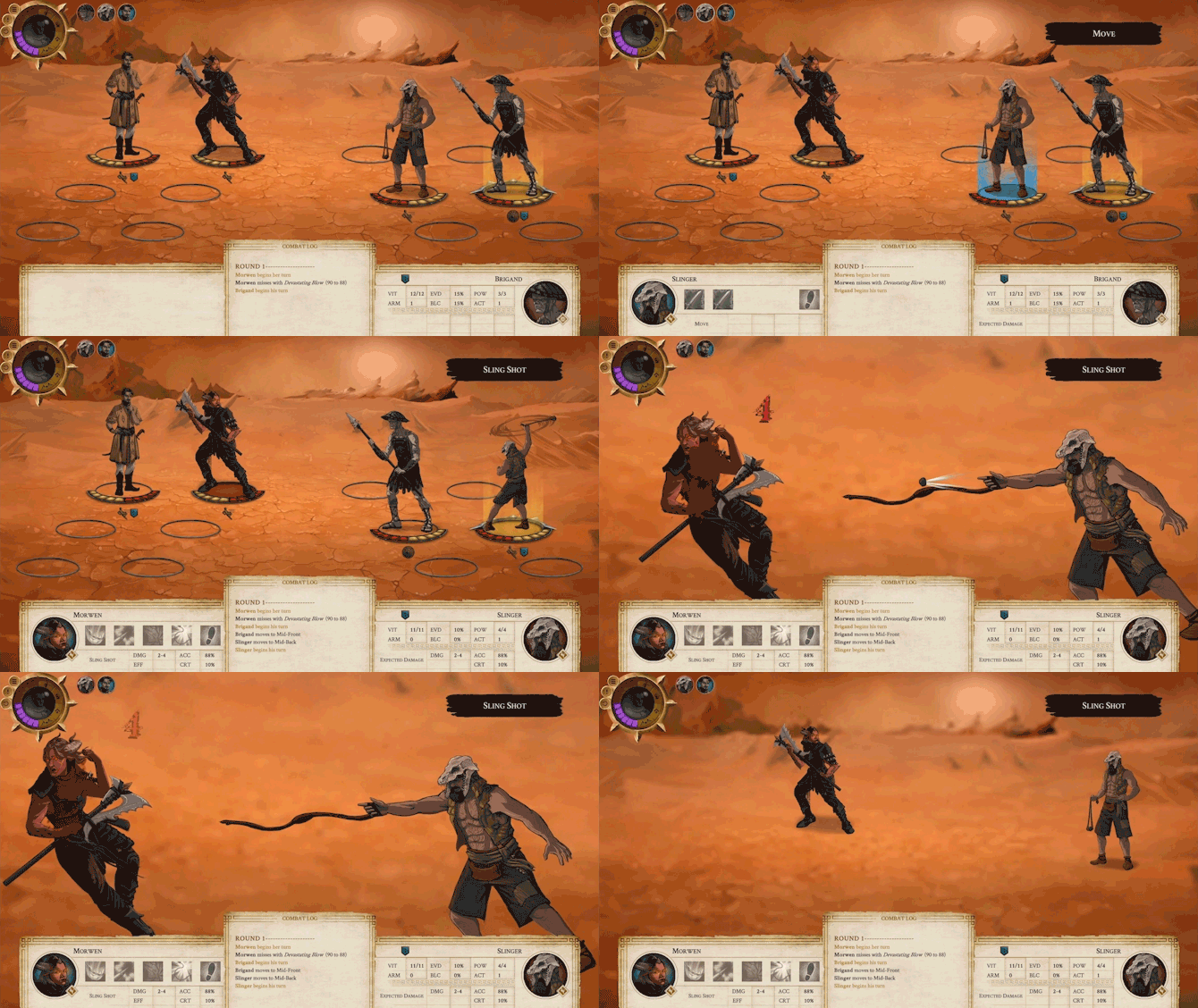
[previewyoutube="5LZxYu3t6uo;full"] Initially, we built Companion Combat without too much focus on the combat AI, knowing full well that it would be a massive task to code and having most of the combat features locked before we do so would make it overall a more efficient undertaking.
Thus, vanilla Companion Combat AI was 'equipped' with nothing more but brute force, running thousands of random choices without any direction that were then evaluated in the back end by a not-too-sophisticated point system spiced up with a dash of random generation aiming to make the AI choose sub-optimal scenarios too from time to time. Otherwise it would have been much too strong.
That unfortunately had its share of drawbacks. It was either extremely slow (too many iterations) or dumb (not enough iterations). After some tuning, we went for the middle ground with a rather slow and occasionally irrational setting. Truth be told, it felt awkward every time we saw someone stream the game like that and initially planned to return to it earlier but our players felt more concerned about other areas of the game, so we moved it behind other open-world features on our priority list.
Now that the first open-world region is in the hands of our backers and patron testers, we finally got around to improve AI, too.
First Objective: Increase Speed
We introduced a number of new attributes for all characters to drive their behavior, such as:
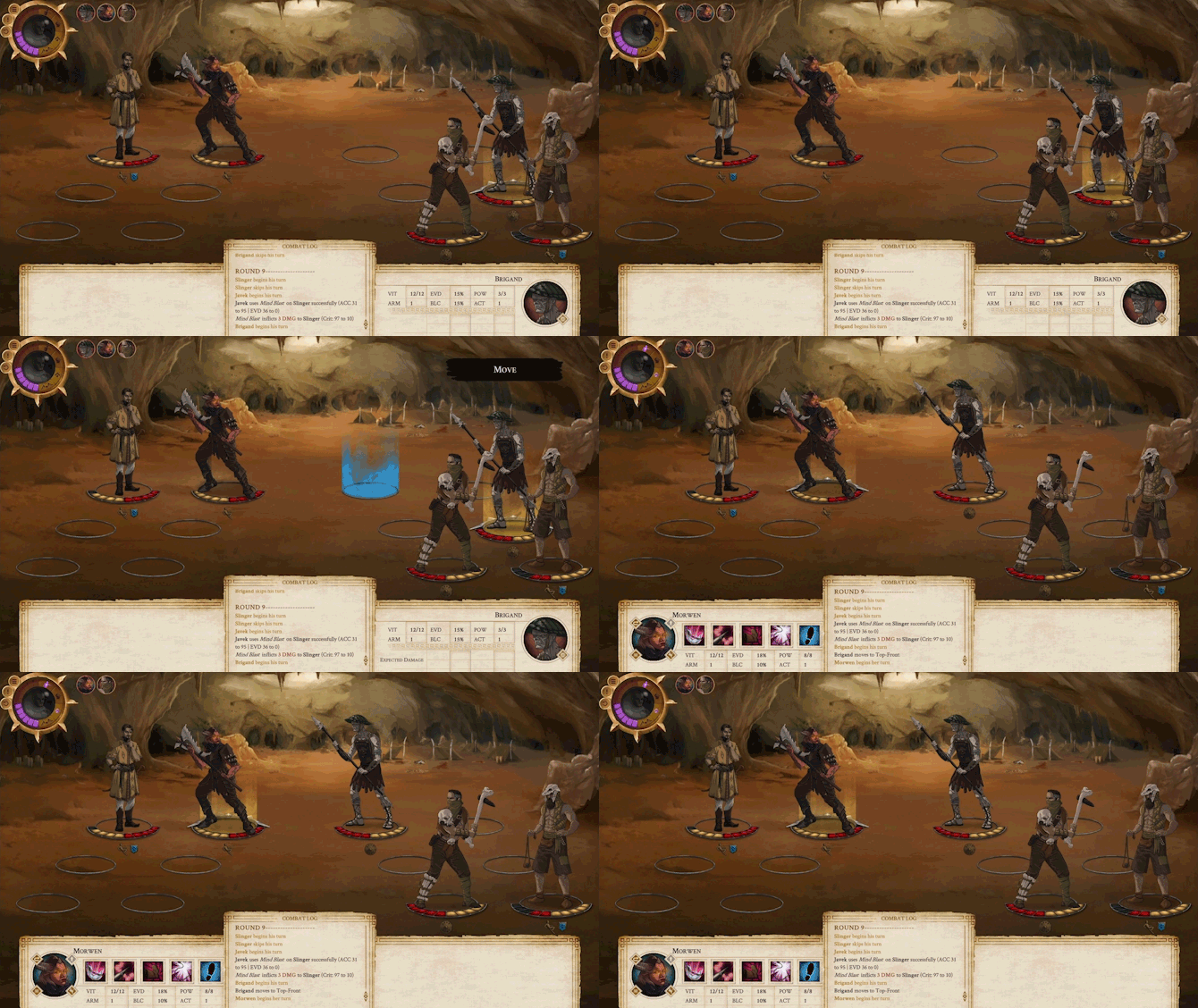
Row preference: Melee or range preference, or being versatile in both. That allowed to eliminate all simulations from non-preferred positions on the battlefield.
Tactical level (TL): Only characters with higher tactical awareness look for high certainty of their available options, while the ones with lower TL could drop the iteration numbers in the simulation drastically.
Expected damage: It is calculated based on the characters' average damage. Characters finding a 'good-enough' option stop the simulation and look no further. The higher the TL of a character is, the higher that imaginary bar of expected damage is set.
Second Objective: Optimal Positioning
When an AI - in any game - makes a dumb move, most of us feel lucky, even happy for a moment but then we immediately start to resent it. We want to beat the game with our superior strategy and not because of the AI's inferior tactics. Thus, we added new priorities for the AI:
Row preference: It was already mentioned above but beside helping with efficiency it also increased the effectiveness of the AI as enemies naturally priorities moving into their preferred rows allowing them to use their most impactful Skills.
Use cover: It is much harder to hit characters in cover with ranged attacks, so it only would make sense for the enemy units to use that advantage (even if only on higher TL).
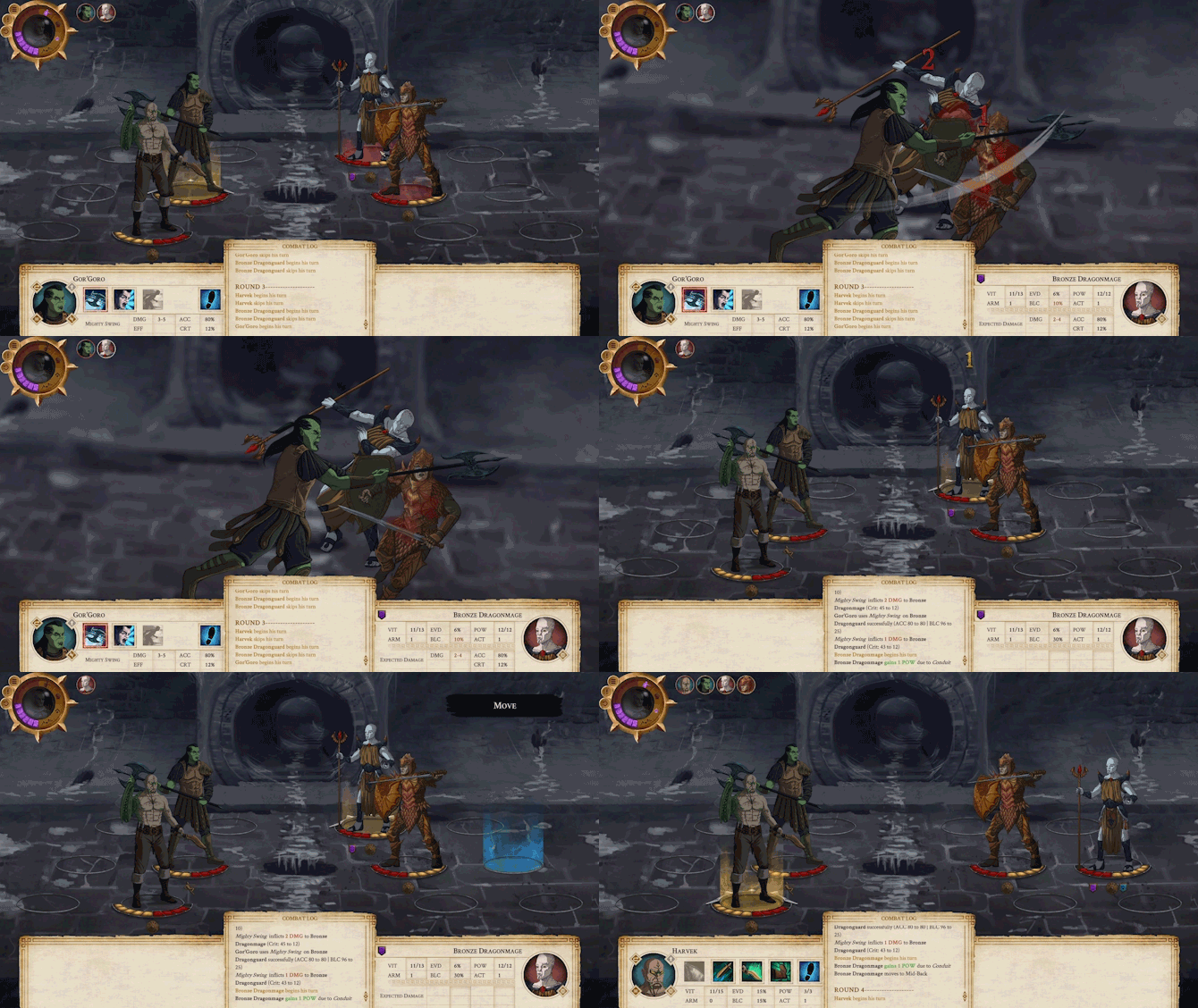
Use swap: Why spend two actions on shuffling around each other when you can swap? The players can do it, and so can the enemies now.
Third Objective: Colorful Skill Usage
Balancing a tactical game is very difficult and can barely ever be perfect - we knew that from the beginning. We are also aware that for a single-player game, variety and challenge is more important than being perfectly balanced, so when we design enemies, we do not mind them having a mix of stronger and weaker skills. On the other hand, we would like the AI to use all of them, even if not with the same frequency, so now the AI takes into account:
Effect prop points: Our old AI gathered 'points' during its simulation for instant and overtime damage as well as heal, also for getting targets stunned, killed, or downed. In the new version, we plugged in buffs, debuffs, and impediments too, so those skills would be assessed on their true merit.
Cleansing matters: We also take into consideration cleansing (meaning removing) effects, since those can be equally helpful or painful, depending on the situation.
Choice pooling: To ensure that weaker skills are used occasionally, we pool all viable options, sort them based on their scoring, then pick from the top number of actions on the list, where the number is determined based on the character's TL. The higher their TL, the narrower the pool, resulting in better choices.
We have worked for weeks on these changes but are quite happy with the final outcome. The next build will include all these changes and we hope to see you guys try them very soon.
Gábor, Lost Pilgrim ------------------------------------------------------------------------------------------------------
🎉 Our crowdfunding campaign is LIVE ▶️Get instant access to the Alpha build at Fig
Wanna get the game as early as possible with even more content? Please share our pages and posts with your friends through your favorite social media channel(s). Appreciate it!
The New Vagrus Open Access Build (v0.5.04) is LIVE!
A Huge 'Thank You!'
We are grateful to everyone who has tried the game and shared their experience of the Open-World prototype. A very special thanks to Deviant, mithc, SomeCommonName, and TheBrightKing for all their testing efforts. With hundreds of hours of gameplay under their belts, their detailed feedback on the use of different systems, balances, and mechanics were immensely useful for us, helping to prioritize what we need to improve first.
So What's in the Current Patch?
Most importantly, the Companion Combat AI improvements, about which we will release a separate post in the near future here. Also, various tweaks to the trading background systems to make the early game a bit more forgiving until we add Tasks. Beside those, we made a metric ton of typing and script corrections, squashed bugs, and added some smaller quality of life features.
What's coming next? We listened to You
We have decided to split our Companion Combat improvement Milestone (milestone 19) into two. In this build, we are releasing the enhancements made to the combat AI speed and logic, while the part that was supposed to cover adding new skills to enemy units will return as a separate milestone later on. Instead, we are refocusing our efforts to some early game improvements, most notably: Trading Tasks.
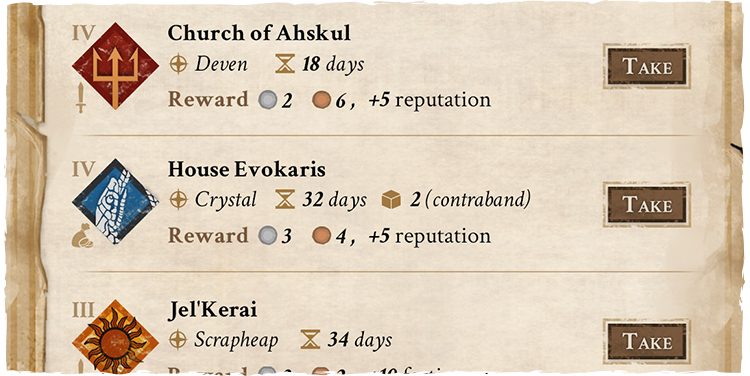
Tasks are jobs commissioned by factions for a fixed fee. Players can take on these Tasks knowing the exact money they will receive without having to dig deep into the trading meta from the start. They are the best and most reliable way to earn reputation with factions, too.
So the benefit of placing Tasks to an earlier spot on our development roadmap is to allow players to ease into the open-world part without having to have an extensive meta-knowledge of what can be bought or sold for a good profit in the different parts of the Empire. While completing these tasks for a fix commission, players also earn reputation with factions, gaining access to higher tier Tasks, better market prices, and one-time rewards. You can find some more details on Tasks in the description of our Milestone 20 here.
Okay, time to jump to the patch notes so you guys can experience this new build yourselves. Enjoy!
PATCH NOTES v0.5.04
New Features 👀
Milestone 19 — Companion Combat AI improvements 💀
The AI takes its turn much faster ⌛
Opponents move between rows based on their preference (melee, ranged) ⚔️🏹
Enemy units take advantage of cover 🛡️
Enemies are now able to swap positions 🔄
New / Updated Content or Game Mechanics 🎁
Trade was made slightly more profitable in the early game with small comitati while significantly harder in the mid/end game
Tweaks to Workforce and Guard requirements to make high-end comitatus size a little more costly (requires more crew to run one)
A number of Perks have been merged to make them more impactful
A shed-load of typos and event scripts corrected (anything you reported is supposedly fixed now 🤞)
Carrying Passengers for longer distances is now slightly more profitable
Scouting has a slightly better chance now (but still not justifies keeping scouts, that will come with Hunting and Tasks only)
Added a few new visual and sound effects for enemy characters
User Interface Improvements 📝
Throw-out window can now be manually triggered from the Cargo pane (to get rid of contraband, unwanted goods, etc.) 🗑️
Goods tooltips improvements (now shows both Buy and Sell prices) ⚖️
Panning on the Chart with keyboard arrows added 🗺️
Fixes 🛠️
A number of bugs causing all kinds of grief fixed (left some in so you can keep reporting them)
Fixed the bug that prevented crew combat to come up during camping. Expect to be ambushed during the night more often. Finally! 💀
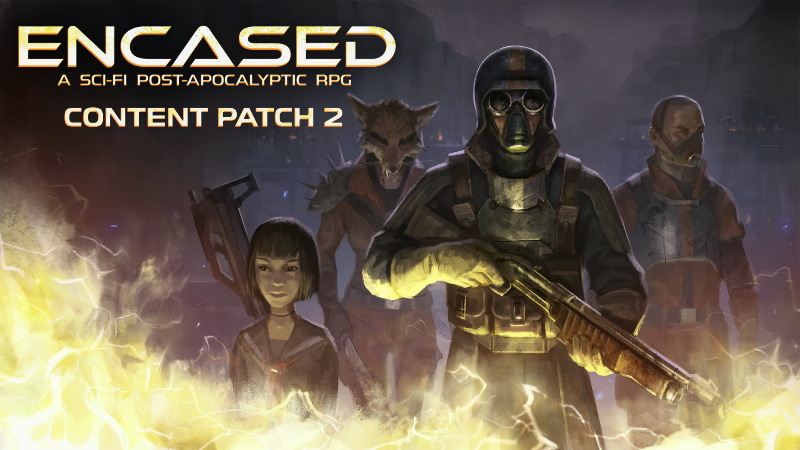
Encased is an old-school isometric RPG, heavily inspired by the original Fallout, Baldurs Gate and Divinity. Story takes place under the mysterious Dome, left by unknown civilization. Player has to fight for life in the harsh post-apocalyptic wastelands, explore anomalies, solve mysteries of the Dome and decide the fate of humanity.
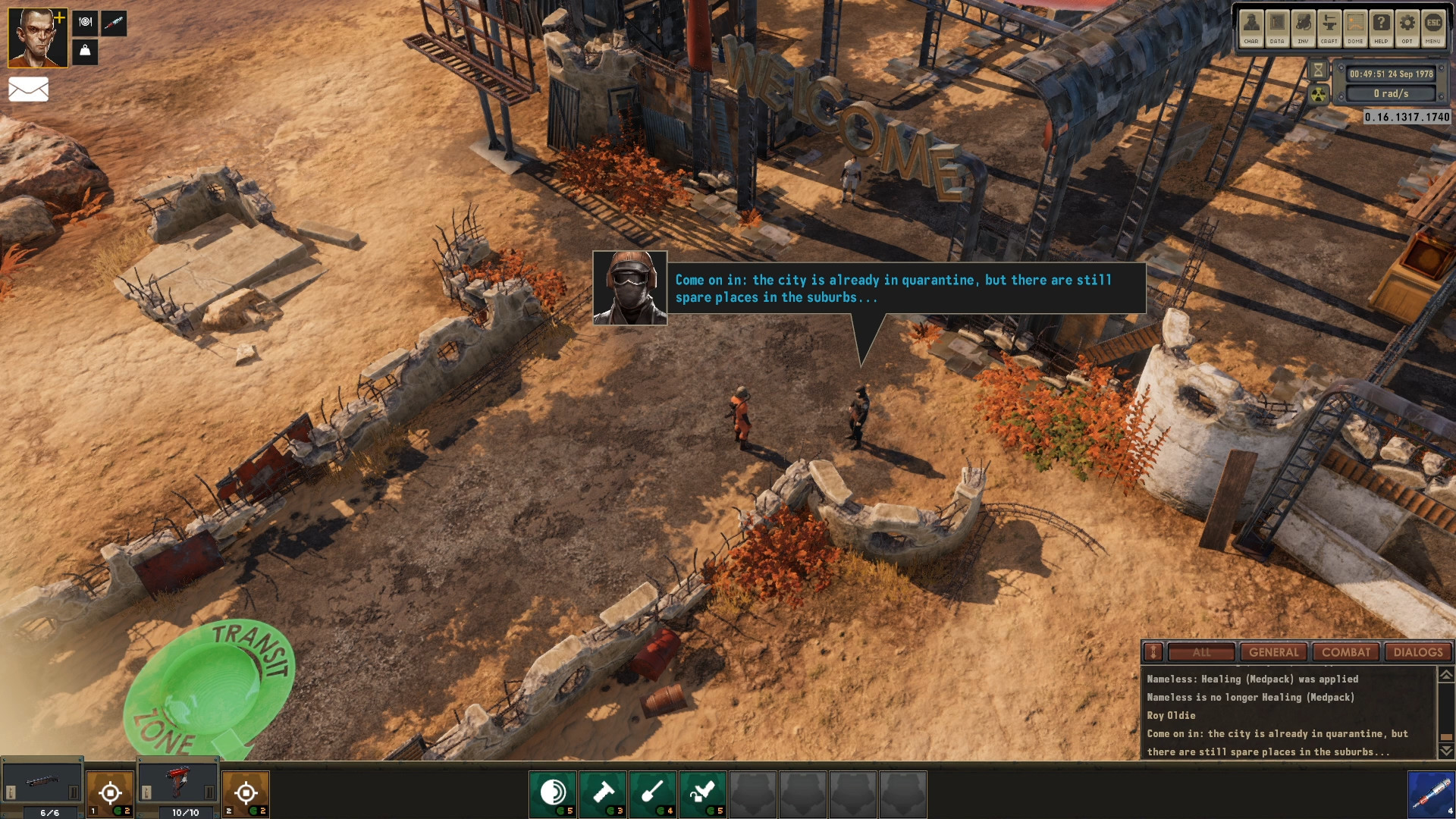
New content patch adds many new locations, characters and mechanics to the game. Players will be able to meet ferocious cyberhyenas and heavily armed raiders, recruit the new companion and witness the dynamic day and night cycle under the Dome.
Main changes of the patch:
Reworked locations. The Concord starting station was changed the most. New NPCs and interactive items were added.
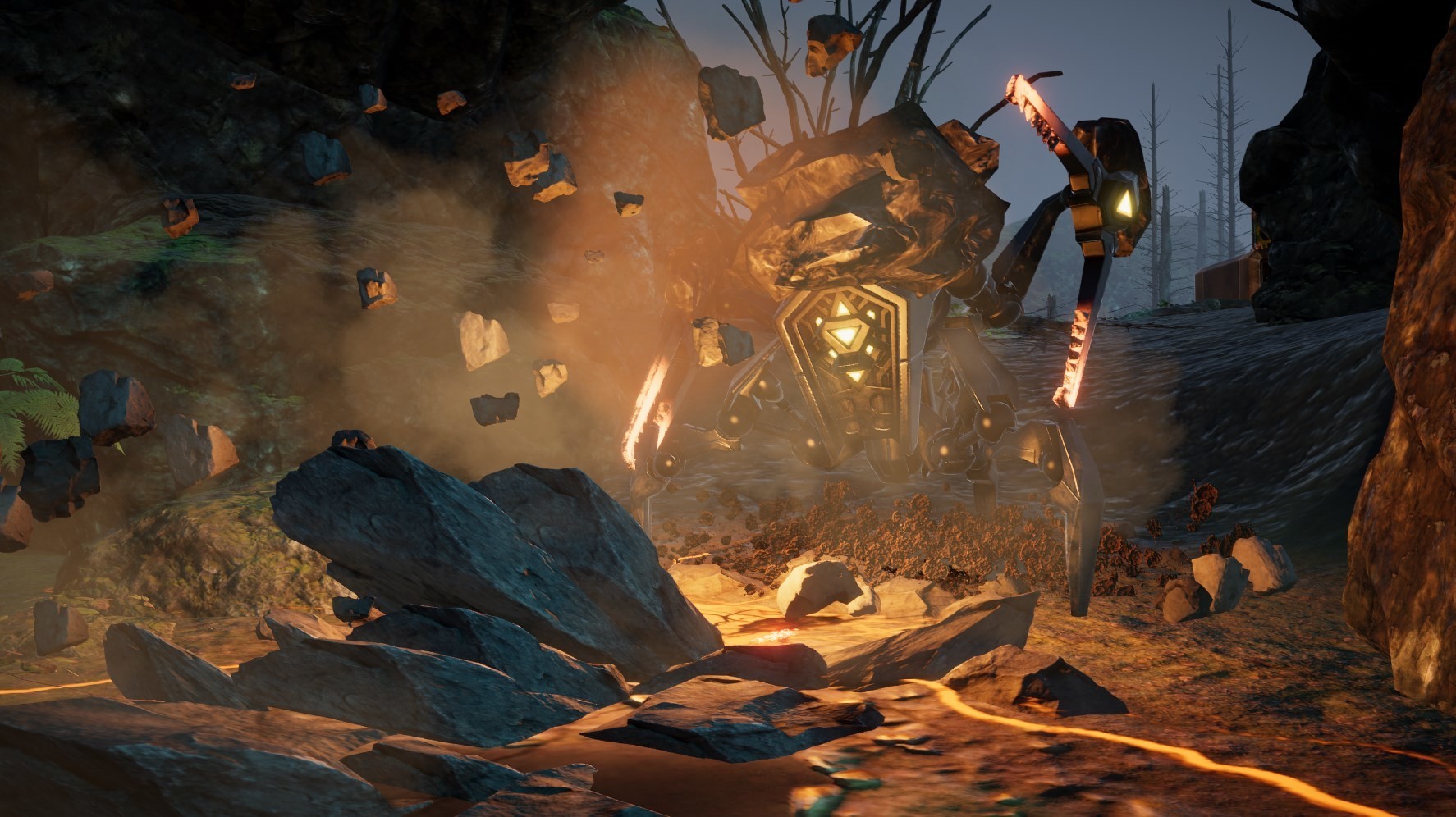
New enemies. New monsters are waiting for you in the wastelands! Cyberhyenas, crazy raiders and overgrown mutants.
New locations and story. Main storyline got new quests. Get ready to complete them in unfamiliar locations.
Day and night cycle. Now all areas under the Dome can be flooded with sunlight or enveloped in the darkness of a cold night.
New random encounters. We've added a lot of random encounters, be more careful when traveling through the wastelands!
New weapon and armor. The arsenal of the main character and his team was increased! Find new ways to kill your targets, while wearing new armor to protect yourself from danger.
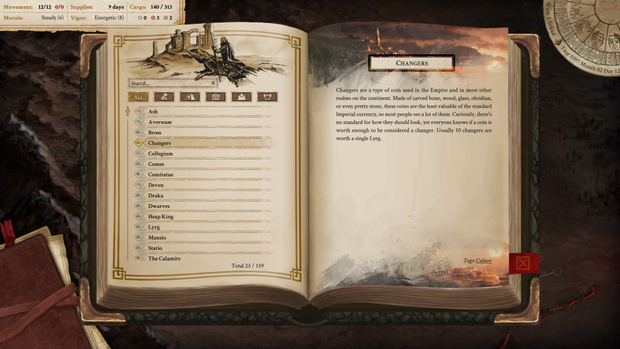
The Riven Realms has been around for over two decades now for us who created it for our tabletop campaigns, and the setting has quite a lot of currencies, even if one only considers the continent of Xeryn. When we set out to develop Vagrus, we picked three coin types not to overcrowd the UI: the Lyrg, a copper coin; the Bross, a silver coin; and Draka, a rare and very valuable golden coin. These are all coins that are used fairly often in large-scale commerce on the continent, and they are also fairly easy to identify as the copper-silver-gold trio of currency is fairly common in historical and fantasy settings.
Problems arose soon from the fact that a lot of common, everyday things are bought and sold for a smaller currency called Changers. For example, food for a day typically goes for around 2-3 Changers, or the daily wages of a worker are also typically around that sum. However, we had no Changers, so we implemented Supplies to represent 10 points of Consumption each. Individual crew wages were raised to 1 Lyrg - the absolute minimum - but this started an internal inflation that led to the rise of a lot of goods and services to make ratios match the world and to allow vagri to earn enough to pay upkeep. Unfortunately, this led to a situation where Drakas became very common, even in the beginning of the game, which in the metal-starved world of the Riven Realms goes against the lore and atmosphere, eroding immersion.
Recently, us Lost Pilgrims decided that Changers have to make a return, and they have to do so before the Open World campaign launches (otherwise the change would mess with saved games later).
At first, you might think this is a simple decimal shift, but it sent ripples out that shook most areas of the game in one way or another.
On the technical side:
Code had Lyrg/Bross/Draka hard-burned in several places, which had to be altered. Our databases, however, store prices as numbers only, so it was fairly straightforward to have prices shift (for example, if something used to cost 1 Draka, 2 Bross, and 5 Lyrg, now automatically costs 1 Bross, 2 Lyrg, and 5 Changers). On the design side, things were looking much more complicated:
The silver trading goods used to cost one or more Drakas per unit, but now only cost one or more Bross, so we had to make them more expensive (it did not make sense in world or any other way to have a bar of silver cost a few silver coins). This of course inflated the prices of all metals further, including Scrap Metal, which you know very well from Pilgrims of the Wasteland. This caused further changes in that prologue section because now you have no funds to buy the metal for the main quest.
Naturally, making metallic trading goods more expensive resulted in all gear, equipment, and items becoming more expensive, too. We'll have to tweak these prices as we go on.
Now that we have Changers to work with, we could de-scale the Supplies-Consumption situation explained above and eliminate the decimal multiplication. One Supply is now indeed one meal, which equals one Consumption. However, this causes Supply goods stacks to now be much less effective, so we are raising the number of Supply goods in one stack significantly to make up for the multiplication loss.
Then there is the question of Drakas, that are now effectively eliminated from the game. It is not a problem from a lore perspective, because gold is indeed very rare and mostly only extremely rich people see them with any kind of regularity. Now that said, your vagrus may indeed become such a person in the game, so we will probably add Drakas in some form or another later on.
Overall, we are happy that we went with the change (of Changers, heh...) despite the added work, especially because it would have been much more problematic later on. Additionally, our tabletop RPG souls are now at rest that the setting and the game are not at odds. :)
Wanna get the game as early as possible with even more content? Please share our pages and posts with your friends through your favorite social media channel(s). Appreciate it!
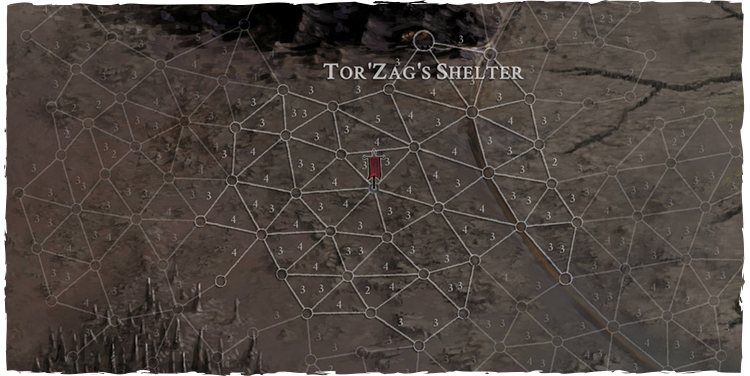
The Open-World Prototype of Vagrus has been released to all our Fig Backers. It is a major step towards getting the game ready to eventually bring it to here on to Steam for all of you to enjoy.
What It Brings
A ton of stuff, really. This is the game we've been working on, compared to which 'Pilgrims of the Wasteland' was only a small appetizer. That said, this large segment is only the beginning, and areas (with their content) will be added later on at intervals. We have discussed this an other details of the Open World Campaign here.
In short, a gigantic area with
dozens of settlements and points of interest to explore,
six Companions,
over 20 new enemy types,
five new soundtracks,
character creation,
and a ton of story content for you to discover are coming in the build.
[previewyoutube="-o169sL_g_A;full"]
We are very excited to see and hear your reactions, how long it takes you to find all the content, and of course to find out how difficult it is to stay alive for players in the cruel wastelands of the Riven Realms.
Wanna get the game as early as possible with even more content? Please share our pages and posts with your friends through your favorite social media channel(s). Appreciate it!
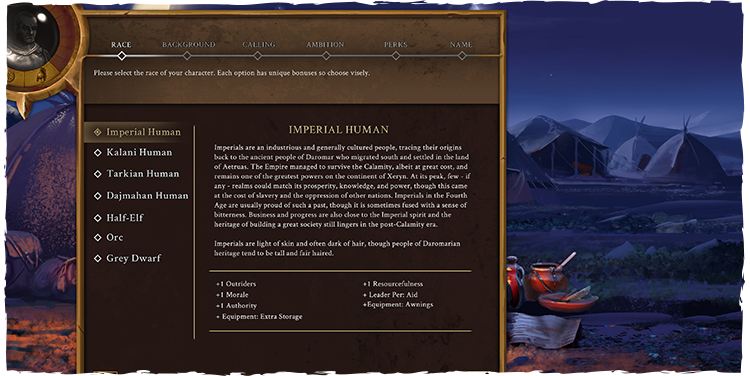
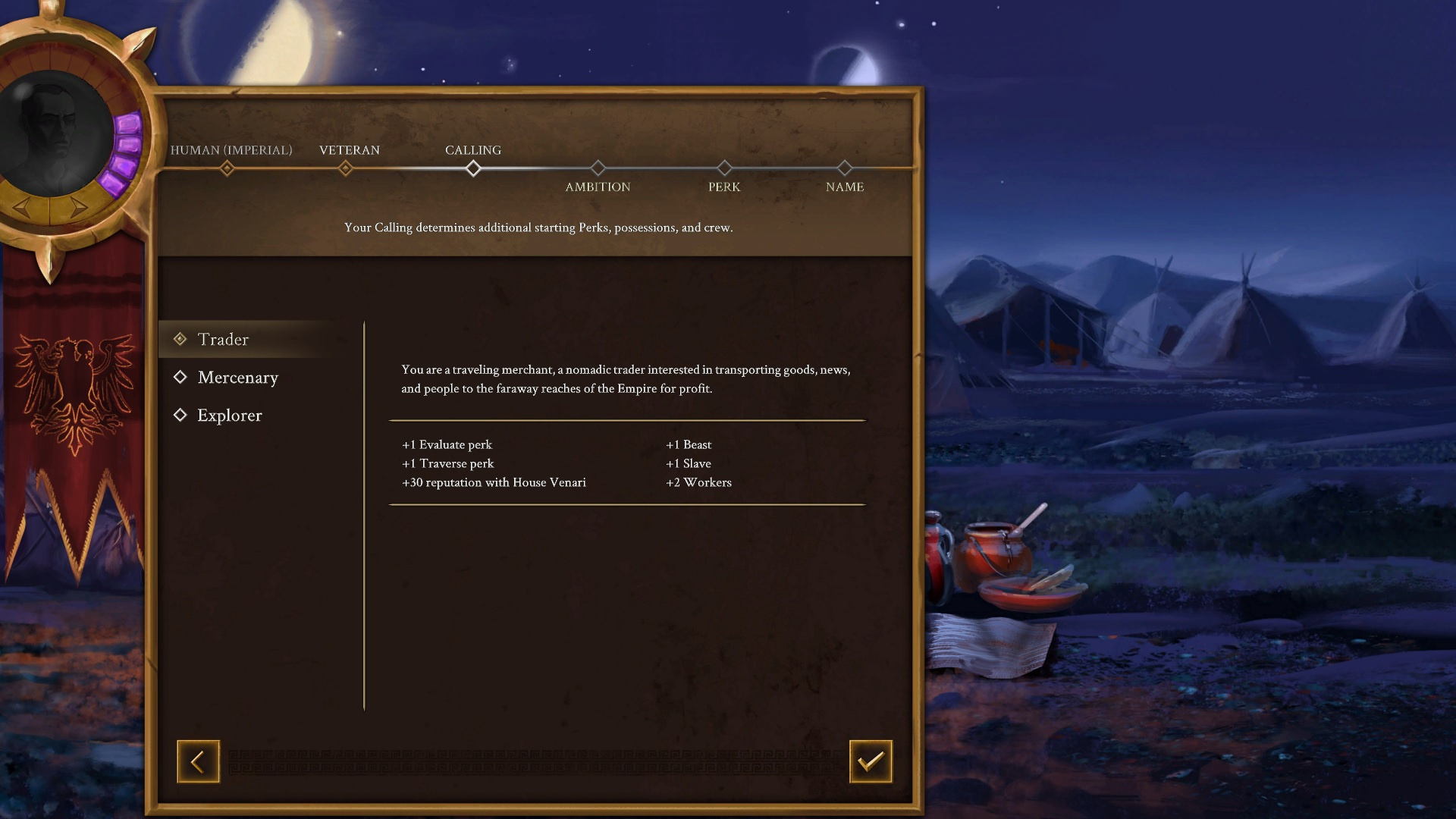
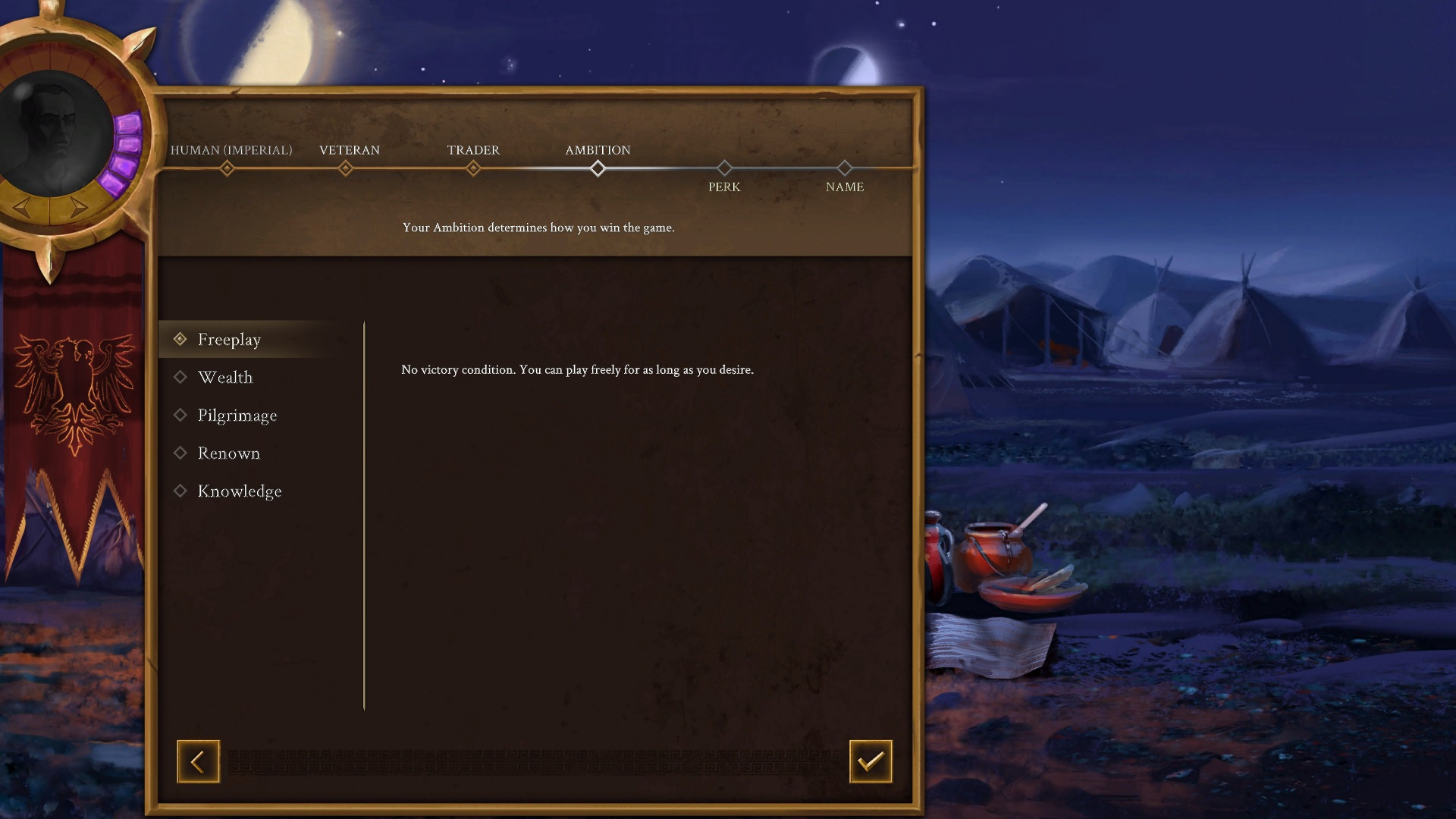
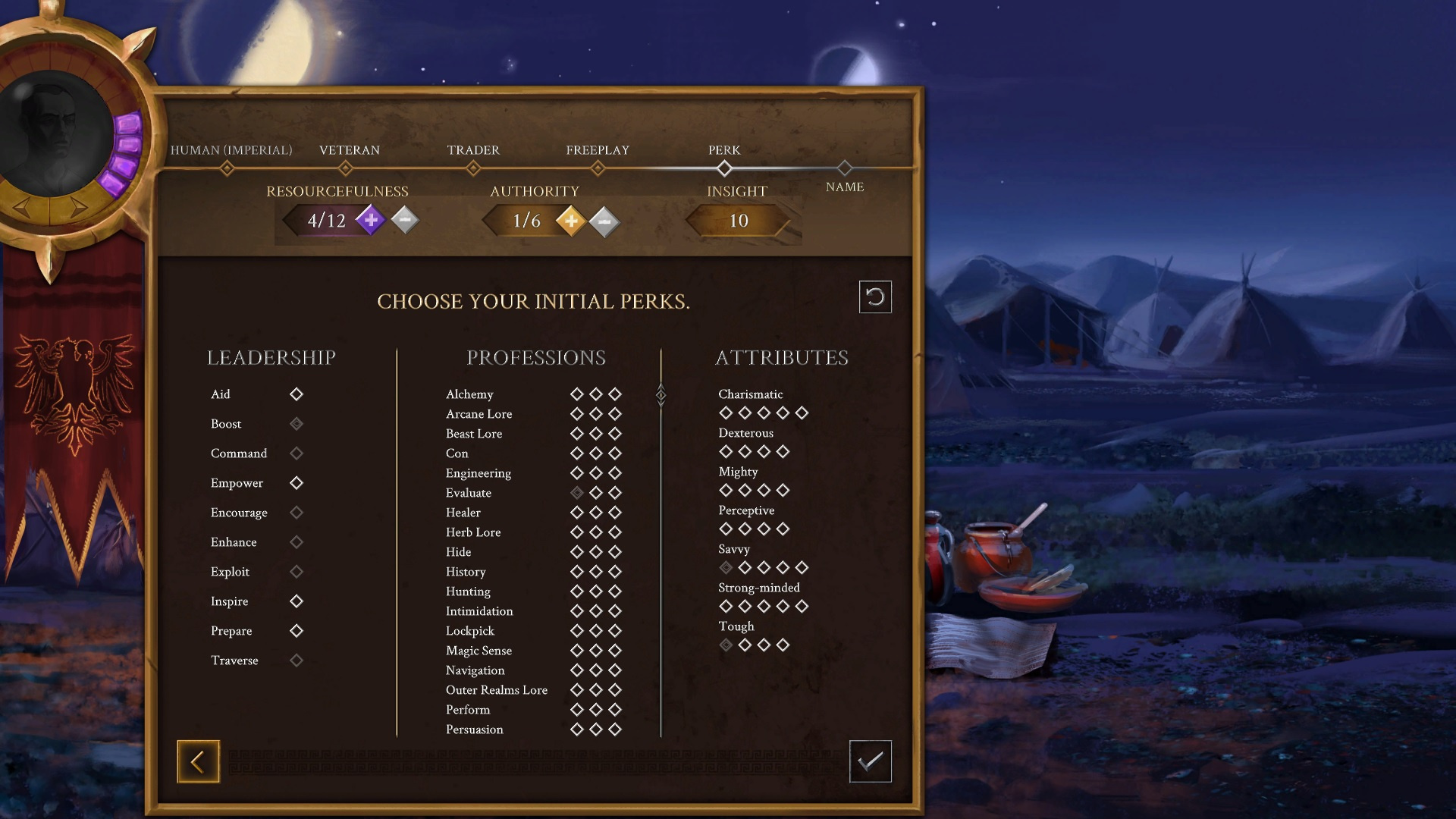
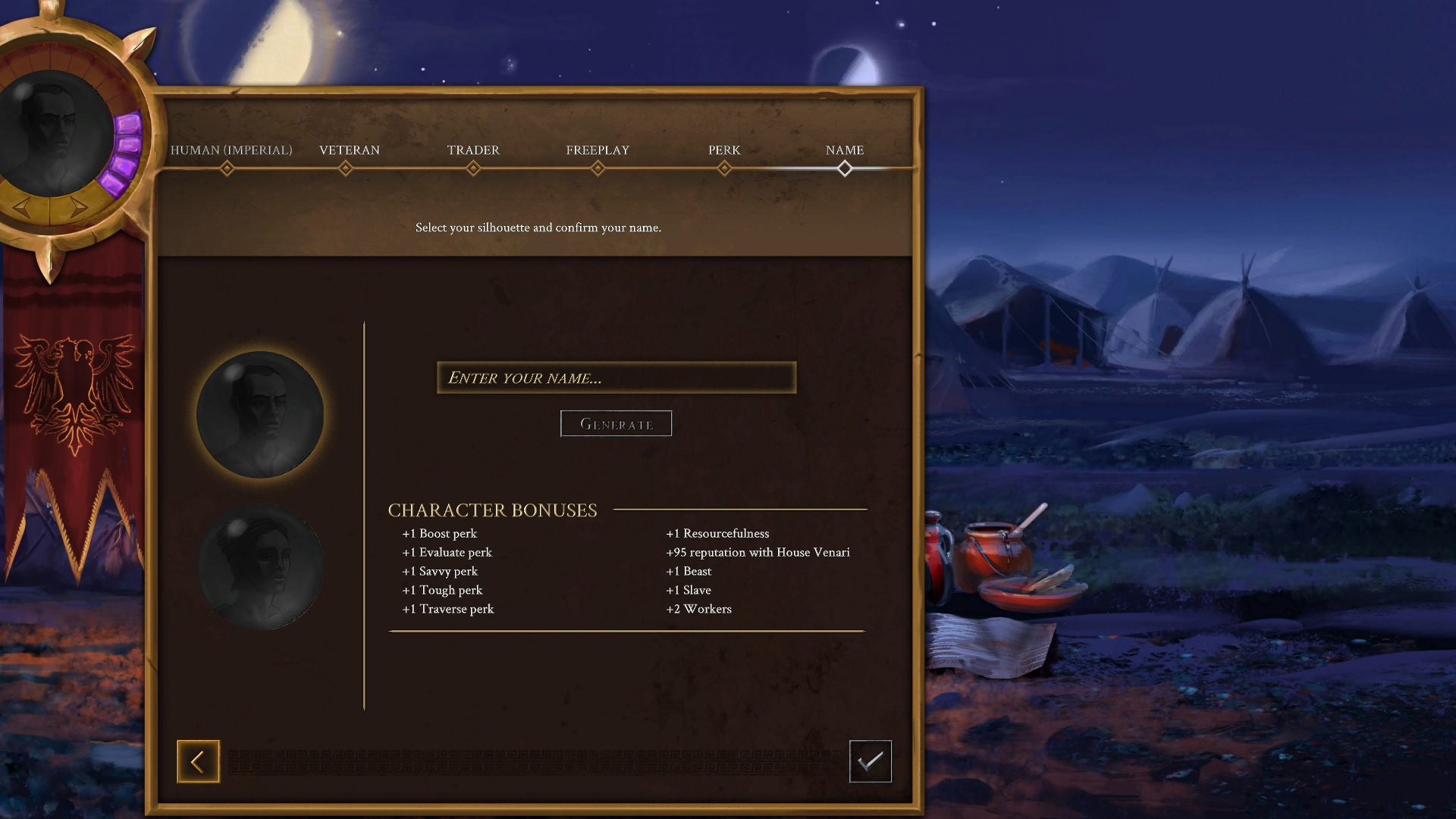
One of the last big additions to Vagrus' Open World Campaign that is now coming very close to being released is the character creation sequence at the start of the game. That is the feature that allows you to customize and set up your own vagrus by selecting a variety of options in subsequent steps. To give a quick idea of the many amazing options, here's a little rundown:
Race
The first such choice is Race. The Riven Realms is home to a lot of unusual creatures - some may be found in other fantasy games though probably quite different from their counterparts on Xeryn - while others are quite unique. Initially, you will be able to choose from six Races and we'll be adding new ones later on.
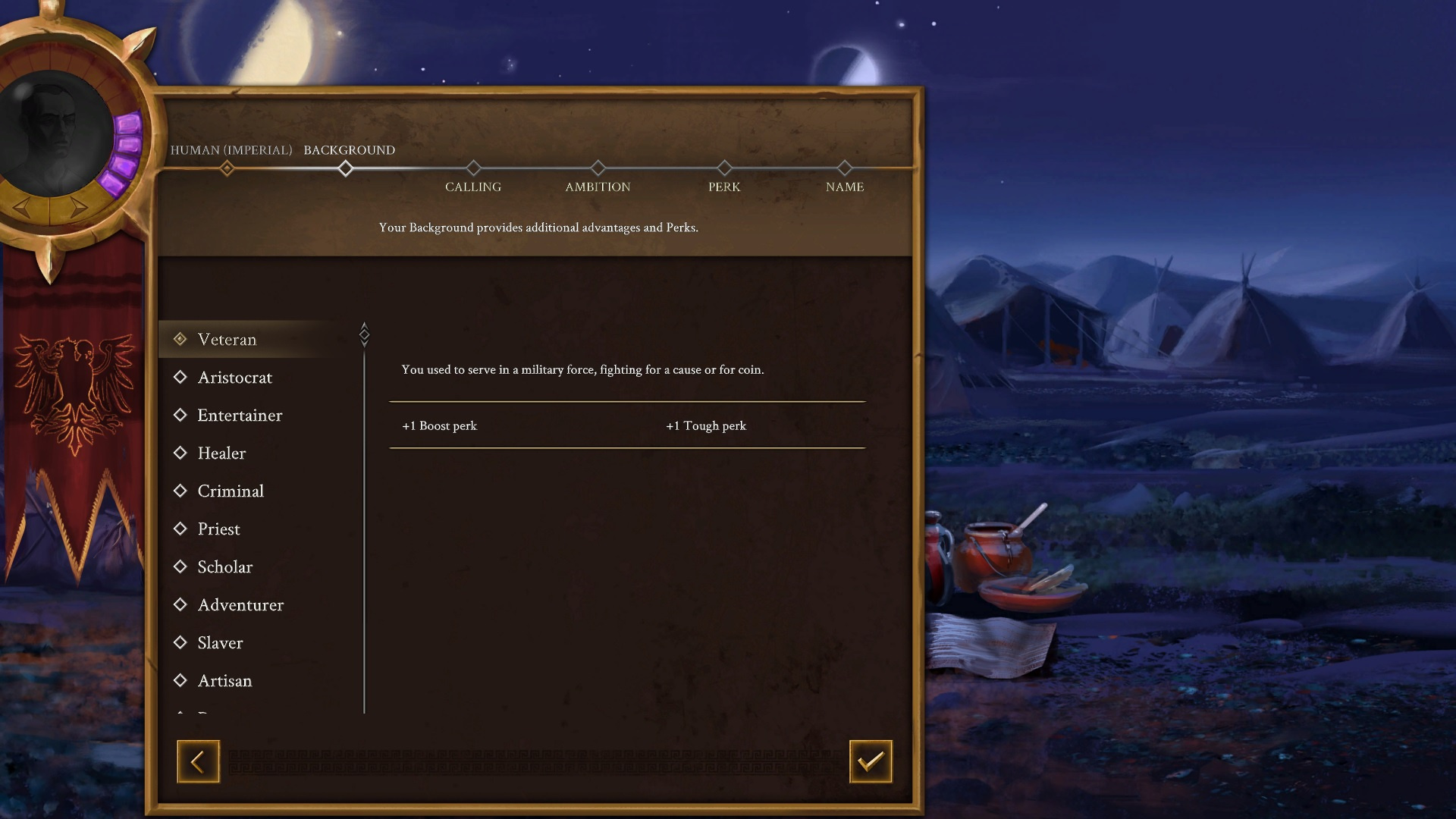
Background
Another way to spice things up a bit is character background. These are former professions or occupations (for example, aristocrat, veteran, criminal, scholar, or priest) and they provide additional Perks and resources to your character. Of course, not all combinations are possible - you won't see an Orc Slaver, nor an Imperial Savage.
Calling
Trader, Mercenary, or Explorer. Though there are only three options here, this choice has a much greater impact on your starting crew, Leadership Perks, and some other stats. You are by no means locked in such a game-style later on, however, as character progression for your vagrus is very open-ended.
Ambition
This choice sets your victory condition for the game. Initially, you will only be able to start freeplay (no victory condition) but later on you'll be able to choose from Wealth (you win by becoming rich), Knowledge (you win by learning everything possible from the Riven Realms), Renown (become well-known), and finally - towards the end of the dev cycle - a story-based Ambition.
Perks
With all starting Perks calculated (deriving from Race and Background), you will now be able to spend your starting Insight on rounding out your character further.
Customization
At the end of character creation, you will be able to customize your character by giving it a name and selecting a portrait (later on also a banner to represent your comitatus). [previewyoutube="GoRjtcvMqF0;full"] In the video above we are now presenting a little sneak peak into how it looks in the current build. As you can see, there are a lot of combinations to begin with and we're planning to expand on it in a big way. Stay tuned, for exciting times are coming to Vagrus!
Wanna get the game as early as possible with even more content? Please share our pages and posts with your friends through your favorite social media channel(s). Appreciate it!
Each Crew Combat encounter identifies the two sides as either the Attacker or the Defender. The player's comitatus can typically be the attacker when they raid small settlements or prey upon other travelers, while they are often found as the defender when getting accosted by monsters, outlaws, or worse.
Ambushes
When you are the defender, a hidden test is made based on your comitatus' vigilance against the attackers ability to ambush (various stats govern this test). If you are ambushed, there are serious penalties on your Combat Strength, representing your inability to set up your fighters properly. Other than that, you will be restricted in the use of Combat Actions when they are added later to the game.
Whether you are ambushed or not, a fight is about to go down.
Appeasing the Attacker
In the current builds, the only option is to fight. At a later stage, we intend to add a Flee option, though it will not be a reliably successful option. You can increase the chance of success with offering what the attackers demand, like offering 'bribes' to bandits, or leaving supplies for monsters. Appeasing the enemy will not always be an option: mindless Undead or motivated bounty hunters can not be bargained with.
Nevertheless, fleeing results in losses, but - in most cases - less so than trying to defend yourself in an unwinnable fight.
Attacking and Goals
If you are the attacker, you have the option to leave the opponents in peace and just Move on. This might be useful when not wanting to fight because you are already bruised, when not wishing to upset a certain faction, or when bumping into something you probably can not handle.
If you do decide to attack them, however, you need to first select a goal. This is mostly dependent on the type of enemy, and involves things like looting their cargo, trying to catch some of them to force them into slavery, and so on. Some options may not be available, like on image below you can see that the enemy has no mounts, so Poach Beasts can not be selected.
Fighting in Crew Combat
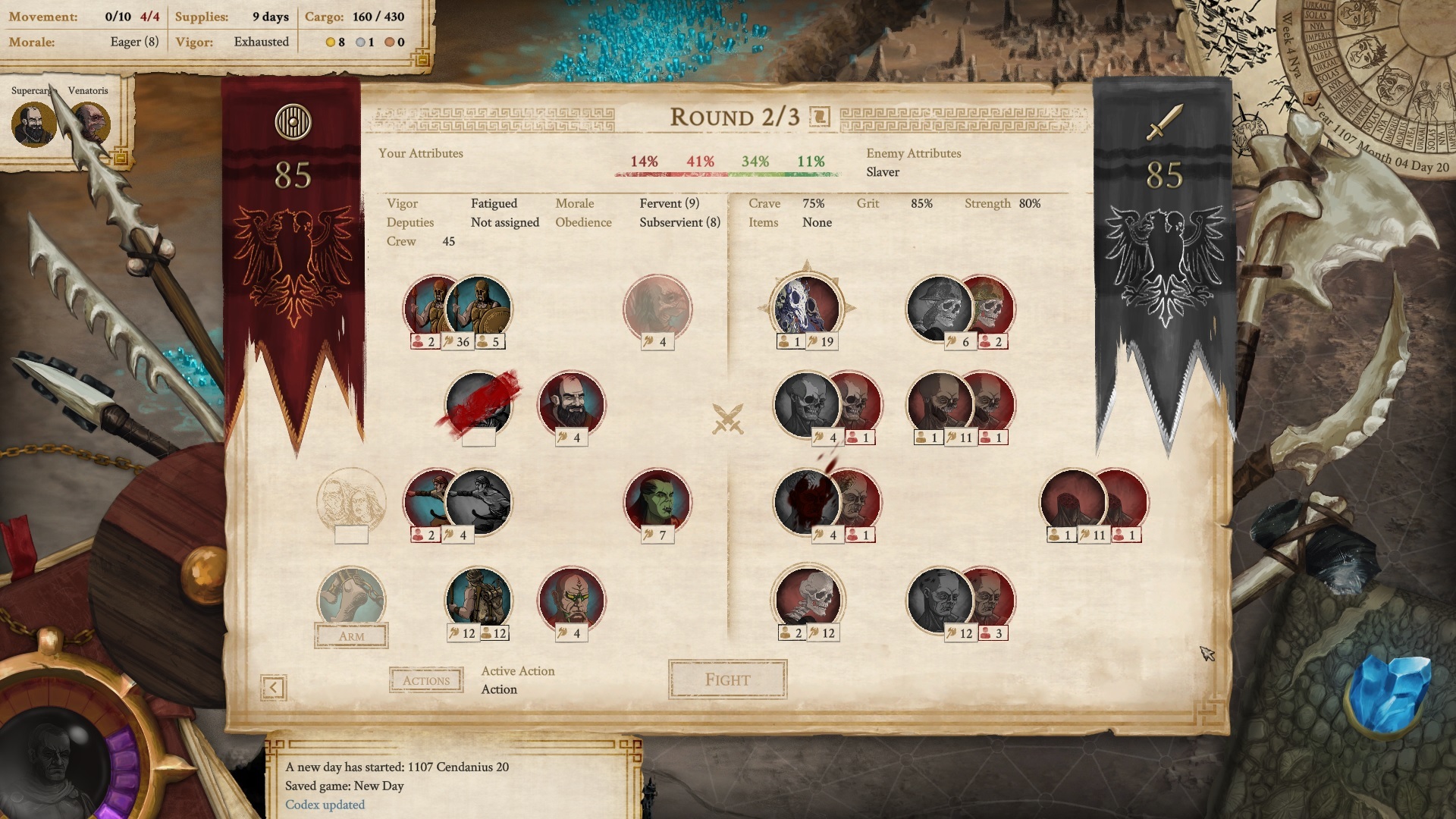
Once you get into the actual combat, your forces are shown on the left, while the enemy is on the right. The Combat Strength (CS) total of each side is displayed on their respective banners. One side will have to defeat the other in no more than 3 combat rounds.
Your CS is mainly calculated from the crew that takes part in the fight: fighters, scouts, outriders, and of course Companions. Vigor and Morale have significant impact on CS, and there is also equipment as well as conditions that can influence its total value.
Slaves and Passengers can be also be armed for the fight, but only at a considerable cost.
Wounds
Why not send everyone in every case? Well, because you risk the lives of those who you pick to fight and you might want to prevent that. However, if you sustain significant damage, your non-fighing crew can be slain as well regardless. So sending forth only a small team is often ineffective, too.
In another conflict (image below) we did have the option to poach beast, but it turned into a botched attempt: many of our crew members got wounded. The red circles around their portraits indicate a wounded combatant. By default they are taken out of the next round of fighting so you do not risk losing them but sometimes you need to send them into fight regardless (to avert greater losses).
Rounds and Rolls
As stated above, Crew Combat normally lasts for 3 rounds. Each round, a roll is made to determine whether the player wins or loses the round. Outcomes can be Critical Failure, Failure, Success, and Critical Success. The percentage boundaries for these are calculated based on the compared CS of each side.
If there is no definite combat result by the end of the third round, an 'aftermath' round follows that calculates the final result.
Crew Combat ends prematurely if:
Either of the sides is completely destroyed.
The attackers fulfill their goal and disengage.
The enemy loses its Confidence test in a round and retreats or flees.
Healing
If the comitatus survives the fight, a Heal phase commences, in which your skills in healing (along with that of your Companions' skills and your store of medical supplies) determine how many wounded crew members you can save.
Sweet Victory and Bitter Defeat
So how does victory come about at the end of all this? Well, during combat, both sides get points for Success and Critical Success attacks. Attackers gets points for snatching goods or other things according to their initially set goal. Defenders get points for preventing the attackers in said goal and also for keeping their crew safe, which is represented by the percentage of crew that survives.
This is a simplified run-down of how Crew Combat works, and as you can see, there are a lot of depth to it, which will be further augmented by the addition of special actions that your vagrus can perform, as well as the option to attempt to flee. We hope you enjoyed this outline and that you'll have a lot of fun with Crew Combat in the game.
The video below is a little peek into how Crew Combat works. At first, you can - as the attacker here - set what you wish to accomplish by assaulting the foe. Then a 3-round fight commences where you can decide which type of your crew and which companions fight. You can see the chances of a successful round above between the current Combat Strength of each side, and the casualties after each round are allocated based on that roll. Later on, we'll be adding special actions that you can perform each round to bolster your chances.
[previewyoutube="fI2NQd_QauE;full"] Crew Combat is the most common way you will handle violent conflicts as you roam the wastelands of the Riven Realms. We wanted to give you a rundown of the basic concepts here so that those interested might find some insights.
Wanna get the game as early as possible with even more content? Please share our pages and posts with your friends through your favorite social media channel(s). Appreciate it!
we've been busy implementing the milestones backers unlocked on Fig in the last few months but thought to give a heads-up to those of you primarily following us here on Steam. In the following (Part II.) collection of short videos we demonstrate some of the many recently added features to the game.
Enduring Effects
[previewyoutube="iZ7VJU54sqw;full"] In this short video we demonstrate Enduring Effects (long-lasting attributes that help or hinder your comitatus), with the Blessing of Sergorod now appearing on the (redesigned) crew UI. Sharp-eyed viewers can spot other UI differences as well.
Obedience
[previewyoutube="qu8jiPSNqr8;full"] In this video we demonstrate the workings of the Obedience mechanic, which represents how well-behaved your slaves are. A slave is liberated first in the video, which immediately raises Obedience (by the indicated number in the action popup). This is quite expensive however, as slaves cost a lot of money.
Then slaves are punished several time to demonstrate how that mechanic works. You can pick how many slaves you punish, which can raise the Obedience bonus or penalty. There are also diminishing returns to pacifying them so, and you can end up losing Obedience just like at the end of the video.
Workforce
[previewyoutube="j3M2gKzYU8c;full"] This short video shows where the 'workforce' stat appears on the crew pane. Selling slaves and sending away workers results in a severe drop in generated 'workforce' and so the comitatus becomes more and more understaffed, incurring serious penalties.
Butchering
[previewyoutube="gX6AA7-hutE;full"] Beasts of burden and mounts that a comitatus uses are large animals. They are the lifeblood of a traveling company, carrying people, cargo, and supplies on long journeys through desolate wastelands. Sometimes, however, they can literally become sustenance - in cases when you run out of supplies or when there are not enough workers to tend to them. Still, these creatures are usually very valuable but sometimes butchering them can be the difference between life and death out in the wasteland. The video here shows how a depleted caravan gains a lot of rations by using this simple but important new feature.
Hope you enjoyed these quick delves into some of the recent features.
Wanna get the game as early as possible with even more content? Please share our pages and posts with your friends through your favorite social media channel(s). Appreciate it!