In short: GameDevDays was phenomenal. The speakers and the community made it an absolutely amazing experience for us.
It started off a little rough considering that we could not borrow a reasonable size car for the trip to Graz and with all the tech equipment we needed to bring along it was a miracle that everyone could squeeze in. In the end we did get there even if a bit cramped. The next hoop we needed to jump was a mix-up with our accommodation (someone was already in the room we booked :O ) but eventually we solved that, too.
From then on, our trip just became better and better. The organizers of the show were helpful and easy-going, the venue was really cool for the size of the event, and then there were the speeches. It would be hard to list all of them, but our favorite two were probably Josh Sawyer (Obsidian) and Marta Fijak (11 Bit Studios).
The visitors who played Vagrus all praised its art, music, story, and enjoyed it so much that one guy that they often ended up playing for hours on end. Someone managed to establish a new record: he played for three hours straight. On the second day we had to put an additional laptop to work so more people could try the game without waiting for long.
The greatest moment of course was when RPG dev legend Josh Sawyer came to our table and played the game himself.
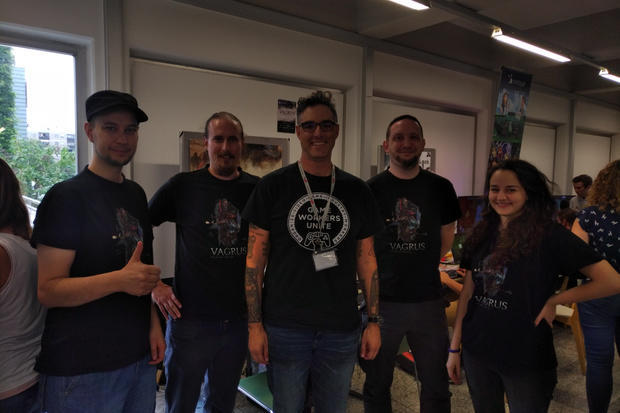
As the lead designer of many great RPG titles (Neverwinter Nights 2, Pillars of Eternity I-II, Fallout: New Vegas), Josh is a role model for us and his works are very important sources of inspiration, so him playing Vagrus and talking about RPGs was a dream come true. Our team was beaming when he joined us for a team photo, too (see the header image of this post).
The conference was an eye-opening experience from a community perspective as well. With support from the city of Graz and Technical University Graz but mostly thanks to the many dedicated organizers and volunteers from the gaming community, this event felt like everyone knew each other and looked at each other as friends. We listened to the local GamedevTunes orchestra with awe at the opening of the event and at the closing night-out, not only because they were awesome but because having a group so enthusiastic to practice and play on stage game soundtrack tributes from within an already small game developer subculture was almost unbelievable.
All in all, we had a great time in Graz and felt that we met more enthusiastic Vagrus fans than at any gameshow before. We would not be surprised to find ourselves attending GameDevDays Graz on future occasions as well.
The Lost Pilgrims Team ------------------------------------------------------------------------------------------------------
🎉 Our crowdfunding campaign is LIVE ▶️Get instant access to the Alpha build at Fig
Wanna get the game as early as possible with even more content? Please share our pages and posts with your friends through your favorite social media channel(s). Appreciate it!
Devlog #25 | Character Idle Animations (Game Design Post)
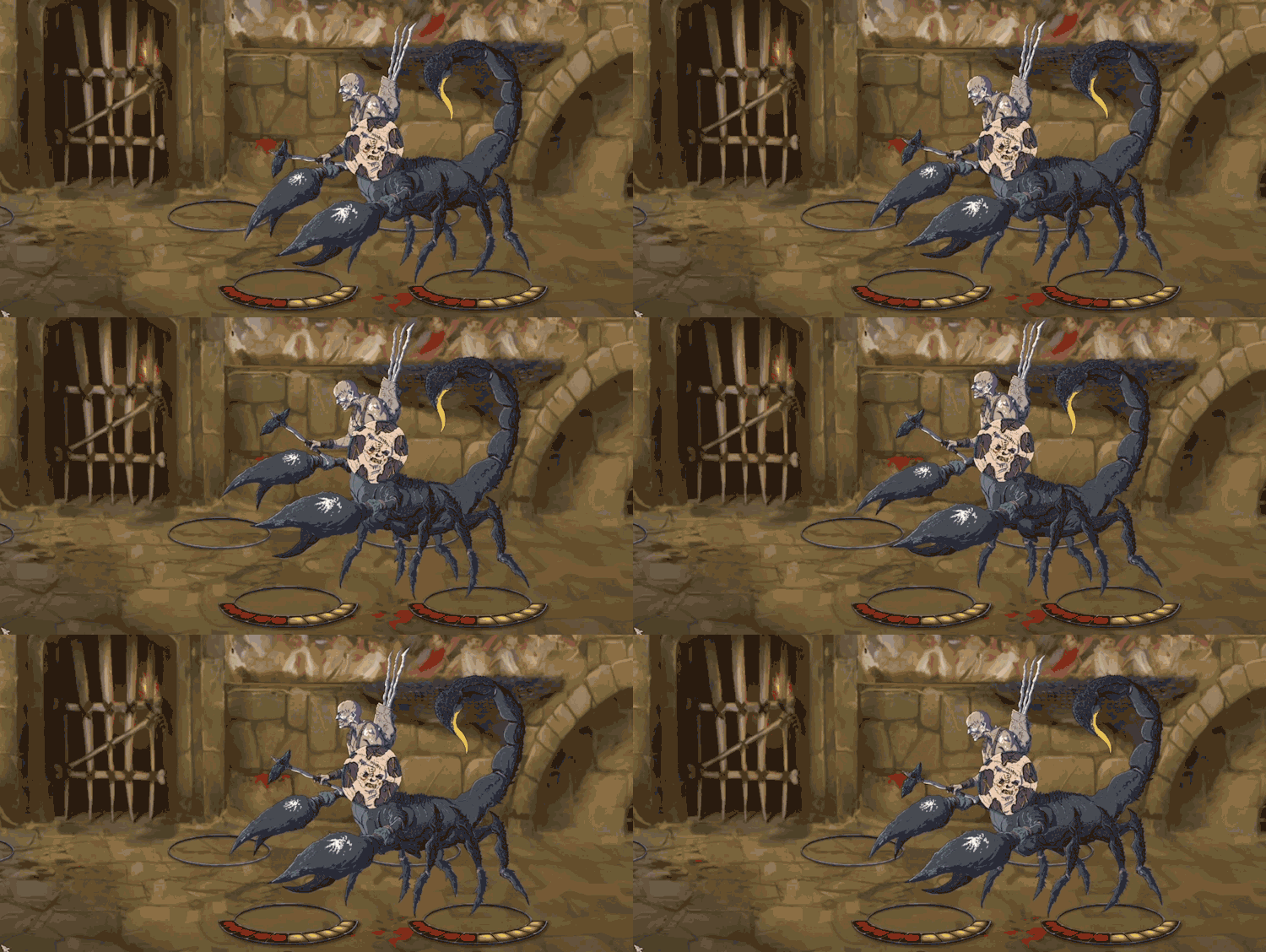
For the last couple of weeks, Szonja has been busy animating our idle characters after we had finally managed to settle on a process. There are still a lot of things to test and work out but after the first few prototypes we came to several important conclusions. For instance, we decided to have two distinct types of idle combat animations. One would be a very simple 'breathing' anim that is the default one for characters, in an endless loop. The other is a more pronounced movement that sometimes breaks up the more monotonous breathing one. A good example is when Javek fiddles with his goatee or when Gor'Goro brandishes his axe and stomps on the ground. We may even end up using the latter type for character activations in combat.
But for the time being enjoy these gifs that provide a glimpse into the future for our Companion combat idles.
The Lost Pilgrims Team ------------------------------------------------------------------------------------------------------
🎉 Our crowdfunding campaign is LIVE ▶️Get instant access to the Alpha build at Fig
Wanna get the game as early as possible with even more content? Please share our pages and posts with your friends through your favorite social media channel(s). Appreciate it!
We are actively working on what we call Enduring Effects for the game. What are these? Well, in short and to put it simply, these are all buffs and debuffs that last for several in-game days or are permanent (until removed somehow). They come in a variety of types and can be used for a lot of things to enhance gameplay and narrative alike.
Challenges and Results
The challenges of implementing such a system are more complex than one would think simply based on how they are supposed to work. We had to create a property system and make it compatible with a huge number of stats and attributes across a variety of in-game entities. Though it involved some heavy lifting (mainly from coding) and it is almost impossible to demonstrate, we are very satisfied with the results. The goal was to have a system that allows content creators to go wild and expand indefinitely, to keep adding stuff wherever the story or the gameplay requires it.
Enduring Effect Types
Apart from the simple distinction of positive and negative effects (that aid and hinder the player, respectively) we identify a number of parameters that set Enduring Effects (EEs) apart into neat little categories.
Leader: This type of EE affects your character, the vagrus. Typically it'll modify stats like Resourcefulness (or making certain Leadership Skills cheaper or more expensive), or alter Perks your character might have.
A good example is Inspiration, which raises the maximum Resourcefulness temporarily, or Blessing of Bal Ur Kaal, which raises the level of social Perks like Charismatic, Con, and Persuade.
Crew: EEs of this kind affect your crew and only your crew (meaning they don't affect Companions for example or your character). Crew-related stats are typically altered by these, such as Vigor or Morale.
Examples include Favor of Irafons, which gives MP to your comitatus, or Hangover, which lowers maximum Vigor for a day.
Companion: This type of EE affects a specific Companion or all of them. Since these characters have a wide range of abilities, combat skills, and Perks, these EEs tend to be complicated more often than not.
The Blessing of Sergorod, for example, gives a Companion some Accuracy and Critical Hit boosts, while the Wrath of Sergorod makes it so that enemies are more accurate and score criticals more often against your cursed Companion.
Comitatus: EEs that effect your whole comitatus can be more complex, modifying a wider variety of stats and mechanics. They tend to have a Companion-related EE counterpart that is automatically assigned when the parent EE is assigned.
Black Rot, for instance, is a dreadful disease that is very contagious. When your comitatus receives this EE, it is transferred to all Companions currently in your employ as well - and keeps killing your crew and Companions until you can rid yourself of the horrid sickness.
Disdain of Ahskul affects the whole comitatus, making it more common that Undead show up as random encounters as well as buffing Undead type enemies against you.
Hope this allowed a little glance into what goes on behind the scenes and gives you all an idea of what to expect from this feature package. Next up, we'll probably talk about animation. See you around, dear Follower!
Wanna get the game as early as possible with even more content? Please share our pages and posts with your friends through your favorite social media channel(s). Appreciate it!
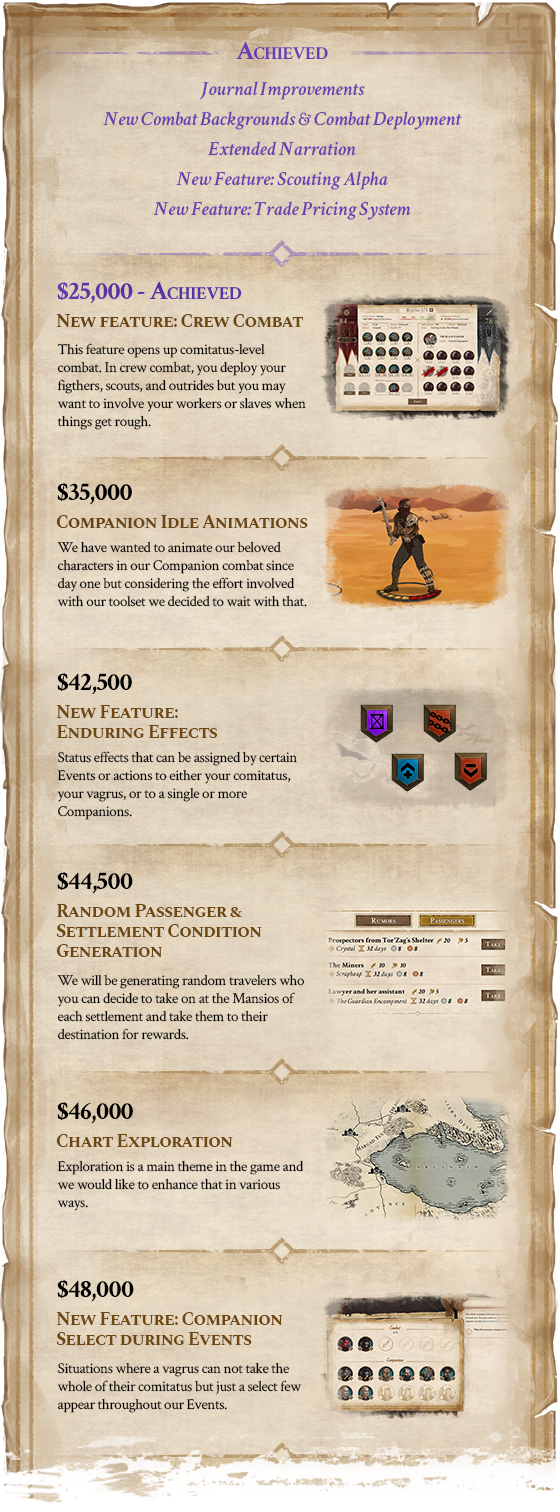
We have just announced some new features and enhancements that are coming down the line. There are smaller and bigger ones, all leading up to the major release that will be the Open World campaign of Vagrus. Every new build we create is immediately shared with our Backers over at Fig, so it's definitely worth checking out our milestone tracker below.
Laurels All Around
In our endeavour to get Vagrus into the sights of as many cRPG lovers as we can, we applied for featured spots in a number of nearby game shows - successfully!
Not only did we get invited to present Vagrus the game itself but our art design and developer pitch has been rewarded as well making it into the official selection of said shows (see above). That reminds us to bring to your attention the upcoming opportunities to meet us in person:
Game Dev Days 2019 in Graz (Austria) on September 6 - 8GDD 2019
The Strasbourg Fantastic Film Festival in Strasbourg (France) on September 20-22FEFFS
AdventureX 2019 at The British Library in London (United Kingdom) on November 2-3AdvX2019
Needless to say, we are extremely proud and grateful to everyone who helped us get here. So again, thanks for your support, know that it means a lot to us and to the project!
The Lost Pilgrims Team ------------------------------------------------------------------------------------------------------
🎉 Our crowdfunding campaign is LIVE ▶️Get instant access to the Alpha build at Fig
Wanna get the game as early as possible with even more content? Please share our pages and posts with your friends through your favorite social media channel(s). Appreciate it!
Side Project Announcement - Working on Ian Livingstone's City of Thieves The Graphic Novel
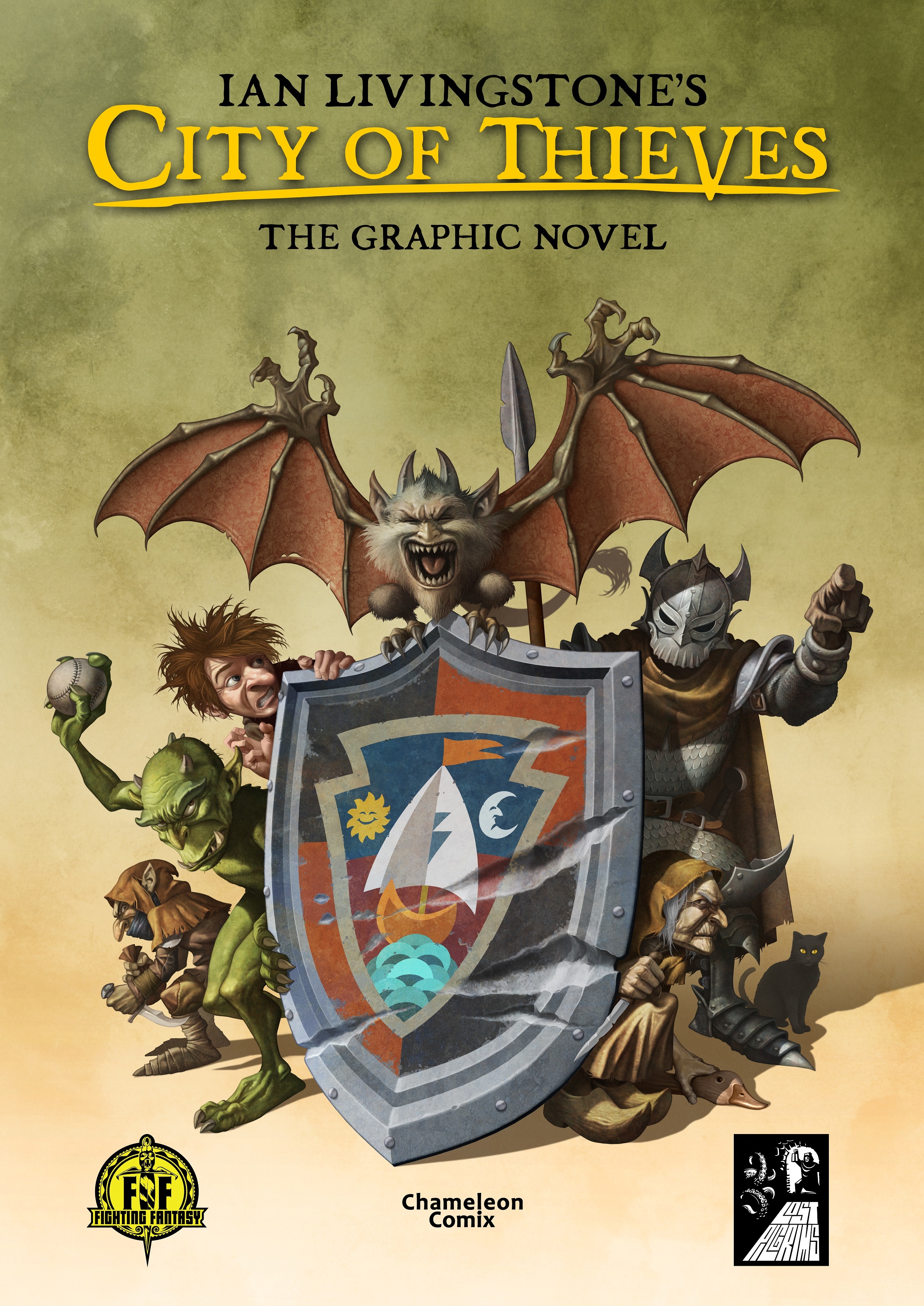
We are extremely proud to announce working alongside Chameleon Comix and Ian Livingstone on a City of Thieves graphic novel. Ian has been our hero ever since our little group of friend gathered around one of his books in elementary school. It has been without a shadow of a doubt a key moment in our lives to turn towards table-top roleplaying games, and eventually start our indiegame development studio, Lost Pilgrims. Having this opportunity to work with him is a dream come true and it's even better since we are joining forces with one of those friends huddling around said book. Gyula has been a long time member of our RPG group, played countless hours on our own world, The Riven Realms too, and he now leads this awesome project with his comic books publishing house. Interested in hearing more? Be sure to follow Chameleon Comix and Lost Pilgrims, and meet us at our stand next to Ian's at Fighting Fantasy Fest 3 at the end of August.
This is a small project compared to Vagrus but it still feels great that such esteemed author like Ian Livingstone thought us worthy to carry on and support his Fighting Fantasy Universe this way.
Devlog #23 | Trade System (Game Design Post)
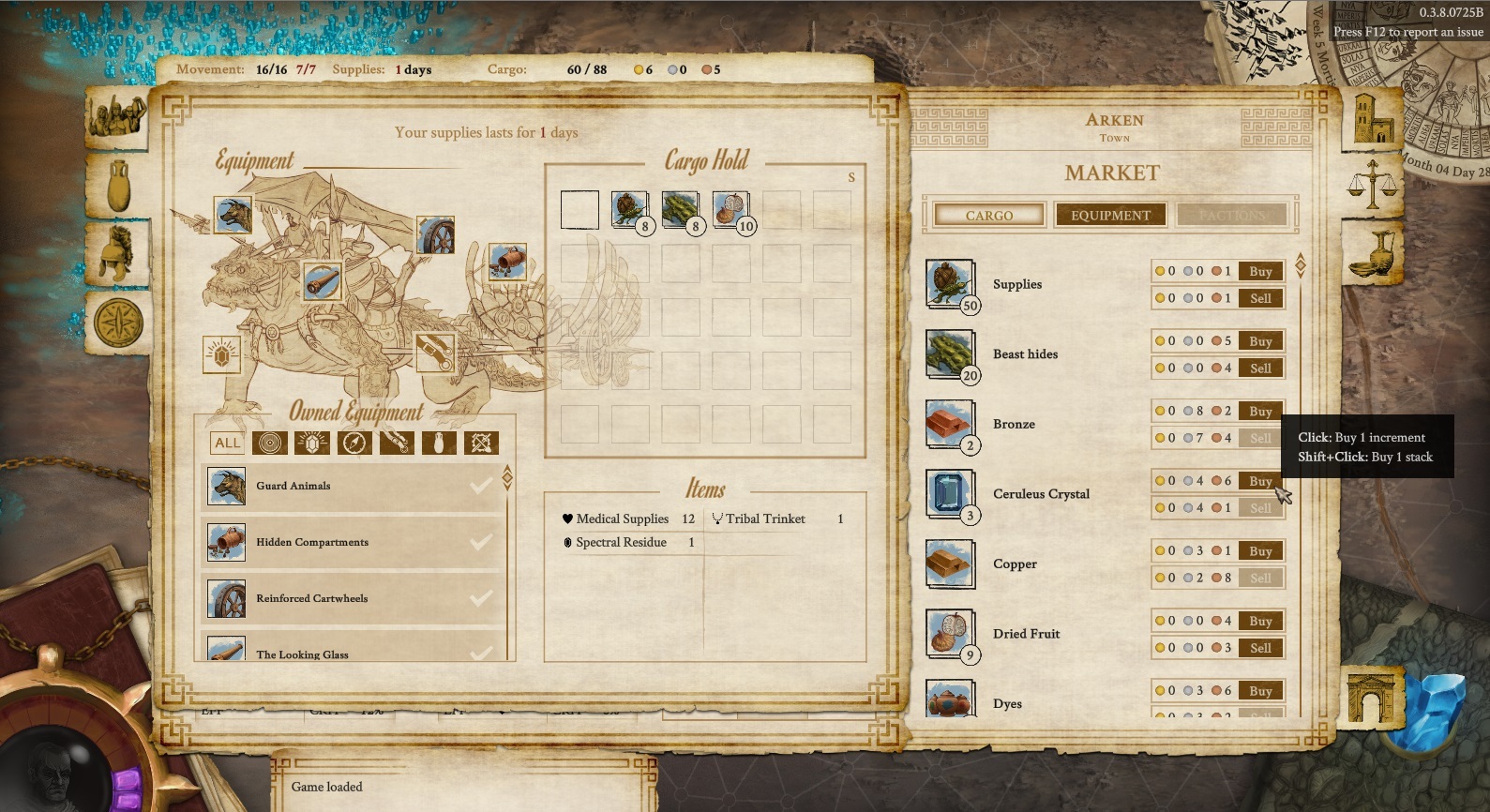
Ever since we came up with the idea of Vagrus, a game where you manage a comitatus, we knew we needed to develop an elaborate, dynamic trade system that would serve as one of the major features of the game and would also aid in fleshing out a living world.
Basic Premises
While trading was always to be one of the main sources of income for the player, we also wanted to avoid creating a pure trading simulator game. It's not that those are not fun for the right people - stories about Gabor dominating the Auction House on our server in World of Warcraft for a period of time still surface in conversations among friends - but because our strengths lie elsewhere. Our unique setting, The Riven Realms, and telling stories with memorable characters was the first and foremost motivation to create Vagrus, so it was also much more likely to excel in that rather than in a simulation - which we knew relatively little of.
For the same reason, our goal was to come up with a game design for trading that supported story-telling and wasn't gonna overshadow it. Hence, trading in Vagrus is just profitable enough to keep you going, to cover the upkeep and consumption of your crew but not much else, making the player look for additional opportunities in the form of Events, carrying passengers and news, or taking on contracts or tasks (a feature we plan to add later on).
Many players highlighted how deep yet consistent the lore and general workings of The Riven Realms felt to them. With a setting so strongly established and transmittable, the challenge of game design is how to integrate other more 'gamey' features into it without breaking immersion too much. With trading, the idea was to create the feel of a natural flow of goods from where they produce them to where others consume those.
The Design
After several prototypes, which either were too complex or too shallow, the one we have been working on implementing into Vagrus during the last few weeks involves quite a number of variants.
Source and Demand
For each settlement, from cities to encampments, we mapped out which goods are created there and whether that was enough for that place. Do they produce a surplus or need a bit more from other sources, or perhaps are completely dependent on the merchants of the realm to bring certain goods to them, or they do not trade at all; we came up with a scale with ten stages describing all kinds of scenarios.
Goods on the Road
If something is not mined, crafted, or produced locally, then it's imported from the closest place where they have a surplus. Of course, no one in their right mind would risk their money - and especially their lives - to carry cargo for the sake of doing good. They do it in hopes of profit, which directly correlates to how distant a location they need to transport those wares from. Towards the right direction that is. In some games, it's enough to carry goods and it's value increases based on how long you have been holding on to them. Not in Vagrus. Players can only make a profit by following the natural commercial flow, from sources of goods to where they are are less available. Carrying cargo between two main sources will result in a net loss if one considers the cost of labor and upkeep.
The Size of Settlements
Of course, commerce is different in a big city than in a small encampment next to a quarry. It impacts the range of goods available on the market, their quantity up for sale, and their prices as well. Cities are generally a bit cheaper since more comitati pass through them, keeping the vital flow of goods running.
Conditions
The Riven Realms is a living, breathing world with a grim reality beating down on its inhabitants. Famine, epidemic, oppression, and rebellions are all too known phenomena. Such events affect the market in many ways. A source location suffering from a plague would have less available workforce, leading to the drop of production and ultimately to the rise of prices. Famine in an area means the drop in the number of paying customers and so merchants often drop their prices to be able to make any trade at all.
Time is of the Essence
For the flow of goods to appear even more realistic, we record conditions in time and their effect ripples through the region(s) like a whiplash. The farther the distance between two locations where essential trade occurs (a source and a buyer) the later in time the players will see the prices going up. It may well be that a slave revolt has already been dealt with by the time the price of pottery increases in a place importing that.
The future
Gaining advanced knowledge about an epidemic that stopped, which enables one to sell all their hoarded cargo before the prices on the market drop, can be worth a fortune. Gathering rumors like that would be no small feat but extremely profitable if acted upon.
With the current implementation of our trade system we are not yet adding the generation of rumors about the change in conditions but it is certainly something we would love to add to the game sometime in the future, so you might see it as a future milestone in our Fig.co campaign.
Let us know what you think about the design and how our development progresses, and of course, thank you very much for your continued support!
Wanna get the game as early as possible with even more content? Please share our pages and posts with your friends through your favorite social media channel(s). Appreciate it!
Devlog #22 | Narrative Design for Vagrus' Open World (Game Design Post)
As we are getting closer and closer to releasing the first playable build of the main campaign of Vagrus, it is perhaps a good time to talk a bit about the differences between the open world campaign and 'Pilgrims of the Wasteland'. The focus of this is going to be narrative design and stories but there are going to be implications on gameplay as well.
Encounters of a Random Kind
One of the most noticeable differences between the standalone story and open world (thought the second part of Pilgrims has this to some extent) is the frequency and importance of random encounters. These Events appear while you are traversing the Riven Realms. The longer it is you haven't come across an Event or encounter, the more likely it is that something will come up.
Part of the encounter Events are unique to each location (regions or sub-regions) while others are more generic and thus can appear in a wide variety of locations. The intent was to give interesting (and dangerous) things to do while en-route to some place and of course, to keep players from becoming careless while 'just traveling'.
There's a Right Place for Everything
Another significant part of Events in the open world part are fixed in location. You can find them by the use of Scouting (or by happening upon them on their node) and interact with them by using the Explore button.
A much more elaborate form of these fixed Events are settlement and point of interest Events. We like to call these persistent Events, though many will disappear upon completing them due to narrative reasons.
Have Anything for Sale?
The aforementioned settlement Events are also mostly persistent; many of these you can repeat again and again, as these represent facilities, shops, tasks you can take, or activities you can do in cities or villages. The selection of these Events gives character and utility to settlements; it also makes players travel between them a lot when certain functions are only accessible (or are only profitable) in certain places.
A Tale for the Ages
The meat and potatoes of content when it comes to Events are of course quests and storylines you can take part of. These are typically started in settlements, though some are accessed through random Events, too. Such storylines come in all sizes and varieties. A certain part of these will be dedicated to Companions' personal questlines. These don't only give backstories to your heroes but are also tied into their progress: Prowess levels 3, 6, and 9 are unlocked by reaching certain points of their questlines.
The impact of quests and stories on the world and the player vary as well but many influence one or the other. Tone also plays into this: Vagrus is low key for the most part but sometimes the player does have an influence on things, for example, in deciding which Trading House wins a rivalry to dominate a settlement. Or if a camp of outlaws get to thrive or be ousted by the Empire.
Challenge Accepted
As you can guess, writing and testing all this complexity is quite a task: the challenge to judge and balance the size and difficulty of Events grows exponentially as more and more content is created. Another tough part is to find the sweet spot of the frequency of random Events, as well as their distribution spatially and even in a timeline (would a story activate only in certain season or at a given point of time?). We have our work cut out for us but the intent is to create a living and changing world that feels dangerous but certainly one you'd want to explore.
We are eager to share the Open world prototype with our Alpha Backers to get feedback about all this and to see what you think of the branching, layered narrative. There are still many things to complete beforehand but we are progressing well, so you can probably expect an announcement about it in the next few months.
Wanna get the game as early as possible with even more content? Please share our pages and posts with your friends through your favorite social media channel(s). Appreciate it!
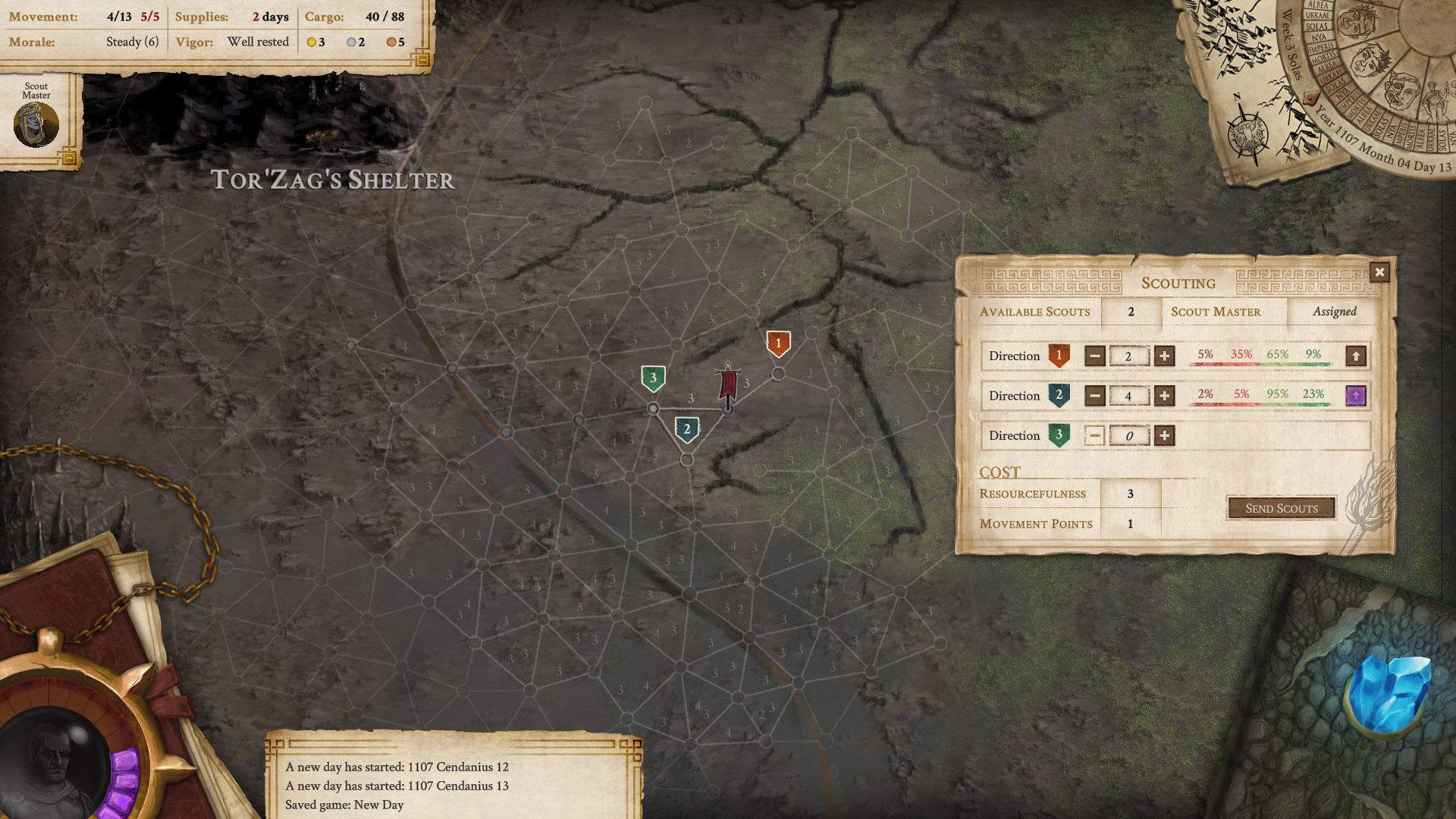
At long last, Scouting is making its way into Vagrus. It is a vital feature in navigating and surviving the many wastelands of the continent of Xeryn.
What is Scouting for?
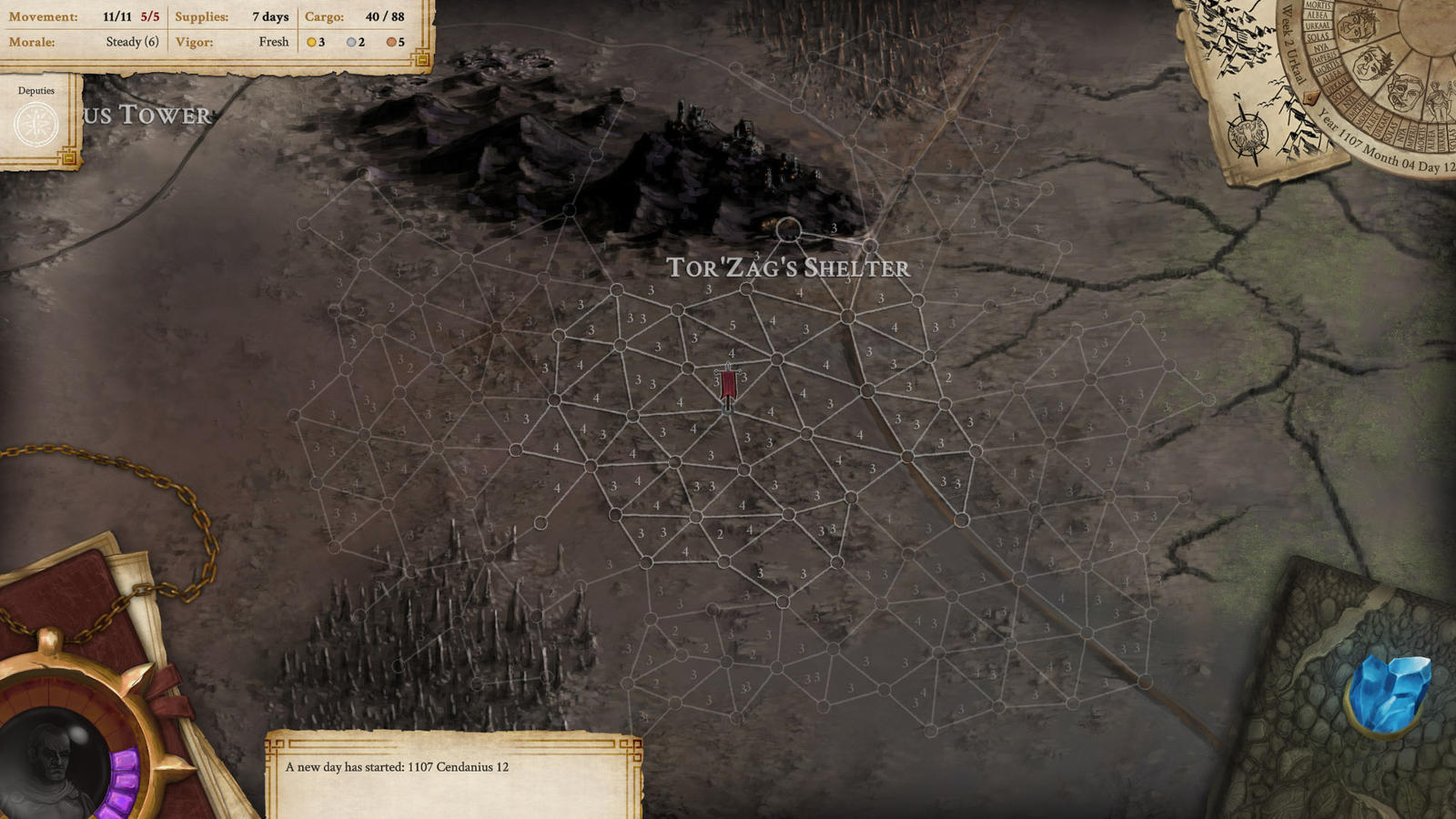
Scouting has two main uses. First, it can give you an indication of what to expect when moving onto specific neighboring nodes on the campaign map. Though these are given in percentages (what are the chances of a fight, and event, or that nothing happens) it still gives a rough idea of risks so that players can make informed choices. Second, Scouting can indicate if there is something fixed on a specific node (either a fixed Event or a Task objective for a faction). This is immensely helpful when looking for something out there in the wilderness with only vague directions to go on.
How do you use Scouting?
You can use Scouting when standing on a node. When you do so, you will have the option to select which neighboring nodes you wish to send scouts to - more than one route costs Resourcefulness for each additional node scouted. Naturally, you'll need scouts to even initiate this action. Scouting costs Movement Points: you have to pay equal to the highest route MP cost. The chance of success for each scouted node depends on how many scouts you send that particular direction and a Scout Master deputy provides further bonuses.
What are the risks of Scouting?
Apart from spending the Movement Points (and potentially Resourcefulness), your scouts have a chance not to return (having fallen prey to one of the many dangers of the wasteland) when you roll a critical failure. This makes spamming Scouting a bad idea, even with a Scoutmaster whose presence reduces the chances of a negative outcome.
Success vs Critical Success
A successfully scouted route provides percentage chances of an Event, combat encounter, or nothing happening. A critical success provides exactly what is going to happen (Event, encounter, nothing) and in case of an event or an encounter, it gives a relative idea of what to expect (obstacles, boon, chance for combat, the challenge rating of a fight, etc).
Scout Master
One of the deputy roles, the Scout Master is extremely useful when it comes to Scouting (as expected). When this role is assigned, it provides flat bonuses to critical success, and reduces the chance of a critical failure. Additionally, you can send scouts to a second node without paying Resourcefulness.
We are very excited to be able to now test Scouting and see how it impacts exploration in the open-world part of the game. We are even more excited to be able to include it in the game builds soon and see how players react.
Wanna get the game as early as possible with even more content? Please share our pages and posts with your friends through your favorite social media channel(s). Appreciate it!
CF Campaign Update - The New Open Access build - includes Milestone 1&2 - is out to all Backers!
Have you played the previous Open Access build of Vagrus? Or are you considering just now to dip your feet into the deep lore of the Riven Realms for the first time?
Visit our crowdfunding campaign and you can jump right in with some pretty neat improvements (via Discord).
The Story Behind the Patch
Truth be told, we got trigger happy. We went further and deeper with some of the changes than we originally planned to, thinking that preparing the system for future features and enhancement will make our job easier later on and it would not impact our delivery timelines much. The first part we still stand by but the second... we were, well, a bit naive. We pulled ourselves into complexities we did not consider, game design decisions we thought to make only later on, not to mention testing and retesting every little thing. Especially the Journal part, which has already been an integral part of the game, proved troublesome to revamp. With all the changes, the hardest part was making the save files compatible backwards. We knew we would break the system - on purpose - we just did not expect to break it this much - not on purpose. Well, that and the untimely sickness grabbing our coder lead resulted in quite a bit of delay. We learnt from it though: gotta keep biting smaller chunks so we could keep up the pace of updates we would like to give you folks.
With the first two milestones delivered in this patch, we are going to start working on Scouting next. Mock-ups are ready; we've given it quite some thought, so we are fairly confident to deliver it in the indicated timeline.
Flash news
We have been invited to showcase Vagrus at Dreamhack Summer between June 15-17, so if you are coming too, don't forget to drop by our booth and say hello.
But back to the present. Here's the list of changes. Let's call it:
Wanna get the game as early as possible with even more content? Please share our pages and posts with your friends through your favorite social media channel(s). Appreciate it!
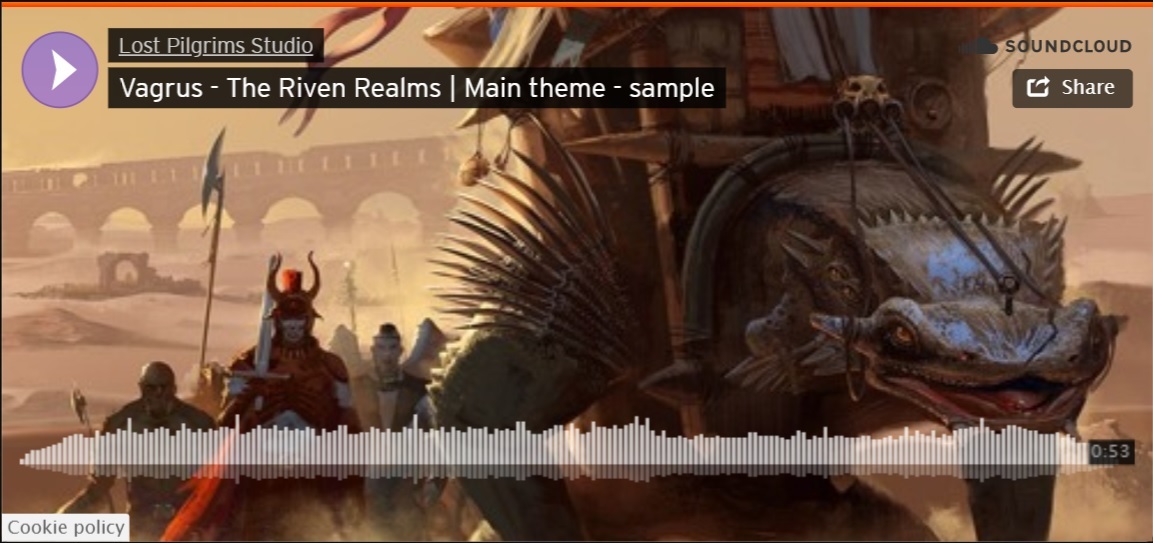
The soundtrack of Vagrus is of key importance in conveying the powerful atmosphere of the setting. Be it foreboding or hauntingly beautiful, the score by George Olah captures the essence of the ravaged world of the Riven Realms perfectly. Even more importantly, the majority of fans and influencers have told us that one of the most important parts of the Vagrus experience for them was the music.
Ever since we started working with George, we usually had him pour over the specific environment artwork and game world descriptions for each theme and together we listened to fantasy music that evokes the feeling we were looking for in that environment. With our tabletop RPG background, we were aiming for ambient, atmospheric music that goes well with each region of the game. Yet it was important for the environment tracks to be non-intrusive not to detract from the reading parts.
You can now get a taste of the main theme of the game above and listen to some other themes over at our SoundCloud page.
Wanna get the game as early as possible with even more content? Please share our pages and posts with your friends through your favorite social media channel(s). Appreciate it!