It's the first one we self-publish, so please help us spread the word!
And if you grab a copy, please leave a review. It helps a ton!
Cheers and have a great end of the year, everyone!
https://www.youtube.com/watch?v=JcCQAy1RuEk
LCB Game Studio
GRIZZLY MAN has been announced!
Everyone, hi!
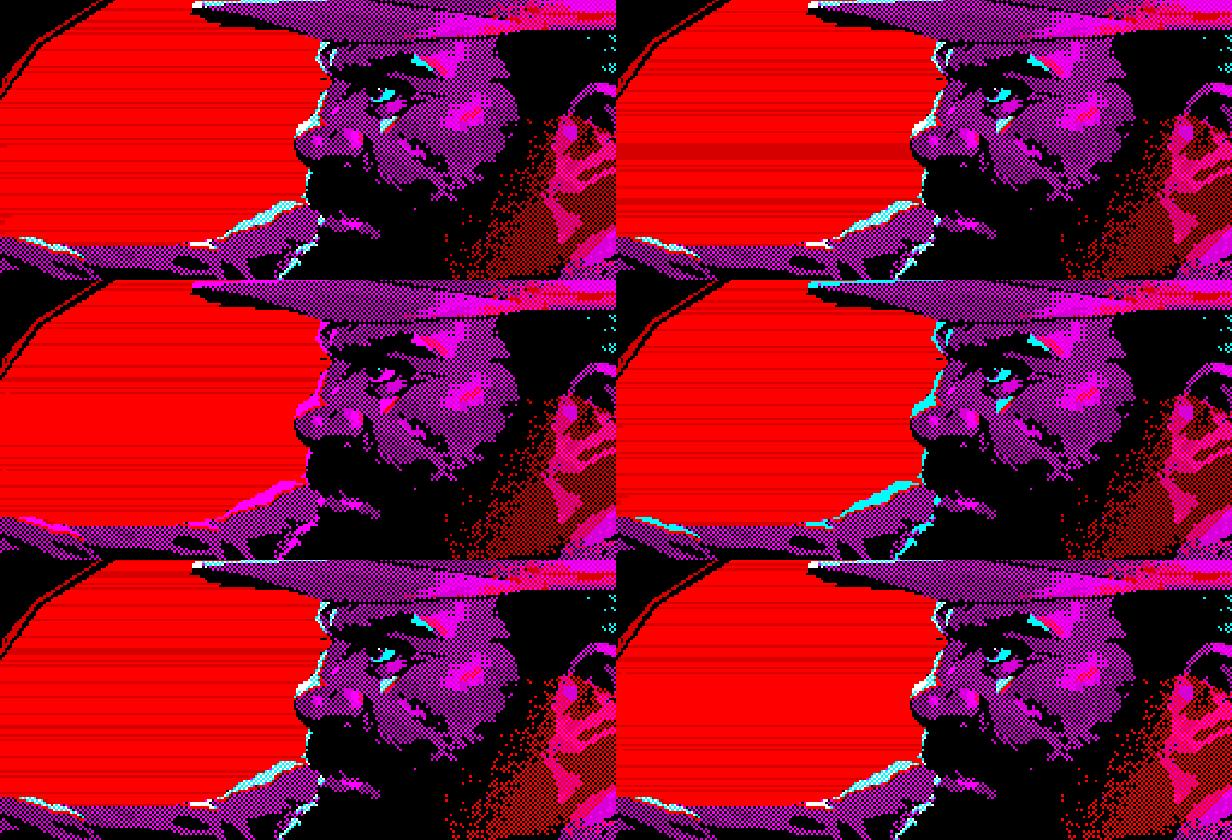
We've just announced GRIZZLY MAN, our newest Pixel Pulp, a grisly game about an amnesiac man in black guiding a group of tourists in Alaska while a slasher starts killing them off one by one!
Welcome to the latest installment from the Bahnsen Knights News Channel on writing Pixel Pulps...
There is something about the idea of 'accumulation' in writing that has always appealed to me. It's not just about the day-to-day stubbornness of the craft—writing two or three pages a day—where, in a short time, you have a novel. Rather, it's the notion that accumulation can be used to justify anything.
I've never been attracted to the elegance of simplicity. Given a choice between minimalist industrial designs and complicated Goldberg machines, I don't hesitate for a second. Exacerbated complexity, redundancy, and gratuitousness are pillars of the kind of art I like the most.
In computer systems development, there is this concept of "refactoring," a procedure by which a developer optimizes code so that it does the same thing but in a more efficient way.
Faced with the idea of refactoring—which etymologically is nothing more than re-considering the elements of the code—I propose the idea of "accumulating." The code is not optimized; more code is written to keep the system doing the same thing.
This same principle guides the writing of our Pixel Pulps. When I was quite a bit younger, I read about the Finite Rules Paradox. Basically, this paradox tells us that the next element of a series cannot be predicted because new rules can always be added to justify any becoming. 1-2-4-8-16... 32? But why not 999? There is a rule—more complex surely—that can justify 999 or any other element.
This same principle guides the writing of our Pixel Pulps. When I was quite a bit younger, I read about the Finite Rules Paradox. Basically, this paradox posits that predicting the next element in a series is impossible because new rules can continually be added to justify any progression. For instance, 1-2-4-8-16... 32? But why not 999? There exists a rule—undoubtedly more complex—that can rationalize 999 or any other subsequent element.
Writing, then, is nothing more than adding rules to be able to narrate anything.
-- Bahnsen Knights is out now... You can even try out the demo if you would like a little taste before delving fully into the world of Pixel Pulps!
Mothmen 1966 and Varney Lake are also currently in the Steam Winter Sale.
Bahnsen Knights is now available!
If you missed the announcement on the Bahnsen Knights channel we were very happy to launch the game. To celebrate it, we've released a brand new trailer!
BAHNSEN KNIGHTS is really important to us. We're so grateful to everyone who played our previous games; the support so far has been amazing. As you may know from previous blog posts, things were... Tough. So we want to thank all of you. THANK YOU. IT MEANS A LOT TO US.
For all of you who get the game, please leave a review. We cannot emphasize enough how much this helps indie developers.
So now go, get on your Sierra, play the game, and tell your friends and family about it.
Have a good ride, everyone!
LCB Game Studio
On Writing Pixel Pulps - II
Here is our next installment from the Bahnsen Knights News Channel on writing Pixel Pulps...
Francis Ponge is a French poet who among many other things wrote a book I read twenty years ago: Le Parti pris des choses (translated into English as Partisan of Things). His procedure is simple: Ponge looks for the extraordinary in the ordinary. He's not interested in exhausting the object in language, he doesn't seek definition by extension. For Ponge the "cigarette" is not a cylindrical roll of paper filled with shredded tobacco, designed to be lit at one end for smoking, but "a small torch much less luminous than aromatic". Ponge does not define an object, he seems to search for something more like an incantation!
While developing Bahnsen Knights, Francis Ponge never crossed my mind. However, upon reviewing my notes, his writing procedure came to mind. Something about pulp fiction has always intrigued me. In this narrative style, character building rarely involves a comprehensive study of a particular personality. There isn't sufficient time for in-depth exploration, and character development is likely to be 'flat'.
Many criticize this in pulp fiction. But this flatness tends to be boring if the definition of a character is based merely on clichés. If it is based on the uncommon, the result can be quite different. All our characters are flat, but of a singular flatness!
Take Kevin, for example, the owner of Danny's Bar in Bahnsen Knights. Kevin inherited the bar, and if he works there it's because he feels he owes it to his father—Danny, after whom the bar is named. Kevin, when he was a young boy waiting tables, met a customer who gave him a copy of Scientific American where he could read a column by Martin Gardner. He became obsessed with that column and his father paid for a subscription. After that subscription, others would follow—most notably, one for a writing workshop.
Who is Kevin then? He isn't just the big guy bartender who gets into an occasional fight with the more violent patrons at a dive bar, Kevin is passionate about math and writing thanks to the mail subscription services of certain publications.
When someone criticizes any narrative work by arguing that a character's development lacks depth, I smile. Rather than depth, rather than exhaustion, I prefer this flatness, the definition on a plane of the uncommon: two singular points can define a unique straight line.
Bahnsen Knights will release on 14th December. If you are intrigued, please wishlist the game!
We want your questions!
Hi Everyone,
For the launch of the latest Pixel Pulps adventure, Bahnsen Knights, we will be recording a brand new developer walkthrough and we would love to answer any questions you may have for us.
So, if you have any questions about the game, the Pixel Pulps series or even just Indie Development in general, please drop your questions in the comments and we'll do our utmost to answer them in the video...
Cheers
Nico, LCB Game Studio
On Writing Pixel Pulps - I
In case you missed these posts on the Bahnsen Knights News channel, we'll post them here too for you to enjoy.
Are you familiar with the "Marvel Method", a process in which Stan Lee would define a synopsis, receive pencilled artwork from the artist and add words over it?
Stan Lee by Fer. Really cool piece, right?
Pixel Pulps writing is somehow similar to the Marvel Method: from a story outline I write, Fer puts together a storyboard in pencil and then I write over it. The iterative aspect is there. But there are at least two fundamental differences in our own process, two things that although they are not interrelated by definition, they do so by our own work logic: Stretching and Wildcards.
In the Marvel Method, Stan Lee cannot stretch ad infinitum the text of a panel. Space is finite. But we? We can! We can keep a single image on screen and render as much text as we want. This process, which I call Stretching, allows us several things from a narrative point of view: to manage the reading pace, to build expectations, etc... But, more importantly, Stretching allows us to let players see Fer's work on screen for longer!
Since the first Pixel Pulps, Stretching has been a resource that I sought to exploit to do justice to the art direction of our games. Now, to keep each scene interesting, text in a stretched scene has to generate something, it can't just be filler.
And this is where Wildcards come into play. In the writing of the outline, I usually add details in order to create a certain atmosphere or define some aspect of a character. The details, in themselves, are not important yet, they are usually superficial, and they add sense to the narrative by simple accumulation.
Once I receive Fer's storyboard, that's when things get interesting. The detail appears as an unavoidable presence, and many times I wonder why I chose what I chose, or why Fer chose what he chose. Wildcards is letting go of the steering wheel for a while and then pick it up and straighten the car.
Let's take as an example chapter VI of Bahnsen Knights, a scene where Vincent spits on the floor after talking to Boulder, the character players embody. In the outline I wrote:
"Vincent and Boulder are standing each against a car hood, waiting on the side of the road. They are waiting for the truck to come. Vincent kicks a rock or spits. You try not to look at him."
"Kicks a rock or spits." Fer chose the action of spitting, and the way it was represented on screen looked great. How could I then stretch the scene to give prominence to a detail that could have been something else?
Building on this, I wrote the following scene, where Vincent tells Boulder about the healing powers of saliva and his relationship with his stepdad.
Stretching and Wildcards. The first is a resource of the dimension of pragmatism: to show Fer's art as long as possible on screen. The second, a challenge, a puzzle, a gamble, something to keep interesting all stages of production of our Pixel Pulps.
Bahnsen Knights will release on 14th December. Don't forget to wishlist the game!
New Bahnsen Knights release date, Next Fest and a message to our fans
Hi Everyone,
As you have hopefully noticed, our latest title Bahnsen Knights is currently included in this edition of Steam Next Fest. As part of the Next Fest activities we have made a new, expanded demo available for you to try. We have also released our first developer walkthrough for the game where we take a look at the demo and also answer some of the questions you sent in.
We have also announced a new release date today for the game. Owing to a recent bereavement for the team we have moved the release date back to 14th December 2023. My friend and colleague Fer, has a few words to say regarding this: ____________________
Hi, Fer here, one half of LCB.
I'd like to talk about the reason why we had to change the release date for Bahnsen Knights.
My older sister, Mariana, passed away at the age of 44. She was in the world before me and taught me how to navigate it.
I will miss her. And I will always need her.
I share this with you to honor her, to let off steam, but above all, to be honest with those who accompanied and supported the Pixel Pulps from the beginning.
Being a studio of only two people implies many things, one of them is that when something so personal hits us, we make a pause because we can't pretend nothing happened. We take a breath, reflect, and as we gather our strength, we continue.
I'm very lucky to work with a friend like Nico (the other half of LCB).
Mary, although not a gamer, was a horror fan and was proud of what we’re doing.
We’re grateful to the community. And with Chorus Worldwide, our friends on this journey.
Thank you, Fer ____________________
As you will appreciate, it has been a difficult time for the team recently. We are a small studio, we are good friends, so tragedy has an impact. We wanted to be candid as to why the game has been delayed and we hope that any of you who have experienced or are experiencing loss, are doing ok.
Thank you for taking the time to read this update on Bahnsen Knights. We really do hope you enjoy playing the demo and watching our walkthrough.
Cheers
Nico, LCB Game Studio
Play the new Bahnsen Knights demo now!
Hi Everybody,
We just wanted to let you know that we have just released an expanded version of the Bahnsen Knights demo ahead of Next Fest, which begins on the 9th October.
In this expanded demo you will be able to get more of a taste of the danger that awaits Boulder as he attempts to discover what happened to his friend and fellow agent Cupra. What do the Bahnsen Knights and their enigmatic leader, Toni, know about his disappearance?
Play the demo now and if you like what you see don't forget to wishlist and followBahnsen Knights!
Cheers!
Nico, LCB Game Studio
Pixel Pulps and storytelling... Plus, we want your questions!
Hi Everyone,
Just in case you missed this recent post from the Bahnsen Knights blog I am putting it here for your perusal. Make sure you wishlist and follow Bahnsen Knights to see all future posts first!
In addition, we also want your questions! We will be doing a new developer walkthrough for Bahnsen Knights as part of our activity for the upcoming Steam Next Fest, which starts on the 9th October. If you have any questions you would like to ask about Bahnsen Knights, the Pixel Pulps series, or even where the best food can be found in Buenos Aires, just leave your questions here in the comments. Thank you.
In the meantime, I thought you would be interested to get an insight into why we make the games we do and what we think of the genre too. You may have seen some of this touched on in the lovely recent Eurogamer article about visual novels (see here), but we thought you might be interested to find out more!
Why create the ‘Pixel Pulps’ interactive fiction games?
Fernando Martínez Ruppel and I, Nico Saraintaris, come from a background of twenty years of storytelling (we are both 39 years old and will turn 40 this year… ancient!). We have experience writing novels, short stories, illustrated stories, comics, storyboards, and scripts. But we've also made lots of games in the past! In recent years we have created many games under another label, games in which exploring innovative mechanics was a key part of the designing process. Just to give you an example, we've made Moveless Chess, a variant of chess in which the player cannot move the pieces. So LCB's games are a combination of these two aspects, our passion for storytelling and our love of designing mechanics that generate new and interesting gameplay systems.
What do you think players enjoy about this genre of game?
I believe that what makes visual novel games so popular is their ability to ignite players' imagination by leaving things unseen. With their static images, transitions, and scene jumps, visual novels seem to create something similar to what a comic does, almost like a movie that skips frames and allows the audience to fill in the gaps. In this type of fiction, the player's imagination is enhanced as they fill in the blanks while being carried away by a narrative with a defined thread (beyond concepts such as branching or multi-threading). Additionally, there is no urgency in a visual novel. Like a book, each player can take as much time as they want to enjoy it.
Where do you think visual novels will go in the future?
I think that visual novels (and I would refer to them as interactive fiction) are more of a meta-genre than a genre, a framework that encompasses multiple gameplay systems. Just as there are infinite numbers between 1 and 2 (the principle of discrete infinity), there are infinite possibilities within the bounds of interactive fiction. In this sense, interactive fiction is pure potential, capable of incorporating elements of resource management, strategy, board gaming, RPG, roguelikes, etc. I believe that these elements (cleverly used within the context of each game's fictional universe) open up possibilities for a future - or rather, a present - full of exploration.
What do you like about this genre of games?
Visual novels (and interactive fiction, once again) have the potential to work as a trap. You are aware that you will be reading extensively, have control over your time, and can submerge yourself in a new world. The familiarity that it offers can be deceptive, as interactive fiction has the ability to surprise you from within, being both familiar in concept and surprising in execution.
I hope you have enjoyed finding out a little bit more about where we came from and why we have really enjoyed creating the Pixel Pulps adventures. Don’t forget to play the demo for Bahnsen Knights and wishlist the game!