Hello all, I can’t believe it’s already June. In retrospect I suppose I thought my May would be fairly quiet, but it really turned out to be anything but that. I should probably expect that sort of thing at this point in my life, but somehow, I’m still being surprised that things come up and take up time.
As mentioned above I had a few things happen that slowed my work a bit, however I did still get things done. Namely the interior design portion of things. I really can’t express how glad I am that its done. I don’t like to get stuck working on systems for long stretches of time. I don’t really mind it from a working perspective, but it just makes progress seem so slow when you look back and realize you’ve been working on the same system for weeks.
So, what is the interior design system I hear you ask. The short answer is that it’s the system that allows you to modify your house layout in game. Incase some preface is needed, in games of this genre (that I’m aware of at least) you’ll generally get a house at the start of the game which is usually something like a one room shack. Over the course of the game, you’ll usually upgrade your home and effectively make the interior larger. Generally, this expansion comes in the form of static upgrades to the interior layout. The important take away is that each player will end up with the same floorplan after buying all the upgrades.
What spawned this idea was that I thought it seemed like a missed opportunity in this kind of game. Assuming you aren’t min/maxing many players I think have fun with decorating their house and setting it up how they like. This system just takes that process one step further and allows you to setup the rooms and walls as you please. To put it briefly the floorplan of your house is now entirely modular down to the individual tiles. You can have as many or as few rooms as you like. You can also make them each whatever shape you want.
This entire process replaces the previous system which was just static upgrades which added rooms on. However, I think I’m likely going to keep the cellar as an option which will just be a static room. There might also be an attic upgrade you can get which will be the same type of thing.
As for the main floor you build these rooms in the same way you would construct other buildings on your farm. You’ll talk to the carpenter, pay a fee, and then be brought to a screen what you can draw in the room as you please. The only stipulation I haven’t decided on yet is if I’ll make new rooms cost resources based on the size you make them. This seems like the proper way to go I think. Probably a static gold cost but then a varying amount of wood, stone, etc based on the size of the room.
In addition to creating rooms you can freely modify and delete them once they are created so if you change your mind, want to renovate, add more doors, etc that option is also available.
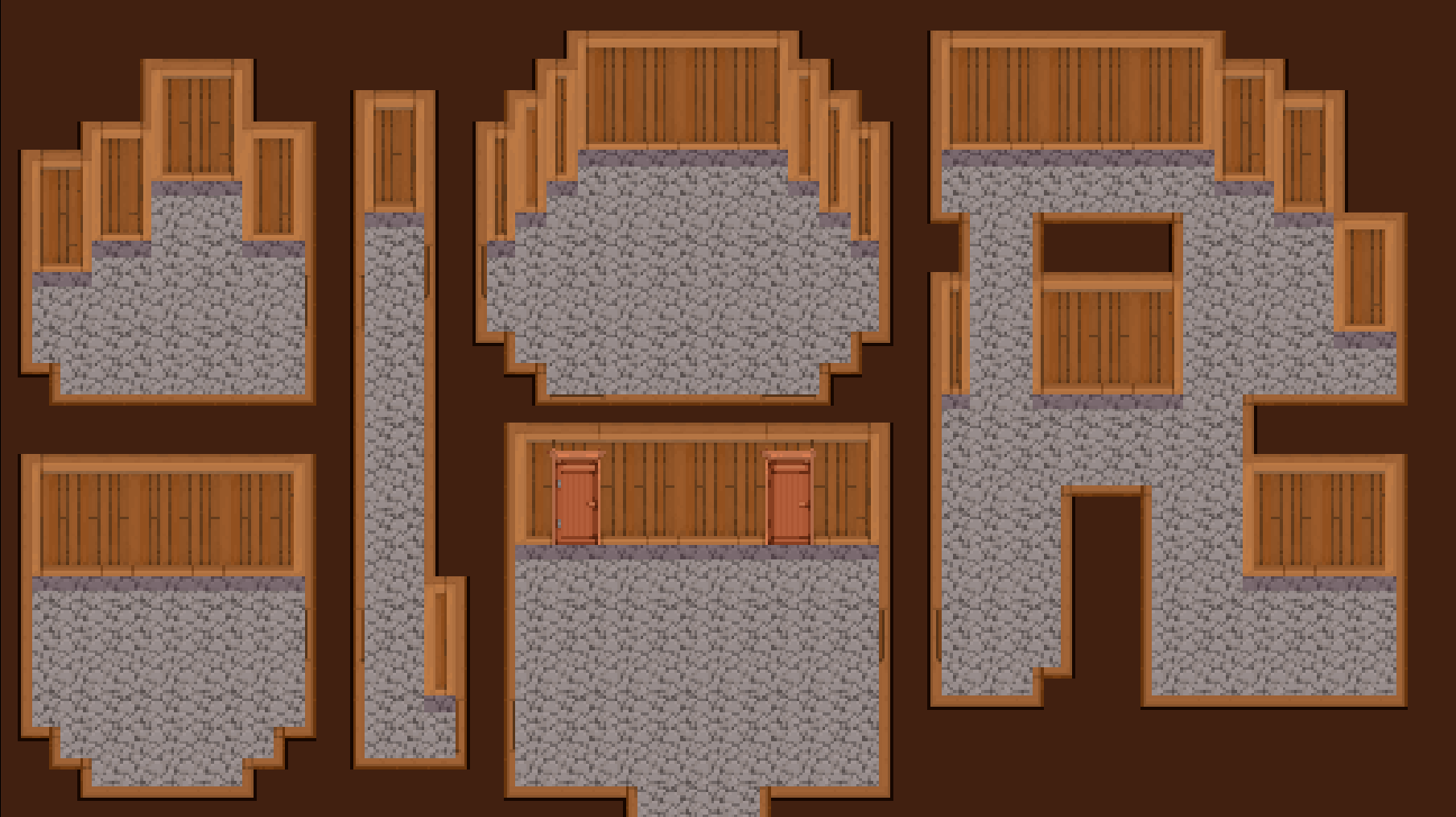
I said I would try to show off something from the system when it was done so I do have a few screenshots. I started to make a gif to show the process of making a room but it takes so long to do the gif was too massive. I’m admittedly not the most creative person when it comes to designing floorplans but the point is really just to show that you can setup your house however you want. You will have to excuse the lack of furniture and the pixilation. Zooming out in the engine to show the entire room at once is currently a bit weird and smushes stuff together but I think the general point comes across.
Because I do feel bad about not being able to really show everything all at once with interior design here are a few mockups from my artist as well for furniture and decorations she is working on. You can expect that once everything is said and done you’ll have something more like this rather than a bunch of empty rooms.
Aside from this system, which took most of the month (again, so happy it’s done now) I have gotten a bit of time to work with other things. I’ve built most of the construction UI at this point which will allow you to both use this system and actually place things like coops and barns. Looking at the UI has made me think that a bit of a color scheme change might be in order, but that would be a minor art fix if it happens.
Once that UI is in place I’m going to get shipping implemented which I don’t think should be too hard although I do want to make some graphical changes to the UI. Once that system is in place I’m going to get furniture setup. To clarify, furniture placement is already 99% in place. The only things that are missing are all the items and sprites and a couple of stipulations for specific furniture types. Adding sprites is tedious, but not difficult. The stipulations should also be pretty simple once a general algorithm is made.
Once furniture is working I’ll have to jump back to the interior design system a bit to make it properly handle furniture in situations where you would delete a room or modify it in such a way that furniture placement becomes invalid. This should also be a mostly simple process as I’ve set up the system to account for furniture already. I just, ironically, don’t have any in game furniture to place outside of chests.
As you can probably tell, many things start to intertwine in games like this. I try my best to make one system at a time, but things like this pop up on occasion where you have to put something on hold while you figure out another system. The further in I get the less it happens, but this is a particularly egregious case.
I don’t have much else to say at this point. Combat sprites are steadily moving forward in the background. Most of the enemy sprites are made with just a few modifications required for some of them. I don’t usually post those because it feels like the sort of thing that should be discovered in game but here’s an example of one. This creature is still in progress and is admittedly pulled from D&D but I always thought they were a cool enemy. I think most of the other ones are a bit more original though.
With any luck now that I’m past interior design things should speed up a little bit. That system was very labor intensive just in terms of all the things to code. Most systems in the game are much more light to program. Hopefully I’ll have a bit more to talk about next month as with any luck June will be more dedicated to working on smaller systems.
I’m also tentatively hopeful that this version might go onto steam soonish. This is a very non-committal statement but a lot of the basic systems are starting to come together. At this point you can farm, fish, chop trees, mine (although the mines don’t exist yet), build buildings, and raise animals. On top of that most of the general functionality of the world is in place. Things like day/night cycle, seasons, inventory management, shops, and some other stuff I’m probably not thinking of are in.
All that said there are still things missing. In order for the game to be a game I’d have to design the world, which is actually a lot easier than it sounds. I also still need to add a few systems. Furniture and shipping as mentioned above, NPCs and dialogue, quests, basic skill levels, and you know a way to save and load your game. Thing is none of those are particularly complex to add. Its not like this will go live next week or something, but this hopefully gives a bit of insight into where I feel I’m at. A lot of the complex stuff has been done at this point, there’s still tons to do but most of it isn’t I guess ‘hard’ to make.
In any case, I’ll cut this off here. I have plenty of game related work to do today anyway. Thanks for taking the time to read, and, as always, for your patience. I’ll be back with more updates at the end of June.
April News Update
It is already the end of April, which is rather alarming. I feel like the month just disappeared but that’s nothing new. I was hoping things would be a bit different by the time we reached the end of the month, but it is what it is. As such this will probably be a shorter update.
As you might remember from the last update there is a change happening to the player house interior. For a brief refresher, in most games (that I know of) like this you can upgrade your house to expand the interior. Generally speaking, this means another room is added onto the layout, or perhaps an existing one is made larger. The point being that every player ends up with the same house layout.
I thought this was something of a missed opportunity so I took it upon myself to try something different. What me of the past didn’t account for was just how complicated this would end up being. I tend to convince myself that complex systems won’t be too hard to code, its admittedly a fault of mine. I was hoping that I’d be done, well, before the month was out, or at the very least by the end of the month. As you can probably guess by reading this, that didn’t happen. However, I am close. I expect maybe another week will be needed to get everything finalized.
As some of the details were a bit up in the air during the last update I’ll explain a bit of how this works. Instead of getting quests to upgrade your house like in the current version you’ll instead have an option to construct a room via the same shop you would use to build a coop or barn.
When you choose to build a room you’ll be taken to your house interior and expected to cobble together a layout for said room. This layout is constructed by basically painting floor tiles with your mouse or controller. As you paint tiles the walls and ceilings adjust accordingly. This process is capable of creating a room of any shape and size as long as all the floor tiles you place down are connected. There is only one stipulation at the moment involving the placement of interior columns close to the top of the room. I’m going to go back and see if this can be adjusted though.
Once you lay out the floorplan for the room you move to the next step which is placing doors on the walls of your room. You can place as many or as few as you want. Although you do have to place at least one because…well, I mean, you have to have a way in. After doors are placed, you finalize the room and are done. There will be a period of time where the carpenter will build the room out and then you can use it like any other. As far as pricing goes, I haven’t decided on a static price or one that varies based on the size of the room. Since you could technically just make one massive room the size of the whole house it seems like it might be a better option to make the price vary to keep balance intact.
Each room will be capable of having its own wallpaper and floor tile pattern. There will also be an option to modify any existing room which functions the same way creating a room does. While I haven’t coded it yet this should be able to account for furniture existing in the room. I have an outline for this that I believe should work. I think I’ll likely add a step to room modification as well that allows you to move existing furniture so you can just do everything at once if you want.
I think this is going to end up branching into coding furniture a bit as well. The ability to place down furniture already exists in the game but it was done basically as a way to allow placing a chest so I could test that. There is likely some extra stuff that needs to be addressed to complete the system. For instance stipulations to let you place things on walls or on top of tables.
That’s sort of the direction things have been going this month. I’m really hoping that I’m correct and I’ll get the rest of this sorted over the next week so I can move on. There’s plenty to do and I hate to just get stuck in on a single feature. At the same time, I suppose its quality over quantity.
I was going to attach a short video showing the system off a bit, but I think I’ll probably wait until next month. The house interior is still in testing mode meaning I’d have to stage a lot of stuff just to show things. Better to just wait until the system is complete I think.
Aside from that there has been some formulating on a few other topics. The one that has seen real growth however is the lore. I believe I mentioned last time that I would be taking weekends to write world lore for the game. For those unaware I work on programming the game Monday through Thursday. My weekends are always pretty scattershot in terms of how much time I have. Since it was hard to get any meaningful amount of time dedicated to coding on the weekends I thought it would be better to handle writing during that time instead.
I can report that things are going well. I’m really not sure how much of this lore will be used but I think its helpful regardless. I won’t claim to be a great author but I think even if you aren’t going to directly reference all of your lore just having it can inform characters in the world and help to make them feel more complete.
I believe I’ve said before that I never really cared about the characters or worlds in these types of games. I’m hoping to avoid that with this game. Hence why there is also something akin to a main story. You won’t be forced to interact with it in any way, but it will be there if you want to pursue it. I guess its sort of like Skyrim. You can do the main quest if you want, or you can just do whatever you want. I’m hoping between this and everything else that the world will be a bit more gripping.
As for what was actually written, lots of kingdom lore honestly, along with some of the larger events in history. There are 5-6 separate nations depending on how you look at them each has their own lore, practices, themes, history, wars, etc. I’ve been thinking that whenever I finally finish this game I might just keep making games in this universe. Sort of just setup this base world and use it for different projects.
Anyway, my only other thought was if I should be sharing any of this lore. I don’t know that it would make sense in these posts. I could always start up another monthly post more dedicated to just dropping lore bits. I have no idea if anyone would find that remotely interesting, just an idle thought I had. That aside I’m also not sure if it would be good to just drop lore like that instead of working it into the game for people to just discover naturally. One of the things mentioned a long time ago by a player was that it would be interesting to be able to interact with things in the world like bookshelves to get bits of lore. I do plan to add that feature so there should be plenty of places to insert lore.
So several things to think about, but that’s hardly new for me. For the moment, I think I’ll cut things off there. I’m sorry that there isn’t much to share. The custom house layout system turned out to be quite the undertaking. With any luck I’ll knock the rest of it out in short order and I can move on to other things for May. Thank you as always for your patience, hopefully a month from now I’ll have a variety of things to talk about.
March News Update
I’m slightly early this month cause of the weekend, but here we are. Things didn’t go as expected this month. Not in a bad way, but I wasn’t really expecting to work on what I did. I think in the last update I talked about maybe moving towards combat. I nixed that decision pretty quick, but we’ll go in order. The month started with finishing up livestock. That ended up taking longer than expected honestly, about half the month if I recall. That was effectively the system that just kept on giving. Every time I thought I was done there was another thing to add.
The majority of what I needed to do was replicate what had already been done across all other animals. At the start of the month basically only chickens functioned. Since then I’ve added in ducks, geese, cows, goats, sheep, and pigs. On top of these there are 1 to 2 forms for each type of animal which I won’t spoil. So they needed the unique aspects of their functionality made too. Along with this there was the entire effort of making the barn as prior to this month only the coop existed. The barn is mostly the same, but has a few unique differences like animals giving live birth rather than having eggs that hatch. Also little player interactions things like being able to milk a cow or shear a sheep.
Lastly, the UI for animals had to be setup which was its own system in general. There are a few small things that weren’t added, but they rely on other systems that don’t exist yet. For instance, naming a newly born animal isn’t set up. They are just given a default name at the moment. The actual implementation of this system is pretty simple though and will be added once the surrounding system goes in.
So, animals are done. Which makes me incredibly happy because it took forever. The last update I put out I said I might move to combat. Problem with that is that the UI isn’t quite there yet. While I could do it with temporary UI it would just end up taking more time when I have to go back and update it to the proper UI.
Because of this combat was out. While I was trying to determine what to tackle next I decided to update some of the existing UI. I’d been working with a few old UI assets as I was starting on this remake but I’ve since gotten updated versions. I took the time to apply these new assets which involved a bit of adjustment to each other them as sizes were slightly different.
This brought me to the construction UI, which is where the remainder of the month went. For those unaware when you want to construct a building like a barn you go and talk to an NPC and a unique UI shows up to let you select a building to construct.
When testing the animal systems I effectively had made a dummy event to trigger the building process to get around the lack of a UI. I did this because at the time I didn’t have the new building UI yet. I have it now.
However, while scoping some things for this UI I went to see how many buildings could be constructed for some data I needed to populate. This got me thinking, which is usually a bad thing, and a precursor to more work. Specifically, I thought about the upgrades to your house. In the current version of the game there are a couple of quests that serve as house upgrades. The quests are basically just you supplying the resources for the upgrade. I’m not sure why I decided on this in the past instead of just having an upgrade option in the construction UI.
As you can probably guess I changed this. The house upgrades will now be done via the construction UI. However, there is more to this. My specific thought was about how every player will end up with the same floor plan, which feels like a waste. In a game that’s basically about living on and improving your land it seems like you should have more say in what your house looks like.
So I said, ‘screw it, why not’, as I sometimes do, and started making a new system. It isn’t quite done yet but the framework is mostly there and far enough along that I don’t think I’m going to revert back on this idea so I feel okay mentioning it. In the new version of the game you won’t have specific upgrades, outside of a basement, and maybe an attic (haven’t decided on the attic yet). Those two things will be a set room. As for the main floor you will be able to design the layout to your specifications.
I’m not 100% on limitations yet, like if I’ll give a cap to the number of rooms you can have. I think it won’t be needed as the total size of the house interior is still set in stone. As it stands you will go to Simeon, likely pay some sort of flat price for a room and then you’ll be shown your house interior. I’m trying to make the system as simple as possible. At the moment you basically just paint floor tiles with your mouse (or controller) and the code is smart enough to form the walls around those tiles.
Along with this you’ll also be able to go back and modify or delete rooms when you want. The only stipulation there is that you may have to manually remove the furniture from a room before you can delete it, but I have an idea on how that may be avoided, we’ll see.
The other thing to mention is that while I can’t guarantee it. It’s likely possible, but I haven’t attempted it yet so I can’t say. I’d like to extend this sort of system out to the farm exterior as well. So when you start the game you can either just take the standard layout or you can craft your own. Like I said, no guarantees on that but I figure it would be a cool thing to add. Probably have some sort of feature to allow for exporting the layout as well so people could share if they wanted.
So yeah, that sort of took over my time as I had to iterate on the system a few times to get it to where I wanted it. Once I finish it I’ll likely go back to what I was supposed to be doing and put in the construction UI.
But wait, there’s more. I hope you read that sentence deadpan because that’s how I thought it for some reason when typing it. I also enjoy writing in my spare time. Which may make you ask, ‘cool, but why do I care?’. Well, I’ve switched my priorities a bit. I was working on world building for a book on the weekends but decided to put it aside for the moment. I should probably mention that I barely get anything done on the weekends, most all the work for this game happens on weeknights.
In any case, I put a pause on the book and have instead started directing my attention to doing all the writing for this game instead. This isn’t too important but I thought it might be worth mentioning. If you’ve been following these update logs for a while you may be familiar with my, lets say indifferent, attitude towards the dialogue in most of these games. Or rather the amount and depth of it.
My personal experience is that I’ve never cared about an NPC in any of these games. Maybe that’s a personal problem but generally I feel that there just isn’t enough there for me to get invested. The worlds are usually pretty simple, the characters are generally also pretty simple. Now, I’m not trying to write Bauldur’s Gate 3 or something, but I think there is some sort of middle ground that can be hit where you can tell some compelling stories and have a bit more depth. Of course all this hinges on my writing ability.
In my experience the first step to making compelling stories is to have an interesting world, so I’ve started doing that. There is a site called WorldAnvil which I happen to subscribe to. If you like to write, or maybe DM for DnD or find yourself in need of a resource to track a world you are designing it’s a pretty neat tool.
I’d been using it for my personal project but I’ve started detailing a world for Verdant Village on there which I’ll be able to work from. It isn’t going to be some sort of Tolkien level world building, but I’d like to have a firm world laid out that I can then use to influence the character writing and events. I actually already have a fair amount of things laid out in a word doc and am currently transferring and expanding it.
The real important thing about this process is that it spaces out the writing. It should keep me from burning out which is what I wanted to avoid. If I had to write all the dialogue and story for everything in the game all at once I’d likely lose my mind. This will let me tackle it at a steady pace. The plan is to full write out one character at a time once I get the world in place.
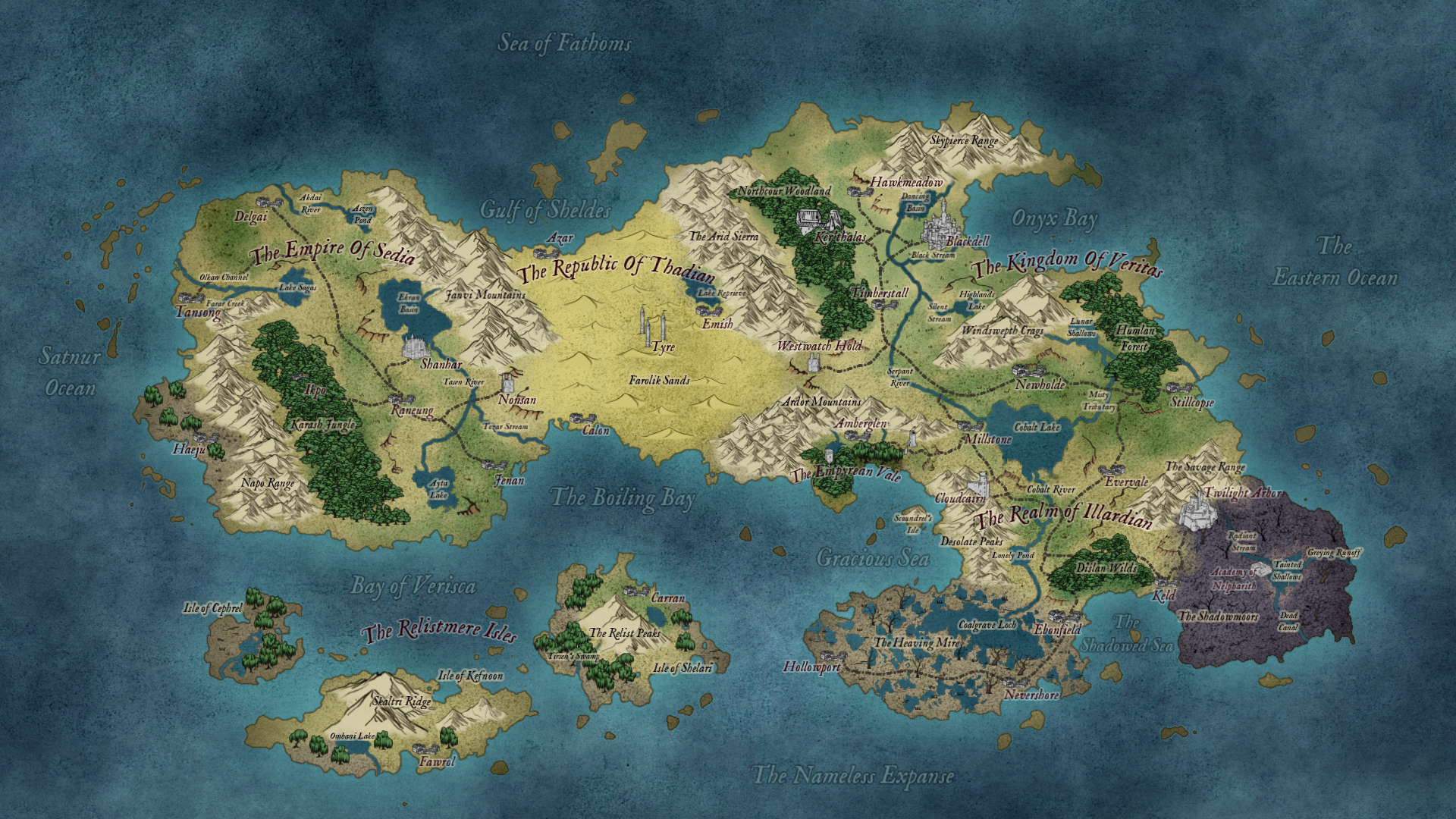
All that said, I do actually have a picture today. It’s a rarity I know. I don’t tend to think that pictures are worth the time it would take to grab and put them in but maybe I should make more of an effort. In any case, below is a world map for the game. Or rather continent map I guess. The world hasn’t been fully charted yet in the lore so this is what people know as the world. Another tip, if again you are into DMing or writing yourself. The map was made with a program called Wonderdraft, pretty easy to use and you can make some cool stuff.
Anyway, I’ve gone on enough here for the month I think. Big things are in process, as usual. I’ll be back in another month for another update.
February News Update
As usual its time for another dev log. I did a bit of looking and actually it has been a year since I announced I would be remaking the game in a new engine. I didn’t think that I made the announcement at the end of February 2023 but apparently, I did. Looking through a few of the subsequent logs though it seems I didn’t really start coding until May. So, its sort of been a year, sort of not.
I’m happy with the progress so far, but obviously I wish things were going faster. However outside of giving up sleep I don’t think there is any additional time left in my days. The progress of the game is sort of hard to judge, but I think I have more done than it feels like. It just seems strange because the world doesn’t exist at the moment. Its just a few test rooms where I just implement systems. I remember when the old version of the game was like that and once I actually built the in game world it felt much more complete.
This month in particular was dedicated to animals, and basically wholly animals. I’m close to done at this point, but not quite there. The remaining work should be pretty low effort though. For a quick summary of what was done I’ll make a short list of the notable stuff below.
Animals now naturally catch disease under certain conditions
Chicken coops have a new internal structure that collects eggs
Fowl now spawn feathers that you can collect
An entire system to make pastures work is now in place (This is so much more complicated than this one sentence implies)
Animals can now actually die and that is managed properly
Animals can be hatched or born depending on what type of animal it is
A new animal status screen has been made to display animal stats as there is now more to track with animals
Because there are multiple things that affect an animals happiness each day a system has been made to record what effects them and how much they are effected
Animals can be sold
Animals can be relocated from one building to another
Animals now appear outside or inside depending on pasture settings for the building
Added the ability to trash items
Fixed a few bugs
So basically, everything revolving around animals was done this month. I’ve also setup the Silo UI. The last things to do are make silos distribute food, which is easy, and then these things need to be replicated across all animals. At the moment, chickens are the only things that work. That may sound like a huge deal but all animals function off the same parent object. So basically, I have to copy and paste code and then make a few minor changes to the specifics on each one. This is all pretty simple and shouldn’t take more than a few days I would think, if that.
I don’t like that animals have taken as long as they have to setup, but looking back I guess it makes sense. I believe I’ve mentioned this before but most systems in this game are fairly simple, mine a rock, make a potion, cook an item, etc. All these things don’t involve much in terms of system design. These types of games are often the combination of a lot of very small systems rather than a few large ones.
Animals are more of a cascading problem though. Before you can even have an animal, you need a building for them. This is in and of itself a giant system to build, move, upgrade, and destroy buildings, not to mention handling all the internals of each. That was what took up most of January if I recall. Then once you actually have a building for animals you have to be able to buy them, name them, store all the relevant data, handle feeding, disease, grooming, health, happiness, product creation, pastures, selling them, transferring them, aging, player interactions, etc, etc. So, it makes some sense that it took a while, I just don’t like it when the end of the month comes and it feels like I did one thing.
Pastures were the biggest difficulty of this month. They were probably the system that took the most time to make. Effectively a system was needed that calculated where you put the building and (without lagging the game) found all the tiles that surrounded that building to form that pasture. Then store that data in a usable way and allow for on the fly adjustments if a player changes the pasture layout. All that said, I’m happy with how it turned out. Its far more stable and compact than the system that exists in the live version of the game.
The only other real change to mention is the structure in the coop that holds eggs. Anyone playing the live game will know that eggs just sort of drop on the ground and you pick them up. I didn’t really like this. Feathers make a bit more sense as fowl would just drop feathers on the ground in real life (I think). I’m not a farmer but I believe chickens lay eggs in their nests, not just randomly on the floor. With the amount of tasks you have to do for animal care increasing I thought this might be a nice little addition to make daily chores a little easier.
Most of the other things that I mentioned were fairly self-explanatory. As mentioned before, I have just a few things to clean up with animals, most of which is just replication for more animals.
Then of course I have to decide what to do next. This is something I’m a bit unsure of. A lot of the UI for the game is currently in flux as I’m having a lot of it redone to make it more consistent. Since I don’t have all the sprites finalized setting up UI is, well, not entirely pointless, but it is sort of annoying. Anything I setup without the finalized UI will likely require me to go back later and adjust a bit. It isn’t hard to do but its just an extra step when I could just wait to have the sprites and then do it right the first time.
This is a bit problematic because a lot of systems rely on UI. At the moment I’m debating between building out the world, or maybe getting some of combat in place. I’m hesitant to do too much world building as there are also sprites being made for the overworld and I think it would be better to do that work when I have all of the assets at my disposal. However, I could start laying out zones in basic ways with temporary sprites and notes.
I’ve likely mentioned this before, but I do want to put out versions of this game again prior to a 1.0. I think getting that feedback helps immensely so I don’t want to just make this entire thing in a vacuum and then let it loose. I’ve got a sort of unofficial list of things I want in the game before I put anything out onto Steam though. Combat is on that list because its something entirely different from the other systems and I want to make sure its enjoyable.
I think it will likely be implemented sort of piecemeal along with the mines. While there is combat related stuff outside the mines they sort of serve as a more traditionally leveled area where it gets more difficult as you go deeper. So likely in one of the first uploads of this new version you’ll maybe be able to go down 2 levels or so (remember there are only 10 very large hand crafted floors instead of 100+ random ones). I’ll likely also add some sort of level cap that I’ll raise as more mine floors get added. This way I can focus on balancing combat in smaller chunks rather than trying to get the whole range of combat right at once.
Aside from balancing I have a general goal of complete systems. I’m trying to make it so that anything a player would see in the game is done. A good example of what I want to avoid is the health bar in the current game. In the live version you have health, food and potions can give you more health, there are buffs for combat too. Despite all of this there is no combat and not even a way to lose health. That’s jarring. Maybe not to someone who has been playing for a while or is watching the development but someone coming in would likely just find it confusing.
The other obvious example of an incomplete system is NPC dialogue. In the current version NPCs have the bare minimum dialogue. I’d like to write everything for a character all at once to keep them consistent in tone. The one caveat here is that while I might write everything all at once, some of the dialogue for each character will be dependent on other things in the game happening. So, while it will be done it may not be accessible right away. The general rule of thumb though is to have things be as complete as possible when they go into the live version. I’d like to avoid uploading a version of the game and having to say “hey, there’s this part of the game that makes no sense right now because I haven’t implemented the other system that feeds into it”. To bring this all back to topic, adding combat is necessary to avoid that issue.
I think that’s mostly it for now. I feel like this was more of a ramble than a dev log. Unfortunately, there isn’t much to articulate about animals unless I start going deep into code talk. I figure this stuff is a bit more surface level, but its probably more informative about what is going on with development. The other option is me explaining the use of recursive functions to trace the tiles that make up a pasture and compiling them into an array of structs that can be easily referenced for calculations. Seeing as that sentence was boring even to me, I have my doubts about it keeping other people’s interest.
So, thank you all for your patience. As time goes on I’ll hopefully have more definite info on when you can expect an actual upload of this version of the game. I think I said this a long time ago but what I might do is upload it as an opt in beta so people can try it if they want but retain access to what currently exists. I’ve also said this before but just as a reminder, if you own the game now you’ll own the new version too, no repurchase required. Alright, I’m going to go finish animal systems. I hope you all enjoyed February 29th, it only comes around every 4 years after all. I’ll have more updates in a month.
January News Update
Hello all, it feels like it’s a been a bit since a wrote one of these, but I suppose its just that a lot has happened. As usual it’s the end of the month so its time I regale you all with what’s been going on with Verdant Village. To be completely honest, I’m looking forward to February because January turned out to be rather busy with some stuff getting in the way of development. Thankfully, February looks a lot more boring, which means more time to get stuff done.
So, as I sort of just mentioned less got accomplished this month than I would have liked. The holidays sort of ran over into the first week of the year. I was then out of town for work for a week, and what would a going out of town be if I didn’t catch some sort of cold afterwards for like a half week.
Anyway, I’m not here to make excuses (although I sort of just did), but I wanted to give a bit of perspective as this wasn’t exactly a normal month. Still, I did get some stuff done. As I remember it, the last update I was getting started on raising livestock. For those that may have forgotten livestock are also getting an overhaul. The last update will explain in more thoroughly but the TLDR is that animals now have a few factors to their care like grooming, types of feed, pastures, and disease. These all feed into an overall happiness level which determines what an animal produces each day.
It should also be mentioned that originally there were plans for monster attacks, which you would have to essentially upkeep a magical ward to prevent. If you let this ward fail animals would potentially be attacked, even inside their respective buildings. I got some feedback on this last time and as a result it has been dropped. I thought about ways to maybe modify it. Most people seemed to be okay with the idea of attacks happening if animals were caught outside, just not when they were inside. Problem with that is that there isn’t really anything to keep an animal from going back inside at the end of the day. Even in games like Stardew it really only happens if the pathing for the animal is messed up or you purposely block them. Adding a system where you have to manually bring animals inside would also be pretty tedious I think. Given that you aren’t forced to go to sleep ever this would end up just being a different version of something that forces you back to your house at night.
I suppose it could be done and then you could later automate something that brings animals inside for you but that seems, how do I put it. Like a needless complication, I guess. Because effectively a system would have been made at that point where having to do it manually would be annoying, so most likely players would just wait to get the automation element before letting animals out and basically just skip the whole thing. Hopefully I’m making sense here. The point is that for the moment at least, there is no risk of attack, animals will just go outside and inside without issue, on their own. Changes could always be made in the future though.
Alright, I’m nearly a page into this and I haven’t discussed anything I’ve done yet. For a quick overview I’m just going to drop in my internal list of things I did this month. I used to keep these when I was still updating the live version so I had a list of what had been done since the last patch. This is just what I did this month instead.
Fixed several UI bugs
Finished transitions allowing players to place animals into buildings
Setup code around displaying what animals exist in what buildings
Setup failsafes during animal purchase to prevent purchase when you have no space or building in general for an animal
Made clock UI and hotbar shift to the opposite side of the screen when needed
Created a system to handle collisions in the world via a tilemap
Animals spawn and move around inside their respective buildings
Setup system to place animal feed
Animals now eat each day
Animals grow from child to adult
Animals can be fed treats once per day
Added quality for specific items in the game, currently just crops and animal products however this might expand out later
Fixed a bug that was persistent through the three chest organization buttons
Animals now contract, spread, and self heal disease over time
Some of that is more self-explanatory, others a bit more vague, and others make a lot of work sound like very little work honestly. A good example of that is the system to handle collisions via tilemap. This is extremely important but I just hadn’t gotten around to it. To explain briefly, most objects in the world have their own collision built in. For instance, a tree, the player’s house, etc. However, there are other elements like cliff faces or bodies of water where because they are tilemaps rather than objects they don’t have a collision paired with them. This means there needs to effectively be an invisible layer placed over the map that acts as the collision mask. That is what was created. Very boring, also very important.
I don’t want to make this post a mile long and over explain things but there is one more thing from that list that I want to touch on, because it’s a fairly large change. You might have noticed near the end I mentioned that specific items now have quality levels. If you’ve played Stardew, or maybe Graveyard Keeper you’ll be familiar with these. For those unacquainted let’s say you get a chicken egg in game. It is no longer just an egg, it will have a quality attached, in the case of Verdant Village, bronze, silver, gold, or adamantium. This quality level at the moment simply dictates value. Items have a base selling value; a higher quality gives a multiplier to that value. For instance, a silver quality might make it worth 1.5x the normal value.
I hadn’t planned on doing this, but I found that I couldn’t think of a better alternative for livestock. As mentioned before livestock have a happiness level that is dictated by several other factors. This happiness level determines what the animal produces each day. In my outline prior it had much more variance. There was no quality so instead higher happiness would alter things such as, having a higher chance to spawn the product at all (yes in that version you could just have an animal not produce when it should have). It could also make animals produce products faster, for instance sheep could grow their wool in less time. Or in some cases you could get situations were instead of getting one chicken egg per day you would get two.
I still like some of these ideas, however there are a lot of problems with it. The first and probably most important being inconsistency. Having a chance to be taking care of your animals and still just not get any products one day because of random chance would feel terrible. Aside from this there was a logistical issue with lowering the time it takes to spawn a product. Sheep for example might take 5 days to grow their wool at low happiness but only 3 days at a high level. While I could do some math behind the scenes and make the numbers work it would lead to inconsistency. The player doesn’t really have an idea of when the sheep will finish growing its wool as the happiness level might fluctuate meaning the wool grows at a different rate each day. This means it could be 3 days, could be 7 days, but its hard to tell without meticulously checking the animal’s stats each day to know what happened.
All this is to say that the old method was fairly vague and I think a little too convoluted for its own good. Adding quality to the items allows for something much simpler where the better the happiness value, the higher the item tier. Simple one to one values. In the case of something like sheep where it will take multiple days to get one item I’ll use an aggregate of the happiness during the growth time to determine the quality of the resulting item.
As I said, I think that’s one of the larger changes that has come out of this. I think the reasoning is sound however. Of course while thinking this I of course considered other items as well. Currently crops have gotten the same treatment. I think they can support the same sort of structure and it feels odd to only have quality on animal products. Crops will gain quality based on fertilizer or alchemic items you put on them. More may be done to affect that in the future but for now that’s all it is. I did have a brief thought about adding quality levels to seeds so you could effectively breed better seeds but I’m not sure how complex I want to get. At some point complexity becomes annoying, so we’ll see.
Of course, I may add this on to other things as well. I actually made a note of systems that it might make sense to add quality to. Specifically, alchemy, brewing, cooking, jewelcrafting, and tailoring. That is entirely up in the air at the moment however. I suppose just don’t be too surprised if you see the system bleed into those. Hunting and fishing could also potentially see it although I’m not sure how quality would be determined outside of some sort of skill level or a luck variable.
Anyway, I’ve talked enough I think. This is already long by my standards. Its funny, I never feel I have much to talk about and then I exposit for about two and a half pages. As I said at the start, I’m expecting February to far better in terms of productivity. I’ve got some animal stuff to finish up still. I’m staring down pastures which will likely be the toughest part. Aside from that currently you can only buy chickens so I have to extrapolate all this code to all the other animals, but that’s mostly just copy paste with some minor edits. After that I’m between doing the shipping system, which I was going to do before livestock but I needed the updated UI (which I just got), or moving into dialogue. I’ll likely decide when I get to it. You’ll hear from me again in a month. I hope you all had a good start to the year, and if you’ve made it this far, thanks for reading.
December News Update
To start things off, happy new year! It’s been quite a year for myself, and Verdant Village in general. I’ve said it before, but I can’t say I was expecting to be in the process of remaking this game at this time. A lot of the framework for the game has been laid since I started in a new engine earlier this year. We’re getting fairly close to the point where the more complex systems are in place and hopefully after that development will speed up a bit.
Now, as for what happened this month, I regret to say it wasn’t much. December is always sort of a weird month just because of the holidays. This year was busier than usual for me, and I also had the pleasure of being sick for a bit. I did make some progress on ranching, but admittedly this month was a bit of a wash. That said January should be far more normal, and I can return to getting things done. While I didn’t get around to that much this month there are two major things that did happen, more so in planning than execution. The first is ranching. It’s the system that I’m working on at the moment and while in the process of setting things up I was taking a look at the actual gameplay systems and determined that I didn’t think much of them.
For anyone who hasn’t gotten to ranching yet in game I’ll explain. In its current state ranching is very simple, basically you just feed your animals each day and they will give you a product as a result. If you fail to feed them for too long, they starve. That’s basically it. There are some other minor things like automatic feeding, a pasture system, and a few animal variations like pink and brown cows as well. All of this is alright as a base, but while I was considering ranching, I came to the conclusion that its sort of lackluster. Something I’ve tried to avoid in this game is systems that are nothing more than a button press. I prefer for there to be some nuance to everything so that this doesn’t just become a chore simulator. This is harder to do with some things, but ranching has plenty of opportunities for complexity. I’ve never raised livestock in person, but I’m guessing it requires more effort than just giving your animals food every day.
So, in that spirit, there will be something of an overhaul coming. In short, there will be more aspects to taking care of animals. Specifically, I currently have several systems planned, health, hunger, sickness, cleanliness, pastures, and wards. Each of these is pretty simple but I’ll explain.
Health is exactly what it sounds like, every animal will now have an HP value. An animal at full health is happier. Health can be affected by things like sickness or monster attacks.
Hunger is obviously how hungry an animal is. Feeding an animal each day will ward this off. However, there will be a few tiers of feed which have other effects. Treats will also be something you can feed animals. These don’t actually fill up an animal but can boost their happiness and HP to help them recover if needed.
Sickness means, as you likely guessed, that animals can get sick. There are a few different types of sickness, that cause damage and even death if they aren’t treated. Disease can also spread if it isn’t taken care of.
Cleanliness is just a simple system where you’ll have to wash or groom your livestock every few days. Pastures are sort of multipurpose but ultimately a pasture serves to make livestock happier. A larger pasture will make the livestock in it happier.
Last is wards. This is related to monster attacks. Monsters can attack your animals each night and wards will keep your animals safe. They have a duration that they last so they’ll need to be replaced. In general, they serve to reduce the frequency and severity of monster attacks.
All of these things play into happiness. In other games like this, happiness tends to be something you build up over time. For instance, if you feed your animal each day and pet it the animal will like you more. This is usually a cumulative system meaning that once your animal is happy, you’d have to really just stop paying attention to it for its levels to drop. Generally speaking, I don’t like this as I think it sort of lowers the stakes for consistent care.
The plan for this system is that happiness will be a value that is determined each day based on the status of the animal. This happiness value will determine what you get from the animal. There are several tiers of happiness, the higher the tier, the better your rewards.
It should also be mentioned that these systems are meant to play off of and affect each other. For instance, not cleaning your animals lowers their immunity which makes them more likely to get sick. Letting animals into a pasture can make them happier, but they’ll get dirty more quickly. Being in a pasture will also provide the animal with food so you don’t need to feed them, but pasture feeding isn’t going to be as good as high-quality feed.
Aside from all these things all animals will have at least one to two transformations that you can change them into by feeding them certain special items. There are a few other things as well, but they aren’t worth really getting into. The hope is that with all these things raising livestock will be a bit more interactive rather than just a mindless task.
Now, if you’ll remember I said I had two major things to talk about. Last month I believe I mentioned that changes would be coming to the mines. The first is that it’s going to be closer to town. The world is getting a general makeover and one issue is that the mines are really far away. So no more winding mountain trails, or at least not as much of one.
That’s a pretty minor detail though. Much like ranching I’ve been contemplating the mining system for the game. Now, the act of mining itself is going to stay the same. The thing I decided to focus on was the mine itself. For those who haven’t played, or seen the mines, it is basically the same as other games of this genre. You enter and descend through around 100 floors. Each time you enter a new floor it randomly generates the layout to add some level of uniqueness to the area. The mines also generate a few different things like stamina drainers, keysprites, treasure chests, seams, lighting, buffs, etc.
The point of this was to vary the mining experience a bit each time you went in and give the player a bit of something to encounter. General combat encounters were also (and still are) planned for the mines.
Looking at the mines I sort of came to a conclusion about the whole setup that I didn’t really like. To put it bluntly, it’s sort of redundant and it’s stretching a fairly thin gameplay mechanic across a large swath of game. Along with this the random things you can find in the mines combined with the random layouts means that rewards are sort of just laying around.
The older I get, and the more games I play, the more I’ve come to the conclusion that random generation is something that really should be used sparingly and in the correct circumstances rather than a replacement for level design. I had thought the mines would be good for this, but I think that was incorrect. Looking at the mines as they are right now, I see it as basically having 100 very subpar levels. The poor quality is offset by the quantity. So, the new plan is to rectify this.
Currently my idea is that there will be 10 levels to the mines. Unlike the current mine levels these will be far larger. Instead of random layouts they will each be handcrafted. There will be a boss enemy at the end of each level to keep people from simply rushing to the lowest floor. The biome will change every two levels and what minerals and gems you find on each floor will change.
The mines will be designed cyclically so that the end of the level winds back around to the start. This way when you want to come back via the elevator you won’t have to traverse the entire level again. There will likely be other ways to hop around the level as well.
Probably the most important part however is that each level will be treated like something of a dungeon. There will be plenty of ore to mine that is scattered about however your progress through the level will be gated by smaller puzzles, locked doors, or combat encounters. Once you’ve reached the end of the level and defeated the boss it will unlock what I’d refer to as a mining room. This would be a large area full of rocks you can mine so once you’ve completed the level you can come back and mine in a more traditional setting without having to run through a maze just to find mining nodes. That’s the general idea. To be clear, I used the term dungeon earlier which makes me think of Zelda. To be clear, this would not be something as extensive as that. There’s already enough going on without adding a Zelda clone to this game.
I’d be curious to know what people think of this, so if you have an opinion feel free to share it. My personal perspective is that I would rather have 10 well-made levels instead of 100 forgettable ones. Doing something like this would also allow me to use the mines for other things potentially since there would be a static layout that I could tie to other things in the game.
Anyway, this post is already very long so I’ll wrap it up. I have plenty of work in front of me which I’m eager to start. I do apologize for not getting a ton done this month. I’m keenly aware that people have already paid for this game and are potentially waiting for me to get on with it. Granted, I don’t think there are people waiting with bated breath on this new version. However, call me old fashioned, I don’t like to keep people waiting, especially when I’ve already taken money from them.
I’ll hopefully have more to report next month. As for now, I hope you all enjoy your new years celebrations and start off 2024 on the right foot.
November News Update
I’m a day late here which I’m going to blame on, uh, holidays, let’s go with that. Totally not me losing track of time. In any case, big systems were the name of the game this month. That and sprites, lots and lots of sprites.
For systems, they may not sound complicated, but both are rather involved. The first is actually something that is new to this version of the game, hybridizers. They have to do specifically with crops and flowers.
In the current version of the game there are what I would consider to be a lot of crops. If you play what is live they are all simply available from the general store from the start. There isn’t anything inherently wrong with this, but I thought it might be a bit overwhelming to a new player. Aside from that, farming doesn’t really have much progression. I suppose putting in irrigation is really the only progression, outside of just scaling up how much you grow. There are a few other things to address that progression issue, but hybridizers are meant to help with this a bit.
At the start of the game you’ll have far fewer crops available to. Three for each season unless something changes. However, one of the opening quests will be to use hybridizers. In short how these work is that you plant two different crops and a hybridizer in between them. Once both crops are fully grown they will potentially spawn a new crop where the hybridizer is. Each crop outside the original three you start with has a specific combination that is needed to spawn it. So you can slowly gain all the crops as you figure out the combinations.
Also, because no one would want to go through this process forever, once you get the new crops you’ll be able to turn in around 5 or so to Lylah and then she will start selling the requisite seeds. This same process is being done with flowers as well. This along with a few additions to automate some of farming in the later stages I think will help make players feel like they’ve made progress as they play. Farming aside, the other system I’ve been working on is livestock, which is actually like eight systems hiding under one name. While I say livestock I’m basically just now getting to making that. I tend to make systems in the same order a player would experience them. So, before you can have livestock you have to have a building to put them in. This was the odyssey I went on this month.
The UI for buying a building isn’t in place yet because, well, in a word, sprites. We will get to that later, but for now I just have a button that initiates the building process. So first we had to make a system to allow you to scroll the view without the player on the screen. Then allow for the creation of a building with stipulations like you can’t build it on top of a tree, or in the water because structural integrity is important kids.
Once that was done, I decided to just go the whole nine yards and add in the ability to move, remove, and upgrade a building as well. So ignoring a few minor things like Simeon actually showing up to build the structure each day, and linking it all to a simple GUI, the framework for building is done. After that I had to build out the transition system that moves you from room to room in the game. Fun fact if you didn’t know already, all of the coop and barn interiors are the same room. In short, everything inside a building that houses livestock is loaded dynamically. To explain, normally when you move to a room everything (generally speaking) in it has been setup by me during development. Every tree, building, chair, path, etc I put in place. Because rooms are static in this way I can just setup an invisible object at the edge of a screen that when the player touches it the game takes you to the corresponding room. For livestock buildings you can technically have as many as you can fit onto your land. Who am I to say you shouldn’t make your fortune through nothing but chickens.
Since I don’t know how many chicken coops you crazy people are going to make I have to allow for any number, which means creating static transitions to the interiors is out. So instead of building out an innumerable amount of coop interiors I just build one. When you enter a coop you always enter the same room, but the transition that occurs when you enter has a few pieces of data tied to it, specifically the tier of coop you are entering, how much feed is there, and the data versions of all your livestock. From all this data it populates everything when you enter.
This is where I’m at currently. At this point it should be smooth sailing for a while until I get to the nightmare that will be pastures. Building out animal functionality is fairly simple it just involves a lot of iteration for the most part. Pastures will likely be a tough cookie to crack, but I have several working ideas of what to do so I’m not worried.
The last thing I worked on this month was sprites. For those unfamiliar with game development sprites are not little forest creatures. It’s just the term used for the images you see in game. Let me tell you, there’s a lot of them in this game. In the previous version I’d been adding them as I got them for the most part. Now I face the annoyance of needing to transfer what already exists (and the new ones coming in) to the new engine. So instead of adding them all at once (and going insane) I’m splitting out some time to add them bit by bit. I mention this mostly because it means the time I have to write code is down a bit while I add these in.
This also does link up with what I mentioned before about GUIs. If you recall I mentioned that constructing buildings doesn’t have a GUI at the moment. If you have played the game however you’ll know that one exists, so what gives?
What gives is improvement. I’m not quite sure how obvious it is from a player’s perspective. I’d guess that some people likely notice and others don’t. At the risk of enlightening people to the blunders of the current game, if you look at the various pieces of UI they are only tangentially similar to each other. A lot of them have similar theming but the details are different.
Generally, it is considered good form to have all your UI match in terms of appearance and functionality. When I was making what currently exists I had an idea to make each bit of UI sort of unique to what you are doing. For instance, the alchemy UI looks like a tome. The fermentation UI has a different look. The forge is made of molten stone, so on and so forth. I don’t think this is a terrible idea, but I think it wasn’t implemented well. In general, I feel that the inconsistency isn’t worth it. It may seem like a minor thing, but having to parse a different UI every time you open a new interface isn’t ideal.
So, the reason there is no building UI yet is because it is being redone. Pretty much every UI will probably have some sort of alteration made, whether it’s a function or visual change, or just an overhaul. Currently we’re in the process of making a guide to make of this by so we can keep things consistent across the board but once its done UI will be added back into the game in a more significant way.
I think that’s it for this month. I was going to talk about changes to the mines, which are planned to be pretty extensive, and in my opinion pretty cool, but I’m just about at two pages here and I like to keep these relatively short so I think I’ll hold off until next month. I suppose the next time I post it will be 2024 or just about 2024. Since I won’t have another chance to say it happy holidays and I wish you all a good 2024! Hopefully your 2023 was pretty good too. I can honestly say I wasn’t expecting to be doing what I’m doing now when 2023 started, but I’m still glad that I am. While starting over was far from ideal I think the game will be far better for it. On that note, I’m off to squeeze in what work I can between the holidays.
October News Update
Hello everyone, thanks for checking out this devlog. Let’s jump right in, its been an interesting month full of things I don’t usually do as much. This month’s work was more planning than work if I had to classify it.
To start out, I did do a few things to the actual code of the game. Chests can now be picked up, so they are back to functioning as they do in the live version of the game. Aside from that I rebuilt a minor system to keep UI behaving correctly, specifically it ensures that you can’t click a button in the same frame it is made. I also fixed an issue where moving diagonally was faster cause that was strange.
Lastly, I rebuilt a system for in game messages. If you play the current game you’ve probably seen the small messages that appear from the top of the screen, that system has now been setup in the new engine.
All of the things mentioned above were really just minor additions. The meat of work this month was, as I said at the start, planning. I wasn’t expecting to do that, but realistically I probably should have expected it. Most of this planning revolved around the shipping chest, specifically the process of ordering items.
For those who are maybe unfamiliar the shipping chest allows you to order objects, usually furniture. This involves paying a fee as well as supplying one to three items. All very simple, in fact making the actual system likely won’t take very long at all. The issue was that the old version of the game essentially populated the database that this system worked from at runtime.
In short what this means is that there isn’t just a spreadsheet out there I can port into this version of the game. As a result I had to scrape the data manually, which wasn’t too bad. The next part was where things sort of spiraled out of control and the reason this basically just turned into a planning month.
Because of how the shipping chest and items work it is better to have everything related to it worked out when it is implemented. So the first step to that was to figure out what exactly the player can order from the shipping chest. This sounds like a simple question, but as I quickly found out, it ends up branching into several other systems, specifically quests, secrets, shops, and tangentially into any sub-system that requires a station to work from like sewing, hunting, or engineering (which is new and not in the current version of the game).
So, the bulk of the work was setting in stone exactly what was a shop item and what was a catalog item. The game has several secret shops that operate on either gold or additional currency. The items in these shops are unique to them. I had to determine what I wanted to just be something you unlock via quest reward and order from the catalog or an item in a special shop.
In addition to this I added a whole bunch of stuff. Partially to fill out some rewards and shops, but also because I felt what was there was a bit lacking. The furniture item list is currently sitting right around 390 items. 229 of those items are ordered through the catalog. All of this is to say that I spent a good chunk of time setting up the prices and item requirements of those 229 items in the catalog.
That however, is not all. As I said earlier this sort of spilled out into other systems. Shops, secrets, and quests were mostly just a matter of re-arranging or setting exactly what would be available. Other systems involved a bit more investment. Mostly this was a lot of nailing down exactly how I wanted things to work. A simple example is archeology. In the current version its just a button in your inventory menu. Because of changes that are coming to the UI there is now a station that you’ll access for it instead. Engineering needed to have its projects sorted and ideas for what it can do for the player set. Engineering is basically the late game automation system for a few things. Tailoring, which is new, had to have its items and stations sorted out. Brewing is also seeing an overhaul which involved a few new things that needed to be set into place.
Which is actually a good place to transition. Last word on the catalog, it is done. It was basically just a lot of data entry as well as setting rewards and requirements for a variety of systems. As for brewing, it will see some changes. In short I’m trying to simplify it. I’m still mulling over exact details, but the general idea is to make it a less intimidating system. First there are now a few degrees of separation. You can now make beer, wine, and liqueurs (flavored liquor). Beer is the easiest, you’ll just throw an item into a station and you get beer after time. Wine is a similar process but adds an element of aging, the longer you let it ferment the better the wine.
Liqueurs are what will replace what currently exists. I still want to simplify it but allow for a bit of player decision as well. Instead of just tossing a bunch of stuff together like in the current version and sorting values this will be a more precise process. I am doing away with custom recipes; I like the idea but I think its daunting to a player. Also, the concept of custom items that are created on the fly in a game like this is a nightmare from a code perspective.
Instead, how I currently have things is that there is a five-step process that you basically setup and let it run. I did some level of research into brewing and this is supposed to mimic that process. If anyone who actually makes alcohol is reading this I apologize because it’s an extremely simplified version of the real-world process.
First, you pick a catalyst which determines what type of alcohol you get. You can make rum, whiskey, vodka, or gin. Next you pick a water purifier. There are basically a couple of items you can use that purify water to various degrees. Third you pick a heat source, again there are a few items that generate more or less heat. Fourth you pick a flavoring item. This is the largest group of items you’ll get to pick from. Basically, there is a big list but the items simplify down into one of 5 categories with some items being better than others. Finally, you determine how long you want to age it.
All of these elements determine a specific item that you create. The better purifiers, heat, and aging you use the better the product. I figure between this, beer, and wine, players can pick how much they want to interact with the system (if at all). This seems better than being forced to learn a huge convoluted system that garners mixed results unless you really invest a lot of time in writing down combinations.
Last thing that I won’t swear to, but I did a bit of fiddling around and I think it would be possible. I know other games, specifically Stardew I guess, offer multiple farm layouts. I may follow suit on that, but I also did a bit of dabbling in a custom map creation tool this month and I think it would be possible. To explain it would allow players to go in and create a farm layout with a simple tile editor and then use it in game. Because of how it would be saved it should be easy to also allow players to basically share their layouts as well if they choose. Like I said I don’t swear to it because it is still early days, but it seems feasible.
And that’s mostly it. There are a couple of things I didn’t get around to but this is already pretty long and those things aren’t super important. Hopefully November will be more coding and less data entry. For my own sanity I hope so at least. As always, thanks to everyone for playing the game and giving feedback. Happy Halloween if you celebrate that sort of thing and I’ll see you all in a month.
September News Update
September has just about come and gone here. I’ve been working on a variety of things with Verdant Village this month as I’m slowly piecing the game back together. I feel like a lot of the framework is in place at this point. There’s still a lot missing, but I think I’m making good progress. Once the framework is done its on to more of the details and little things. I generally find that those little details are usually easier and quicker to add because they are comparably small. A good example is adding perks and skill levels is important, but in terms of system design it’s a minor detail when compared to something like farming.
As for what I actually did, it was a fair amount of jumping around. First, I finished up the shop UI as it wasn’t fully in place. I added buyback for shops, which I believe was mentioned in the last post. Multi item buying has also been added in a more visible way than what is in the current game. Portrait animation and character dialogue was added to the shop. Basically, the character reacts when you buy and sell things. They have a few lines, and their portrait animates.
One of the larger systems that needed to be designed was a particle system. There aren’t a ton of particles in this game but there might be more in this version, time will tell. Regardless I created a whole framework to create said particles and deal with them accordingly as using them incorrectly can cause memory leaks and such.
The next thing I took on was another large-scale system, lighting. The game has had a clock running and simulated days, months, years, etc for a long time now, but there was no lighting to show time moving. So, I made up the day/night lighting system and got it working, along with allowances for things like light from your character, braziers, lanterns, etc. Currently it is getting very dark at night, much more than in the current version. I’ll have to do some testing to see if I want to keep that, but as it stands nighttime might look a fair bit different.
After that I had to make another modular system for passive item functionality. Its another system that is used sparingly but there are a few items that function passively from your hotbar. The most obvious examples are any item you can place in the world and the carpenter’s mallet. When you have a placeable item selected you’ll get an outline of the item that follows your cursor so you can place it. The carpenter’s mallet lets you hover an item with the mouse to select it and remove it. These sorts of interactions happen passively as long as you are hovering the item. So, a system has been developed to arrange all of that.
Along with passive functionality I’ve created the framework for placing objects in the world. So, you can place things down at this point. The only item like this in the game currently is the chest. The reason it’s the only item is because once I made it I created the entire chest UI. Which then involved rescoping inventory interactions to work in a setting where you are looking at an open chest. These interactions with the chest are all done at this point.
This month was admittedly a little slow. My pace varies a bit depending on what I am tackling. For this month figuring out particles was part of that. The other major hinderance however was an internal engine change. For those that don’t know I’m using Game Maker for the remake. I almost picked Unity, given recent news I guess I lucked out there.
In any case, Game Maker, like every engine, has a lot of built in variables and functions to make development easier. Specifically, they have a variable called “room” which would give you the index of the room the player was currently in. I was using this variable as basically a key to allow the player to move between rooms. Sometime this month, I forget when, they updated the engine and changed the value that this variable returned to something very different. So, a chunk of my time was spent rewriting the room transition code to use data that doesn’t rely on that room variable. TL; DR, Game Maker made a change, I had to pivot on a fairly large system which took up some time.
I think that’s it for this month. Nothing terribly exciting but some decent progress nonetheless. I’ll be back to report at the end of October as usual. Hope you all enjoy spooky season, its arguably my favorite time of year.
August News Update
Hello all, time for another update on the game. I think this will be a little shorter than others simply because of what I’ve been doing this month. Less stuff to talk about as it’s been bigger projects. So really, aside from minor fixes and things really two things got done this month. They were both pretty large however. The first is fishing. That’s the system in its entirety. All the fish are in, they all have times and places they can be caught, all that. As anyone who has fished in the game knows the reason this took a little longer is because there is a whole minigame that needed to be programmed. It’s nothing huge but still a bit of a time sink. One change to mention with catching fish is that in the current game each fish has a time of day it can be caught. This time of day specification has been dropped. Fish still appear in specific water types and seasons but the time of day was a bit too restrictive given how short days are.
The main thing to mention with fishing is the minigame that I’ve done some work to hopefully make it feel a little better. For those who haven’t fished you basically hook a fish and then get a small minigame at the bottom where you have to keep a slider over a fish that moves around. This minigame is still in place in this version. The changes have been made to the feel of it all. In the old version the slider was very, abrupt, for the lack of a better term. When you pressed or released a key to move the slider it would start and stop immediately. This is the sort of thing that feels sort of amateurish in my mind. It’s a bit hard to explain honestly but if you’ve played a lot of games like I have you might know what I’m talking about. It feels lacking in polish I guess. Like someone slapped in two lines of code, one to go right, one to go left and then that was it.
By comparison the new system has more of an acceleration and deceleration on your slider. If you slam it into the side of the minigame space it will bounce off instead of just stopping. Little things like that.
The fish that you are trying to catch also got a bit of an overhaul. Before fish basically had a difficulty level of 1 through 5 and they would move faster or slower based on that. Now the fish is given a profile of sorts that makes it dart, or move slow, or fast, etc. This makes each catch, hopefully, feel a little different.
So that’s fishing. Not a ton to say but it took a bit because I think there are about 150 fish in the game and they all had to be added in to databases and setup appropriately. The next thing, that I’m still putting the finishing touches on is shopping.
I don’t know that I really need to explain what shopping is, basically just the act of buying things. As some of you may know there are a few different types of stores in Verdant Village that have different interfaces. The exchange shops, general shops, the blacksmith, etc. This is the basic shop. Although I’m going to integrate the exchange shop into it as well in time.
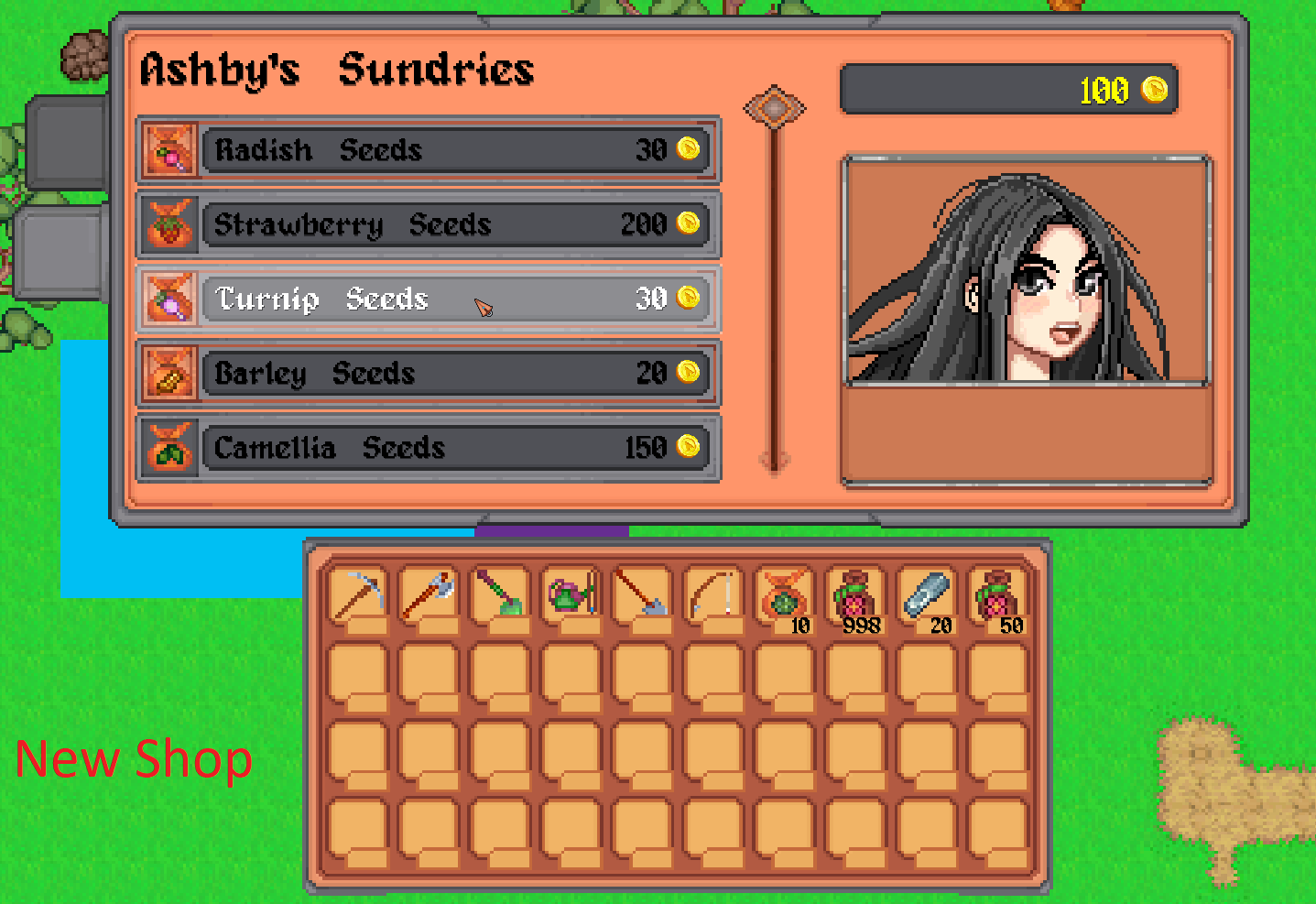
The important point to bring up here is the UI itself. I don’t usually do this because I don’t tend to show works in progress but I think in this case a picture is worth a thousand words. Below is a screenshot of the new shop, and below that is the old shop. Bear in mind that, like I said the new shop isn’t quite finished yet, so its missing a few things as well as some finalized sprites.
So, the new shop. As you can see the inventory has been shrunk. This is a change that is happening across the game. In the original version all inventory item sprites were being stretched to 1.5x size. I did this because I was afraid things would be too small. The problem is that if I do that it takes up a huge amount of screen real estate, which is coming at a premium in many UIs in this game. So I shrunk the inventory down to its normal scale. As you can see there are still some minor adjustments to the stack sizes that need to be made to make stuff fit.
As for the shop, its been changed to a slider layout. One of the things that I decided to tackle early in this was to homogenize the UIs and make them just better in general to navigate. One of the rules I have, that I think I should be able to follow, is no arrow buttons unless it is absolutely necessary. They can work but I think they look clumsy. They also take up way more space than a slider. Finally in controller setups they usually are clunky to use.
Something else that’s changed, that seems minor until you don’t have it. Hovering animations. The one shown isn’t a finalized version, but the code is in place. When you hover buttons in UIs they should react to show they can be used. All buttons will do this in this version. Most of the other stuff is self-explanatory. Your money and the name of the shop up top. Lylah’s (the owner of the store) giant face staring at you. The area just below her will be used to display text. When you buy or sell things it will display little lines of dialogue from the character you are shopping with and the portrait will change. Its nothing important but it adds a bit of flavor.
You might also have noticed the giant tabs on the left. The sprites aren’t complete but those will allow you to switch between the shop and the buyback system. I never did this in the current game because the system was so in place that adding it would have been a nightmare but I think it’s a good idea. In a game where items are everything having the ability to get an item back that you sold on accident is helpful.
The system is planned to be shared between shops. So if you sell something at the general store and then go to another store you can still buy things back that you sold at the general store if that makes sense. It may not make a ton of sense in world, but convenience and all that.
Last change that isn’t visible but I’m going to add in is some sort of button that allows you to buy in bulk. Probably x1, x5, and x10. The current game has a system like this, but its never mentioned. Fun fact, if you shift click an item in the store in the current game you can type in how many of that thing you want. This aims to get the same basic benefit but in a less clunky format.
I think that mostly covers the store. I won’t drone on forever about this but I hope it shows sort of what I’m aiming to do. A chunk of this game is interacting with menus and I want to make that as smooth an experience as possible. The design principles you see in this shop should transfer to other UI menus as well which should in general make a far more cohesive experience for any player. Besides cohesion I’m also on the lookout to add small graphical flourishes. For instance when you select and item in your inventory and drag it around it will now pulse slightly in size to make it stand out against other items. Little things like that tend to go a long way.
And I think that’s it for this month. It wasn’t a slew of smaller activities this time around, but a lot of work got done. I find that in making larger systems I tend to make smaller things that I can then reuse later. For instance, I had to create sliders for the shop, but now the next time I need a slider I can just drop it in and the code is written so that it can be used in any situation with a few variable changes. That’s nothing ground breaking, but it just means that as time goes on and I continue to make little odds and ends each subsequent system will already have small parts done so making it will go faster. With that I’ll take my leave, I’ve got plenty to do. Thank you all for reading and your patience as always. I’ll be back in a month to share more updates on the game.