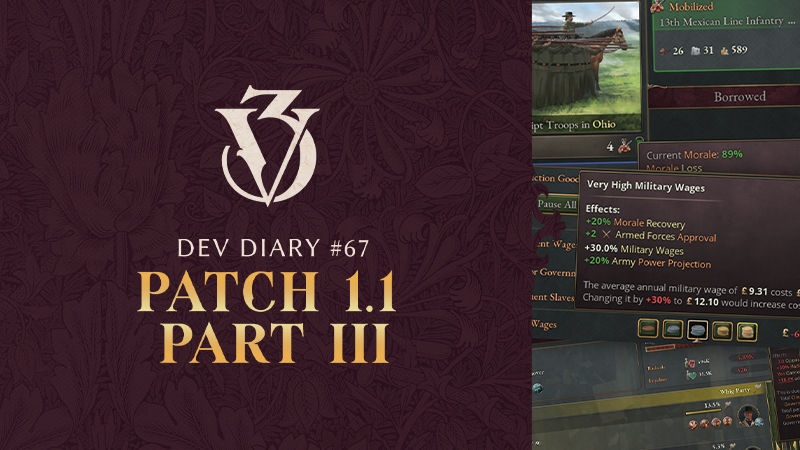
Happy Thursday! Today we'll talk about some more changes we've introduced in patch 1.1, including how Morale works.
For starters, why rework morale? One piece of feedback we heard a lot of post-release was that it was frustrating to watch long, drawn-out battles that tied up the front while your battalions that weren't in that combat perished from attrition. Our goal with these changes is primarily to make battles snappier, ensuring that battles that are all but decided can come to a rapid conclusion so the front can start moving again. Some nice side effects are that your supply, morale recovery rates, and having reinforcements and reserves start to play a greater role than they used to.
In the new system, instead of the losers typically being the only side to take morale damage, units on both sides will take a certain amount of morale damage for each round of combat. That morale damage can be modified by various factors, such as technologies and production methods. In addition, the side that has taken the most casualties will suffer an additional multiplier to their loss of morale, ensuring that combat superiority is still what ultimately wins battles.
The basis for how much morale units lose each day is determined by the organization or ship class production method groups in Barracks / Conscription Centers and Naval Bases respectively. The more modern the method of warfare, the lower the loss of morale. Also, conscripts now differ from regular Battalions in that they suffer more morale damage.
These Ohioan conscripts have a relatively high base morale loss of 15 men per day, but this is reduced due to National Militia. Their morale losses increase somewhat from currently being in a battle where more casualties have been inflicted on them than they have on the enemy. When all remaining men in the unit have been lost to casualties or morale loss, the battalion will detach from the battle. Once fighting has concluded, their commanding General's Experienced Diplomat trait will increase the speed by which their morale recovers. Morale will also recover along with fresh reinforcements from the Conscription Center supporting them.
Modifiers can affect how much morale your own troops lose, such as good modifiers from First Aid and Field Hospitals, or bad modifiers from battle conditions such as Broken Supply Lines or commander traits like Reckless. But the morale damage you take can also be modified by the enemy's forces, for example via production methods like Siege Artillery or Chemical Weapon Specialists, or character traits like Wrathful.
When battles start, units are now deprioritized to enter combat if they are injured or demoralized. What this means is that even if you end up with fewer than your full complement of battalions in a particular fight, the rest of them will make use of this short respite to recover for the next one.
Speaking of recovery, we have also made a few changes to the way Wage levels work. Higher military wages than usual now affect how quickly units recover morale when not in combat, letting flush governments push frontlines by gradually overcoming the enemy's fighting spirit - at least as long as you're able and willing to rack up an enormous body count in the process.
Recovering Morale faster than the enemy does could be well worth the expense in the long run. It will also give your Officers and Servicemen a better Standard of Living, building Loyalists in your Armed Forces over time. Their increased Wealth will provide them with more Clout to throw around in internal politics as well, of course, so take that into account.
This isn't the extent of the changes to government and military wages in 1.1. These settings used to be a highly efficient way of directly and immediately altering your Interest Groups' Approval scores, which we have toned down a bit in 1.1 by making the Approval changes limited to -2 / -1 / 0 / +1 / +2 for the five different levels. Of course, the act of raising or lowering wages still has the usual knock-on effects on Approval by increasing or decreasing the purchasing power of the pops that tend to make up those groups, leading to changes in Standard of Living and therefore Radicals and Loyalists.
High or low military wages also affect your armed forces' Power Projection, leading to a Prestige impact also during peacetime. Low military wages also affect your buildings' training rate, i.e. how rapidly they can reinforce battalions and flotillas that have become underpowered due to casualties. To round it out, low government wages provide a direct impact on Prestige while higher levels now provide additional Authority.
As a final note, an update from our first Patch 1.1 update on Legitimacy levels. One oft-repeated concern with how Legitimacy works currently is that under most democratic systems, having two parties in a coalition government does not provide much of a penalty, even if those parties are vehemently opposed to each other. From one perspective this was working as intended, as it represents a trade-off between Legitimacy (in this case, popular representation) and ability to actually enact any new Laws (since the incoherence between the ideologies in government would make debate and stall outcomes very common). But on the other hand it felt wrong to have the two completely incompatible parties working together in a highly functional government - as long as they didn't try to make any changes, that is.
In response, we have changed the Legitimacy penalty from government size to one that actually represents ideological incoherence. Adding a party or Interest Group to government will now cause any conflicting ideologies (as measured by their stances on Laws) outside party boundaries to inflict a Legitimacy penalty. This encourages formation of government groups that are both strong and effective together. We're very interested in hearing how this change feels to you all, once patch 1.1 drops!
Despite representing the majority of Clout and Votes in Great Britain, an unholy alliance between Tories and Whigs is just too incoherent to form government together. You could still confirm such a government, but the penalties for doing so would be enormous and no legislation could be passed while Legitimacy is that poor.
The changes we have discussed in this and the previous two dev diaries represent just a fraction of the changes you will see in the new update. These ones are maybe the most visible, but a number of under-the-hood improvements and bugfixes have been made as well. Next week we will go through the full changelog! Until then!
Dev Diary #66 - Patch 1.1 (part 2)
Greetings my fellow Victorians, Paul here to talk about some of the things I have been doing for Patch 1.1.
As was said in previous dev diaries, this patch (1.1) is going to primarily focus on game polish: bug fixing, balancing, AI improvements and UI/UX work, while the next major free patch (1.2) is going to be more focused towards making progress on the plans we’ve outlined in our Post-Release Plans DD by iterating on systems like warfare and diplomacy. Hotfix (1.0.6) should be out for you all with performance improvements and some bug fixes in the meantime.
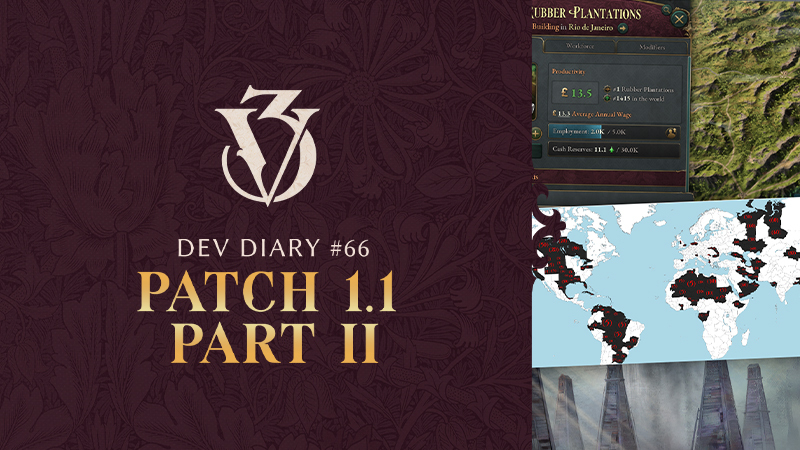
So what have I been doing? Balance work, alongside bug fixing, and assisting with some UI work and bettering of the player experience. I’m new to the design team and during my onboarding I've been able to utilize one of my special talents: I love spreadsheets and data - so I’ve been working on building profitability, production methods, and resource availability. In Patch 1.1 two large changes I have made are to Oil and Rubber and I’ve got some cool resource maps to show you the changes.
And before you take a look at the images showcasing what changes I have done, a big shoutout to @Licarious who made the tool that I am utilizing here today. This tool is open for you all on the forum in this thread. I have found the tool to be particularly lovely, helping me make quick visualizations of the changes I am considering in the game. It's one thing to balance a spreadsheet but another to take a look at the changes proposed on the map itself.
The World’s discoverable Oil Supply as of 1.0.6
In the version of the game you are all currently playing, these are the oil reserves that are discoverable in game. They are mostly the historical oil fields that were cultivated over the current knowledge of where Oil is and has been accessible (even if we did not find out about it until later than 1936). As you’ve no doubt noticed in your later games, Oil is a scarce resource and limits the progress of later game industrialization. While we want Oil to be an important late-game resource, its current bottleneck as an available resource is a little too harsh to the player’s experience so we’ve expanded the discoverable oil fields in game.
I spent a few days going through various feedback threads on the Discord and forums, alongside as many natural resource distribution maps as I could to give a better estimate of the world’s oil supply and help make the game representative of that. As of now we’ve doubled the world’s potential oil fields to give rise to a more plentiful supply in the world by both player and AI actions.
The World’s discoverable Oil Supply as of 1.1.0
I know some of you might be asking, why did we not just increase the production of oil methods and leave the historical oil fields in place? Why have you included [specific] oil fields that were not tapped until ~1950! etc.Those fields represent a usage of either Oil Sands, or some various substrate that would have not been accessible at the time.
These are all some valid questions and I will no doubt go into more detail in the thread about choices made, but some quick answers.
Oil production methods are already incredibly profitable and buffing them further would help but probably not fully solve the problem.
The gating of Oil Fields to only historically extracted areas is always tricky, if Russia and the United States collapse in game, 50%+ of the world's oil supply is locked behind their regression and the world suffers. We want to have historical credibility but also give players multiple avenues to pursue.
We don’t exactly leave a track record of “this field would have been accessible in 1880" etc in our history books when we discover new resources, so best guesstimates have to be used and a balance between historical and semi-balanced gameplay has to be found.
We are by no means done with Oil, this is my first step in their balancing and it's been sent off to QA to run tests and gather feedback. I’ve got plenty of possibilities to look into but I want to make iterative changes instead of altering many things at once and not seeing the full impact.
Things I am looking into for the future includes
Gating some oil reserve potential behind tech to make it where deposits that were not found until more modern days are harder for the player to get to, but still possible.
If Oil Supply is still too short - looking into adding more variation of production methods of balancing of input/output of those factories.
Giving the Whale Oil Industry a bit more of a kick into gear in the early stages of the game.
So keep your feedback on the forums/Discord coming! I might not read and answer them right away but I do collate them for future reference and they’ve been incredibly helpful in my efforts.
And now onto the world’s rubber supply, which I have also adjusted for Patch 1.1.
The World’s discoverable Rubber Supply as of 1.0.6
While not as much of a bottleneck as the world oil supply, rubber is found to not be plentiful enough to meet world demand at current. And as we make the AI better at extracting and utilizing resources in game, we no doubt have to increase the rubber supply available to the world.
And so here are the changes.
The World’s discoverable Rubber Supply as of 1.1.0
Notice the differences? Your eyes aren’t deceiving you, the two maps are the same - and this is not a mistake. The changes to Rubber have been focused on its vertical margins as opposed to the horizontal margins. While I could have upped the world supply of rubber, looking at the later game saves I found it was population issues which were preventing the resource from meeting demands, etc.
So, what I did instead was add a new PM to Rubber Plantations, giving them an automatic irrigation system (like that of the other Plantations this building shares relation to in name only) to symbolize later efforts to modernize plantations and not be fully rainfall dependent. This would help increase the productivity of buildings already in game.
Rubber Plantations can now double their effective output in the later game, by replacing some employees with machines.
Items I am looking into for the future include:
Adding more Rubber potential to the world if this PM is not enough
Potential synthetic rubber in the late game?
State traits for the specific areas of the world best suited to its cultivation to help throughput
These two resource changes have been put into 1.1 among other things and are currently being vetted for balance and functionality by the QA team. I look forward to hearing your thoughts as well but remember that all numbers are currently WIP. If you have thoughts and opinions and can find me a source backing up your claims, please feel free to put them in the thread or on Discord/forums where then can continue to be collated for me.
What am I doing while this is being vetted? Why I am breaking ground into future balance changes in 1.2! As stated elsewhere on these forums, I am looking into the arable land balance of the game making changes to them. Since these changes have the potential to upend the world economy, I’m getting this branch settled early so we have as much time on our end to iterate on its balance. I will also take feedback from players upon 1.1s upcoming release, then look into tweaking other resources’ balance and such. There are always a few things to tweak!
And that’s it for this dev diary, with this little peek behind the curtain of work being done I am now going to return to it and read through the QA feedback. Then do some further balancing as needed and my work for Patch 1.2.
Patch 1.1 is planned to release before the end of the year and it's already November so it's not that far away in the grand scheme of things. Next week we will talk about some more of the changes in that patch.
Patch notes for 1.0.6
- Reduced the number of monthly radicals from political movements to enact and restore
- Reduced the number of pops in the mid- to late-game by merging very small pops back into the general population - Reduced the number of pops in the mid- to late-game by forcing unemployed pops to switch profession when sufficiently poor - Improved performance of updating trends for political movements - Improved performance of enumerating Liberation war goals
- Increased AI tendency to stick by its allies and subjects in conflicts - Fixed AI acceptance for 'powerful protectors' factor to appear in virtually any alliance/customs union - Fixed AI confidence and peace desire from gold reserves not being capped to 100% reserves - Fixed AI incorrectly calculating how much an ongoing war or diplomatic play should add to their neutrality, making them abandon allies due to involvement in small conflicts - Fixed AI involvement in a diplomatic play shown as an empty string in their neutrality calculation
- Fixed settings (such as in-game language) not being saved correctly when path contains non-latin characters - Properly fixed flotillas not recovering morale - Fixes "Pass a Law that enables an Institution" tutorial challenge being impossible to complete or writing to the error log under certain circumstances - Fixed issue where a placated Political Movement might still trigger a revolution - Fixed issue with American Territory Achievement using an incorrect trigger - Fixed issue with not being able to get Berlin Conference Achievement. - Star Swarmed Banner no longer requires exactly 100 states exactly to get the achievement, but rather 100 or more - Fixed issue with placeholder image being used for flamethrower event modifiers - Fixed CTD in CPdxTerrain::CreateEffect - Fixed CTD in CWarGoal::IsAdjacent - Fixed CTD in CBuildingType destructor
Dev Diary #65 - Patch 1.1 (part 1)
Hello and welcome to the second post-release dev diary for Victoria 3. Today we’ll be talking about the first major post-release patch, which we’re aiming to get to you before the end of the year. This patch (1.1) is going to primarily focus on game polish: bug fixing, balancing, AI improvements and UI/UX work, while the next major free patch (1.2) is going to be more focused towards making progress on the plans we’ve outlined in our Post-Release Plans DD by iterating on systems like warfare and diplomacy. With that said, there’s a few more significant changes coming in 1.1 as well, which we’re going to go over in this and next week’s dev diary.
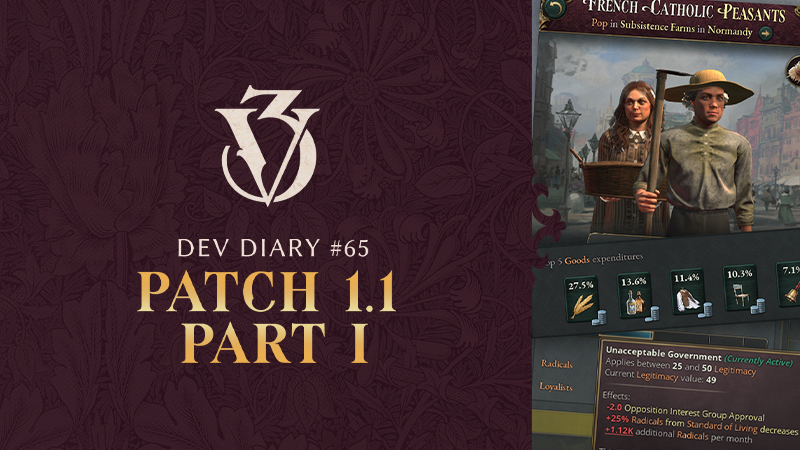
The first of these changes is a rework of the interface for individual Pops, with a particular emphasis on improving the visualization of Pop Needs. In addition to the general overview, there are now separate tabs for Economy and Consumption, with Economy showing a more detailed breakdown of the Pop’s income and expenditure, as well as their top 5 Goods expenditures, and the Consumption tab showing a detailed breakdown of all their Goods expenditures, along with pricing information for the State and Market. We also plan to iterate on Pop Needs further in the future to give you a better idea of what your population needs are country-wide.
The next significant change in 1.1 is a rework of Legitimacy: some frequent criticisms we have received about the political system in Victoria 3 is that Legitimacy doesn’t matter enough and isn’t clear enough about its effects, as well as that elections don’t have enough of an impact. This rework aims to resolve all those problems by making several changes: First, legitimacy, while still a number from 0 to 100, is now divided into five categories with differing effects, some of which will increase or decrease based on the actual number and not just the threshold:
0-24: Illegitimate Government: This government is considered blatantly illegitimate by most everyone in the country. This legitimacy level reduces the approval of all opposition IGs, makes it impossible to enact laws, and generates a steady stream of radicals in increased numbers the lower Legitimacy is.
25-49: Unacceptable Government: This government is generally not considered acceptable to the people of the country. Laws can be enacted, but opposition IGs will disapprove and radicals will be created over time, though in amounts less than in an Illegitimate Government.
50-74: Contested Government: This government is considered to have somewhat shaky foundations. Opposition IGs will disapprove slightly but otherwise there are no ill or good effects.
75-89: Legitimate Government: This government is considered proper and legitimate. Over time a small number of Loyalists will be generated, with increased numbers the higher Legitimacy is.
90-100: Righteous Government: This government’s legitimacy is considered to be unassailable. In addition to generating Loyalists over time, enactment time for new laws is cut in half.
The way you gain legitimacy has also been altered in democracies, with the share of votes (rather than just clout) represented in Government now having a direct effect on Legitimacy, the degree to which depends on the laws - under more restrictive voting systems, Clout can still be more important than votes, but as more of the population becomes enfranchised votes grow in importance and under Universal Suffrage it should be virtually impossible for a government that doesn’t have the voters behind it to be considered legitimate.
Despite being the largest party in terms of Clout, the Whigs alone are not considered Legitimate due to only commanding 47% of the votes in the last election.
Lastly for today, we’ve also made a balancing change to the Church and State and Citizenship laws - previously, the only balancing consideration for these laws was that less tolerance gave more Authority, which we felt was neither particularly balanced nor really a complete representation of the reasons that a country might want to discriminate against part of their population. To try and address this, we’ve made it so that by default, slightly more radicals are created by Standard of Living decreases than Loyalists from Standard of Living increases, but offset this with modifiers on the more restrictive laws that increase Loyalist and reduce Radical gain among the accepted parts of the population - the more restrictive your cultural/religious tolerance, the greater the effect on the part of the population that actually falls within it.
That’s it for today! Next week we’re going to continue talking about Patch 1.1, which as I said at the beginning of the dev diary is planned to be released before the end of the year. We’re also still working on another hotfix (1.0.6) which should hopefully include some late-game performance improvements and other fixes and which we are aiming to release sometime next week.
Patch notes for 1.0.5
- Changed so that Trade Centers cost 1 infrastructure per 10 levels instead of 1 infrastructure per level
Dev Diary #64 - Post-Release Plans
Hello and welcome to the first of many post-release Victoria 3 dev diaries! The game may now be out at last (weird, isn’t it?) but for us that just means a different phase of work has begun, the work of post-release support. We’ve been quite busy collecting feedback, fixing bugs and making balance changes, and are now working on the free patches that will be following the release, the first of which is a hotfix that should already be with you at the time you read this.
Our plans are naturally not limited to just hotfixes though, and so the topic of this dev diary is to outline what you can expect us to be focusing on in the first few larger free patches. We will not be focusing on our long-term ambitions for the game today; we certainly have no shortage of cool ideas for where we could take Victoria 3 in the years to come, but right now our focus is post-release support and patches, not expansion plans.
However, before I start, I want to share my own personal thoughts on the release. Overall, I consider the release a great success, and have been blown away by the sheer amount of people that have bought and are now playing Victoria 3. I’ve had a hand in this project since its earliest design inception, and have been Game Director of Victoria 3 since I left Stellaris in late 2018, and while it certainly hasn’t been the easiest game to work on at times, it is by far the most interesting and fulfilling project I’ve ever directed. The overarching vision of the game - a ‘society builder’ that puts internal development, economy and politics in the driving seat - may not have changed much since then, but the mechanics and systems have gone through innumerable iterations (a prominent internal joke in the team is ‘just one more Market Rework, please?’) to arrive where we are today, at what I consider to be a great game, one that lives up to our vision - but one that could do with improvement in a few key areas.
The first of these areas is military: The military system, being very different from the military systems of previous Grand Strategy Games, is one of those systems that has gone through a lot of iterations. While I believe that we have landed on a very solid core of how we want military gameplay in Victoria 3 to function and we have no intention of moving back towards a more tactical system, it is a system that suffers from some interface woes and which could do with selective deepening and increasing player control in specific areas. A few of the things we’re looking into improving and expanding on for the military system follow here, in no particular order:
Addressing some of the rough edges in how generals function at the moment, such as improving unit selection for battles and balancing the overall progression along fronts
Adding the ability for countries to set strategic objectives for their generals
Increasing the visibility of navies and making admirals easier to work with
Improving the ability of players to get an overview of their military situation and exposing more data, like the underlying numbers behind battle sizes
Finding solutions for the issue where theaters can split into multiple (sometimes even dozens) of tiny fronts as pockets are created
Experimenting with controlled front-splitting for longer fronts
The second area is historical immersion: While we have always been upfront with the fact that Victoria 3 is a historical sandbox rather than a strictly historical game, we still want players to feel as though the events unfolding forms a plausible alt-history, and right now there are some expected historical outcomes that are either not happening often enough, or happening in such a way that they become immersion-breaking. Again, in no particular order, some areas targeted for improvement in the short term:
Ensuring the American Civil War has a decent chance to happen, happens in a way that makes sense (slave states rising up to defend slavery, etc), and isn’t easily avoidable by the player.
Tweaking content such as the Meiji Restoration, Alaska purchase and so on in a way that they can more frequently be successfully performed by the AI, through a mix of AI improvements and content tweaks
Working to expose and improve content such as expeditions and journal entries that is currently too difficult for players to find or complete
Ensuring unifications such as Italy, Germany and Canada doesn’t constantly happen decades ahead of the historical schedule, and increasing the challenge of unifying Italy and Germany in particular
General AI tweaks to have AI countries play in a more believable, immersive way
We're balancing cultural/religious tolerance laws by having more restrictive laws increase the loyalty of accepted pops, so there is an actual trade-off involved.
The third area is diplomacy. While I think what we do have here is quite good and not in need of any significant redesign, this is an area that could do with even more deepening and there’s some options we want to add to diplomacy and diplomatic plays:
‘Reverse-swaying’, that is the ability to offer to join a side in a play in exchange for something
The ability to expand your primary demands in a diplomatic play beyond just one wargoal (though this has to be done in such a way that there’s still a reason for countries to actually back down)
More things to offer in diplomatic plays, like giving away your own land
Trading (or at least giving away) states
Foreign investment and some form of construction in other countries, at least if they’re part of your market
Improving and expanding on interactions with and from subjects, such as being able to grant and ask for more autonomy through a diplomatic action
While those are the major areas targeted for improvement, there are other things that fall outside the scope of either warfare, historical immersion and diplomacy where we’ve also heard your feedback and want to make improvements, a few examples being:
Making it easier to get an overview of your Pops and Pop factors such as Needs, Standard of Living and Radicals/Loyalists
Experimenting with autonomous private-sector construction and increasing the differences in gameplay between different economic systems (though as I’ve said many times, we are never going to take construction entirely out of the hands of the player)
Ironing out some of the kinks with the late-game economy and the AI’s ability to develop key resources such as oil and rubber
Making it more interesting and ‘competitive’ but also more challenging to play in a more conservative and autocratic style
One of the first mechanics we're tweaking is Legitimacy, increasing its impact and making it so the share of votes in government matters far more, especially with more democratic laws.
The above is of course not even close to being an exhaustive list of everything we want to do, and I can’t promise that everything on the list is going to make it into the first few patches, or that our priorities won’t change as we continue to read and take in your feedback, only that as it stands these are our plans for the near future. I will also remind once again that everything mentioned above is something we want for our free post-release patches. At some point we will start talking about our plans for expansions, but that is definitely not anytime soon!
What I can promise you though, is that we’re going to strive to keep you informed and do our best to give you insight into the post-release development process with dev diaries, videos and streams, just like we did before the game was released. I’ll return next week as we start covering the details of the work we’re doing for our first post-release patch. See you then!
Patch notes for 1.0.4
################### # Game Balance ################### # Economy - Petit-Bourgeoisie now also care about government wages - Slashing government wages will now reduce prestige - Slashing military wages will now reduce training rate - Debt slavery can now enslave pops up to wealth level 9, in reduced numbers for each point of wealth - Reduce the max number of pops enslaved each week by debt slavery from 5% to 0.5% of state population - Debt slavery will no longer enslave additional pops when slaves is 20% or more of the state population - Tweak subsistence production in decentralized nations so African pops don't start at starvation levels # Politics - Increased the chance of progressive political movements appearing over the course of the game - Movements to Preserve now have a larger effect on the chance for a law to stall, making it harder to pass laws opposed by powerful groups - Political Movements for or against changes in Slavery and Government principles laws will now be more radical - Reduced base effect of Propagandists Intelligentsia trait from 50% to 25% - Reduced effect of guaranteed liberties on loyalists and radicals growth # Colonization - Native Uprisings now get a significant bonus to their combat capabilities, mainly on the defensive - Reduced the chance of Native Uprisings occuring when provinces are colonized ################### # AI ################### # Diplomacy - AI is now a bit less likely to back down in diplomatic plays - AI is now a bit more likely to get involved in diplomatic plays - Make the AI more keen on swaying countries to its side if outmatched in a diplomatic play # War - AI is now a lot more focused on taking land-adjacent states and conquering contiguous land areas in general - Increase AI aggression against Unrecognized countries after unlocking Civilizing Mission # Colonization - Increased AI tendency to get involved in Native Uprisings slightly ################### # Interface ################### # Tooltips - Improve revenue predictions when constructing buildings to show more accurate and useful data ################### # Bugfixes ################### - Fixed a bug where capitulating in one war could cause your generals in another war to standby - Added additional check to prevent monuments from being targeted in tutorial - Added a check to the Declare Interest Tutorial that was miscounting the maximum amount of Declared Interests possible. - Fix issue where Investment Pool could be used for disallowed building types - Fix issue where predicted price for goods after goods substitution would sometimes show the wrong value - Political movements can now start organizing a revolution at 50 radicalism rather than 100 (100 is needed for the revolution to actually begin though) - Fixed typos in several defines - Fix pop attraction reasons tooltip CTD in Asian languages - Fixed a CTD caused by trying to create a shipping lane between two market areas with at least one of them being only nominally coastal due to the entire coast being impassable - Fixed a CTD that could be triggered when clicking on the "mobilize all" button" - Fixed late game CTD when transferring troops - Fix CTD when hovering sell orders after having country join your market (__chkstk (chkstk.asm: 109)) - Fix CTD in NPdxParticle2Internal::SParticlePool ::GetActive - Fix CTD in CJominiSplineNetworkGraphics::GetStripLengthInternal
Player Resources
Greetings Victorians!
This post has been created to gather useful information for players. Tutorials, Links, and various other resources that both new and old players can use to make their experience easier and more enjoyable.
Where to find the Victoria 3 and Victoria 2 Remastered Soundtracks
Good Day Victorians!
With the release of Victoria 3, you have been listening to the soundtracks of Victoria 3 and Victoria 2 Remastered in-game!
You may be excited to learn that you can access the soundtracks of Victoria 3 and Victoria 2 (if you pre-ordered) in the game files to listen to as you like outside the game! You can find the files by following the paths below:
Path to Victoria 3 Soundtrack MP3/FLAC:
"\game\soundtrack\original_game_soundtrack"
Path to Victoria 2 Remastered Soundtrack MP3/FLAC: