

WarpVector
WarpVector released
We'd also love to hear about your experience with the game and any feedback or suggestions you might have. You can post on the discussions page or join the Forbidden Realm Simulations Discord server.
Devlog - Shipboard Combat
Players have the opportunity to board enemy craft in order to gain control of their ship. One way to initiate a boarding aciton is to matching the position and velocity of an enemy ship, as shown in the screenshot below. There are also some items, such as the Quantum Breach Gateway, that can be used to initiate a boarding action from afar once a ship's shields are down.
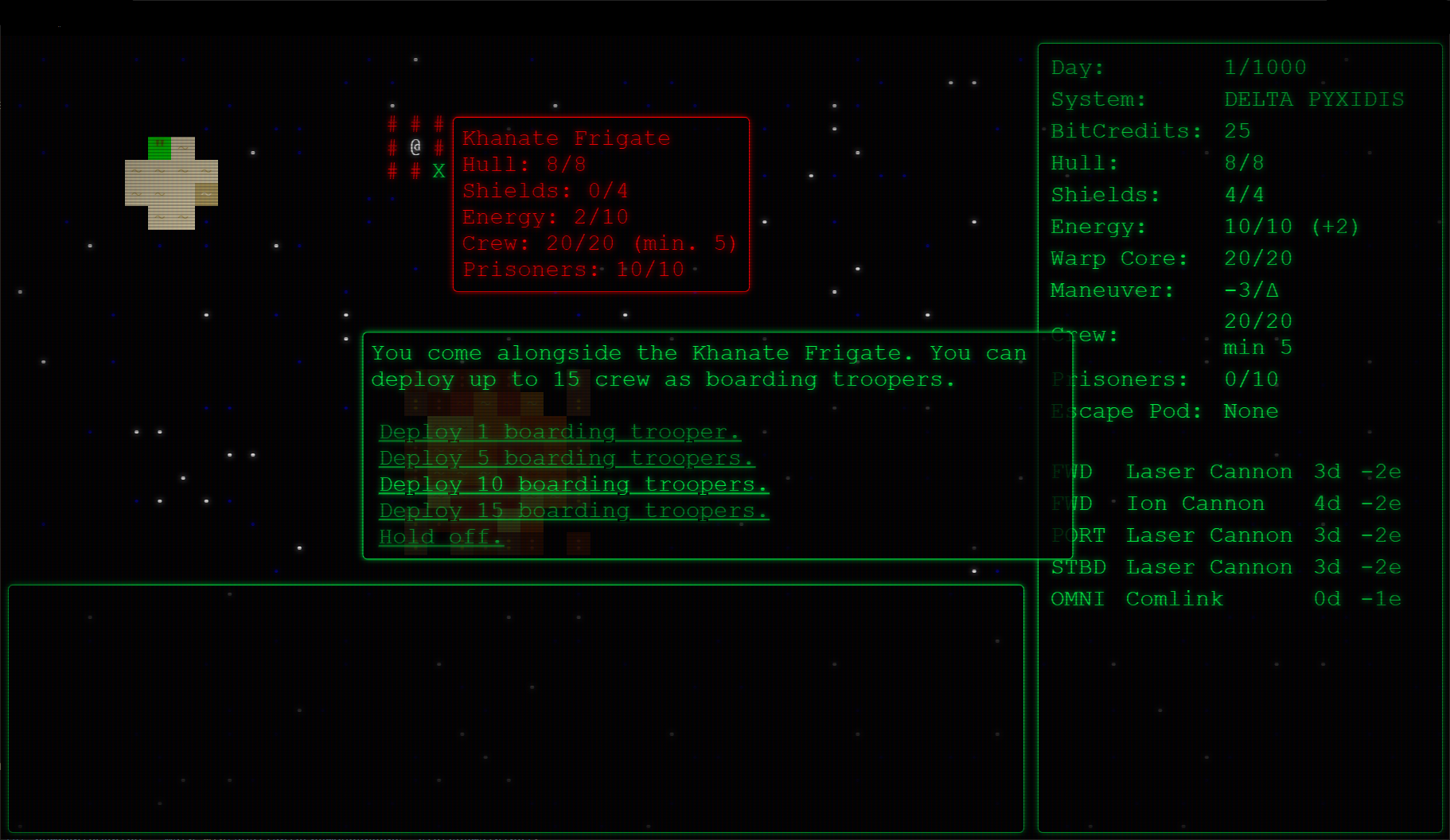
Once the boarding party reaches the enemy ship, they will engage in shipboard combat with the enemy crew. Each turn, the progress of the battle will be printed in the combat log at the bottom of the screen. The player's boarding party must either kill or force the crew to surrender in order to commandeer the ship. Once commandeered, a ship can be given orders using a Comlink just like any other ally. However, in order to warp a commandeered ship out of the system, you will need to pay a fee representing the costs of refitting the ship for long-term use.
But the danger doesn't stop there: enemy ships might also attempt to board the player's ship, forcing the player to defend their own crew in a battle for survival!
We're excited to see how players will approach this new system and use it in combination with other weapons like tractor beams, ion cannons, and the Precursor purification ray.
Devlog - Escape Pods
Once your ship is equipped with an escape pod, for example by purchasing one at a space station, you can launch it at any time. The escape pod becomes the player ship, and any remaining crew will continue operating your original ship. Unlike most other ships, escape pods have no weapons, shields, or maneuver capability. However, they do contain a comlink which can be used to issue orders to allied ships, as shown in the screenshot below.
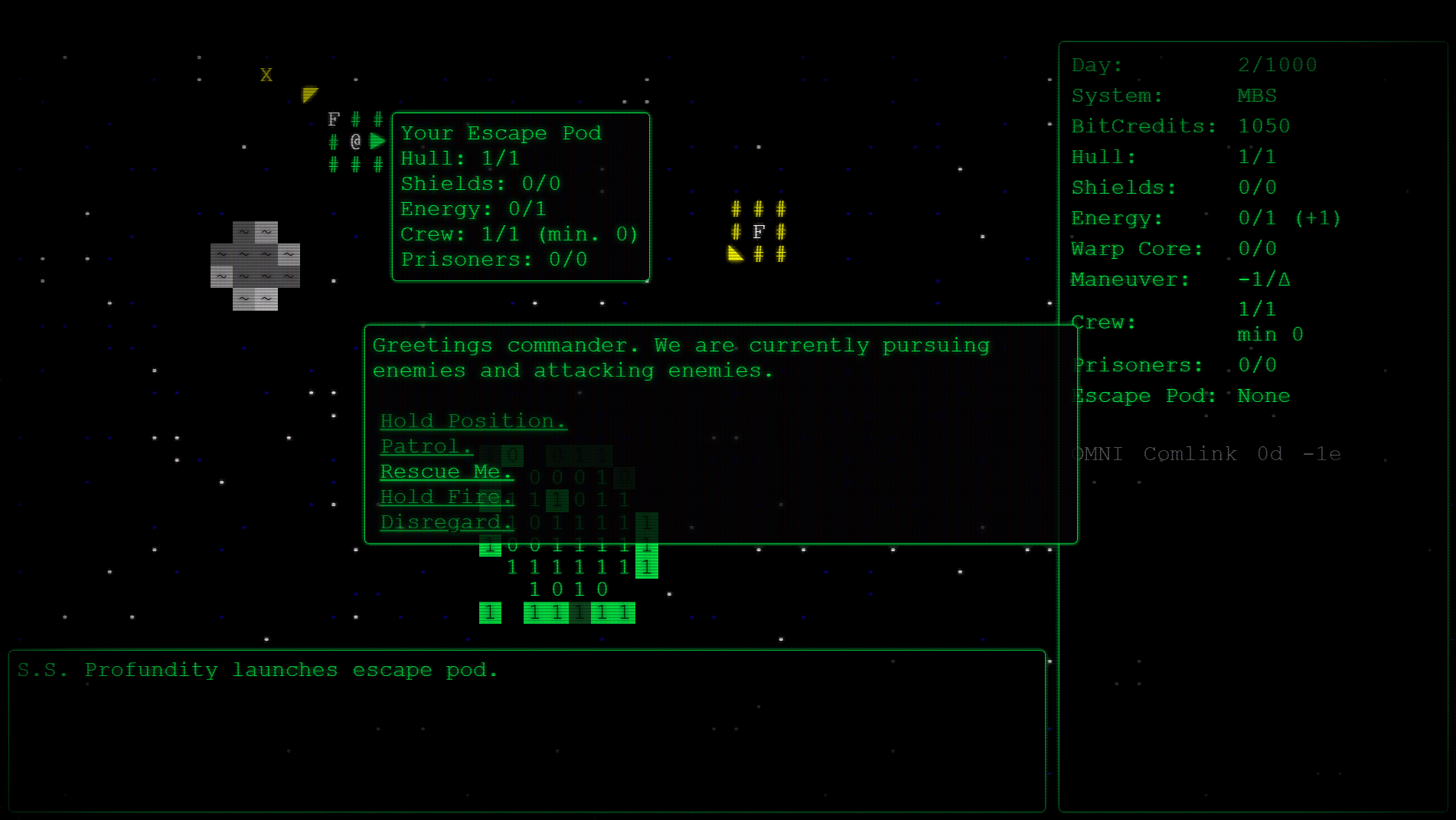
If you order an allied ship to rescue you it will attempt to come to the escape pod's location and match its velocity. (Escape pods are launched with zero velocity relative to the star system for simplicity and in analogy to lifeboats at sea.) The rescuing ship will then become the player ship and you can continue your exploration of the galaxy.
However, if an escape pod is not rescued within a certain number of turns, its life support systems will be exhausted and its passengers will perish. This ensures that when stuck in an escape pod with no chance of rescue, the player does not get stuck in a situation where there is no chance for advancing the game.
The most complex aspect of implementing this escape system was the AI navigation logic for rescuing escape pods. The AI-controlled ships use the same maneuver mechanics as the player ship and so the AI must consider, for example, how much energy must be saved in order to decelerate when approaching an escape pod.
Because they build on existing game mechanics, escape pods can open the door to interesting emergent gameplay. For example, suppose a Khanate frigate disables your engines with an ion cannon, leaving you hurtling towards a black hole. In desperate situations like this, an escape pod can give you some options to use as a last resort when all else fails.
Devlog - Galaxy Map
Each game of WarpVector takes place within a single galaxy, which is a 5x5 grid of star systems. Systems come in various types:
- Civilized Systems usually surround yellow stars, and are home to merchant ships and stations. Though they are occasionally attacked by hit and run pirates, they are relatively safe places to stop and refit your ship.
- Frontier Systems usually surround blue stars, and feature asteroids, pirate stations, and large pirate fleets. They are dangerous areas for new captains, but provide an opportunity to capture vessels, seize new weapons systems, and battle-test your crew.
- Anomalous Systems usually surround quasars, and are home to extremely distorted quantum-gravitational fields. The anomalies in these systems must be surveyed with care, or an unwitting captain could trigger a breakdown of the space-time continuum itself!
- Ancient Systems usually surround red giants, and are host to dead worlds that contain the cyclopean tombs of the earliest starfaring civilizations. Extremely powerful artefacts may be found here, though they are guarded by precursor defense fleets, some of the most deadly warships in known galaxy.
- Ancient Anomalous Systems usually surround black holes, and contain high numbers of anomalies as well as a substantial precursor presence. They are extremely dangerous locations, although they can be highly rewarding to a well-outfitted fleet.
As you travel further from your starting region of the galaxy, Civilized systems become rare, and more dangerous systems like the Ancient and Anomalous types become common. There are also extremely rare systems to encounter that offer unique challenges and rewards, making every run a new experience.
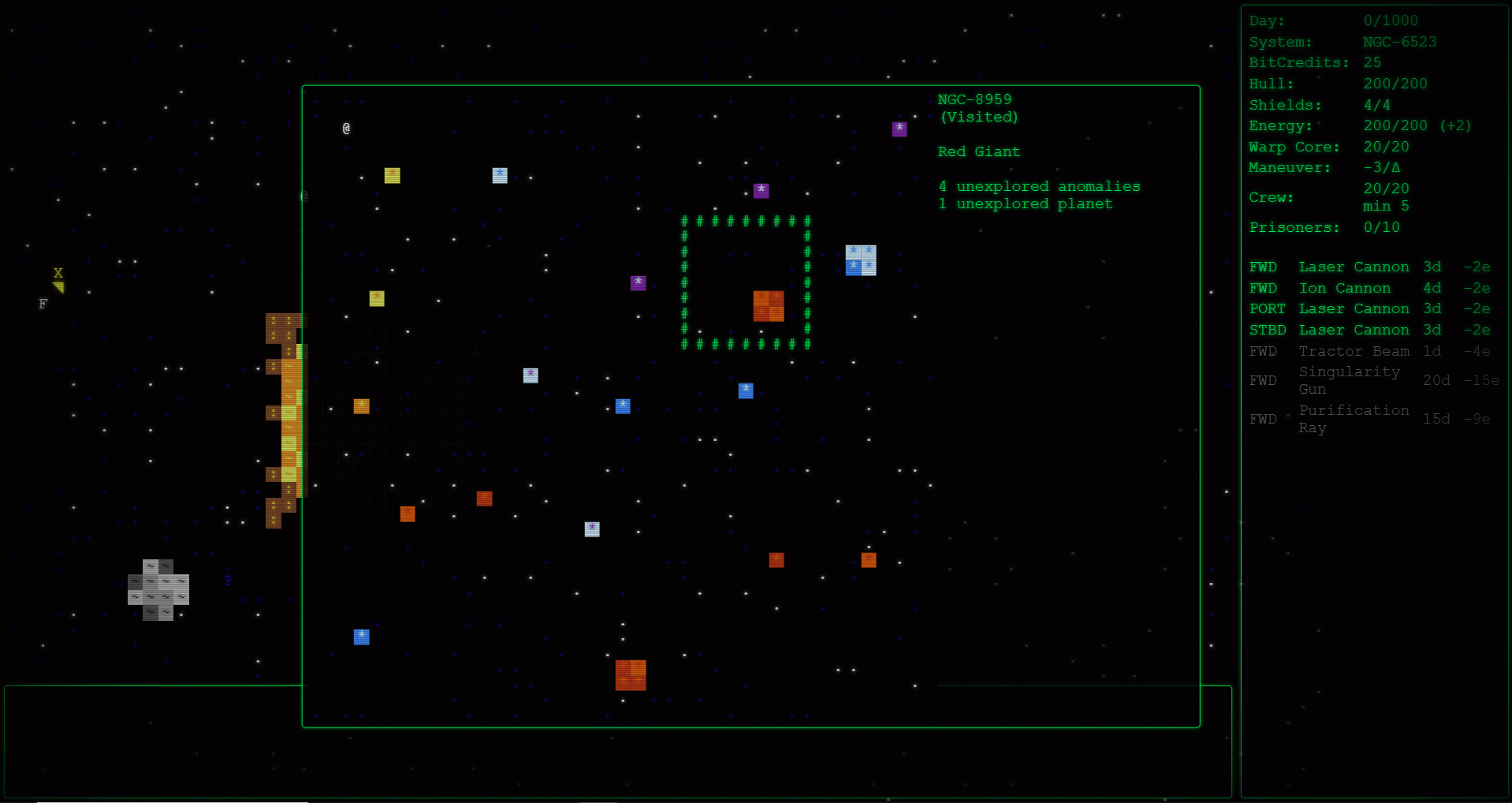
When your warp core is fully charged, you can open up the galactic map view and select a system to jump to. Initially, you don't have warpspace coordinates for any other system, but as you explore you will eventually discover coordinates for more and more distant (and dangerous!) stars.
We are currently overhauling the boarding and shipboard combat system, so stay tuned for another devlog next week. 🚀