Happy Joy day everyone! We hope you are all out there being responsible Wellies.
I know many of you are looking forward to a release date announcement for We Happy Few. We are almost ready for that. However, as you may have noticed, last week we passed the original launch date of the game (April 13). So, after updating you on our launch schedule changes and the reasons why in January, I wanted to take a break from the retrospectives to give you a follow up on how production is doing.
Where we are in the process
The team has been working very hard over the last few weeks, as we begin bug fixing and proper “beta” user testing. The last two weeks have been focused on two important aspects:
On the content and usability side, on Monday Gearbox began a two week playtest for playing through the full game. To get this build ready, we had to make sure that the content was finished (no placeholder content) and no “progression blocker” bugs were present in the game. We finished that up last Friday, and so far so good: no blockers have been encountered, and it looks like players are completing Arthur without too much difficulty! We have been receiving helpful comments on balance, onboarding and how people are using mechanics like combat, stealth and conformity. We also took a day off development to play the game (the whole team), and we have received a ton of great feedback from our team: animators, artists, designers, programmers, we all play differently and it’s important to see things from different perspectives. The next step for us is to review all of the feedback, to then decide what we can realistically achieve before shipping (and what we can’t).
On the technical side, we have been preparing builds for a first round of testing from Microsoft and Sony, to help us prepare for final submission on consoles. It’s the first time these guys have seen the game, so they need to check a range of basic things: for example, does the game use too much memory (and crash), does it display properly on all TVs, does it copy correctly from the Blu Ray, etc. In order to do this we have done a significant amount of optimization work, from art asset optimization to code performance and memory tweaks, and we’re excited to say that the game is now running well on both platforms. It’s even running better on PC, so stay tuned in the coming weeks for updated (and final) PC specs.
In the meantime, the rest of the team has been fixing hundreds of bugs, ranging from conditional progression blockers (eg if I spin around in circles 3 times, and lockpick the wrong chest, I’ll break the game) to minor art bugs (eg a chest is floating 10cm off the ground). In this phase, we prioritize inside each discipline, focusing on the serious and gamebreaking bugs first, then on bugs that cause player frustration, and finally on to cosmetic or otherwise less important bugs. Occasionally we create more - eg when fixing a bug or implementing changes required by optimization or player feedback - but by and large the bug database is reducing at a steady rate. That’s a good sign for release.
Next Steps
The next few weeks are a bit touch and go - the window for addressing feedback and fixing bugs is closing, so we spend a great deal of time prioritizing over and over again to make sure we’re addressing the right feedback. However, we are looking to be in good shape.
The next steps on the production side are getting ready for console submission, so it’s the QA team’s time to shine. We’ll be bringing them lots of coffee over the next few weeks.
I want to thank everyone for all of your comments, feedback, bug reports and (constructive!) criticism over the years. It’s been a huge process for us growing this game, and we’re proud to have had you guys with us all along the way. It’s (almost) time to get hyped.
Thanks for tuning in!
Weekly Journal - Encounters and Questing
Hi everyone,
This week we will talk about the evolution of the encounters and questing in We Happy Few!
We Happy Few began as a high difficulty roguelike survival game set in a urban city, with a story that could be found through small encounters. Like in Don’t Starve, if you die, it was game over. Every playthrough would teach the player something new to get further, and the game was meant to be replayed a lot, and so we planned to have a large number of small, systemic “encounters” that would teach the player about the world.
However, over time, we realised that players were more and more interested in the storytelling and lore of the world, so the encounters had to change into something more ambitious - something that much more resembles quests that you all know and love. This journal tells that story.
PAX 2015
The first version of the game, that had anything resembling encounters, was the PAX 2015 demo. We created the first two encounters for the community to try and find, which if they completed would grant them a key to the game. These were the Odds and Ends shop and the Butcher shop. All the players had to do was to find keys to open locked doors, but they had to navigate a series of environmental challenges to do so. At the time, we thought these would be the largest type of encounter in the game - a single, normal sized, house.
However, this was really it. It was a sandbox demo, so other than surviving in a small procedural version of the Village, the player had no purpose, and there was no goal to the game yet.
Kickstarter
Our Kickstarter in mid 2015 gave some backers direct access to the pre-alpha right after the campaign, so it was important that we gave them something to do. For this version, the game finally had a purpose: escape Wellington Wells. The player would start in a shelter and wake up to a prompt informing him that he was a Downer and had to survive long enough find the hatch and escape the city. While this was just a pop up - a single message that said “get out” - this was the first glimpse of a quest system.
As discussed in previous journals, at this point the game still heavily revolved around a roguelike/survival experience. The exit hatch was located in the Parade District guarded by two Bobbies, and the player had to traverse the Garden District and the Village to get there. Along the way he could find the two encounters from PAX as well as some “points of interest”; smaller encounters that showcased unique situations in the world - think of something like encountering a space station in FTL, although in our world this might be a mad hatter’s tea party. This would give the player some items to help him survive longer, and a small bit of lore. Bridge encounters were also making their debut, to give players new challenges when crossing islands.
Apart from the initial prompt upon waking up, there was no other prompt or text. There was also no saves, so quitting the game or dying would restart the entire playthrough.
Early Access
The Kickstarter feedback was pretty overwhelming - people gave a lot of feedback on survival, but also wanted to know more and more about why the world was the way it was. We realised quickly that we would need to up our encounter game. So, the Early Access launch in July 2016 saw a big change to encounters, as it contained the first encounters that could properly be called “quests”.
To begin, we started with Arthur’s real intro - we did this to help introduce players to the world, because Kickstarter feedback was “I don’t really know what I’m doing”. So, we added the intro, and then upon leaving the shelter, we added a new and fancy prompt indicating the player’s goals, which would then get tracked in their Quest screen. The Early Access “story” ended when Arthur made it to the hatch that would lead him to the Parade District - a temporary ending until the real one comes along.
Once you were in the world, the encounters were much more fleshed out: they all had a developed background story, larger and unique locations,and full on dialogue with truly unique NPCs, all animated. We added a compass, dig spots and dozen of points of interests. We had enough quests to rotate some of them from one playthrough to another, which mean you might not have always gotten the same encounters two playthroughs in a row! We were confident that the game’s story and world was beginning to become what people wanted.
However, we hit a snag: a great deal of feedback from the early access launch came in the form of “I don’t get it, where is the story?” While some of that related to the main story not being present, we also realized that many players weren’t finding our encounters. A prompt would appear indicating a quest had been added to your journal but it wasn’t always very clear where it came from, and most players would just walk on by. For example, Eric “Crazy Legs” Liddel would just run away from the player, meaning Arthur would just talk to himself for a while if the player wasn’t paying attention. If you didn’t spot Eric, none of that would make any sense at all.
The game was becoming much bigger, the player was now able to save and we introduced the second wind option, moving slowly away from the roguelike gameplay we originally envisioned. So, we realised that we had to go back to the drawing board.
The Clockwork Update
The Clockwork update was a BIG one, that introduced a number of technical systems that improved the game on many levels (hence the name!). Due to the complexity of the game increasing, and the early access launch feedback, we had two goals: increase the reliability of our game systems, and increase the visibility of our quests.
To start, we completely reworked the quest and save systems (things that you don’t see in a playthrough, but which affect the stability of your game). This system changes quest tracking from a pure scripting-based system to a code based system, where the game knows at all times exactly where you are in any given quest. This made it much simpler for us to create encounters, because the systems and tools didn’t need to be recreated for each quest, and also much more reliable (because it wasn’t possible to introduce nearly as many scripting errors). We no longer needed to have complicated scripts tracking save/quest/item situations, and instead could focus more on gameplay and making cool things. While you guys couldn’t see any of it, this was a huge change that allowed us to create bigger, better, more complicated, and better realized encounters.
We also added a “puppet” system, which meant NPCs could have highly scripted behaviour, instead of their normal systemic behaviour. The puppet system allowed us to remove their systemic brains and give them specific actions to do, rather than having the two systems fight (which led to all manner of crazy shit). So, NPCs could now do normal game things, like patrol an area, rather than just wander off and do whatever the hell they wanted.
Finally, we introduced “conversation mode”, to address the visibility issue. Upon finding a new quest, conversation mode would now trigger, which means the player would enter a “cutscene” with the NPC in question. This led to a clearer understanding of the encounter as they would no longer just pop up on screen when passing near them (a pop up you would likely ignore). The system also allowed us to better match animation to the VO, and quest givers couldn’t be interrupted by other NPCs, or you, or even themselves. Aka, the game didn’t lose the plot as much anymore, and it was a much more cinematic.
These new systems required us to refactor all our old quests, but we did find time to add a couple of new ones. Throughout the rest of Early Access, these systems allowed us to build newer, bigger and better encounters, and really build out the weird and wonderful parts of our world. We could easily create little points of interest with the puppet show, we could create multi step quest chains with the quest state system, and tell a far better story with our (already delightful) VO and animation.
Current
Today, the game contains the encounters you have seen, plus the story of our three characters (both the main story and new sidequests). We’re almost ready to talk about it - that’s coming very soon now. Hopefully you’ll enjoy what we have to say.
Thanks for tuning in!
Compulsion Games
Weekly Journal - Inventory
Hi everyone,
This week we would like to chat about a topic that was trending a lot during during Early Access, the inventory! In this journal, we will go through the major changes it went through, and explain in a bit more depth why we made the decisions we made. We’re also tackling the holsters and quickslots, as you can’t really have one without the other.
The inventory changed radically to meet the needs of the game as it evolved. As we received feedback from players and changed core mechanics in the game, the inventory and the quickslots needed to adapt to the new designs. This meant that the story of the inventory is a tiny summary of the entire game’s development.
The Beginning
Back in the early days, the game was a lot simpler. At the time, the game was looking like it would be a roguelike/survival game, and so we looked around at systems other games were using (Day Z, Rust, Minecraft etc). At the time, we had relatively short playthroughs in mind - something you could play in a single sitting.
Here is a picture of our very first inventory in 2014 - keep in mind that in early development, programmer art reigns supreme.
In the first version, what clothing you were wearing would determine how many slots you had available to use in your inventory. The jacket above would allow you to carry four items and the pants, eight. Finding a better suit would have unlocked more slots etc. The third slot was for Arthur’s briefcase, which he could also upgrade as you went throughout the game. You could think of it as finding jackets with extra pockets, or suitcases that just got bigger. At the time, all loot was physicalised in the world.
We wanted to be able to use both weapons and items in regular gameplay, so created a holster and quickslot system that you would use both in the inventory screen and in gameplay.
The quickslots were extremely simple, with two weapon holsters and one quicklsot for an item (food or bandage) that you could cycle using your mouse. The quickslot items would be chosen by hand in the inventory and didn’t stack, which was pretty cumbersome. Naturally, we thought it was great.
PAX 2015 - first publicly playable version
By the time PAX 2015 rolled around, our inventory had gone through quite a major change already: a step closer to what we really had in mind. To simplify looting and inventory management, we moved to a single, unified inventory - ditching the fixed slots system for a grid. Clothing no longer gated the inventory size, but instead became fully about conformity and other modifiers (which remains the case to this day).
NPCs, the ground, and chests were now containers - aka loot was no longer restricted to being physically in the world, and NPCs (or containers) could have “inventory”. This was represented in the left panel above - you could open this via looting prompts or by just going into your inventory. We also moved “player menu” categories to the top, as opposed to on the side of the screen.
We still had two weapon holsters, but added an extra quickslot. Throwable weapons had been added by then, and took up a weapon slot.
The in-game quickslot became smaller and cleaner. One for a weapon and one for an item. This horrible programmer art remained in-game for YEARS.
Kickstarter
Progress continued throughout 2015, expanding on the system.
For the Kickstarter playable build, the gating returned not only for the inventory but for the weapon holsters and the quickslots. The player could find expansion kits (briefcases made a brief comeback!) around the game to unlock them.
The survival meters were also now present in the inventory because we didn’t have a status screen yet. The player menu screens are now icons, instead of names.
The quickslots did not change much apart from getting button prompts - we started turning more and more attention to how we communicated things to the player, rather than just building systems (that we already knew how to use). We also added durability for weapons, and weapons could no longer be swapped in the middle of combat, which meant that getting that holster upgrade became more important.
At the time, the game was still supposed to be a relatively short duration. However, once Kickstarter players got their hands on this build, we realised that everything would need to change.
Early Access
Throughout the remainder of 2015 and early 2016, we began substantially changing the game. The community’s response was super exciting, but we realised that a lot of the assumptions we had made were wrong - people were happy with the gameplay but what they REALLY cared about was what kind of story we could tell.
This brought about a very significant change where we started adding a lot of character, love, and story into the game. This also increased the average playthrough/run time substantially.
For Early access, we decided that we did not want the game to pause while in the inventory. Gameplay wise this would add a layer of pressure to the player, for a more hardcore survival experience. After all, we really wanted our game to be about paranoia.
However, not pausing while in the inventory meant that we had to ditch the fullscreen, so we had to make the best out of a limited space. The player could now see directly his survival stats and the time and date in the HUD, so we didn’t need them in the inventory screen itself. Currency was added, so the player could now buy and sell items to merchants.
However, the initial Early Access feedback told us two important things: inventory management was becoming a chore (a side effect of adding more and more craftable items and things to use in the game), and the number of hardcore survival fans in our audience was dwarfed by the number of people who just wanted to be in a cool world.
Nothing changed for the in-game quickslot. However, with the expansion of useable items, the criticisms about inventory tetris applied to the quickslots too.
Life in Technicolour
The current Early Access build (Life in Technicolour) is our attempt to solve these issues, and another huge turning point in the life of the inventory.
By the time this update came out in mid 2017, we had been in Early Access for over a year, which means plenty of discussions with the community had happened by that point. We heard all kinds of feedback about the inventory but one was truly prominent, players were spending too much time in their inventory organizing it. Some loved it - they loved to organize things exactly the way they liked it - but many more players hated it. Inventory tetris just isn’t that popular. We knew we had a choice to make, because the game length was increasing - we didn’t have bite sized playthroughs any more. We Happy Few was looking less like Day Z and more like an rpg.
Based on the feedback above, we felt that players were spending too much time in the inventory instead of the game. So, we bit the bullet and moved onto a weight based system. That makeover was so drastic that we had to make a video explaining it at the time.
https://www.youtube.com/watch?v=2IiP4mBK37w
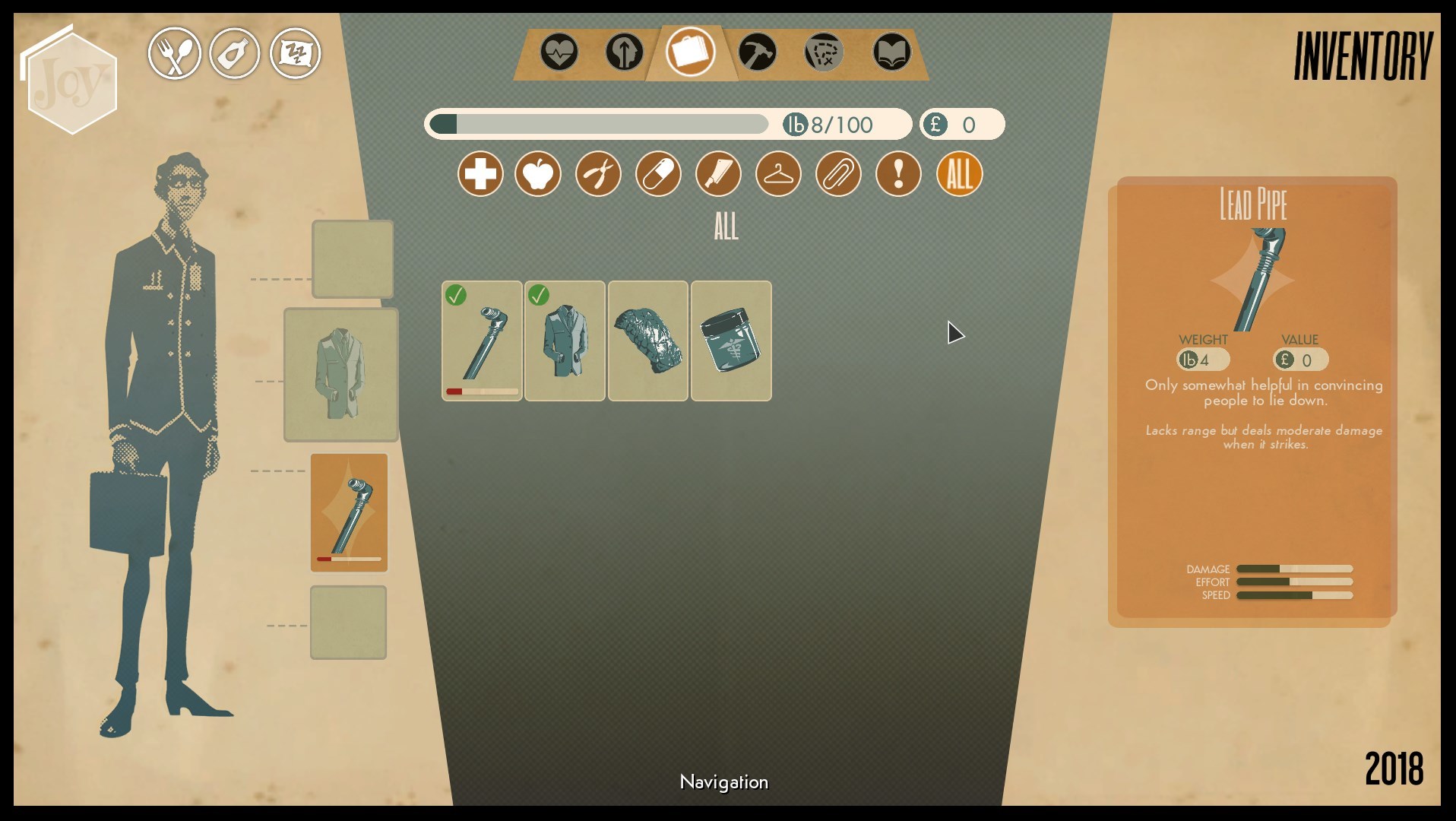
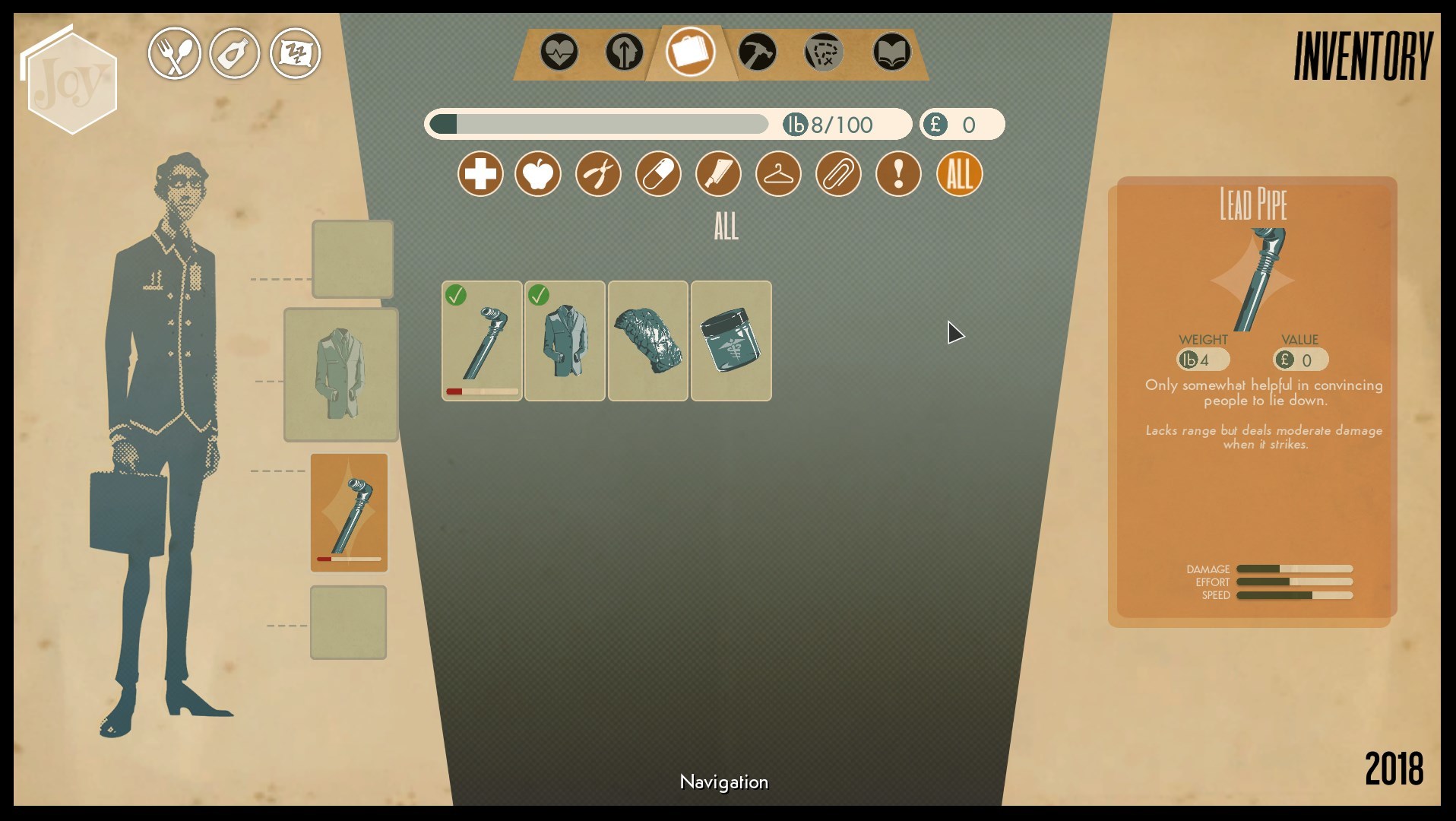
Aesthetically and thematically we finally had time to do what we wanted - it took a long time to plan, but we were happy with it. We added filters to the inventory and now had room for item descriptions, so players could sort their inventory and learn what items were a lot more easily. We were also able to add quest items as undroppable (and costing no weight), which allowed us to avoid a ton of pesky gamebreaking bugs.
The quickslots got their first overhaul in a while. We experimented with autopopulation of quickslots - the top slot would automatically choose a healing item, and the bottom one autopopulated with all tools you could use (and you could cycle through it). We thought you’d urgently need health, but maybe not other things. The weapon slot would also autopopulate with the next weapon once it got broken.
Current
The new system has been the subject of a lot of discussion. Players were frustrated at not being able to see very many items, but otherwise it received a lot of praise. Some players didn’t like the new quickslot system - the health slot was too inflexible and the tool slot was too flexible (too many choices). We have adapted the system to reflect that feedback, and here is where it is today:
For technical reasons, we decided to revert back to pausing the game while in the inventory. While not pausing did bring tension to the game, it also could create a significant number of issues. We realised that restricting weapon/armour swapping would do the job well enough. As a result, we felt like we no longer had a reason to see the game world in the inventory, so we moved back to fullscreen. This solved a few issues automatically, such as the amount of items that could now fit comfortably on screen. We kept the status icons in the top left, but overall we think this is now in good shape - although we may still make some minor tweaks as we approach release.
The most recent quickslot system also had refinement - we wanted to keep the autopopulation, because we believe that convenience is more important here than urgency, but improve how it works. There are now (again!) four quickslots, which are autopopulated and each can be cycled through individually. The categories are healing items, survival (such as food and beverage), gadgets (rocks, distraction devices, and the torch), the last one for Joy and other drugs. These categories are matched by new filters in the inventory, so you can see easily what is populating in each quickslot.
Reviewing all these changes in one place, and tracking why we made the changes we did, hopefully helps give perspective on how game development can change your initial ideas in subtle but important ways. Hopefully, when you play the final version, you won’t think about this at all!
Thanks for tuning in!
Compulsion Games
Discuss this post here
Weekly Journal - The evolution of environmental storytelling
Hi everyone,
This week we will touch on the evolution of environmental storytelling throughout the development of We Happy Few! Don’t worry, this won’t spoil the main story before the release of the full game, but instead will focus on the many ways there are to tell a story outside of cutscenes and the central story, and how our writers extraordinaire, Alex Epstein and Lisa Hunter, approached it as the game grew bigger.
Since our game is procedural, environmental storytelling is key for submerging the player into our vibrant world. It was particularly important during Early Access, because we didn’t want to spoil any of the central story but wanted to introduce the world and its eccentricities. Before we start, let’s define story and narrative: story is what happens to the main characters, narrative is everything that makes you care about the world and its people.
For those of you joining us now, We Happy Few takes place in 1964, in the fictitious city of Wellington Wells, England. In our alternate history, the citizen of Wellington Wells are hooked on a happy drug called Joy, in order to forget a traumatizing event that happened in the past. Living in blissful denial, the Wellies do not take kindly to anyone not taking their Joy, as they view them as a threat to their happiness. We Happy Few is the tale of three people who no longer want to partake in this make believe society.
Inspirations and challenges
British culture has been an inspiration not only artistically, but also in the writing of We Happy Few. There is a parallel between the way our narrative is written and how many famous pieces of British literature are structured. Much like in a Dickens novel or Shakespeare play where a huge cast of characters are all interrelated in non apparent ways at first, but all become connected at the end.
One of the ways the game grew with each milestone (Kickstarter, Early Access etc.), was the addition of quests (or as we have called them in the past, encounters). More quests meant more characters, therefore more lore to expand on and more depth to create - a tree whose branches just keep on growing and intertwining. However, we can only do so much with dialogue - only through environmental storytelling such as notes, poems, newspapers, song lyrics, snippets of conversations, posters and graffitis can we truly communicate to the player the depth of our world. A world is much more believable if you can uncover the relationships, hopes, insecurities, dreams or grudges of its individuals. A quest feels less like a quest when the player’s emotions are involved.
One of the challenges our writers faced was Early Access. We Happy Few was always going to have a core story, and we wanted to try a new approach, creating a survival story based game in a procedural world. However, we felt that that new approach required massive input from the community, hence why we went on Kickstarter and Early Access. But, we couldn’t add any story to our Early Access, as it wouldn’t make any sense to spoil our main story before the final release. Everything is intertwined in We Happy Few and adding lore to the world without saying too much about the main story was a struggle.
Another challenge our writers face is the conciliation of gameplay and narrative. Some gameplay design decisions might not fit at first with the world we are creating, but this doesn’t discourage our writers. There is a rule in improvisation that is called the “Yes, and.” rule. This means that when presented with a new idea or concept, you never say no to it, you say “Yes, and.” If our design director wants a box in the middle of a district that spawns random items, at first this might not make sense to the narrative department. Why would it spawn random items? The writers will not shut down the idea, they will expand on the idea and create a reason for it to exist in our world. As in game, gameplay comes first.
Chronological progression
During the early stages of the game’s development, we did not focus heavily on narrative. Our focus at the time was about creating the story, the characters, and the world lore in general. Not much can be taken away from our world other than it is taking place in a quaint and odd English town with strange folks, a little reminiscent of Hot Fuzz and The Prisoner.
We also weren’t sure yet what we would need to do on this front - as you will see, feedback and enthusiasm from players made us expand our plans on this front .
PAX East 2015 contained the first environmental narrative in the game - a couple of small encounters that contained no dialogue, no written material, but a story told through props and staging. One of these was the first version of the “Odds n Ends” shop, which was locked up, alarm sounding, and no way in - unless you found the secret passage out the back. Inside you found a dark building, discoverable with a torch, and dead bodies strewn around the floor. A story that you could discover through lighting, layout and props alone.
It turns out, players found these parts of the world the most interesting part of what we were building. This was the first indication we had that we would have to expand the story we were telling, and focus more heavily on these moments (and less heavily on a systemic world). So, in the first playable Kickstarter build, Arthur starts with someone else in the shelter, Mrs. Stokes! Mrs. Stokes unfortunately did not stay for many versions but at the time, the player could find a piece of her diary next to her where she would describe her breakdown as she was slowly getting off her Joy. This is the very first note we added to the game, which we expanded significantly after this point. It had voice over acting at the time, from Arthur’s voice actor, but we opted not to do that in favour of a journal based system.
It was also the first implementation of Uncle Jack through the radio and on televisions, which was a huge step forward in setting the tone and the rules of Wellington Wells.
NPCs then also had some barks (voice lines they “bark” at you while you’re walking around), mostly for gameplay reasons to give feedback to the player about their conformity status. However, we made sure these were themed appropriately to enhance the feeling of a living, complete world.
This was also the first implementation of the newspaper. Mostly good news! The Garden District also makes its first appearance with its war torn houses and strange graffitis. The Village now has billboards showcasing Uncle Jack and other propaganda posters highlighting a victorious past or a bright future ahead.
We received a lot of feedback about how these things impacted the world, and worked very hard on expanding this for Early Access. There were two major improvements for the Early Access build: we added Arthur’s intro (the first and only bit of real story in the game), and added more interesting encounters. Arthur’s intro was huge as it gave a lot more context and information about Arthur and Wellington Wells. Redactor articles and Rat pinata aside, Arthur can venture in the offices next to him and find all kind of information about his colleagues, showable in a consistent journal format.
About a dozen encounters/quests have been added to this version, which means more singular NPCs. For example, Johnny Bolton has a penchant for spy movies/novels as made obvious by his “top secret” lair but also by the drawings inside it of different spy techniques.
These encounters showcased the world and the depth of the lore, but we realised very quickly that we weren’t doing enough to draw your attention to them - many players thought there was no story in game, and that was because you could entirely skip over that side quest content (something we would fix and improve as part of the Clockwork Update).
The mailboxes in the Village now also contained letters written by the Wellies. From fan letters to Uncle Jack to conversations between two Wellies, they are great insight into a Wellie’s mind and what they are going through.
In addition, Arthur now has much more of a voice and can speak to the Wellies and Wastrels! He mostly mumbles to himself about the world around him, sometimes wondering about the past, or as a way to warn the player about his survival status, or to point out some gameplay elements such as the fog rising up. We increased the amount of barks NPCs have. Not only will they give feedback to the player about their conformity but they will also mutter to themselves about all kinds of things - many of which are purely about atmosphere and narrative. The Wastrels will mumble mostly about the past and their guilt or how they are starving while the Wellies will remain cheerful about their day.
We also added phone booths in the Garden district. They do not distribute Joy but they are a great place to add posters. Some of them even contain phone messages the player can listen to.
The updates during 2016 expanded on these processes - adding more and more lore, more environmental storytelling, more barks, and more unique situations. However, we also improved what we call “realization” of many side quests. With the Clockwork Update we added several systems that helped us improve encounters - most specifically the “Conversation Mode”, which brings black bars down and allows us to tell a better story inside an encounter. The NPCs have better voice acting, more atmospheric settings, and animation chains that give life to the character. We created a better map that showcased where all of these moments were. All of these efforts seem small, but the Clockwork Update was the first update where people realised “oh there actually is a narrative here!” This was a big step for us, and informed all of our internal story development as well.
During 2017, we mostly increased significantly the amount of content available in the game. We were able to add more interesting characters, that had relationships to each other, without spoiling the main story. We are very proud of that, even if we had to redact a few important pieces of information in the process.
Conclusion
Nothing in We Happy Few is one dimensional. Everything is layered or contrasted, from the architecture to the signs and the characters. If you look at the environment, the old is mixed with the new, the line between what is real and what is fictional is blurred, after all, one of our main themes is the fallibility of memory and denial. You might see a poster representing something but later find a newspaper clip that contradicts it completely. Our game is a satire full of humor, irony and over exaggerations but we wanted our characters to feel like real people with their own stories which is why we have over 200 notes to pick up and 20,000 lines of dialogue.
Our latest word count is north of 200,000 words, making Wellington Wells phenomenally rich in history and interesting people, and we hope that you enjoy exploring it!
Thanks for tuning in!
Compulsion Games
Weekly Journal - A Man’s Home is his Castle
Hi everyone,
In this week’s retrospective, we are taking a look at some of the houses in We Happy Few. As most of you know, the game takes place in the south west of England and more specifically a set of fictional islands called Wellington Wells.
During the pre-production stage of the project, we settled on 1960s England as the setting for the game, and began research on architecture, music and artistic inspiration, and recent English history (as it would have been at the time). Our Art Director Whitney is particularly interested in architecture and atmosphere, and how it contributes to creating a unique and interesting experience. She spent a great deal of time researching architecture (even spending some of her vacation time in a trip to the UK, to understand how the game should feel).
Architecture is an important facet of We Happy Few, but it’s a pretty big topic! So in this weekly, we will only touch on the subject of houses, as along with the Wellies and their masks, creating houses was the first step towards building our world.
Inspirations and early concept
When creating the first concept, Whitney looked in a great deal of detail at the concept of “contrast”, if you’ll pardon the reference, as it was a major theme in 1960s England. It was a time of great social change, where the traditional past clashed with optimism about the future, young culture vs old, etc. We took this symbolism and exaggerated it to fantastical levels all throughout We Happy Few.
We wanted a contrast between different houses, but also between their interior and exterior. Our Village houses reflect the symbolism of rejecting history for an idealistic view of the future, and our Garden District houses contrast with the Village by showing the other side of the coin (it’s not like England was always pretty and mod - only parts of the world were that happy idealistic reality).
The exterior of the Village houses were inspired by two styles, the Tudor houses from The Shambles, York and the stone houses from Haworth. The outside is old, crumbling, historic, and reflects real history. The inside is clean, modern, overly cheery, blissfully rejecting history and looking towards the future. The inside has inspiration from minimalist, mid century designers such as Robin Day and Arne Jacobsen. To maintain consistency, the Garden District houses have similar exteriors, but would have older interiors.
A little note about the stone - it's stained dark grey from the soot, back when england was heated by coal.
First steps
Believe it or not, but a world like We Happy Few doesn’t start out very pretty. The first buildings we put into the game were shells designed to test metrics - something our level designers could look through and figure out concrete things like “how much space to we need to move around, how will the AI walk through the areas with you” and then more esoteric things like “how should these spaces feel”. We started with these houses because in those days, we didn’t anticipate that we’d have anything bigger than a house.
Here is a picture of a very early prototype for the world, which we have never shown before! This is one of the first procedural prototypes.
Most of the houses are attempts to match the level design requirements with the artistic vision - how do we create the thin, terraced houses that we wanted for the art, but also have interesting gameplay areas?
You’ll also notice in the left hand pic the first two early art prototypes. The building on the corner was an interactive shop - the precursor to the Butcher today. The second building from the left is the first “filler” house - houses that we created to fill space, because we didn’t want every house to be interactive, so that the world would “feel” more like a city.
This was a gameplay decision we made because we wanted a sense of scale to the city, but if we made everything interactive, we’d have to make each individual house have much, much less loot (given that loot density is a function of size of the island, and the rough amounts of items we want you to be able to get). You’ll notice that other games do this - if you think of the Witcher 3, relatively few houses are enterable. This is a trick many games use to balance space, size, density and workload (because if we made every house enterable, we’d have to have many, many more variations) required to build a game.
A Familiar Look
Once we figured out the metrics, and felt confident that the spaces and concept would work, we could begin work on the first “real” houses! This is the first step from pre-production into production, as we focused on creating a build for PAX.
We built filler houses, interactive houses, and “shops” for the show. You can see on the left an example of each. On the left is the filler house - houses designed to blend into the background, and not draw your attention. In the middle is the interactive house - lights around the doors to indicate there is something worthwhile inside. On the right is a shop - the first “encounters” in the game, which were designed to be special. During PAX we only had two: the Butcher and the Odds & Ends shop, which both had a small challenge to get inside and unlock a reward. If you found the reward, we gave you a key to We Happy Few, to help us test as we went forward.
Once we finished PAX, we realised that a lot of people were excited about what we were doing. We realised we needed to improve the quality of what we were building, as well as the scope, and our next step was Kickstarter. One of the tiers gave people access to the in-development branches, the first of which looked like this:
On the left is a Village house, very similar to the one in the picture above. However, it looks very different because the lighting in the game dramatically affects the appearance of the 3D art. The Kickstarter build had a very sickly green feel, that we thought was an okay start but wasn’t really what we wanted.
On the middle and right are the exterior and interior of the first Garden District houses! We had realised that we needed a larger environment diversity, so rather than have dilapidated houses in the Village (which had been the initial plan), we created a new biome - an area full of this stuff. You can see that the inspirations are fairly similar, but are abandoned/destroyed as a result of WW2 and neglect. The art of this area was intended to evoke the loss of tradition and history.
Early Access
After Kickstarter, we realised that we would need a significant amount of investment and testing to create the game we wanted, so we chose to go onto Early Access. We knew that the houses would require a big upgrade.
You can see that the style of the houses has remained consistent. However, the quality of the assets and placement has increased dramatically. Hurray! Finally something that was beginning to look good. We added substantial foliage, improved textures, and gave more character to the Garden District buildings (which were lacking before Early Access).
The lighting changes we made also presented this art far better, so that the detail wasn’t lost in the gloom. Overall, we were very happy with how the game looked for Early Access. However, we weren’t quite done yet! One thing you can notice about the houses in the above shots is that they don’t blend in brilliantly with the environment yet - they still look like they’re being plopped in sporadically. So we decided to improve that, along with the ongoing improvement of the house art to match the quality of the other areas of the game (that we have kept quiet about).
Now
And here’s where we are today?
If you’re looking closely, you’ll spot a few changes to the houses. The first is that Village houses now come with alleyways - an improvement we made to allow for better Village hide and seek with the Bobbies, and also more controlled access to the back of houses. We also improved the interiors, with new interior layouts and stealth improvements.
For the garden district, we changed how the buildings were laid out so that they are more like older English cottages, and blend in better with their environment. We added more variation and opportunities for stealth and vertical gameplay.
Extras
And finally, just because we think it’s cool, here are a couple more concepts that we created along the way, to help the artists visualise what things could look like:
Developing the houses was a highly iterative process - a constant balance between scope, ambition, quality, and gameplay constraints. Dealing with that inside the procedural world has been a complicated process, but in the end we are quite happy with the result. It’s unique, and we’re confident that there won’t be anything else quite like it.
Thanks for reading!
Weekly Journal - Joy Retrospective
Hi everyone,
Welcome to our new journal format! As we approach the final release of the game, our weekly journals will be looking back on development, at the evolution of individual parts of the game. Think of the next few months as a gigantic recap on the growth and change of We Happy Few over the past four years.
To start, we chose something that hopefully you’re all aware of: Joy! Why it exists, how it changed during development, and where it is now. For those of you who are just starting to learn about We Happy Few, Joy is the fictional drug that the citizens of Wellington Wells take to be blissfully happy and ignorant of their past. It’s manufactured happiness, in convenient pill form.
Joy: Why make a game about happiness?
When we began development on We Happy Few, one of our core pillars was survival based gameplay, in an urban setting, with a procedural world. We wanted to expand on the traditional survival gameplay (food/water etc) in an urban setting, and one idea was to incorporate fictional drugs into the survival loop - pharmaceutical drugs, not illicit ones. We also had themes we wanted to explore, like memory loss, dystopia and ghosts of the past, and artistic inspiration from 60s culture (eg psychedelics).
Joy was born initially out of the desire to make the narrative and lore of the world more fun than your regular dystopia. The typical vision of a drab, controlled society like 1984 was less interesting to us than something like Brave New World. So, Alex (our narrative director) derived from these gameplay concepts the idea of society obsessed with happiness. If people were obsessed with happiness, we felt like it was because something bad had happened in the past; a trauma that they wanted to forget. The idea was born that citizens would voluntarily take a special drug, Joy, that kept them happy. That way, they wouldn’t need to worry about “that nasty business in the past” as Alex would probably phrase it. This was very organic and took years to develop completely, during which time we iterated on both gameplay and narrative, cross inspiring from both in the process.
We also wanted to incorporate this into gameplay, so that there would be a new mechanic for the community to play with. Because we were building a dystopian world, where everybody wanted to ignore unhappiness, it flowed pretty well that Joy would help you “blend in” with all the regular PCs. That’s roughly how Joy began in early to mid 2014, which as many of you know, eventually became this:
Many of the other aspects of the game have become iconic because of their relationship to Joy - for example, our Downers are very specifically people who have gone off their Joy. So in one sense, We Happy Few began with Joy.
Evolution
The first implementation of Joy was, as most prototypes are, pretty bare bones. It was more important to build the other building blocks of the world, so we didn’t get around to this until early 2015, around about the time of our first demo at PAX East. There was a simple joy pill that you could pick up in the environment, and use either in your inventory or in a quickslot. When you did this, a small meter appeared on screen, which reduced over time, and while active allowed you to conform a little bit. That was it!
However, we had bigger plans: over the year since coming up with the idea, Joy had become something that also altered your vision, to make the world seem a happier place. So by the time we launched on Kickstarter, Joy came with visuals that made it very clear when you were on Joy, and off Joy. We also needed to have a negative aspect to taking Joy, otherwise it was overpowered. So, we developed the concept of a Joy cycle, including a crash, which would be more intense the more Joy you took.
So, this was a start, but several issues became obvious very quickly:
The visual side was the easiest, as it evolved naturally alongside the world. For example, this was what it looked like on Early Access launch.
However, the gameplay side took a bit longer than we had hoped to iron out. It became a challenge to balance how drug dependency worked in real life versus in the game. During Early Access we did develop two important additions: the withdrawal and overdose states. Crash became the very long term side effect of prolonged Joy use, and withdrawal the short term side effect of “coming down” from Joy. Overdose limited your abilities in game, but only happened if you took too much Joy in a very short time. One thing we did do was change the prototype bar into a status icon:
A surprising element that became clear over time was how the community spoke about Joy. In addition to the community’s enthusiasm for all the silliness surrounding Joy, some feedback was from a more sober angle (pardon the pun). We had several people write to us explaining how they saw Joy as a representation of modern antidepressants, which helped them think differently about their depression and issues they were going through. These comments appreciated how we were discussing issues like mental illness, or prescription drug abuse, or even less overt issues like the “facebook culture” of always showing the “best side of you”.
As developers, we want games to be fun or engaging. However, occasionally we stray into real world topics, and when we do it’s important to treat them with nuance. So, treating the concept properly, while still making an interesting mechanic, was constantly on our minds throughout development.
Current Version
As many of you who have played the Life in Technicolour Update will know, that final Early Access update was focused on Joy. We wanted to amp up the visuals, including by manipulating more of the world itself (and not just the lighting), and by making the positive and negative stages more visually distinct. We also changed the audio to give a more hallucinatory experience, eg Wellies laughing when they attack you (if you’re on Joy). This led to the final version of the Joy visual effects:
We also wanted to make sure the transition itself was suitably interesting:
At our current stage, we have (finally!) settled on the Joy mechanics, and in particular we have finalised the lore reasons and mechanics behind the long term side effects of Joy on the player characters, which we’re very happy about. “Crash” as a concept made some sense, but not in the way we wanted. We now believe Joy makes sense within our world, and properly fits as a unique element of the game. Without wanting to give away too much, this is the final Joy HUD icon in various unordered states, which we hope you like:
We’ll leave it to your imagination to figure out how this will all work for the final game.
Conclusion
Joy remains a core part of We Happy Few, and there’s a lot more to it than what we’ve mentioned here. During development, we have seen a great deal of enthusiasm for Joy (maybe a little too much for some folks…), and we hope you will enjoy it in the final version.
So, that’s it for our first retrospective! If you are curious about a specific part of how the project or the studio have developed, let us know. We’ll do what we can to respond.
Thank you for reading, and don’t forget to take your Joy.
Compulsion Team
Weekly Journal - Last journal as we know it!
Hi everyone,
In 2015, a few weeks before we launched our Kickstarter, we asked ourselves: if we were going to try “open development”, what would be the most important thing to help build a good, lasting relationship with a community?
For us, it was open, transparent and consistent communication. Since June 2015, we have posted an update every Friday, taking breaks only for Christmas holidays. An update about what was going on in the project, the studio and a short note from different members of the team about their work that week. We wanted to introduce you to our team, so that you’d know who we were, and could see the challenges we faced, and our hopes and dreams for the project. We hope that you have enjoyed being here with us, and have enjoyed hearing from members of the team.
Today we sit at a total of 145 updates! We didn’t anticipate that we’d have that many - we thought we might get to 50 before launching the game. How things change, eh? It is pretty funny going back and reading the very old entries, as you can witness all the changes the studio and the project have undergone. We have posted each one on Kickstarter, open to the public, and now we have this fascinating time capsule to look back at.
A few weeks ago we announced that we would change the format of the weekly journals. This is because work on content has slowed down, and everything at this point is mostly bug fixing, optimization, or a spoiler. So instead of having the regular format, we are going to look in more depth at specific parts of the game, focusing on how it has evolved throughout development!
Every week we will touch on an area of the game and show some old and new screenshots, what was the original design, what decisions we made and the final(?) results.
So here it is, the last weekly as we know it! If you want us to speak about the evolution a particular topic (crafting, UI, combat, art, etc..) in the new journals, feel free to let us know! And if there is a specific team member you want to give a shout out to, now is the time :)
Thank you, as always, for reading.
Design Team - David, Hayden, Antoine, Adam, Ben, Eric, And Benji
Eric
This week I finished up one of the new bridges for Arthur’s story. In addition to that I spent a lot of time polishing the first two hours of the game; mostly things that help teach people the mechanics of the game in a smooth and fun way. In addition to that I sort of floated around between a few other maps polishing specific target areas to make these levels overall better by polishing out the stuff that wasn’t great. Plus I saw a bug that Remi swears is a naming convention bug. Either way it turns NPCs faces into a Tim Burton nightmare. It was pretty awesome. I say ship it.
Also, tata for now! It’s been a fun year for me here at Compulsion. Starting out on creating side missions, then working on the core Arthur story missions, bug fixing, rejiggering things based on feedback, and making some spreadsheets. I do love those spreadsheets. Thanks, and hope you guys love this game as much as we love making it.
Adam
I’ve added a lot of polish to the Mad Scotsman. There have been main blockers, conditional blockers, nice to haves, “necessaries but can ship withouts”. There’s also a lot of “Hey, it would be awesome if you could this, Adam!” …. Yeah, I agree… you’re right. Will not fix, no time. Also, it’s fun to see Sam stress out. When most people are stressed, you see a vein on the forehead.. But not Sam. His face remains calm, but his beard starts twitching. Most fucked up thing I’ve ever seen.
On another random game note, we had these things called “AI decorators” which were just supposed to spawn some random NPCs doing random things to make the world interesting. Turns out it was this evil system that just duplicates characters whenever you try to move it or delete it. So at one point, I think I had 50+ characters trying to look in the windows of the pub.
Antoine
What’s up everyone ?! I’ve been spelunking here in the caves of Unreal. It’s very pretty in here. Lots of colors and wires going everywhere slowly building up a world (that doesn’t sound pretentious at all pfff). So, little update on the Miss Thigh Highs aka Sally Boyle ;). She’s going well but let me tell you that her playthrough has being reworked and reworked and rejiggered to the point where I feel confident we got something that feels right. The bulk of the rework I’ve been doing is making sure there’s not too much unnecessary back and forth between quest locations. I’ve been working on a pretty hilarious scene where Bobbies are singing to Miss Boyle as a token of their appreciation for one of her accomplishments. Another cute thing I’ve done for Sally is that she now has a special table in her house that enables her to play music whenever she wants.
Hayden
Well hello there, folks, how the hell are you doing? It’s good to be back for the last full team community weekly.
I’m rarely seen with the other LDs these days, as I’ve been spending most of my time in the Parade District, with my pinky finger up in the air as I sip on tea (and occasionally whiskey) with some of Wellington Wells upper crust; discussing new scientific discoveries, listening to Uncle Jack broadcast, and not to mention, trying on new clothes at an undisclosed location (still a bit too pricey for me) and window shopping at the Market.
And despite some of the absurd rumors you may have heard going around; a disruption in food, and disruptions in motilene supplies and Joy, and even talk of a god damn quarantine; I’m not concerned at all.
I have a basket full of joy and I’m on the right side of any gate that comes my way. It’s totally safe in here… And it’s always a lovely day for it.
Animation Team - JR, Rémi, Vincent, Mike P, Jules, and Raph
Jules
Hi! This week I finished the takedown of Sally for all of the NPCs! Basically, to be able to perform a takedown when playing as Sally, you need to craft a syringe. The animation of this takedown is shorter than the takedown from Arthur.
After this task, I moved to the famous Jolly Brolly! As you know, if you have preordered the game or have backed us on Kickstarter or Early Access, you will receive this fancy weapon! You will be able to shove the NPCs with style. That's it for me this week. Thanks everybody for your comments during all these weeks, I really enjoyed reading them.
MikeP
Sup folks! This week in the amazingly exciting land of the animators, I have been busy making little interactions. A surprising amount of them actually. Also posing a few dead corpses along the way. I kinda feel like the Swiss Army knife of the animation department this week, as I have many tools, people generally forget me in a drawer till they need the corkscrew or that screwdriver bit that doesn’t actually properly fit the screw your trying to tighten and then completely strip before you give up and drink that wine you just opened, in defeat. So actually maybe not completely like a Swiss Army knife, except for the wine drinking part. Anywho, here’s a picture of a guy that probably didn’t die peacefully in his sleep.
That’s it for me this week folks, tune in next week, Same Bat Time, Same Bat Channel! Actually, that’s not true. Apparently this is my last personalized post, so… As Edward R. Murrow famously said: “Goodnight, and good luck!”
Vincent
Bonjoir! Mostly organizing stuff this week, trying to make sure nothing gets forgotten and the playthroughs have all the anims we need! Sounds a lot like ‘not getting actual things done’ (to me too), but important nonetheless. Among all that task writing and bug fixing, we joined a bit the optimization front by compressing thousands of animations. Whoo! That was easy.
As to not disappoint for the last ‘up and personal’ weekly, let’s leave on an extremely exciting note: I’ve started working a bit on having the first person hands not clipping inside the surrounding geometry. It’s just quick tests, but we should not be the shame of the whole industry when the game’s out! See if you can spot the subtle difference:
Well, it’s been a pleasure, seeya in the new weekly format next week maybe!
J.R.
Hi! You wonderful people you. Remember me? This week marks the last traditional weekly, as we'll be moving to a cool new format until release. So I'm sneaking out of my secret-stuff hole (that didn’t sound right) momentarily to say one thing... thank you. Thanks to those who have been there since the beginning, and those who came by and said hi when we were at PAX. Thanks to the fans who kept sending nice mail and sweet, sweet art to the team. Thanks to the new blood, the fans who came around to support us over the years. Thanks to the guy who noticed that my "lost NPC" animation looked like Vincent Vega at the intercom. Thanks to the youtubers that reacted to our trailers, for some weird fucked up reason I can't get enough of these. Thanks to the guys at IGA for bringing the booze for Fridays...
So many others, but all in all just thank you. I wish I would have been able to show you more of my work in the last few months, but I reckon the rest of the animation team did a great job of keeping you guys informed. In the meantime, I'll move back into my shroud of secrecy and hopefully when the game comes out, you'll be enjoying the cinematics at least a little bit! Much love, bless you all, and don't be a downer.
QA Team - Lee, JP and Stephanie
Lee
Hey everyone. I haven’t posted in awhile as we’ve been very busy locking down the build and making sure we’re in a good place for our submissions leading up to 1.0. This has involved creating loads of test cases and making sure they’re up to date with the latest design. These test plans help us and our friends at Gearbox ensure the game is as bug-free as possible before release.
There’s a whole lot of game here compared to the early access release and we can’t wait to show you all the amazing additions the team has been working on when we launch later this year.
Jean-Philippe
QA is gearing up for the final few phases of testing. This involves creating a lot of test plans to cover pretty much everything in the game as thoroughly as possible. Test plans to cover Stealth, Combat and Encounters have been created, among others. There are still many test plans that need to be created in an effort to help polish the game.
Some verification on ensuring consistent WorldGen was also performed. Ended up with a rather fun bug where Wastrels will fall down the very steep road incline.
Art Team - Whitney, Emmanuel, Tito, Marc-André, Sarah, Guillaume, Cary And PH
PH
It’s officially optimization time! Yeahhhhhh… (sarcastic voice). There’s so much to be done in the art side. But we want to give you the best experience possible and optimization is one of the great pillars of a good game. So I’ve just started to review some levels trying to decrease the numbers of assets. It’s huge! There are thousands and thousands of assets in each level. It will take a while but definitely nothing impossible.
Sarah
Dang, gang, this is it!! The last couple of weeks, Clara, Michael, and I took on some MAAAAJOR major HUD overhaul, and I think you guys are going to love the improvements. It's way more readable, whether you’re alerting the suspicion of NPCs, trespassing, or dying from something unpleasant. There's also a dippity dope new visual way to track your Joy intake (I'm especially excited about that feature!) The HUD is sleek and minimalist, with all the information you need to navigate, without being a complete eyesore. I mean, I hope it is, that was the goal anyway. In addition to these exciting changes, I’ve been polishing existing assets, making the last of the pick-up item icons, and making the odd scribbly sign.
I'm going to miss these updates. It's been such a privilege to share this journey with you, and I can't wait for you guys to play! Ta ta for now
Carylitz
I spent some time doing small levels and fixing small tasks, a little bit of everything really, having some fun here and there! Unfortunately I have nothing substantial to show this week, but it’s been a pleasure showing you guys some of my work for the past 2 years. Also, have you ever noticed that sometimes the name of the team members would be in spanish? It was me all along! jajaja
Engineering Team - Matt, Serge, Michael, Lionel, Rob, Evan, Maarten, Céline, Neil And Guillaume (Sometimes)
Lionel
I would like to quote something from the Big Lebowski here but nothing comes to mind. Anyways, this week the work continues on curved roads.
There are a tons of constraints to respect if I don’t want to break the game but it is getting there. I am also working on shortening the bridges between the islands. The new placement system for the islands put them a bit too far from each other, so I am adding a compression pass to make them closer. After that, it’ll just be bug fixes until release!
Céline
Hi everyone. From now on, it is going to be full-time super fun bug fixing! Gotta fix ’em all! The game is coming along nicely and it is very different from the early access version (for the better). Please look forward to it, I cannot wait to hear your feedback when the game releases!
Michael
Things continue HUD-ing in the right direction, but seriously now, the HUD is really starting to look pretty cool. We've got a solid design where all the elements are fitting well together stylistically, or at least that's what the artists tell me. My favourite thing about working on the UI and HUD is the design element of working out what information is useful to let a player know, when you need to know it, how urgent it is to make you notice this before you get in trouble and how important it is relative to the rest of the information being presented to you.
For the HUD we did a good job of feeding these questions through many members of the team to make sure we captured all the issues, and then took those requirements to determine how things should look and be represented. It was a good process, I like good processes.
Anyway, It’s still all coming together, and looking better everyday, Thanks for reading!
Serge
Hello world (I never get tired of that line),
There's a system in our game that we call 'Point Of Interest' that is used to keep the NPCs busy when the player is not a threat to their happiness. They are meta data placed in the level by the designers, with the animations and the archetype it needs to be started! This mechanic has evolved a lot during the development and we started observing some conflicts between archetypes who were trying to do the same tasks, so I spent the week understanding all the dependencies and refactoring the code to make it more robust.
That's what 'bug fixing' is all about: finding the gaps in code logic that came from initially prototyping a feature, and then adding more and more specific environments or interactions to that feature that needed custom support during the game development. I hope you enjoyed our regular updates; I really enjoyed the feedback we received from you.
Maarten
Hey guys! Last weekly in the current format so one last report from your humble engine-coder-in-the-shadows. We're hard at work prepping a build for the first PS4 TRC sweep. That means we have to abide by a whole set of rules Sony provides, and entails a lot of different tasks: we're preparing and testing PSN trophies, getting all the package details right, hiding our debug menus, fixing localization issues and last minute PS4-specific rendering bugs, updating the PS4 SDK we build against, removing debug libraries linked in to our package, ensuring safe areas are respected etc etc. So yeah, a hell of a lot of i's need dotting. Luckily QA gives us great support in flagging any potential issues, and based on our Jira, we're almost ready for that first sweep!
Thanks for reading, I hope you guys liked these weeklies, and I hope you're all looking forward to the release as much as me! See you then!
Narrative Team - Alex and Lisa
Alex
Well, we have had a first stab at finishing voice recording, and then a second stab, and now we are onto Elevensies. That is to say, I have three more recording sessions lined up, and then we really, truly will be done recording. Unless it turns out we have to do some more later.
I had an amazing session with [redacted], who plays [redacted]. She’s become a really superb voice actor. Also, Allan Cooke, who plays the Mad Scotsman, and the translucent as-yet-I-think-still unannounced [redacted] who plays Sally.
I’ve just finished editing a slew of audio flashbacks for the Mad Scotsman, which will reveal all sorts of interesting things about how he got where he is now. Have to figure out where to put them in the polymorphing geography of the game.
And I’ve been trying to help the localization folks, who need to know what “Awa an bile yer haid, ye weapon!” means, so they can translate it into other languages. Google Translate does not seem to cover Scots, alas (it’s not the same as Scots Gaelic).
Production
Sam
Adam is just jealous.
As the producer on the project one of my most important tasks is to keep us focused on shipping. We can build and build and build, but at some point we have to start tightening, and be content with what we have. I am very proud of the team’s progress on this front, as we have been very efficient with the time we have had.
Another part of my role is to play cheerleader for the team, and support them through to the finish line. While this isn’t directly related to the game, as part of this, I fully shaved off my beard at the end of October, and since then have been growing a “shipping beard”. I occasionally trim the sides, because otherwise I look like an old toothbrush, but the length will stay growing until we ship this game.
We’re all in this together. I hope you guys have enjoyed reading about how we have created We Happy Few! We’ve certainly enjoyed having you here.
Thanks for tuning in!
Compulsion Games
Editor's note (aka Capt Scarlett/Naila): This is silly but this hits me harder than I would have thought. For 2.5 years, every Friday, I've been pestering team members to write something for the community. Having this personal link between the studio and the community was truly special <3
Weekly Journal - March Hare
Hey everyone,
Things are very busy in the studio right now. We are continuing polishing and wrapping up the final content. We received some very interesting results from the playtests and have decided to do some last minute changes. We cannot wait for you to see it all!
Narrative Team - Alex and Lisa
Lisa
You know how, when you take a trip, no matter how many lists you’ve made, you always remember something you SHOULD have packed after you’ve arrived at your destination? This week has been sort of like that. I’ve been going back through my “suitcase” of environmental narrative and adding signs and small details for clarity. I’ve also gone through the last bits and bobs of certain characters’ dialog, because we’re approaching the last recording sessions. Hopefully I will have packed everything you need for your journey to Wellington Wells!
Design Team - David, Hayden, Antoine, Adam, Ben, Eric, And Benji
Adam
We are 1 week away from complete content lock on the Mad Scotsman. It has been a bit hectic, considering the many many ideas flying back and forth right now to fix or tweak situations. Ultimately, “time” has the final say, so simple is best. That said! I’m super proud of having lead the entire Mad Scotsman playthrough, and I’m pretty damn sure you’re all going to think of him as your favorite ;p
Eric
This week has been a very productive week I think. First half of the week was polishing off levels, but about mid week we got some great feedback from a playtest we held a little while back so I went straight onto fixing that. Smoothing out the intro of the game and making sure our crazy world is understood and as clear as it can be.
Engineering Team - Matt, Serge, Michael, Lionel, Rob, Evan, Maarten, Céline, Neil And Guillaume (Sometimes)
Lionel
This week, I worked on making the roads less straight. Breaking the sightline is one of the ways to make the Village and the hamlet more organic. So our city/village/hamlet generator had to be extended. It looks simple in theory but as they get packed with content, it is as you can imagine, harder in practice. Only the parts of the roads that are connected to non static houses can move. It is not finished yet but it looks promising.
Serge
This week for me was all about support and bug fixing tasks related to a paradigm that we use for performance. What I mean by that is there's non-playable characters whose brain is reduced to the bare minimum until the player interacts with him. The challenge was to fix conflict between the different piece of code that call for animations on these characters. Reusing code allows us to prototype the feature faster but once the data has been created we discover edge cases that need to be supported (like a paired animation of lovers on a bench for example). That's it, polish and bug fixing until we release the game!
Art Team - Whitney, Emmanuel, Tito, Marc-André, Sarah, Guillaume, Cary And PH
PH
This week was full of little tasks for me, but I worked mainly on the different suits that you can craft. I refined the textures, reworked fabrics and patterns and added some details (stitches, buttons, seams,etc..).
Carilitz
Had a break from small stuff and got into some level art for some days! It was a rollercoaster of changes, trying to achieve the perfect feel for one of the last levels. I can't show it but, if you ever get to the end of the game you’re gonna be able to see it :D. Beside that, I have been also doing small fixes here and there like the past weeks.
Marc-André
Optimisation, optimisation, optimisation. Been grating away polygons of the buildings of the last biome. Saved a good 5 million triangles… out of 91 500 000. Also been helping Emmanuel with the refactoring of the wilderness area. We are moving the encounters closer to the streets which helps reduce the size of the islands and make them less hidden so they scream “look at me” to the player.
Animation Team - JR, Rémi, Vincent, Mike P, Jules, and Raph
Vincent
This week has been mainly filled by reviews! Lots of meetings with people from all the departments, looking at whole playthroughs (with some cheating in the middle, that game has got quite big!) and taking notes of what’s left to tackle… There’s still quite a bunch of stuff. Panic! Erm. I mean, everything is 100% under control, nothing to see here, move along! In between reviews are the usual feedback, and sometimes even a bit of animation! I started work on a funny animation for our beloved Bobbies!
Also, I went back a bit on the giant Mother TVs, as we now need them to track your altitude, which I didn’t plan for back when I scripted/animated it! If some of you are interested, it now uses a 2D Blendspace, which blends 4 different ‘idle’ animations depending on the relative position of the player!
MikeP (AKA: lesser danger Mike)
Sup folks! This week in the thrilling life of an animator, I made a bunch of little cutscenes for the game. One of which you can see in the gif. Dropped those rocks like it was no one’s business! Plus got some cool VFX from our VFX guy Weili to finish it up and voila! Some rock falling goodness! Sweet falling rock, eh! Also did a few little animation chains to round up the week. Nothing terribly exciting, but productive nonetheless! Well that’s it for me this week, tune in next week, Same Bat Time, Same Bat Channel!
Jules
Hi everybody! So for me this week I started on the soldier’s animations and in particular their search animation. Here is a gif of it.
During the rest of the week, I switched to a super exciting task, Sally’s stealth takedowns! But it is still a work in progress. I might be able to show you a gif of it next week, if the censors allow it. See you next then!
Thanks for tuning in!
Compulsion Team
Weekly Journal - Moderately terrible people
Hey everyone,
This week, the team continues on final content integration and the beginnings of polish and bug fixing. We have received the results of the playtest from two weeks ago, and are really happy with the improvements we have made, particularly on the onboarding and the comprehension of Arthur’s story. The extra time we have spent on these aspects of the game has really paid off.
That doesn’t mean we’re done, though. We have a list of issues to deal with on this front, so as we finish up the content, we’ll also be tweaking things here and there to respond to the issues raised. Playtests are so important, and we’re very glad to have the team at Gearbox here to help.
Narrative Team - Alex and Lisa
Lisa
As part of finishing the game, Alex and I are running around trying to make sure that we have everything written that we need.
This week, I’ve been writing “pensive barks,” which are things our characters say to themselves while you’re playing the game. The idea is to give you a deeper sense of who the characters are and how they feel -- without having to stop the action for a cut scene. With Sally, pensive barks are a fun challenge, because the face she presents to the world isn’t necessarily the same as how she feels inside.
The danger is that we have promised you characters who are “moderately terrible people,” so I have to avoid falling in love with characters so much that I make them too good.
Design Team - David, Hayden, Antoine, Adam, Ben, Eric, And Benji
Eric
The level design team is a collection of busy bees this week, integrating, fixing and finaling the level content we have in the game. That means a lot of polish, but also a lot of meetings to review the content we’re finishing up.
As for what I did this week, I fixed some Arthur main story bugs and blockers, worked with Alex to make sure VO and narrative was both present and made sense, and the rest of my time I spent finishing some levels that came in late and just weren’t fully finished. Plus I got to hook up a sweet Arthur shower scene. So that was fun!
Engineering Team - Matt, Serge, Michael, Lionel, Rob, Evan, Maarten, Céline, Neil And Guillaume (Sometimes)
Michael
We've been working on upgrading the HUD elements. Some of it is revising old pieces that need some new polish, or presenting in better ways. The rest is finding ways to represent important information that was previously hidden from the player, for example we want to make a bigger deal of when curfew starts and when you enter a trespassing zone. (Everything is optional, for those who want a clean screen).
So after Sarah has finished doing her mock-ups in Photoshop over a screenshot from the game, we take an element and break it down into it's moving parts ( for things that fill up and move ) and then I create a widget object in Unreal's widget designer and hook it into the game so that we can review it, and iterate on it further. Often with a good deal of programmer art filling in the gaps and making the artists cry.
Céline
Hi everyone ! The bug season has started so this week for me it was mostly the following : finding a long-existing bug which questions everything, fixing it, observing that related features are broken/need rebalancing, supporting level designers, adding a skill which questions everything, adding it, observing that related features are broken/need rebalancing… etc. Hopefully the game will end up more fixed than broken at the end, I am confident!
Animation Team - JR, Rémi, Vincent, Mike P, Jules, and Raph
Jules
Hi everybody! So this week for me I mainly worked on the Doctor. I've finished polishing his different heal and resurrect animation. As you can see on the Gif... if you want to interrupt him during his resurrection you better have enough stamina for a run or be ready to be hit by his bone saw! See you guys next week!
Art Team - Whitney, Emmanuel, Tito, Marc-André, Sarah, Guillaume, Cary And PH
PH
We have a huge spreadsheet where the designers have gathered all the pickups, crafting recipes, wearables, weapons, components,etc… It’s huge! There are 900 entries in it. So this week was dedicated to pickups for me (pickups are the 3D models of items in the game, when you drop an item on the ground). I worked with the Level Designers to provide them the last ones for the game, and they’re now almost all ready to go. For example, I’ve done texturing work on different versions of a canteen and some modeling work to create key cards.
Guillaume
It’s been a while since I showed you guys what I worked on, as it has been mostly story locations that I don’t really want to spoil before the game ships. But this time I have a little teaser for you.
This location is specific to Sally’s playthrough and some scary surprises are waiting for you there.
Marco-André
This week I’ve been finalizing work on the new special bridge and, for the most part, doing a bridge refactoring. This purely aesthetic change means that some bridges will now look as if they are dirt paths alongside a cliff, making them more interesting and more unique. I modified the levels and also created new modular pieces that will repeat to create the “bridge”/cliff path.
Thanks for tuning in!
Compulsion Team
Weekly Journal - New journal structure coming soon!
Hey everyone,
It’s been a really fun week for us at the studio! As you know, love was a really big theme in the 1960s and we certainly felt it with all of your beautiful fan art and great love songs that you sent us, so thank you for that! On our side we released a recipe for some Victoria (ha!) sponge hearts that the lovely folks from the community team at Gearbox Publishing put together. You can get the recipe here!
And because we love our community so much we wanted to share something special. This is a new concept art piece of a new bridge in the game, which we created as part of Arthur’s restructuring. By our Art Director, Whitney Clayton.
We also released the lyrics of a traditional Wellie drinking song written by one of our writers extraordinaire, Lisa Hunter.
Production
Sam
Hello everyone! As we have mentioned over the past few weeks, we are in the final stages of tightening up, polishing, and finishing the content in the game. It is coming along well, and it looks like we’ll be moving onto pure bug fixing in 3-4 weeks.
Last week was our first week-long playtest, run by the folks at Gearbox. The initial feedback has been great, with both some really helpful suggestions (eg suggesting we reduce grinding for ingredients half way through the playthrough, because that’s a rubbish way to spend an afternoon!), and some very positive reinforcement (good news: they really like the story). We will be incorporating as much of this feedback possible over the next 3-4 weeks, as this is our last chance to tweak before locking things down for real.
As we continue onward, the new content we have available to show in weekly journals will slowly dry up. We can only mention “fixed XYZ bugs this week” so many times before you guys will get bored. So, when we get to that stage, we’re going to be looking for some interesting content to focus on, with maybe a look back in more depth at specific features (eg how the UI has changed over the years). If you have any suggestions on what you’d like to see, please let us know in the comments.
Narrative Team - Alex and Lisa
Alex
Well, this has been a fun week. We’ve been iterating on the story trailer, which is fancy dev talk for reworking it. Because lines have been moved around, we were concerned that they didn’t follow emotionally. So I re-recorded a scene between two voice actors, to try and get the feeling right. (They weren’t in the same studio at the same time – I played one character for actor 1, and the other for actor 2.) In the end, we only used two lines from the session in the story trailer, but they are the last and the first, so they make a difference; and it was worth it to confirm that we had the best performances I know how to get.
Much more fun has been editing some unique audio-only moments that you will hear as part of Sally’s playthrough. (Because why not?) You can pick them up and hear more about the world and her if you are so inclined. The immensely talented young actors Harry Baxendale and Bradley Henderson voiced Young Arthur and Percy in Arthur’s playthrough. Lisa wrote most of Sally’s scenes, being as she has much more experience being a teenage girl than I have. I recorded Sally’s voice actress last week, and got all of these moments; I’d already recorded the other characters who appear in them, some of whom are in the game elsewhere, and some of whom are not. It’s huge fun to put together separate performances into a coherent dramatic scene.
Amelia Tyler, who voices Sally’s mum, told me “This woman is literally my mother, by the way,” in the session. I consider this the highest possible compliment.
Lisa
We are in the thick of working on Sally’s playthrough. I’ve been writing pensive barks (things Sally says to herself) to give you a better sense of her internal motivations and fears. I can’t wait till you get to meet this character! Don’t tell Arthur, but she’s my favourite.
Design Team - David, Hayden, Antoine, Adam, Ben, Eric, Roxanne And Benji
Eric
When not wrecking my car by driving into piles of snow and nearly beaching it in the process I was working on Antoine’s lovely Doctor HQ map. Mostly this was implementing a fun little narrative audio/visual ‘ride’ thing. Originally I was worried it didn’t have the ‘oomph’ that it could, so we jazzed it up a bit and I think it’s turning out pretty well now.
Art Team - Whitney, Emmanuel, Tito, Marc-André, Sarah, Guillaume, Cary And PH
Carylitz
Tons of small and medium things that I have been doing lately! I can't show anything, but I think in general 80% of my weeks lately has been to close small tasks. A lot of “move this object 10 units… and its done” and things like that. Monkey work mostly but every now and then a prop comes along or a small location, which is really nice! So I have been as usual everywhere fixing, helping, supporting, moving, dancing, singing around and having fun.
PH
This week I worked essentially with designers to model the last wearables for the game. I also had the opportunity to visually upgrade the old lootable rubble pile we had in the game from the beginning of the development. Main difficulty here: add some mortared bricks that wouldn’t appear lootable for the player. We don’t want the player to think he can loot an infinite amount of bricks on this pile to start a brick war in Wellington Wells. After few iterations here’s the result compared to the old version:
Animation Team - JR, Rémi, Vincent, Mike P, Jules, and Raph
MikeP
Sup folks! This week I worked on some animation chains for encounters, fixed some animation chains that weren’t working, polished some NPC animations, worked on falling rocks and integrated an explosion. Been a mixed bag as they say. Well that’s it for me for this week, tune in next week Same Bat Time, Same Bat Channel!
Jules
Hi! This week I continued to polish the animation I made a few weeks ago. So all of the feints, taunts, and other communication animations during combat by the NPCs are done! Now I move on to the Doctor. I've made a few tweaks to his attack with the bone-saw, it now looks totally crazy and scary. Also, I reworked the animation for when he heals himself because it was not clear enough in the game who was the target of this heal. As you might know, the Doctor can heal himself or heal another NPC. So we need to make it obvious who receives his heal. I really hope that you enjoy it as much as I had fun making it. See you next week for more news about the Doctor!
Vincent
Ahoy! This week has been mainly about planning… lots of reviewing of the last two characters playthroughs with the Level Designers (mainly the newly revealed Sally, have you seen that?), entering Jira tasks and discussing what we can manage in the time we have left. In the meantime, some bug fixing, technical stuff, the usual help here and there and feedback... Not much animating going on for me this week, sorry!
Engineering Team - Matt, Serge, Michael, Lionel, Rob, Evan, Maarten, Céline, Neil And Guillaume (Sometimes)
Michael
More work on Achievements this week, but all back-end stuff. Working out how to send events to Xbox Live and Steam, and why those events aren’t working. It was a great moment to see the little indicator pop up for the first time, to see that I’d Achieved something (very meta!). That happy feeling was gone when the rest of the achievements unlocked immediately after it, their happy chimes telling me that I had failed in some way.