

Giraffe
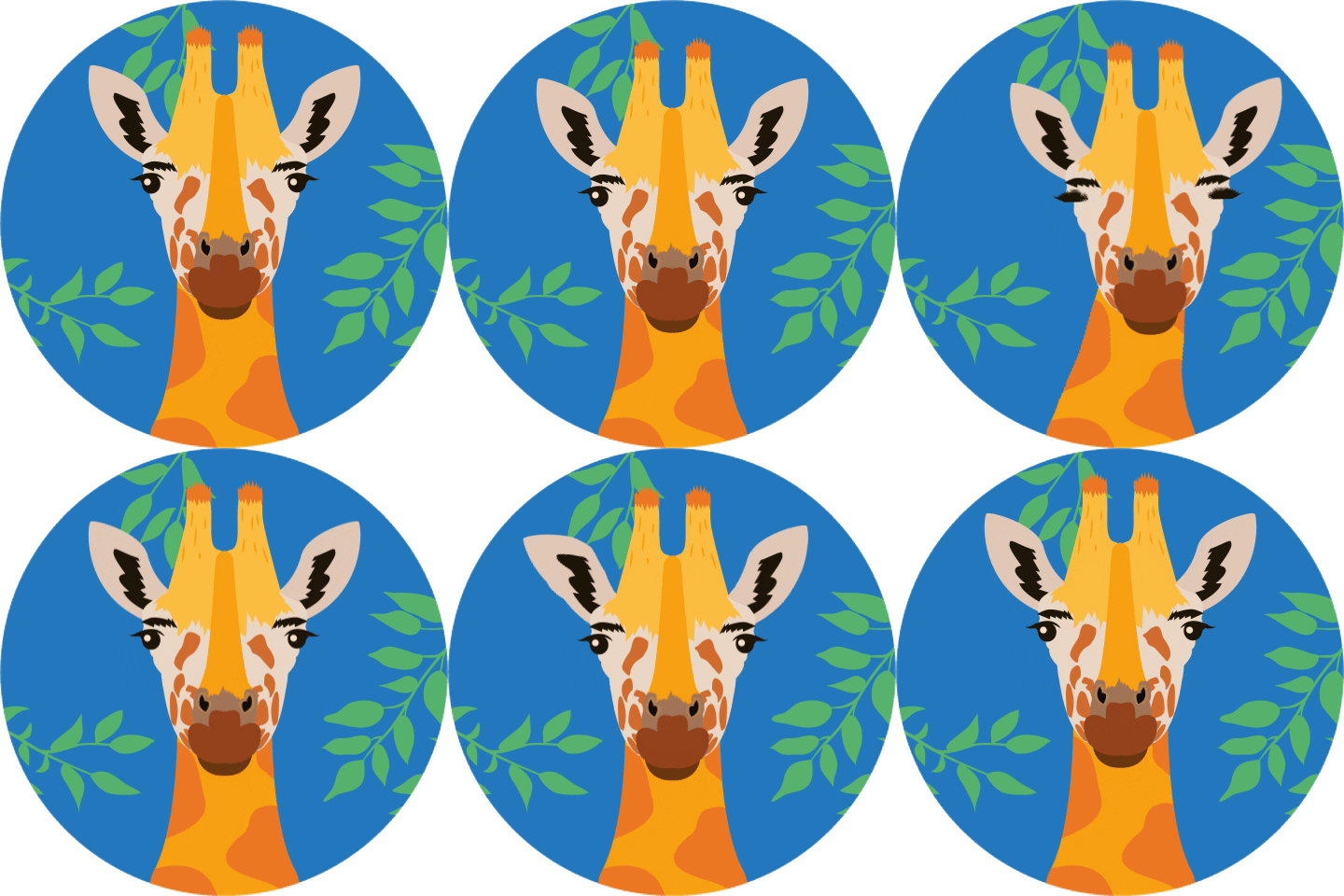
Fully grown giraffes stand 4.3–5.7 m (14.1–18.7 ft) tall, with males taller than females. The average weight is 1,192 kg (2,628 lb) for an adult male and 828 kg (1,825 lb) for an adult female. Despite its long neck and legs, the giraffe's body is relatively short. The skin of a giraffe is mostly gray, or tan, and can reach a thickness of 20 mm (0.79 in). The 80–100 centimetres (31–39 in) long tail ends in a long, dark tuft of hair and is used as a defense against insects.
The coat has dark blotches or patches, which can be orange, chestnut, brown, or nearly black, separated by light hair, usually white or cream coloured. Male giraffes become darker as they age. The coat pattern has been claimed to serve as camouflage in the light and shade patterns of savannah woodlands. When standing among trees and bushes, they are hard to see at even a few metres distance. However, adult giraffes move about to gain the best view of an approaching predator, relying on their size and ability to defend themselves rather than on camouflage, which may be more important for calves. Each individual giraffe has a unique coat pattern. Giraffe calves inherit some coat pattern traits from their mothers, and variation in some spot traits is correlated with neonatal survival. The skin underneath the blotches may serve as windows for thermoregulation, being sites for complex blood vessel systems and large sweat glands.
A giraffe's front and back legs are about the same length. The radius and ulna of the front legs are articulated by the carpus, which, while structurally equivalent to the human wrist, functions as a knee. It appears that a suspensory ligament allows the lanky legs to support the animal's great weight. The hooves of large male giraffes reach a diameter of 31 cm × 23 cm (12.2 in × 9.1 in). The rear of each hoof is low, and the fetlock is close to the ground, allowing the foot to provide additional support for the animal's weight. Giraffes lack dewclaws and interdigital glands. The giraffe's pelvis, though relatively short, has an ilium that is outspread at the upper ends.
A giraffe has only two gaits: walking and galloping. Walking is done by moving the legs on one side of the body, then doing the same on the other side. When galloping, the hind legs move around the front legs before the latter move forward, and the tail will curl up. The animal relies on the forward and backward motions of its head and neck to maintain balance and the counter momentum while galloping. The giraffe can reach a sprint speed of up to 60 km/h (37 mph), and can sustain 50 km/h for several kilometres. Giraffes would probably not be competent swimmers as their long legs would be highly cumbersome in the water, although they could possibly float. When swimming, the thorax would be weighed down by the front legs, making it difficult for the animal to move its neck and legs in harmony or keep its head above the water's surface.
A giraffe rests by lying with its body on top of its folded legs. To lie down, the animal kneels on its front legs and then lowers the rest of its body. To get back up, it first gets on its front knees and shifts hindquarters onto its back feet. It then moves from kneeling to standing on its front legs and pulls the rest of its body upwards, swinging its head for balance. If the giraffe wants to bend down to drink, it either spreads its front legs or bends its knees. Studies in captivity found the giraffe sleeps intermittently around 4.6 hours per day, mostly at night. It usually sleeps lying down; however, standing sleeps have been recorded, particularly in older individuals. Intermittent short "deep sleep" phases while lying are characterised by the giraffe bending its neck backwards and resting its head on the hip or thigh, a position believed to indicate paradoxical sleep.

Giraffes usually inhabit savannahs and open woodlands. They prefer Acacieae, Commiphora, Combretum and open Terminalia woodlands over denser environments like Brachystegia woodlands. The Angolan giraffe can be found in desert environments. Giraffes browse on the twigs of trees, preferring those of the subfamily Acacieae and the genera Commiphora and Terminalia, which are important sources of calcium and protein to sustain the giraffe's growth rate. They also feed on shrubs, grass and fruit. A giraffe eats around 34 kg (75 lb) of foliage daily. When stressed, giraffes may chew the bark off branches. Giraffes are also recorded to chew old bones.
During the wet season, food is abundant and giraffes are more spread out, while during the dry season, they gather around the remaining evergreen trees and bushes. Mothers tend to feed in open areas, presumably to make it easier to detect predators, although this may reduce their feeding efficiency. As a ruminant, the giraffe first chews its food, then swallows it for processing and then visibly passes the half-digested cud up the neck and back into the mouth to chew again. The giraffe requires less food than many other herbivores because the foliage it eats has more concentrated nutrients and it has a more efficient digestive system. When it has access to water, a giraffe drinks at intervals no longer than three days.
Giraffes have a great effect on the trees that they feed on, delaying the growth of young trees for some years and giving "waistlines" to too tall trees. Feeding is at its highest during the first and last hours of daytime. Between these hours, giraffes mostly stand and ruminate. Rumination is the dominant activity during the night, when it is mostly done lying down.

Distribution
Northern giraffes live in savannahs, shrublands, and woodlands. After numerous local extinctions, Northern giraffes are the least numerous giraffe species, and the most endangered. In East Africa, they are mostly found in Kenya and southwestern Ethiopia, though rarely in northeastern Democratic Republic of the Congo and South Sudan. There are about 2,000 in the Central African Republic, Chad and Cameroon of Central Africa. Once widespread in West Africa, a few hundred Northern giraffes are confined in the Dosso Reserve of Kouré, Niger. It is isolated in South Sudan, Kenya, Chad and Niger.
The earliest ranges of the Northern giraffes were in Chad during the late Pliocene. Once abundant in North Africa, they lived in Algeria since early Pleistocene during the Quaternary period. They lived in Morocco, Libya and Egypt until their extinction around the year AD 600, as the dry climate of the Sahara made conditions impossible for giraffes. Though their remenant's; bones and fossils, have been found across these countries.
The southern giraffes live in the savannahs and woodlands of northern South Africa, Angola, southern Botswana, southern Zimbabwe, Zambia and south-western Mozambique. After local extinctions in various places, the South African giraffes have been reintroduced in many parts of Southern Africa, including in Eswatini.

Conservation
In 2016, giraffes were assessed as Vulnerable from a conservation perspective by the IUCN. In 1985, it was estimated there were 155,000 giraffes in the wild. This declined to over 140,000 in 1999. Estimates as of 2016 indicate there are approximately 97,500 members of Giraffa in the wild.
The primary causes for giraffe population declines are habitat loss and direct killing for bushmeat markets. Giraffes have been extirpated from much of their historic range, including Eritrea, Guinea, Mauritania and Senegal. They may also have disappeared from Angola, Mali, and Nigeria, but have been introduced to Rwanda and Eswatini. As of 2010, there were more than 1,600 in captivity at Species360-registered zoos. Habitat destruction has hurt the giraffe. In the Sahel, the need for firewood and grazing room for livestock has led to deforestation. Normally, giraffes can coexist with livestock, since they do not directly compete with them. In 2017, severe droughts in northern Kenya led to increased tensions over land and the killing of wildlife by herders, with giraffe populations being particularly hit.
Protected areas like national parks provide important habitat and anti-poaching protection to giraffe populations. Community-based conservation efforts outside national parks are also effective at protecting giraffes and their habitats. Private game reserves have contributed to the preservation of giraffe populations in southern Africa. The giraffe is a protected species in most of its range. It is the national animal of Tanzania, and is protected by law,nand unauthorised killing can result in imprisonment. The UN backed Convention of Migratory Species selected giraffes for protection in 2017. In 2019, giraffes were listed under Appendix II of the Convention on International Trade in Endangered Species (CITES), which means international trade including in parts/derivatives is regulated.

That's it for today. See you all next time.
Join our Discord channel
Follow us in Twitter
Follow us in VK