

Zor: Pilgrimage of the Slorfs
Witness the arrival of ZOR, coming soon to Steam!
If you’re looking to check out the game early the demo is available now, and we’ll be announcing more features for the EA build as we get closer to launch. As ZOR continues to evolve throughout Early Access we’re looking forward to getting even more feedback from players to make ZOR as fun for you to play as it has been for us to create.
Development Diary #3
Being totally consumed with work on ZOR!
We have been improving our tech, creating a ton of new gameplay content, and we just got the first version of our fully procedural progression system working. The game can now generate a full length pilgrimage run with procedural content which is HUGE.

A grimp runt goes out in a blaze of glory
The March of Progress
Next Fest was a huge milestone for us and a big test of ZOR's fundamentals. Afterwards, we took a short break and reflected on the response. Here is what we learned:
Gameplay
We are really happy with the response we saw, and where the game is at. Some excellent suggestions and improvements emerged which we are excited to add, but for the most part things went great. (phew!) Check out these videos of players discovering ZOR for the first time:
Tech
The frenzy of content creation leading up to next fest pushed our implementation to its limits and exposed a few issues we needed to address. After an intense few weeks in March, that work is done for gameplay and map (cards are getting some love next). It is allowing us to go way more crazy with ideas, and get them working much faster, with less bugs. The rate of prototyping has increased significantly.

Hulga loses the attention of some bugs by hiding in the grass
Impressions
Because the demo only showed the intro of the game, it left some wondering about what the game will be beyond that. Is it a roguelike? A linear tactics story? Something else? Here are some answers to these questions:
Sense of Progression
Story
There is a narrative in ZOR about the Slorfs, their cosmic religion, and a terrifying omen, but full disclosure: the game is not a story rich game packed with cut scenes. It will not play out as like an old school tactics game, with a linear series of levels followed by dialog. The primary focus is on gameplay.
Rogue credentials
Roguelikes and ZOR share a bunch of qualities, so its fair to say that we are closer to that space than any other. Although it may actually be illegal to call ourselves one (our lawyers are looking into it), It is useful to communicate that the game is tough, different every time, death ends a run, and it is designed to be enjoyable the more you play, with lots of surprising moments and discoveries. We shake up the formula with bring card driven, having interaction and survival folded in, and our dense puzzle sized levels.
Pilgrimage of the Slorfs
In the demo you play a two stage intro to the game, the tutorial and a short run called "Hunt the Big Grimp!". The cards are limited, and the content of levels is fairly scripted. It exists as a proving ground to make sure you understand the flow and tactics of ZOR before fully diving in.
Upon completion, you will earn the right to take the Pilgrimage.
This is the main mode that you will replay many times and has the following characteristics:
- Runs are longer and properly difficult
- More tech options and cards
- Content is super varied making every run unique
- Has several bosses and rare surprises
- It has an end and can be completed. Although that will be a huge milestone to reach, it will not be the end of the game.

Gorb gets up to his neck in problems
That's all for now! The demo will be up until the end of the upcoming Going Rogue event so make sure to check it out while it lasts.
Challenge: One shot the Big Grimp!
This is almost impossible, but why not try! Can I one shot the big grimp?!
Development Diary #2
That doesn’t stop the first thoughts at a glance being:
Is this just another typical card battler?
The answer is no, not at all! If you play the demo you will get this right away, but for those just taking a look, I made a list of:
Fresh things about cards in ZOR!
One card a turn, with a hand shared by two units
Each turn, the Slorf will use a single card from a shared deck. When viewing your hand, you are thinking of which card will be used for which Slorf, in what order and in what way.
With this approach you don’t have the crazy powerful hand dumping combos, like playing a bunch of armor cards, and finishing with a massive “do damage for every armor”.
There are powerful combos, but the way you execute them is a sequence of card plays from turn to turn. This can be perfect timing of a card play that is stacking up with several factors you have set up, or a really satisfying sequence of careful moves that squeezes out the last item on the map before you start starving.
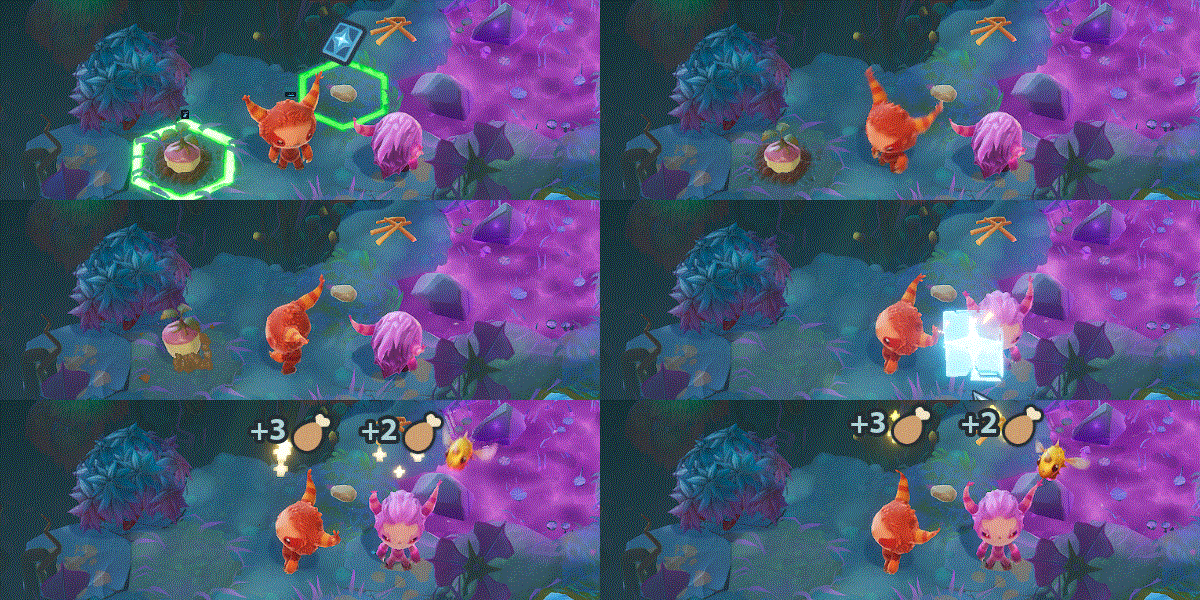
Tactical Tubers! If Slorfs eat food while adjacent they share, doubling the benefit
Spend food and water to pay for cards
Slorfs have food and water stores, that they spend to play cards. They can always play the card, but it will damage them if they can’t cover the cost.
The two vitals (food and water) play differently, and the planning around each has its own feel. Food stores are higher and offers more breathing room. You eat things around the level to put gas back in the tank bite by bite. Water stores are low, but it automatically fills up when next to a water source.
The rough metaphor is food is spent for movement (calories) and water is spent for hard work (sweat) including harvesting, attacks, or using items.
This is the other key feature that makes every turn feel important and interesting. The card costs create the ticking clock of food and water running out, but because there are two vital types and many cards you have some control over how things play out. You might specialize and have one Slorf spend the water cards by the lake, while the other battles and picks mushrooms. Or stick together for the sharing and combat benefits.

Food, sweat and tears
Harvest cards
These cards represent a larger undertaking, and target an object in the word to interact with. For example, you might drop a harvest card on some weeds to tear them down.
Most interactions can be done by simply stepping into the hex, like picking up items or eating some small morsel of food. However, a handful of objects in each map can ONLY be activated with a harvest card. The magic ingredient is that the harvest card can be used for either of these cases, so the temptation to sneak in a little harvest to save some walking (and food) can be a good decision.
Usually in a tactics game, you have a mix of moves and attacks. Adding this third layer, makes the tactics even crazier because with only a small number cycling through your deck though, you need to plan for it or risk being caught scrambling, as well as weave it into combat safely.

Hulga uses a range 2 harvest card to grab some grass over the pond
Inventory as cards
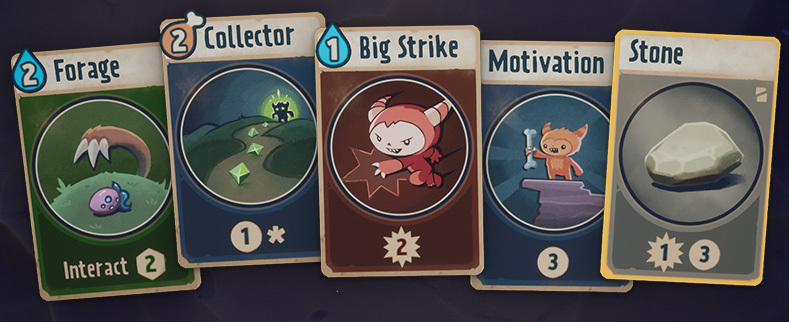
Moving? Card. Attacking? Also card. A rock? Believe it or not, card as well.
Earlier in ZOR’s development, inventory was a separate system from the deck, and no matter which way we approached it it was feeling really clunky and spread the design too thin. So the solution was that everything is represented in your deck as a card.
Moves, attacks, harvesting and items like a branch are all cards in the deck. What came out of this was that every item by design must do something in game, which opened up a new layer of strategy where you decide which cards to use in game, and which to save for crafting.
For example, when you find a stone, it can take out an enemy at a distance, or can be used in an upcoming crafting recipe.
There is a balance where hoarding everything will cripple your tactics by clogging up your hand (a kind of abstraction of encumbrance), and consuming everything will slow your crafting progress. A skill of the game is knowing when to pickup, use, and save item cards. (either extreme is a mistake)
Another useful aspect of items is they are often a free pass (in ZOR you can discard to pass, but must pay the card cost)

Gorb throws the stone at the thorn bug knowing he can find another
I hope I have convinced you try the ZOR demo!
Next up we will cover what we learned from Next Fest, and then after some final planning, details of what you can expect in the early access release. (hint: more challenging, and way more content)
-Clint
ZOR: Pilgrimage of the Slorfs
In my first ever stream, I will play through the demo and chat about the game, answering questions as best I can.
I hope you will join me!
Clint Jorgenson
Development Diary #1
It seems like the best place to start is:
What is the vision?
The inspiration for ZOR was a confluence of three separate things I couldn’t stop thinking about. Anyone who had lunch with me around that time would be sick of hearing these things over and over.
- “I want to make a game that feels like the first 50 turns of Civilization for the entire game. Where the decisions are simple but have a huge impact (like building library or walls) and the snowball effect hasn’t taken over yet. Every time you play its a new puzzle using familiar elements”
- “Survival games appeal to me, but wish it didn’t have to be as tedious. Like, 100 sticks? I would love to see it concentrated down to board game mechanics where picking up a single stick vs stone is as monumental and tense as a turn in Agricola”
- “The breadth of stone age tech is so huge and just gets skipped over by most games. I want a game that never reaches metallurgy, where weaving is like discovering electricity” (Was reading clan of the cave bear, and binging on primitive technology videos at this time)
Over time these merged into the general vision of:
Survival with the feel of a board game
This meant a turn based take on the familiar survival elements of gathering, crafting, and managing vitals. What would that experience be like? My dream version was like this:
- Chess like decisions: Simple, deep and tense because there is a huge impact.
- Tenuous balance between survival and combat layers, you cannot ignore either
- The game rewards thinking ahead, mastery and knowledge of content
- Designed to be resistant to min maxing and metagaming
- Puzzles to solve naturally emerge each turn
- Each element like cards and resources have value and meaning
The next question I grappled with was:
What kind of systems and rules could achieve this?
- Small numbers
- Smaller, manageable scale
- Hex grid map, since survival is tactical, and the outdoors is organic
- Cards for crafting and collecting, since a board game would undoubtedly. Maybe they could drive the tactics on the board rather than just be an inventory?
The vision became a plan. More specifically:
A tactical survival game, driven by a deck of cards.
And more ambitiously, that deck of cards represents the actions the Slorfs take, and also the objects you gather and craft. (this part took remaking the core game about three times to get right)
I will finish off with some additional things that excite us about a game where cards drive the action on a hex map:
- The formula has been used in board games, but less common in video game space, so it would be fresh.
- Cards have an elegant way of adding randomness and keeping the decisions manageable, with a consistent rhythm. One by one you work your way through a gauntlet of new and puzzling decisions
- Combining card play, a smaller scale, and the survival layer, solve a common issue with grid based combat games where movement can be tedious in between the action. Moving an army of units to the exit tiles anyone? Or how about walking across the map over 6 turns to attack that one remaining unit? The click-move-click-move moment is an anti-vision.
- Card relationships with the map, rather than typical card to card synergies in deckbuilders, could be more resistant to the game being solved. When and where to use a card on a procedural map can be fun forever like those first 50 turns of Civilization. Card synergies are amazingly fun, but over time tends to fall into a pattern of knowing the obvious choice and starts to feel scripted.

There is big value in thinking a few steps ahead
Finally, being Righteous Hammer, it has to be this wild early 80s style fantasy setting which mixes cute and creepy, light hearted and dark. Think Dark Crystal, Secret of Nimh, Labyrinth, and so on. Like, you might want to pet the Slorfs but they would bite your arm off.
If you made it this far, thanks for reading! And please, share your thoughts on our demo and this vision for ZOR!
Next time we will get into some specifics in an overview of the game and how its played, we hope you enjoy the demo.