Welcome back for another Astra Exodus dev diary. Today we are going to talk about artificial intelligence in the game, but more specifically on the mechanisms the different factions play differently as well as the many effects difficulty settings have.
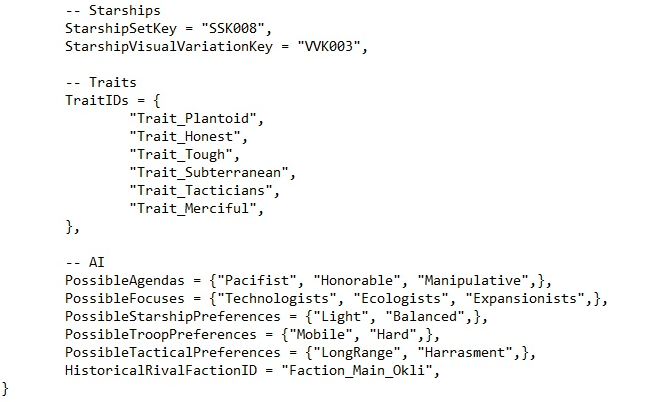
Focuses One of the core features of the AI system is the Focus for each faction, which determines to a rather large degree what the AI will build and when. This is done internally by affecting its desires accordingly and thus greatly affecting its decisions each turn. For each Faction, the game has 3 different focuses, with a 60/20/20% chance of them being chosen each game. In total there are seven focuses in the game: Militarists, Technologists, Ecologists, Industrialists, Expansionists, Economists and Balanced.
The Militarists focus will obviously center colony production on combat starships and ground troops in order to maintain military supremacy over its rivals. Technologists will target research, maximizing its output through building installations and increasing the number of scientists. Ecologists will aim at having large populations by terraforming worlds into Terran planets and also maintaining a low pollution level. They compensate any production lost by generating more income through taxes and commerce. Industrialists are the total opposite, they will focus on industrial production regardless of any pollution and colonize planets with a high mineral output; regardless of their habitability. Expansionists are not picky at all in contrast, they will focus on colonizers and constructors as long as possible with the goal of settling all planets in range. Economists concern themselves more on commerce, taxes and trading. They usually generate a high income quickly, purchasing instead of building most colony projects. Finally, a Balanced focus will make the AI not center on anything in particular. Instead it’ll be more reactive, responding mainly to other player actions.
Agendas In contrast to Focuses, Agendas mainly affect how factions conduct diplomacy and what victory conditions they go for in a skirmish mode game. Just like with Focuses though, there are 3 possible different agendas per faction, with a 60/20/20% chance each of being chosen. There are 7 possible Agendas in total: Ruthless, Aggressive, Pacifist, Honorable, Xenophobic, Manipulative and Erratic.
An AI with a Ruthless Agenda will be quite dangerous, it will attack without provocation and be willing to sacrifice both its own troops and alien populations in war. In contrast, an Aggressive Agenda is more measured, as it will attack only when in favorable position and with at least some provocation. As radically different to the previous two, a Pacifist AI will try to maintain peace, by proactively managing Relations, Trust and Threat it has with others. It will also of course sue for peace more eagerly if at war. A more sensible Honorable AI will almost never break a treaty and will not attack faction with which it has good relations. However it will react twice as much when it is the victim of espionage. Xenophobic AIs go against diplomacy in general and they rarely interact with others without being prompted first. They do not always wage war, but when they do, they stop nothing short of genocide. In contrast a Manipulative AI will often interact often others, preferring to use trading and espionage to achieve its ends. Finally an Erratic AI Agenda, as the name implies, will make the faction rather unpredictable; as it will switch between all other agendas randomly throughout the game.
Preferences The final core AI system is the one that sets the preference for starship roles, troop types and battle tactics for the faction to use. In this case there are two choices, with a 50/50 chance of any of them being picked at game start.
For ships roles we have 4 different preferences: Light, Balanced, Average and Heavy. Light will focus on Frigates/Destroyers, Average on Cruisers and Heavy on Battleship/Titans. A balanced approach will make the AI ignore this as a factor when deciding what to build.
With troops we have again 4 preferences: Soft, Hard, Mobile and Balanced. Soft will make it focus on Infantry/Airborne, Hard on Armor/Mechs and Mobile on Mechs/Airborne. Finally, as well as with ships, Balanced will make the AI ignore this when deciding what to build.
Regardless of what starship focus the AI picks, starships need to be fitted with modules and be built as proper ship designs. This starship design is made by the AI thanks to the battle tactic it has chosen to follow in space. These can be: Long Range, Close Support, Fast Assault, Missile Swarm, Balanced, Engagement and Harassment. Depending on which battle tactic a faction chooses then a faction will focus its research on specific types of weapons, defenses, etc to arm its starships with.
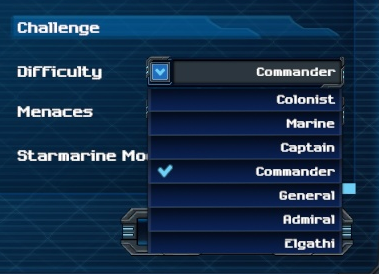
Difficulty There are seven possible difficulties for the game, and can be picked for both the story campaign or a single skirmish game. These are: Colonist, Marine, Captain, Commander, General, Admiral and Elgathi. Without going too much into detail, Commander is the standard difficulty, where the AI has no penalty or bonus to speak of. Thus, the closer you go back to Colonist, the easier the game is and the same in reverse, Elgathi being the hardest difficulty level.
Difficulty levels not only affect bonuses/penalties, but more importantly they affect how the AI plays the game. For example, on General and upwards, the AI will target the weakest enemy first in ground battles. In Commander and upwards the AI will maintain formation in space battles, right up until the main line faces the enemy. In contrast however, a game with a difficulty of Marine or less will have the AI ignore starship abilities and not use them.
That’s it for today! We will be back next Tuesday with our last dev diary before release. Astra Exodus is releasing on January 30. Are you ready?
Release date amended, out on January 30
We have a new release date for Astra Exodus: it will be released on January 30.
Contrary to what was announced shortly before the holidays, we have decided to move the release date of Astra Exodus by one week.
It is a decision which was taken by the publisher, simply based on reasons of internal organization and scheduling.
The game's development is complete, and we are very happy about how it has progressed and shaped up.
You can take a look at our recent Let's Plays, where Richard Yorke plays the single player campaign. You can follow him every Tuesday at 6 pm GMT on our Twitch channel.
Welcome back for another Astra Exodus dev diary. My name is Atomic Kaiser and today I’ll be talking about the game’s factions, the systems behind them and some examples from the game. I’ll be careful not to give any spoilers out though!
Before we get to the dev diary itself, don’t forget to check on today’s preview stream on Twitch. Join us at 6 pm GMT on our Twitch channel for a first look at Astra Exodus!
Factions
The universe depicted in Astra Exodus is inhabited by several factions, some of which do not have what you would call a government or structure in the classic sense of the word. In fact that’s why they are called factions rather than nations or civilizations. One such case is the Followers of Kala, which function more like a religious cult than a classic empire for example.
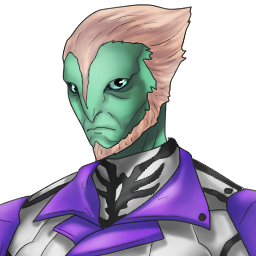
All factions have a leader, a central figure that directs its will and whom you will interact with - or take command of! This leader will also be served by several advisors, and they will offer their counsel on the central topics regarding the management of your faction.
Regardless of the fact that all of them are humanoid shaped, these factions are highly diverse, both in form, function and thought. They vary a lot on how they look, why the look that way, what they are trying to achieve in the galaxy and how they want to do it. This is reflected in the game’s lore as well as in their abilities or characteristics (called traits in game), both of which we’ll talk more about a bit later on.
From an AI perspective, each faction will then have a preference on how to win through what the game calls an Agenda and who they essentially are through a Focus. AI also has a preference regarding what classes of ships to build and troop types to train. This helps with differentiating factions especially when played by the AI.
Traits
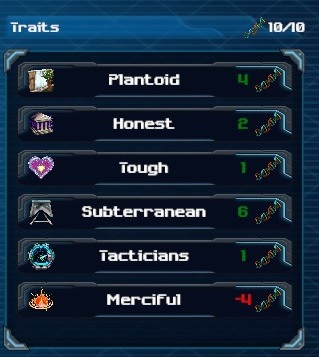
Traits are what make a faction different from others, gameplay wise. Each faction has a unique set of these traits which define its capabilities, by either improving or diminishing a gameplay aspect that affects the player. They can be very basic, such as the Miner trait, which increase materials production per miner in each colony, or quite complex, such as the Ancient trait, which reveals the whole galaxy at the start of the game.
The game uses a trait Pick Points systems, in which each Trait gets a positive or negative value accordingly and the sum of them is the same for all factions.
Lore
The history or lore of the known galaxy in Astra Exodus long predates the arrival of humans to the sector and the events that will unfold in the game’s campaign. However, much of the history known at the game’s start is more myth than anything else. From the role of the Precursors in the shaping of the galaxy, in their terrifying ancient wars and alleged surveillance of all major species, to the so called “old gods” with truly infinite power, they are all treated like myth and legend rather than history.
However we do have some actual bits of history to share, without going into any campaign spoilers, on each of the major factions of the Skirmish Mode.
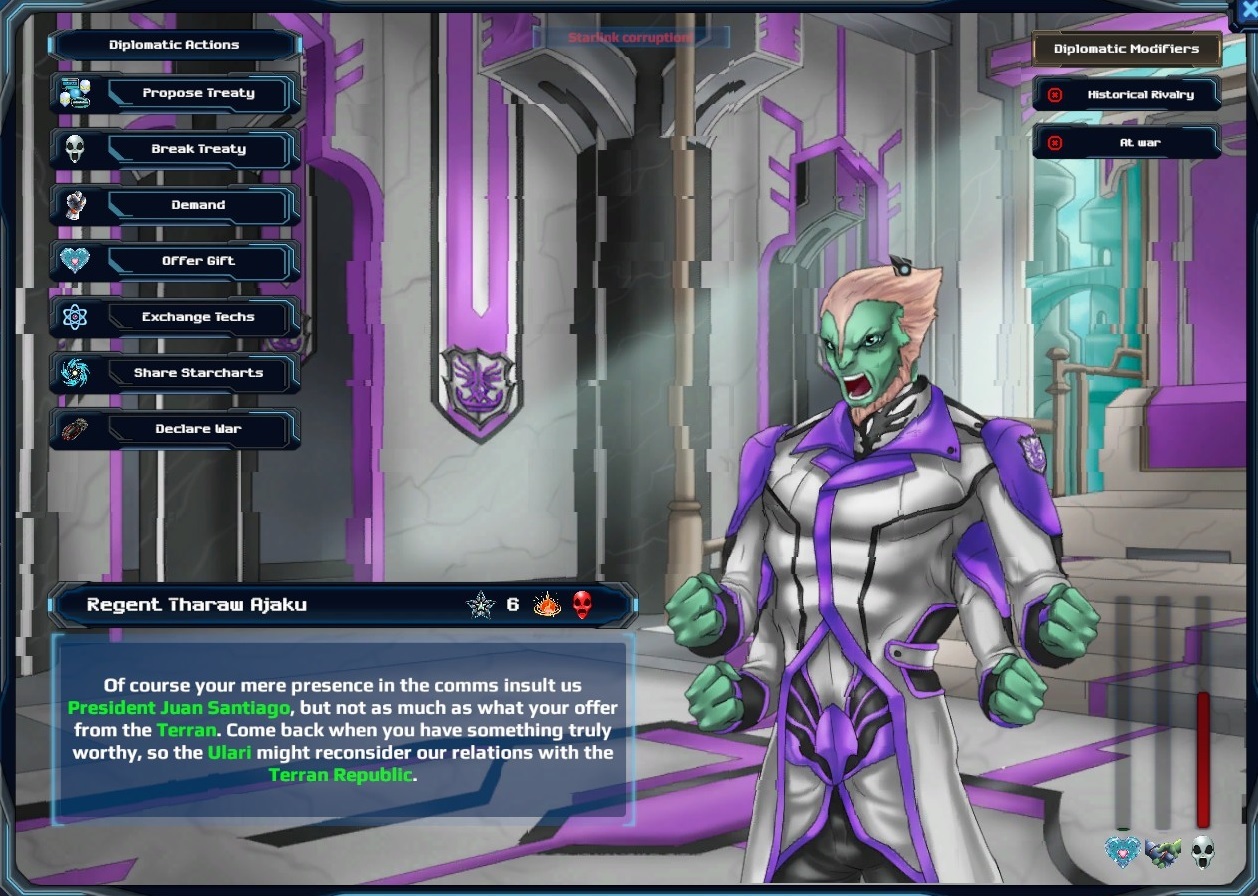
The Potermi Dominion is a major power in the galaxy, which has been in constant fighting to keep its borders against many enemies, ever since the faction’s peak, some 2500 cycles ago. Sadly the Ulari have not found much success with their current regent and seem to be ever shrinking in the extent of their power.
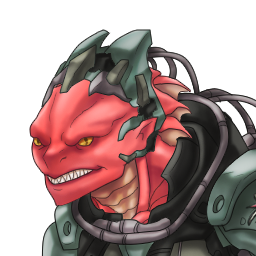
The Veloran Horde is a chaotic collection of warring tribes, banded together under the current Grand Boss Jarak, who achieved her title by betraying the previous grand boss. The Velor are known to be raiders, slavers and pirates; however never had they posed such as threat to the galaxy as they do under the Horde.
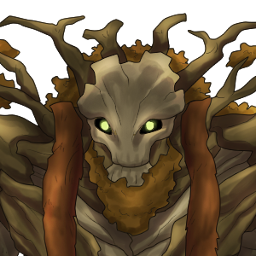
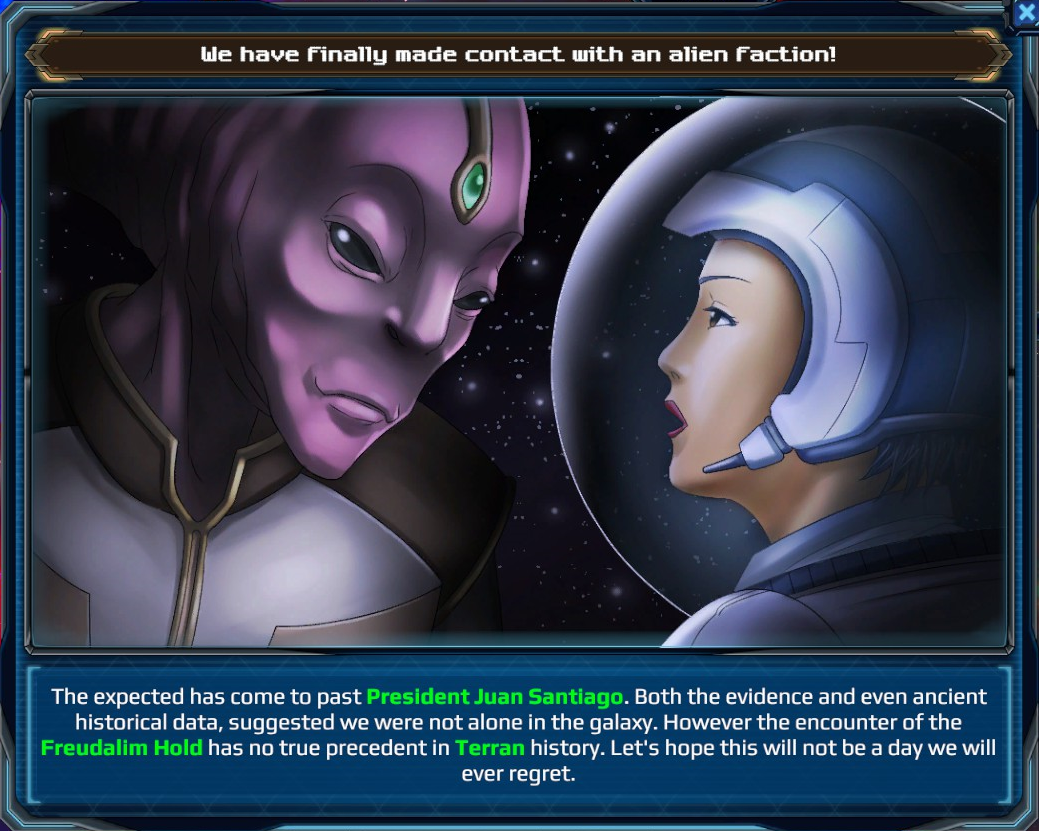
The Guardians of the Seed represents a peaceful yet powerful group of vegetal based sentient beings, which some believe to have been created artificially. Like humans, they are newcomers to the sector. They had a first contact war with the Freudalim Hold, that quickly stripped them of any naivete about interstellar affairs.
The Terran Republic represents the last known group of humans who survived the Exodus from Earth, thousands of cycles ago, by coming through the Great Eye (a colossal wormhole that collapsed behind them). They have focused on rebuilding until now, as they set out to find their lost brothers and the history behind their ancient exodus.
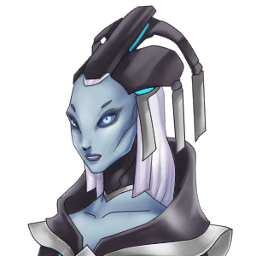
The Followers of Kala are a secretive and highly advanced, yet deeply spiritual organization, and they are almost as ancient as the Freudalim Hold. Not much is known about them, as any probe into their territory is hardly ever heard from again. What little is inferred however from contacting them, is that somehow the Kalin are all females, or so it seems at least.
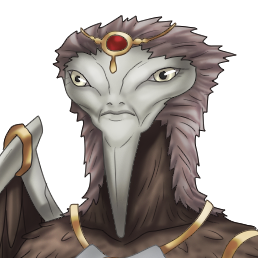
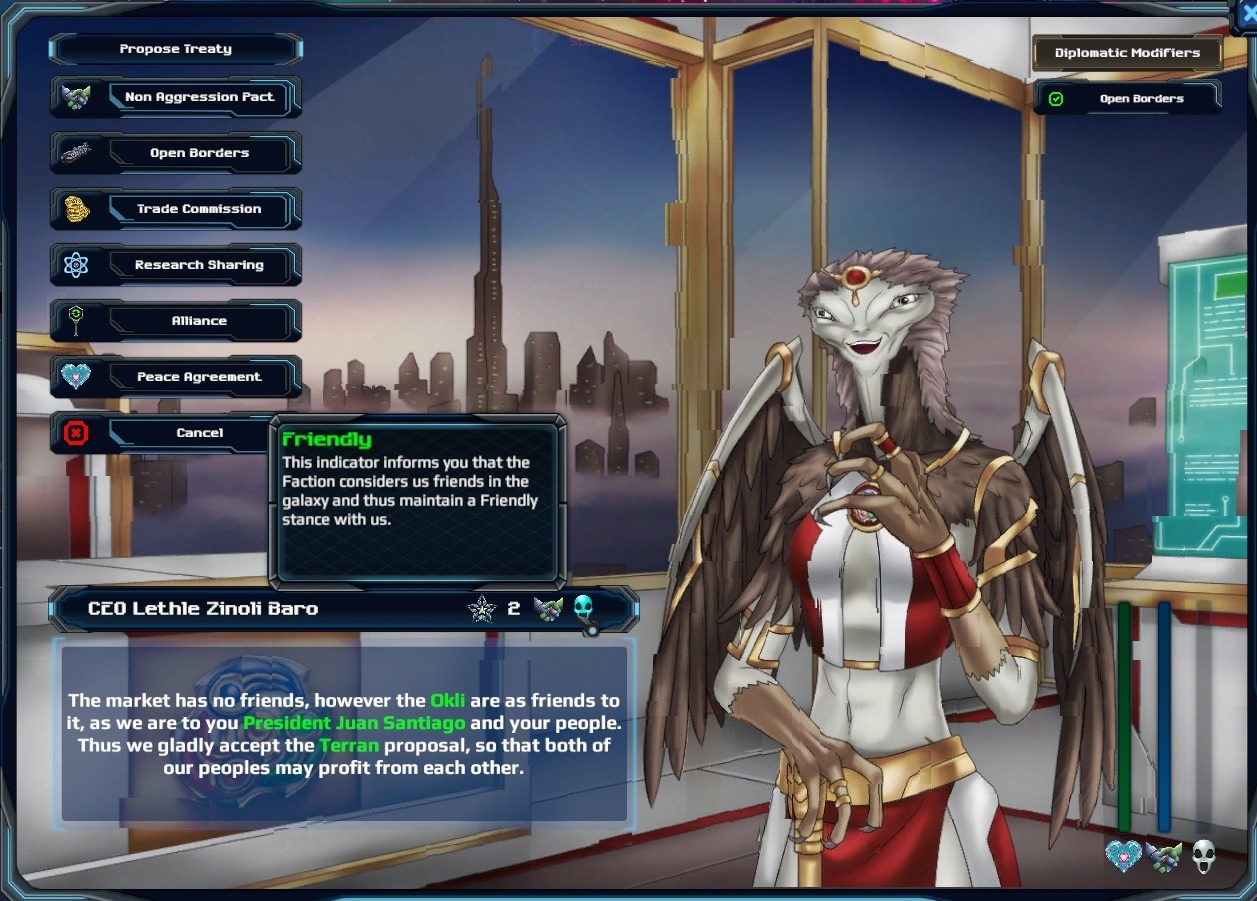
The Okli-To Consortium is a corporate based government of winged beings, who suffered a massive accelerated technological advancement in a very short period of time thanks to the interference of minor smuggler factions in their homeworld. This quickly changed their ethics: they got rid of old idols and replaced them with worship of wealth. This reflects on the freighter-like look of their starships.
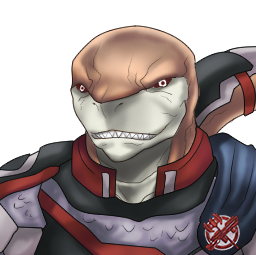
The Ilumina Starnation is a utilitarian, authoritarian and collective government of aquatic sentient beings who used to be ruled by the Potermi Dominion until they rebelled in a series of conflicts now known as the Great Patriotic Revolution. They are renowned for their industrial and physical might, having been used by the Dominion for centuries as their elite shock troops.
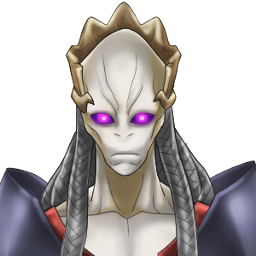
The Freudalim Hold represents an ancient and honorable (or so they claim to be, at least) race of sentient marble-skinned mammals. Ages ago, they used to rule much of the galaxy, with the permission of the Precursors. Once they left however, the Hold faded into inner turmoil, thanks to its self absorbed senate and lost power on the galactic stage rather quickly, becoming a mere shadow of what they used to be.
There is a lot more to be found out about the lore of Astra Exodus and its factions, but that it’ll be up to you to learn by playing.
This will be our last dev diary in 2019, but we will be back in January to resume our series of dev diaries. As mentioned, don’t forget to follow us later today on Twitch for the first Astra Exodus preview stream. Furthermore, on Friday we are going to announce something which I’m sure will excite all those who are waiting for Astra Exodus!
Astra Exodus is an upcoming sci-fi 4X strategy game. Developed by Atomic Kaiser, we have been featuring it weekly on the site with our series of developer diaries.
We had promised you we would show you the full game before the holidays, and we'll keep our word!
Richard Yorke will be live streaming Astra Exodus on our Twitch channel on Tuesday 17 at 6 pm GMT! It will be the perfect chance to have a first look at the game and see its features and gameplay mechanics in action.
For all those who cannot make it, don't worry. We will upload the video afterwards on our YouTube channel.
Astra Exodus is still in beta but its development is progressing well. It is currently fully playable, and we are not far away from release. Stay tuned for the announcement of the release date, which will come very soon.
We’re back with a new entry of the Astra Exodus dev diaries. This time we’ll be going over Diplomacy and Trade. Most of what we are talking about happens on the audience screen, which can be summoned for any of the factions met at that point in the game.
Diplomatic Actions
Once an audience has been setup you will face the leader of the corresponding faction and you will then have the chance to interact with them through diplomatic actions. This can include trading, issuing demands, giving gifts, proposing treaties and of course declaring war. All of these will affect your relations with the faction and trigger a modifier in turn. We’ll talk more about these later.
One of the actions possible here is to propose or break a treaty. There are several treaties available in Astra Exodus. These include: Trade Commission, Research Collaboration, Open Borders, Military Alliance, Peace Agreement and Non-Aggression Pact. The Trade Commission has both factions increase the total commerce they generate by a percentage of what each other generates. Similarly speaking, the Research Collaboration does the same but for research. Open Borders grants rights of passage and refuel for each other’s ships. A Military Alliance is a defensive pact, in which if attacked by a third party, both factions swear to help each other by declaring war against the aggressor. As the name implies, a Peace Agreement marks the end of hostilities between two factions, effectively ending a war. Finally a Non-Aggression Pact is a basic treaty, required for higher tier ones, promising peace between two factions. Breaking it carries a galactic wide diplomatic penalty.
Depending on your military strength, you might be in the position to either issue or receive demands to/from other factions. The terms these demands can include: technologies, systems, credits, tribute, breaking all treaties with a third party, declaration of war against another factions or even agreeing to a truce in a war. If the target faction does not accept the demand then relations will be negatively impacted, with a corresponding modifier.
Relations, Trust and Threat
For each faction, the game keeps track of three essential values, relative to all others, to impact the diplomatic relations and interactions between them. They are also directly taken into consideration by the AI in order to make its choices. These values are called Relations, Trust and Threat.
Relations represents the overall sentiment of the faction towards another. It fluctuates mainly with the corresponding faction’s actions. For example, if X allies with Z, which is a sworn enemy of Y, then Y will not have favorable relations with X. In contrast Trust increases slowly with time and can only decrease when a treaty is broken or a promise is not kept. Trust is essential for higher tier treaties and trades (an alliance treaty for example) as the AI not only needs to have high relations with a faction but also needs to trust it. Finally, Threat measures how dangerous a faction is perceived to be by another faction. This is measured in both the relative military might as well as the industrial capacity involved and the perceived willingness to go to war.
Depending on the Relations value is the Attitude the corresponding leader will have with you and your people. They are clearly distinguished from each other, through the leader character visuals and also on how he or she communicates with you during the audience. There are 5 different possible leader attitudes in the game, which from best to worst, are: Friendly, Cordial, Neutral, Hostile, Warring. You can check how they came to be thanks to the relationship modifiers involved with the faction.
Relationship Modifiers
Each diplomatic action a player takes (as well as many non diplomatic actions, like for instance the bombardment of an enemy colony) generate a positive or negative Relationship Modifier. These are triggers that either increase or decrease the Relations, Trust and Threat between factions. They also serve as a summary for the human player to understand why an AI “feels” like it does with him or her.
There are many possible relationship modifiers within the game, from a positive one like having the same enemy in a war, to a common negative one like having close borders. Regardless of the source of the modifier and whether if it is positive or negative, they will all expire at some point (all but a few exceptions), either once enough time has passed or because the galactic context has changed.
Gifts and Trading
There are several assets which can be gifted in game to other factions in order to increase the relations with them. This can be very important to avoid war, especially if you seek to ally with a powerful faction. These assets include: technologies, credits, tribute (credits per turn) and entire star systems (with any colonies or outposts they include). They obviously affect relations in different amounts, depending on the case.
In contrast trading implies an exchange: giving something but getting something else in return. Most important here is the exchange of technologies, since otherwise a faction can not complete a level of a Research Field, as we have already pointed out in a previous dev diary. However you can also trade star charts with other factions, which helps you to map the galaxy out very quickly.
We will be back next Tuesday with a new Dev diary, this time on the Factions we will encounter in Astra Exodus!
Welcome back for the eleventh Astra Exodus dev diary! I am Atomic Kaiser, the designer behind the game. Today I am going to talk about troops, ground battles and planet bombardment.
Troops
There are several Troops types in Astra Exodus, each of them with specific characteristics that might make them more desirable in a specific location or situation. Some are better suited at defense, others excel in certain terrain types and/or to flank the enemy. There are 4 main types: Infantry, Armour, Mechs and Airborne.
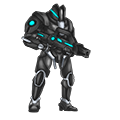
Infantry and Armour are pretty self explanatory: the first category consists of armed humanoid beings and the second of heavy combat land vehicles, typically tracked but sometimes with hover capabilities. Mechs in turn are relatively large, bipedal combat crewed robots with great mobility on the battlefield. Last but not least, Airborne troops consist of atmospheric strike-craft capable of striking quick and hard anywhere on a planet.
Even if each troop in the game has a set type, each is different from all others, both visually and mechanically. Speaking of stats, besides the obvious Hit Points, there are Soft, Hard and Air attacks, plus Defense and Initiative. Each troop type is more vulnerable against at least one type of attack: the most obvious example of this are Airborne units, which are most vulnerable to Air Attacks. Defense works as a chance to prevent damage and can be improved through different techs for each troop type. Ground battles are fought with an active time system which works like a fractioned RTS. The Initiative of a troop indicates how often it can move or attack, so the higher the Initiative; the more mobile and deadly the troop can be.
Finally, troops of course need to move across the galaxy, and you will need Transports / Freighters for this (the same which are used for moving resources, as covered in a previous dev diary). Thus logistically it is very important to manage their availability, to ensure both the resource pooling and the unimpeded movement of your armies.
Invasions
Once all orbital defenses of a Colony are destroyed, if the fleet carries troops for the task, a planetary invasion can commence. Invasions are the main part of ground battles, as you will always be either attacking or defending a colony. The maximum number of attacking troops allowed per invasion depends on the garrison size, which in turn depends on the size of the planet involved.
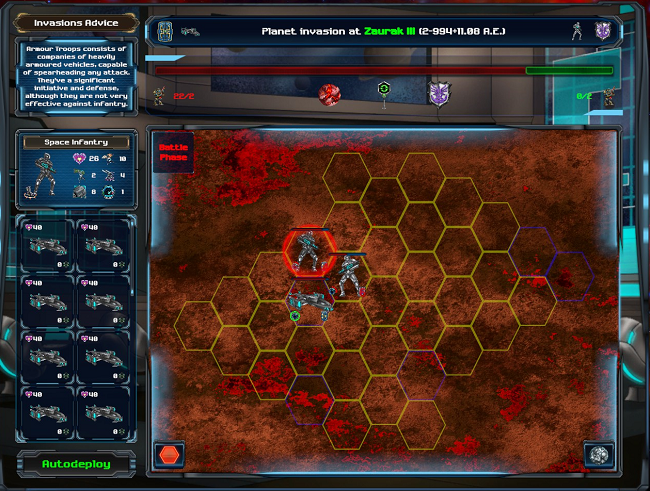
First a Set Up Phase starts, which can last up to 30 seconds (this depends on difficulty), where you need to place your troops across the surface of the planet, which is divided in hexes. This hexagonal territory might be composed of land or some liquid like lava or water. Only Airborne troops can be placed on non land based hexagonal territories. The player can also use an Autodeploy function, that will automatically deploy the available troops.
Once both the player and AI deploy their troops, the proper Battle Phase will commence. On this phase, you order the troops to either move or assault any hexagonal territory. You can only do this once the troop’s Initiative bar has filled up and this, as explained in an earlier section depends on the troop’s stats. The side that is able to eliminate the opposing forces will win the battle.
Bombardment
A Fleet might choose to bomb the planet first or even after an invasion. In order to do this, it must have starships equipped with bombs and have enough ordnance stored to use them. It is important to point out though, that a fleet can only move, attack, bombard, invade, settle or build (depending on its abilities) once per turn.
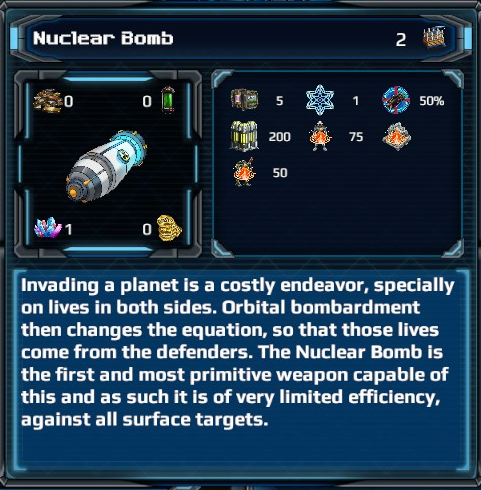
There are many different bomb modules in the game, however they differ from each other not only in their strength and cost, but also in their efficiency versus troops, installations and populations. Some like the Xenophage Bomb, are ideal to destroy the population of a Colony, while a relatively more primitive Fusion Bomb is in contrast more useful against Installations and Troops. It all depends if you want to take the Colony with at least some infrastructure intact, or if you just want to remove the enemy from the planet.
Regardless of the case, the player must take into account the diplomatic ramifications of any planetary bombardment, as this will generate negative modifiers for all other factions in the galaxy. Only a historic rival of the victim faction will ignore such a clear case of attempted genocide in the galaxy.
We will be back next week on Monday 9th with a new dev diary on Diplomacy & Trade!
Once again it is time for another Astra Exodus dev diary!
This time we will focus on the many types of events you can encounter while playing as well as the DataNet, which serves as the game’s notification system. All of this is designed to breathe life into the galaxy, the lore behind it and increase replayability.
The DataNet
Practically speaking, the DataNet holds the notifications the player receives about the issues, aspects and decisions that require his or her attention. These can be as mundane as a colony’s empty build queue or a warning that you’re not researching any technology. They can also be quite complex and engaging, like an incoming diplomatic message from another faction, which requires a response in order to progress with the game. More importantly, it’s mainly through the DataNet that you will find out about the many galactic events that can be triggered while playing the game.
Exploration Events
While exploring the galaxy, your scouts will encounter all manner of strange phenomena. We already talked about things like Supernovas and Wormholes in the void, but Exploration Events represent the discovery of even stranger things on the surface of alien planets or orbiting strange stars.
For example, any of your wandering fleets might encounter a band of friendly smugglers who will decide to join your faction, adding their freighters to your cause. Or possibly they could run into an incredible substance called Xenobiomass, which can greatly increase the materials production in one of your planets. Other more mundane exploration events can also be found, such as Hibernations Pods, that provide extra population to one of your colonies, or the discovery of a Splinter Outpost that will immediately rejoin your empire.
There are many of these events available for you to find, however the AI can also scout these out and if you fall behind in the exploration game you might miss out on many of them.
Random Events
With an even greater impact than Exploration Events, galactic-wide Random Events (also called Galactic Crises), can also happen occasionally. These are so massive that affect all the factions in the galaxy, regardless of where they start.
These often offer some insight on the work of the enigmatic progenitors and include some truly gameplay altering effects, such as the Progenitor Mindprobe. A psychic pulse from an unknown source that sweeps the galaxy, putting all heroes out of commission for a while, regardless if they are active or not. Another dangerous example is the Subspace Anomaly. This event effectually reduces the Hyperspace range of all starships by half, thus possibly cutting off entire regions from the rest of the galaxy.
Regardless of the random event however, the player always has the option to research a corresponding special tech. Once researched, it serves to nullify the event’s effects to the player’s faction, effectively granting an advantage over all others. Finally, it is worth it to mention that you can adjust the frequency of these events on the game rules panel when starting a Skirmish game.
Narrative Events
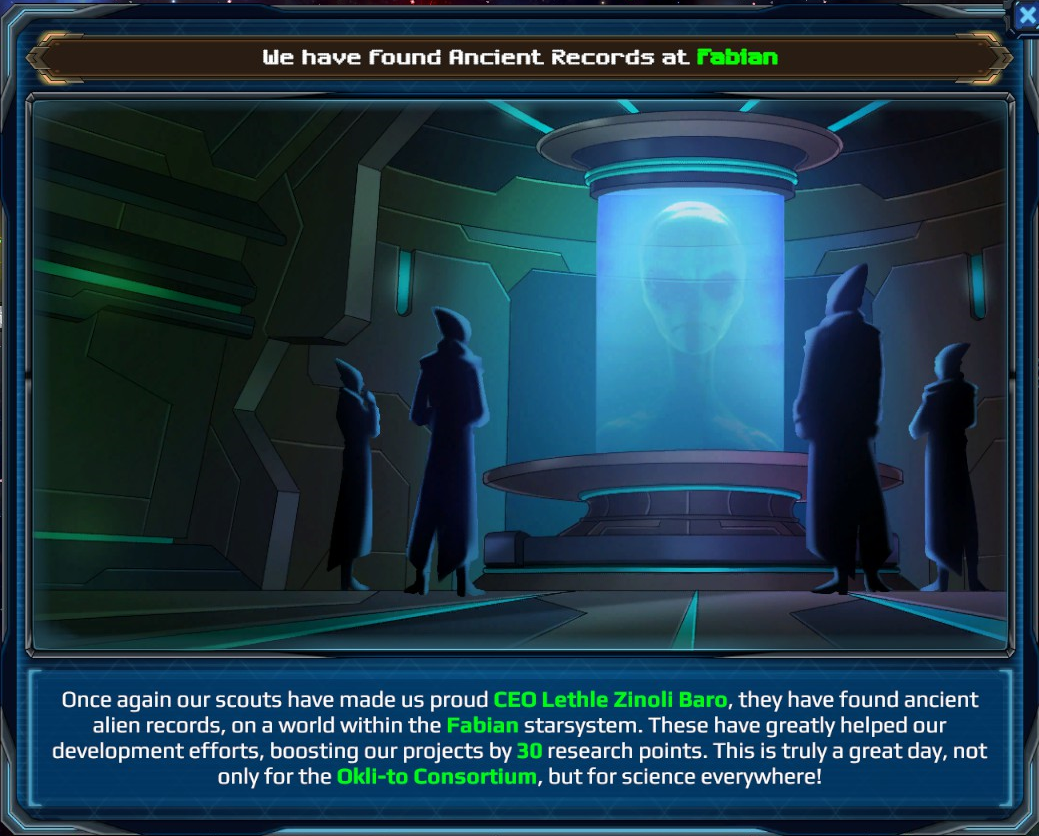
Narrative Events are only available in Skirmish Mode, since the Campaign already has its own narrative systems. They serve to highlight the many milestones the player goes through in any regular game. From colonizing the first world to a first contact (and interstellar war maybe), to discovering the whole galaxy. Each one of these events has a plaque (pretty image), with a text incorporating the details of the current context of the faction.
We will be back next Tuesday with a new Dev Diary, this time on Ground combat! Don’t miss it.
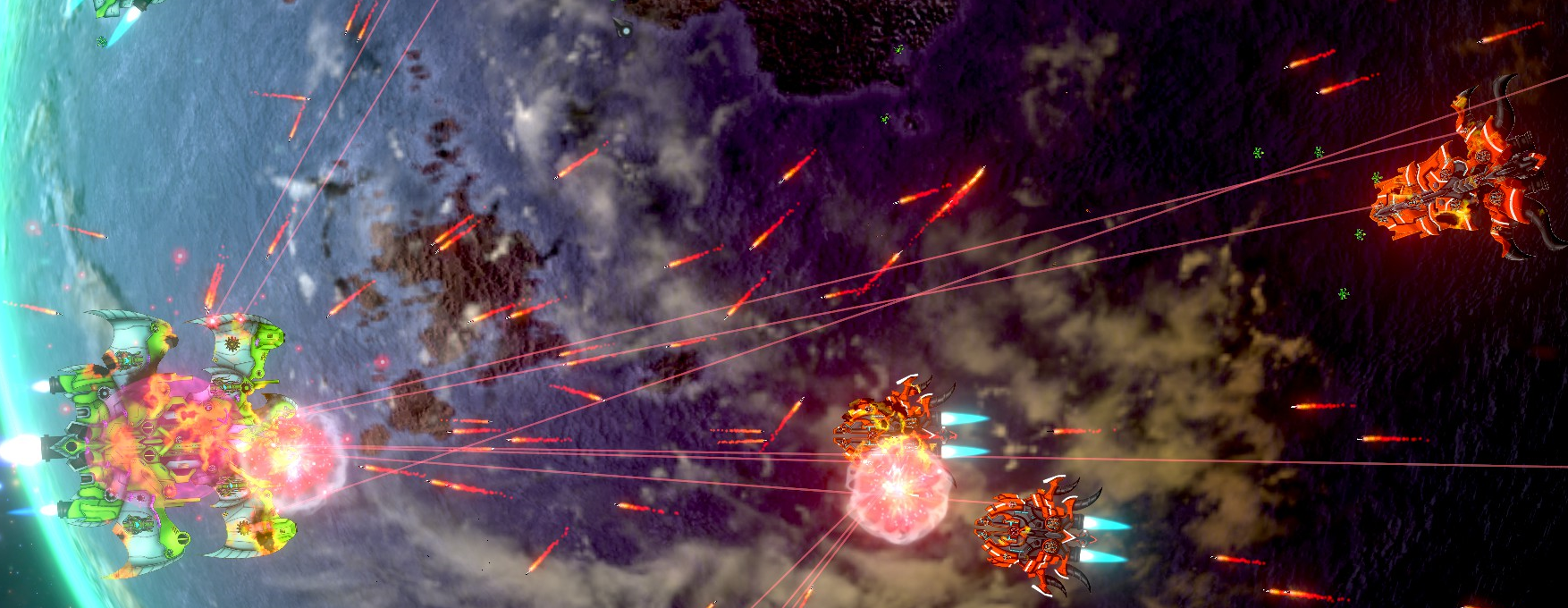
Welcome back to another Astra Exodus dev diary! Today we are going to go over the pausable real-time space battles.
Base Concepts
Whenever two hostile fleets engage each other a real-time space battle will take place. It is marked on the star map with a red target over a star system. This can happen while exploring, when you encounter galactic menaces, and more generally when a colony, outpost or fleet is attacked. Then the player can either retreat, auto-resolve or fight it out as a tactical battle.
When a Colony is under attack, depending on whether or not it has orbital defense installations, the defensive force will be bolstered by a static weapons platform. There are several types of these platforms available, from small Orbital forts to gigantic Stellar bastions and supporting Spacedromes with their strike-craft squadrons.
One of the most important factors to consider is that Armour and Shield damage is directional. This means that there is one section per facing (bow, starboard, etc.) for these defenses which you then have to wear down before actually damaging a starship. This obviously means that maneuvering, fire arcs and facing become quite important.
Fleets can have up to 49 ships each, meaning that a single battle can have close to 100 starships in total, not to mention any strike-craft squadrons that might have launched. Each of these fleets can be under the command of an Admiral, who, thanks to his or her skills, will surely impact the outcome of the fight.
Battle Management
The selection and command of units in Astra Exodus follow standard RTS practices. You click and drag to select a group of ships, generate control groups with control plus a number and right click to execute a context command, like move or attack.
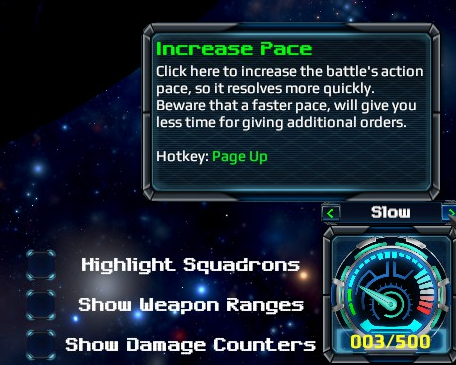
Time Dilation controls are an important tool to manage the battle flow and allow tactics to be properly executed. This allows you to slow down the action to a total stop, or speed it up to accelerate time. In practice this means that if the player is overwhelmed at any point, he or she can simply press the Space Bar to totally stop the action and give any orders in the meantime. This system allows for the tactical depth required by the starship design system, without forgoing the spectacularity of real time battles that can hopefully be a blast (no pun intended!) to watch as they are to play.
There are some basic orders available to all starships. These are Halt, Retreat and Hunt Strike-craft. The first two are quite self explanatory, however it is worthy of mention how the Retreat order functions. Your ship will break away from battle, head towards the closest edge of the battlefield and open a Hyperspace jump point. It will be vulnerable in the meantime. The Hunt Strike-craft order will command the ship to target the closest enemy strike-craft squadron target and engage it as soon as possible.
Starship Abilities
Starships can also have special abilities available according to the modules they have installed. These can have a Passive or Active effect on the battle, meaning that in some cases they apply their effects at all times to the ship, while in other cases the player might trigger them, they will work for a given time window and then reset again with time.
Passive abilities include things like preventing enemy starships from retreating or reducing the penalty that armour adds to a starship’s tactical speed. These effects are constant and do not need to be activated. In contrast, Active abilities can be things like engaging a Spatial Compresor to teleport the starship across the battlefield or a Nanite Cloud to repair the ship mid-battle. All passive and most of the active abilities require the presence of a special support module in the starship design.
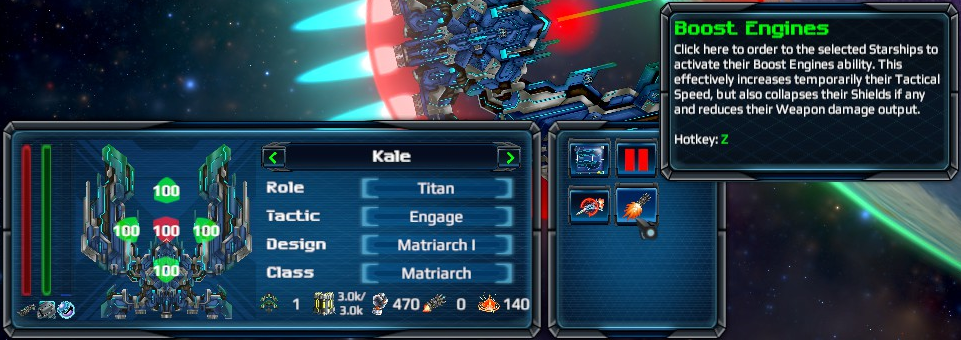
Among all Active abilities there are those which we can call basic, which only depend on the presence of core systems. These are: Boost Engines, Weapon Overload and Recharge Shields. Boost Engines allows for a starship to increase its speed momentarily at the expense of collapsing any shields available and reducing its weapons damage output. The Weapon Overload ability in contrast drastically reduces speed and shielding while increasing damage output. Finally, the Recharge Shields ability immediately resets a collapsed shield at the expense of speed and damage output. Basically, you are sacrificing all other aspects in order to benefit one, temporarily.
Let us know what you think of these mechanics on either our Facebook or Discord group! We will be back next Tuesday with a new Dev diary of Astra Exodus, this time titled DataNet and Events.
We are back for another dev diary, this time regarding Starship Design.
Before we get to the subject at hand, don’t forget to join the Discord channel and follow our official Astra Exodus Facebook page, so you can be notified of all the latest news as well as talk with other fellow fans.
Classes, Roles and Sizes
In Astra Exodus all factions have their own classes of Starships. A Class is merely the name for a role and the specific graphics a faction has for it. More specifically, there are 5 military starships, 2 civilian starships and 2 strike-craft roles in Astra Exodus.
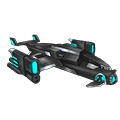
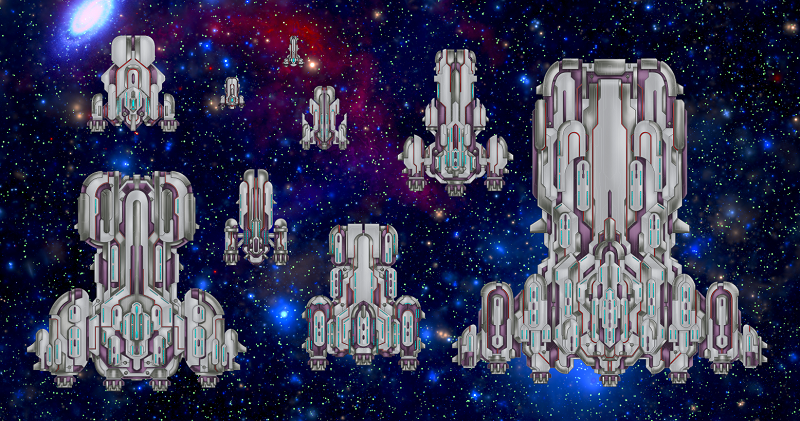
The military starship roles are: Frigate, Destroyer, Cruiser, Battleship and Titan. Each of these is 1.5 times bigger in relation to the previous one. Each role has different characteristics that allow it to excel above others. Frigates are cheap, fast and hard to hit giving their size. Destroyers have additional anti strike-craft weapon mount points, so they excel at escorting bigger ships. Cruisers are jack-of-all-trades yet masters of none, being able to tackle many jobs if designed correctly. Battleships have tons of heavy weapon mount points and armour; however, they lack defenses against smaller ships. Finally, Titans have tremendous firepower and armour, yet they are severely lacking in maneuvering and speed. They are also the only ones who can mount Massive grade weapons, which are devastating against orbital defense installations.
Then we have 2 civilian roles, Constructor and Colonizer, which are approximately as big as a Destroyer and Cruiser approximately. Obviously, as their names indicate, Constructors can build outposts on alien planets and Colonizers can settle them and found new colonies.
Finally, strike-craft are a small portion of the size of a Frigate, come in squadrons of 5, and can either be Fighters or Bombers. Bombers are fitted to engage capital ships, while Fighters are mainly best employed to counter enemy bombers, although they can also pose a threat to bigger ships in large enough numbers.
Weapon, Core and Support Modules
After picking a Class, in order to create a Starship Design you need to fill it with modules (like weapons, armours, engines, generators, and much more). In Astra Exodus you have 3 types of modules: Weapons, Core and Support.
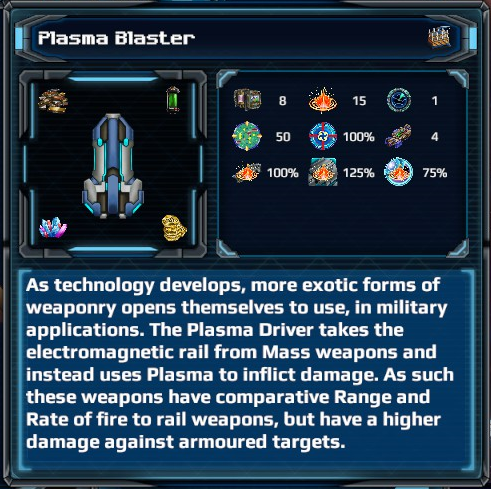
Weapons are quite self-explanatory: they serve to pummel the enemy, but they can also be further categorized in Beam, Particle, Missile and Mass weapons. Each Weapon has its own characteristics, but certain types tend to excel in certain areas. For example, Beam weapons tend to do extra damage against armour and have average range, while Mass weapons have a high rate of fire but poor accuracy. All the weapons are always placed on a mount point within a starship. This is a logical and visual representation of where the weapon is located on the ship’s structure or hull.
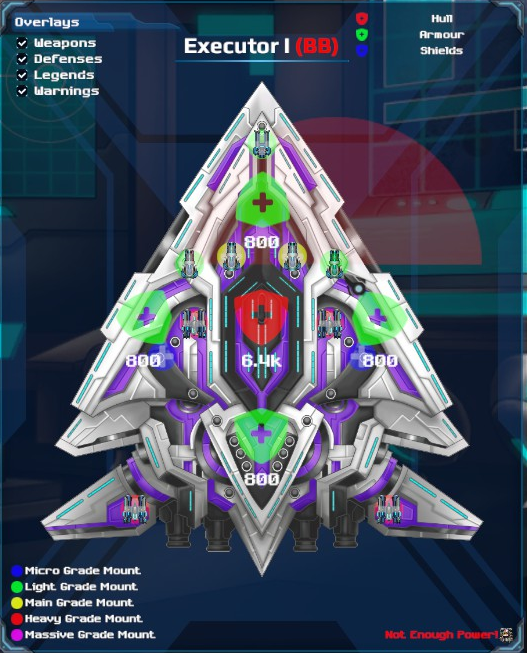
Mount points have 5 grades: Micro, Light, Main, Heavy and Massive. The larger the mount point, the more powerful the weapon mounted in that spot will be. However, it will also be less accurate and have a smaller field of fire. Also, Micro mounted weapons are the only ones that can target strike-craft. Not all weapons can fit all mounts, so you’ll have to pick wisely if you want to fit all the mount points on an optimal design.
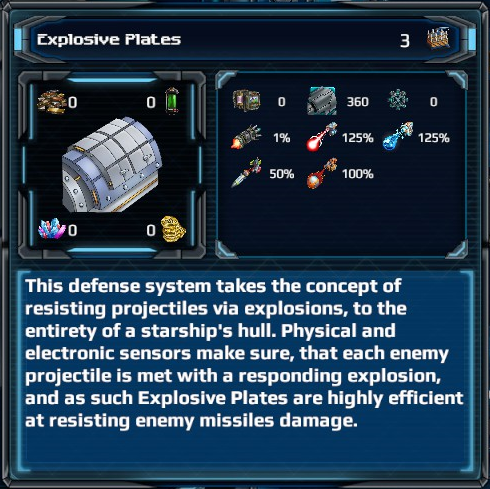
Core Modules or Systems are essential to any starship. They can be categorized in: Engines, Hull, Armour and Shields. The most critical are the Engines, without one of these modules a Starship Design will never be valid. Hull modules serve to reinforce the structure, adding additional hit points to the ship. Armour instead provide directional defense, meaning it defends the starship from a certain facing (port, starboard, etc), at the expense of additional weight and thus a slower tactical speed. Shields also provide directional defense, but in this case at the expense of power consumption. They also collapse with each section (one per facing) destroyed, requiring a small time window to reset, during which the ship is vulnerable.
Finally we have many types of support modules. Things like Generators, Capacitors, ECM Suites and Bombs fall into this category. Generators are used to power the ship, while Capacitors are required for Beam and Particle weapons to function. This is in contrast with Missile and Mass weapons, which require ordnance storage holds to be installed. ECM Suites enable the starship to avoid enemy fire by reducing the accuracy of their weapons. Bombs serve to bomb planets, although one must be careful with their use, as that can carry a significant diplomatic cost.
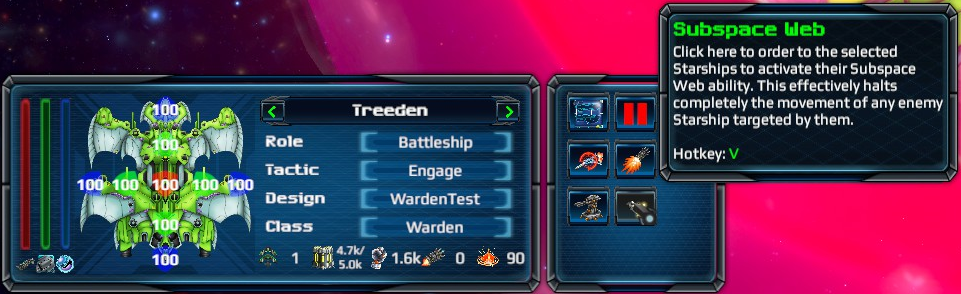
There are many other Support module types, but the most important are the ones classified as Special. These alter the game rules in some way, not necessarily combat related. For example, the Trading Holds special module allows your ships to generate income while being idle. Then there is the Subspace Web, which grants the ship the ability to temporarily immobilize a target. All the Support Modules have a value indicating how much space they occupy aboard a ship: the bigger this ship is the more space it will have and thus the more modules it will be able to fit. This is balanced by the fact that the more weapons/shields/engines/etc a ship has, the more support modules will require, so bigger ships will not always benefit the most out of this.
Battle Tactics
Once you have selected a Class and installed all the required modules you will still need to select a name and most importantly a battle tactic. This setting defines the behaviour a ship will have when given an attack order against any target. There are 4 different battle tactics in the game: Engage, Assault, Harass and Disengage.
The default tactic is Engage, in which the starship will automatically maintain optimum firing distance, with a frontal facing to the enemy. This is better served for slow-moving Battleships and Titans. In contrast, with the Assault tactic a starship will maintain movement at all times, going towards and past the target; in strike-craft like runs. This tactic works best for small starships, like Frigates and Destroyers. The Harass tactic has the ship orbiting the target at maximum range, trying to maintain the most distance with it, while nibbling at it with long range weaponry. This long-range tactic is better suited for carriers or missile cruisers. Finally there is the Disengage tactic, which is used mainly for civilian ships. This will trigger an automatic hyperspace retreat, the moment the ship comes into sensor range with the enemy.
Let us know what you think of this dev diary and on Astra Exodus’ starship design system! We will be back next week with a new dev diary.
Welcome back to yet another rambling Astra Exodus dev diary! Today we will be talking about Heroes and Espionage. If you’d like to discuss this dev diary with other fellow fans, please join the new Discord channel by clicking here.
Heroes
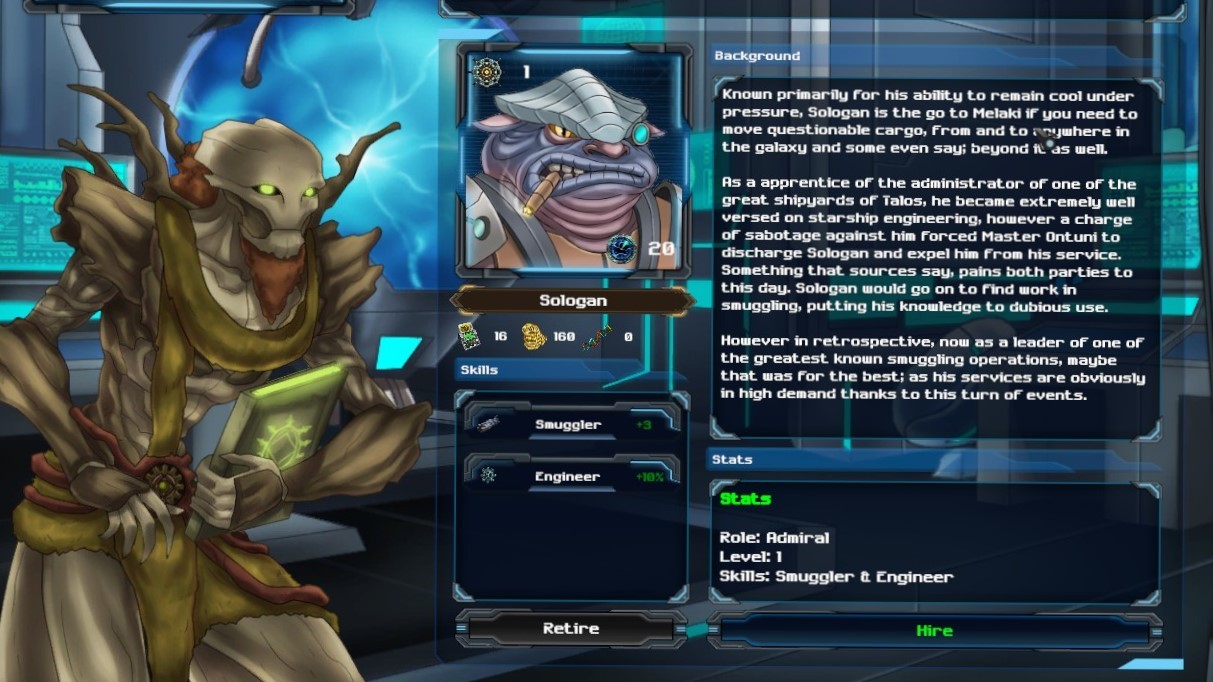
Heroes are very important characters in the galactic community, whose experience and capabilities make them incredibly powerful allies to have (in return of a hefty contract fee and salary of course). It is also through Heroes that we can have a look at the larger galaxy. From the Academy of Talos to the Wunet Confederacy and the Quantum Nebula, the backstory of each hero helps shape this narrative.
In Campaign mode Heroes are unlocked by completing missions, while on Skirmish mode Heroes will randomly offer their services to you, either spontaneously or once you find them while exploring the galaxy, stranded on forgotten planets. Regardless of how they become available to you, you will have to pay a hiring fee plus their monthly salary. Heroes in the Campaign will wait for you as long as it takes to be hired, however in Skirmish mode many will get tired of waiting and might withdraw their offer. In a regular game you can have up to 4 Heroes at your service at one time. However, there are factions traits that both increase and decrease this number.
Each hero has three possible roles to play: they can be either an Admiral, Governor or an Operative.
Admirals, as the name indicates, are experienced starship leaders. Admirals will grant advantages (for instance, bonus damage against menaces) to any ships in their fleet. Governors on the other hand focus their efforts on more earthly pursuits, providing aid to your star systems (for example, by increasing the system’s morale). Finally, Operatives provide you with a way to wage war through more subtle ways (by sabotaging the enemy colonies for example, deep behind the main battle lines).
Skills
Heroes can achieve results thanks to their Skills. Each hero can have up to 4 Skills and usually most if not all are heavily related to his or her role in the game. The more skills a hero has, the more expensive his or her services will be.
While in service, a Hero will gain experience and eventually levels. With each level gained, out of which there are 10 to gain per hero, you get two Skill Points to spend. These can be used to level up specific skills (up to level ten), significantly improving their effect on the game. This means you will have to decide which skills to level up and which to neglect according to your needs.
Espionage
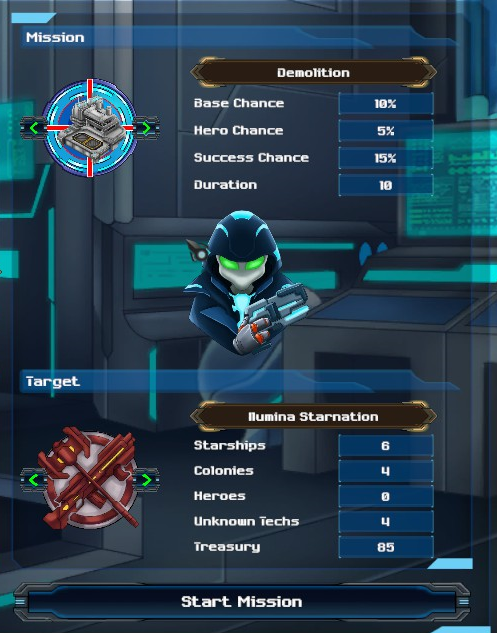
The Espionage system lets the player fight and protect from damage without using his or her military units. As previously mentioned, Operatives are the only heroes who have the skills required to conduct espionage missions. There are seven types of espionage missions available in the game:, Sabotage, Counterespionage, Hacking, Stealing, Assassination, Rebellion and Demolition.
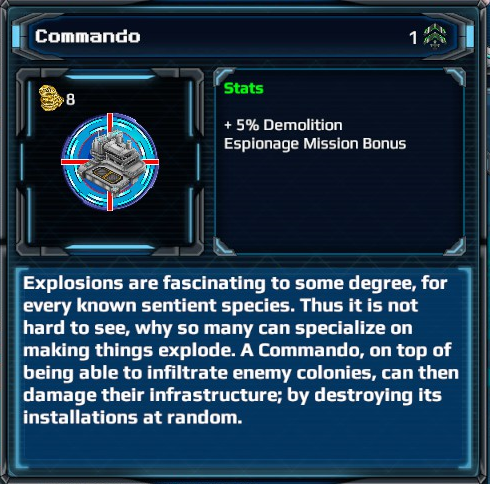
A Sabotage mission has a chance of destroying an enemy starship at random. Counterespionage in turn is used to defend, as it decreases the chance of enemy operatives being successful in their missions. Through Hacking you can extract a technology from a foreign power, while Stealing is the same concept but it applies to treasure instead. Assassination, as the name implies, revolves around killing an enemy hero. However, thanks to cloning technology, their death does not have to be permanent. Then there is Rebellion, which can turn a Colony against its own government. Last but not least the Demolition mission involves the destruction of an enemy installation at random.
We will be back next week for another dev diary of Astra Exodus!