Hello heroes! 👋
Want to playtest 🕹️🎮 the game? We are running a playtest right now! 🕺💃 Join our community and embrace the challenge in Business Heroes: Food Truck Simulation! 😉
It is no secret that the foundation of a food truck business’s success lies in the quality of its food. But the question remains, how do entrepreneurs develop a recipe that delights their customers and keeps them returning for more?
In this edition, we delve into the inner workings of the product development process and how we designed the feedback system to help players perfect their recipes.
Discovering Customer Needs 🍔
There are nine customer segments in the city. Each group has unique preferences for its burger. The player's food quality goal is to discover the perfect recipe for their target customer segment.
During our second playtest, we discovered that giving players a preferred range for the perfect recipe of each customer segment drastically improved their playthrough.
We added this range in the tooltip of each customer segment:
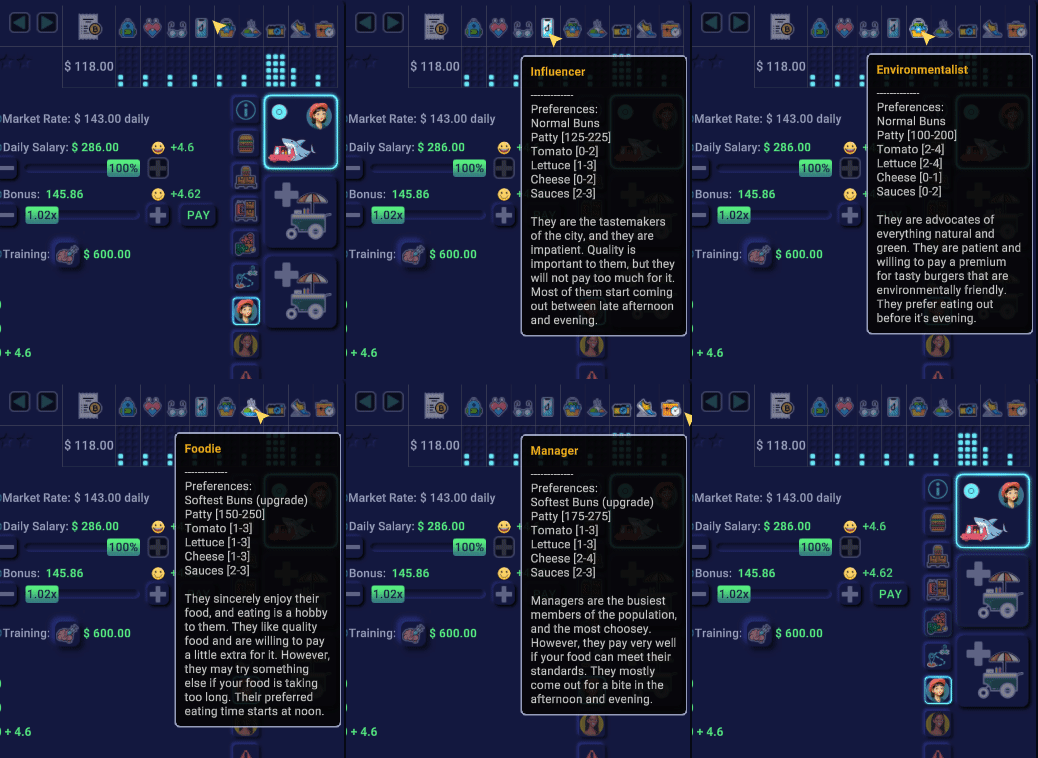
The perfect recipe for all customer segments changes with each game, but the preference range stays the same.
The recipe has five ingredients with a minimum and maximum amount that can be included per burger:
Patty: 100g - 300g per burger.
Tomato slices: 0 - 5 slices per burger.
Lettuce leaves: 0 - 5 leaves per burger.
Cheese slices: 0 - 5 slices per burger.
Sauce: 0 - 3 sachets per burger.
Depending on the player's target customer segment, they can use the preference range to decide their initial ingredient combo and modify it based on customer feedback.

Feedback Interpretation 👩🏫
We implemented a recipe feedback interpretation system to help you know exactly how much more or fewer ingredients your burger needs.
Customers give one of four types of food quality feedback whenever they buy a burger:
- Terrible burger - Yuck!
- Excess ingredient - The burger is overloaded.
- Insufficient ingredient - The burger is empty.
- Perfect recipe
Their feedback depends on the margin of difference between their perfect recipe and the number of ingredients in the burger they just bought.
Let’s take tomato slices, for example:

In the above example, 2 tomato slices are perfect for the customer segment. When no tomatoes are added to the recipe, the customer will give an 'Insufficient' ingredient feedback, meaning the slices should be increased by 2.
If 4 slices are added, the customer will give an ‘Excessive’ ingredient feedback, meaning the tomato slices should be reduced by 2.
When 5 slices are added, the customer will give a ‘Terrible Burger’ feedback, meaning the tomato slices should be reduced by 3.
Whenever the customer does not give food quality feedback, the ingredients are close to the perfect recipe and only require one increment or reduction.
Feedback Prioritization ⬆⬇
Because the recipe feedback applies to all ingredients and we only wanted to show one per customer purchase, we had to prioritize them.
Terrible burger has the highest priority. Hence if any ingredient in the recipe meets that condition, the customer will give a terrible burger feedback, even if all other ingredients are excessive or insufficient.

Excess ingredient is next in priority, but only when there is an equal number of Insufficient ingredient feedback in the recipe. If either feedback is more in the recipe, it will show as the recipe feedback.
For instance, if a recipe has an excess of 2 ingredients and an insufficiency of 2 ingredients, the feedback shown is for 'Excess' ingredients.
But if a recipe has an insufficiency of 2 ingredients and an excess of 1, then the feedback shown is for 'Insufficient' ingredient.
We hope this prioritization will eliminate confusion, allow players to quickly resolve their recipe's most severe problems, and get them closer to the perfect recipe faster.
That's it for this episode!
Don't forget to join our community to get these behind-the-scenes specials delivered directly to your inbox. Plus, we've got other exclusive perks waiting for you.
Live Long and Prosper 👋,
Team Visionaries