Work on mod support has continued. In the unreleased dev build, it's now possible to have multiple mods installed and to select specific ones to use per world. This makes it a lot easier to switch between modded and unmodded worlds, and to combine multiple mods. At the moment, this functionality exists only in the server, we've still got to add new UI elements to the regular in-game menu.
Zun did a couple of highly technical things this week, but.... they're highly technical. It's important but hard to explain. But there is something else we've been discussing for a longer time, and we think we can decently explain that!
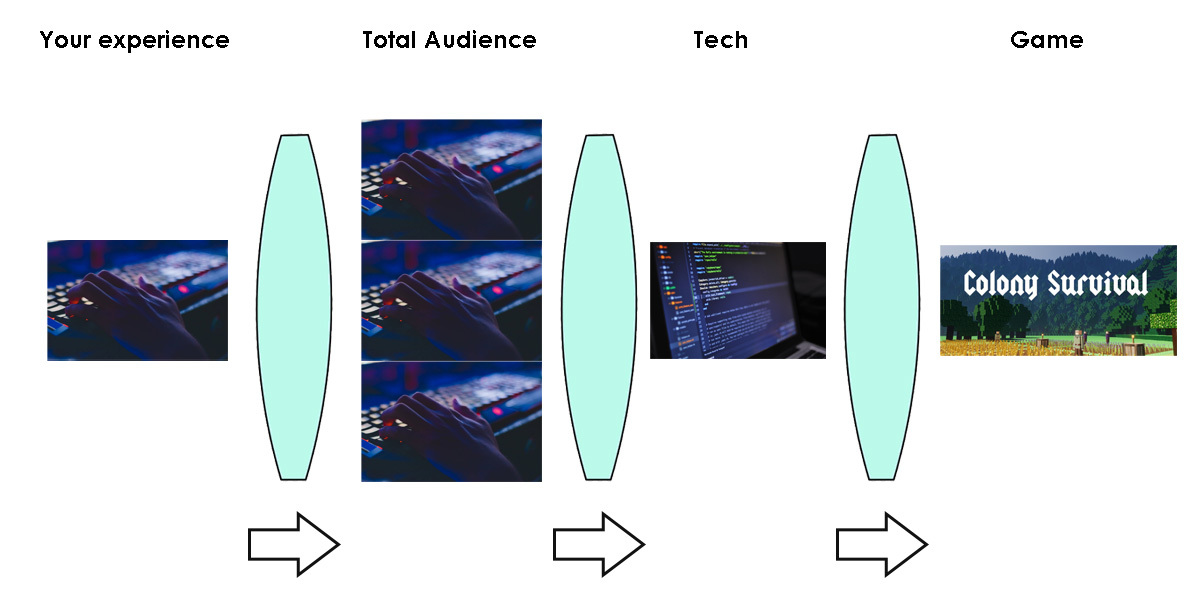
We're always listening to our community, but there are common suggestions that we seem to ignore, or at least, that we're not working on. The steps that an idea has to go through to be implemented can be pretty difficult. We think it can be best explained by a concept of three filters, or three 'lenses', that all 'distort' an idea and affect the end result. Here are these three filters/lenses:
It's easy to notice when something is wrong. It takes less than a second to conclude that a car, or a house, or a painting is ugly. It's equally easy to conclude that something tastes bad. But explaining why exactly something is ugly or wrong, and detailing which steps would fix the problem, is a lot harder. Why a specific individual subjectively likes or dislikes something is a very complicated subject, and it's hard to communicate about it accurately.
So a lot of feedback that we receive is pretty 'raw' and relatively unspecific, and it takes 'processing' on our side to figure out the exact problem and potential solutions. For example, in update 0.4.0 we added quite a lot of content to the science system. Players kept suggesting a hierarchal tech tree, something you'd see in games like Civilization. We were opposed to that, because it would make the tech tree harder to change, and it's going to need a lot of change before we leave Early Access.
It took us a while to realize that we had to do some interpreting. We should not have read it literally as "the game lacks a hierarchal tech tree". We should have understood that it meant something like "the current science system is unclear and it should be more intuitive". We spent a couple of hours working on it, we added clear labels and separations between different categories (available, unavailable, completed) and we applied a black-and-white filter to unavailable science. Since that update, the "hierarchal tech tree" suggestion has all but disappeared!
During World War II, using airplanes for mass bombing was a relatively new strategy. Lots of bombers were shot down, and engineers tried to optimize their survivability. They analyzed where bombers were hit when they returned from bombing missions, and were considering to add armor to these areas. These areas can be seen in the image above. Pretty smart!
Until statistician Abraham Wald thought about it. It's hard to aim accurately at planes flying at high altitudes with 1940s tech. All parts of the plane were probably hit pretty evenly. But a direct hit to the cockpit or the engine would have a much more catastrophic impact than a hit to the edge of a wing. Critically hit bombers would not return to allied territory for a thorough damage inspection, so only bombers hit in less important areas would be included in the analysis. This is called 'survivorship bias'.
So Wald gave the opposite advice: don't add armor to the areas that seem to get hit all the time, add armor to the areas that always seem to be unscathed! They are vital to the survivability of the plane.
We have got to keep this advice in mind. Only a small minority of players writes reviews, leaves comments or shares their opinion on Discord. These are the "survivors" that we notice - but how many were 'shot down' somewhere along the way? People who would've loved the gameplay but were turned off by their first impressions, people who tried the game for an hour but didn't "get it", people who happily played for dozens of hours but don't care about blogs and surveys. How different are they from the people who "survived" to the survey or Discord?
In recent surveys, "better tutorials" received a very unenthusiastic response. A large majority voted for the "low" and "very low priority" options. We believe it's too easy to conclude that a better tutorial is indeed not that valuable. Those players who would have most benefitted from a tutorial are probably the ones who have the lowest chance of sticking around and participating in surveys.
So we've got to keep in mind - who is giving comments, who is answering the survey, and to what degree do they reflect the audience we're trying to reach?
Lens Three: Technical Difficulty
Every feature has a cost. In development time and in performance. Both are limited, so we've constantly got to weigh whether what we're doing and choosing is worth the expected improvement.
How much development time something costs can be highly unintuitive. Some things that are very easy in real life are very hard in tech, and vice versa. If you want to give the walls of your living room a different color, it will take many hours of work in real life while a similar task is often accomplished in seconds if you do it digitally. The best chess players of the world have been consistenly losing to computers for more than twenty years, while a four year old child is still better at holding a conversation than the most advanced Artificial Intelligence of 2019.
Zun has pretty much written a custom engine for Colony Survival. I'd say it's highly optimized: it can run on pretty old hardware, and you can have lots of colonists and monsters without lag on regular hardware. It's highly flexible and easily customizable in certain areas, while it's rigid and limited in others. Some things that seem easy aren't, while other things that seem hard, aren't either.
One special technical complication for Colony Survival is the server/client split. When you're joining an online server that somebody else runs, you're only using the client. If you're playing a singleplayer world, the game sneakily launches its own server in the background. But a lot of things that you'd expect to be relatively simple, are actually separated between a client component and a server component that have to communicate between each other. The client is relatively dumb - it doesn't even know whether a colonist is part of your colony or not, nor does it know where a colonist is going. It just waits to receive that info from the server. We're considering to add such info in UI elements and tooltips, but the server/client split requires us to add additional steps: first the client has to ask the server, the server has to process the request and send information back, and then the client has to handle that information.
So this adds another layer of complication. An idea can sound brilliant and be widely appreciated by the entire audience, but if we don't expect to be able to get it work decently within a reasonable timeframe, we've got to ignore/postpone the idea...
Conclusion
We hope this makes clear how hard it is for a random suggestion to become the thing we're working on, especially if it's a big feature that requires a lot of development time. I struggle with the exact same problem: I'm pretty sure at least 4 out of every 5 suggestions I make is shot down by Zun and/or Vobbert :) But the fact that we're not working on your exact suggestion doesn't mean we're not listening - we're constantly monitoring how people react to both in-game and potential features and callibrating our priorities accordingly. So please keep sharing your feedback, it's valuable and definitely influences the direction of the game!
Work has continued on Steam Workshop support. Currently, every mod you've installed affects the game in its entirety. We're changing that. You should have the ability to enable and disable mods for every individual savegame. You should be able to play both non-modded and modded worlds without having to deinstall & reinstall mods. This means mods have to load after you've selected a world, not when they currently do: when you launch the game. Rearranging this is going well.
We've also taken the first steps in adding client mod support. At the moment, we only support server side mods. A lot of things can be done there: adding new blocks, new monsters, new science. But other things are impossible to accomplish: you can't overhaul the interface, for example. We want to make this possible in 0.7.1.
It's difficult to predict precise timelines, but we expect 0.7.1 to be ready for release within 1 to 2 months - perhaps 3 if testing shows a pressing need for certain other features.
Potential Progression
While Zun was in Japan, I tried quite a lot of new games, and it really caused me to think about making sure the start of the game was as intuitive and engaging as possible. Now that Zun's back, we've focused on a single multiplayer game and played that together for a while. It made us discuss the progression system in Colony Survival.
We arrived at the conclusion that we're lacking a clear, stable path forward. In a lot of games, there's a clear progression system: gain XP, level up, new skills and items become available, repeat. Colony Survival's central progression system is science, but the required ingredients vary wildly from one research objective to the next, and it also ends pretty abruptly.
Eventually (after Steam Workshop support, after improvements to the UI and the early game) we'd like to make that a lot better. We'd like to add some core resources like XP/VAT (for distributing happiness items), data and/or electrical energy that can be systemetically gathered and used to improve your colony for a long, long time.
But Zun immediately added the disclaimer that he doesn't want to merely add "stats grinding", he'd like to introduce new mechanics as well. We've thought of adding new mechanics to the endgame, but Zun suggested that we add them before the current endgame, instead of afterwards. There could be some early industrialization in the center colony, requiring minecarts, rails, steam engines and the primitive production of electricity. Further upgrading this to more modern forms of technology would require resources from distant biomes, like rubber and oil.
Last week, we shared our opinion about climate change. It lead to some interesting discussions and quite a lot of comments. Nobody seems to have been opposed to the things we've said specifically, but we did receive a number of responses that reminded us that they in general don't like to see games & politics mixed. We respect that, and aren't planning to make political commentary a regular part of the Friday Blog. We'll keep our opinions to off-topic #serious on Discord :)
Friday Blog 122 - Working on Steam Workshop Support, Alt-Mouse & Climate Change
After 3,5 week of holiday in Japan, Zun is back in the Netherlands! He arrived here last Friday, so this week was a regular workweek. Our first priority is Steam Workshop support. There are awesome mods available for Colony Survival, and we want to make it a lot easier to discover, install and use them!
Zun has focused on a relevant technical issue. Players automatically download audio, textures and meshes when joining modded servers. This requires servers to send hundreds of files, and players have to cache each of these individually. It's suboptimal, prone to problems and relatively unsafe. Zun is revamping all these systems, making them quicker, safer and more robust.
During his absence, I made a list of potential improvements. These mainly concerned the UI. We've discussed this now and have agreed on which ones to implement.
Much of the UI is pretty barebones and primitive. The Colony-tab is a disorganized chaos. Some buttons are merely white rectangles, sliders are very primitive shapes and menus don't have borders. We feel like a major improvement is to add some 'lighting/shading'. With some minimal effects, we can make it look like the UI has some 'depth', with for example the top and left of borders and buttons being a bit brighter, while the bottom and right side are darker. Doing this consistently should make the UI feel clearer and more professional.
Another thing we've talked about a lot is something we're now calling "alt-mouse" or "free mouse" internally. Currently, while playing, the mouse is used to steer the direction of the player character. In top-down view (which will always be optional, we're not going to remove first person view), players could be free to use the mouse to hover over the world and click both in-game items and UI elements. This could make the game both easier to control, and more accessible to new players. Take for example the statistics in the top-left and top-right corner. You can't hover your mouse over them while playing, so we cannot display a tooltip. When "the mouse is free", we could consistently add tooltips to UI elements ánd in-game items. Imagine hovering your mouse over a colonist and getting some info about him and his path, or imagine hovering over a monster and getting some details on his health, speed and special abilities. Imagine checking and changing jobblocks from a distance.
Instead of developing a new UI for top-down view only, and keeping the old one for regular first person gameplay, we'd like to develop a consistent UI that can largely be used from both perspectives. By pressing a button like "alt" in the first person perspective, the mouse would be "freed" and allowed to roam the screen - letting players select colonists and jobblocks from a distance. Imagine quickly going to the top-right corner of your screen and adjusting which items are tracked and displayed there. The consistent tooltips should make the game more intuitive and easy to learn, while the free mouse simultaneously alllows us to add more complex mechanics for advanced players. We're very enthusiastic about it and would love to hear your opinion!
Steam Workshop support is a technical issue that doesn't require new models or textures, so I can't help Zun a lot there. That's why I've decided to continue learning about Unity and programming. I've really noticed that things that seemed complex and barely understandable initially are becoming pretty intuitive.
I've been working on a simple ecosystem, with growing grass and hungry animals finding and eating them. Here's a small GIF. I hope to have expanded it further next week!
[End of the regular Friday Blog. If you think climate change is too political, you're free to stop reading here, you won't miss important game-related stuff]
Zun and I live in the Netherlands. It's a small, densely populated country. Despite that, we're the second-largest agricultural exporter after the US. Apparently, letting lots of people, lots of agriculture ánd some patches of nature coexist in a small country is pretty hard. The government claims there is too much nitrogen pollution, which disrupts natural preserves. The farmers get a lot of the blame, and one of our ruling politcal parties says they want to get rid of half the amount of livestock in the country.
Simultaneously, activists from Extinction Rebellion are blocking important streets and infrastructure in Amsterdam, and they seem to be doing the same thing in London and other major cities globally. Lewis Hamilton posted a depressing story on social media: climate change is such a major problem for him that it makes his entire life feel meaningless, and he wants to shut down completely and give up on everything. And finally, Greta Thunberg's "how dare you-speech" is very recent, and it's still the target of daily memes.
The centre of Groningen occupied by farmers
So the subject seems very important and divisive, already affecting lots of people in their personal lives. We feel like our own opinion is pretty underrepresented and love to share it.
We feel like there are two major groups in the world. On one hand, there are those who care a lot about the subject. We often hear calls from them about giving up all kinds of luxuries and conveniences. Stop eating meat, sell your car, stop using airplanes, only buy used clothes, don't have children.
We're not very enthusiastic about that. Most people are not going to give all of that up voluntarily. And even if people in Western countries did that, lots of non-Western nations are still developing rapidly, with growing populations who are using more energy and consuming more products. We don't want to go back to a medieval standard of living, and we don't want to deny developing nations a higher standard of living either.
On the other hand, there are those who completely deny climate change and act like there's nothing wrong. That seems naive and unwise. Our society and our economy have changed a lot in the past one - two centuries, and that definitely has adverse effects.
The only viable solution seems to be technological. We need better, cheaper batteries to power cars, planes and homes. We need safe nuclear energy. We need lab-grown meat. There are lots of potential optimizations that allow people to keep comfortable lifestyles while dramatically reducing our impact on the environment.
Scientists are already working in these directions. Humans have made major progress in the last decades. Creating awareness for climate change is a good thing, but we should make sure not to make people hopeless. There is a road forward - a road of progress and improvement, not one of restrictions and asceticism. We would love to see less division and polarisation, and móre humans working on a better future.
What's your opinion? Should our Friday Blogs touch subjects like this? Do you worry about climate change, and what do you think about potential solutions? Let us know in the comments or on Discord!
Friday Blog 121 - Survey Results and The Return of the Zun
This is the last day of Zun's trip to Japan! He should be back in the Netherlands this evening.
Last week, we asked you to participate in our survey. 390 people did so - thanks a lot! Lots of people have asked us to share the results, so we'll do exactly that.
Most people seem to quit playing the game after reaching at least 250-300 colonists, but right before hitting 500. Multiplayer is more popular than I thought, and quite a lot of you have tried mods!
It's interesting to see how many of you are on Discord. Especially in the first hour, nearly all participants had joined it. I do wonder how exactly the cycle works. Is Discord the best way to keep in touch with fans of the game who like reading the blogs, or is Discord just the best way to reach fans? Do we lead fans to Discord, or does Discord lead fans to the blog? I think there's a bit of both.
Last but not least, only a small minority of you has written a Steam Review for Colony Survival! We do appreciate them - but it's also fine to wait with the review until the definitive release :)
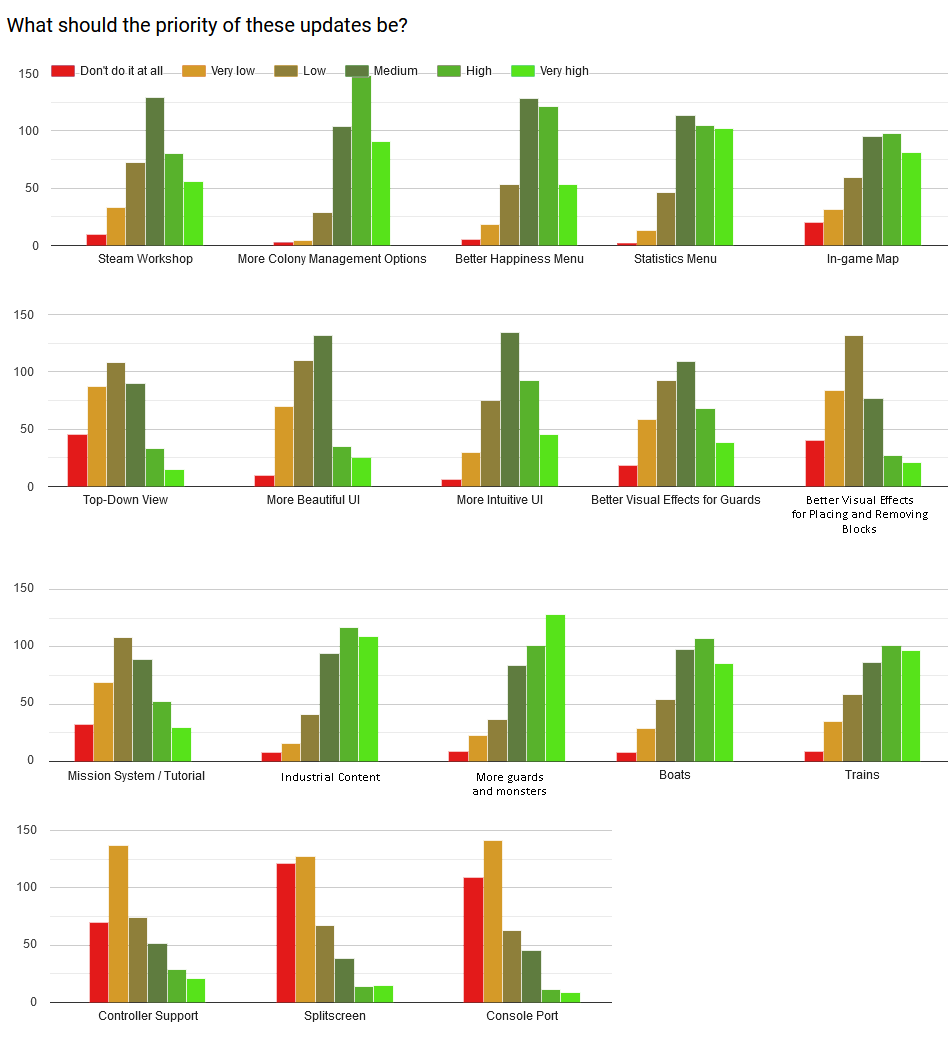
Here's a list of all the major features and changes we're currently thinking about, and a ranking of their priority by players. They're roughly in the order we want to implement them, although the mission system probably comes earlier.
We're glad to see that Industrial Content has become pretty popular! It was more controversial in the past. We held another survey shortly after releasing 0.7.0, and new content was in relatively low demand at that time. Interesting to see how that has changed as well.
It's interesting to see how some features aren't merely considered "very low priority", but are actually opposed. For example, better visual effects for placing blocks, top-down view, controller support and splitscreen. We often hear that lots of people miss splitscreen in modern games (and we consider ourselves part of that group) but it's clearly unpopular.
You were quite a bit older than I expected! I noticed lots of people in the range 16 to 21 joining the beta a couple of months ago. I'm surprised by the amount of 26+ year olds - but a mature audience is certainly welcome! Especially the earliest responders were relatively old.
The total playtime is also very high! Nearly half of everybody who responded played for more than 100 hours, nearly three quarters played 50+ hours.
The last part of the survey were two forms where participants could leave custom suggestions and answers. I won't share them, both for privacy reasons and because there's no room here for literally 500 answers. But the answers were very interesting, helpful and encouraging! Lots of good insights, new suggestions and very kind words :D
So, Zun's holiday is over. He has enjoyed his time there, and in the meantime, I've been learning a lot of new things and gained a lot of insight into programming, Unity and game design. We're looking forward to developing new updates next week!
Friday Blog 120 - Survey + Drawbacks of a Better Interface
We've got a new survey! We'd love to see your answers. Here's the link.
Zun is currently entering the last week of his holiday in Japan. He is scheduled to arrive back in the Netherlands next Friday!
This is the first month-long break in development since releasing the game more than two years ago. While practical development is paused, we're still thinking about the game a lot. I do it pretty much all the time, and Zun mainly while visiting castles and when he's reading all of my rants / discussions with Vobbert when he returns to the hotel.
The combination of the break, and having access to like a dozen new games on both my PS4 and PC, has really changed my way of thinking about Colony Survival. We've been working on and playing the game for more than five years now. We know how all the systems work and have deep experience with them. It has become very, very hard to imagine what a new player goes through.
But being a new player in a different game, with an eye for gamedesign, is extremely useful. Instead of trying to extend the endgame by adding new content and features, I'm now highly motivated to redesign the early game to be clearer, more fun and more intuitive.
All photos in this blog made by Zun in Japan
Some improvements are obvious, but some parts of UI design / QoL improvements can be very counterinuitive. For example, both Classic Runescape and Classic World of Warcraft are making a resurgence. Why, when there's a more polished, more modern alternative of the same game available?
One reason is the lack of Quality-of-Life features. When trading is hard, you need to assemble at an in-game location and compete with others who are "physically" present. Adding a digital Auction House where it's easy to offer and purchase goods is technically an improvement. It makes gameplay smoother. But the point of games is not to offer smooth rides - players often want interesting challenges. And to many, the old way of trading was exactly that.
Another example is raiding and guilds, mainly in WoW. In early WoW, raiding was hard. You needed to find a group of like-minded players, determine which dungeon to attack, determine a date and time, and make sure everyone starts travelling there early enough. This was relatively hard to accomplish, and it encouraged people to join guilds and communicate outside of the game.
Throughout the years, the developers have tried to make raiding easier, allowing people to team up with strangers from other servers automatically and making travel less restrictive. While I 100% understand why the devs have tried to do this, it has partly removed the challenge that players loved, and made guilds way less important. This makes people less likely to make friends and thus less likely to stick with the game in the long term.
The same idea holds true in singleplayer games. In the past week, I've played a couple of hours of both Metal Gear Solid V and the new Ghost Recon Breakpoint. On the surface, they're pretty similar. Open world stealth games with vehicles and gadgets.
But one big difference is that MGSV has no mini-map and no automatic objective markers, while Breakpoint has both. At first I missed the mini-map in MGSV, but then I realized how it impacted gameplay. In MGSV, I actually take my time scouting, using my binoculars to mark all enemies. I look at the physical, in-game terrain to find enemies.
In Breakpoint, I look at the mini-map, and when I see a red blur on the map, I align my character to watch straight at the blur and then try to spot the enemy. No surprises, no extensive scouting, just running/driving forward and pausing a moment when I see a red blur. It obviously makes the whole stealth gameplay less immersive and exciting.
The game itself sort of realizes this. When I got tasked to visit a distant harbor, the game explained that I could toggle off objective markers and try to find the harbor myself based on some descriptions. On one hand, I loved the idea. On the other hand - I didn't do it!
So why didn't I turn off the mini-map and the objective markers if I like that so much? Metal Gear Solid V was meant to be played without them. To compensate for this, they added features like interrogating enemies, an advanced binoculars with many zoom levels, and enemies that stand out from the terrain. It was designed, tested and reviewed like this. But Breakpoint isn't like that. Enemies are often hidden in foggy and hazy swamps, and you don't start out with great binoculars. Disabling these features might be interesting when playing the game for a second time, but during my first round I'd like to play the game as intended.
We're not trying to trash WoW, Runescape and Breakpoint here! We're just trying to distill some principles of game design. I'd say these are two counterintuitive rules:
Quality-of-Life improvements can make your game less fun to play
Simply allowing players to turn these features off is not a perfect solution
The examples above are highly related to last week's blog. Games should be challenging, but creating the right challenge is very hard. Every individual is different, with different amounts of game experience, different preferences and different time constraints. What's challenging for one person might be too boring for someone else. Zun and I feel like we're stuck in the middle.
We've played lots of games in the past twenty years, so many popular AAA titles aren't that interesting for us. "We've done it all before", and a generic third person action game with some looting and crafting doesn't show us anything we haven't seen before. Many of these games are aimed at more casual audiences, with a tutorial streteched over hours of intro. We've got a hard time getting through that.
Luckily, there are indie games with ambitious goals. While they may contain more depth and more unique gameplay mechanics, they quite often suffer from bugs / performance issues / bad UI design / lack of a decent tutorial, making it very hard to get into them. That's one of the reasons that pushed us in the direction of game development - we had a hard time finding the games we wanted to play.
Now, we don't want to imply that all games are bad or that Colony Survival is perfect. Metal Gear Solid, Rainbow Six Siege, Factorio, Kerbal Space Program and 7 Billon Humans are all great games. But I believe there's plenty of room for more games with unique gameplay mechanics, great depth ánd an intuitive UI / tutorial / intro that makes getting into the game smooth!
All pics in this blog made by Zun in Japan, who is halfway his holiday
Fifty blogs ago, I wrote a vague rant about chaos and order keeping games interesting. Nearly a year later, I've reached the same conclusion again, but I've started applying it to more and more stuff. I've spent this week learning about programming, discussing potential improvements for Colony Survival, and playing new games on the PS4. The more I thought about the fundamentals of these things, the more they seemed the same.
Let's start with a summary of last year's theory, brazenly stolen from Jordan Peterson. Chaos = The unknown, the undiscovered, darkness, evil, pain Order = The known, the discovered, light, goodness, pleasure
It seems that nearly everything we do in life seems to fit the description of turning chaos into order. We eat to turn hunger into satiety, we study to turn the unknown into the known, we travel to turn the undiscovered into the discovered.
This cycle causes a couple of interesting problems. Firstly, once we've read a book, or watched a movie, or been in a location long enough, it's fully/mostly known and we grow bored of it. So that leads to the second problem. We don't crave order - we crave turning things into order, so we actually need chaos. What's a videogame without enemies, a movie without a compelling villain, a life without any kind of struggle?
That's the origin of the yin and yang symbol - the realization that these opposing forces complement eachother, and that you need a nice balance of both of them. Too much chaos, and you can't understand anything, can't make any progress. Too much order, and you're bored or stifled.
I think the relation to game design is obvious. We've got to make sure that Colony Survival is exactly that engaging mix of known systems and interesting threats, from the first ten minutes onwards, as long as possible. We believe there's currently too much "chaos" for a lot of new players, so we're going to work on improving the interface. But there's not enough of it for experienced players, so we'll also add new threats that only appear for larger colonies.
Programming
This week, I've continued to learn about programming, and I've really noticed the importance of the pattern above. Programming can be very overwhelming. It can be a 'land of chaos' where you fail to accomplish anything of use. There are quite a lot of weird rules you've got to know before you can succesfully execute a program. When you start running into arcane errors, or when you try to build things in Unity but things fail again and again and it's hard to find the source of the problem, it's easy to give up because you just don't see a way forward.
Something that really helped me grasp the fundamentals of programming better in a very enjoyable way was 7 Billion Humans. https://www.youtube.com/watch?v=KYdH5MoAGKI I played it a couple of weeks ago and I definitely notice that I find it a lot easier to understand and write code now. It's a game about giving programming-like instructions to a group of robot-like humans. You can see exactly how each human goes through your instructions, and where it goes wrong. That's something that doesn't happen during regular programming, but experience with 7 Billion Humans helps you visualize it for yourself.
And the brilliant thing about 7 Billion Humans is how it continuously has an optimal balance between chaos and order. Each new command is properly explained and first used in a simple puzzle, after which the difficulty slowly ramps up. In the end, you'll be doing pretty complicated stuff that is truly valuable outside of the game. For anyone who is even remotely interested in programming, I'd definitely recommend it!
"Have you gone mad?"
"What's all this nonsense about chaos and order? Did he really only just figure out that games have to be the right balance between understandable and challenging?" If you were thinking that, I fully understand!
I'm pretty sure most of you think that the fact that things have to be a bit challenging (but not too much!) to be interesting is common sense. But I've spent the past two weeks learning about Unity and programming, playing new games on the PS4, and thinking and talking about Colony Survival in these terms. I've taken a very thorough and critical look at what I am confronted with and how I respond to it.
When does a game truly engage me and motivate me to keep playing? When do I get a bit bored but continue anyway? When do I quit in frustration? And of course, exactly the same questions can be asked in regards to programming.
In the end, I was "rating" and comparing every detail of the games I played. Their tutorials, their animations, their menus. And I believe I've learned a lot in terms of how to build an engaging tutorial and a compelling progession system.
Just a comparison between Metal Gear Solid V and Red Dead Redemption II is very useful. RDR's world is more technically advanced and more detailed. But I still have a hard time "getting into" the game. The game is mostly focused on the story, and at least in the beginning, there doesn't seem to be a lot of "long term interaction" between the player and the world. Sure, you can kill random people and make the sheriffs angry at you. You can hit a signpost while riding your horse and ragdoll of your horse realistically.
But the progression system mostly seems to focus on "eat, drink and bathe to keep your HP/stamina high". I need to play scripted story missions to progress, I can't go adventuring and free roaming and significantly improve my character by just doing that.
On the other hand, MGSV quickly explains all of its progression systems to you and makes it very clear when you're interacting with them. To unlock new weapons, gadgets and uniforms you need to collect GMP, resources like fuel and staff. You need staff in multiple branches, and every soldier has unique stats making them more or less suited for these branches. All of these can be found in the open world. You can get new staff by knocking enemies unconscious and extracting them to your headquarters. These headquarters can be visited and upgraded, physically adding new structures.
At the end of every mission there is a detailed report. You receive bonus currency for completing side objectives and for being quick and stealthy. You lose currency when you get spotted and ignite open combat. All the gear you carry into the field also costs currency, so there is an incentive to only pick what you need.
There's something very satisfying to spotting an enemy with exactly the skills you need, sneaking towards him, putting him to sleep and extracting him, knowing that you've permanently upgraded your headquarters. Both the action itself and the rewards are fun. Designing a game that does both in the long term is quite a challenge!
Next week will probably be the last Friday Blog while Zun is still in Japan. When he's back, Steam Workshop support is one of the highest priorities. And when that's finished, we'll significantly overhaul the interface and the progression system!
[Zun is in week 1 of his 3,5 week holiday in Japan - making this blog an intercontinental collaboration!]
Since launching the game on Steam two years ago, we've received many requests for a console port. We've always held the stance that we don't want to release Early Access updates on multiple platforms simultaneously. We're going to finish the game first, and only publish on consoles once that's done.
But that doesn't mean we aren't thinking about it. Changes that are necessary for a console port, like controller support, benefit PC players as well. We'll be adding features like that before the port itself happens.
Combined with Zun's holiday, I used this as a good excuse to purchase a Playstation 4. We hadn't really experienced modern consoles since purchasing an Xbox 360 more than a decade ago (I feel old now). I also purchased a good amount of PS4 games, mostly exclusives that I had been unable to play.
I'm not just sharing this because I'd like to talk about how I spent my spare time. As a game dev, knowledge of game platforms and modern games is highly important. What do other games do well that we can use for CS? What do other games lack, leaving a niche for us to fill? What are the benefits and drawbacks of other platforms? There is no fixed set of rules, no standard manual for developing a great game. Experiencing lots of games and analyzing them seems to be the best way to get some insight.
On the PS4 itself
When we were young, PCs were hard and difficult to use, while consoles were the opposite. PCs required the right combination of hardware and drivers, installation procedures and activation codes, lots of Googling to solve errors and tweaking with settings.
Consoles laughed at that. Buy a disc, insert disc, game works. Couldn't be easier! I was looking forward to smooth sailing like that.
Nooope. That didn't happen. I didn't buy discs - it's 2019! I wanted to buy digital copies. So I opened the store on my PS4. It was slow. Very slow. And cumbersome! Navigating Steam with your mouse (and multiple tabs) is so much easier than swiping through tiles on the PS4, slowly loading individual pages, not finding the info you're looking for and digging through menus to find what you need to know. Most of us take Steam for granted, but I was really missing its features at that moment. Eventually, we resorted to Zun browsing the Playstation Store on his smartphone to help me out, and in the end I even purchased games on the Playstation website using my desktop PC.
That was a bit disappointing. Steam uses all kinds of tricks and tools to display personalized suggestions to every user, and these systems generate most of our day-to-day income. We expected PS4 to work in a similar way, but my first, personal experience wasn't like that.
Actually playing the games was a struggle as well. Downloading was slow, and when that was finished, these games still required installation. I was expecting the 30-60 second procedure from Steam games, but I was watching progress bars that literally didn't move! Apparently, it's normal for games like Star Wars Battlefront to require 10-15 hours of installing. I didn't know that, and it seemed ridiculously inconvenient compared to the PC games I'm used to.
Luckily, the PS4 is good in downloading and installing an entire list of games while in rest mode, so one night later the games were ready to go.
All photos in this blog made by Zun
On Red Dead Redemption II
I absolutely loved Red Dead Redemption 1. I literally left my last final exam in highschool early to get this game, and I have never regretted it. I was intensely curious when the sequel released last year, but without a modern console, I couldn't play it. I did watch this very informative (and funny) video though, and it really alligns with my and Zun's view on game development:
https://youtu.be/MvJPKOLDSos I'm still playing the intro, so I can't post very deep, insightful conclusions now. The world is absolutely stunningly gorgeous. Very, very impressive. The animations are top notch and unprecedently realistic. But I'm a tad worried about the actual gameplay. In regards to free roaming, there are lots of things you can do, but I'm afraid they won't really amount to anything. You're free to fish and hunt, but your camp doesn't seem to depend on it or really benefit from it.
On Spider-Man (the 2018 PS4 game)
This was the game I was looking forward to most when I bought the PS4. Batman: Arkham City generated some of the best gaming experiences I've ever had, and this game seemed to have learned quite a bit from it. Webswinging through New York also seems brilliant.
Well, I've played it a lot now. The webswinging is brilliant. The combat is great. The stealth is good. What surprised me the most is how deep, comprehensive and intuitive the progression system is.
There are at least three upgradeable "tech trees" - one for your suit, one for your gadgets, and one for your skills. These upgrades often require certain missions in the main storyline to be completed before they become available, but you still require tokens to unlock them.
These tokens do not require a boring grind. There are a lot of different kinds of tokens, and each requires its own kind of action. Stop random crimes to gain crime tokens, find backpacks to gain backpack tokens, defuse bombs to get challenge tokens and defeat enemy bases to gain base tokens. It really is a very addictive system, and the loop of completing story missions, free-roaming, gaining tokens and unlocking new gadgets and upgrades is extremely satisfying.
These systems might not sound innovative, but swinging, sneaking and fighting as Spider-Man is. Exciting gameplay combined with a perhaps standard but very deep and well executed progression system is perfect for me.
What I've learned
This experience reaffirms to me how important it is to revamp and upgrade Colony Survival's progression system. Currently, crafting and distributing happiness items happens automatically, in the background, pretty much invisible. I believe it feels unrewarding. What if distributing happiness items resulted in a unique resource like XP, that can be used to improve the productivity of your workers? What if we track the amount of items you produce, the amount of monsters you kill, the amount of arrows you fire, the amount of nights you've survived, display them in a beautiful statistics menu, and integrate them in the tech tree? For example, "fire 250 bronze arrows" as a prerequisite for unlocking the crossbow.
We'd love to know how you feel about these subjects. What's your experience with consoles? What do you think of RDRII and Spider-Man? What kind of systems in games do you hate, and which ones do you love? How do you feel about the suggested changes in Colony Survival? Let us know in the comments or on Discord!