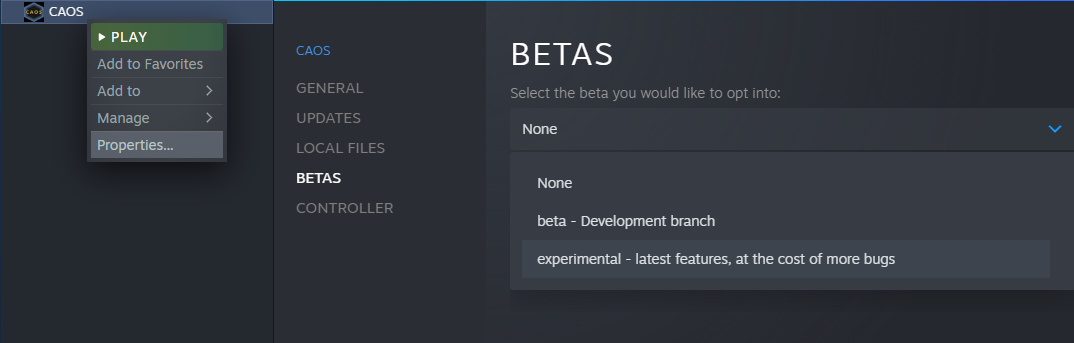
Update 1.0.8.2 - Combined Content and Polish Update
Update 1.0.8.2 is here with a host of improvements and content additions, big and small! On the UI/immersion side, we are very keen to hear your feedback on our first pass at turn resolution and C2 visualization improvements. On the content side, we have a ton of additions to German and Soviet forces in 1941, namely a the addition of 2 full new OBs: Heeresgruppe Nord, and its Soviet adversary the Northwestern Front, as well as an update to the "standard" German 1941 OB. All in all, lots of fun new explosive toys to throw around, and general interface improvements.
Immersive Turn Resolution and Dynamic Command Hierarchies:
Update 1.0.8.2 brings an experimental pass at improving the visualization of turn results and better visualizing command/control hierarchies. We are particularly interested in player feedback on both systems.
Improving Turn Resolution/Replays:
We have several improvements that affect both turn resolution, and the replay system:
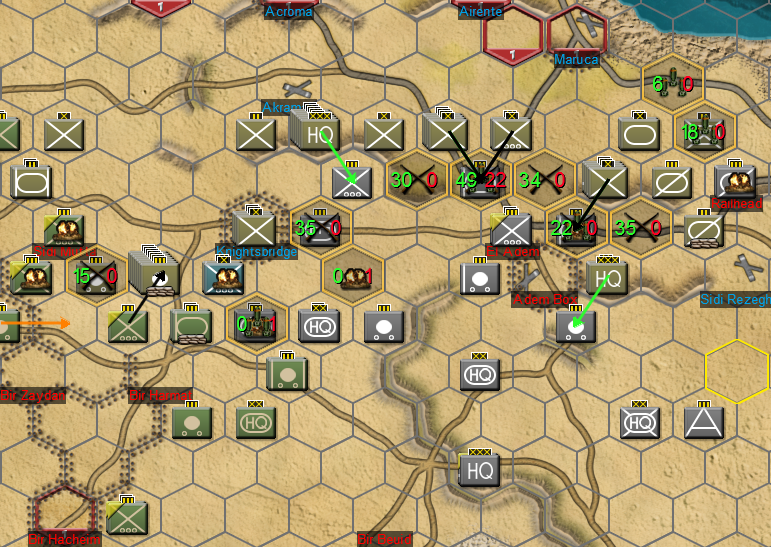
Hexes now highlight after combats/barrages/air attacks, and keep a running tally of total casualties, per side, in that hex during the turn.
Enemy units now display directional movement arrows when they attempt to move/attack into one of your units, or your Zone of Control.
Turn replays include a modified version of both above changes that reflect what happened in each impulse, so you can better analyze what happened as the turn unfolded in retrospective.
In our internal testing we have found: 1) works incredibly well, and makes it MUCH easier to visualize what is actually happening as a turn unfolds. 2) Is a helpful addition. 3) Is a good pilot, but it only scratches the surface of what we could potentially do with replays, since replays do not have to worry about moving quickly, unlike turn resolution itself.
Regarding point 2, we initially experimented with displaying both side’s movement lines and color coding them, but this caused contested frontlines to descend into unreadable tangles of movement lines as both sides attempt march attacks through each other. Internally, we have discussed the idea of adding a series quick filter system to the turn replay system to let the player decide what interaction lines (movement, artillery, etc.), per side, they want to see and leave it to player discretion. But we have not yet prototyped that concept.
Visualizing Command Hierarchies
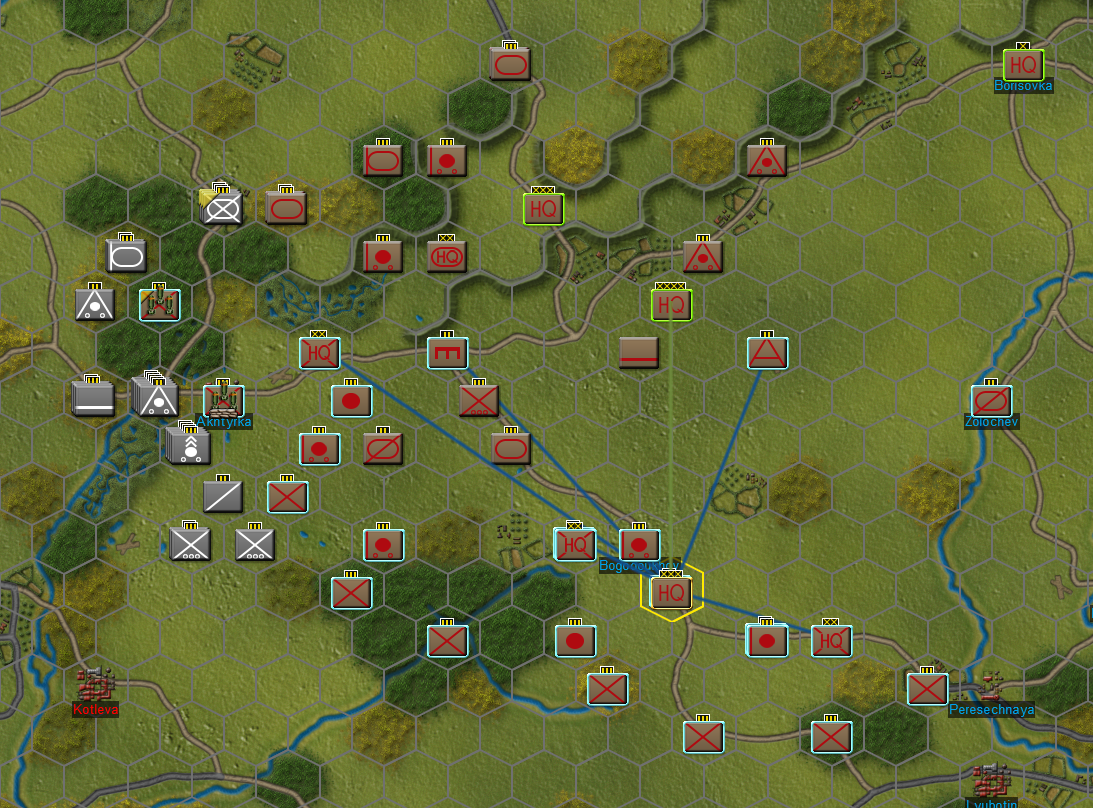
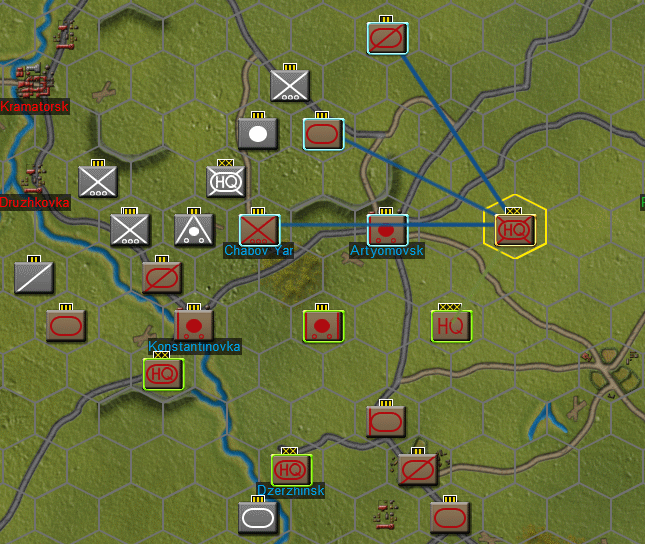
One of the biggest challenges in any large-scale CAOS scenario is identifying what units are relevant to each other at a glance. Who shares the same command hierarchies and thus, what units can benefit from integrity bonuses together? To help tackle this challenge, selecting any friendly unit will now highlight subordinate units with blue frames, and superior units/sister units (those that share the same higher command), with green frames.
This change allows you to visualize connections between entire blocks of units extremely rapidly. For instance, select a Corps HQ and see every single unit descended from it highlighted at once, from division commands all the way down to individual companies detached from some distant subordinate. This mechanic only shows the current, unbroken, chain of command. If an intermediate unit/HQ somewhere along the chain is destroyed, then its subordinates will no longer be highlighted by their former higher command as they are no longer eligible for integrity combat bonuses.
Heeresgruppe Nord and the Northwestern Front
Heeresgruppe Nord and the Soviet Northwestern Front in their late June/early July organizations have been added as playable OBs in any game mode. These are both Army Group level OBs, composed of 3 armies each, so we cannot fit a full discussion of either OB into these update notes. Check out their respective OB dev blogs below for all the fine details:
German 1941 Overhaul:
Germany’s standard 1941 OB is also receiving a fair amount of attention, primarily centered on the fine details of the panzer forces, with smaller updates to the other arms of the Wehrmacht.
Unit revisions and additions
Panzer/Mot Division Updates:
Added various armored support vehicles to armored Panzerpionier battalions, including SdKfz 251/5 platoon command vehicles (with PaK 36s), and 28/32cm schweres Werfer Granat (the (in)famous Wurfrahmen 40).
Added missing 2nd armored car company of the 37. Aufklarungs Abteilung, (7th Panzer Division) and added correct captured French (Panhard 178) armored cars to the unit.
Separated Kradschutzen battalions out as independent units. We previously included them as a 3rd battalion inside the 2nd Schutzen regiment of each division for convenience.
Separated German armored recon battalions into detachable Mot/Support and Armored Car companies, instead of trying to shoehorn the entire organization into a single attachment.
Corrected gun mix of divisional flak companies in the 1st and 7th Panzer Divisions. Both companies erroneously had an extra SP-gun platoon in place of their towed platoon.
Replaced armored pioneer company of the 32nd Pionier Abteilung (12th Panzer Division), with a motorized company. 12th Panzer Division was not authorized to have an armored pioneer company on June 22.
Infantry/Mountain Division Updates:
Updated rifle battalion organizations for each Gebirgsjager Division to reflect the variant, and often unique, ToEs employed by each division as of June 22, 1941.
Added extra Austrian/Czech and Norwegian 75mm mountain guns issued to 2nd and 3rd Gebirgsjager Divisions in preparation for Operation Barbarossa.
Various minor tweaks to organizations of various infantry division wave ToEs, and variant ToEs for individual divisions. Tweaks include swapping out cavalry for bicycle recon where appropriate, and subtle differences in support weapon allocation within infantry regiments, and replacing Czech AT guns with French 47mms, where necessary.
Flak/Artillery:
Added the 737th schwere Artillerie Abteilung, equipped with the excellent Czechoslovak-designed 15cm sFH 37(t) howitzer.
Added the 625th schwere Artillerie Abteilung. Armed with 15cm SK C28M naval guns in the Heersgruppe Nord OB according to its June 1941 ToE, and 17cm K 18s in the German 1941 standard OB, according to the unit’s fall 1941 ToE.
Went through 21cm Mrs 18 units with a fine-toothed comb and ensured each is using the proper 9-gun mobile organization, or 12-gun semi-mobile organization, according to each unit’s historical ToE on June 22.
Split German AT battalions in 1941 into their historically accurate 3-battery organizations, instead of consolidating batteries together into 2 attachments for convenience.
General Changes/Additions
Soviet Equipment Changes:
The Soviet Northwestern Front brings with it a bunch of foreign, obsolete, and obscure equipment!
Added AT value to all Soviet 76mm divisional guns in 1942 and beyond, as the USSR routinely repurposed their light divisional guns into an AT role throughout the war.
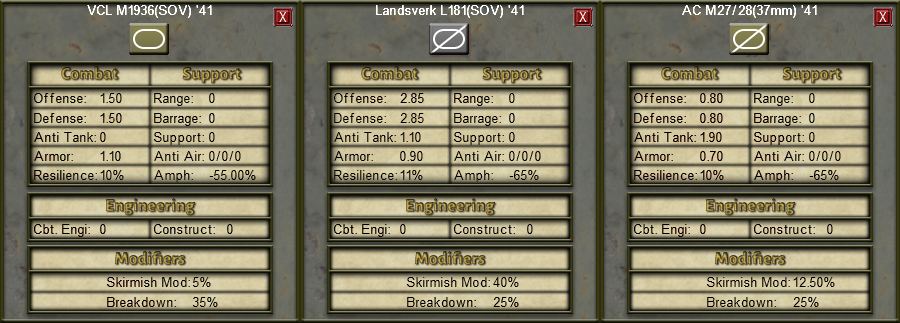
Added Vickers Carden-Loyd (VCL) M1934, M1936, and M1937 light tanks, produced by Britain and employed by the Latvian and Lithuanian armies. M1934/M1936s are strictly MG armed, while the M1937 sports a 40mm bofors, and would actually be reasonably dangerous interwar light tank if it were available in meaningful numbers.
Added Arsenal M28/29 Armored Cars, an inter-war Anglo-Estonian armored car used in limited numbers by some Soviet units. Modeled in both MG and 37mm cannon armed variants.
Added Landsverk-181 Armored Cars, an inter-war Swedish armored car used by the Lithuanian army and employed in limited numbers by the Soviets.
German Equipment Additions and Changes:
A quick sampling of some of the rarer German equipment coming to CAOS in 1.0.8.2.
Added Wurfrahmen 40 rocket artillery, used by German panzerpionier units.
Added 24cm K(t), an Austrian/Czech siege gun in German service. Long ranged and hits like a freight train, but unbearably slow and incapable of fire-support missions.
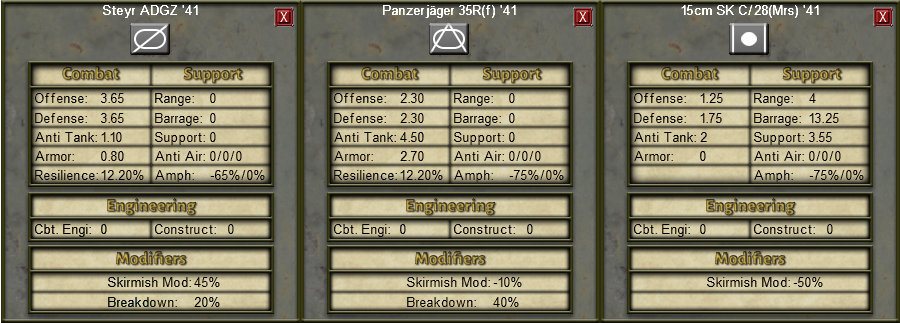
Added 15cm SK 28M, a 15cm naval gun mounted on the carriage of a 21cm Mrs 18. The SK 28M has exceptional range, but mediocre high-explosive potential for a weapon in its class, as it shells are designed for range and accuracy necessary in naval combat, not raw explosive potential.
Added GebK 247(n), the German designation for the truly obsolescent Norwegian 7.5 cm Gebirgskanone Model 1911, used in limited numbers by German mountain units and occupation units in Norway.
Added Panzerjager 35(R), a dubiously useful tank destroyer built on a modified French R-35 chassis. Relatively well armed, but slow and suffering from appallingly poor mechanical reliability during its combat debut in Operation Barbarossa.
Added Steyr ADGZ armored car, an Austrian heavy armored car used in limited numbers by some German police units.
Added OA. Vz. 30 Armored Cars. An obsolete interwar Czechoslovakian armored car used in limited numbers by some German police units.
Added numerous militia, garrison, and rear-area security squad types, armed with all manner of captured equipment.
Updated artillery fire calculations for all Czech guns in German service of 8cm bore and above. As we found better documentation detailing precise explosive payloads for Czech shells in German service. In general the fire support/barrage capabilities of all Czech heavy guns, except the sFH 25(t), have increased.
Other Improvements/Bug Fixes:
The highest echelon unit now always draws ontop of a stack. For example, a corps HQ will draw over any regiments, or a division HQ over a regiment, and so on. This will make it more difficult to misplace your higher commands.
Static units should no longer draw over mobile units that are stacked with them.
Numpad +/- are now hotkeys to move turn replays forward and backwards through the impulses.
Any PNG file in the assets > images > Backgrounds folder and add them to the main menu image carousel.
Fixed a rare crash that could inconsistently occur when a battalion was detached via button press (but not hotkey) from a battlegroup, while the battlegroup was simultaneously stacked with the origin regiment of the battalion that was just detached.
Fixed an AI turn planning bug that could occur if the AI detected that an uncrossable lake was the geographic centerpoint of defensive hardpoint.
Ever Onwards:
We are very happy with 1.0.8.2, and this is an update model we will carry forward. Most updates will not have 2 new full new OBs included, but the combination of new OBs paired with interface and engine improvements is one we believe works particularly well. This style keeps core systems developing while also providing novel new units, and ultimately future fodder for editor extensions.
The interface updates herein are still experimental and subject to change so please let us know your thoughts here, on the forums, or on discord. What's working for you as players and what isn't! In the mean time, will get back to cooking up update 1.0.8.5 which will bring various improvements to fortress/urban combat, and some much-needed love regarding priority alerts for enemy air/amphibious actions in the SITREP!
Dev Blog 16: Northwestern Front OB Deep Dive
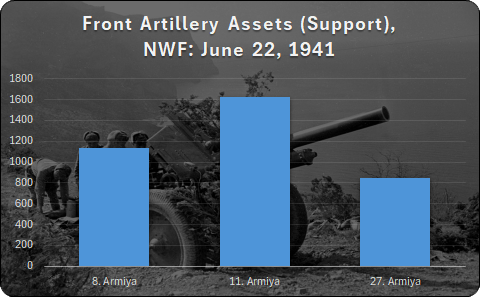
Greetings! Today we bring you a peak into the Soviet Northwestern Front (NWF) as it stood in June/July 1941! The Northwestern Front (or Baltic Special Military District until June 24) is symbolic of the 1941 Red Army in general. It has great potential, on paper, but severely underperforms in actual combat. If properly employed, NWF can bring to bear an astonishing volume of barrage fire to hammer their opponents, negate their zones of control, and inflict terrible casualties However, the frontline protecting the Front’s heavy artillery is dreadfully prone to shattering. Likewise, the armored units responsible for breaching enemy lines or providing mobile reserves are inundated with obsolete equipment and inconsistent motorization. NWF can be an incredibly satisfying OB in the hands of an experienced player, but make no mistake, there is far less room for error here than in most Soviet OBs.
Northwestern Front: June/July, 1941:
Type: Historical OB Preferred Playstyle: Artillery-Centric Attrition
NWF is a defense-focused order of battle boasting strong artillery and air capabilities, but middling armor and a large selection of expendable infantry. If you are playing a custom scenario where training levels can be changed, NWF is a solid B-grade OB, but playing strictly historically requires getting creative. Your artillery is the key to victory. Most Soviet heavy artillery cannot conduct fire support, but their barrage capabilities are potent. Use your big guns to relentlessly harass hostile concentrations, pin enemy artillery that might provide fire support to key battles, or negate enemy ZoC to enable your own units to move through hostile lines. Likewise, NWF has vast quantities of cheap fighter and bomber cover. NWF will never command a qualitative advantage in the sky, but its sheer numbers alone present a challenge to any opponent.
Weaknesses:
NWF’s Achilles heel lies in its armor/motorized forces. Without the support of your tanks, the frontline will swiftly collapse in the face of concentrated enemy armor. But your obsolete tanks will struggle to take the Germans in particular on head-to-head. Proper employment of combined arms, and keen judgement to know when to fight and when to run are essential as NWF has less room for error than most Soviet OBs. NWF also suffers from a shortage of recon aircraft, and what is available are obsolete R-5 biplanes that will quickly be neutralized by halfway decent enemy fighter cover. NWF must conduct a delicate balancing act that requires: 1) Skillful maneuver to preserve its armor. 2) Good situational awareness to spot for its arty. 3) Do both of these while being chronically blind.
Diving Into Details:
Let’s take a closer look at the assets at NWF’s disposal.
Tank/Motorized Divisions:
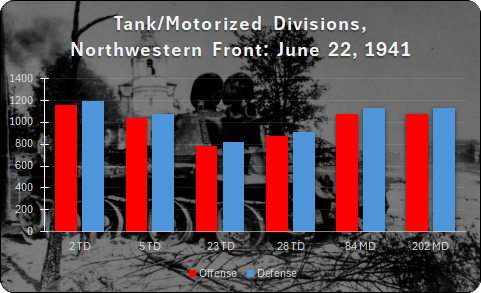
NWF’s armor suffers from dreadfully obsolete equipment, poor readiness levels, and generally slow movement speed compared to their German adversaries. Of the Front’s 4 tank divisions, only 1 (2nd TD) has any meaningful number of modern T-34s and KVs. T-26s and BTs of various types make up the bulk of its armor, and many units are simply understrength. Even in units blessed with modern equipment, insufficient time on type among crews, inadequate unit training, and skilled personnel shortages created by the purges catastrophically degrade morale and cohesion. Inconsistent mobility hammers the final nail in the coffin of NWF’s mechanized forces as many of their tanks are slow, their truck-borne infantry easily outrun them, many artillery units are pulled by civilian tractors, and some “motorized” units lack motorization of any kind! NWF’s armored forces can be effective if properly employed, but they should not be expected to endure sustained combat.
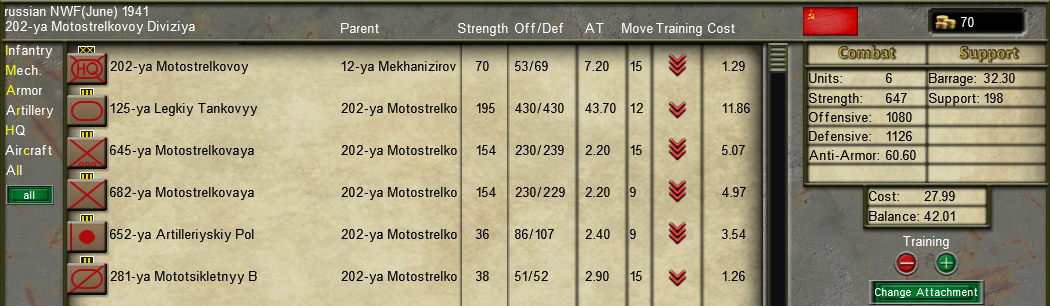
The 202nd Motorized Division endures all the curse's of the front's mechanized forces. (De)Motorization, poor training, and obsolete equipment.
Infantry Divisions:
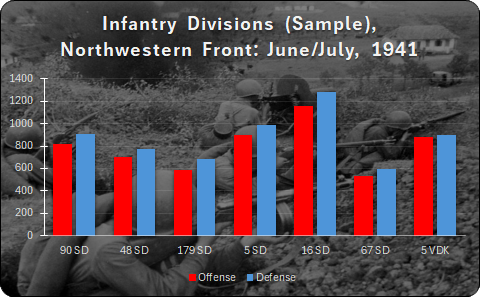
NWF’s infantry runs the full gambit from good (16th Rifle Division), to speedbump (67th Rifle Division). Most of the Front’s rifle divisions are at their peacetime establishment of roughly 80% ToE strength…if they are lucky. We have also modeled small arms allocations, including SMGs, SVTs, and LMGs, per unit as closely as possible. The result is a wild degree of variation between divisions in both strength and combat power. Among this colorful cast of infantry divisions, none are so unique, or so doomed, as those formed from the former Baltic militaries. Not only do the Baltic rifle divisions suffer from the lowest morale, considering they are largely unwilling soldiers of the Red Army in the first place, many also retain their old weapons, large and small. Expect to see German PaK-36s, British light tanks and WW1 field guns, and the occasional indigenous armored car you have never heard of. On the upside, even poor infantry can put up effective resistance with proper support and advantageous terrain. Use terrain wisely, build minefields liberally, avoid letting your infantry fight armor unsupported, and if a division gets destroyed…don’t sweat it….you have more.
Artillery:
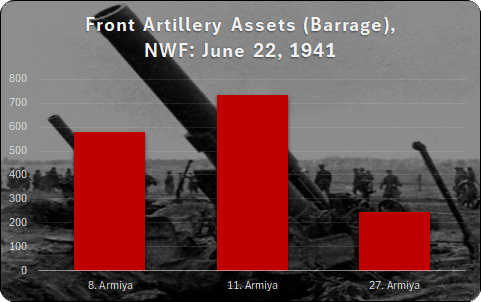
Artillery is the saving grace that can swing a battle in NWF’s favor. Historically, none of this mattered as poor communication and coordination between Soviet forces in summer 1941, combined with the speed of the German advance, swiftly neutralized this crucial force multiplier. But in a more favorable situation, NWF’s heavy artillery enjoys a range and concentration advantage over virtually any adversary. The 110th and 402nd Howitzer Regiments (High Power), each commanding x48 203mm M1931s, are individually 2 of the most dangerous artillery units of the entire war. Likewise, the “lighter” 152mm ML-20s and 122mm A-19s either outgun or outrange most adversaries that do not happen to be American. Your opponent will swiftly deduce that your artillery is your greatest asset and they will stop at nothing to silence it. Unfortunately, the anti-aircraft assets at your disposal are generally lacking, so you can expect the bombs to arrive on your most treasured assets early and often.
Update 1.0.8.2 is in its final internal testing stages now and we expect to release it this week. It will not be long before you get a chance to take NWF and HGN out for a spin yourself! We thoroughly enjoy building self-contained historical OBs like these, as they allow us to explore playstyles, or historical oddities, that the “standard” OBs that reflect a nation’s general combat style across an entire year simply do not allow us to touch on. They also serve as an excellent basis for custom scenarios as, in addition to being beautifully detailed snapshots of organizational history, they also come with fully pre-assembled command chains. You will see more updates like this in the future, as general research for longer-term projects tends to surface many fascinating OBs that we will otherwise never find a use for.
Before we go, we will leave you with one final glimpse into a new mechanic we are cooking up for Update 1.0.8.2 to dynamically visualize Command/Control networks whenever you select a unit. Blue borders indicate subordinates to whatever unit you have selected, green are "sisters" that share the same higher HQ. In this example the same corps command. More to follow soon!
Dev Blog 15: Heeresgruppe Nord OB Deep Dive
Greetings! Let's take a deep-dive into one of the 2 new OBs coming in update 1.0.8.2: Heersgruppe Nord as it stood at the start of Operation Barbarossa! Heeresgruppe Nord (HGN) is a robust order of battle that lacks raw armored might, and suffers from inadequate air support, but enjoys deep reserves, great engineering potential, and strong artillery support. Next week we will explore their Soviet adversaries, but for now, let’s dive into one of the most unique German OBs yet included in CAOS!
Heeresgruppe Nord: June 22, 1941:
Type: Historical OB Preferred Playstyle: Attrition Warfare
Heersgruppe Nord has a few very powerful hammers, and a whole bunch of anvils. If you just want to hold an enemy in place and bludgeon them to death, this is your OB. HGN has enough panzers to make a breach, enough infantry to outlast virtually any opponent, a high concentration of engineers, and excellent artillery support. If you have a problem, HGN has a 15cm howitzer, or a Czech siege mortar, or a random French 155 long-gun, waiting to solve it. This is one of, if not the, most formidable defensive OB currently in CAOS, but its still imminently capable of offensive action, as its Soviet opponents can attest.
Weaknesses:
HGN has 2 key weaknesses: 1) limited armored reserves, and 2) inadequate air support. Skilled opponents will know that you only have 3 panzer regiments, and of those 2 are strong, and 1 is mediocre. Expect your armor to be relentlessly bombarded the moment they’re spotted. Moreover, you do not have solid options to create your own alternative armored battlegroups. The Sturmgeschutz units at your disposal lack numbers, and the 559. Panzerjager Abteilung is secretly awful because it uses an R-35 based panzerjager that is both slower than every other motorized unit on the OB, and has an extremely prone to breakdown.
HGN’s dedicated air cover from Luftflotte I is insufficient to support the army group, and historically Luftflotte II assets supporting Heersgruppe Mitte were diverted to ameliorate this deficiency. The air cover available to HGN consists of 6 fighter groups, of which 2 are reserve/training units. No Stukas. 8 bomber groups, and an impressive 13 recon squadrons. However, this relatively high concentration of bombers and recon aircraft will swiftly be slaughtered if you lose air superiority. Experienced opponents will go all-in in the air war because it is your greatest weakness and the quickest way to endanger your precious artillery and armored units. Do not trouble yourself with struggling for air supremacy, this OB is not built for it, instead preserve your aerial might so it can be activated at the decisive moment. Play this air game like late-war Germany, not early-war Germany.
Diving Into Details:
Let’s take a closer look at the capabilities of the panzer/motorized, infantry, and artillery assets at HGN’s disposal.
Panzer/Motorized Divisions:
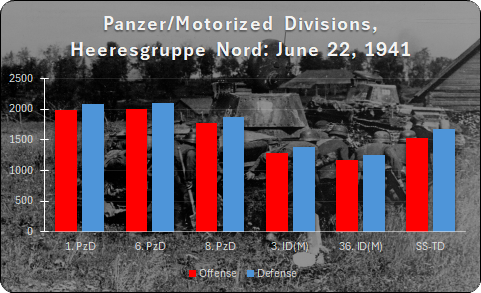
The 1st and 6th Panzer Divisions are both formidable, but for different reasons. 1st Panzer Division has the fewest tanks on hand of the army group’s PzDs, but it boasts both a high allotment of modern Panzer III F/Js and 2 mechanized infantry battalions, compared to the single mechanized company of 6th and 8th PzD. It also possesses a Sturmpanzer company, but you are only ever 1-unlucky battle away from losing them, so don’t get too excited. 6th PzD draws its strength from sheer numbers of borderline obsolete Pz 35(t)s. It’s a perfectly fine division so long as your opponent lacks heavy armor or high anti-tank concentrations. 8th PzD is a fairly standard Panzer Division, albeit one using Pz 38(t)s. 8th PzD has better, but fewer, tanks than 6th, and more tanks of lower quality than 1st.
As for motorized divisions, 3rd and 36th Infantry Divisions are well trained and highly mobile, but otherwise unremarkable. The SS-Totenkopf Division on the other hand is incredibly robust, owing to its sheer size. After your panzers make the initial breakthrough, SS-TD will often be the first division committed into the breach to absorb the inevitable counterattack.
Infantry Divisions:
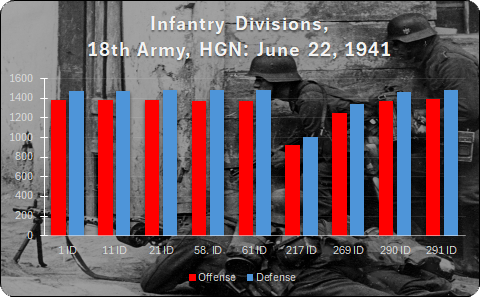
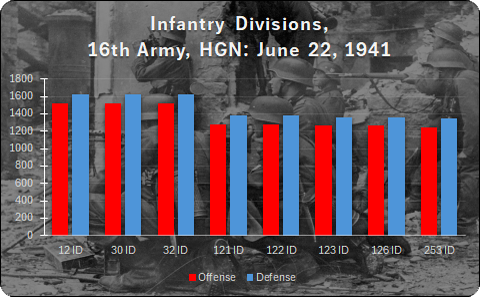
HGN commands a robust infantry lineup, primarily composed of mobilization wave 1-4 divisions. Virtually all of them are at, or near, establishment ToE. Infantry training levels are high, even among units that were initially raised as reserve units in spring 1940. Summer 1941 is the height of the German infantry arm in CAOS and arguably of the war in general. The meat grinder of the Eastern Front has not yet induced reductions in infantry force structure or degraded the quality of their replacements. Equipment shortages exist, but effective replacements (typically foreign gear) are readily available, and critical supporting corps/army artillery and AT units are generally motorized. Moreover, Germany’s adversaries, namely the Soviets, are only just beginning to embrace mass SMG-warfare that will prove so hazardous to the average German rifleman as the war proceeds. HGN stands at a fleeting pinnacle of German infantry power, enjoy it while it lasts.
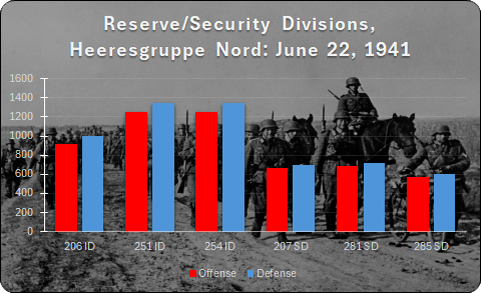
To the surprise of absolutely no one, the reserve and security divisions held at army group are the weakest units on the OB. The 206. Infanterie Division is barely suitable for frontline combat and the 3 Sicherungs Divisions will collapse if threatened with anything heavier than an armored car. A substantial chunk of the personnel of the Sicherungs divisions are militia, use them for positional defense within fortifications or as mere speed bumps, as nothing useful should be expected of them.
Artillery:
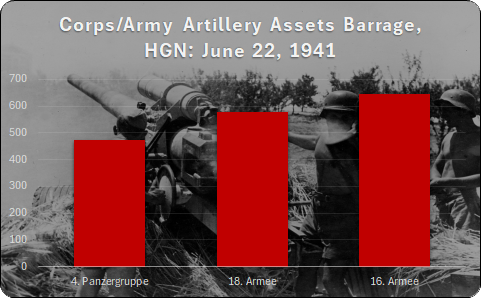
HGN’s artillery arm provides excellent fire support, but it is slightly deficient in counter-battery capability compared to its Soviet adversaries. HGN’s artillery overwhelmingly has a range of 2 hexes. Longer ranged guns are rare, and in some cases concentrated in the hands of 2nd-line coastal artillery battalions operating captured equipment. Historically, this potential weakness did manifest as ineffective communications, supply shortages, and limited cooperation between air recon and artillery units rendered Soviet counter-battery fire largely ineffective during 1941. Despite limited range, HGN’s sheer volume of artillery, the high motorization levels of its army/corps assets, and the incredible power of its heaviest weapons remain potent force multipliers.
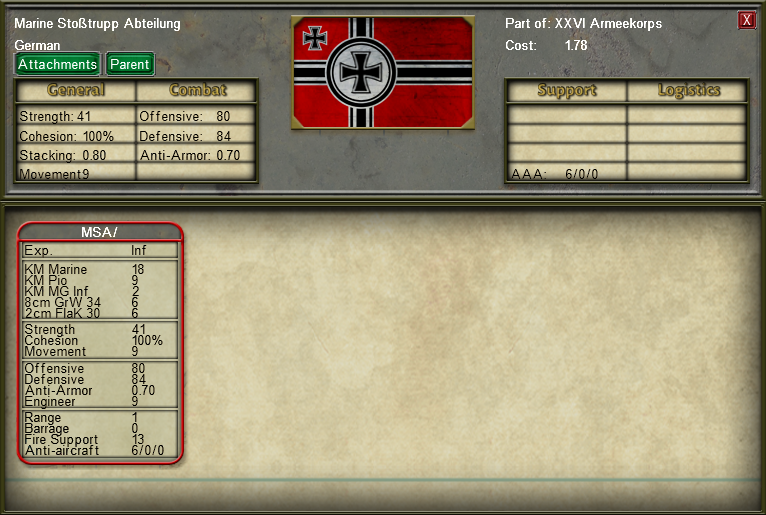
One of the interesting oddities of building Heersgruppe Nord was the frequency with which units we previously modeled for Operation Sealion re-appeared. Primarily because 18th Army was slated to participate in Sealion, and later transferred east for Barbarossa. Several infantry divisions, Sturmgeschutz batteries, artillery battalions, and even the commandos of II/800 Lehr Regiment Brandenburg appear on both OBs. But of these units the most curious was the Marine Stoßtrupp Abteilung, a relatively obscure German marine battalion whose organizational details eluded us for a while during Sealion development until we found the excellent Deutsche Marineinfanterie 1938-1945 by Jörg Benz. Now, the Marine Stoßtrupp Abteilung makes its public debut not on the beaches of England, but rather being fed into the woodchipper of an Eastern Front OB.
Marching Onward:
That will be it for HGN! Next week we will return to explore their Soviet adversaries in the Northwestern Front. An OB that will include many oddities, seized from the Baltic states and incorporated into the Red Army, including British artillery, locally produced armored cars, and even the occasional German AT gun. Both of these OB updates will release alongside a general Germany 1941 update and our first pass at improving turn resolution in late April.
Update 1.0.7.7
After an extended development period, Update 1.0.7.7. is finally here, with the Kharkov map, UI improvements, Soviet 1941 updates, a new air pricing formula, some sweet quality of life improvements and a crucial fix to one of the most insidious CAOS combat bugs we have ever uncovered.
Kharkov Map:
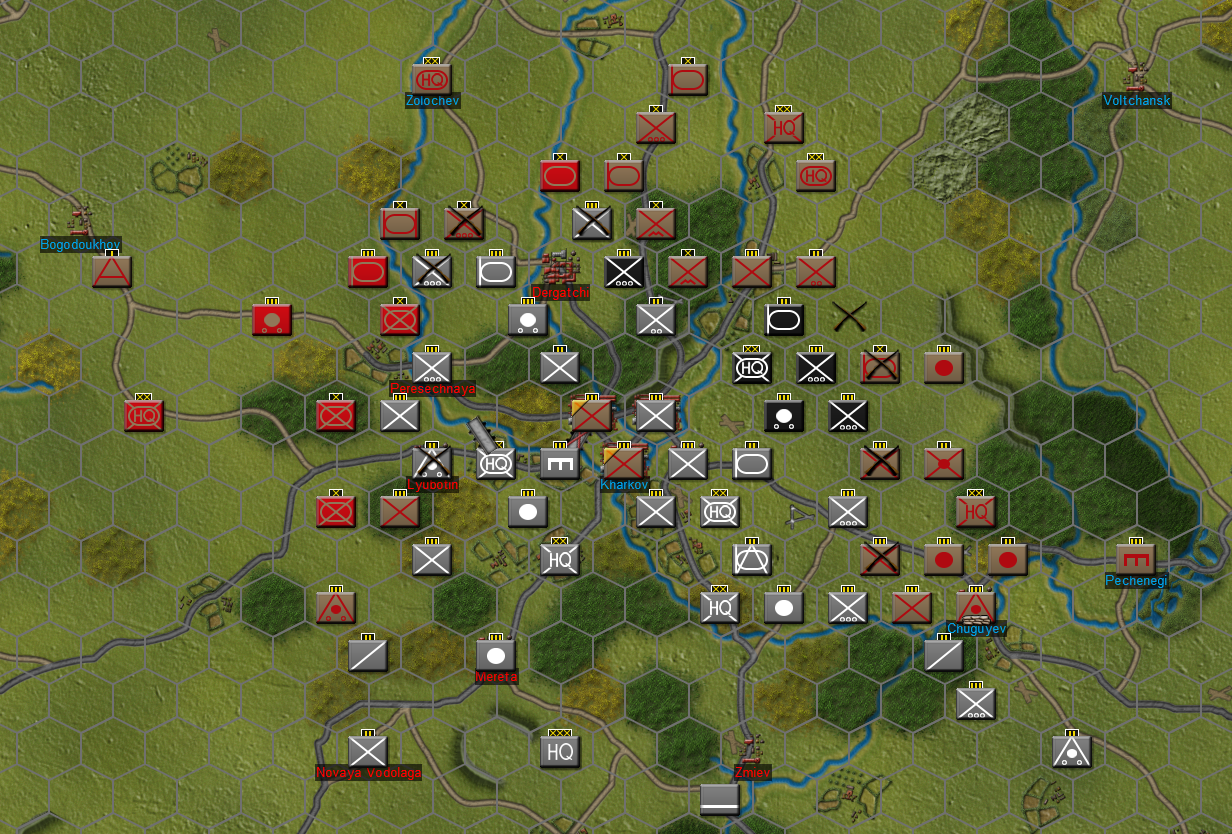
Welcome to the Eastern Front! Kharkov is our first historical USSR map and it is a wholly unique experience that differs dramatically from existing maps due to its sheer size. Kharkov combines the mobility of the Russian Steppe with the powerful defensive anchors of fierce urban combat, and the logistical threat of inadequate infrastructure. We have meticulously modeled the region as close to history as we could get using pre-war Soviet maps, and the result is a beautiful nightmare. In some sectors you will fight for dense industrial suburbs, in others you'll be mired in marshes and thick forests, and sometimes there is hardly a settlement to be found for dozens of kilometers and nary a paved road in sight. Your flanks will be vast, your spearheads overextended, and the roads never seem to lead where you need them to...so dive in and enjoy the hospitality of the Soviet Union!
Kharkov also prototypes a few new changes coming to other large-scale maps in the future, namely a slower reinforcement tempo to give breakthroughs more time to expand before defender counter-attacks, and a highly experimental Army + (approximately 11 divisions) starting point level.
Soviet 1941 Overhaul:
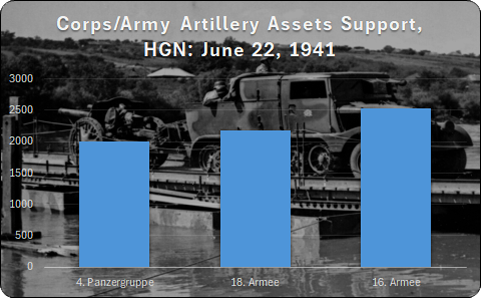
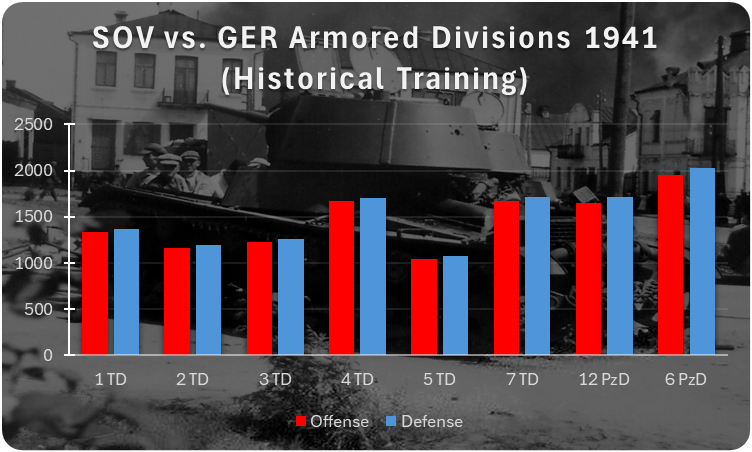
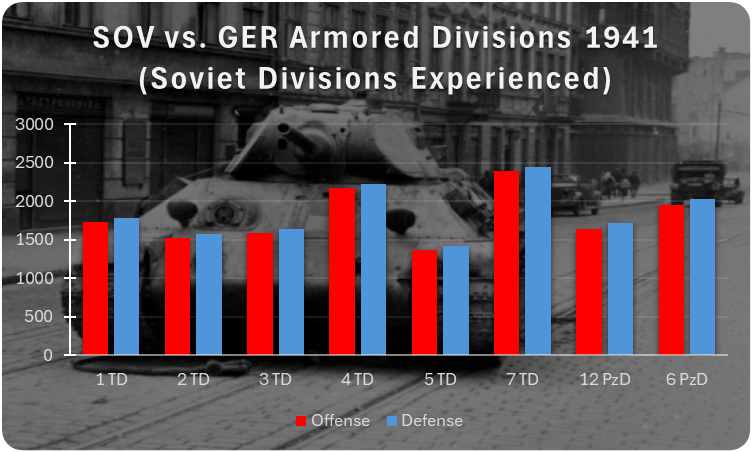
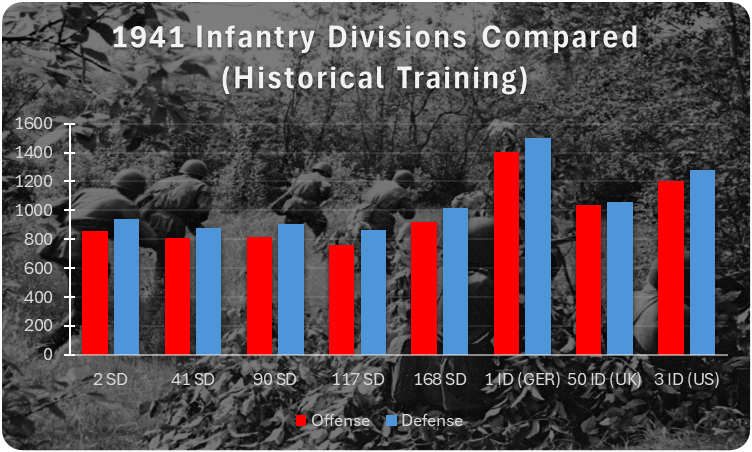
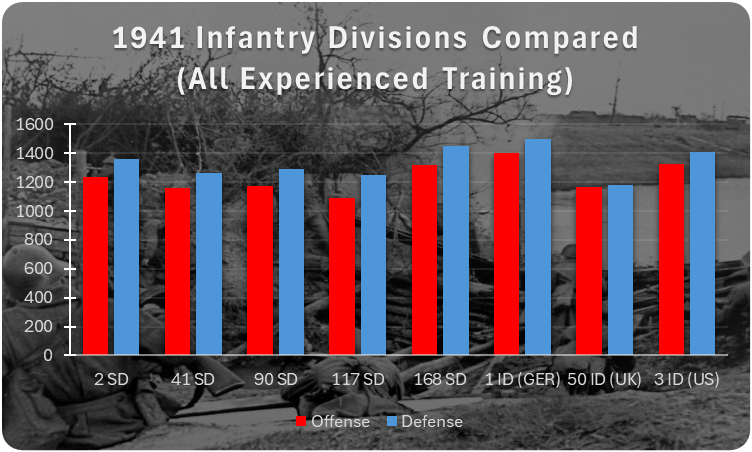
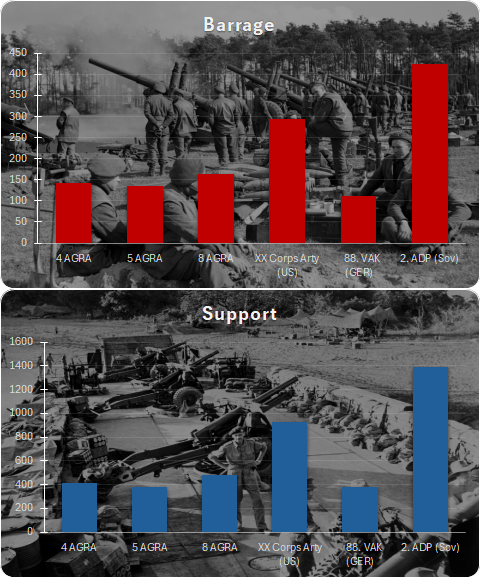
Update 1077 also brings a host of revisions to Soviet forces in 1941 to better reflect the chaotic state of the Soviet Armed forces at the beginning of Operation Barbarossa. The Soviet 1941 OB has been expanded, but units now deviate far more from their official tables of equipment and training levels are lower. When played strictly historically, the Soviet 1941 OB tends to either strangle its opponent through sheer volume of force and Zone of Control locks… or collapse spectacularly. However, unshackled from the training and morale limitations induced by the Great Purge and constant re-organizations in custom scenarios, the Soviet military can be truly dangerous. Just take a quick look at some of the graphs below to see just how dangerous the Soviets can become if they are fighting on an even footing.
Unit revisions and additions
Armor/Mech:
Updated tank type allocation in the 2nd and 5th tank divisions to better match strength reports on the eve of war.
Brought motorized infantry battalions of the 2nd, 4th, 5th and 7th tank divisions up to ToE strength, as these units were relatively close to establishment personnel strength.
Added armored car recon companies to tank regiment HQs where appropriate.
Added 15th Motorcycle Regiment, from the 1st Mechanized Corps (Leningrad).
Lowered training levels of most KV and T-34 equipped units from recruit to conscript, stemming from extremely limited training available to crews on new vehicles, due to Soviet security concerns.
Lowered training levels of infantry and artillery in mechanized and motorized divisions from recruit to conscript, as Soviet mechanized forces suffered from most of the same officer and NCO shortages as standard rifle divisions.
Infantry:
Infantry divisions re-organized in accordance with their June 22 OBs. This places most infantry divisions at roughly 85% ToE strength, further modified by equipment, organizational, and manpower, variations according to the Front they are subordinate to.
Added 168th Rifle Division (Leningrad), a near war-time establishment infantry division.
Added 117th Rifle Division (STAVKA Reserve) a 2nd line reserve division, near full peacetime establishment, but desperately short on SMGs.
Motorized the howitzer regiments of many infantry divisions.
Added 120mm PM-38 mortars to infantry regimental artillery batteries where appropriate.
Raised training levels of cavalry regiments from conscript to recruit, as these units were typically less affected by the radical reorganizations of 1940.
Lowered training levels of the 1st and 211th Airborne Brigades (1st Airborne Corps) from experienced to recruit, as like many VDV units at the time, they were still forming and undergoing training at the time of the invasion.
Added missing 76mm M1938 batteries (4 guns) and AA/HMGs (6 sections) to heavy weapons battalion of Airborne Brigades.
Artillery:
Added 403rd and 108th Howitzer Artillery Regiments (High Power). With 36 and 24 203mm B-4 howitzers respectively.
Added 3 cannon and 6 corps artillery regiments, armed with various mixtures of 152mm ML-20s and 122mm A-19s. Regiment strengths vary wildly, as some battalions retain the pre-1940 8-gun organization, while some use the more recent 12-gun battalion org. Some regiments have a full 4 battalions, some only have 2, etc. Total gun counts vary between 20 and 48 guns per regiment.
Reduced motorized movement speed for division-level Soviet artillery in 1941 from 15 to 12 to reflect shortages of prime movers and chronic reliance on civilian tractors to transport guns.
Units equipped with 203mm B-4, 122mm M1910/30, and 152mm M1909/30 howitzers motorized movement speed reduced from 15 to 12 in all other years as well, as these guns suffered from slow towing speeds due to their carriage designs.
Equipment Changes:
Added pre-war SOV Inf(Apr) ’41, to distinguish infantry squads that are near, or at, ToE strength, from their underequipped brethren.
Removed close air support mission roll from MiG-3s, as Soviet battlefield communications could not effectively coordinate close air missions in 1941.
Increased breakdown rate for T-26s from 20% to 30%
Increased breakdown rate for BT-2s from 20 to 25%.
Reduced breakdown rate of T-35 heavy tanks from 80% to 50%. T-35s historically had some of the highest mechanical readiness rates among Soviet vehicles at the start of the war. Primarily because they were concentrated in units with better logistical support. Still, the CAOS breakdown rate considers both actual breakdown rates and maintenance hours, so their breakdown rate remains high.
Air Price Overhaul:
The Air Pricing Problem
The previous air price formula had 3 key problems:
Aircraft were slightly too expensive from 1943 onwards
It excessively punished multi-role aircraft by adding an additional price for every mission they could perform. This created a serious air balance problem for nations that relied on multirole aircraft for air superiority, notably the USA and Great Britain.
It made bombers that were also capable of strike missions (PE-2s) unreasonably expensive.
Collectively, these problems created a head-to-head meta where players frequently did not buy air superiority aircraft at all on turn 1 in 1944/1945 games, and instead simply turned those points into more ground units. Moreover, the historically air-focused nations of the USA and Britain were less likely to buy aircraft because their multirole squadrons were prohibitively expensive to deploy in substantial numbers.
While shorting air forces to bolster ground force should be an option, and sometimes even a desirable option, it was effectively always the optimal choice under the old pricing system.
Our Solution:
In update 1.0.7.7 we have rebalanced the air price formula to moderately reduce the cost factor of air superiority missions, made interdiction missions completely free, and slightly reduced the cost factor for bombing missions. In general, fighter costs are reduced by 20% and bombers by 10%.
The lists below display some highlights from each nation. USA:
P-47D price reduced from 17.54 to 13.96 (20% reduction)
P-51D price reduced from 16.6 to 13.42 (19% reduction)
P-40F price reduced from 12.61 to 11.07 (12% reduction)
P-39D price reduced from 12.49 to 8.79 (29% reduction)
P-38G price reduced from 13.67 to 11.39 (16% reduction)
Great Britain:
Typhoon Ib price reduced from 14.41 to 12.4 (14% reduction)
Spitfire XXI price reduced from 18.63 to 13.7 (26% reduction)
Spitfire IXe price reduced from 15.04 to 10.83 (28% reduction)
Spitfire Vb price reduced from 9.9 to 7.92 (20% reduction)
Hurricane IIb price reduced from 9.21 to 6.17 (33% reduction)
Germany:
ME262 A-1a price reduced from 25.06 to 20.05 (20% reduction)
FW-190 A-8 price reduced from 16.6 to 13.33 (20% reduction)
FW-190 G-8 price reduced from 17.11 to 14.9 (13% reduction)
BF109 G-6 price reduced from 13.57 to 10.46 (23% reduction)
BF-109 F-4 price reduce from 9.34 to 7.48 (20% reduction)
BF-110 G-2 price reduced from 16.33 to 11.54 (29% reduction)
JU-87 D-5 price reduced from 9.77 to 6.77 (30% reduction)
USSR:
LA-7 price reduced from 12.09 to 10.21(15% reduction)
Yak-9D price reduced from 8.9 to 7.43 (16% reduction)
Yak-7 price reduced from 6.36 to 5.09 (20% reduction)
Yak-3 price reduced from 6.45 to 5.16 (20% reduction)
PE2-FT price reduced from 11.51 to 8.51 (26% reduction)
IL-2M price reduced from 9.03 to 7.03 (22% reduction)
UI and Quality of Life Improvements:
The updated New Game screen, neat, categorized, and built with plenty of room for expansion in mind.
Added an option to toggle the hex grid on/off. This can be changed in the Options menu, or in game using the F2 hotkey.
Updated the Create Game screen to be cleaner and more user friendly. The updated menu also allows the player to select both Red and Blue orders of battle from the create game screen. Players can still choose to change their OB in the ready screen if desired.
Updated unit requisition window to be larger, made divisions between data fields clearer and left some extra room for further improvements in the future.
Air requisition menu now displays air unit names and training levels (As graphics, instead of as numbers), at all times.
Updated the Save and Load games screens, they are now larger and we fixed a bug that could cause the save screen to skip characters as a player typed save names in scenarios with high unit counts.
Added a hotkey (Shift+P) to place retreat rally points for selected units.
Added a button to the air orders menu to automatically place all air orders. Place any air orders you want to micromanage, then let the AI place the rest for you.
Added a button to the air orders menu to cancel all planned air missions.
Barrage reports now show the percent of effectiveness lost (to terrain, etc.), instead of just the raw value lost.
Improved the graphic for all orders menus to make them more readable by adding clear cell-divisions between orders.
Bug Fixes:
Fixed a bug that could cause units to fail to conduct a march attack when another friendly unit was destroyed, anywhere on the map, earlier on the same impulse. This was caused by a bug in the system that semi-randomizes which of your units move first on any given impulse. This bug was the cause of the vast majority of combats where units failed to participate, or failed to attack at all.
Fixed a bug that could cause the defender’s reinforcement point to appear inside the attacker’s starting spawn zone in Attack scenarios on very large maps (Paris and Lake Okum).
Fixed a pair of duplicate British unit names on the 1940 and 1944 OBs.
Ever Onwards:
Update 1.0.7.7 is really 3 smaller updates wearing a trench-coat, that tackle separate pieces of our 2024/2025 design roadmap (Air price overhaul, UI update, Soviet 1941/Kharkov map). These updates ended up bundled together due to a number of personal time constraints that are unrelated to CAOS. Now that 1.0.7.7 is out, we are very excited to say we have major news regarding Operation Sealion, which will be announced in mid-April. In the mean time, development will primarily focus on AI and further UI improvements, but we also have some new historical 1941 OBs cooking on the side-burner that we look forward to seeing in action.
Update 1.0.7.4 - UK 1945 Overhaul
Welcome to the grand finale of the British army in Europe during World War 2! Britain is bruised and bloody, but it stands on the precipice of victory none the less. Standardization has become a myth, and adaptation is the watch word of the day. British organizations now vary wildly from under-gunned and under-strength infantry to the finest armoured divisions the Western Allies field during World War 2. The final six-months of the war in Europe witness great adaptation in British tactics and organization in response to the unsustainable attrition of 1944. Now, we bring these unique organizations to life in CAOS!
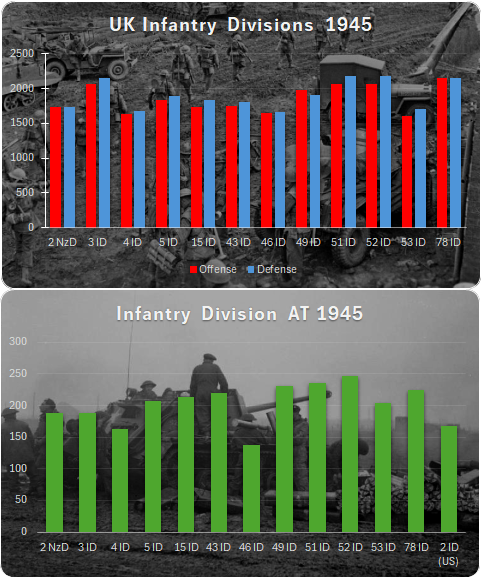
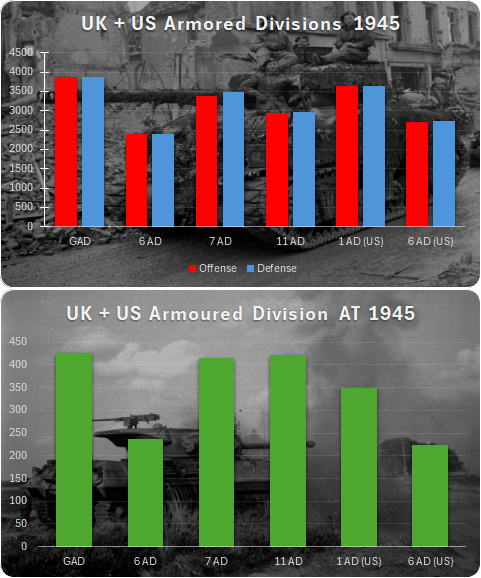
Britain 1945 enjoys high-highs and low-lows. British armoured forces are drowning in spare equipment, and the proliferation of 17pdr sabot ammunition presents a potent hazard to any opposing armour. Likewise, the ponderous Churchill VII and its flamethrowing Crocodile twin presents a terrifying foe to enemy infantry. Heavy artillery has also finally returned to the forefront of British planning, though it falls far short of its American or Soviet colleagues in sheer concentration of fire. The problems facing Britain in 1945 primarily fall on the shoulders of the infantry. Years of attrition have practically ground some prestigious units out of existence (the 1st and 50th Infantry Divisions), vastly diminished the veterancy of others (51st and 78th), and forced substantial ToE adjustments to most infantry units. Across the British army experienced units are being dissolved, artillerists are handing in their cannons for rifles, and the distinction between 1st and 2nd line personnel wanes. British infantry are now both chronically under-armed and they have lost their veterancy edge. Consequently, Britain 1945 is a substantially more capable offensive OB than past years, but the robust defensive capabilities of the British army have eroded substantially.
UK 1945:
Infantry:
Removed 1st Infantry Division, as it was moved to lower establishment and transferred to security duties in Palestine, due to attrition in Italy.
Added the 2nd New Zealand Division in its February, 1945 table of organization. The division is substantially understrength when separated from its armoured brigade. The Recon, MG, and motor infantry battalions have been consolidated into a new Infantry brigade. The anti-aircraft regiment disband, and the anti-tank batteries roughly halved in size.
Reorganized 3rd, 15th (Scottish), 43rd (Wessex), and 53rd (Welsh) Divisions’ infantry battalions into reduced strength 3-company organizations featuring fewer total squads, but more MGs per squad.
Reorganized 4th Infantry Division into its January 1945, Greece OB. Changes include: Reduced strength 3-company infantry battalions. Infantry anti-tank companies converted into infantry squads. MG battalion absorbed into infantry battalions. 2 Field Regiments + 1 AT battery converted into a new Motorized Infantry Brigade.
Reorganized 5th Infantry Division into a full-strength Mediterranean Theater infantry division.
Reorganized 46th Infantry Division into its Winter 1944/1945 Greece OB. Infantry battalions use the reduced strength 3 infantry company organization. Infantry anti-tank companies converted into infantry squads. One anti-tank battery dissolved.
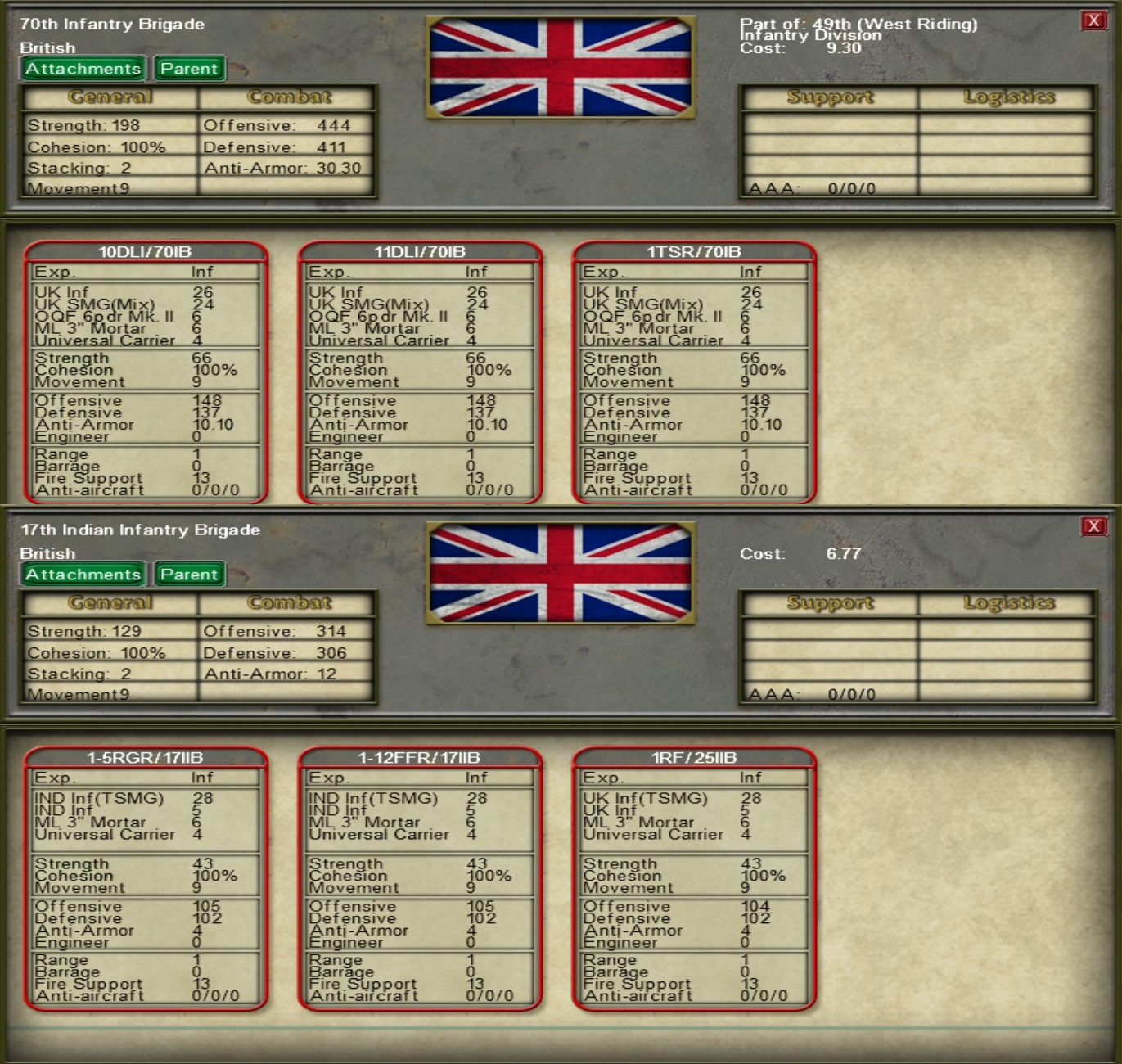
Added 49th (West Riding) Division in its hybrid SMG/assault organization, in use since August 1944.
Reorganized 51st (Highland) Division into its Winter 1944/1945 OB. Carrier companies in infantry battalions dissolved. Additional LMGs dispersed to rifle squads where available, and scout/sniper platoons added.
Reorganized 78th Infantry Division into its Winter 1944/1945, Po River Valley OB. The division boasts substantially more 4.2” mortars than ToEs suggest and relatively full-strength infantry battalions. One battery of the 64th Anti-Tank regiment has been dissolved.
Added the 43rd Independent Gurkha Brigade (motorized).
Reduced training of 115th, 305th, and 307th Infantry Brigades to recruit. These brigades were either emergency conversions of Royal Artillery units, or line of communication units raised in response to Britain's infantry manpower crisis.
Training levels in infantry units generally decline to experienced or trained, depending on the sheer volume of replacements absorbed per brigade. Royal Artillery converted to infantry service may fall as far as recruit.
Armo(u)r:
Reorganized the Guards Armoured Division to its February, 1945 organization. See Guards Armoured Division section below.
Reorganized 6th Armoured Divisions into its April 1945 order of battle. Increases allocation of Sherman 76s and 105s, and adds 1st Heavy Support Company to division HQ with x12 4.2" mortars.
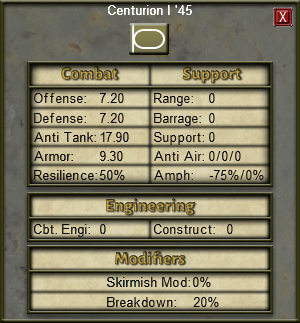
Reorganized the 7th Armoured Division into its June 1945 order of battle, complete with Centurion I field test troops, partial Comet I conversion for the 1st RTR, and partial mechanization of the 131st Infantry Brigade in Ram Kangaroo APCs provided by the 79th Armoured Division.
Reorganized the 15/19th King's Royal Hussars (11th AD) into their late March, 1945 ToE, mostly equipped with Comets.
Added the 7th Armoured Brigade, armed with a variety of Sherman 76s, Sherman Vcs, Churchill VIIs, Crocodiles, and M8 Greyhounds.
Reorganized the 2nd Dragon Guards (2DG) of the 2nd Armoured Brigade into their January/February 1945 organization, primarily armed with Sherman (76) and Sherman Fireflies.
Revised every British independent tank/armour brigade to either reflect actual field strength (usually in March, 1945), or Basic Organization, where precise field strength was unavailable. Many of these brigades are actually over-strength.
Added 27th Lancers Regiment, a Staghound-equipped Corps Armoured Car regiment from the Mediterranean Theater.
Revised Inns of Court and 2nd Household Cavalry, Corps Armoured Car Regiments to their November 1944 TOEs, now including AEC Mk. III close support vehicles.
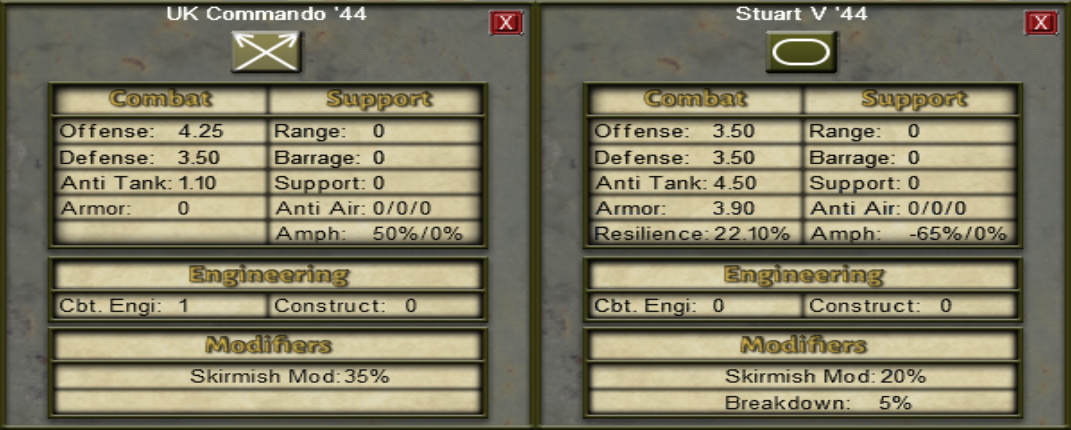
Replaced Stuarts with Stuart Recces (Stuart light tanks with turrets removed) where appropriate. This change is ongoing and will be retroactively applied to prior years where necessary in future updates.
Removed brigade and battalion level AA tanks from most armoured/tank brigades, in keeping with standard British field practice after August 1944.
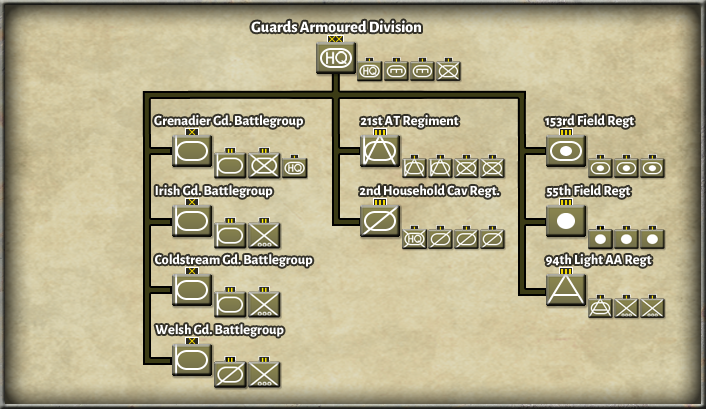
Guards Armoured Division - February, 1945: The Guards Armoured Division is the best organized and equipped Allied armored division in CAOS. Other divisions match its skill, but within the Allies, none match the flexibility of its organization. The division is organized into permanent battlegroups, boasts more mechanized infantry than its British colleagues, and superior anti-tank capability to its American peers. The Guards Armoured Division competes on equal or better terms with anything in German or Soviet service, but it is not invincible. Its infantry are good but not great, it lacks organic heavy artillery (like all British divisions), and the 17pdrs that equip most of its tanks are excellent tank-killers, but less effective infantry support cannons. The Guards Armoured Division is a finely-tuned tool to be wielded with precision, not a hammer to be swung wildly. Use it with skill, and it will accomplish great things.
Anti-Tank, Artillery, and Anti-Aircraft:
Added 4th Army Group, Royal Artillery.
Added the 3rd Super Heavy Regiment, using US 240mm howitzers and 203mm guns.
Added the 54th Heavy Regiment, using a mixture of US 203mm and 155mm long-guns.
Added 1st Heavy Regiment in its March, 1945 organization featuring US 155mm M1A1s and...4 Soviet 122mm A-19s captured from the Germans during Operation Veritable.
Re-equipped the 12th HAC Regiment, Royal Horse Artillery with Sextons, instead of Priests, in line with its January 1945 re-organization.
Added 100th Anti-Aircraft Brigade in its February 1945, crossing the Rhine OB.
Added quad .50cal M16 MGMC anti-aircraft halftrack troops (x6 vehicles per troop) to British light AA units where applicable.
Detached 51st Light Anti-Air Regiment from the 6th Armoured Division and re-organized it into its March, 1945 infantry support OB, mixing 40mm bofors and 4.2" mortars.
Added the 105th Anti-Tank Regiment with: x4 6pdr, x8 17pdr, x18 M10, and x12 Archers.
Added 64th and 86th (Corps) Anti-Tank Regiments, each armed with x36 M10c Achilles.
Revised every British divisional anti-tank regiment to reflect the numerous battery organization variations. Some divisions gained substantially more tank destroyers (49th West Riding), some lost firepower by adopting the new 10-gun battery organization.
Removed the 91st (Corps) Anti-Tank Regiment, as it was placed in suspended animation in January.
Reduced training level of UK AA units to recruit, except in units that demonstrated particular talent for ground combat.
Added historical battery names to all Royal Artillery units.
UK 1944 Revisions:
Updated all Recon Regiments to their July or August 1944 ToEs. In general this means more armoured cars and fewer universal carriers.
Removed 59th Recon Regiment from the 59th Infantry Division, as the regiment was split from the division in December 1943.
Added full allotment (6 per squadron) of Humber LRCs to UK Armoured Division Engineer squadrons.
Equipment Changes:
New Equipment/Equipment Changes:
Centurion I (Main Battle Tank)
Cromwell VII (Medium Tank)
Churchill IX (Heavy Tank)
Archer I (Light Tank Destroyer)
UK Inf (RamKang) ’45 (Mechanized Infantry)
Stuart V Recce (Light Recon Vehicle)
Enabled barrage for 17pdr towed guns. 17pdrs were widely employed as part of "pepperpot" harassment bombardments in the final months of the war.
General Updates and Bug Fixes:
Added an editor config-level toggle to disable Force March orders. Forced March is now disabled by default in Skirmish and Meeting Engagement scenarios.
Added an editor config-level option to control the range at which temporarily static units are mobilized by enemy proximity.
Added an editor config-level option to lock out training level changes in requisition. This is off by default, but is enabled in all historical and alt-historical scenarios.
Added an editor level option to lock out purchasing replacements. This is off my default, but is enabled in all historical and alt-historical scenarios.
Fixed a bug that caused tutorial textboxes to activate and force the game into windowed mode when a connected client used a hotkey to buy units.
The Path Forward:
The 2025 CAOS development roadmap is due to come out this weekend, so we'll get into the details of future development then. But for the moment Sealion development continues, and we will hold a developer Operation Sealion let's play on our discord on November 17, at 10AM Pacific Standard time (6PM GMT-0). Beyond that, with the UK 1945 overhaul wrapped, we are working on a new historical map, set on the Eastern Front. As Sealion moves into its latter stages of production, the focus of CAOS development marches inexorably eastward.
Update 1.0.7.2 - UK 1944 Overhaul
1944 Order of Battle Updates:
At first glance, the British military seems to be at the zenith of its World War 2 power on the eve of the Normandy landings. British armoured brigades are powerful battering rams. British infantry divisions remain substantially larger than their allies and adversaries alike. Their anti-tank guns are among the finest in the world. Meanwhile, the RAF can challenge any opponent on equal or better terms in the skies above. Britain, and the Commonwealth generally, has come far since the dark days of 1940. Yet…a crisis brews beneath the surface. Years of total war from Malaysia to Tunisia have bled Britain dry. The Italian theater consumes manpower in hard-won bloodbaths like Anzio and Monte Cassino, while the fighting at Caen and the triumph in the Falaise Pocket inflict their own heavy price. By mid-August 1944, only 1,100 trained infantry replacements deemed ready to reinforce 21st Army Group remain in Home Forces. British infantry training levels stand on the precipice of a sharp decline. As fighting rages on in the Low Countries, Italy, Greece, and the Pacific, the demand for fresh infantrymen continues unabated. Britain must adapt, but the path forward is fraught with challenges.
Adapting to the Crisis: Britain’s manpower inefficient infantry divisions posed a serious challenge as the replacement crisis deepened. British infantry divisions were large, upwards of 18,000 men, and lacked the battalion-level firepower common in contemporary armies. British commanders were hardly blind to these deficiencies and forces in the field engaged in a wide variety of local adaptations. The 5th Infantry Division hoarded an impressive 40 4.2” mortars, distributed at division and brigade levels. The 49th West Riding Division converted roughly half its rifle sections to SMG sections from July onwards. 51st Highland Division organized scout/sniper platoons in most battalions. In the summer some divisions in the Mediterranean started converting rifle battalion AT companies into mechanized infantry. By September some units were eliminating the anachronistic 4th rifle company per battalion entirely, and embracing a 2-LMG per squad organization. Ad-hoc combined arms columns were assembled from divisional anti-tank batteries to create quick reaction forces incorporating mechanized infantry, mortars, and tank-destroyers. Divisions in the field were skillfully adapting to the manpower crisis and deficiencies of their organizations, but the War Office did not institutionalize these adaptations army wide. Instead, the War Office focused its efforts on the equally important tasks of dissolving excess units and squeezing manpower out of other arms with merciless efficiency.
Playing UK 1944 UK 1944 primarily models the British army at its height between April and July. As such, the deleterious effects of the growing manpower crisis are perceptible, but they are not yet critical. Many infantry divisions now have variant organizations. Some excel in close combat, others enjoy superior AT capabilities, some buckle under the weight of mounting attrition; each has its own niche to fill. Britain enjoys substantial advantages in flexibility and mobility over past years, especially if commanders utilize creative battle-grouping. Mechanized MG and recon units, 4.2” mortar, M10/Achilles, and self-propelled AA companies, provide an excellent basis for combined-arms battlegroups. Use these battlegroups as cheap and effective combined arms support for your infantry brigades. The massive proliferation of 17pdrs, mounted in Shermans, M10s, Challengers, or even simply towed, presents a serious threat to enemy armor. The proper employment of 17pdrs means life or death against enemy tanks as the PIATs and 6pdrs controlled by infantry brigades will not defeat concentrated armor assaults. In defensive battles the British army in 1944 remains one of the most capable orders of battle in CAOS. Always keep your infantry properly supported, immobilize your opponent, harass their artillery from the air, and once they have lost momentum, unleash your powerful tank brigades in a decisive counterstroke.
UK 1944:
Infantry:
Implemented variant MTO and Northwestern Europe infantry division organizations and tables of equipment. Units in Northwest Europe typically employ more mechanization and primarily use Stens as SMGs. MTO units are more likely to use Thompsons, incorporate MMGs down to the battalion level, and use more older 6pdr AT guns, or sometimes eliminate AT units entirely.
Added the 2nd New Zealand Division in its July 1944 organization, just after its post-Monte Cassino reorganization.
Added the 10th Indian Infantry Division in its April 1944 organization, immediately after arriving in Italy.
Added the 43rd (Lorried) Independent Gurkha Brigade, a motorized brigade formed from Gurkha battalions that served as a fire brigade style reserve unit serving with Indian divisions in Italy.
Added the 17th Indian Infantry Brigade, a veteran brigade detached from the 8th Infantry division in Italy.
Added the 233rd Infantry Brigade, a 2nd line security unit based in Malta, and the 162nd Infantry Brigade, a line of communications unit under the command of 21st Army Group before Operation Overlord.
Re-organized the 59th Staffordshire Infantry Division to its early August organization, reflecting declining training levels, and just before the division was disband.
Re-organized 51st Highland Infantry Division to its June 1944 OB, including scout/sniper platoons attached to each rifle battalion. Additionally, the 5th Queen’s Own Cameron Highlanders Battalion (152nd Infantry Brigade) receives the 2pdrs they still had instead of 6pdrs in July 1944. Yes. We were surprised to learn this too.
Re-organized 49th West Riding Infantry Division to its July 1944 OB, including dedicated SMG assault squads.
Re-organized Brigade Support Groups in the MTO to their actual field ToE, instead of their official war establishment. This transformation completely removes their AA guns, but increases their MMG and 4.2” mortar allotments.
Added the Lovat Scouts, a crack independent infantry regiment (battalion strength) specializing in mountain warfare and light infantry combat. They boast both mountaineering capabilities and substantial skirmish combat bonuses
Issued SMGs to company, platoon, and section leaders, throughout UK 1943 and 1944 MG battalions. Raises close combat value from 1.85/2.5 to 2.1/2.65
Mechanized UK 1944 MMG sections (in Universal Carriers), where appropriate, primarily applies to units in Northwestern Europe. Close combat 2.65/2.75
Organization of Independent MG Companies in Armoured Divisions (using the March 1944 Basic Organization No. VIII), updated to reflect the unique tables of organization used by these units.
Armo(u)r:
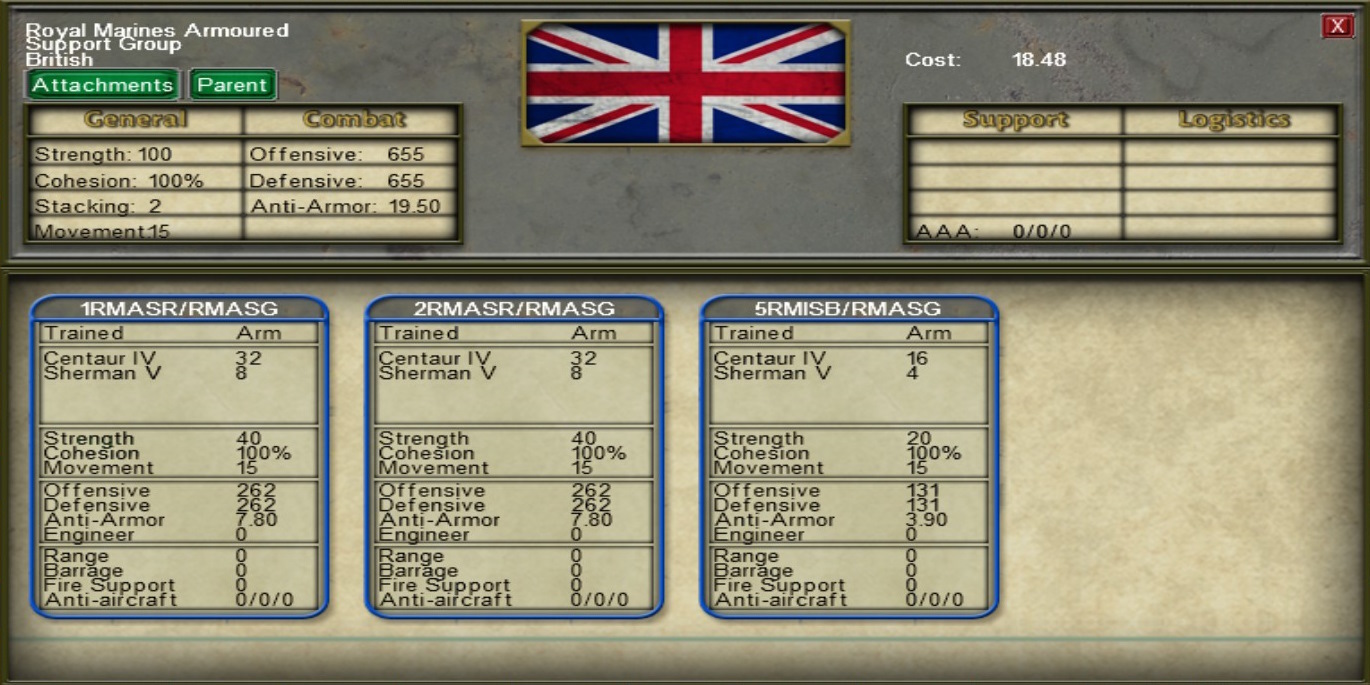
Added the Centaur-Equipped Royal Marine Armoured Support Group, in its June 6, 1944 organization. This new addition lends UK 1944 a novel, relatively cheap, armoured regiment that excels in an infantry support role.
Armoured recon regiments of the Guards and 11th Armoured Divisions re-organized to their July 1944 orgs, complete with Challenger TDs that could not be landed during Operation Overlord.
Anti-Tank, Artillery, and Anti-Aircraft:
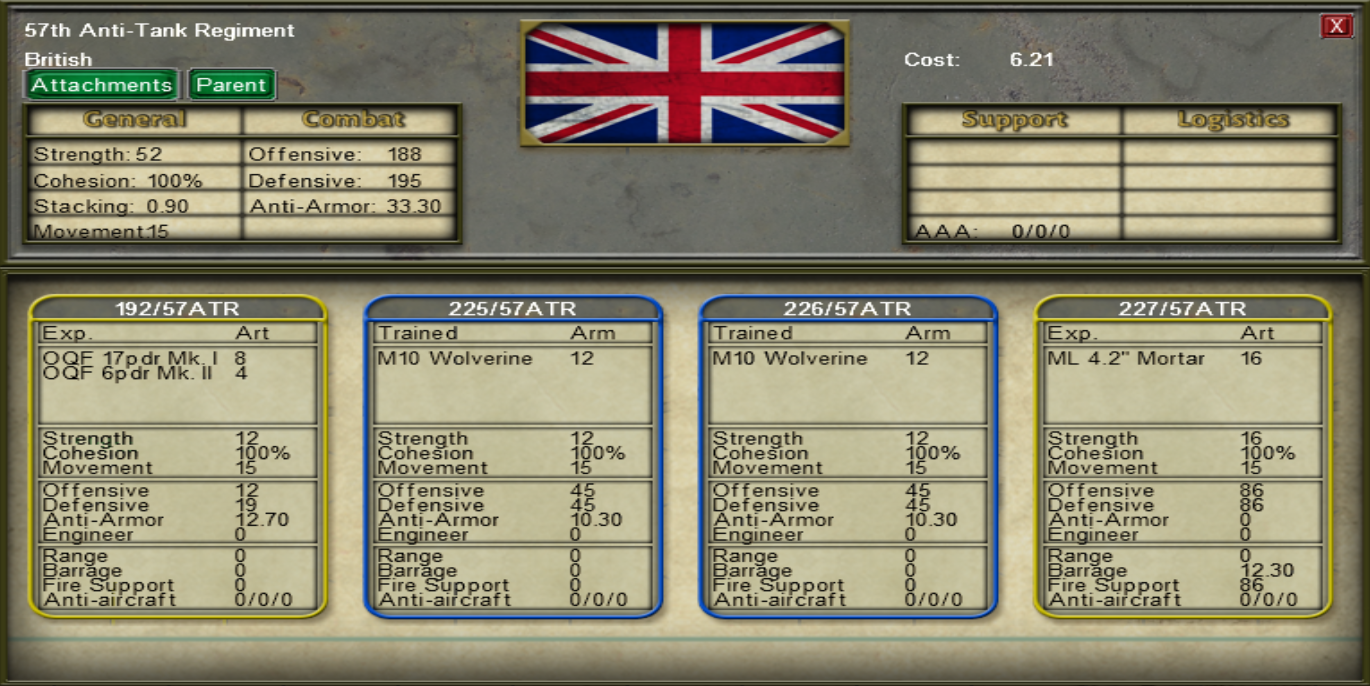
Added 57th Anti-Tank Regiment, composed of 1 battery towed AT, 2 batteries M10s, and 1 battery of 4.2” mortars, specialized for combat in Italy.
Added 105th Anti-Tank Regiment, composed of 1 towed battery, and 2 self-propelled M10 batteries.
Added 62nd Anti-Tank regiment, composed of M10 Achilles and towed 17pdrs.
Re-organized 102nd AT Regiment (50th Infantry Division) to its June 1944 organization, including 2 Achilles SP batteries borrowed from the 73rd AT Regiment.
Reorganized 74th, 90th, and 124th Field Regiments royal artillery to their June 6th landing ToEs, armed with M7 Priests and Sexton SPGs.
Issued M7 Priests to 12th Regiment RHA. It was previously erroneously equipped with towed 25pdrs.
Re-organized 4th Regiment, RHA into its June 6 assault OB with towed 25pdrs instead of self-propelled Sextons. The 4th RHA did not convert to an SP Regiment until September.
Made the 1st Mountain Regiment, RA an independent unit.
Reorganized 7th and Guards Armoured Division Anti-aircraft regiments to their overstrength June 6th landing ToEs.
Added the 93rd Light Anti-Aircaft Regiment in its June 6 assault organization. This is a specialist low-altitude AA unit is armed with towed triple Polsten AA guns and the only field-deployment of the triple 20mm cannon variant of the Crusader AA tank.
Reduced training level of UK AA units to recruit, except in units that demonstrated particular talent for ground combat.
Added historical battery names to all Royal Artillery units.
UK 1943 Revisions:
2nd New Zealand Division 1943 Revisions:
Added Armoured Brigade HQ tanks to 4th NZ Armoured Brigade.
Added missing scout cars to 18th and 20th Armoured Regiments, 4th New Zealand Armoured Brigade.
Added missing Stuart Vs to 19th Armoured Regiment, 4th New Zealand Armoured Brigade.
Corrected Sherman types from Sherman IIs to Sherman IIIs in 4th NZ Armoured Brigade.
Replaced Sten SMGs in 2nd New Zealand Division infantry squads with Thompson SMGs more common in the MTO.
System Updates and Bug Fixes:
Added a drop-down button to swap sides in the editor, instead of needing to end turn to swap sides. You will still need to run the turn at least once to establish the air control grid, or prepare the scenario for saving and uploading to the workshop.
Added code support for air landing units. Air landing units will play a key role in Operation Sea Lion, but you’ll see them in the general national OBs before then.
Increased beach persistence by 1 turn in invasion scenarios, this applies to all scenarios.
Airfield values can now be set per side at the scenario config level. Useful if you want to create scenarios where airfield control is more valuable to one side than the other.
Fixed a bug that prevented corps HQs from extending port-based supply networks in Invasion scenarios.
Fixed a bug that could allow armored units to cross under-construction (brown) bridges. Infantry ARE supposed to be able to do this, but armor should not.
Fixed a bug introduced in the last update that caused minefields on broken terrain hexes to become impassable to all enemy units.
Update 1.0.6.9/Dev Blog 15 - Amphibious Warfare Rework
We’re back with a combined update/dev-blog featuring a series of new mechanics developed for Operation Sea Lion that greatly enhance broader CAOS amphibious combat gameplay, editor additions, and UK 1943 OB expansions.
The first half of these update notes double as a CAOS Amphibious Warfare Overhaul dev blog. Fair warning, it gets table heavy and deeply nerdy. The second half tackles the more routine aspects of the update.
Amphibious Combat Overhaul:
The amphibious combat system has been totally overhauled to reflect the extreme difficulty of amphibious operations and differences in capability, doctrine, and naval fire at the national and equipment level. Each country now receives its own amphibious assault modifier tied to year, naval barrage/fire support is now directly derived from specific ship types, and every equipment type in the game has its own amphibious combat modifier.
Modding: All of the modifiers below can be easily modded in the naval_support, amphib, and wep, inis inside the game files.
Amphibious Equipment Modifiers:
Amphibious equipment modifiers are derived from three essential questions: 1) How will the soldiers reach the beach? 2) Do they have specialist training and doctrine for amphibian operations. 3) Does their equipment give them some unique advantage or penalty?
All weapon types suffer severe amphibious combat penalties, but these can be reduced or completely overcome through various modifiers. Amphibious tractors that can deliver combat personnel directly into combat such as the LVT-2 provide the best bonuses, but any kind of landing ship that can run directly up on a beach helps. Armored vehicles use a similar model, which generally favors swimming tanks, but bottom crawling tanks still enjoy benefits. Doctrine is split into four categories (from highest to lowest), marine-commandos, marines, commandos, and naval infantry. Finally, vehicle size and weight plays a decisive role; it should come as no surprise that you really should not include King Tigers in an assault landing force. Amphib modifiers can be viewed on any weapon card; they are currently listed under the Support header, pending a re-organization of the graphic itself.
See the table below for generalized examples of the new system, combined with UK 1944 national modifiers as a benchmark. [table] [tr] [th]Weapon Type:[/th] [th]Amphib Mod:[/th] [th]UK 1944 Mod:[/th] [th]Total Mod:[/th] [/tr] [tr] [td]Marine-Commando[/td] [td]+70%[/td] [td]+35%[/td] [td]+105%[/td] [/tr] [tr] [td]Marine[/td] [td]+50%[/td] [td]+35%[/td] [td]+85%[/td] [/tr] [tr] [td]Naval Infantry[/td] [td]-15%[/td] [td]+35%[/td] [td]+20%[/td] [/tr] [tr] [td]Infantry[/td] [td]-50%[/td] [td]+35%[/td] [td]-15%[/td] [/tr] [tr] [td]Swimming Medium Tank[/td] [td]-40%[/td] [td]+35%[/td] [td]-5%[/td] [/tr] [tr] [td]Crawling Medium Tank[/td] [td]-60%[/td] [td]+35%[/td] [td]-25%[/td] [/tr] [tr] [td]Heavy Tank[/td] [td]-90%[/td] [td]+35%[/td] [td]-65%[/td] [/tr] [tr] [td]Medium Tank[/td] [td]-75%[/td] [td]+35%[/td] [td]-45%[/td] [/tr] [tr] [td]Light Vehicle[/td] [td]-55%[/td] [td]+35%[/td] [td]-20%[/td] [/tr] [/table]
Each nation receives a global amphibious combat modifier, tied to year, that reflects all aspects of a country's ability to wage amphibious operations not already reflected by the equipment modifiers detailed further below. This national amphibious modifier is derived from a nation’s: 1) Joint air-land-sea planning capabilities. 2) Logistical capability to support landings. 3) Experience conducting opposed landing operations. Unsurprisingly, the dominant naval powers enjoy substantial amphibious combat advantages. For instance, the US and UK enter the war with +10% amphibious assault modifiers, and their modifiers rise to an imposing +40% by 1945. Conversely, Germany enters the war with a -10% amphibious penalty, and rises to a +10% bonus in 1941. See the table for details below, by nation.
Direct naval fire support and pre-invasion naval barrage is now modeled by nation, by ship-type. Each naval fire support or barrage mission rolls on a table to select what type of ship is servicing the fire mission. Naval support missions utilize destroyers and light cruisers (sometimes gunboats for Germany and the USSR), while naval barrage selects anything from destroyers to heavy cruisers. The chance of each vessel type being selected for the fire mission are not equal. Larger ships such as CAs, or rare/unique ships such as the German Emden CL, are less likely to make an appearance. The tables below display a sample of ship types, some countries, particularly the UK, have far more sub-types than can be displayed here.
The system does not currently let you micromanage what ship types cover what landings, but if we ever extend this system to include capital ships then a manual selection system akin to the air orders button will likely be implemented.
Broad outcomes: Larger hulls do not necessarily correlate to better naval fire performance in support of amphibious operations. Indeed, the best performers in the current destroyer/cruiser dataset are Cleveland class CLs, and their even more terrifying Brooklyn class siblings, due to their substantial rate of fire advantages over heavy cruisers armed with 8" guns.
[table] [tr] [th]USA:[/th] [th]Gleaves (DD):[/th] [th]Fletcher (DD):[/th] [th]Omaha (CL):[/th] [th]Cleveland (CL):[/th] [th]Baltimore (CA):[/th] [/tr] [tr] [td]Barrage (Avg.)[/td] [td]77[/td] [td]97[/td] [td]145[/td] [td]230[/td] [td]161[/td] [/tr] [tr] [td]Support (Avg.)[/td] [td]41[/td] [td]51[/td] [td]73[/td] [td]121[/td] [td]N/A[/td] [/tr] [tr] [th]UK/CMW:[/th] [th]Tribal (DD):[/th] [th]Leander (CL):[/th] [th]Town (CL):[/th] [th]County (CA):[/th] [th]Roberts (Mon):[/th] [/tr] [tr] [td]Barrage (Avg.)[/td] [td]39[/td] [td]94[/td] [td]141[/td] [td]158[/td] [td]191[/td] [/tr] [tr] [td]Support (Avg.)[/td] [td]22[/td] [td]49[/td] [td]74[/td] [td]N/A[/td] [td]97[/td] [/tr] [/table] As two of the world's dominant naval powers, it's little surprise that the United States and Great Britain generally dominate the naval fire charts. Within the destroyer/cruiser dataset we base these calculations on the US enjoys superiority due to the outstanding performance of their modern 5 and 6" guns. British naval fire can be formidable, but it is inconsistent. Britain's 15" armed monitors are potent and their Town class CLs are excellent. Yet, their DD support is brutally average and some of the other British light cruiser classes (Didos/Bellonas, specifically) fail to impress. Most of these deficiencies are budgetary in origin, owing either to ships continuing to use old weapons, or never receiving their full allocation of guns, or both. Still, even on the Royal Navy's worst day, they outperform Italy, France, the USSR, and unlike the Germans they will never have to rely on a patrol gunboat...
[table] [tr] [th]Germany:[/th] [th]Helene (PGB):[/th] [th]Z-36A (DD):[/th] [th]Emden (CL):[/th] [th]Konigsberg (CL):[/th] [th]Nurnberg (CL):[/th] [th]Admiral Hipper (CA):[/th] [/tr] [tr] [td]Barrage (Avg.)[/td] [td]N/A[/td] [td]42[/td] [td]70[/td] [td]123[/td] [td]148[/td] [td]180[/td] [/tr] [tr] [td]Support (Avg.)[/td] [td]6[/td] [td]23[/td] [td]36[/td] [td]63[/td] [td]77[/td] [td]N/A[/td] [/tr] [/table] The Kriegsmarine performs admirably...when they actually show up. German naval fire does not reach potential heights of the Anglo-American maritime powers, but they stand firmly ahead of the other continental states due to relatively high rates of fire and solid weapon design. However, Germany falls flat in employment and thin reserves. In the case of Operation Sealion planning for instance, fire support consisted of converted patrol vessels and armed barges due to the combined factors of low ship availability (the Kriegsmarine had 10 destroyers ready for action in the English channel in late September 1940) and poor interservice cooperation between the Kriesgmarine and the Heer/Luftwaffe. In gameplay terms this means German landings either enjoy competent support, or worthless barges, and you will not know which you are getting until you hit the beach.
[table] [tr] [th]Italy:[/th] [th]Turbine (DD):[/th] [th]Navigatori (DD):[/th] [th]Giussano (CL):[/th] [th]Cadorna (CL):[/th] [th]Zara (CA):[/th] [/tr] [tr] [td]Barrage (Avg.)[/td] [td]18[/td] [td]29[/td] [td]32[/td] [td]64[/td] [td]126[/td] [/tr] [tr] [td]Support (Avg.)[/td] [td]9[/td] [td]14[/td] [td]17[/td] [td]33[/td] [td]N/A[/td] [/tr] [tr] [th]France:[/th] [th]Aigle (DD):[/th] [th]Le Fantasque (DD):[/th] [th]Duguay-Trouin (CL):[/th] [th]La Galissonniere (CL):[/th] [th]Suffren (CA):[/th] [/tr] [tr] [td]Barrage (Avg.)[/td] [td]21[/td] [td]31[/td] [td]44[/td] [td]67[/td] [td]117[/td] [/tr] [tr] [td]Support (Avg.)[/td] [td]11[/td] [td]17[/td] [td]22[/td] [td]35[/td] [td]N/A[/td] [/tr] [/table] France and Italy suffer from different naval fire deficiencies that lead to very similar outcomes. Italian naval gun design favors excessively high velocity, necessitating short barrel lives and thick shell walls that leaves less room for explosive filler. Consider for instance, that the 152/53 M1929 cannon carried by most of the Condottieri family of CLs (Cadorna, Montecuccoli, etc.) carries HE shells containing 2.3kgs of explosives, compared to 3.3kgs on average in 5"/38s carried by most US destroyers. 5"/38s further boast substantially higher rates of fire. Consequently, for the purposes of naval barrage and fire support, Italian CLs are routinely outperformed by ships weighing 1/3 their displacement.
French guns on the other hand employ perfectly adequate bursting charges, but suffer from chronically low rates of fire, due to the age of the designs or sometimes defects in more modern designs. While neither France nor Italy play German gunboat roulette, their average naval fire rolls are still well below Germany and in the DD category, even below the Soviets.
[table] [tr] [th]USSR:[/th] [th]Zhelezniakov (Mon):[/th] [th]Gnevny (DD):[/th] [th]Leningrad (DD):[/th] [th]Kirov (CL):[/th] [/tr] [tr] [td]Barrage (Avg.)[/td] [td]N/A[/td] [td]46[/td] [td]58[/td] [td]84[/td] [/tr] [tr] [td]Support (Avg.)[/td] [td]10[/td] [td]24[/td] [td]30[/td] [td]41[/td] [/tr] [/table] Purges, industrial inefficiency, and the pressing need to prioritize land and air forces, left the Soviet Navy woefully underprepared for war. The Chapeyev class CLs were not finished before Operation Barbarossa commenced, and the Kirovs suffered from rates of fire far below design specifications. Consequently, the Soviets lack effective cruiser support, their destroyers are respectable, and sometimes invasion support ends up in the hands of ships that have no business being anywhere near an active landing zone.
Order of Battle Updates:
This update brings UK 1943 up to a modern CAOS standard, with a slight expansion of the OB, including the flexible 2nd New Zealand Division, 2nd tier line of communication units, and various minor corrections for historical accuracy. 1943 is actually a relatively stable year for the UK; it lacks both the desperate improvisation of the war's early years, or the rapid adaptations to combat in continental Europe that the Commonwealth armies will undergo in 1944.
UK 1943:
Added 2nd New Zealand Division in its September, 1943 order of battle. Complete with the freshly raised 4th New Zealand Armoured Brigade and Staghound heavy armoured cars.
Added the 3rd Infantry Division, a formerly veteran division stripped of its battle hardened personnel and relegated to Home Defense.
Added the 227th Independent Infantry and 25th Indian Infantry Brigades as independent units.
Added Y (17/6pdr) and Z (M10 Wolverine) batteries to 21st Anti-Tank Regiment.
Converted 146th Field Regiment RA and 13th Royal Horse Artillery Regiments to their Tunisian Campaign OBs using towed 25pdrs instead of SPGs.
61st, 64th, and 81st Anti-Tank Regiments received partial batteries of 17pdrs.
52nd Anti-Tank Regiment expanded to 5 batteries and received a handful of 17pdrs.
3rd Anti-Tank Regiment, RCA brought up to full strength (each battery was previously missing 1 troop).
Added the 87th and 93rd Anti-Tank Regiments, with 3 and 4 batteries, respectively.
Removed erroneous 4th battery from the 105th Anti-Tank Regiment.
69th Medium Regiment weapons corrected from 5.5 to 4.5” Guns.
Added the 75th Medium Regiment, equipped with 5.5” Guns.
Reduced training level of British AA units to recruit.
Added historical battery names to all Royal Artillery units.
Editor Updates:
Added support for asymmetric victory conditions in custom scenarios. For instance, you could set Red to require 70% of VPs to win, but only 50% for Blue.
Added support for historical dates in custom scenarios.
Custom scenarios can now be created without any units pre-deployed on map on turn 1.
Unit availability in requisition pool can now be time-gated in custom scenarios. Use this to deny access to specific units until a certain date.
Bug Fixes/Changes:
Fixed the infamous ultra-wide resolution screen tearing bug caused by opening regiment cards or issuing orders.
Fixed a bug that could unit pool to become unopenable after loading a save during a preturn after turn 1.
Fixed a bug that caused the requisition screen to draw over the multiplayer ready screen in custom scenarios.
Fixed a bug that could duplicate the host player’s requisition points during reinforcement turns in head to head custom games.
Operation Sea Lion Development Status:
That wraps it up for today's dev blog and update notes combo! Operation Sea Lion development has also led to the creation to code support for air mobile divisions, contestable port lines of supply, and many other cool features we'll be rolling out into the base game once they are stable. Broader Operation Sea Lion development itself is currently experiencing an AI development bottleneck, because it requires effectively totally overhauling the the AI to handle scenarios that are far larger than anything the base CAOS was designed to handle. That said, even if it takes a while, general AI improvements are a welcome improvement to CAOS as a whole.
Update 1.0.6.4 - Scenario Editor Release
Update 1.0.6.4 has reached full deployment! The scenario editor and the order of battle updates it brings with it are live. If you played the experimental branch, you already know what to expect; the transition from experimental to live build was remarkably smooth. These patch notes are very long so the short summary is: the scenario editor is here, the supply system was re-written, ultrawide support improved, and UK, USSR, and Germany all received major early war updates.
Scenario Editor:
With the arrival of the scenario editor you can make your own custom CAOS scenarios and upload them to the Steam workshop to share with friends and the community. The editor tools can even be used to make variants of our own historical scenarios, or other scenarios off the workshop, go nuts!
The version of the editor deployed today has a few more features than the preview last year, including the ability to reduce units to units to a percentage of TOE strength, the capacity to lock out training level changes in a scenario, and upload to Steam workshop directly from inside the game, among many others.
The manual has also been updated a new chapter covering the editor, and the official CAOS discord server has an official editor support channel. If you have any questions, even just questions about how to design a scenario you've imagined, feel free to let us know on Discord.
Example Scenarios:
We have prepared several example scenarios, all available for download on the Steam Workshop to help inspire your own creations, and for the pure fun of playing them as well: Siege of Paris (1940): A siege scenario pitting outnumbered French defenders of the city of Paris against invading German forces. https://steamcommunity.com/sharedfiles/filedetails/?id=3126158090
Somme Map Control (1942): A conquest style scenario pitting the USA against the USSR, where every objective on the map is worth points and both sides receive requisition points on an ongoing basis. The battle starts small but escalates over time. https://steamcommunity.com/sharedfiles/filedetails/?id=3126155387
Fortress Sassari (1945): US forces must hold out against an unrelenting Soviet onslaught until time expires. https://steamcommunity.com/sharedfiles/filedetails/?id=3126155697
Al-Hudud Offensive (1944): British forces must penetrate and capture a multi-layered German fortress line before powerful German reinforcements arrive on Turn 16 to initiate a counter-offensive. https://steamcommunity.com/sharedfiles/filedetails/?id=3126155163
Entering the Editor, Playing Custom scenarios, and Enabling Workshop Scenarios:
To access the editor, select Single Player, choose the Editor menu option, and setup a new scenario.
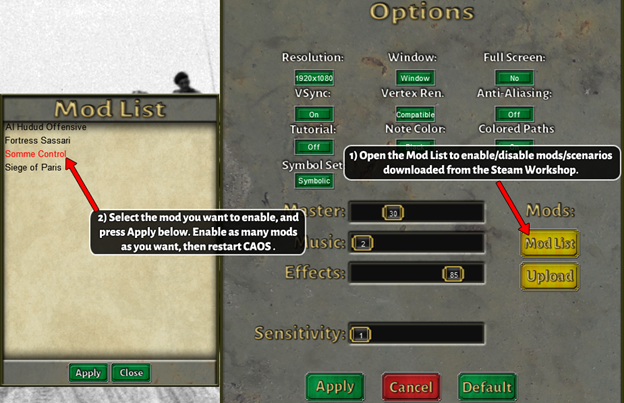
Custom scenarios are listed under the new Custom scenario type header during game creation (both single and multiplayer). Scenarios downloaded from the workshop also need to be enabled in Options (see below).
After downloading mods from the workshop, you can enable them from the Mod List in the Options menu.
System Updates:
Completely re-wrote supply propagation code to optimize it for larger maps/scenarios. Turn run speed on larger maps increased by upwards of 84%.
Completely re-wrote code used to graphically draw air grid to eliminate lag while the overlay is active on larger maps.
Improved ultrawide screen support. Some ultrawide displays still experience graphical tearing, but the sinister bug that caused the right edge of the screen to draw out of sight has been slain (thanks to Max and Mezentius for bringing this to our attention).
Fixed a crash caused by buying more than 9 landing markers at once.
Fixed an exploit that allowed players to reset supply depot cost to 0.02.
Order of Battle Updates:
This update continues our campaign to flesh out older orders of battle or add new and interesting tools to your arsenal of destruction. Editor testing has particularly highlighted the need for more diverse options for independent units for custom scenarios, and this update aims to please.
United Kingdom:
In terms of unit quantity and types, UK 1941 and 1942 previously ranked among the smallest and least detailed OBs in CAOS. Update 1.0.6.2 resolves this by bringing major additions to the early war British OBs. Exotic independent units have been added, often overlooked divisions from Home Forces join the fray, and the evolution of British armoured forces, both in the Desert and at home is reflected in detail. Be it the 2nd Armoured Division’s Italian M13/40s in March 1941 or 1st Armoured Division’s iron fist of Shermans and Priests at 2nd Alamein, we have gone to great lengths to reflect the unique evolution of British armoured might.
UK 1941:
Added 9th Armoured Division, a Home Forces armoured division equipped with Covenanters.
Added 38th (Welsh) and 49th (West Riding) Infantry Divisions from Home Forces.
Added 65, 69th, 70th Anti-Tank Regiments as independent units.
Added 111th and 140th Field Regiments as independent units.
Added exact battery numbers for all royal artillery units
Added 25th Army Tank Brigade in its July organization, as Churchill IIs started to arrive.
Reorganized 21st Army Tank Brigade to its fall organization, armed with Churchills.
Added the 24th and 31st Infantry Brigades as (substantially over strength) independent units.
Added No. 3, 5, and 7th Commando Battalions.
Lowered training level of most UK units held in Home Forces during 1941 from experienced to trained.
9th Australian Division and Tobruk Fortress:
Reorganized 9th Australian Division to its April/May 1941 Siege of Tobruk organization, complete with plenty of captured equipment.
Made the 2/2nd Australian MG Battalion, 2/7th Field Regiment RAA, 2/8th Field Regiment RAA, 2/3rd Australian AA Regiment (minus 8th battery), and 9th Divisional Cavalry Regiment independent units. These elements of 9th Australian Division did not see service during the Siege of Tobruk.
Added various elements of Tobruk Fortress (as of April/May 1941), including 4th AA Brigade, 51st Field Regiment, 1st, 3rd, and 107th Regiments Horse Artillery, and the Tobruk Fortress Engineers, either as subordinates to 9th Australian Division or independent units.
UK 1942:
Added 9th Armoured Division, a Home Forces armoured division in its spring, 1942 organization, with Covenanters.
Added 4th Infantry Division, a mixed infantry division with 2 infantry and 1 tank brigade in its fall 1942 Home Forces organization, with Valentines.
Added 26th, 25th, and 21st Indian Infantry Brigades as an independent units.
Added missing HQ platoons (sometimes companies) of British armoured/tank brigades.
Added 121st Field Regiment (on Bishop SPGs) as an independent unit.
Added 66th Royal Engineer Mortar Company, armed with 4.2" mortars, to XXX Corps CSAEC.
Removed 8th Armoured Division and made most of its remaining elements independent units. The division was historically stripped to bring many other armoured divisions up to strength for the battles of El Alamein.
Reorganized 2nd New Zealand Division to its October 1942 state. Division motorized and 4th NZ Infantry Brigade removed (converting to armour at this time).
Reorganized 1st and 10th Armoured Divisions to their October 23 organizations at the start of 2nd Alamein.
Reorganized 6th Armoured Division to its Fall 1942 state, after its transfer to the Middle East.
Reorganized 7th Armoured Division to its November 1, 1942 organization (adds the 131st Lorried Infantry Brigade).
Made 4th Armoured Brigade an independent unit, using its September 16 organization.
Made the 20th Armoured Brigade an independent unit (detached from 6th Armoured Division in April).
Corrected balance of Churchill tank types in 25th Tank Brigade. The brigade previously had too many Churchill Is.
Reduced number of operational Matilda Scorpions in the 1st Tank Brigade from 16 to 9 to reflect on-hand strength on October 23.
Soviet Union 1942:
Soviet 1942 was already a large and well-equipped OB, but it was also one of the oldest in CAOS. This update brings Soviet 1942 up to the research standard of our newest OBs. The Red Army underwent numerous organizational evolutions during 1942 and this update reflects these evolutions from squad to corps in infantry and armored units alike.
TOE Updates:
Guards Mechanized Corps:
Increased SMG squads in Guards Motor Rifle Battalions within Guards Mech. Brigades from 3 to 9.
Increased MG squads in Guard Motor Rifle Battalions from 4 to 7.
Increased 82mm BM-37 mortars in Guards Mech. Brigade mortar company from 6 to 12.
Added missing signals and recon platoons to Guards Tank Regiments. +2 T-34s and +3 BA-64s.
Guards Tank Corps
Removed SMG Company from Armored Infantry battalions of tank brigades. SMG Companies do not enter their official TOE until January 1943.
Removed 45mm AT guns from Armored Infantry battalions of tank brigades.
Increased 82mm BM-37 Mortar strength from 6 to 8 in armored infantry battalions of tank brigades.
Removed sapper and recon platoons from Tank Brigade HQs that were not implemented until 1943.
Added 37mm AA gun section (4 guns) to Tank Brigade HQs.
OB Updates:
Mechanized/Tank Corps and Brigades:
1st Guards Mechanized Corps reorganized into its December 17, 1942 OB. It previously included attachments it did not receive until the Donbas fighting in January/February 1943.
1st Tank Corps re-organized into its March 1942 OB.
2nd Tank Corps re-organized into its July 1942 OB.
6th Tank Corps reorganized into its August 1942 OB.
21st Tank Corps reorganized into its May 1942 OB.
24th Tank Corps re-organized into its November 1942 OB.
26th Tank Corps re-organized into its November 1942 OB.
29th Tank Brigade re-organized to its April 1942 infantry support organization.
21st Tank Brigade re-armed in its April 1942 infantry support organization.
15th Tank Brigade re-armed in its August re-organization, post 2nd Kharkov, equipped with American tanks.
3rd Tank Brigade re-organized to its September 1942 OB.
Added 235th Flame Tank Brigade, as it was committed to Stalingrad in October, 1942.
Added Maikop Tank Brigade, a training unit armed with BT-7s deployed to the Caucus Front in July 1942. The 235th Flame Tank Brigade in all of its napalm-fueled glory.
Infantry: All Soviet rifle divisions and independent brigades reorganized according to their December 1941, March 1942, or July 1942 OBs and ToEs. Most, but not all, rifle battalions are represented reduced by roughly 1 company in strength to reflect common manpower shortfalls during the period.
8th Guards Rifle Division re-organized into its March 1942 OB.
13th Guards Rifle Division re-organized into its July 1942 OB.
40th Guards Rifle Division re-organized into its July 1942 OB.
45th Rifle Division re-organized into its July 1942 OB.
1st NKVD Rifle Division re-organized into its September 1942 OB (as the 46th Rifle Division).
10th NKVD Rifle Division re-organized into its July 1942 OB.
49th Rifle Division re-organized into its July 1942 OB.
51st Rifle Division re-organized into its December 1941 OB.
55th Rifle Division re-organized into its March 1942 OB.
86th Rifle Division's infantry battalions re-organized according to the December 1941 Shtat (as a former Leningrad militia division, it already has a highly non-standard organization).
109th Rifle Division re-organized into its March 1942 OB.
146th Rifle Division re-organized into its March 1942 OB.
160th Rifle Division re-organized into its March 1942 OB.
243rd Rifle Division re-organized into its July 1942 OB.
250th Rifle Division re-organized into its March 1942 OB.
277th Rifle Division re-organized into its July 1942 OB.
306th Rifle Division re-organized into its July 1942 OB.
334th Rifle Division re-organized into its March 1942 OB.
354th Rifle Division re-organized into its March 1942 OB.
411th Rifle Division re-organized into its March 1942 OB.
Infantry battalions of the 23rd, 106th, 109th, 119th, 134th, 141st, 234th, 235th, Separate Rifle Brigades reorganized according to December 1941 Shtat.
Germany:
Germany receives a series of cheaper 2nd line infantry divisions and a range of specialist armor or mechanized units to enhance its early war flexibility.
Germany 1939:
Added 8. Infanterie Division (Wave 1 Division)
Added 216. Infanterie Division (Wave 3 Division)
Added 251 and 253 Infanterie Divisions (Wave 4 Divisions)
Base training level for German field flak units in 1939 lowered from experienced to trained.
Germany 1940:
Added 8. Infanterie Division (Wave 1 division).
Added 208 and 216 Infanterie Divisions (Wave 3 Divisions)
Added 251 and 253 Infanterie Divisions (Wave 4 Divisions)
Added Infanterie Regiment (Mot.) Großdeutschland.
Added 601 and 505 Fla-Bataillon. Armed respectively with 4 and 3 companies of SdKfz 10/4 self-propelled 2cm Flak guns.
Added 40. Panzerabteilung z.b.V, in its April (Invasion of Norway) OB. The battalion consists of three mixed companies of Panzer Is and IIs, plus a single platoon of Neubaufahrzeug heavy tanks.
Added 659 and 660 Sturmbatteries. Each equipped with 6 StuG III As.
Added 525 and 605 Panzerjager Abteilung. Armed with mix of 8.8cm FlaK 36s and 3.7cm PaK 36s.
Added 1st Company, 8th Panzerjager Abteilung as an independent tank destroyer unit armed with Sdkfz 8 8.8cm Bunkerflak. This unit historically operated under XIX Armeekorps during the Battle for France.
Reduced Wave 4 Aufklarungs Abteilungen to company strength and attached them to their divisional Panzerjager Abteilung, in accordance with Spring 1940 re-organization.
Removed regimental pioneer company from Wave 4 divisions, in accordance with February 1940 revisions.
Replaced 4th rifle company in Wave 4 infantry battalions with an MG company, in accordance with February 1940 revisions.
Other OB Updates:
Added 1st NKVD Rifle Division in its August OB to Soviet 1941. These hastily mobilized border troops are of dubious quality, but they're cheap and expendable.
Added 184, 191, 203, and 210. Sturmgeschutz Abteilungen to Germany 1941.
Graphics:
Replaced Hold and Defend order action graphic with a shovel.
Replaced on map Hold and Defend graphic with sand bags.
Brits on the Horizon:
Further immersion and quality of life improvements are already in development, including the ability to replace turn numbers with historical dates, and better visual distinction between Red and Blue air hubs, among others. An intermediate update centered on UK 1943 OB improvements alongside a series of editor improvements is already in internal testing. With the mammoth work of getting the editor ready and all the Steam workshop integration that came with it off our shoulders, it is time to gradually grow the editor's capabilities and cast our gaze once more upon the Cliffs of Dover.
Expect a development roadmap update next week.
Update 1.0.6.4 (Experimental)
Greetings! We are back with a major experimental build introducing the scenario editor and a series of hefty order of battle updates. These patch notes are very long so the short summary is: the scenario editor is here, the supply system was re-written, and UK, USSR, and Germany all received major early war updates.
See the picture below for information on how to opt-in to the Experimental build if you’re interested in playing new updates early.
Scenario Editor:
With the arrival of the scenario editor you can make your own custom CAOS scenarios and upload them to the Steam workshop to share with friends and the community. The editor tools can even be used to make variants of our own historical scenarios, or other scenarios off the workshop, go nuts!
The version of the editor deployed today has a few more features than the preview last year, including the ability to reduce units to units to a percentage of TOE strength, the capacity to lock out training level changes in a scenario, and upload to Steam workshop directly from inside the game, among many others.
See the screenshot below to opt into the experimental branch and give the editor a try:
The manual has also been updated a new chapter covering the editor, and the official CAOS discord server will receive a dedicated editor support channel tomorrow.
Example Scenarios:
We have prepared several example scenarios, all available for download on the Steam Workshop to help inspire your own creations, and for the pure fun of playing them as well: Siege of Paris (1940): A siege scenario pitting outnumbered French defenders of the city of Paris against invading German forces. https://steamcommunity.com/sharedfiles/filedetails/?id=3126158090
Somme Map Control (1942): A conquest style scenario pitting the USA against the USSR, where every objective on the map is worth points and both sides receive requisition points on an ongoing basis. The battle starts small but escalates over time. https://steamcommunity.com/sharedfiles/filedetails/?id=3126155387
Fortress Sassari (1945): US forces must hold out against an unrelenting Soviet onslaught until time expires. https://steamcommunity.com/sharedfiles/filedetails/?id=3126155697
Al-Hudud Offensive (1944): British forces must penetrate and capture a multi-layered German fortress line before powerful German reinforcements arrive on Turn 16 to initiate a counter-offensive. https://steamcommunity.com/sharedfiles/filedetails/?id=3126155163
Entering the Editor, Playing Custom scenarios, and Enabling Workshop Scenarios:
To access the editor, select Single Player, choose the Editor menu option, and setup a new scenario.
Custom scenarios are listed under the new Custom scenario type header during game creation (both single and multiplayer). Scenarios downloaded from the workshop also need to be enabled in Options (see below).
After downloading mods from the workshop, you can enable them from the Mod List in the Options menu.
System Updates:
Completely re-wrote supply propagation code to optimize it for larger maps/scenarios. Turn run speed on larger maps increased by upwards of 84%.
Completely re-wrote code used to graphically draw air grid to eliminate lag while the overlay is active on larger maps.
Fixed a crash caused by buying more than 9 landing markers at once.
Fixed an exploit that allowed players to reset supply depot cost to 0.02.
Order of Battle Updates:
This update continues our campaign to flesh out older orders of battle or add new and interesting tools to your arsenal of destruction. Editor testing has particularly highlighted the need for more diverse options for independent units for custom scenarios, and this update aims to please.
United Kingdom:
In terms of unit quantity and types, UK 1941 and 1942 previously ranked among the smallest and least detailed OBs in CAOS. Update 1.0.6.2 resolves this by bringing major additions to the early war British OBs. Exotic independent units have been added, often overlooked divisions from Home Forces join the fray, and the evolution of British armoured forces, both in the Desert and at home is reflected in detail. Be it the 2nd Armoured Division’s Italian M13/40s in March 1941 or 1st Armoured Division’s iron fist of Shermans and Priests at 2nd Alamein, we have gone to great lengths to reflect the unique evolution of British armoured might.
UK 1941:
Added 9th Armoured Division, a Home Forces armoured division equipped with Covenanters.
Added 38th (Welsh) and 49th (West Riding) Infantry Divisions from Home Forces.
Added 65, 69th, 70th Anti-Tank Regiments as independent units.
Added 111th and 140th Field Regiments as independent units.
Added exact battery numbers for all royal artillery units
Added 25th Army Tank Brigade in its July organization, as Churchill IIs started to arrive.
Reorganized 21st Army Tank Brigade to its fall organization, armed with Churchills.
Added the 24th and 31st Infantry Brigades as (substantially over strength) independent units.
Added No. 3, 5, and 7th Commando Battalions.
Lowered training level of most UK units held in Home Forces during 1941 from experienced to trained.
9th Australian Division and Tobruk Fortress:
Reorganized 9th Australian Division to its April/May 1941 Siege of Tobruk organization, complete with plenty of captured equipment.
Made the 2/2nd Australian MG Battalion, 2/7th Field Regiment RAA, 2/8th Field Regiment RAA, 2/3rd Australian AA Regiment (minus 8th battery), and 9th Divisional Cavalry Regiment independent units. These elements of 9th Australian Division did not see service during the Siege of Tobruk.
Added various elements of Tobruk Fortress (as of April/May 1941), including 4th AA Brigade, 51st Field Regiment, 1st, 3rd, and 107th Regiments Horse Artillery, and the Tobruk Fortress Engineers, either as subordinates to 9th Australian Division or independent units.
UK 1942:
Added 9th Armoured Division, a Home Forces armoured division in its spring, 1942 organization, with Covenanters.
Added 4th Infantry Division, a mixed infantry division with 2 infantry and 1 tank brigade in its fall 1942 Home Forces organization, with Valentines.
Added 26th, 25th, and 21st Indian Infantry Brigades as an independent units.
Added missing HQ platoons (sometimes companies) of British armoured/tank brigades.
Added 121st Field Regiment (on Bishop SPGs) as an independent unit.
Added 66th Royal Engineer Mortar Company, armed with 4.2" mortars, to XXX Corps CSAEC.
Removed 8th Armoured Division and made most of its remaining elements independent units. The division was historically stripped to bring many other armoured divisions up to strength for the battles of El Alamein.
Reorganized 2nd New Zealand Division to its October 1942 state. Division motorized and 4th NZ Infantry Brigade removed (converting to armour at this time).
Reorganized 1st and 10th Armoured Divisions to their October 23 organizations at the start of 2nd Alamein.
Reorganized 6th Armoured Division to its Fall 1942 state, after its transfer to the Middle East.
Reorganized 7th Armoured Division to its November 1, 1942 organization (adds the 131st Lorried Infantry Brigade).
Made 4th Armoured Brigade an independent unit, using its September 16 organization.
Made the 20th Armoured Brigade an independent unit (detached from 6th Armoured Division in April).
Corrected balance of Churchill tank types in 25th Tank Brigade. The brigade previously had too many Churchill Is.
Reduced number of operational Matilda Scorpions in the 1st Tank Brigade from 16 to 9 to reflect on-hand strength on October 23.
Soviet Union 1942:
Soviet 1942 was already a large and well-equipped OB, but it was also one of the oldest in CAOS. This update brings Soviet 1942 up to the research standard of our newest OBs. The Red Army underwent numerous organizational evolutions during 1942 and this update reflects these evolutions from squad to corps in infantry and armored units alike.
TOE Updates:
Guards Mechanized Corps:
Increased SMG squads in Guards Motor Rifle Battalions within Guards Mech. Brigades from 3 to 9.
Increased MG squads in Guard Motor Rifle Battalions from 4 to 7.
Increased 82mm BM-37 mortars in Guards Mech. Brigade mortar company from 6 to 12.
Added missing signals and recon platoons to Guards Tank Regiments. +2 T-34s and +3 BA-64s.
Guards Tank Corps
Removed SMG Company from Armored Infantry battalions of tank brigades. SMG Companies do not enter their official TOE until January 1943.
Removed 45mm AT guns from Armored Infantry battalions of tank brigades.
Increased 82mm BM-37 Mortar strength from 6 to 8 in armored infantry battalions of tank brigades.
Removed sapper and recon platoons from Tank Brigade HQs that were not implemented until 1943.
Added 37mm AA gun section (4 guns) to Tank Brigade HQs.
OB Updates:
Mechanized/Tank Corps and Brigades:
1st Guards Mechanized Corps reorganized into its December 17, 1942 OB. It previously included attachments it did not receive until the Donbas fighting in January/February 1943.
1st Tank Corps re-organized into its March 1942 OB.
2nd Tank Corps re-organized into its July 1942 OB.
6th Tank Corps reorganized into its August 1942 OB.
21st Tank Corps reorganized into its May 1942 OB.
24th Tank Corps re-organized into its November 1942 OB.
26th Tank Corps re-organized into its November 1942 OB.
29th Tank Brigade re-organized to its April 1942 infantry support organization.
21st Tank Brigade re-armed in its April 1942 infantry support organization.
15th Tank Brigade re-armed in its August re-organization, post 2nd Kharkov, equipped with American tanks.
3rd Tank Brigade re-organized to its September 1942 OB.
Added 235th Flame Tank Brigade, as it was committed to Stalingrad in October, 1942.
Added Maikop Tank Brigade, a training unit armed with BT-7s deployed to the Caucus Front in July 1942. The 235th Flame Tank Brigade in all of its napalm-fueled glory.
Infantry: All Soviet rifle divisions and independent brigades reorganized according to their December 1941, March 1942, or July 1942 OBs and ToEs. Most, but not all, rifle battalions are represented reduced by roughly 1 company in strength to reflect common manpower shortfalls during the period.
8th Guards Rifle Division re-organized into its March 1942 OB.
13th Guards Rifle Division re-organized into its July 1942 OB.
40th Guards Rifle Division re-organized into its July 1942 OB.
45th Rifle Division re-organized into its July 1942 OB.
1st NKVD Rifle Division re-organized into its September 1942 OB (as the 46th Rifle Division).
10th NKVD Rifle Division re-organized into its July 1942 OB.
49th Rifle Division re-organized into its July 1942 OB.
51st Rifle Division re-organized into its December 1941 OB.
55th Rifle Division re-organized into its March 1942 OB.
86th Rifle Division's infantry battalions re-organized according to the December 1941 Shtat (as a former Leningrad militia division, it already has a highly non-standard organization).
109th Rifle Division re-organized into its March 1942 OB.
146th Rifle Division re-organized into its March 1942 OB.
160th Rifle Division re-organized into its March 1942 OB.
243rd Rifle Division re-organized into its July 1942 OB.
250th Rifle Division re-organized into its March 1942 OB.
277th Rifle Division re-organized into its July 1942 OB.
306th Rifle Division re-organized into its July 1942 OB.
334th Rifle Division re-organized into its March 1942 OB.
354th Rifle Division re-organized into its March 1942 OB.
411th Rifle Division re-organized into its March 1942 OB.
Infantry battalions of the 23rd, 106th, 109th, 119th, 134th, 141st, 234th, 235th, Separate Rifle Brigades reorganized according to December 1941 Shtat.
Germany:
Germany receives a series of cheaper 2nd line infantry divisions and a range of specialist armor or mechanized units to enhance its early war flexibility.
Germany 1939:
Added 8. Infanterie Division (Wave 1 Division)
Added 216. Infanterie Division (Wave 3 Division)
Added 251 and 253 Infanterie Divisions (Wave 4 Divisions)
Base training level for German field flak units in 1939 lowered from experienced to trained.
Germany 1940:
Added 8. Infanterie Division (Wave 1 division).
Added 208 and 216 Infanterie Divisions (Wave 3 Divisions)
Added 251 and 253 Infanterie Divisions (Wave 4 Divisions)
Added Infanterie Regiment (Mot.) Großdeutschland.
Added 601 and 505 Fla-Bataillon. Armed respectively with 4 and 3 companies of SdKfz 10/4 self-propelled 2cm Flak guns.
Added 40. Panzerabteilung z.b.V, in its April (Invasion of Norway) OB. The battalion consists of three mixed companies of Panzer Is and IIs, plus a single platoon of Neubaufahrzeug heavy tanks.
Added 659 and 660 Sturmbatteries. Each equipped with 6 StuG III As.
Added 525 and 605 Panzerjager Abteilung. Armed with mix of 8.8cm FlaK 36s and 3.7cm PaK 36s.
Added 1st Company, 8th Panzerjager Abteilung as an independent tank destroyer unit armed with Sdkfz 8 8.8cm Bunkerflak. This unit historically operated under XIX Armeekorps during the Battle for France.
Reduced Wave 4 Aufklarungs Abteilungen to company strength and attached them to their divisional Panzerjager Abteilung, in accordance with Spring 1940 re-organization.
Removed regimental pioneer company from Wave 4 divisions, in accordance with February 1940 revisions.
Replaced 4th rifle company in Wave 4 infantry battalions with an MG company, in accordance with February 1940 revisions.
Other OB Updates:
Added 1st NKVD Rifle Division in its August OB to Soviet 1941. These hastily mobilized border troops are of dubious quality, but they're cheap and expendable.
Added 184, 191, 203, and 210. Sturmgeschutz Abteilungen to Germany 1941.
Graphics:
Replaced Hold and Defend order action graphic with a shovel.
Replaced on map Hold and Defend graphic with sand bags.
Marching Forward:
Update 1.0.6.4 will stay on the beta while the scenario editor takes its first steps "in the wild." We look forward to hearing your feedback and to seeing what you guys create on the workshop! The deployment of the scenario editor marks a major step in CAOS development, and it will become the basis of what we envision as a more expansive map/terrain editor in the future. After the editor reaches its full public release, outside of experimental branch, we will release our updated 2024 development roadmap as well.
For now, go forth and create to your heart's content, report bugs, and enjoy the order of battle updates as well!
Tutorial Hotfix
A quick hotfix today to resolve a bug introduced with the 1.0.5.7 update that caused the tutorial to become stuck when attempting to assign fire support to the 6th Armored Infantry Regiment.
Special thanks to Cush for bringing this to our attention.
Work continues on the editor update as usual, we are currently writing the editor manual and assembling the two example scenarios that will deploy with the editor update.