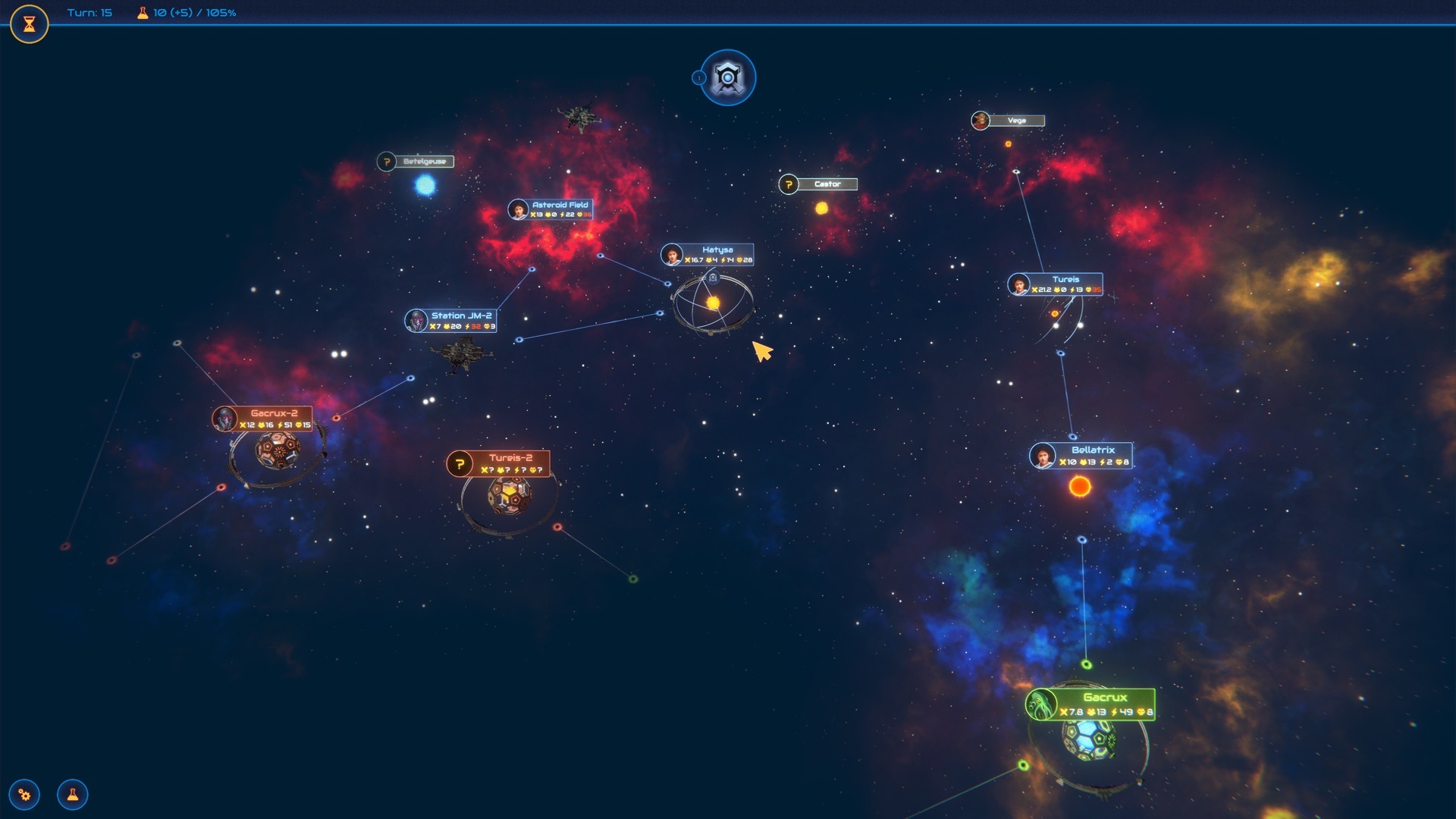
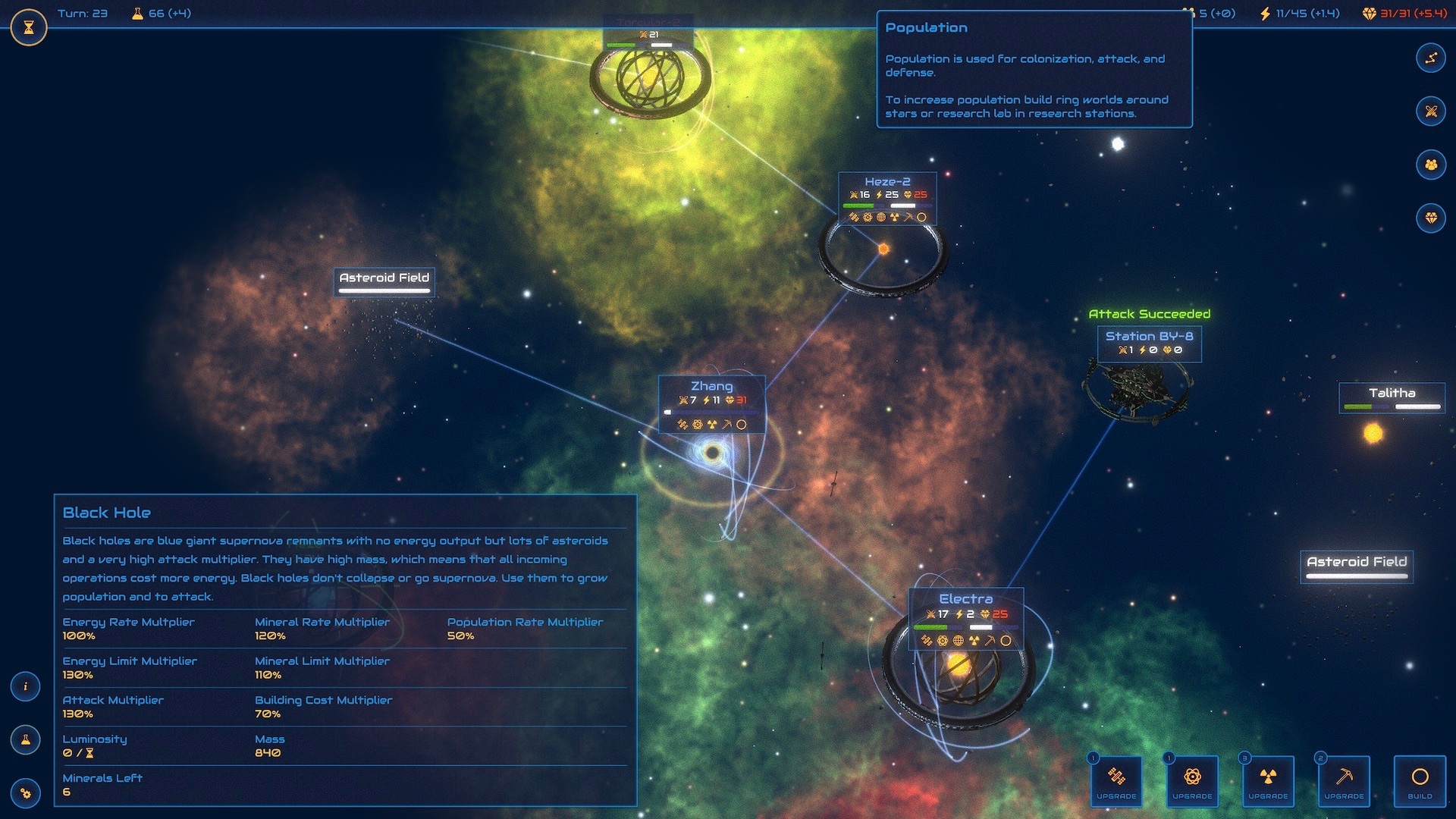
Eons of War development is going swimmingly: game loops are tightening, graphics are improving, and sounds—well—are sounding better.
With this update, we'd like to start covering some of the core game mechanics and systems. The first topic is the in-game economy since it's used in many game loops.
Energy
Energy is used to power all of you space stations. If there is not enough energy then stations' efficiency steadily declines. This has different consequences for different types of stations. For example, shipyards will slow down ship production and sentries won't fire weapons as fast.
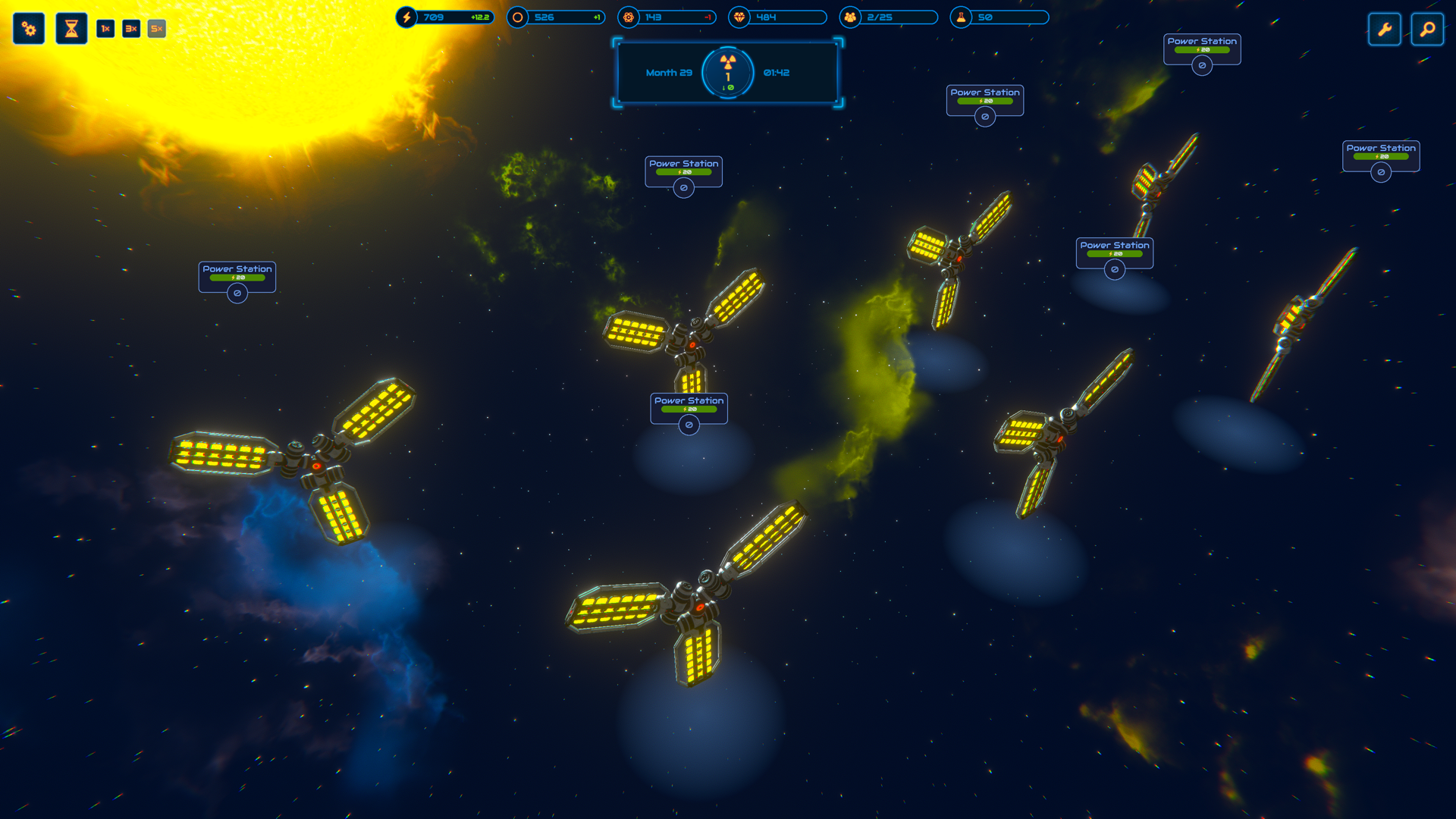
A cluster of solar arrays next to the Starbase.
To get more energy you have to build solar arrays. The closer they are to the star the more energy they generate.
Credits
Credits are used to pay spaceships for their services. If a spaceship is assigned to a specific location then it expects to be paid a salary. If you don't have enough credits then the spaceship's loyalty will decrease. Decreasing loyalty affects spaceships behavior, making them worse workers, and, eventually, if their loyalty drops to zero, they will leave the colony.
More stations—more credits!
To earn credits, you have to build more stations at the beginning of the game. Later, once you research various improvements, spaceships will buy them from the colony bringing some of their earned credits back.
Minerals and Nuclear Fuel
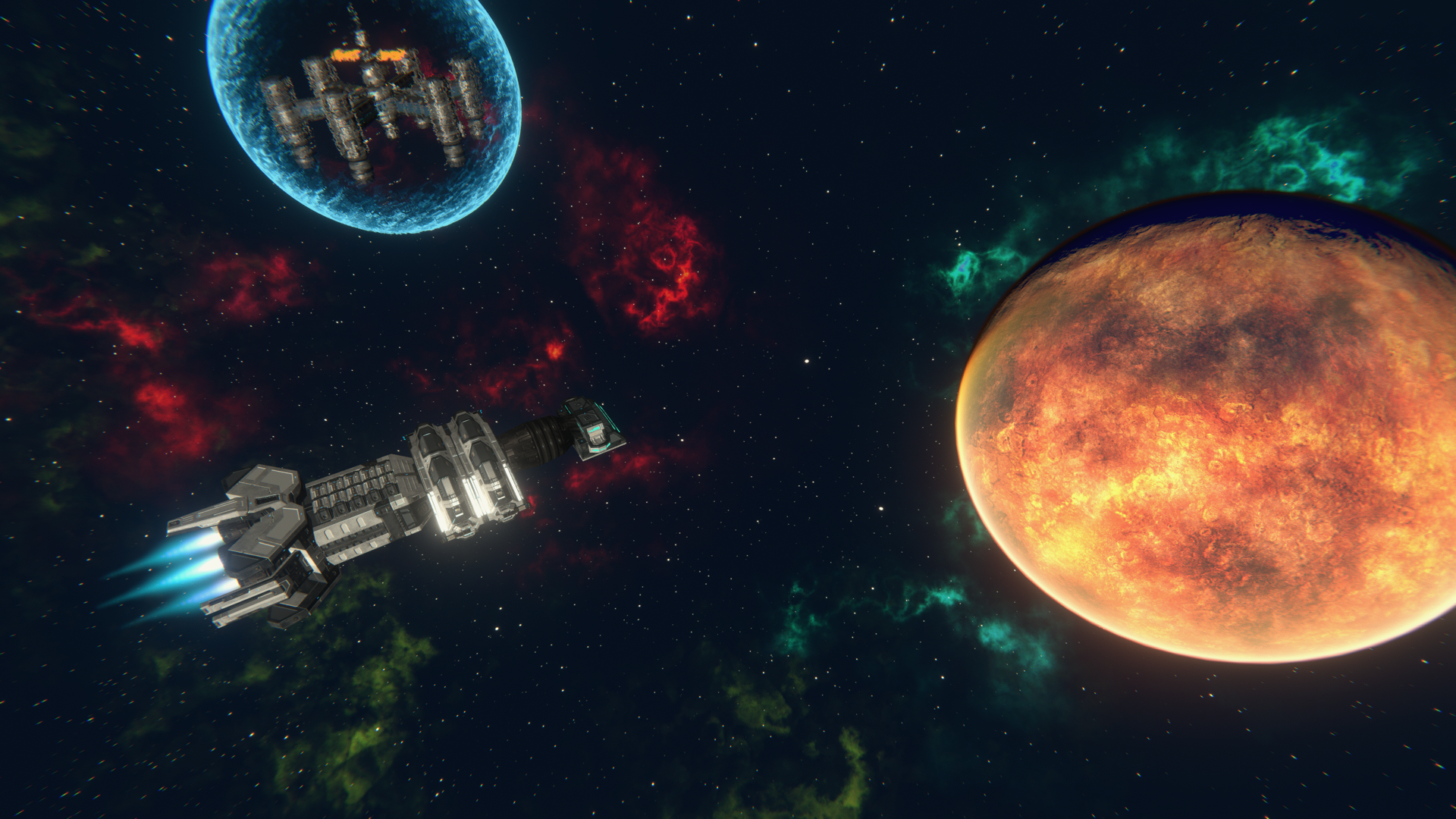
Minerals and nuclear fuel are mined from asteroid fields and transported back to the colony by miner ships.
Mining minerals.
Minerals are used to build and repair stations. Nuclear fuel is used to power planetary shields during stellar radiation spikes.
Each asteroid field contains one type of resource and it's limited in quantity, so you have to explore the planetary system early in order to find more fields.
Miner ships have weak defenses, so it's always a good idea to guard them with sentries or the military.
Antimatter
Antimatter is used for special actions such as super weapons, station and spaceship repairs, and some others.
Chasm spawning a Rift spaceship.
To gain more antimatter you have to destroy more enemy spaceships from the Rift. The stronger the ship the more antimatter it generates.
Population
You need population to build new spaceships.
Planets are the only source of population in the game. As long as the planet is protected from stellar radiation by an active shield and enemy ships are not bombing it, population will increase steadily. There are improvements and some other actions you can do to speed up population growth but those are currently a work in progress.
Every planet has a population limit and if you've reached it, but you still need to build more ships, then you'll have to explore new planets and potentially terraform them if they don't support life.
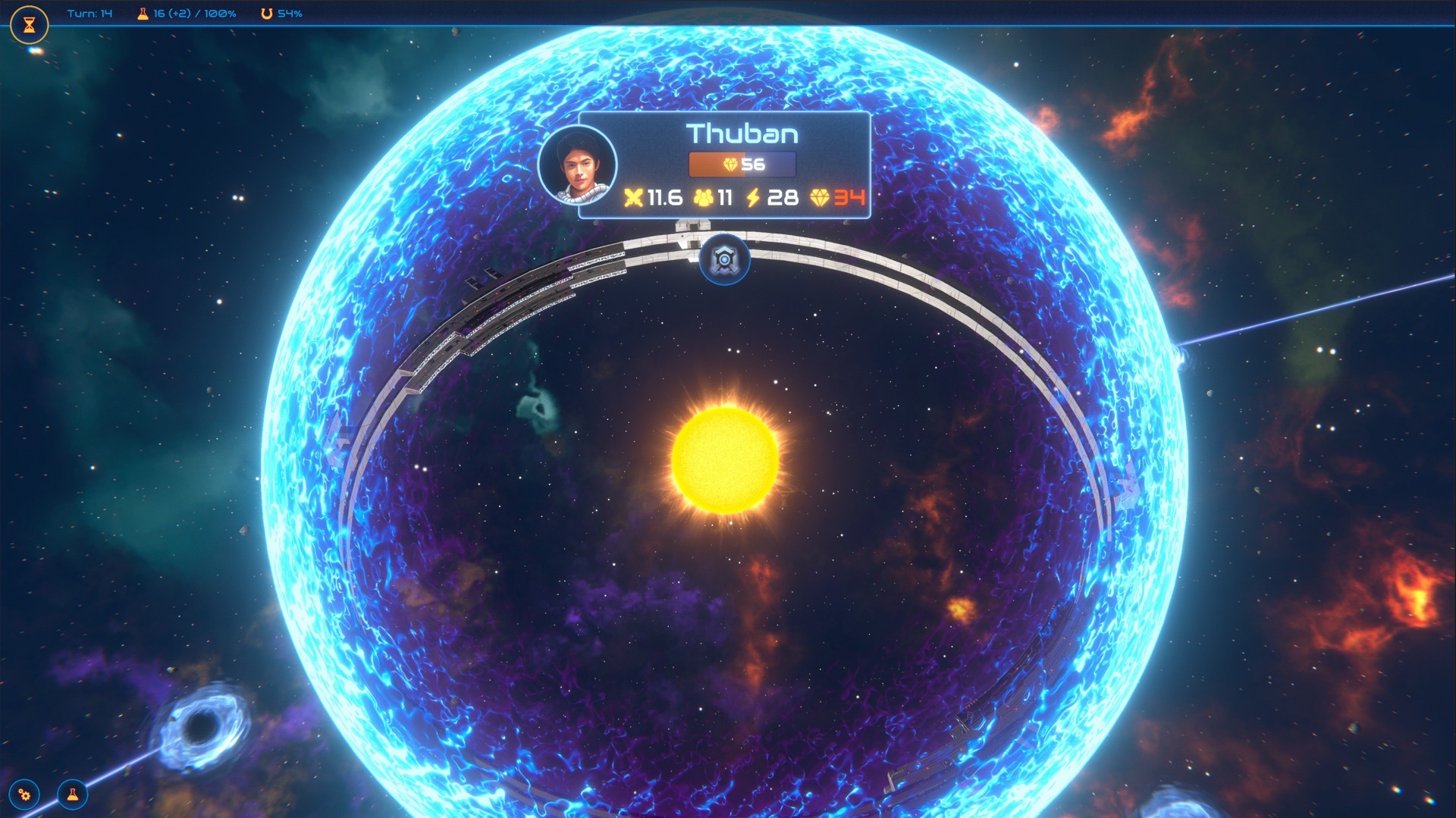
Planet protected by a radiation shield.
Dev Update #29: Survival, Indirect Control, and Rogue-lite
After a long hiatus, I was pleased to announce a little over a month ago that Eons of War is back and it's being actively developed. We have an actual budget now to help us hit future milestones and contract out music, some graphics, creative writing, and marketing.
While parsing the feedback from the private beta players and doing more internal playtesting, we realized that the 4X game mechanics weren't compelling enough, so we started brainstorming how to fix it. After several months of churning through various ideas, we made the decision to change direction. Eons of War is now a real-time survival strategy with rogue-lite progression elements.
Whoa, that's a big change, right? It certainly is and we believe it's for the better. The updated game is in very early alpha and is already loads more fun to play. There are many more game loops left to implement but for the first time in over a year I'm very optimistic about the whole thing.
Let's take a look at some of the more exciting new mechanics and graphics!
Survival and Base Management
Survival became the main theme of the game. According to the new lore, stars in your sector of the galaxy started to "malfunction" decades ago producing intense radiation spikes that destroyed space equipment and sterilized planets, killing millions.
The most effective remedy to those spikes are giant energy shields that can be enabled around planets and space stations. Shields require thorium to function making it critical to find the right balance between typical RTS-y things (like mining resources, building out your base, and hiring units) and managing shield protection levels. A good analogy for shields is the generator and steam hubs in Frostpunk.
Autonomous Spaceships
As in any typical strategy game, you have to build units, but in Eons of War you also have to hire crews to pilot them. Crews require space credits to keep performing their tasks otherwise they might quit and you'll be left empty-handed.
Spaceships act completely autonomously deciding themselves when to do their assigned jobs (terraforming, mining, exploration, battling, etc.) vs. having to perform upgrades and repairs with the money they've earned.
Rogue-lite Progression
To make level progression more interesting, we decided to add rogue-lite elements to the game. Just like before, all levels are procedurally generated for greater replayability.
There are two game layers that you'll interact with while playing in the story mode: the galaxy layer and the planetary system layer. Planetary systems is where all the action takes place. As you complete a level, more planetary systems open up in the galaxy view.
The story unfolds during in-game quests that you can either complete or fail. Some quests will reward you with resources and artifacts. Artifacts are special items that can be deployed on planets and space stations. As levels get increasingly more difficult, it becomes more critical to pick the right collection of artifacts to bring with you on new missions.
Hopefully, this gets you excited about the new direction! Our goal is to post monthly updates exploring game mechanics and features in more detail up until launch.
We are going to run a private beta in June 2021, so if you are interested please signup on our site:
https://www.eonsofwar.com/beta/
Dev Update #28: Eons of War Is Back!
Hello everyone!
First of all, I'd like to apologize to the whole community about keeping you in the dark for over a year.
Life and other projects got in the way of development but I'm pleased to announce that Eons of War is back on track. We've been making good progress addressing problematic game mechanics, writing code, and making things look pretty.
After weeks of brainstorming and deliberation I decided to make significant changes to the game across multiple dimensions.
First of all, Eons is not a turn-based 4X strategy game anymore. I know, I know...you've signed up for some 4X goodness in space and this might feel like a letdown but please hear me out first.
The game is now a real-time indirect control survival strategy with 4X elements.
All and all, it's a very good thing since the old vision wasn't working the way I wanted it to and, honestly, it just wasn't fun to play after a few hours. Even though the new mechanics are in the alpha stage, it's already way more exciting to play.
The premise of the game has changed as well. Now, you are at the helm of a space corporation in a planetary system constantly ravaged by abnormal solar activity. To make matters worse, an unknown alien civilization has been carrying out attacks on peaceful planets through temporary interstellar rifts that open and close seemingly at random.
As a player, you have to deal with the multiple crises that come in waves. You now get to hire different types of spaceships, manage solar flare shields, mine minerals, collect energy, research new technologies, and strategically defend and attack planets, rifts, asteroid fields, and space stations. All that in a constantly evolving planetary system with spaceships acting independently following their own agendas that don't always align with yours.
Where do we currently stand in terms of development? Since so much of the game had to be changed, it's going to be a few months until we run a private beta for select players again. The goal is to have a playable beta by June and to launch the game in late 2021.
In the next monthly update I will talk more about the new game mechanics and share some new screenshots.
Again, thank you so much for being a part of the community and supporting the game!
Happy holidays and let's make 2021 a great year!
Dev Update #27: The State of Things
Apologies for the lack of updates! There’ve been lots different things happening in the past couple of months and I couldn’t dedicate much time to Eons of War.
I tested the most recent version with a small group of folks and it seems like the core game loop is still not where it should be. The problem is that after several battles it all starts to feel too similar and mundane.
One way to fix it is to make every game session more dynamic and unpredictable by applying a few mechanics that I’ve been experimenting with. The tough thing is that it will take several months to implement, test, and tune them properly.
Since I won’t have as much bandwidth for the next few months, I had to make a decision to postpone launch until 2020 and cancel (for now) the private beta. I’d still very much like for this project to happen but I want to do it right and not launch something I am not proud of.
On the flip side, while working on Eons I learned a ton, got a lot of feedback from all kinds of folks, and made a few friends.
Once development is back on track I’ll post another update.
Exciting news: I can finally see the light at the end of the tunnel, so private beta 2.0 will be starting on May 6!
I am pretty excited about it since the game is in incredible shape compared to the first early beta that we ran in December of last year. There are tons of new game mechanics, better graphics, and, overall, much more enjoyable battles. There are still quite a few things to improve and kinks to work out over the next couple of weeks—namely better AI, balancing, bug fixing, and polish—but I’m confident it will all be completed by the deadline.
If you haven’t contacted me yet about participating in the beta please do so by joining our Discord server or shooting me an email at vasily@vasinovgames.com.
This time around the beta will go for only two weeks. The reason for this is twofold:
During the first beta, lots of folks procrastinated and didn’t submit adequate feedback. I’m hoping that having a tighter deadline will help with that.
Running a beta is actually a lot of work, so I’d like to be reasonable with how much time I spend on it, so I could collect feedback quickly and then move on with development.
Please do share any additional thoughts or comments that you might have about the game or the beta and thanks so much for participating! It means more than you can imagine!
Dev Update #25: Karma, Notifications, and What's Next
Build 0.17.0 of Eons of War is out on Steam with minor game mechanic changes and some polish work. Let’s dive right in!
Karma
Prior to this update, the game didn’t have a negative feedback loop meaning that players with a stronger initial position and economy would likely come out on top at the end. The fundamental positive feedback loop—more locations mean more resources—is very similar to chess in the sense that the more pieces (or, in our case, resources) one player has the better off they are. It’s fine to have in some games but it could result in a pretty frustrating grand strategy game experience: being crushed by a stronger opponent often feels unfair after you’ve spent hours expanding and building your empire.
This update introduces a negative feedback loop called karma. Here’s how it works: when the player builds structures their karma goes up and if they attack or use weapons then their karma goes down. If karma is above 50% then it’s more likely that a positive random event will happen instead of a negative one. Higher karma also affects how much of player’s population survives during battles. If your karma is at 100% then you’ll get only positive random events and the maximum possible population will survive in all battles. The opposite is true for when your karma is 0%. Thus overly aggressive players get meaningfully handicapped and disadvantaged players have an opportunity for a come back.
Notifications
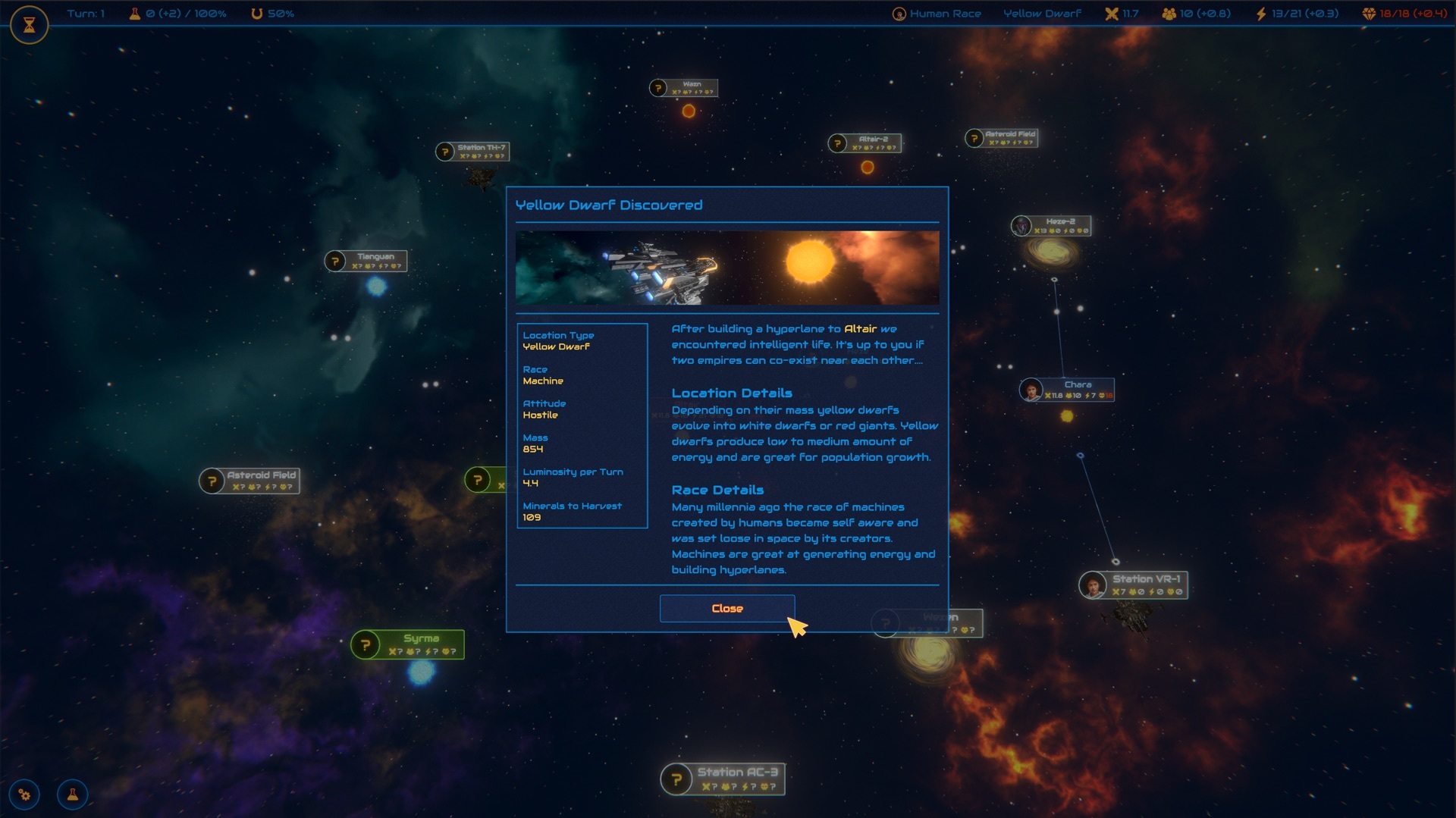
In order to make the game more immersive we added overlay notifications that come up during some important events like the start of the game, discovery/colonization of new locations, and when the game is won or lost. Overlay notifications work as alerts in order to convey important information and engage players on a different level.
I can see this mechanism being used more in the future when we implement story-based missions. For now, the most useful application of this new UI mechanism is the ability to display short summaries about newly discovered locations with location and race descriptions as well as several key location properties like mass, the amount of minerals, luminosity, and attitude.
What’s Next
Over the next two weeks we’ll be focusing on rewriting the AI engine from scratch and doing more balancing. This is an exciting development that will contribute to the success of beta 2.0 starting at the end of April. I will post another announcement with the beta launch date at some point soon.
This update introduces a long-overdue change to how action energy costs are calculated. Before this change costs didn’t take the underlying units into account. For example, the cost of a mineral transfer would be the same for one mineral as well as 20 minerals. This didn’t make much sense, especially considering that costs for weapons were dynamic, so we decided to change it.
Now, action costs for transfers and attacks depend on how many population units and minerals are involved. The final cost of an action depends on the number of units multiplied by the sum of all modifiers. Modifiers come from distance to target, star mass, research, race, structures, events, and factions just like they used to except now they are multipliers instead of cost components that get added and subtracted.
We also ended up replacing the All Action Costs modifier with more granular Transfer Costs, Weapon Costs, Attack Cost, and Hyperlane Cost. This allows for more strategic decisions regarding research and faction choices.
Another change that this update introduces has to do with locations that don’t belong to players. Before this update all non-player locations were unpopulated and whenever a player built a hyperlane to such a location it would automatically become theirs. Now, some locations have neutral civilizations that don’t expand or build structures. All resources around such locations increase every turn at a low rate and whoever builds a hyperlane to a neutral location will also have to attack it in order for it to become theirs.
Finally, we decided to add the ringworld structure to space stations, so they can grow population just like regular stars. The only thing that space stations can’t generate is minerals.
This update might seem small but it changes battles for the better. The fact that locations can exchange low amounts of resources on the cheap is very important. It also makes it hard to steamroll the battlefield in the endgame when supernovae go off and some locations on the outskirts have tons of population left that can be used to take over the battlefield. Now, the cost of doing that is prohibitive.
Yesterday marked one year since I started working on Eons of War—at least that’s what my version control history says! It felt like an important milestone to me, so I decided to go over some development highlights in this post.
I was at a low point in March 2018. My cat just passed, I didn’t have any desire to work on “serious” software projects, and I was considering switching careers into something more creative outside of computers.
My wife suggested that I make a list of things that I always wanted to work on and dedicate two months to every entry on that list. I put “make a computer game” at the top of the list and that’s how it all started.
One of the early game prototypes.
After two months of tinkering with prototypes in Unity I didn’t feel like stopping, so, naturally, I continued building.
The first working prototype was a scifi RPG where the main character flew around star systems and engaged in arcade battles. After winning a battle the player could mine minerals and upgrade their ship combat components and the fuel tank. The character could also gain experience from battles and level up their battle skills. It was a simple game that ultimately didn’t have any interesting mechanics, so I decided to keep brainstorming.
During summer vacation I came up with an idea that made me re-think what kind of game I wanted to build. The idea could be described by asking one single question: what would a strategy game in space feel like if instead of the usual hundreds or thousands of years the gameplay was focused around tens of millions of years?
That seemed like a thrilling idea with tons of possibilities: empire development mechanics focused on a general strategic direction instead of tactical micromanagement, stars constantly changing their properties and eventually going supernova, and outrageous mega-structure projects, like Dyson spheres and ringworlds, being commonplace.
Of course I immediately jumped to prototyping it!
Early alpha version with real-time mechanics.
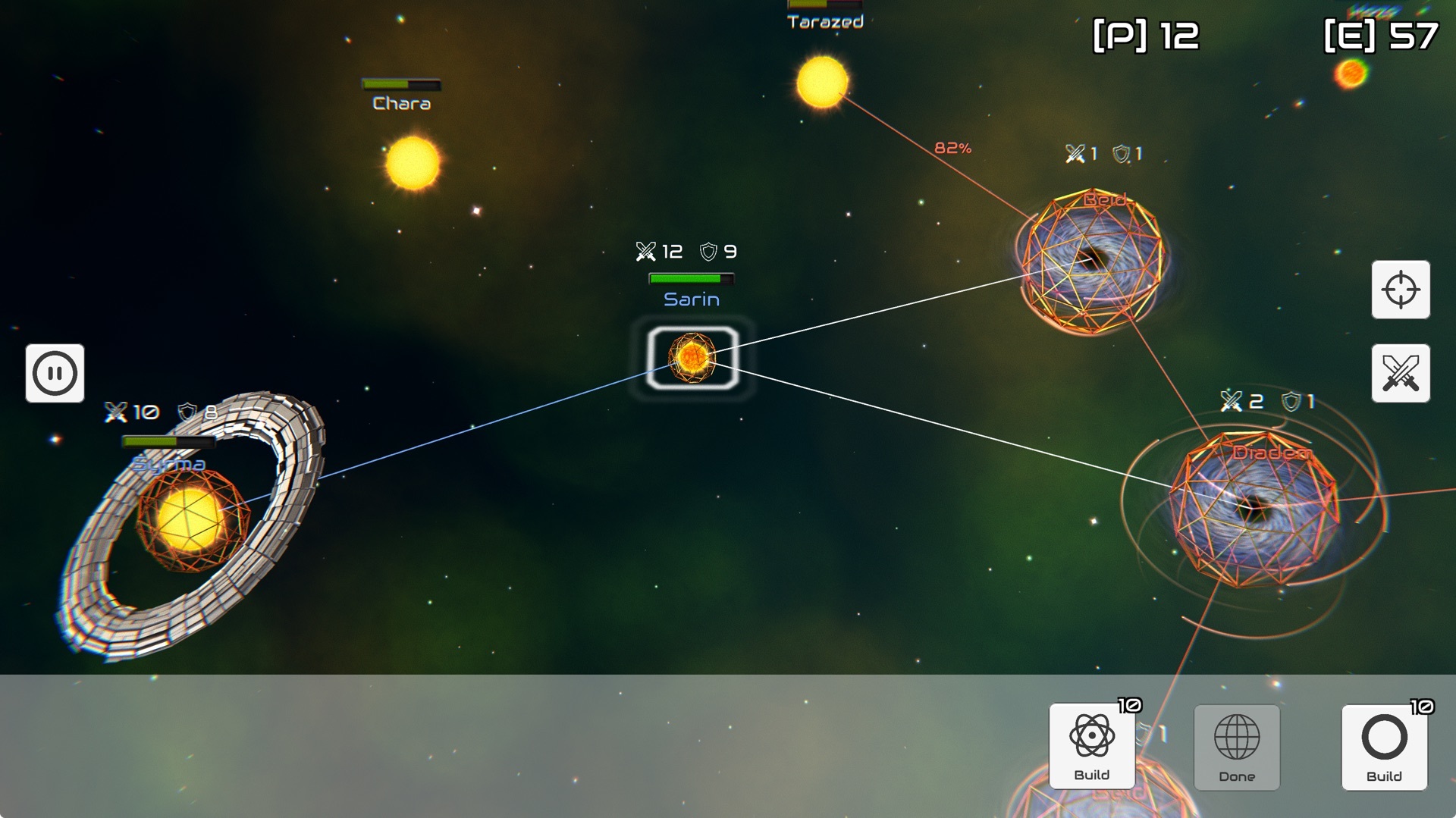
The first prototype was an RTS game with active pause. All stars had a certain amount of “health” that really was just the amount of energy they had left before collapsing into a black hole. The player could build three buildings around captured stars: energy spheres for capturing energy, ringworlds for growing population, and space fleets for higher combat strength. To reach other locations the player had to create hyperlanes. The game only featured two resources—energy and population—that were used for all actions.
I quickly realized that playing the game (even with such simple mechanics) was very tedious if the player had more than three locations to manage. Simple brute-force AI would beat me almost every time, which was a good sign that something was off.
I decided to make the game turn-based and have actions take several turns depending on the distance between locations.
Public announcement version with a very limited set of features.
After a couple of months of work I had a prototype that was more fun: it introduced a new resource: minerals. The player could also transfer resources between their locations. I also made all actions take only one turn, which dramatically reduced the amount of tedious bookkeeping that the player had to do.
It was October 1 and that’s when I announced to the world what I’ve been working on. I received some pretty subdued reactions, since the game was pretty simple and the graphics weren’t particularly impressive.
I had to keep grinding to make my vision a reality!
After two more months the game changed pretty dramatically. I added space stations for tech research, asteroid fields, fog of war, sounds and music, better graphics, and, finally, implemented the supernova mechanic. The game started to really shape up and I was ready to let players try out an early beta.
This is what the early beta looked like in December 2018.
To my great surprise, most reactions were very positive and several people spent hours playing the game. They shared tons of great feedback and ideas for new features. Honestly, after looking at what the game offered back then I’m shocked that people even gave it a chance.
Beta success gave me more confidence in what I was doing. I decided to double down on quality and more mechanics to make patterns of emergence in the game more diverse. I also started to really think through how the game arc felt to players during each play session.
The most up-to-date version of the game with (mostly) complete game mechanics.
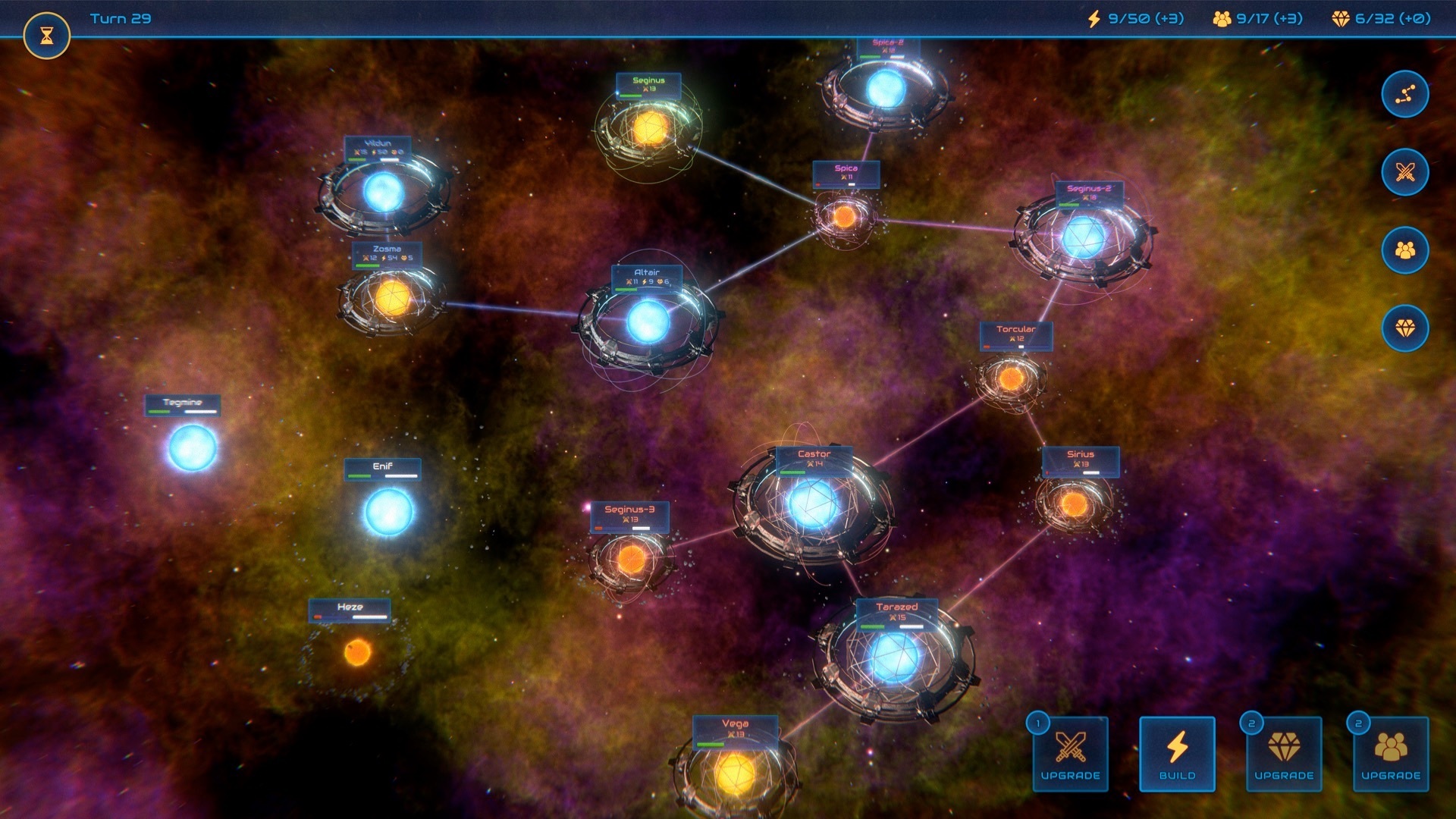
Fast forward a few more months to today…the game is in great shape! I added lots of new features, improved graphics, and polished several game systems. There’re currently 10 different structures that the player can build around their locations. In addition to hyperlanes, black holes can be used for attacks and transportation. Each location has a race that provides different bonuses. The player can setup an energy shield to protect themselves against supernovae and attacks. There’re also remote weapons that affect resource production and can even destroy stars! Finally, I added factions, which are movable units that gain experience and can be upgraded to provide disproportionately high bonuses to individual locations.
All new features fit nicely with the original idea of one million years passing by on every turn. Also, it’s still a pretty fast-paced game where each session takes 30-60 minutes on a medium map.
Of course, there’s still plenty of work to finish: improve AI, add multiplayer modes, balance factions, races, and research, polish the graphics, and add more content. I’m super pumped to see what the game looks like in late April when beta 2.0 begins.
I’m grateful to everyone who’s been supporting development from the beginning. I hope you are enjoying following the progress and learning how long-term projects are developed by (mostly) solo creators.
After two weeks of focused work build 0.15.0 is finally out on Steam! It includes a new game mechanic called factions and several other improvements. This release concludes our work on core game mechanics. It’s time to focus on AI, balance, content, and polish.
Factions
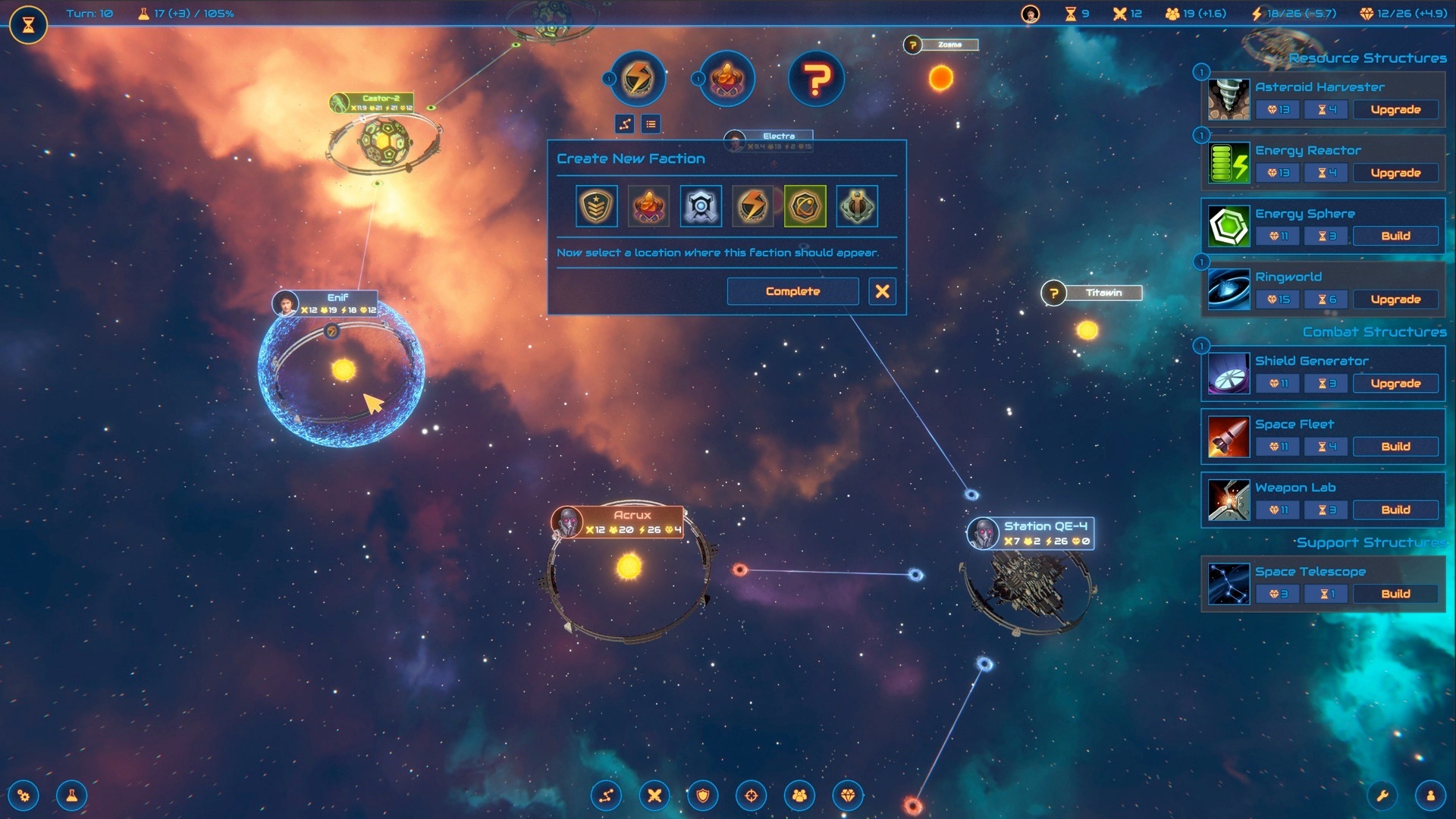
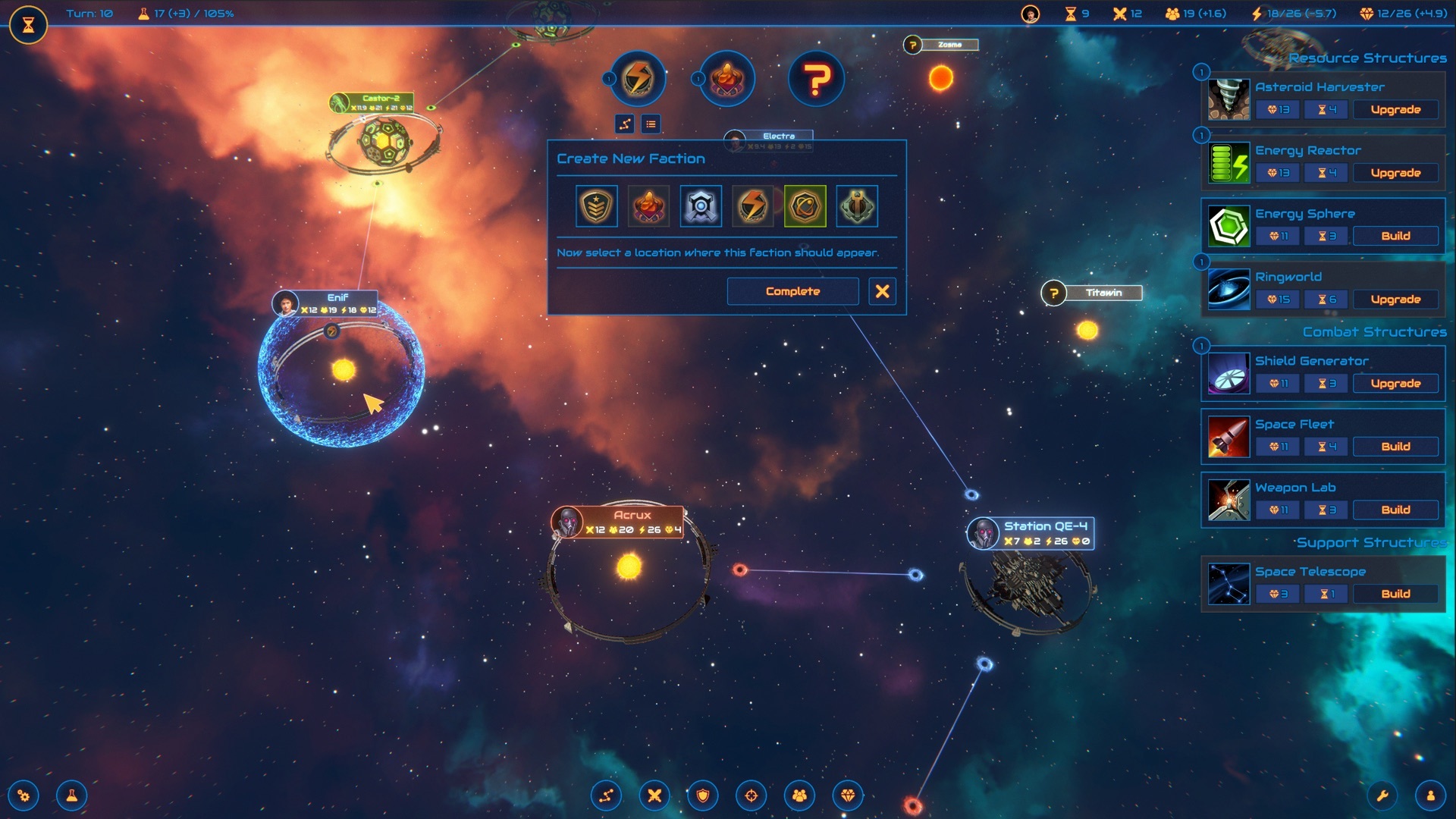
Factions are special units that can be moved around the map and upgraded after they gain experience. They also add disproportionately high bonuses to locations they are currently at. Think of them as super units that have to be strategically positioned around your empire.
New factions can be added during turns 10, 20, and 30. Each player can only have up to three factions at a time.
Factions can be moved between different player locations as long as there is a hyperlane or a wormhole between them. The cost of movement depends on the distance to the destination and its mass.
Factions receive experience points from actions like attacks, construction, and some others. Each faction has three different traits that can be upgraded every time they level up.
There’re currently six different factions in the game, each focusing on a specific resource or mechanic that can lead to victory. Let’s take a look at all of them!
Builders Guild Focuses on reducing all construction costs, construction time, and shield energy per turn cost. Add this faction if you want to build up new locations from the ground up quickly.
Energy Institute Focuses on increasing energy collection rate, reducing all action energy costs, and reducing all weapon energy costs. Depending on your strategy this faction can be used for population attacks, cheaply firing weapons, or transferring resources around.
The Brotherhood of Might The brotherhood focuses on increasing combat strength, reducing attack energy cost, and shield energy per turn cost. This is the only truly combat-focused faction that can be used for direct attacks.
Asteroid Rats This faction of miners focuses on increasing mineral collection rate, reducing construction time, and reducing mineral transfer energy cost. Need to kick-start a new location? Use this faction!
Nomad Alliance Focuses on increasing population growth rate, reducing population transfer energy cost, and race conversion energy cost.
Frontier Academy This faction focuses on increasing research speed, research points per turn, and shield efficiency. Use Frontier Academy to try out various research-based strategies and to protect locations at the forefront of the battle more efficiently.
Other Changes
[UI] Add new structure icons in the construction panel.
[UI] Don’t show zero modifiers in tooltips.
[UI] Improve CPU performance for several UI elements.
Super excited to get build 0.14.0 out on Steam! And it’s a big one too with the new weapons mechanic and several important UI optimizations that should increase FPS on slower machines.
Super Weapons
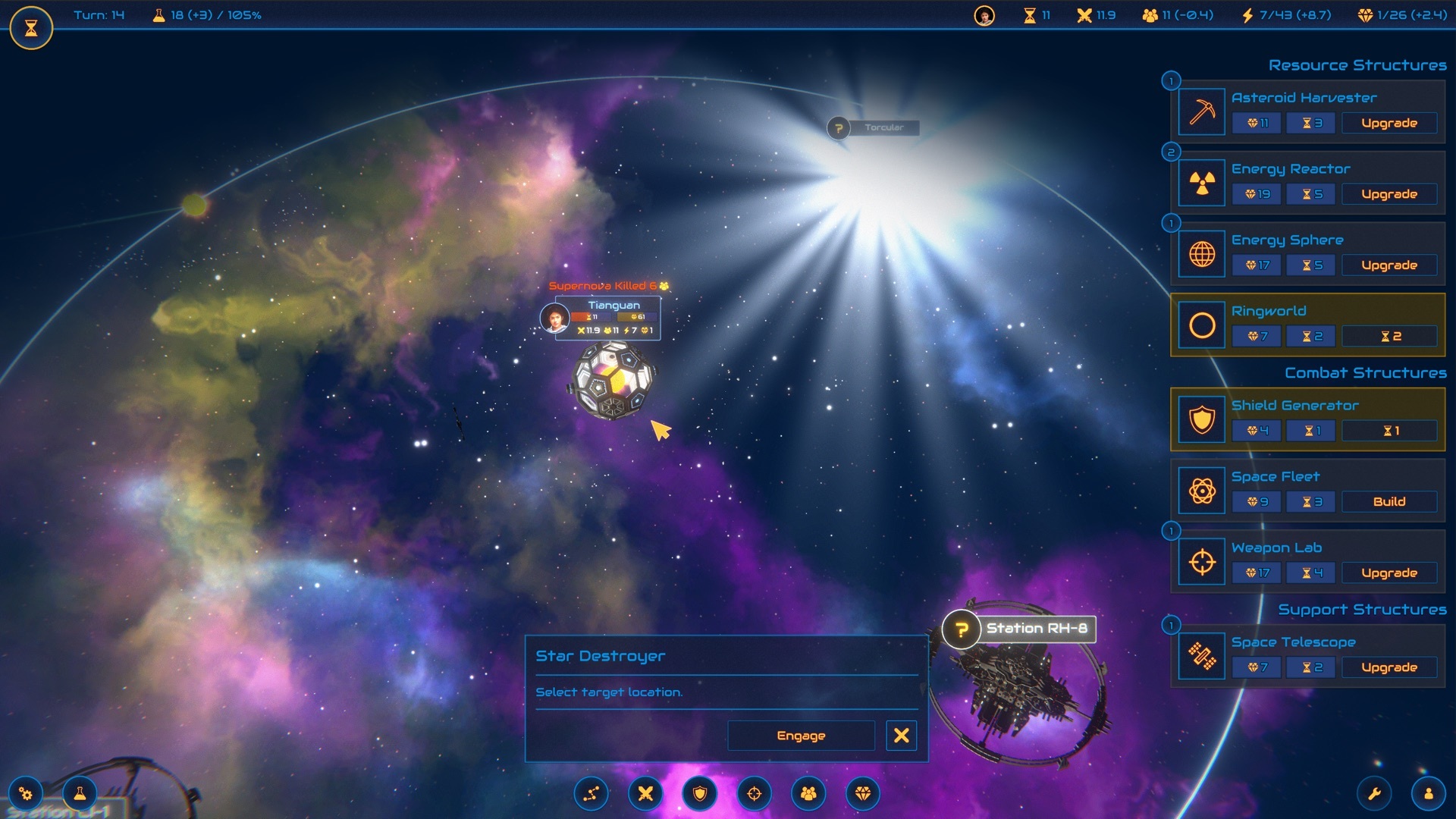
Adding weapons to the game has been on my mind for at least three months now and it’s finally here! This mechanic adds another dimension to the game by introducing special actions themed as “weapons” that allow the player to influence other stars and stations without having direct access to them through hyperlanes and wormholes.
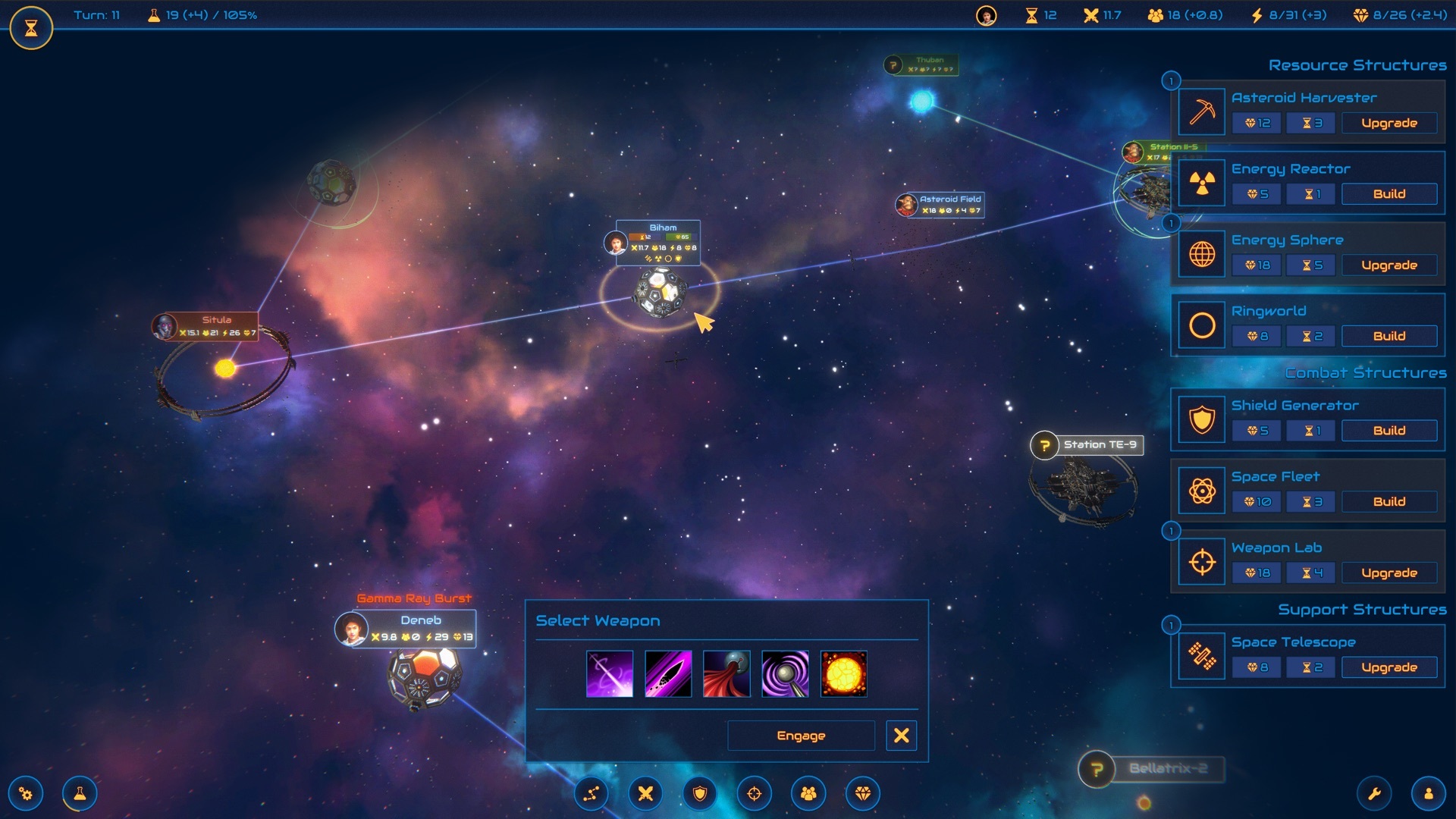
To start using weapons you have to build a Weapon Lab that unlocks weapons near a specific star. Each weapon has a range and an energy cost, which depend on the type of weapon and the amount of affected resources. To increase the range and decrease the energy cost players can upgrade their weapon labs.
The current version of the game includes five different weapons. Let’s take a look at all of them!
Dark Matter Beam This weapon destroys population around another location or, if that location has the shield enabled, it reduces the shield. It’s super useful in situations when you are low on population and are about to get attacked or when another one of your locations needs help attacking but can’t quite win the battle during this turn.
Mineral Teleporter This weapon steals minerals from other locations. Need I say more? :)
Mineral Teleporter introduces a wide array of new strategies where the player can focus just on collecting energy and not harvesting minerals from asteroid fields.
Psychic Beacon This weapon permanently reduces base combat strength at a given location. This is a powerful support weapon that can be used to effectively take over a location. Just remember that this effect lasts for the entirety of the game, so once the location is yours it will remain vulnerable unless you complete research that increases combat strength across all of your locations.
Antimatter Bomb This weapon permanently reduces base energy collection rate. It can be used in multiple scenarios when the attacking player needs to handicap enemy’s energy production.
Star Destroyer This is perhaps the most fun weapon in the game! It literally forces any star to go supernova even if the star can’t naturally do it. Since this is such a destructive weapon that throws a whole star neighborhood into disarray the cost of it is pretty high and depends on the mass of the target star.