What's happening / TLDR: Developer diaries introduce details of Espiocracy - Cold War strategy game in which you play as an intelligence agency. You can catch up with the most important dev diary (The Vision) and find out more on Steam page.
---
Welcome back,
In the second dev diary about guerrilla warfare in Espiocracy, we will focus on player agency - available actions, interactions between players, degrees of freedom. This very central lens of the development receives a lot of attention in prose of many dev diaries (#22 in particular). To spice up the agential focus by a notch, here we'll skip the prose altogether and jump straight to bullet points interspaced with screenshots that answer the most important question: what can you actually do in the game?
Counterinsurgency
► Gameplay focused on grand strategic interventions and denial of future capabilities
► Spread defense between borders, population centers, critical infrastructure, transport networks
► Achieve degree of control over insurgents to push them towards particular actions
► Gather intelligence on incoming ambushes to evade and counterambush them
► Strike weapon flow and caches
► Search, destroy, and other SOF approaches
► Many approaches to propaganda, from false materials to radio stations
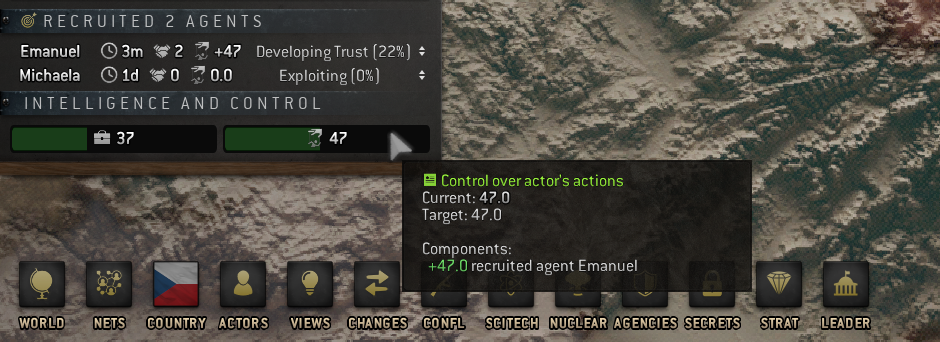
► Recruit, infiltrate, and other intelligence operations
► Capture and interrogate people
► Negotiate with intercepted saboteurs
► Cooperate with population centers, governors, and actors inside
► Establish resettlement camps
► Force relocation of entire villages
► Bounty and amnesty programs
► Destroy terrain, including the likes of Agent Orange
► Hunt down double agents among own ranks
► Deal with ill-disciplined acts and massacres, from trials to cover-ups
► Detect and intercept covert international support
► Loss of operatives as an opportunity to strike, pursue intelligence, or change sides
There is also a small community around Espiocracy:
--- "Warfare is no longer a matter of chivalry but of subversion, and subversion has its own special arsenal of tools and weapons" - Stanley Lovell, CIA officer
Dev Diary #26 - Simulation Engine 🧳
What's happening / TLDR: Developer diaries introduce details of Espiocracy - Cold War strategy game in which you play as an intelligence agency. You can catch up with the most important dev diary (The Vision) and find out more on Steam page.
---
Before we proceed to the second part of mechanics making up guerrilla warfare in Espiocracy, we ought to take a detour - Guerrilla Warfare 1.5 - to explore a system that plays a vital role in conflicts and deserves a dev diary on its own (be warned: it's more dev and more diary than usually, as you can judge from this very long first sentence).
Some design questions look like mathematical challenges. Find Z for the following X and Y. Find the outcome of an operation executed by particular operatives against a particular target. Find the result of an ambush given such and such belligerents. Find consequences of a raid, battle, sweep, or negotiation rounds. Given enough similar questions, like in mathematics, human mind recognizes the pattern and solves not just a single example but a larger category, perfecting methods that are useful beyond the original set of problems. This is the simulation engine in Espiocracy.
It's easier to understand it by roughly following the path of development. Originally (7 months ago), operations such as assassination or recruitment ended with one of the five hardcoded outcomes. On paper because in practice players avoid negative consequences and usually cannot afford extremely positive results, narrowing down the outcomes to just two or three variants. Bummer, let's solve this!
We add additional non-exclusive outcomes (eg. you successfully recruited X but you left behind breadcrumbs that can endanger X)
These should logically originate from the course of action (eg. "1" caused by a careless meeting under the eye of surveillance)
Actions should be defined by other actions, including player decisions (eg. "2" caused by rushing to meet X in their homeland instead of waiting until X leaves the country on holidays)
Additional outcomes are no longer always additional, they sometimes should directly affect the main outcome (eg. "3" -> "2" -> "1" blowing up the cover and halting the final approach)
Then, we essentially arrive at chains of actions and outcomes, A -> B -> C. Steps and branching, classic approach in many video games, maybe a little bit more emergent than usually.
Here's where things start to get spicy: there's nothing that prohibits such a simulation from spawning more simulations. On the one hand, we can horizontally proceed from entire simulation A to entire simulation B, for instance from recruiting X to eliminating Y given opportunity, crafting full adventure as we go - the staple of great movies and books. On the other hand, we can vertically flesh out details of any action, adding depth at will. The final pitch during recruitment operation can become a simulation inside simulation, with the course of conversation determining the result and non-linear details, and then mother simulation picking up from its result to, say, pursue hastened exfiltration of an operative because they were seriously threatened during the conversation.
Given that not every interesting set of actions in Espiocracy is an operation, this engine was naturally extrapolated to other parts of the game. It became not only a useful tool for connecting many mechanics in one space but also an interesting design lens: it's not just a procedural generation of the environment (although it can be!), it's usually a competition between active entities, whether it's a car chase, conversation, or nuclear bombing. Generalizing the pattern even further, the engine is really a universal game, intentionally developed as a flexible and efficient von Neumann machine, with inspirations drawn from a wide ensemble of games such as go, football, Nethack, or C:DDA.
Example: Ambush
At their core, most simulations generate organic results in the background. You can always inspect them (if you have appropriate intelligence).
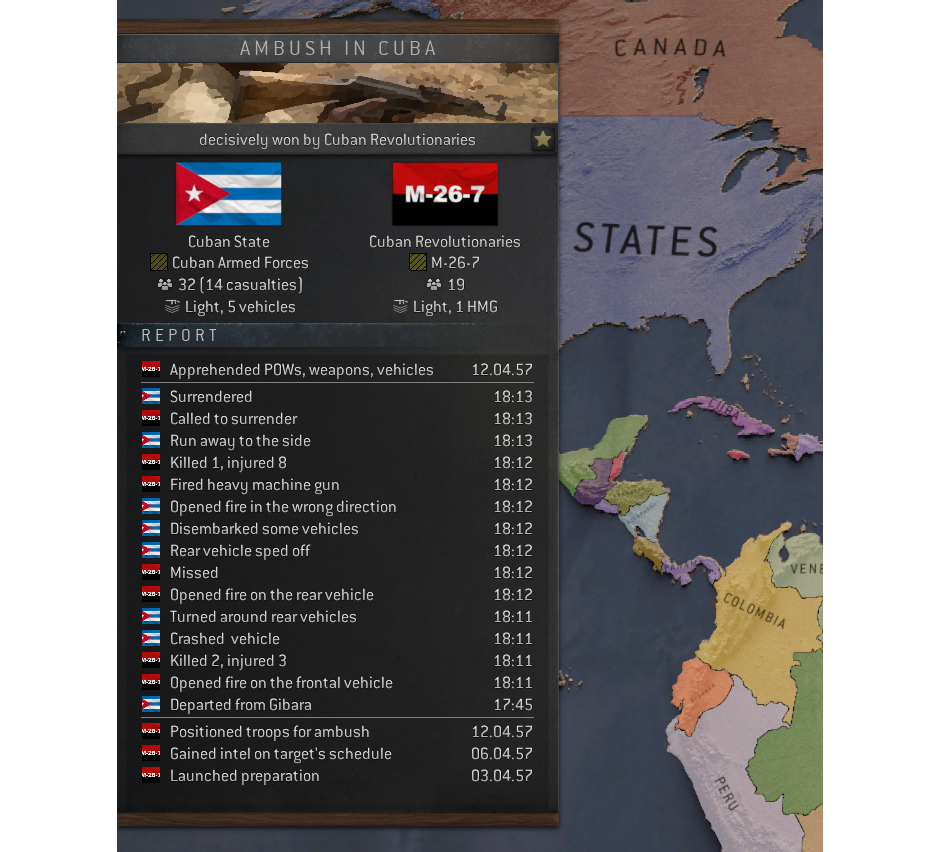
Mockup of ambush simulation.
This ambush consisted of two simulations, macro (daily) level and final approach (minutes). Available actions and course of events depended mainly on available people and weapons. Precise details such as killed and wounded in action, surviving materiel, or even survivors fleeing the scene are determined minute by minute. One can easily imagine many different sequences of events - for instance, without a heavy machine gun and multiple injuries in one sweep, the battle could go on much longer with varied consequences such as more damage to vehicles, rear squad returning with reinforcements, one of the sides running out of ammo, leader killed in action, and so on. All of these are fed back to the world during simulation, changing existing world entities and creating new opportunities (eg. here POWs to be interrogated, exchanged, or even recruited).
Example: Operation
Some simulations can be followed in a more hands-on fashion. Naturally, by default you observe in detail and interact with operations:
When a player participates as one of the sides in a simulation, these are the usual types of available agency:
Changing objectives (eg. choosing a more attractive target that became available during operation)
Optional proactive actions (eg. many ways out, engaging other participants, using more costly methods)
Reactions, sometimes also prompted by operatives (eg. discovered three leads - pursue A, B, or C)
We'll certainly return to details of operations in the future.
Example: Operative Backstory
A simulation can be also closer to procedural generation - they are currently used to invent backstories of intelligence operatives, which contribute to their views, traits, motivations, and vulnerabilities.
Simulationist Tangents
In the next dev diary, we'll see more places and modes of interaction with simulations. We will be also returning to them in the future, since simulations find their use also in significant political changes (eg. coup d'etat), interactions between players (eg. negotiations between intelligence agencies), rare events, and so on.
Among unusual uses (tested, not universally implemented at the moment), simulations take part in the Monte Carlo approach to AI - hundreds of runs featuring decision P and then decision Q can be compared by outcomes to provide statistical aid, not only universal between simulation types but also potentially predicting wider strategic choices (that's right, simulation approximating entire Espiocracy). This surely requires a very efficient engine, so let's peek under the hood to see one of the optimizations.
From the get-go, the number of available events/steps was recognized as a possible significant bottleneck. If we want really detailed simulations, they should feature hundreds of probabilistic checks as frequently as possible, and if every one more event/step decreases performance, designers and modders would be outright punished for fleshing out depth - an antithesis to the engine's purpose. This issue is also present in the whole game with thousands of grand-strategy-style events multiplied by dozens of players. Although the latter can be usually sidestepped by distributing checks in time (eg. a dozen of different checks every day), it doesn't work for dynamic and relatively short simulation where anything should be available at any tick. Solution? Balanced binary search trees with probabilistic weights updated externally (on change of factors), nodes rotated for optimal search lengths, and then performing usually a single check per tick for all events.
Removing a node from a balanced binary search tree. Attribution: Nomen4Omen
As with most optimizations, it doesn't exactly eliminate the bottleneck, and instead just moves it into a more convenient place - in this case away from the number of events/steps towards much less frequent and less important probability updates. Here's a practical comparison of two approaches, standard vs tree-based, nicely illustrating O(n) vs O(log n) increase in computational complexity:
Even for the vanilla case of 100^3, we're looking at a performance increase from 24 cycles per second to 61 cycles per second, and this does not include other optimizations such as concurrent simulation runs or reuse of similar trees. More importantly, beyond 100^3, designers of simulations are no longer (severely) punished for expanding the number of events or steps.
Modding
Speaking of designers, simulation engine is a prime example of modding capabilities in Espiocracy. You can modify any existing type of simulation, create new ones, and attach them to most of the mechanics and interactions. This is a good excuse to now get really technical.
Type (blueprint) of simulation is defined by XMLs describing:
Phases of simulation (eg. preparation, final approach, return - just a guidance instead of limitation, they can be easily shuffled during simulation)
Roles and sources of participants (eg. an intelligence agency and a target)
"Capabilities" of participants (eg. surveillance skills - mostly fixed parameters calculated from properties of participants)
"Developments" of participants (eg. trust - parameters developed or decreased during simulation, serving also as flexible memory)
"Objectives" of participants (eg. recruitment, guides autonomous agents and AI, can be null or changed during simulation)
Available "actions" assigned to roles (initiated by one of the participants, eg. intelligence agency meeting the target)
Possible events, simulation-wide and role-specific (happening to but not initiated by)
Optional display details
Setup sequence
As you can probably guess, actions form the beating heart of a simulation, suggesting a design lens again, this time: progress usually stems from active agents doing things, not just from sitting and waiting. Their various types are defined by a plethora of parameters (from temporal configuration to tactical intelligence requirements) and many possible effects. On start, when active, or on finish they can:
Modify capabilities and developments
Directly change probability of events
Launch branches of parallel actions (non-interruptive, resolved outside the main thread)
Launch another action from a probabilistically weighted set (with weights calculated from base value, capabilities, and developments)
Expose a set of reactions, available to defined participants (including the player)
Do just about anything because you can always attach a callback to another function in the game
Generally, simulations start with all participants launching a "background" action type appropriate for the role and the phase. In a usual operation, an intelligence agency starts with preparation in the background, the target - unaware of the battle - starts with simple enough "daily life" action in the background, and counterintelligence services go about their usual surveillance activities until they discover something suspicious. These background actions are always present and serve as the hook for an active agent in the simulation, with attached decisions (eg. approach the target or take a vacation), probabilistic steps, progress over time, and so on. When another action is launched, it can branch off as much as you want it to, including launching another simulation.
According to tests so far, this is an advanced enough system (a lot was refactored away) to simulate the gist of most competitions in the world. One of the examples, written for fun in one evening, is a very simple football match engine!
You probably have heard about programmer art but did you hear about programmer logs? Here you already get a seed of (sport) story from this simulation: after 1:1 in the first half, Blues quickly scored after the half-time, and then Reds reacted with two subs which led them to score the equalizer. Now just plug it into an event about West German - East German match...
This is how it roughly looks in the setup:
And from the perspective of the background action:
Note that it's the simplest possible approach - demonstrating how easy it is to boot up a new kind of simulation, and then how it can be elegantly fleshed out to hundreds of actions and events. With regular fallback to background action and unlimited connections between actions, it's also not as scary as it sounds, since we're not really designing a convoluted quest tree and instead we are closer to electric circuits or pseudoprogramming (and if these sound scary, check out quest trees even for fairly linear RPGs).
Final Remarks
Now we're ready for continuation on guerrilla warfare - see you on August 5th.
If you're not already wishlisting Espiocracy, consider doing it:
There is also a small community around Espiocracy:
--- "Almost every problem that you come across is befuddled with all kinds of extraneous data of one sort or another; and if you can bring this problem down into the main issues, you can see more clearly what you are trying to do and perhaps find a solution. Now in so doing you may have stripped away the problem you're after. You may have simplified it to the point that it doesn't even resemble the problem that you started with; but very often if you can solve this simple problem, you can add refinements to the solution of this until you get back to the solution of the one you started with." - Claude Shannon
Dev Diary #25 - Guerrilla Warfare I 🔥
What's happening / TLDR: Developer diaries introduce details of Espiocracy - Cold War strategy game in which you play as an intelligence agency. You can catch up with the most important dev diary (The Vision) and find out more on Steam page.
---
Modern guerrilla warfare was born between the 1930s and 50s, maturing right around the start date of Espiocracy.
Spectacular successes of insurgencies and revolutions - from Yugoslavia to Cuba - and dramatic failures of counterinsurgencies - from Indochina to Afghanistan - solidified popular uprisings as a nation-forming tool. These conflicts were often anything but clear, a stark contrast to pleasant war rooms of WW2. Here, irregular combatants were virtually invisible, cycling between hideouts and hit-and-runs, silently winning over villages, and corrupting local security forces. This messiness is common for most Cold War conflicts, where insurgencies erupted in reaction to other successful insurgencies, irregular forces evolved into conventional armies, military organizations employed guerrilla tactics, foreign states used civilians as disposable agents of influence, and the fire of civil wars ravaged entire countries for many years.
This developer diary marks the start of series about armed conflicts in the game. Today we begin at the most elemental level: conflicts where combatants can be indistinguishable from civilians. We will take a look at the general structure and course of guerrilla conflicts. Player agency and interactions are largely omitted - they will receive a separate developer diary.
---
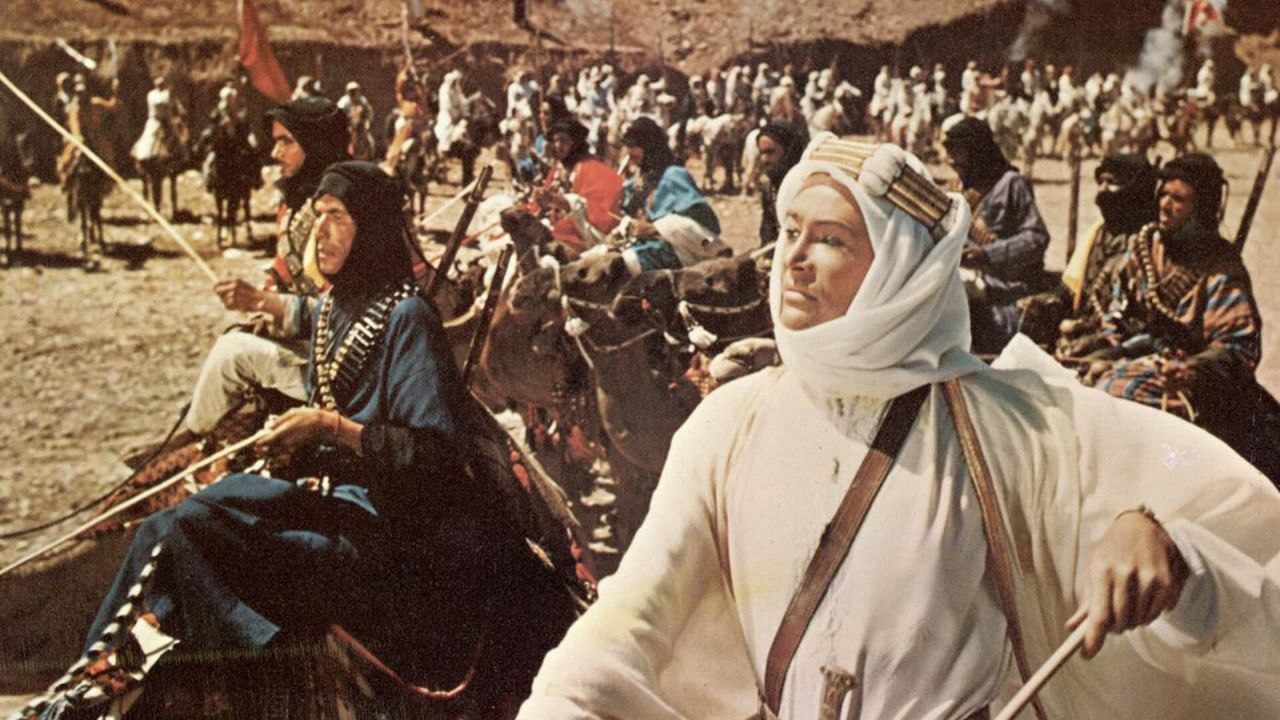
How did we go from this...
Lawrence of Arabia, frame from the 1962 movie
...to this...
Situation in Afghanistan around 2009. It's not as bad as it looks, the original presentation breaks that into 30 slides: http://www.willreno.org/Afghanistan_Dynamic_Planning.pdf
...in eighty years?
As per usual with Espiocracy, we begin by poking human psychology. What convinces ordinary people, civilians, to take up arms and risk their life?
Causes
People need real reasons to volunteer. Usually, guerrilla conflicts in the game are propelled by multiple fundamental causes:
Government perceived as illegitimate (eg. after a coup)
Ethnic and historic self-determination
Opposition to foreign interference
Ideology (usually communist or anti-communist)
Religious beliefs
Severe political repression
Economic crisis
Power vacuum
Weak opponents
Access to tools of irregular warfare
The conflict starts in minds of people who wage whether violence can substantially improve their situation.
Sometimes people judge insurgency as not possible at all - postwar Germany is good example of a population that probably won't wind up in wider guerrilla warfare. Exhausted and starved crowds, fed by strong occupation authorities, receiving promises of rebuilding severely bombed country - they are not keen on assisting Werwolf or even opposing forced expulsion from western Poland. Moreover, large propaganda campaigns, enormous POW camps, widespread judicial and military actions were further proving that any resistance would be truly futile.
Other times, armed resistance can be possible but people usually require the last spark(s) to begin armed struggle. This may be a reaction to political change (which includes anything from lost elections to the death of the leader), widely popularized event (for instance activists killed by the government), introduction of highly controversial policy, or protests evolving into violence.
There is no arbitrary first day of a conflict. Fights can silently escalate, under the guise of criminal activities, beyond the control of local police forces, and lead to the loss of first villages and entities. Ultimately, population is funneling their will to fight via ubiquitous system of actors, which here focus on political parties creating military wings (like SWAPO), armed organizations (such as many postwar partisan movements), and obviously state actors.
Indirect Conflict
There are two main resources acquired and spent in guerrilla wars.
People - recruited, trained, and fed. Even if the population widely sympathizes with the causes, organizations have to put a lot of effort into recruitment (historically, there were for instance only 7,000 insurgents for 1 million supporters of the Malayan Emergency). Low numbers mean that losing any of them can be noticeable. In addition to vital members, wider popular support provides food and hideouts for insurgents - or lack of these when people remain loyal to the other side. Last but not least, population is also a priceless source of intelligence for all sides of the conflict.
Weapons - acquired, stored, distributed, resupplied with ammunition. Their flow across borders, transport networks, and caches is directly simulated, which creates emergent defensive challenges and opportunities to strike for all sides. Postwar abundance of weapons favors civil wars early in the game but so do regional conflicts (leading to very practical waves of irregular wars), black market, or mass production of the iconic AK-47.
In a cycle of sorts, insurgents procure people and weapons and use them to get more people and weapons. At the same time, state actors try to deny access to people and weapons. Needless to say, actions constantly influence both factors in many dimensions, for instance, indiscriminate attacks or ill-disciplined members can anger the population whereas protection of villages against them can earn the support of local people.
Indirect competition is extrapolated into the wider game world. All kinds of neutral actors can be brought over to one of the sides with promises, protection, coercion, and alignment with the causes. Usually, they are more or less opportunistic, deciding which side promises better favors and has a higher chance to actually implement them (by winning the war) but these loyalties are highly fluid. Naturally, support extends far into the international world, with countries providing training, sanctuaries, and weapons. Here, borders take an extremely important role, with access to the border of an ally often making an entire difference between victory and defeat.
Direct Conflict
The precise course of the war - establishing camps, conducting ambushes, raids, battles, patrols, sweeps, cordons, aerial campaigns, and other tactics - depends on multiple factors. In addition to people and weapons spent on attacks, local terrain plays critical role. Mountains, jungles, and forests provide necessary hideouts. Dense countryside can serve as a powerful base of members and defines main targets in the conflict (eg. compare Indonesian National Revolution in a country with 15% urbanization - to Cuban Revolution on an island urbanized in 60%). In more motorized countries, transport networks become common and very useful targets, providing and denying supplies.
Clashes between asymmetric belligerents or factions of civil war are tied to the notion of contested territories and cities. Without conventional army and law enforcement services, it's usually difficult to control vast liberated areas. This is true also for the state apparatus under pressure that leads governors to spread their forces thin. Oftentimes, one or more sides focus simply on undermining authority over the territories of their opponents. Failure to protect controlled territories may introduce the feeling of helplessness and betrayal, that can quickly turn into action motivated by the sheer need to survive, leading to entire villages, police units, and companies changing sides in exchange for safety.
Guerrilla warfare is the queen of ambiguous decisions. Villagers punished by the state are angered both at the government (as punishment is usually collective, indiscriminate, and/or based on false intelligence) and the insurgents (for lack of sufficient protection and being the ultimate cause of punishment). Patrolling activities can very risky and poor for morale (lowering for instance enlistment rates), especially in environments such as jungles, but lack of pronounced state presence breeds insurgency. Introduced repressions push the government into a spiral of harsher and harsher policies, in the fear that concessions would suggest weakness and grant legitimacy to the insurgents. Use of corrupted officials with poor morale - or mercenaries and foreign volunteers - can prove disastrous for the popular reception but can be necessary for the progress in combat.
Spoils of Guerrilla War
Most irregular conflicts are about attrition that wears off capabilities of all sides over years. Unlawful combatants are generally too weak to push for decisive battles. Unless state authorities flee (which is often the case) or negotiate a peace deal (usually when the body count becomes too high), the main road to victory lies in conventionalization. This can happen in multiple ways:
Establishment of state-like administration and military order (eg. communists in the Greek Civil War)
Acquisition of heavy weapons (eg. Viet Minh in the First Indochina War)
Conventional army units surrendering and joining the insurgents (eg. 2021 in Afghanistan)
Creation of air and navy units (eg. Yugoslav partisans)
Inviting foreign army, possibly under disguise (eg. little green men in Donbas)
The boundary between irregular and regular warfare is not sharp. A new conventional army can work alongside volunteering partisans - and, vice versa, a national conventional army in retreat or under occupation can resort to underground combat.
It's not required to conquer or hold the capital for any of the sides. Although it can lead to decapitation of government, generally governments do evacuate, and other sides can make any city a new capital of their self-proclaimed state. Further consequences of such a conflict play out equally on the ground - by rebuilding security infrastructure, preventing secondary insurgencies, disarming the population - and in the sphere of diplomacy, where international recognition can solidify the new status quo.
Final Remarks
In summary and as a follow-up to the Afghanistan graph:
The next dev diary, Guerrilla Warfare II will explore mainly the interaction and player agency.
If you're not already wishlisting Espiocracy, consider doing it:
There is also a small community around Espiocracy:
--- "War upon rebellion was messy and slow, like eating soup with a knife" - Thomas Edward Lawrence
Dev Diary #24 - Spy Gear 🪗
What's happening / TLDR: Developer diaries introduce details of Espiocracy - Cold War strategy game in which you play as an intelligence agency. You can catch up with the most important dev diary (The Vision) and find out more on Steam page.
---
As a primer for the summer and incoming dev diaries on wars, today we'll take a short and simple dive into spy equipment.
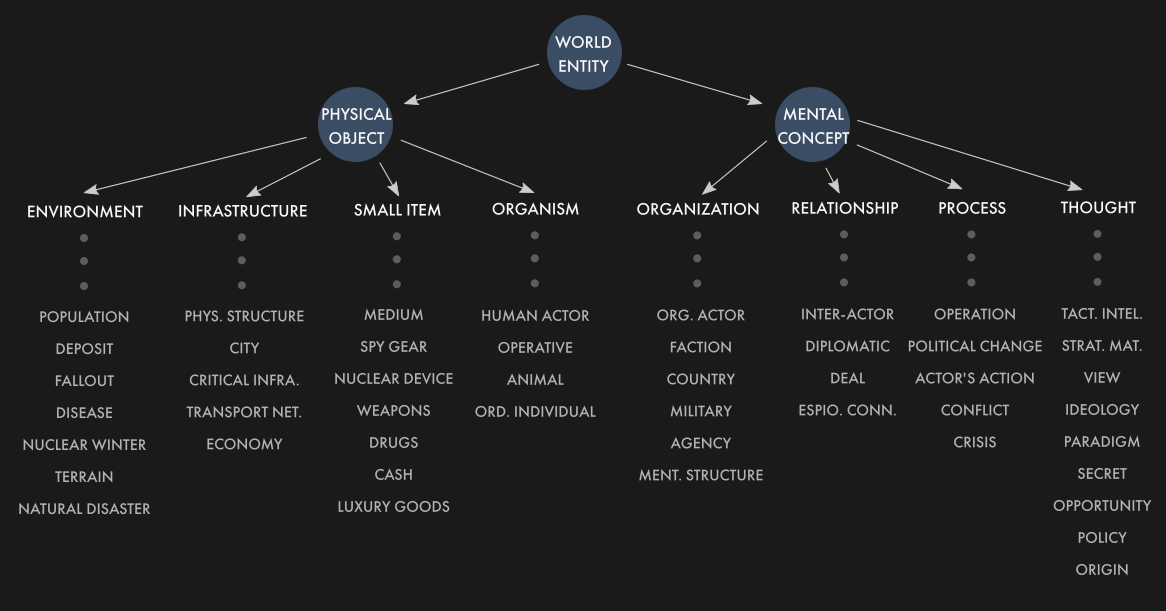
From time to time, I use the word "simulationist" to hand-wave certain mechanics. What does that exactly mean in Espiocracy? Usually this:
The entire game world in one chart. More than a mere classification exercise, this is the beating heart of simulationist implementation.
Spy gear is the perfect excuse to explain this approach in concrete terms. A lipstick gun is:
an entity - can be selected, described, created, followed, be a subject of mental concept
a physical object - occupies space, can be controlled and change hands, physically destructed
a small item - can be used, moved, concealed, produced, convey intelligence, can malfunction
a spy gear item - precise modes of use, production, etc
Such accumulation of properties and capabilities creates a game full of open-ended tools. In the previous 23 dev diaries, you may have spotted that we rarely talk about "rules", which is slightly unusual in the context of grand strategy tropes. This is the reason - the game is not exactly sculpted in rigid terms, no one sat down to write a rule that a lipstick gun can be destroyed in a nuclear explosion, it's just an emergent consequence of being a physical object and nukes destroying physical objects. So is the ability to steal your spy gear or said nuclear device!
Inventory
Following this angle, the player essentially has an inventory of espionage equipment:
Transcript: Widget with spy gear abilities, queued spy gear, and available items.
Its contents scale from the smallest intelligence agencies (just one person) to the gargantuan likes of CIA and KGB. In general, there are three tiers of spy gear:
Standard tools of trade such as handguns, one-time pads, subminiature cameras, listening devices
Unusual gear such as concealed weapons or inflatable aircraft
Large projects like U-2 or counterpart of Bletchley Park
Player's attention shifts with the scale. As a group of a few people, you will struggle to procure handguns but not as an established agency. On the other end of the spectrum, largest projects are available only to largest players. Between these two extremes, most players engage with the middle tier of spy gear - interesting enough and not yet prohibitively expensive - which expands player's agency one item at a time.
Crafting (kind of)
Cutting-edge gadgets can be crafted at player's will by operatives, laboratories (including Soviet sharashkas), and contractors:
Transcript: Window with choice of a new gear to develop.
Availability depends on developed capabilities (agency-wide know-how), entity developing the gear (for instance strong local industry), scientific and technological paradigms, policies, willingness to acquire secrets (illegal experiments can enable or accelerate the process), and obviously budget. This is also one of the places where a realistic hero economy can enter the stage - employing a genius can be as impactful as building a large laboratory.
Majority of items do not have to be developed after player's orders - operatives invent devices on their own during operations. In this learning-by-doing mechanic, performing for instance many assassinations can bring in new weapons, built and refined by creative people trying to solve an issue.
Gallery of examples
It's that simple! Focus on the grand scale naturally makes spy gear a non-core part of the game. Such an approach motivates the search for most interesting items out there - fun enough to be worth player's limited attention! Here are a few of the items to be featured in Espiocracy:
-> Single-shot pen gun
Credit: Ahmed Bin Mazhar
-> Umbrella with poison in the tip, also known as Bulgarian umbrella
Credit: ossr.ru
-> Explosive material concealed as a lump of coal
Credit: Nostrifikator
-> Cat with an eavesdropping device, also known as acoustic kitty
Credit: Spycraft (2009)
-> Radioactive equipment used for lock picking (one of the most insane espionage stories of the Cold War! described in an entire book full of interviews and photos from the most secret embassy rooms, unfortunately not available in English)
Credit: Łukasz Karolewski
-> Special Atomic Demolition Munition, or simply - nuclear backpack
Final remarks
For now, we conclude the sequence of dev diaries about espionage. Next up, we will focus on various shades of conflicts, with the first coming on July 8th: "Asymmetric Conflicts I".
If you're not already wishlisting Espiocracy, consider doing it:
There is also a small community around Espiocracy:
--- Banner image: AN/PEQ-1 SOFLAM, laser designator produced by Northrop Grumman and used in Afghanistan by American special forces.
--- "My wife often said I mumble in my sleep, but that I never said anything clearly. Except one night, apparently, I sat up and shouted, ‘Those f*cking batteries!’" - CIA operative from Technical Services Division
Dev Diary #23 - Secrets & Opportunities 📸
What's happening / TLDR: Developer diaries introduce details of Espiocracy - Cold War strategy game in which you play as an intelligence agency. You can catch up with the most important dev diary (The Vision) and find out more on Steam page.
---
There is a question that closely connects the imagination of both players and game designers: will a game feature X, Y, and Z? Naturally, games cannot represent all complexities of the world (even Dwarf Fortress does not have seemingly straightforward items like boats) - many of them have to be abstracted away to create an approximation, a model.
As mathematicians say, "all models are wrong but some are useful". In this context, useful should probably mean logical, interesting, challenging, and sometimes fun (sometimes - fun is not the only emotion evoked by good games). This is reflected by the hotly debated issue of mana points in grand strategy games. It is also an important culprit in the hunt for sins of espionage systems in strategy games, since most of them (with the significant exception of hooks in Crusader Kings 3) model espionage as knowledge tax where you just pay to uncover something. Paying taxes does not sound like interesting gameplay.
In an attempt to build a different espionage system, one founded on constructive actions and discrete results, Espiocracy models espionage as a world full of secrets and opportunities, which have their inherent dynamics, can be acquired and weaponized, and may even bite you back.
Acquiring Secrets
Secrets are one of the many facets behind reactive world-building in the game. Murders happen, people can get away with them, but the act will stay in memory of the perpetrator as a secret. These memories can be elicited from friends, in drunken conversation, or during interrogation. Sometimes they expand to the larger world of witness accounts and hard evidence (photos, recordings, signed documents), giving modus operandi of removing witnesses and Hoover-style kompromat hoarding.
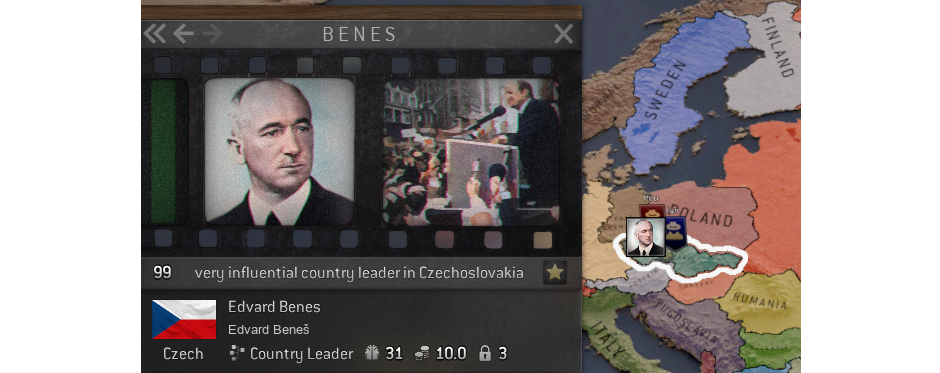
Transcript: Widget with Edvard Benes indicates 3 secrets associated with the actor.
Their inherent design is simulationist. Real world secrets are surprisingly granular and escape any wider generalization. There is an obvious angle of significant law breach - but what happens when the law is unjust or is not enforced or is dropped but the stigma remains? The UK prosecuted "homosexual acts" in the 50s and convicted GCHQ's Alan Turing to chemical castration but Guy Burgess, Soviet spy in MI5, who "made no attempt to conceal his homosexuality" did not have any issues. The law was dropped in 1967, but the British government in its system of "positive vetting" rejected homosexual candidates all the way to 1991. It is anything but simple!
The game tries to capture the most important parts of this granularity by making secrets local, personal, and situational. In the USSR believing in communism isn't a secret, in the USA it is. For one person, a love affair is dramatic secret, for another, it's a reason to boast.* Murders during the war are much less of a secret in contrast to a long period of peace. Above all, this leads to a continuous instead of binary (secret or non-secret) spectrum, which nicely plays into metaknowledge about secrets: falsifications, allegations, and different types of evidence weigh differently on the impact.
Speaking of which, secrets serve as full blackmail material - not only in the form of threat but also as a real tool with large impact. Leaking a secret to the press can destroy a career, purge an organization, or even topple governments. It's not limited to public scrutiny and can be used to open doors, for instance revealing a secret to the government can give you green light and special funding to harass the organization out of your country.
Protecting Secrets
The Player, as an actor in the game, is also subject to the world of secrets. Since you are an intelligence agency, rules are made to be broken - by accepting the challenge stemming from a new secret in your backyard, the risk of blackmail, whistleblowers, and scandals.
Transcript: Starting a new operation will lead to the acquisition of a new secret "assassination of country leader".
Coming back to the introduction and murder example, people are often jokingly asking if you can kill your president in the game - that's the place where the system of secrets kicks in. Following the intelligence rule of need-to-know, this secret is privy only to operatives engaged in the operation. It arises on the first day of planning and evolves over time ("planned to kill the president" has an obviously different weight than "killed the president"). Successful assassination, even with the best cover in the world, can still leave traces of evidence for nosy reporters, detectives, and other players. Moreover, it remains in the memory of executing operatives. Should they stay in the conspiracy circle or be eliminated? If elimination goes partially wrong, won't some of them run for their lives and reveal the secret to the world? Maybe blaming everything on one scapegoat is enough? (Here's also where the stakes are spiced up by one of the game-over conditions: grand treason. If this particular secret is revealed, it can lead to complete dissolution of intelligence apparatus, loss of all operatives, and therefore end of the game.)
There are many less grave secrets: illegal wiretaps, enhanced interrogation, creative accounting, deals with gangs and terrorists, experiments on humans and animals (that comes down to mentioned local sensitivities; in the era of CIA's illegal experiments on humans in MKUltra, the idea of eavesdropping "Acoustic Kitty" was feared as too dirty for people concerned about animals), and so on. There are even rare secrets that can be brought upon the player by operatives, such as covering up a stupid crime committed by an operative too useful to be imprisoned.
Opportunities
Following the KISS principle (keep it simple, stupid!), Espiocracy features literal extensions of player agency: opportunities. Examples include the ability to intercept a person in transit, infiltrate an organization with an agent of ideal background, steal a piece of technology presented at an expo, funnel money from the government to an actor, and so on. They are essentially a discrete currency of the intelligence world, acquired during operations, bought from actors and other players, received from the government, or sometimes just randomly stumbled upon.
Transcript: "Funding" opportunity in the outliner. Tooltip describes its dynamics: can be funneled to Czech actors, cannot be passed to other agencies, expires when Benes is no longer country leader (possible in next elections, 5 months).
On the most basic level, they are as intuitive as the word "opportunity" can get (which is why this section is rather short). From the strategic point of view, they introduce one more layer of decisions that contributes to planning, preparation, cooperation, coordination, and a few other staples of decision making. Some of the opportunities get more complex dynamics, limiting their use to a particular time window, location, or a set of requirements (the last one can be broken by getting, for instance, the "creative accounting" secret). Other times, they function as a sincere favor system - after assisting the local mafia, they may return the favor in the form of opportunity. There are also cases where opportunities can make failure worthwhile by opening new opportunities. Rarely, some opportunities can feed into the paranoic side of the game, where a player can dangle manufactured opportunities to ambush other players.
Final Remarks
The order of espionage dev diaries has been switched, next up we'll have previously announced "Spy Gear" - on June 24th.
If you're not already wishlisting Espiocracy, consider doing it:
There is also a small community around Espiocracy:
--- * Relevant anecdote: At the height of the Cold War, Eastern counterintelligence services tried to recruit the wife of a diplomat in a Western embassy. They found out about her love affair, bugged the house of her lover, and acquired photos of them. When they produced these photos during the recruitment pitch, the wife responded: "I look beautiful in these photos, show them to my husband, maybe he'll finally start paying attention to me"
--- Photo credit: See-ming Lee 李思明 SML
--- "In chaos, Madame Ambassador, there is opportunity" - CIA officer Douglas London
Dev Diary #22 - Contacts & Targets 2.0 🤝
What's happening / TLDR: Developer diaries introduce details of Espiocracy - Cold War strategy game in which you play as an intelligence agency. You can catch up with the most important dev diary (The Vision) and find out more on Steam page.
---
Jason Schreier in "Blood, Sweat, and Pixels" wrote:
People often wondered how CD Projekt Red sharpened the writing in Witcher games so well, especially when there was so much of it. The answer was simple. "I don’t think there is a single quest in The Witcher 3 which was written once, accepted, and then recorded," Szamałek said. "Everything was rewritten dozens of times"
Iteration is central for Espiocracy as well. Some mechanics went through 20+ cycles of implementation, playtesting, and redesign. One of them is core loop of the game, "contacts and targets", eight months ago described as an interface between player and actors (characters, organizations, populations). True to the usual disclaimer "subject to change" found at the end of dev diaries, today we will explore a new version of this system and swing by a few other changes. (Don't worry about reading the outdated 7th diary, the following description will be largely universal.)
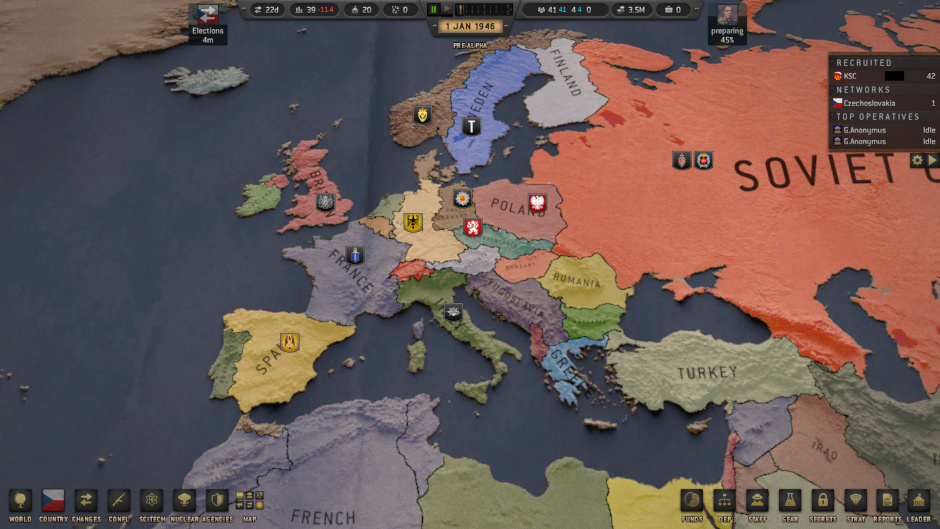
Subject to change! Transcript: Screenshot of current main & empty view in the game with some agencies visible on the map.
Quintessential Why
Core loop was italicized above for a reason. It's easy to define a core loop for entire genres - shooting or collecting experience points - but it gets tricky with 4X and grand strategy games. Which one of the ten concurrent loops is most important? Is there a unifying pattern? What should be the core loop of Espiocracy, if anything at all?
Perhaps one of the most universal suggestions was eloquently proposed by Troy Costisick. In an article for eXplorminate, he tried to stray away from the traditional definition of 4X games (explore, expand, exploit, exterminate) and focused instead on the motivation: at the heart of these games, player unlocks hidden tools for victory. When you research technology, build a city, or create a unit, you get new tools to achieve your goals, which are, then, used to acquire even more new tools, and so on in the loop. This point of view is obviously not new, there are even entire books* which argue that game designers sculpt mainly in the medium of player agency (agency understood as the ability to do things, not an intelligence agency). Troy's observation, however, goes a step further: enjoyable strategy games put the player in the sculpting seat. You're not just reliving agency planned by the game developer, you're designing your own agency during a campaign.
This is the real core loop of Espiocracy: expansion of player's agency.
Following this perspective, contacts and targets evolved from the primary mode of interaction with actors into an intricate first half of interaction which can open up the second half, full of new strategic possibilities.
RICSE
Transcript: Visible some actors in Poland, player selects recruitment option, after selection actors with impossible actions are greyed out, player clicks one of the recruitable actors, and then a context menu popups with four options: ego, money, coercion, and custom.
Now, the first half of interaction with actors relies on intelligence operations divided into five categories:
Recruitment
Infiltration
Cooperation
Subversion
Elimination
These are further fleshed out by methods, customization, and progress that roughly follows 12th dev diary. In this iteration, operations - by blending them with contacts and targets - become a key to continuous interaction instead of a one-off affair (with the honorable exception of spectacular murders, a.k.a. elimination). How exactly?
Agency of Actors
Transcript: Widget with an actor in the USSR which has the following available actions: meeting, support, subvert, change, write a book, tour the country, create private art piece for an actor.
Using operations, players expand their agency by tapping into the agency of actors. In less convoluted description, after recruiting a writer, you will have the ability to nudge them to write a specific book, abandon the manuscript of a book that would be detrimental to your ideology, develop a relationship using their reputation to spy on your behalf, and so on. Extrapolate that to all actors, types, situations, countries...
Actors become a battlefield. Intelligence agencies compete for control over pawns, attack assets known to be controlled by other players, generously support their favorites, create an environment in which some actors succeed whereas others fail, put the right pieces on the chessboard, sometimes to execute a machiavellian plan, and sometimes just to have backup options.
This is where differences between operations create emergent strategies far beyond original contacts and targets. Subversion includes also deception and threats that can push actors into different actions. Cooperation features plethora of deals, either with strings attached to particular decisions of the actor, or as a method to gain trust before future operations. Infiltration is an exciting case in which spies can become members of an organization or get closer to a character, and influence some of the decisions. Finally, recruitment is the pinnacle of control, where via a combination of MICE (money, ideology, coercion, ego) actor's decisions can be more or less fully controlled. Note that the same actor can face attempts at cooperation, infiltration, or even recruitment from multiple intelligence agencies, naturally allowing, i.a., double or even triple agents.
If you think hard about it, it's really "Inception" of agencies of agencies of agencies. What's the better place to pursue that kind of gameplay if not a game where you play as an intelligence agency?
Preparation
If you are familiar with the original system of contacts and targets, it all should map fairly well except for the big-picture focus of espionage. Previously, you could target not only actors but also entire countries. Now, this part of preparation is integrated regular espionage: if player wants to expand in particular countries, they simply establish stations, covert cells, and purpose-specific structures (like smuggling lines and SIGINT arrays). This is also a partial answer to mistakes detected in playtests with old contacts and targets, where the optimal strategy was to contact everyone and to constantly shuffle targets. Currently, the simulationist principle takes over the wheel, and your operatives autonomously develop relationships with everyone and spy on all the actors likewise (with the ability to strategically nudge them, e.g. focus on terrorists).
Transcript: Fragment of country widget, with local intelligence value, parameters of local network, and buttons for establishing new structures.
Furthermore, regular espionage now also features literal spy networks, where operatives acquire assets in a particular country, and follow fairly realistic intelligence ladder: spotting candidates -> developing relationships with them -> getting them to divulge random intelligence (a.k.a. sources / informants) -> recruiting them for cooperation that can be directed or even used in operations (a.k.a. agents).
Other Significant Updates
The following paragraphs are far from dev diary patch notes, just a few - in my opinion - interesting changes.
DD#6: ethnic groups are now represented as special population actors and the role of previous sectors is distributed between these special actors and SPI parameters. On the one hand, it frees up countries from boring repeatable actors (e.g. academia or industry in every country) and solves awkward detachment of propaganda from other operations, on the other hand it extends mechanics such as influence or actions to ethnic groups, facilitating for instance different levels of discrimination and the ability to create new actors.
Transcript: Small widget with summary of funding sources and ability to change spending.
DD#8: player's resources were spiced up and adjusted to different levels of gameplay, from a small organization to a governmental juggernaut. Money can be flexibly procured from many sources, not only from the national budget, but also from cooperation, actors who will attempt to control you with strings attached, or even illegal means. This is, then, translated to staff and special budget. Staff is the main currency that the player spends on spying, networks, and structures. It is now divided into three tiers: amateur, professional, and elite, providing classic strategic trade-off between 100 duck-sized horses or 1 horse-sized duck. Operational budget - as not exciting enough - was abstracted away. Black budget - as too gamey - was replaced partially by special budget (millions of dollars to be spent on propaganda radio stations, large bribes, and so on) and partially by opportunities (which will receive dev diary on their own).
DD#12: speaking of which, operations now have procedurally simulated endings, to be explored in a separate dev diary. Just to hint at a general idea and reasoning behind it, five rigid outcomes for operations turned out to be a little bit too stale for espionage-based gameplay, so now they can result in different details, consequences, fallout, evidence, counterintelligence possibilities, depending on the details of a simulated car chase, murder in the train, or a particularly heated... recruitment conversation.
Final Remarks
With this dev diary, we return for a while to everything espionage-related in Espiocracy. The next diary will be posted on June 10th: Spy Gear.
If you're not already wishlisting Espiocracy, consider doing it:
There is also a small community around Espiocracy:
--- * See for instance, C. Thi Nguyen (2020) "Games: Agency As Art"
--- "We provide for their needs, they provide for ours, it's the way of the world" - John le Carré
Dev Diary #21 - Space Race 🚀
What's happening / TLDR: Developer diaries introduce details of Espiocracy - Cold War strategy game in which you play as an intelligence agency. You can catch up with the most important dev diary (The Vision) and find out more on Steam page.
---
Jules Verne in "From the Earth to the Moon" describes how three people conquered the Moon by launching themselves from a cannon. Curiously enough, the French novel has been translated into English with large changes, entire passages rewritten, and "boring parts" removed. Verne complained that this barbarism painted him as a writer of fiction for children, despite his serious approach to the matter.
We could argue that the topic itself - space flights - already pushed him into the shelf of simple amusement. First a dream, later a reality, space was at best an entertainment and at worst, for some, fringe activity that distracts people from important Earthly issues. This attitude was captured perfectly at the peak of the Cold War by Sister Mary Jucunda in an accusatory letter sent to NASA:
"How could you suggest spending billions of dollars on such a project at a time when so many children were starving on Earth?"
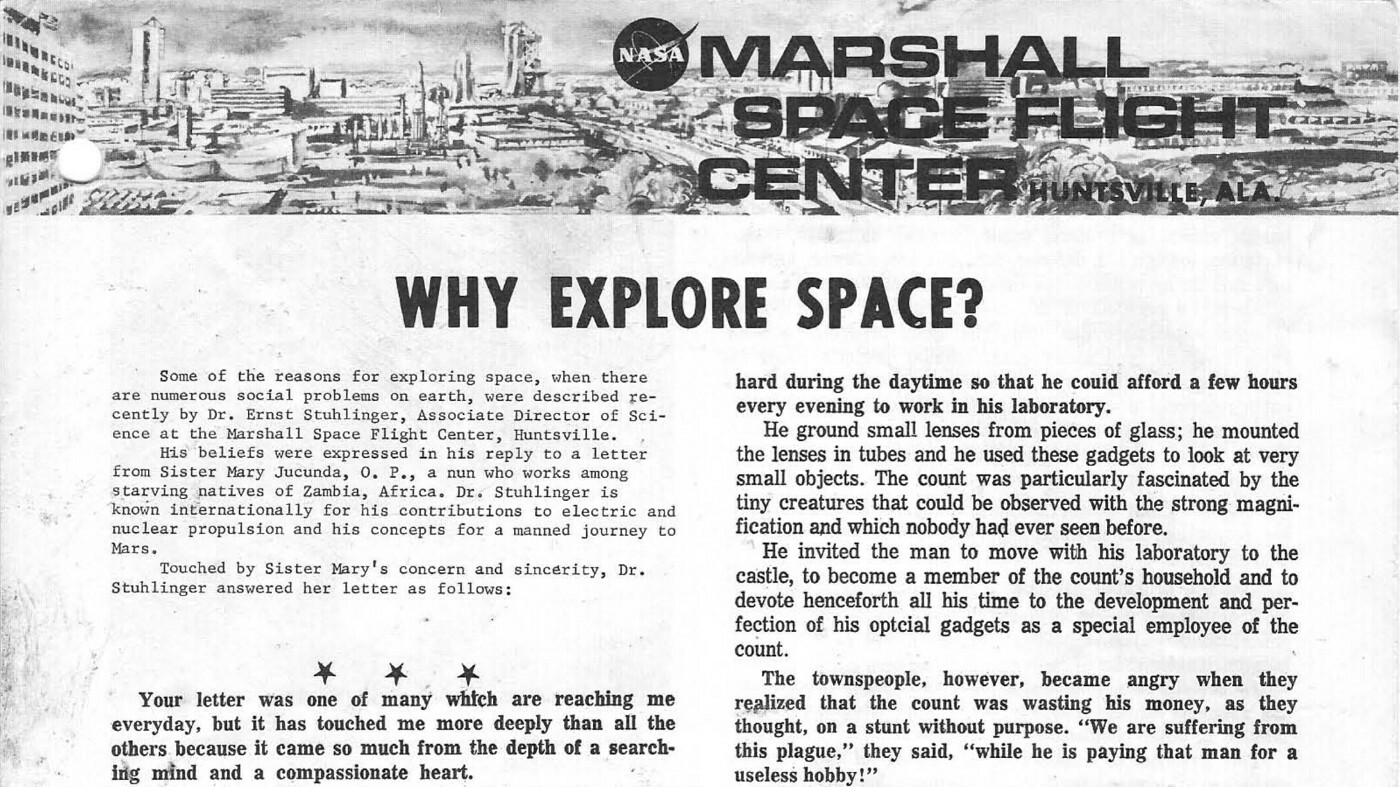
Director of science at NASA responded in widely popularized "Why Explore Space?" which can be distilled to the following line:
"I believe that this project, in the long run, will contribute more to the solution of these grave problems we are facing here on Earth than many other potential projects of help"
The letter printed in Marshall Space Flight Center journal.
Ironically, just around this exchange, the budget of NASA was dramatically slashed by billions of dollars, lunar program Apollo came to a halt, and the project mentioned here (manned landing on Mars) is currently scheduled for 2033, sixty-six years after the letters. In the meanwhile, World Food Conferences, UN FAO, The Hunger Project, and others started to spend billions of dollars on the issue of starvation.
Regardless of whether Sister Jucunda was morally right, she correctly predicted the future, grasping the age-old collective thinking. Following the words of Joseph Conrad, Espiocracy will "attempt to render the highest kind of justice to the visible universe" by featuring the space race not as just as a few checkboxes to tick, but as a conflict between nations, peoples, and lines of thinking.
The Value of Space
On the national stage of the Cold War, countries pursued space conquest to prove their ideological and economic superiority over competitors. There are no gamified prestige points - the main reward lies in spreading the ideology, as was the historical case of the Soviet-American race. In gameplay terms, it creates very concrete motivation for participation in the space race, where achieving one of the firsts (satellite, man in space, man on the Moon, and so on) achieves more than any propaganda campaign could ever do, and provides heaps of material for actual propaganda activities, such as the USSR parading Gagarin around the world (except for the USA which deliberately barred Yuri from entering).
Soviet cosmonauts in a TV studio, 1963. Attribution: RIA Novosti archive, image #879591 / Khalip / CC-BY-SA 3.0.
Pursuing a space program after the initial push can still yield limited political gains. The first satellite in South America or the second in Africa can move regional imagination. Fulfilled promise of sending a man into space, even if it's the tenth nation to do so in the world, can significantly influence incoming elections. At the same time, these projects have to be weighed against real and imagined opportunity costs - in some countries, spending money on space initiatives can backfire.
Beyond pure politics, the space race expands player's agency, provides more options, opportunities, and tools. It is no coincidence that "Why Explore Space?" focused on space-borne inventions broadening the toolset used in programs attempting to solve the issue of poverty.
Agency expansion
Continuing political options, a successful space program in the game opens avenues of cooperation with other countries: sending their satellites and astronauts to bolster relations, establishing joint programs, providing valuable data from Earth-facing satellites, and so on.
At the same time, space is an important step forward for many technologies of the era such as TV, radio communication, and positioning systems. Most importantly from our perspective, it hands the player a new important tool - spy satellites! Real-world history counts at least 18 satellites launched by the CIA over two years (1959-60) despite fledgling space engineering. They truly were at a forefront of technological espionage.
KH-4B Corona, satellite produced and operated by CIA between 1967 and 1972.
In the game, satellites directly collect a wealth of intelligence:
Precise mapping
Early warning of a nuclear strike, monitoring of nuclear tests
Military units and bases, including missiles
Activity of strategic factories
Deployed air-defense measures
Interception of communication
At the moment, direct interaction of the player with the manned space program is limited to a healthy dose of events and some juicy event chains (including one with a spy sent into space). In the future, they may be a scene for espionage operations - on a space station or a Moonbase, closer to Bond movies than the history. Speaking of which...
Plausible Points of Divergence
The space race is a great place to ask a few interesting "what if" questions in Espiocracy.
Stemming from the plethora of mechanics explored in the previous dev diary, pace and participants will largely depend on actors (including Operation Paperclip) and paradigms (mainly around missiles and electronics). The progress relied on many tests and disasters, represented here to punctuate the race with unpredictability. Some of them will have international consequences, providing additional challenges during the campaign - such as the case of Kosmos 954, a Soviet satellite with a nuclear reactor onboard, which disintegrated over Canada. Other failures, paradoxically, will open up new opportunities - for instance, the CIA planned to blame the jamming of Cuban revolutionaries for (unrealized) death of the first American astronaut (with a bit of imagination, space-based casus belli right there!).
Transcript: Newspaper header with a photo of Soviet nuclear-powered Kosmos spy satellite and title: "Could spread destruction, radioactivity if it hits a populated area. Soviet satellite out of control." Note, this is about Kosmos 1402, a few years later after Kosmos 954.
One particularly significant "what if" is the eventual militarization of space. Contrary to almost all the science-fiction, humankind did not export warfare into space, and we know only of a single space-borne weapon test (R-23 autocannon attached to Salyut 3 in 1975). However, players should be able to take a different path in Espiocracy. Instead of signing peaceful Outer Space Treaty in 1967, the limited development of space-to-space weapons is a somewhat neglected yet plausible alternate history. This can further escalate beyond space-faring nations if the weapons in space - nuclear bombs, god rods, Strategic Defense Initiative - start facing Earth.
God rods, kinetic weapons capable of destroying nuclear bunkers.
Second important "what if" comes back to the introduction. What if we did not stop on Apollo 17? The world of Moon bases, landings on Mars, and spaceships orbiting Venus was in the early stages of the space race presumed to happen. By capturing the tension between people with a desire and disregard for space conquest, Espiocracy will also feature the world in which the first group leads superpowers away from The Hunger Project, to continue the exploration of space.
Early proposal of Soviet lunar base found by wonderful Anatoly Zak, a legend in space history circles: http://www.russianspaceweb.com/lunar_base.html
Smaller "what if" is also dedicated to the commercialization and internationalization. The space industry is currently worth 420 billion dollars, ten times more than the movie industry which is rather generously represented in the game (directors, actors, Hollywood as a special sector). Espiocracy will simulate that what-if with space-focused companies, famous engineers, initiatives such as the European Space Agency, and cooperation leading to the International Space Station - all of which could take different paths, creating a slightly different world in every campaign, opening strategic opportunities such as SpaceX reaching for space in player's country.
Final Remarks
Sorry for the lack of screenshots, the game undergoes important changes. The next dev diary should make up for it - we will talk about the new iteration of Contacts & Targets on May 27th.
If you're not already wishlisting Espiocracy, consider doing it:
There is also a small community around Espiocracy:
---
"Oh Little Sputnik, flying high / With made-in Moscow beep / You tell the world it’s a Commie sky / And Uncle Sam’s asleep" - G. Mennen Williams, Governor of Michigan
Hooded Horse to publish Espiocracy
Espiocracy was announced to be published by Hooded Horse and a new trailer was shown in the Hooded Horse Publisher Showcase at PAX East 2022. The publisher showcase revealed new content and announcements across Hooded Horse’s strategy games.
What's happening / TLDR: Developer diaries introduce details of Espiocracy - Cold War strategy game in which you play as an intelligence agency. You can catch up with the most important dev diary (The Vision) and find out more on Steam page.
---
Modern world has been forged in the fire of science and technology. Far from an anonymous historical process, all discoveries and inventions originated from a relentless march of scientists and engineers, people with their own ideas, thoughts, and beliefs. This is the point of view embraced by Espiocracy: humans & human minds. Instead of featuring just a set of technologies, we will be talking about paradigms.
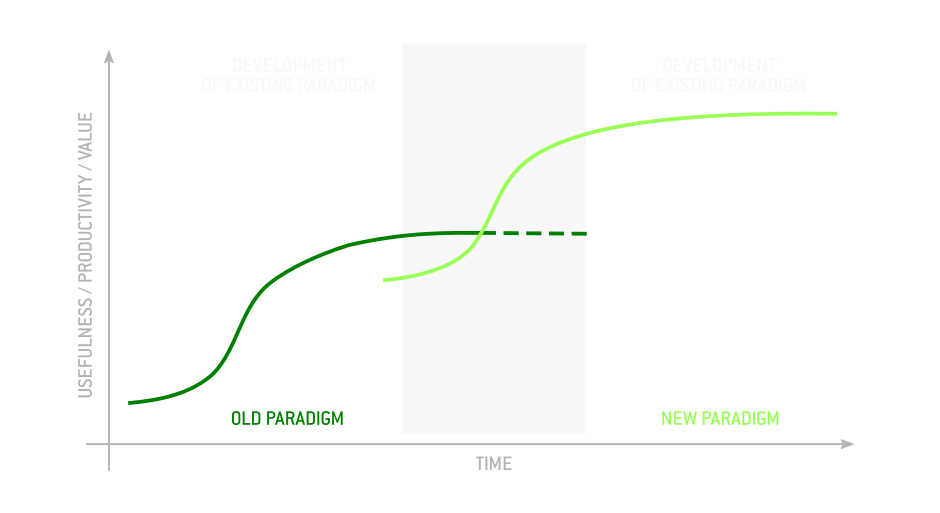
A paradigm is a line of thought, set of beliefs, body of evidence supporting particular conclusion. In this context, it was popularized by Thomas Kuhn to describe perhaps the most significant change of thinking about our place in the world: the Copernican Revolution. 500 years ago, the geocentric paradigm (Earth as the center of the universe) was replaced by the heliocentric paradigm (Earth orbiting the Sun) in a somewhat fierce conflict between the old guard and the revolutionaries. History of science, Kuhn argued, is punctuated by multiple such shifts in thinking - about electricity, the origin of species, or the law of gravity*. Between these events, science proceeds in the ordinary staccato of experiments, publications, and slight corrections within the existing paradigm.
Transcript: Chart with usefulness on the y-axis and time on the x-axis. Paradigms progress from left to right as a sigmoid curve. The old paradigm at some point in time is met by a new paradigm that overlaps the old paradigm in the exponential part of the curve.
Espiocracy adopts modified version of Kuhn's paradigms to model STEM (science, technology, engineering, mathematics) with two cycles: paradigm shifts and paradigm development. Here, paradigms are extended to practical inventions, usually less violent, and less grandiose than stopping the Sun and moving the Earth. The timeline is too short to expect many significant scientific revolutions, which means that most paradigm shifts work gently by weakening and strengthening other paradigms, shaping a unique STEM landscape in the simulated world. You, as an intelligence agency on the bleeding edge of STEM, participate by placing bets on the combination of paradigms and cycles via the plethora of espionage- and state-based tools.
Example Paradigms
Currently, paradigms are divided into six sectors:
Electronics - from vacuum tubes to AI
Nuclear Physics - from atom bombs to generation IV reactors
Rocketry - from V2s to SpaceX-like VTVLs
Vehicles and Weapons - from jet airplanes to drones
Medicine and Biology - from vaccines to CRISPR
Basic Sciences - from information theory to exoplanets
The staple of the Cold War serves as a primary example of a paradigm:
Transcript: Widget with atom bombs represented as a paradigm in the game. The description follows in the next paragraph.
Nuclear bombs (atom bombs, fission weapons) produce energy from enriched uranium or plutonium. This is in contrast to thermonuclear bombs, which use isotopes of hydrogen to spark much larger explosions - a paradigm that will replace atom bombs in the future. At the start of the game in 1946, atom bombs are still in the exponential phase of development, where normal science attempts to industrialize production of these weapons. Relevant actors include American Atomic Energy Commission and a set of other organizations, currently unknown to the player. There are many requirements to start local development, out of which only one is met by player's Czechoslovakia (uranium mine in Jachymov).
Since paradigms are first and foremost about thinking (among professionals), they can get unusual in comparison to the classic set of technologies encountered in strategy games. Some of the shifts change the world by influencing popular behaviors - there are paradigms pertaining to the health effects of cigarettes and the development of seat belts in cars. Others are straight-up damaging and objectively incorrect, following the example of the geocentric paradigm. These include Nobel-winning lobotomy, Mao's campaign to eliminate sparrows, or Lysenkoism. Far from simple conspiracy theories (which are handled by the system of views), these paradigms have powerful actors vouching for them, wider recognition, and oftentimes are enforced by the state.
Paradigm Dynamics
Paradigms are global, the same for the whole world, which reflects interconnected STEM communities of the modern world. It doesn't mean that everyone has an identical technology tree - far from it, since the global set of existing paradigms is only the source of choice for particular countries. (Think of random 'choose one out of three' slots seen in recent 4X strategy games, where randomness is instead largely controlled and can be strategically influenced.)
Existing paradigms are locally mastered by actors in a country. For some paradigms, it's just an autonomous process, where sufficiently strong actors are all you need. Others require funding, special access, materials, political decisions, or intelligence. There are also lavish paradigms that require state-funded Big Science projects.
"Mastering" a paradigm equals convincing people to a particular line of thought, implementing experiments, producing devices, rolling out measures in the population. The process doesn't stop after the paradigm is mastered! This is where Kuhn's normal science kicks in: the paradigm is further developed and optimized in subcycles (atomic bomb case: better yields, safer handling, faster production). There's always a new, better version waiting on the horizon.
Beyond the horizon of normal science, there are new paradigms. Their arrival depends on investments across the world. In the design documents, this system is referred to as a "STEM stock market", because betting on the next paradigm shift is not only a prediction (we'll be rich if we're putting money on the right horse!) but also a direct intervention (this horse will be richer because we're putting money on it!).
Eureka moment, a paradigm shift, happens to a particular actor semi-randomly, where luck favors the prepared. New paradigms initially remain in the pre-shift phase. The country of origin can try to conceal the invention and widen first-mover advantage. At the same time, other countries - their intelligence agencies! - hunt for paradigm shifts, with early acquisition of relevant materials being a boon to the local STEM community. It is usually a competition leading to temporary advantages (with rare exceptions), because shifts are not exclusive, and can be invented by other actors and countries.
When the new paradigm is advanced enough to be widely accepted, the point of paradigm shift arrives. Sometimes it takes a form of flashy event, the final straw of evidence to convince the world:
Transcript: Event window with title "Paradigm Shift: Thermonuclear Weapons" and the following description: "It's a boy," Edward Teller wired proudly after the first successful test of a thermonuclear weapon. The explosion produced a yield of 10 Mt, making it more powerful than all combined nuclear weapons in the world. The sheer destructive force vaporized Pacific island of Elugelab in an instant, leaving behind a 41 km high mushroom cloud. The news of the test came as a shock to the public. A mixture of fear and awe is palpable in the streets. No one knows what to expect next...
Naturally, the country of origin starts with the paradigm already mastered, ready for further progress in development subcycles. At the same time, other paradigms are over time influenced by the paradigm shift itself - they can be made obsolete (nuclear bombs - by thermonuclear bombs), weakened (Lysenkoism - by genetic code), strengthened (computers - by information theory), or enabled as a possible new paradigm (microprocessors - by MOSFET). In addition, some paradigm shifts will be met not only with reactions of relevant actors but also wider world, even to the point of sparking new movements ("ban the bomb!").
Interacting with Science & Technology
The combination of global paradigms, local developments, and actors creates an intricate decision space.
Starting on the lower level, we can:
Strengthen STEM actors at home
Weaken foreign competitors ("weaken" in this game equals, i.a., sabotaging a nuclear plant)
Acquire STEM intelligence
Move actors, vide Operation Paperclip
Smuggle in materials, sometimes despite embargoes
Combat detrimental paradigms
Promote, exploit, defend selected paradigms
On the higher level, through cooperation with the leader of the country, we can nudge local STEM into chosen direction via fairly realistic:
Incentives
Contracts
DARPA-like institutions
Big science projects
International cooperations
Grand strategic, big picture approach to science & technology in Espiocracy suggests at least a few possible strategies:
Investing in fast development of an existing paradigm and putting it to use while temporary advantage lasts
Pushing for paradigm shift to make an existing - mastered by others - paradigm obsolete
Specializing in a set of actors and paradigms (e.g. Japan & microprocessors in the 80s)
Promoting detrimental paradigms and views in other countries
Shaping different world to ride the wave of ripple effects (what if the internet arrived earlier or green revolution happened later?)
Final remarks
As always, mechanics and screenshots are work in progress, subject to change, and may even receive a new dev diary down the line.
Don't hesitate to chime in with feedback, there is a lot that Espiocracy can get wrong on science & technology!
In the next dev diary, we will continue the topic by exploring a fascinating product of the Cold War: the space race.
If you're not already wishlisting Espiocracy, consider doing it:
There is also a small community around Espiocracy:
--- * Kuhn's "The Structure of Scientific Revolutions" didn't really convince epistemologists at large and remains controversial in metascientific circles. As one of the reviewers noted, "paradigm is a word you seem to have fallen in love with!", and as another reviewer observed, Kuhn used the word "paradigm" in 21 distinct ways. There are many legitimate objections to his treatise, many of which I agree with. Among them, the narrow focus on dogmas in scientific communities seems like the largest culprit, which is somewhat corrected here (STEM actors in Espiocracy are generally not dogmatic). Thankfully, I have not only the freedom of iterating on Kuhn's paradigms but also of inventing an entire virtual world in which they are accurate enough!
--- "A new scientific truth does not triumph by convincing its opponents and making them see the light, but rather because its opponents eventually die, and a new generation grows up that is familiar with it" - Max Planck
April 1st Special 🥸
In spirit of April Fools' Day, this dev diary will be on much lighter side. Don't worry, it's not a hoax or a joke - instead, we will take a look at two quite silly prototypes from the early days of development. No in-depth analysis, just many odd tidbits, enjoy the ride!
Espiocracy as a... 4X
It was bold, blue, and wrong. Some versions of the map were overwhelmingly atrocious...
...and other just overwhelming:
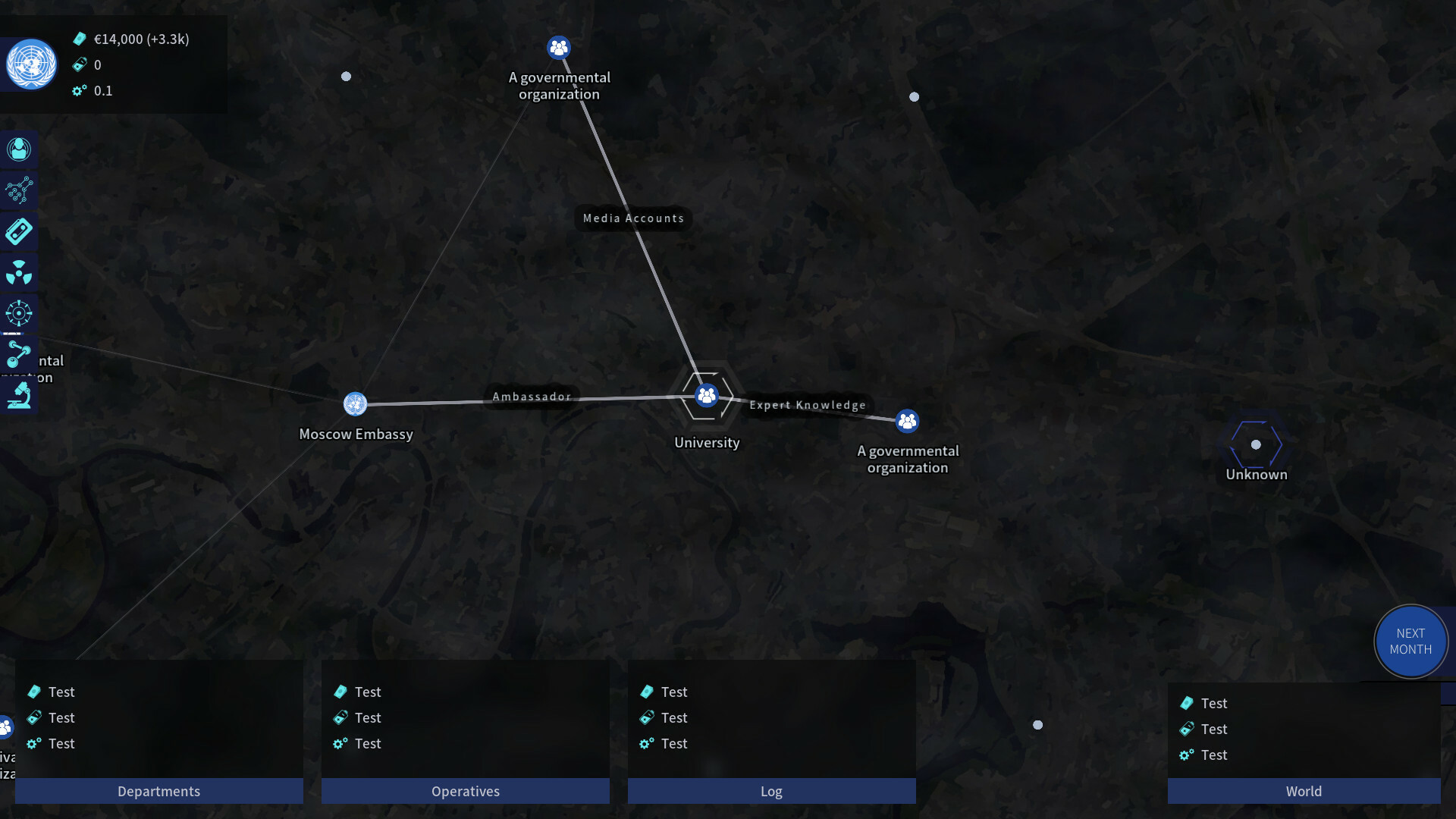
The prototype drank a lot of 4X Kool-Aid and tested literal exploration - with solar systems replaced by organizations - which actually turned out to be somewhat fun.
The analogy was taken to the limits, working even on the internal level of organizations, providing network gore in place of border gore:
At the same time, this prototype tested some deeper mechanics around procedurally generated characters via shameless bags of statistics:
Hiring window appealed to fans of sliders:
And the hiring was accomplished by winning in a full-fledged negotiation minigame!
By full I mean: opposite character had simulated state of mind and body language, they could get angry (depending on character's personality), and AI juggled actual negotiation strategies (distribution, integration, compromise, bluff, double bluff, accommodation).
Espiocracy as a... mobile manager
Mobile approach was really a random decision (I can't recall now, probably just curiosity about development process for Android). As a one of the first prototypes, it was also a test of Godot game engine and its scripting language (later ditched for C#), written in two weeks of complete freestyle. What this means is that the code was absolutely disgusting!
Gameplay paid homage to good old strategies from the 90s by providing scenarios instead of campaigns or start dates.
Core loop revolved around weirdly quantified cooperation with the government:
The prototype tested detailed approach to espionage - 54 methods of tradecraft which you couldn't directly use (yay!).
Instead of direct choice, AI operatives were crafting plans, presented later to the player. Needless to say, they usually came up with stupid ideas.
Ultimately, gameplay leaned into survival genre. You were either wiped out in nuclear war, suffered from wave of terrorist attacks, or failed at tasks requested by the government.
The game tested time-based tension in a few places, including game over condition:
Final farewell was rather dense & nerdy:
And this is also where our journey through prototypes ends!