What's happening / TLDR: Developer diaries introduce details of Espiocracy - Cold War strategy game in which you play as an intelligence agency. You can catch up with the most important dev diary (The Vision) and find out more on Steam page.
---
Why are people willing to die for an idea? What makes the idea of a "nation" so powerful? How do nations form?
Espiocracy embarks on a journey to answer these big questions. Starting on January 1, 1946, the game launches you into a world recovering from the Second World War and into the long shadow this war cast on the concept of statehood.
Countries once described as empires, proud conquerors of the world, were themselves conquered or economically crippled. Even after victorious war-time counteroffensives, they were no longer in a position to retain their power over colonies. Some nations even owed part of their hard-won liberty to conscripted colonial subjects, who, for their part, had seen first-hand that Europeans were not as civilized as they had been led to believe.
At the same time, two anti-colonialist powerhouses were emerging from the ashes of WWII. United States and Soviet Union, eager to make a case for their opposing ideologies, armed freedom fighters and promised economic miracles to potential new countries.
And so, the era of decolonization begins - Petri dish of nation forming.
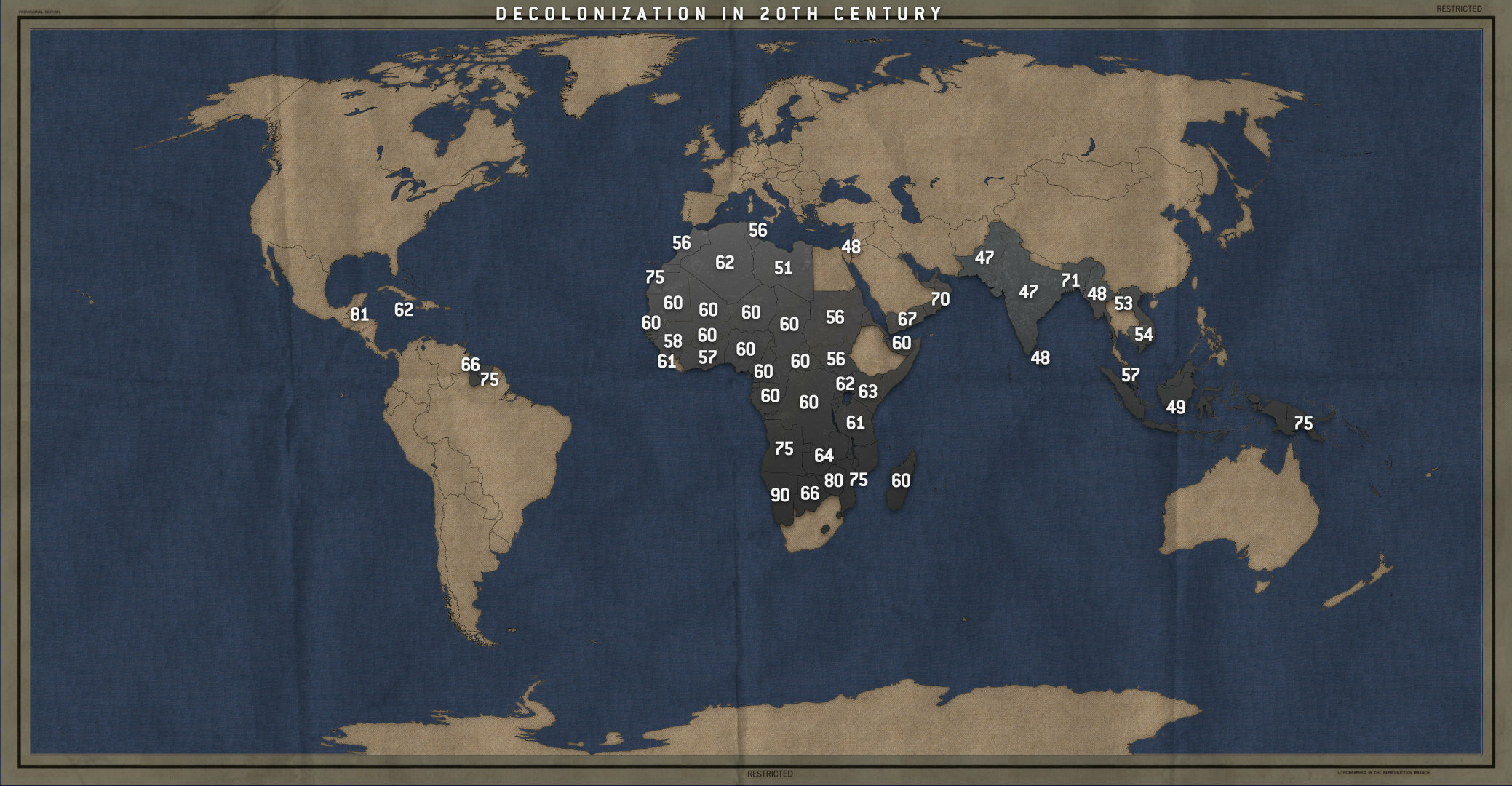
Transcript: 19XX year of independence for majority of decolonized countries in the real world history.
The Cold War precipitated decolonization of dozens of countries. In the game, decolonization powers multiple ways in which events could have come to pass, mixing diverse interactions to create different alternate history every time you play.
Anatomy of a colony
In Espiocracy, colonization shares features with occupation. Colonies and occupation zones fall into the wider category of proto-states: separate ecosystems of actors (influential people, organizations, and sectors) controlled and exploited by another country through a set of external actors (colonial administration, military forces). Subtypes and power of the latter define details of proto-state's dependence, ranging from indirect rule through indigenous leaders (the British model) to de jure incorporation (e.g., French Algeria).
Colonies are populated by groups divided along ethnic, linguistic, and religious lines; for instance a white minority and indigenous majority, Tutsi and Hutu, or major ethnic groups of Indonesia. In this model, there is no inherent anti-colonial conflict (besides the usual anti-settler tensions). Instead, there are conflicts (and cooperation) between groups and actors that can be exacerbated by a colonial/anti-colonial divide but that also extend to tensions around settlement, economic exploitation, indigenous clashes, secession from colonial rule, and many more.
Populations and actors are mutable. They are modified by the wheel of history: migration, urbanization, green revolution in agriculture, new forms of media, lack of environmental resources, and supranational institutions.
This is where establishment dynamics kick in. Seeds of national identity reside in population groups, whereas physical countries are formed by concrete actors, such as political leaders and social movements. Delicate dance between these forces differentiates one colony’s fate from another’s. Two extreme examples of this phenomenon can be seen in trajectories taken by two neighboring countries: Guinea (whose anti-French movement under Ahmed Sékou Touré led to dramatic departure of colonists who literally unscrewed lightbulbs when leaving) and Senegal (where pro-French rule under Leopold Senghor saw Senegalese troops sent to crack down on rebellion in another French colony).
Playing in a colony
Espiocracy leverages its unique approach to the grand strategy genre - playing below the level of nation spirit - in decolonization gameplay. Here, you can start as a part of potentially-nation-forming organization in a colonial proto-state and work from the shadows towards independence.
This part of gameplay is vastly different from the usual international spy intrigue. Instead of heading governmental intelligence agency with numerous employees, you guide a small group of fixers without diplomatic immunity or ability to form robust surveillance groups. This is where the system of contacts can shine. A few properly developed contacts can provide substantial support and result in deals that can mean the difference between successful decolonization and failure of your movement.
In addition to contacts, other ways to play direct role in decolonization include:
Undermining colonial government
Organizing popular resistance
Cooperating with other independence movements
Harnessing external support
Infiltrating state actors
Protecting actors (think: Gandhi)
Promoting pan-continental ideas
Essentially, this element of gameplay is a twist on the diagram presented in the first dev diary, moving the center of gravity towards characters: Transcript: On a spectrum from playing as a nation to playing as a character, middle position of an intelligence agency moves towards characters in the decolonization phase. It is partially inspired by real-world examples, such as highly active intelligence components of Vietnamese independence organizations or members of Polish anti-communist opposition forming counterintelligence cells.
Playing in an empire
Colonial empires, famously, have taken very different paths in the decolonization process, often on a case-by-case basis. In-game differences between these trajectories depend on economics, use as a political and military outpost in the region, government’s views on colonialism, views on goals and race (e.g., difference between British racism and France’s “civilizing mission”), ability to project the power, schemes such as a second colonial occupation, and direct relationships between actors in the homeland and those in dependent territories. In gameplay, these factors are complemented by external factors such as events (such as Suez crisis accelerating decolonization) or international pressure (like the formation of the UN, signing of the Geneva Accords, and emergence of global superpowers).
As a player, you are asked for advice and can proactively recommend action on a spectrum ranging from all-out military intervention (e.g., the Dutch in Indonesia) to fleeing the scene (e.g., the British in Palestine), all of which have far-reaching consequences. Repression is handled by military and separate secret police, but you can also choose to directly engage in the process as an imperial state actor following, for instance, the Portuguese approach in Mozambique, where PIDE allegedly assassinated Eduardo Mondlane, leader of local independence movement.
In some territories, you can nurture close cooperation with the white minority, which may be profitable not only for the country but also for your organization. Colonies can also influence homelands via actors (e.g., Jacques Soustelle, the French Governor-General of Algeria who planned a coup to overthrow government in Paris) and population (primarily through migration).
Moreover, decolonization gameplay includes the option to interfere in other colonies. The Cold War was very much a conflict between proxies of proxies with France supporting anti-colonial movements in British dominions, the US backing apartheid anti-communist governments, Cuba exporting revolution to Angola, and alleged conflict between Soviet and Chinese intelligence services spilling over into Africa.
Independence
There's more than one way to skin a cat:
Unilateral declaration of independence
Autonomy granted by the empire
Diplomatic negotiations and subsequent transfer of rule
Victory of local actors in a civil war
Violent overthrow of the colonial administration
Flight of the colonial administration followed by a brief stateless period
Referendum (fair or... rigged)
Policy (e.g., British majority rule, French union)
Legal pressure within the empire (e.g., Félix Houphouët-Boigny)
Secession of the colonial administration (e.g., Rhodesia)
Borders of newly-formed country are defined by actors in power: practical control (loyal boots on the ground), location of populations, neighboring countries, and natural barriers. In some cases, decolonized countries at first have fluid borders which remain an issue to be resolved through diplomatic means. This very important topic will likely get a separate dev diary in the future.
After independence, the fate of the new country is decided by international recognition, access to the UN, and the establishment of state structures. Often, new countries are overflowing with competing factions, such as population groups that value local patriotism over loyalty to the whole country. They must also deal with neighbors who try to exploit their vulnerabilities and often undeveloped economy. In some cases, civil war is inevitable. Gameplay at this stage transforms from a local faction-related affair to international gameplay involving the acquisition of much-needed technology, knowledge, and alliances, all of which must be achieved while avoiding neo-colonization.
Final remarks
With this dev diary, we finished initial sequence of articles focused on nations in Espiocracy. Next up - science and technology!
If you're not already wishlisting Espiocracy, consider doing it:
There is also a small community around Espiocracy:
--- "At the stroke of the midnight hour, when the world sleeps, India will awake to life and freedom" - Jawaharlal Nehru, 1947
Dev Diary #17 - Interaction with Leader 🏛️
What's happening / TLDR: Developer diaries introduce details of Espiocracy - Cold War strategy game in which you play as an intelligence agency. You can catch up with the most important dev diary (The Vision) and find out more on Steam page.
---
Hello there,
The Cold War was shaped by an extraordinary set of personalities: Truman, Stalin, Churchill, Eisenhower, Khrushchev, Kennedy, Castro... the list goes on and on! How do you incorporate them meaningfully in a strategy game?
Let's face it, historical rulers don't matter in strategy games. With the notable exception of Crusader Kings, leaders are usually reduced to a few bonuses and maluses, akin to +2 wood monthly from a lumber mill. This design choice stems directly from embedding the player as a nation spirit in the game world - after all, how could you limit the god king?
Espiocracy asks the opposite question: how could you override the decisions of Stalin or Mao? What's left of historical immersion if you can shoehorn Franco to the corner? Why French generals would threaten to invade France just for de Gaulle if he's only an appendix to the player? Are games always about playing out a boundless fantasy?
These issues sit at the very heart of the game and are solved by the primary design principle: player persona is an organization. Described already in The Vision in the context of coups and elections, it is also an honest attempt to make leaders matter on a strategic level. Practically speaking, every country has a leader, including the player's country. For the latter, there is a special set of mechanics, which can be summed up in one peculiar sentence - if you start in the USSR, Stalin is your boss.
Relationship
A country leader is an actor (that is: has own views, goals, activity) tied to the player in the contact framework (that is: there is trust, meetings, diplomacy-like interaction).
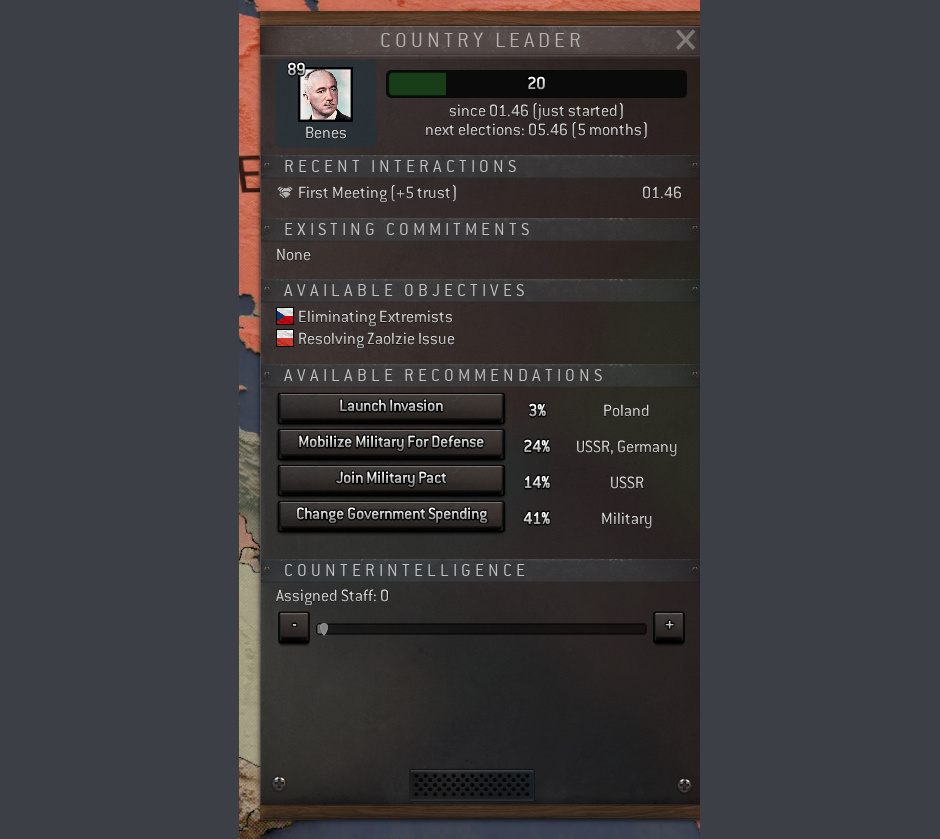
Transcript: Widget about leader of the country. Features trust, recent interactions, existing commitments, available objectives, available decisions, and counterintelligence config.
This is strongly inspired by real-world relationship. Many rulers are close to their intelligence services. Some of them start the day with an intelligence brief, there's a direct line of communication between the spymaster and the leader, and this is also one of the first places to call in case of crisis. The relationship is even stronger for autocratic leaders.
Critical parameter of trust combines multiple meanings:
Base level of public opinion on intelligence agencies in the country
Personal stance on intelligence sector
Built by successes (eg. acquired war plans of the enemy)
Lost after failures (eg. botched and publicized loss of an operative)
Additionally expanded by chasing personal ruler's objectives (eg. Kennedy's obsession with assassinating Castro)
Most importantly, modified by decisions and other interactions with the leader
Higher trust directly leads to a higher budget and indirectly to the expansion of available decisions - trusting leader will more often take the advice at face value. On the other side of the spectrum, negative relation limits options, and dramatic loss of trust can even lead to soft game over in the form of dissolving intelligence agencies. There were two times in history when even CIA could have been dissolved after particularly large failures!
Decisions
Grand-level decisions - launching wars or joining pacts - are always made by the leader of the country. Player, depending on developed trust, can be embedded in this decision-making process in a few different ways.
Transcript: New recommendation window. Description: Mobilization executed before a military conflict can significantly increase defensive capabilities. However, it is costly, disrupts the economy, and can be maintained only for a month. Recommend mobilization only if you believe that we will face military conflict (success condition). Otherwise, after a month of peace you will significantly lose credibility (failure condition). It will take 7 days to mobilize military to the proposed extent. After the description, in case of success player will gain trust, staff, and black budget; in case of failure player will lose trust, black budget, and SPI. Benes, country leader, comments: I will cautiously accept limited mobilization.
Proactively, you can recommend a decision. If it aligns well enough with the leader, you're good to go - if not, they will need convincing evidence, for instance in the form of casus belli. After this initial (and usually low) barrier is crossed, stakes are defined by the mechanic of "accountability": the leader is here to hold you accountable for your recommendations - a challenge in a challenge. If the war recommended by you ends up miserably for your country, you'll be facing huge repercussions. However, if it greatly enriches your country, you will be richly rewarded. Lower trust or an illogical decision (eg. attacking a larger country) usually means that the stakes will be higher.
Further Interaction
Interaction is also initiated by the other side. The ruler - along with other leaders, government, political parties - may consider significant decisions and you will be:
Asked for advice (eg. how to react to a particular crisis)
Given the ability to convince the leader with strategic materials (eg. to drive them away from pointless invasion)
Participate in war-room-like conferences (in some political systems, eg. number of actors and subactors weighing in with "go" or "no go" before a war)
These opinions, solicited from the player, will be also subject to accountability. Leader (and especially a council of actors) can go against player's advice, but it's more important to be on the right side of the history - for instance, suggesting "no go" before the war that later turns out to be a tremendous success will lead to significant loss of credibility in the eyes of the leader.
Transcript: Popup soliciting advice. Description: Egyptian president Gamal Abdel Nasser nationalised the Suez Canal Company. According to our intel, France, UK, and Israel plan military invasion to retake the canal. At the same time. USA and USSR oppose military intervention. What is your advice? Available decisions: Cease Arms Deal; Increase Shipment of Arms; Seek Mediation with France, UK, Israel; No Reaction.
Furthermore, sometimes the interaction will spill over to the player's area of expertise. The ruler can for instance try to drag the intelligence community into a shady activity, to influence a particular operation, to overstep the chain of command, to open Pandora's box of internal political interference, or even to blame the player for someone else's mistakes. These will follow ruler's traits and goal, creating a separate strategic decision space out of interaction with Eisenhower or Stalin.
Final Remarks
Details of this system will certainly return in the future, for instance in the context of military conflicts. As always, screenshots are a work in progress, and mechanics will evolve during playtesting.
If you're not already wishlisting Espiocracy, consider doing it:
There is also a small community around Espiocracy:
--- "Do not play on the chessboard, play the opponent" - Garry Kasparov
Dev Diary #16 - State Power Index 📊
What's happening / TLDR: Developer diaries introduce details of Espiocracy - Cold War strategy game in which you play as an intelligence agency. You can catch up with the most important dev diary (The Vision) and find out more on Steam page.
---
Hi Folks,
We continue our "Once Upon a Time..." ("Il était une fois...") journey through the anatomy of countries in Espiocracy. After exploring political changes, today we will look into unashamedly glorified spreadsheet: State Power Index (SPI)*.
To start with proper Zeitgeist, let's begin by peering behind the scenes of strategy game design.
Transcript: Score screens of Master of Orion 2, Civilization 6, and Stellaris.
Most popular 4X games score players based on:
eliminating other players, growing population, achieving fast success (Master of Orion 2)
building cities and other assets, researching technologies (Civilization 6)
colonized and conquered solar systems, relative monthly income (Stellaris)
One of the earliest prototypes tested the idea of implementing Espiocracy as a 4X game - espionage-themed exploration, expansion, exploration, and extermination. Although it didn't work (that) well, it suggested a few interesting features. This is where SPI was born. Originally, it followed victory points and victory conditions, but quickly evolved from arbitrary points into the direction of simulation.
Transcript: Ledger screens of Europa Universalis 4 and Crusader Kings 2.
EU4 and CK2 sport different kind of scoring system. It takes a back seat but is also more complex, attempting to create composite score of sectors (administrative, diplomatic, military, and so on) and/or resources (prestige, piety). Usually far from gameplay, it serves as a helper, which is perhaps best visualized by famous ledgers.
Transcript: Ranking screens of Victoria Revolutions and Victoria 2.
Victoria series iterated by producing global ranking of countries. This time, it's tied to a prestige parameter, merging two of the best worlds: accessibility and depth. Moreover, it's a positive feedback loop - higher ranked nations have more agency, which places prestige among one of the strongest motivators for players, always keen to expand their decision toolbox.
With this analysis in mind, we can move to the scoring system of Espiocracy. Here, we take one step further towards simulation and integration with gameplay.
Simulation
State Power Index compares all nations in the world purely based on real indicators, such as GDP or number of modern tanks. SPI is built from weighted comparisons between ~50 indicators in ~4 layers, giving comprehensive yet approachable summary of global position in the form of a single number from 0 to 100.
SPI is inspired by modern economic indicators. Instead of naive ranking (first, second, third...), it uses distance to frontier calculation.
Transcript: The worst performing country is assigned to number 0, the best performing country to number 100, and all countries in-between are proportionally normalized to 0-100 value.
This calculation is performed separately for every indicator, which are then averaged by subsectors, sectors, and build composite SPI for the whole country.
SPI has a few desirable effects on the gameplay. It is pretty immune to two worst offenders near scoring systems: failure trap and snowballing. The best performing country can always improve - even if their score remains at 100, boosting the indicator pushes competition farther away. On the opposite end of spectrum, globally worst countries can catch up with the rest and influence other rankings by, for instance, changing particular indicator from nice-to-have to must-have over decades.
Depth
These are current sectors, subsectors, and indicators of State Power Index.
(Sector) Economy (25% weight)
(Subsector) Size: (Indicator) GDP
International Leverage: Companies, Reserves
Technology: R&D Spending, Nobel Prizes, Top-Tech Non-Military Projects
Connectivity: Exports, Imports, Investors
Economic Diplomacy: Treaties
Military (25%)
Defense: Spending
Armed forces: Personnel, Readiness, Experience, Command and Control
Weapons: Tanks, Infantry Vehicles, Ships, Submarines, Airplanes, Top-Tech Military Projects
Signature Capabilities: Missiles, Long-Range Projection Ships, Area Denial etc
Intelligence Capabilities: Know-how, International Reach, Personnel, Top-Tech Intelligence Projects
Global partnerships: NATO or Warsaw Pact or Non-Aligned Countries or others times strength
Resilience (15%)
Internal Stability: Risk of Coup, Risk of Civil War, Risk of Terrorist Attacks
Resource Security: Access to Coal, Oil etc
Geopolitical security: Risk of Military Invasion
Cultural Influence (15%)
Cultural projection: Global Cultural Actors
Migration: Diasporas
Future (5%)
Economic: GDP Trend
Defense: Military Spending Trend
Resilience: Stability Trend, Security Trend
Demography: Working-Age Population Trend
Needless to say, it will change during playtests, balancing, and - most importantly! - during the gameplay itself, where new indicators will attempt to capture some of the historical changes.
Integration
State Power Index, naturally, defines superpowers and regional powers in the game, suggests alliances and rivalries, gives a set of clear goals for many AI agents in the world. However, the most important feedback loop extends directly to the player: SPI partially defines budget available to player's intelligence community (set of intelligence services, eg. MI5, MI6, and GCHQ in the UK). It gives clear motivation to improve position of own country - and clear consequences of losing international race.
Since this is a tight motivation loop, it also defines decision scope for the game in general. Every indicator can be influenced by the player, for instance GDP improved by industrial espionage, access to resources secured in covert operations, global cultural actors supported from the shadows - and the other side of the coin, lowering position of competing countries by ruining their indicators.
Final Remarks
We will probably return to the topic of SPI (with screenshots!) in a future dev diary about in-game economy.
If you're not already wishlisting Espiocracy, consider doing it:
There is also a small community around Espiocracy:
--- * - "State power" as in international relations, used in this context for instance in "Back to Basics: State Power in a Contemporary World" (2013) Photo Credit: D Sharon Pruitt
--- "It is possible to commit no mistakes and still lose. That is not a weakness. That is life" - Picard
Dev Diary #15 - Political Changes 🔁
What's happening / TLDR: Developer diaries introduce details of Espiocracy - Cold War strategy game in which you play as an intelligence agency. You can catch up with the most important dev diary (The Vision) and find out more on Steam page.
---
Welcome back!
Usually, we finish dev diaries with a quote. Today, we will begin with a striking paragraph from Britannica:
"Great empires disintegrated; nation-states emerged, flourished briefly, and then vanished; world wars twice transformed the international system; new ideologies swept the world and shook established groups from power; all but a few countries experienced at least one revolution and many countries two or more; domestic politics in every system were contorted by social strife and economic crisis; and everywhere the nature of political life was changed by novel forms of political activity, new means of mass communication, the enlargement of popular participation in politics, the rise of new political issues, the extension of the scope of governmental activity, the threat of nuclear war, and innumerable other social, economic, and technical developments" Source: https://www.britannica.com/topic/political-system/Development-and-change-in-political-systems
This abominably long sentence perfectly captures the gist of political change in Espiocracy. Countries and governments are simulated with the emphasis on change rather than static stability. Constant political panta rhei sits at the heart of the game - it combines points of divergence in the Cold War, grandness in the grand strategy genre, and the activity of intelligence agencies. In fact, for some (larger) countries this is the core gameplay, the main way to win.
States of states
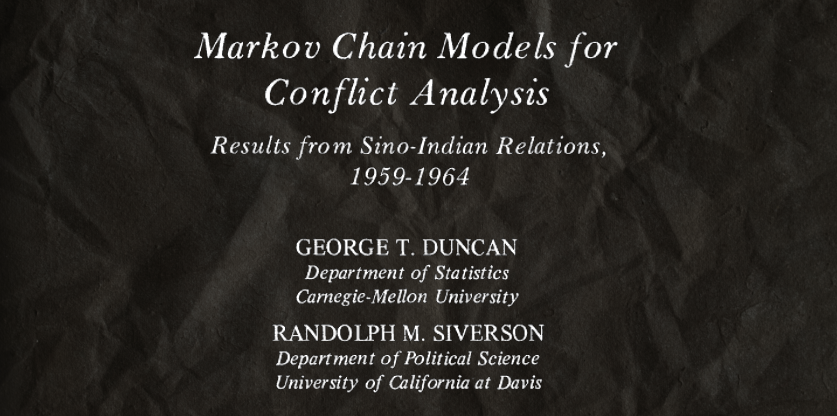
Political changes are modeled with Markov chains. Use of this tool in political modelling goes back as far as the 70s:
Source: https://www.jstor.org/stable/2600315
More recent works use them even to model the future:
And this is the current shape of political Markov chain in Espiocracy:
Hopefully, "show, don't tell" explains the model on its own. If you need a few nerdy details:
Circles and connections represent, respectively, all possible states and transitions
Transitions have assigned accumulation factors spiced with RNG and integrated with other systems such as actors (in standard Markov chains this is just probability)
All factors of transitions coming out of a single state must sum up to 100%
The state is memoryless - previous states theoretically don't matter
In practice though, factors are shaped by other systems which do react to a sequence of states
Steps are discrete, but will be seamlessly integrated with the in-game flow of time
Some (factors of) transitions are controlled by schedulers, for instance elections
Struggle for power
Fundamentally, political fate of countries and governments is controlled by possible political changes. Players compete to affect them via direct activities (e.g. plotting a coup) or indirect means (e.g. funneling money to social movement). The latter also extends to population, actors, and larger external circumstances. This is where a crisis can lead to government resignation, death of a fierce dictator can open up the pathway to liberalization, or where a nuclear bomb collapses a country into anarchy.
There's one more critical factor which governs possible changes: axis from democracy to autocracy.
In a simple yet meaningful approximation of very complex phenomenon, the game attempts to capture multi-decade trajectories of political systems. Every political change - and some events - has capability to slightly move country's position on the axis. On the one hand, it means that strong democracy (usually) cannot change to dictatorship overnight, and instead needs years of undermining (active measures vibes!). On the other hand, it conveys the fact that you (usually) cannot just slap democratic structures on a country and call it a day (Afghanistan vibes) or follows the history of some post-autocratic countries which, after brief democratic period, returned to various shades of dictatorship.
Mind you, democratic-autocratic axis is political supradomain, further fleshed out to many subtypes, from crowned parliamentary democracies to dynastic communist autocracies.
Regnum Defende (defend the realm, motto of MI5)
Interaction with political changes will greatly differ between the countries. There are:
Possible specializations in capabilities, types of contacts, and operations
Strategic materials which, when revealed, can topple whole governments
Legal constraints, such as anti-assassination policy in the USA after JFK death
Inter-agency agreements, for instance CIA and KGB did not directly interfere in internal politics of the opposite superpower
Number of allies to strengthen and enemies to weaken
Costs of actions, operations, infrastructure
The last point effectively limits interference capabilities for most countries in the world. Czechoslovakia (generally) won't be able to affect political changes in the USA, but may interfere in politics of neighbors if it dedicates enough resources. That doesn't mean lack of agency though - instead, minor countries usually focus on rare but still significant internal political changes. The design here reflects strategic approach to espionage (counterintelligence), in which frustrating blows out of the blue are replaced with consciously fought battles.
Importantly, the game doesn't choose optimal political changes for you. Quite the opposite, it introduces economic (and by extension, moral) ambiguities, which follow historical examples from many corners of the world - intelligence agencies fiercely fighting to strengthen weak government (e.g. Israeli Mossad), siding with external actors who take over the country but will increase their influence (e.g. Czechoslovak StB), supporting autocratic capitalist over democratic communist (e.g. CIA in Congo), and so on.
Example simulation
After starting with a quote, let's finish with an old prototype simulation. Below, every country walks political Markov chain in one-year steps, with colors (confusingly, sorry for that!) corresponding to democracies (blue) / autocracies (red), and pins signalling transitions:
Final remarks
The next dev diary will explore one of the crucial historical processes of Espiocracy which intersects with the framework of political changes: decolonization.
If you're not already wishlisting Espiocracy, consider doing it:
There is also a small community around Espiocracy:
--- Photo credit: Santeri Viinamäki
Dev Diary #14 - Counterintelligence 🛡️
What's happening / TLDR: Developer diaries introduce details of Espiocracy - Cold War strategy game in which you play as an intelligence agency. You can catch up with the most important dev diary (The Vision) and find out more on Steam page.
---
In the world of intelligence, nations usually bet on turtling strategy. Local defensive activity - counterintelligence (CI) - receives more resources and more staff over foreign espionage operations. British defensive MI5 numbered 4,053 people in 2016, whereas overseas-focused MI6/SIS had 2,594 employees. The discrepancy was even wider in the past. The Cold War has seen one of the most impressive counterintelligence organizations in history, with the top position occupied by ~200 thousand (!) CI officers in KGB.
This is mirrored by the design of Espiocracy. Many systems are built with counterintelligence in mind from day one. In fact, I could argue that the whole concept of the game is rooted in the observation that CI is the critical ingredient of fun, interaction, and competition in espionage systems. In the 14th dev diary, it becomes clear that counterintelligence naturally emerges from all the other systems explained previously.
Surveillance State
Following the Russian proverb "trust, but check" (доверяй, но проверяй), surveillance is the foundation of CI in the game. It is developed as a kind of domestic infrastructure: mobile surveillance groups, embassy monitoring, observation points, mail interception, and other approaches (e.g. face detection in late gameplay). Denser CI network directly translates to a higher detection rate of foreign activities. The possible extent of surveillance and consequences are tied to the local political system and views, and can even lead to the reaction of politicians and population, akin to the case of CIA's MKCHAOS.
Special attention is given to national borders. Borders are the main risk point of foreign operations. The lack of green borders and rigorous border control are the first lines of defense. It's no coincidence that KGB, in addition to espionage activities, was also responsible for guarding the borders. Here, the player can decide between a hands-on KGB model (directly spending resources) and a separate governmental institution (lobbying for a certain standard of security). The latter action, lobbying, can be extended to laws, which could limit migration from specific countries, introduce visas, or even shut down borders to 99% of the world (North Korea simulator, ultimate turtling experience).
Two actor types play important role in counterintelligence. Every country has law enforcement forces - their size, strength, influence, infiltration can assist or harm CI activities. Some countries also have secret police, separated from the intelligence sector even if it was historically the same organization. This is purposeful change, carefully designed to avoid forcing the player into playing as a brutal repressive organization that is still fresh in our memories. I think that it holds some (limited) historical merit, as operatives running foreign spy rings were usually completely separated from truncheon-equipped officers. At the same time, it also creates an interesting strategic situation: the player can decide between supporting a repressive organization (which assists CI to some extent but is detrimental to the population) and limiting its influence (which harms CI but liberates fellow citizens).
Foreign Assets
Methods used offensively by other players can also be exploited for defensive purposes.
Starting with contacts, the list of actors cooperating with foreign intelligence agencies is one of the most prized strategic materials in the game (the list of traitors!). With that evidence in hand, you can arrest, expel, dissolve - or turn actors into double agents, literally doubling the fun by providing false intel and seizing money funneled to the agent. However, you don't have to acquire this list physically. The conflict, as it should be in the espionage-focused world, already plays out in the mind: you can anticipate which actors are contacted, observe who became vulnerable to recruitment, who unnaturally gained larger influence, and prepare an ambush or a sting operation. Needless to say, it cuts both ways and an agile player will employ counter-counterintelligence tactics of deception.
Likewise, approximation of foreign targets can be used to prioritize protective operations or spy on foreign assets spying on the target (spy-ception). Speaking of which, other players will certainly have multiple physical assets in your country: infrastructure and operatives. This is one of the most important differences between standard grand strategy games and Espiocracy - player is under the state of constant invasion. There's no definite remedy, as even North Korea has espionage scandals every now and then. Foreign infrastructure can be only partially detected and destroyed, but usually, it's wiser to leave it under observation and catch agents red-handed. Some foreign operatives are noted and followed, your surveillance groups will work them out and gradually increase interception efficiency, but - again - simply eliminating them can cause more harm than good, as the known enemy is usually better than an unknown...
Intercepting Operations
All of the mentioned mechanics culminate with protection against foreign operations.
Some of the CI activities establish risk points. Stricter border control or denser surveillance network is a risk known to the opposite player before launching an operation. This is deterrence in itself since the failure at a risk point can have huge consequences. Other CI measures provide intercepting capabilities. These differ from operation to operation, but, generally, better CI leads to earlier and more frequent interception of foreign operations. This allows the defending side to deploy direct countermeasures during the duration of an operation, such as the use of top operatives for CI purposes or special defensive approaches.
With proper counterintelligence in place, some foreign operations should end in the capture of operatives. In addition to the wealth of knowledge gathered from documents, spy gear, and uncovered conspiracy, player can decide about the fate of people in custody. Available decisions depend on details of the operation (e.g. whether diplomatic immunity was used) and local law (e.g. postwar Japan had no anti-espionage law). These are also applicable to foreign spies, moles, detected inside own intelligence agency (more on that probably in the future). Some of the options include:
Various levels of interrogation
Expulsion and persona non grata status
Trial, conviction, years of prison or execution
Covert murder
Silent release
Exchange of spies
Reverting/doubling
Final Remarks
This is the last dev diary about the basics of espionage in the near future. After connecting espiocratic dots, we'll return to the mechanics behind the world simulated by Espiocracy.
The next dev diary - "Decolonization" - will be posted on January 21st.
There is also a small community around Espiocracy:
--- "It's the oldest question of all. Who can spy on the spies?" - John le Carré
Christmas Special 🎄
What's happening / TLDR: Developer diaries introduce details of Espiocracy - Cold War strategy game in which you play as an intelligence agency. You can catch up with the most important dev diary (The Vision) and find out more on Steam page.
---
Today's dev diary happens to be scheduled exactly for Christmas Eve. It's a good occasion to try something more casual, less about the nitty-gritty and more about simple gameplay. Welcome to the first micro-AAR (after action report) of Espiocracy!
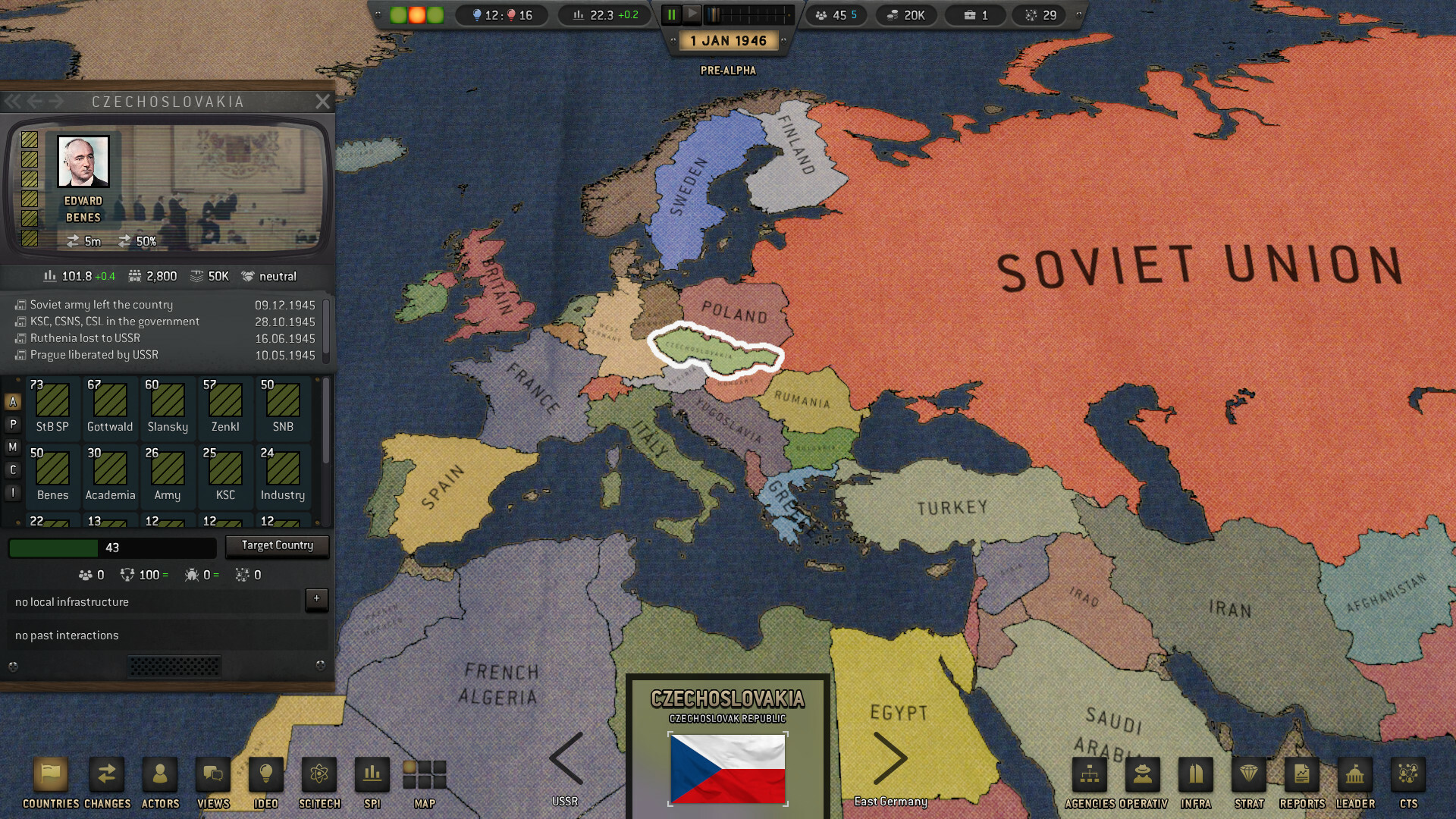
We play as Czechoslovak StB, starting on January 1st 1946.
Our situation is pretty dynamic. We are a weak democratic state with the danger of a communist takeover looming over the nation. Can we turn the tide of history and defend our democracy?
Soviet military forces liberated our country and departed just a moment ago, but they left heavily infiltrated security apparatus. Law enforcement, secret police, and even our intelligence agency are dominated by pro-communist members. This is further deepened by the presence of Soviet advisers among our top operatives and too-intimate contacts with KSČ - the Communist Party of Czechoslovakia - and MGB (predecessor of Soviet KGB). We cannot even launch anti-communist operations. It won't be easy...
Let's begin by consolidating power. We expand in the homeland by establishing numerous safehouses, a large network of informants, and a few courier rings. These will be useful immediately - supporting regular espionage - and in the future - when we launch the final blow.
We quickly run out of scarce postwar resources. Now, we can kill two birds with one stone and turn to our friends: propose a deal to MGB where in exchange for resources we will provide them benign tactical intelligence about Czechoslovakia. It can backfire in the future - they will use this knowledge against us - but at the moment it will provide much-needed resources, increase their trust, and lessen their need for physical presence in the country. Soviets are paying us to lull them into a false sense of security!
After a few months, Czechoslovakia held parliamentary elections. Unsurprisingly, KSČ has won - pro-communist views are popular, originating from the role of communist organizations in anti-Nazi resistance. The election was fair but it hands Czechoslovakia to the Soviets on a plate. The risk of coup d'état crossed 70%. Pro-communist actors - led by the secret police - are becoming bolder.
Offensive operations against these actors are currently not possible. However, we approach the problem from the other side and provide a secret stream of support to anti-communist actors via seemingly innocent contacts. This earns us their trust and loyalty while keeping them afloat for the time being. But it's just passive defense, we need even more ingenious approaches.
What about external cooperation? Surely, Americans will be interested in preserving democracy in Czechoslovakia. Let's venture out for a clandestine mission to establish contact with CIG (predecessor of CIA), using an anti-communist operative and extreme secrecy. This special operation should have a special name: we choose one of the Czech classic literary works, Kafka's "Metamorphosis".
Thanks to the common border with West Germany, it went smoothly. Initial trust is low - Americans are afraid of StB's provocation. To assure them about our intentions, we supply tactical intelligence on pro-communist actors. This is better but not good enough. They are still wary of closer cooperation. What could convince them?
We ask one of our trusted actors near the military to perform an operation on our behalf: steal strategic material about Soviet armed forces. In white gloves, we acquire materials on Soviet order of battle, which are then quickly passed to the CIG, finally bringing Americans to the table.
What do they want? Anti-communist government. Wait, KSČ is the legitimately chosen ruling party. Are they asking us to overthrow our government? Not exactly, but it might end in either their coup or our coup... What do we want? Everything! Money, operatives, tactical intelligence, cooperation on the ground. After a few rounds of negotiations, the deal is struck: rich cooperation in exchange for establishing democracy.
When resources start to flood the agency - obviously obfuscated so that the advisers remain in the dark - we use them to hire non-pro-communist staff. The small population of Czechoslovakia, ravaged by the war, is a significant limiting factor and we have to accept many underqualified candidates. This means that sophisticated operations will be out of the question for some time - instead, we'll turn to simpler operations. Sabotage & arrests, that's our goal.
After reaching proper numbers, Soviet policies limiting StB shifts from legal & strictly enforced to legal & rarely enforced. This means that in combination with extreme secrecy, we can finally target pro-communist actors. We start multiple operations of this kind, but all are set up only for preparation - after preparation is finished, we will have the ability to launch them all in a single day. Moreover, on the same day, we pass the strategic material on coup prepared by KSČ (acquired by CIG) to the non-communist minority in the government, which in cooperation with our top operatives rigs the parliament, outlaws communist parties and throws their members out of government. Last but not least, we dedicate a small but loyal force - cooperating on the ground with CIG operatives - to purge Soviet and pro-communist operatives out of StB. Banhammer.
We lost some of the precious experienced operatives but we gained real independence. Is it preemptive coup d'état? Whoever fights monsters should see to it that in the process he does not become a monster...
Soviets are in shock while the West swoops in with large material help for the current government. The fight has just begun. We are surrounded by communist East Germany, Poland, Hungary, and obviously the Soviet Union. After regrouping, they will surely attack us with the full espionage arsenal. We can already see the immediate danger: Slovak separatists who, with proper Eastern support, will not only break away half of our country but also form a communist echelon with personal connections to our land...