Field of Glory II: Medieval - History of Aragon Tournament
We are pleased to announce another Field of Glory 2 Medieval public tournament, covering the history of the Crown of Aragon. It will be played using the normal Field of Glory 2 Multiplayer system and our automated tournament system.
Anyone who has Field of Glory II Medieval can enter. You do not need to own any DLCs to enter.
The first round will commence on Monday 15th May 2023 at 10.00 am GMT. No further entries can be accepted after the tournament has begun.
Specific tournament rules: This tournament will involve five rounds. Each round will last 14 days. The battles will be Medium sized custom battles:
Navarre 1106 AD: Aragonese 1050-1136 AD vs Andalusian 1050-1154 AD. Mediterranean Agricultural.
Haute-Garonne, France 1213 AD: Aragonese 1200-1274 AD with French 1155-1319 AD allies vs French 1155-1319 AD. Mediterranean Agricultural.
Valencia 1238 AD: Aragonese 1200-1274 AD vs Andalusian 1228-1248 AD. Mediterranean Hilly.
Sicily 1290 AD: Aragonese 1275-1319 AD vs Neapolitan 1267-1300 AD. Mediterranean Hilly.
Kingdom of Naples 1442 AD: Aragonese 1400-1449 AD vs Neapolitan 1400-1442 AD. Mediterranean Agricultural.
Games are paired, so each matchup will be played both ways. Each player will be able to choose his forces using the normal force selection system. In each round, all players will be playing on the same randomly generated map for both games.
First round pairings will be selected randomly, subsequent rounds using the Swiss Chess system. Nobody will play the same opponent in more than one round.
The scoring system is as follows:
If a game runs to the turn limit, each side scores points equal to the enemy % routed at the turn limit. If the game times out, adjustments may be made, depending on how far the game has progressed and who took longer over their turns – see below.
If one army breaks, the victorious player scores 60 points plus the difference between the enemy % routed and his own % routed. The loser scores points equal to the winner's % routed.
Examples:
If Ben defeats Tamas's army, and has inflicted 45% routed on Tamas, and Tamas has inflicted 15% on Ben, Ben will score 60 + (45 – 15) = 90, Tamas will score 15.
However, if Ben defeated Tamas’s army by inflicting 62% routed on Tamas, and Tamas had inflicted 56% routed on Ben, Ben would get 60 + (62 – 56) = 66 points, and Tamas would get 56.
If the game is unfinished (or it reached the turn limit) with Ben inflicting 20% routed on Tamas, and Tamas inflicting 10% routed on Ben, Ben would score 20, and Tamas would score 10. (Provided that between them they have played at least 36 turns in all – see below).
Note that this system rewards aggressive play over desultory skirmishing. If you rout an enemy unit then hide for the rest of the game, both players will get extremely low scores - lower than if they played hard and lost.
Byes: If an odd number of players sign up for the tournament, one player will get a bye in each round. In the first round this is random. In subsequent rounds it will be the player with the lowest score. The score for a BYE is 75 points for each game.
Round times and timing out: Each round will last 14 days.
Any battles that are not completed by the end of the round will be timed out. The player who has had the game in his “My Turns” box the longest overall will be the one who is deemed to be timed out. This will not normally incur any penalties, unless insufficient turns have been played: If the timed-out player has played less than 18 turns, his score will be reduced proportionately, and his opponent will be granted (100 - the timed out player's adjusted score) if this value exceeds his current score. (This means he will get the full BYE score unless the timed out player's adjusted score is more than 25).
If the timed-out player has played less than 6 turns, he will not be included in the draw for the next round. This is to prevent someone else’s enjoyment being spoiled by being drawn against someone who has apparently dropped out of the tournament.
Field of Glory: Kingdoms is now on Discord
Attention all Field of Glory: Kingdoms fans!
We are excited to announce that our official Discord channel is now open and ready for you to join! This is the perfect place to connect with other players, share tips and strategies, discuss all things related to the game, and stay up-to-date on the latest news and updates related to the game.
Whether you're a seasoned veteran or a new player just getting started, our Discord channel is the ideal community to get involved with. You'll have the opportunity to meet other players from around the world, participate in community events
Join us today and become a part of the Field of Glory: Kingdoms community on Discord!
It's Tea Time with Field of Glory Kingdoms
For anyone who doesn't know, Tea Time is a regular live stream event hosted by Slitherine CMO Marco A. Minoli, where Slitherine developers and members of the community come together to discuss and showcase various aspects of their games.
In this week's episode of Tea Time, Marco has shown some exciting screenshots about Field of Glory Kingdoms.
See below this week's episode of Tea Time
One of the most interesting aspects of the gameplay footage was the focus on diplomacy and alliances. Players will be able to form alliances with other factions in order to increase their power and influence. However, these alliances are not always stable, and players must be wary of betrayals and backstabbing.
Another exciting feature of the game is the emphasis on exploration and expansion. Players will be able to discover new territories and expand their kingdoms, building new cities and fortifications along the way.
Kingdoms features one campaign and three scenarios, one of which is Manzikert. Here, you will have to win as either the Byzantine Empire or the Seljuk Turks. These focused scenarios are excellent for short multiplayer games.
Stay tuned to know more and don't miss the latest news for the upcoming Field of Glory: Kingdoms
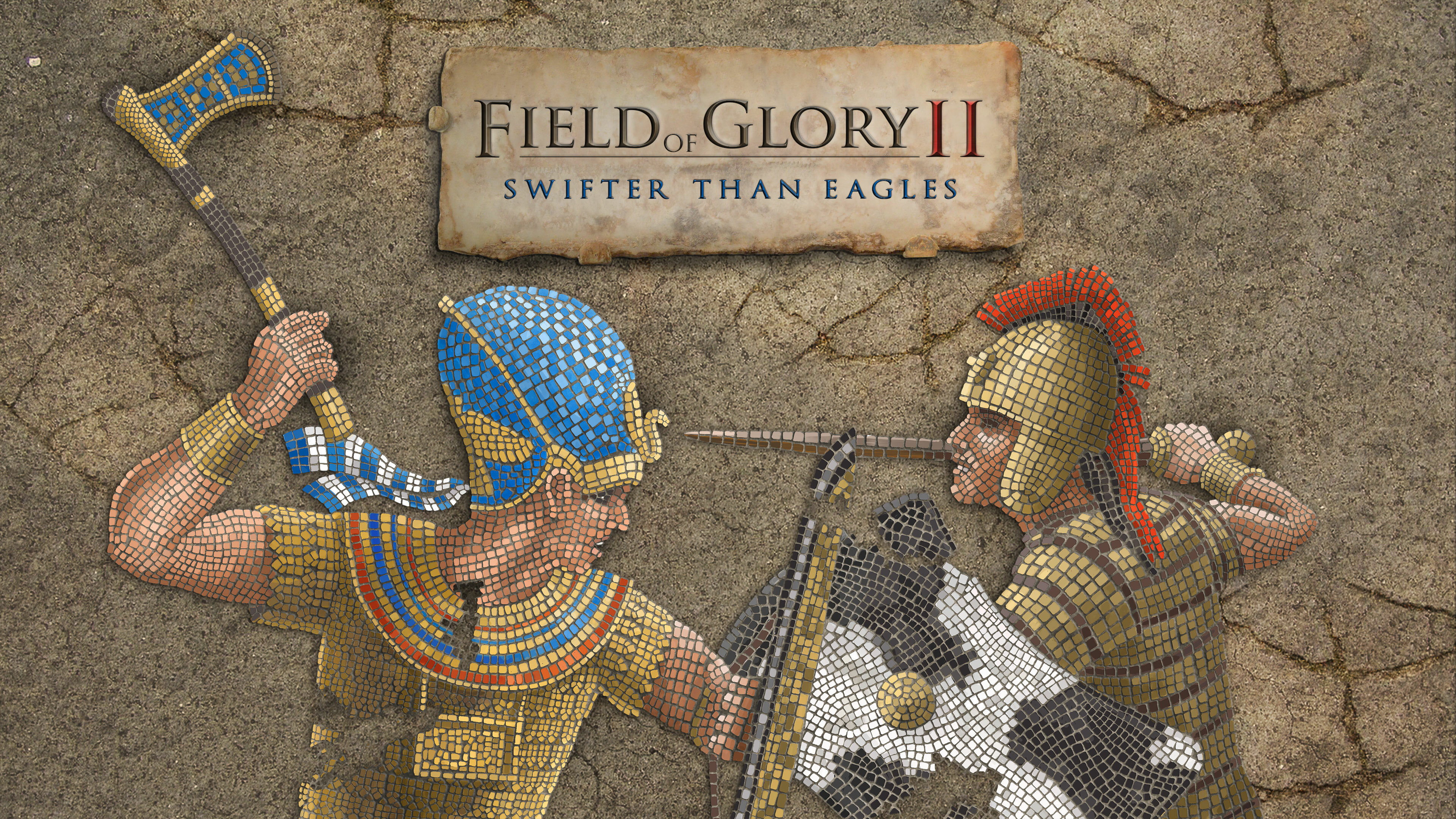
Field of Glory II: Swifter than Eagles is out now
The last DLC of the Field of Glory II franchise is now available on Steam.
“Swifter than eagles, stronger than lions” 2 Samuel 1:23
Tune in today on our Slitherine Twitch Channel at 17:00 PM GMT where Richard Yorke will show you the new DLC.
After downloading Swifter than Eagles DLC, do not miss the chance to sign-up to the new Swifter Than Eagles Tournament, which will start on February 23rd. Stay tuned for more details on our channels.
About this game
Smite your foes with bow and spear as you lead your mighty chariots to glorious victory. Swifter than Eagles extends Field of Glory II backwards to the dawn of “civilised” warfare, covering the period from 2500-681 BC.
The first civilisations in the Near East arose during the Early Bronze Age, 3500 to 2000 BC, in what is known as the Fertile Crescent, a vast semi-circular area of agricultural land stretching from Egypt to Mesopotamia. The most important of these were the many Sumerian city states, and the Old Kingdom of Egypt ruled by kings worshipped as living gods.
The Middle Bronze Age, 2000 to 1600 BC, saw mass migrations of peoples into the Near East, which saw the rise of new states such as the Mitanni, Hittites, Babylon and Assyria. Northern Egypt was overrun by the Hyksos, who ruled as the 15th Dynasty. Chariots were developed in this period as truly effective battlefield weapons.
Around 1550 BC, the Hyksos were expelled from Egypt and the New Kingdom period began. Under the New Kingdom Pharaohs, Egypt adopted a more aggressive foreign policy, and carved out a foreign empire in Canaan and Syria. This placed them in direct competition with the other great international powers of the Late Bronze Age, 1600 to 1200 BC, first Mitanni, then the Hittites. Most of these great civilisations experienced a major crisis at the end of the 13th century BC; The Mycenaean and Hittite palace cultures collapsed, the Kassite Babylonian dynasty fell, the Egyptians abandoned their Asiatic empire, Ugarit and other Amorite city states were destroyed. The reasons for this crisis are not fully understood, but probably included drought and famine. Another possible factor was the migration of aggressive tribes into the region, including the enigmatic Sea Peoples.
After civilisations had recovered from the Late Bronze Age collapse, the Near East was dominated by the Neo-Assyrian Empire, which crushed all opposition with extreme brutality, eventually ruling over almost the entire Fertile Crescent during the 7th century BC. Meanwhile, Egypt went into a long period of decline, which saw her conquered by a succession of different foreign powers.
Summary of features
· 19 new factions · 46 new units · 66 new army lists · 8 new Epic Battles · 70 new Quick Battles · Expanded Custom Battles module. · Expanded Sandbox Campaign module. · 4 new historically-based campaigns.
For this occasion, we have discounted the rest of the entire franchise up to 75%! Including Field of Glory II: Medieval, Field of Glory: Empires, and all their DLCs. Don’t miss this promotion to revive from ancient battles until the Medieval period.
Field of Glory II: Medieval - Forlorn Hope Tournament
We are pleased to announce another Field of Glory 2 Medieval public tournament, covering the “last hurrahs” of some ill-fated historical factions. It will be played using the normal Field of Glory 2 Multiplayer system and our automated tournament system.
Anyone who has Field of Glory II Medieval can enter. You do not need to own any DLCs to enter.
Games are paired, so each matchup will be played both ways. Each player will be able to choose his forces using the normal force selection system. In each round, all players will be playing on the same randomly generated map for both games.
First round pairings will be selected randomly, subsequent rounds using the Swiss Chess system. Nobody will play the same opponent in more than one round.
The scoring system is as follows:
If a game runs to the turn limit, each side scores points equal to the enemy % routed at the turn limit. If the game times out, adjustments may be made, depending on how far the game has progressed and who took longer over their turns – see below.
If one army breaks, the victorious player scores 60 points plus the difference between the enemy % routed and his own % routed. The loser scores points equal to the winner's % routed.
Examples:
If Ben defeats Tamas's army, and has inflicted 45% routed on Tamas, and Tamas has inflicted 15% on Ben, Ben will score 60 + (45 – 15) = 90, Tamas will score 15.
However, if Ben defeated Tamas’s army by inflicting 62% routed on Tamas, and Tamas had inflicted 56% routed on Ben, Ben would get 60 + (62 – 56) = 66 points, and Tamas would get 56.
If the game is unfinished (or it reached the turn limit) with Ben inflicting 20% routed on Tamas, and Tamas inflicting 10% routed on Ben, Ben would score 20, and Tamas would score 10. (Provided that between them they have played at least 36 turns in all – see below).
Note that this system rewards aggressive play over desultory skirmishing. If you rout an enemy unit then hide for the rest of the game, both players will get extremely low scores - lower than if they played hard and lost.
Byes:
If an odd number of players sign up for the tournament, one player will get a bye in each round. In the first round this is random. In subsequent rounds it will be the player with the lowest score. The score for a BYE is 75 points for each game.
Round times and timing out: Each round will last 14 days.
Any battles that are not completed by the end of the round will be timed out. The player who has had the game in his “My Turns” box the longest overall will be the one who is deemed to be timed out. This will not normally incur any penalties, unless insufficient turns have been played: If the timed-out player has played less than 18 turns, his score will be reduced proportionately, and his opponent will be granted (100 - the timed out player's adjusted score) if this value exceeds his current score. (This means he will get the full BYE score unless the timed out player's adjusted score is more than 25).
If the timed-out player has played less than 6 turns, he will not be included in the draw for the next round. This is to prevent someone else’s enjoyment being spoiled by being drawn against someone who has apparently dropped out of the tournament.
Field of Glory II: Swifter than Eagles DLC is coming on the 16th of February
“swifter than eagles, stronger than lions”
2 Samuel 1:23
We are pleased to announce the latest DLC of the Field of Glory II franchise named Swifter than Eagles will be available on the 16th of February.
Historical background Smite your foes with bow and spear as you lead your mighty chariots to glorious victory. Swifter than Eagles extends Field of Glory II backwards to the dawn of “civilised” warfare, covering the period from 2500-681 BC.
The first civilisations in the Near East arose during the Early Bronze Age, 3500 to 2000 BC, in what is known as the Fertile Crescent, a vast semi-circular area of agricultural land stretching from Egypt to Mesopotamia. The most important of these were the many Sumerian city states, and the Old Kingdom of Egypt ruled by kings worshipped as living gods.
The Middle Bronze Age, 2000 to 1600 BC, saw mass migrations of peoples into the Near East, which saw the rise of new states such as the Mitanni, Hittites, Babylon and Assyria. Northern Egypt was overrun by the Hyksos, who ruled as the 15th Dynasty. Chariots were developed in this period as truly effective battlefield weapons.
Around 1550 BC, the Hyksos were expelled from Egypt and the New Kingdom period began. Under the New Kingdom Pharaohs, Egypt adopted a more aggressive foreign policy, and carved out a foreign empire in Canaan and Syria. This placed them in direct competition with the other great international powers of the Late Bronze Age, 1600 to 1200 BC, first Mitanni, then the Hittites.
Most of these great civilisations experienced a major crisis at the end of the 13th century BC; The Mycenaean and Hittite palace cultures collapsed, the Kassite Babylonian dynasty fell, the Egyptians abandoned their Asiatic empire, Ugarit and other Amorite city states were destroyed. The reasons for this crisis are not fully understood, but probably included drought and famine. Another possible factor was the migration of aggressive tribes into the region, including the enigmatic Sea Peoples. After civilisations had recovered from the Late Bronze Age collapse, the Near East was dominated by the Neo-Assyrian Empire, which crushed all opposition with extreme brutality, eventually ruling over almost the entire Fertile Crescent during the 7th century BC. Meanwhile, Egypt went into a long period of decline, which saw her conquered by a succession of different foreign powers.
New features added:
19 new named factions: Amorite, Early Nomad, Gasgan, Hittite, Hyksos, Luwian, Makkan, Minoan, Mitanni, Mycenaean, Neo-Hittite/Aramaean, Nubian, Philistine, Sea Peoples, Sumerian/Akkadian, Syrian, Syro-Canaanite, Trojan, Zagros Highlanders.
46 new units: Picked Sumerian/Akkadian Spearmen, Sumerian/Akkadian Spearmen, Sumerian/Akkadian Spearmen with Pavise, Raw Sumerian/Akkadian Spearmen with Pavise, Sumerian/Akkadian Battle Cars, Early Chariots (Spear), Early Chariots (Bow), Egyptian-style Light Chariots, Egyptian Close Fighters, Egyptian Guard, Shardana Guard, Sherden Swordsmen, (Other) Sea Peoples Swordsmen, Picked Sherden Swordsmen, Picked (other) Sea Peoples Swordsmen, Philistine Spearmen, Philistine Guard, Libyan Foot, Libyan Swordsmen, Libyan Light Javelinmen, Nubian Close Fighters, Nubian Light Javelinmen, Nubian Light Archers, Anatolian-style Light Chariots, Anatolian-style Heavy Chariots, Anatolian Spearmen, Syrian Spearmen, Maryannu Light Chariots, Ugaritic Heavy Chariots, Minoan/Mycenaean Heavy Chariots, Minoan-style Spearmen, Aegean Light Chariots, Sea Peoples Light Chariots, Libyan Light chariots, Mycenaean-style Spearmen, Myrmidons, Early Middle-Eastern Close Fighters, Gasgan Warriors, Zagros Warriors, Neo-Hittite-style Spearmen, Early Assyrian-style Cavalry, Anatolian Irregular Foot, Anatolian Light Javelinmen, Early mixed bow and spear infantry, Raw early mixed bow and spear infantry, Early Levies.
66 new army lists (which expands the total number of army lists to 355).
Amorite 2000-1595 BC Assyrian 1365-891 BC Assyrian 890-746 BC Assyrian 745-705 BC Assyrian 704-682 BC Babylonian 1594-891 BC Babylonian 890-729 BC Cypriot 800-681 BC Egyptian 2686-1551 BC Egyptian 1550-1451 BC Egyptian 1450-1277 BC Egyptian 1276-1201 BC Egyptian 1200-1150 BC Egyptian 1149-1069 BC Egyptian 1068-946 BC Egyptian 945-720 BC Elamite 2500-2193 BC Elamite 2192-1801 BC Elamite 1800-1501 BC Elamite 1500-816 BC Gasgan 1450-1076 BC Greek 1179-681 BC Gutian 2190-2115 BC Hebrew 1000-801 BC Hebrew 800-682 BC Hittite 1680-1595 BC Hittite 1594-1351 BC Hittite 1350-1276 BC Hittite 1275-1180 BC Hyksos 1650-1591 BC Hyksos 1590-1535 BC Kushite Egyptian 732-728 BC Libyan 3000-1251 BC Libyan 1250-651 BC Libyan 650-550 BC Luwian 1680-1595 BC Luwian 1594-1180 BC Makkan 2500-1301 BC Makkan 1300-1001 BC Makkan 1000-891 BC Makkan 890-313 BC Mannaean 1000-751 BC Minoan 1600-1450 BC Mitanni 1594-1250 BC Mycenaean 1600-1251 BC Mycenaean 1250-1180 BC Neo-Hittite/Aramaean 1179-891 BC Neo-Hittite/Aramaean 890-700 BC Nomad 2500-1001 BC Nubian 3000-1281 BC Philistine 1166-801 BC Philistine 800-600 BC Phoenician 1099-801 BC Phoenician 800-682 BC Sea Peoples 1208-1176 BC Sherden 1278-1209 BC Sumerian/Akkadian 2500-2193 BC Sumerian/Akkadian 2192-1762 BC Syrian 2500-2200 BC Syro-Canaanite 1594-1276 BC Syro-Canaanite 1275-1208 BC Syro-Canaanite 1207-1100 BC Trojan 1250-1180 BC Urartian 870-781 BC Urartian 780-750 BC Zagros Highlanders 2500-1001 BC
8 new Epic Battles: Kerkha River 2272 BC (Akkadians vs Elamites), Megiddo 1457 BC (Egyptians vs Syro-Cannanites), Zippasla 1410 BC (Hittites vs Mycenaean Greeks), Kadesh 1274 BC (Egyptians vs Hittites), Fields of Perire 1208 BC (Egyptians vs Libyans and Sea Peoples), Ilion 1184 BC (Mycenaean Greeks vs Trojans), Qarqar 853 BC (Assyrians vs Aramaeans, Hebrews and others), Per-Peg 730 BC (Kushite Egyptians vs Libyan Egyptians).
70 new Quick Battles (almost all playable from either side).
Expanded Field of Glory II Custom Battles module now includes all 355 army lists from Immortal Fire, Rise of Rome, Legions Triumphant, Age of Belisarius, Rise of Persia, Wolves at the Gate and Swifter than Eagles. (Purchase of the appropriate DLCs is necessary to access them all).
Expanded Field of Glory II Sandbox Campaigns module now includes all 355 army lists from Immortal Fire, Rise of Rome, Legions Triumphant, Age of Belisarius, Rise of Persia, Wolves at the Gate and Swifter than Eagles. (Purchase of the appropriate DLCs is necessary to access them all).
4 new historically-based campaigns: Sargon the Great (Akkadian Empire) Hittite Empire Ramesses II (New Kingdom Egypt) Shalmaneser III (Neo-Assyrian Empire)
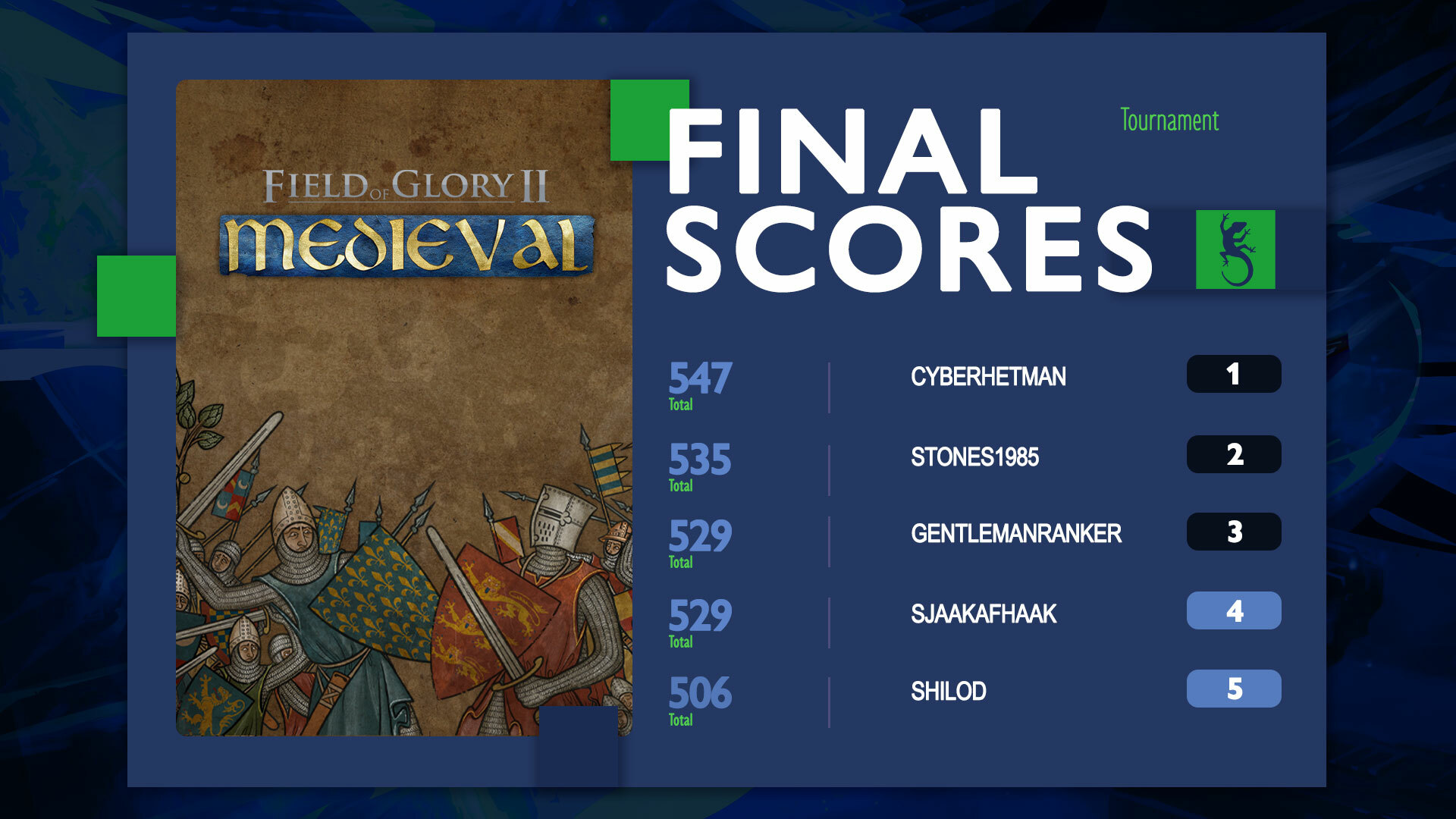
It was a close one and it was very exciting for us to follow it.
We really want to thank everyone of you for playing in this tournament and congratulate once again with our championCyberHetman.
See you next.
Field of Glory II: Medieval - White Christmas Tournament
White Christmas Tournament
We are pleased to announce another Field of Glory 2 Medieval public tournament. This will be played using the normal Field of Glory 2 Multiplayer system and our automated tournament system.
Anyone who has Field of Glory II Medieval can enter. You do not need to own any DLCs to enter.
To enter, go to the tournament page here: https://www.slitherine.com/tournaments
The general tournament rules can be found here: https://www.slitherine.com/tournaments/rules
The first round will commence on Thursday 8th December 2022 at 10.00 am GMT. No further entries can be accepted after the tournament has begun.
Specific tournament rules:
This tournament will involve three rounds. Each round will last 14 days. The battles will be Medium sized custom battles:
East Prussia 1370 AD: Teutonic Order 1320-1379 AD vs Lithuanian 1360-1385 AD. Open Battle. Frozen Agricultural.
Yorkshire 1461 AD: English (Yorkist) 1461-1482 AD vs English (Lancastrian) 1461-1484 AD. Open Battle. Frozen Agricultural.
Lorraine 1477 AD: Swiss 1476-1477 AD vs Burgundian 1471-1477 AD. Ambush by Swiss. Frozen Wooded.
Games are paired, so each matchup will be played both ways. Each player will be able to choose his forces using the normal force selection system. In each round, all players will be playing on the same randomly generated map for both games.
First round pairings will be selected randomly, subsequent rounds using the Swiss Chess system. Nobody will play the same opponent in more than one round.
The scoring system is as follows:
If a game runs to the turn limit, each side scores points equal to the enemy % routed at the turn limit. If the game times out, adjustments may be made, depending on how far the game has progressed and who took longer over their turns – see below.
If one army breaks, the victorious player scores 60 points plus the difference between the enemy % routed and his own % routed. The loser scores points equal to the winner's % routed.
Examples:
If Ben defeats Tamas's army, and has inflicted 45% routed on Tamas, and Tamas has inflicted 15% on Ben, Ben will score 60 + (45 – 15) = 90, Tamas will score 15.
However, if Ben defeated Tamas’s army by inflicting 62% routed on Tamas, and Tamas had inflicted 56% routed on Ben, Ben would get 60 + (62 – 56) = 66 points, and Tamas would get 56.
If the game is unfinished (or it reached the turn limit) with Ben inflicting 20% routed on Tamas, and Tamas inflicting 10% routed on Ben, Ben would score 20, and Tamas would score 10. (Provided that between them they have played at least 36 turns in all – see below).
Note that this system rewards aggressive play over desultory skirmishing. If you rout an enemy unit then hide for the rest of the game, both players will get extremely low scores - lower than if they played hard and lost.
Byes:
If an odd number of players sign up for the tournament, one player will get a bye in each round. In the first round this is random. In subsequent rounds it will be the player with the lowest score. The score for a BYE is 75 points for each game.
Round times and timing out:
Each round will last 14 days.
Any battles that are not completed by the end of the round will be timed out. The player who has had the game in his “My Turns” box the longest overall will be the one who is deemed to be timed out. This will not normally incur any penalties, unless insufficient turns have been played: If the timed-out player has played less than 18 turns, his score will be reduced proportionately, and his opponent will be granted (100 - the timed out player's adjusted score) if this value exceeds his current score. (This means he will get the full BYE score unless the timed out player's adjusted score is more than 25).
If the timed-out player has played less than 6 turns, he will not be included in the draw for the next round. This is to prevent someone else’s enjoyment being spoiled by being drawn against someone who has apparently dropped out of the tournament.
Next? Slitherine
Slitherine Next, the spiritual successor of our Home of Wargamers events, is coming soon. Save the date: December 13th at 16 pm GMT on Twitch
It'll be the perfect occasion to learn more about upcoming games and get an insight directly from the developers.
It will be 100% live: there will be no pre-recorded segments and we'll have a level of interaction with the players like never before. You'll be able to ask us anything and be answered directly by the developers.
Stay tuned for the full schedule!
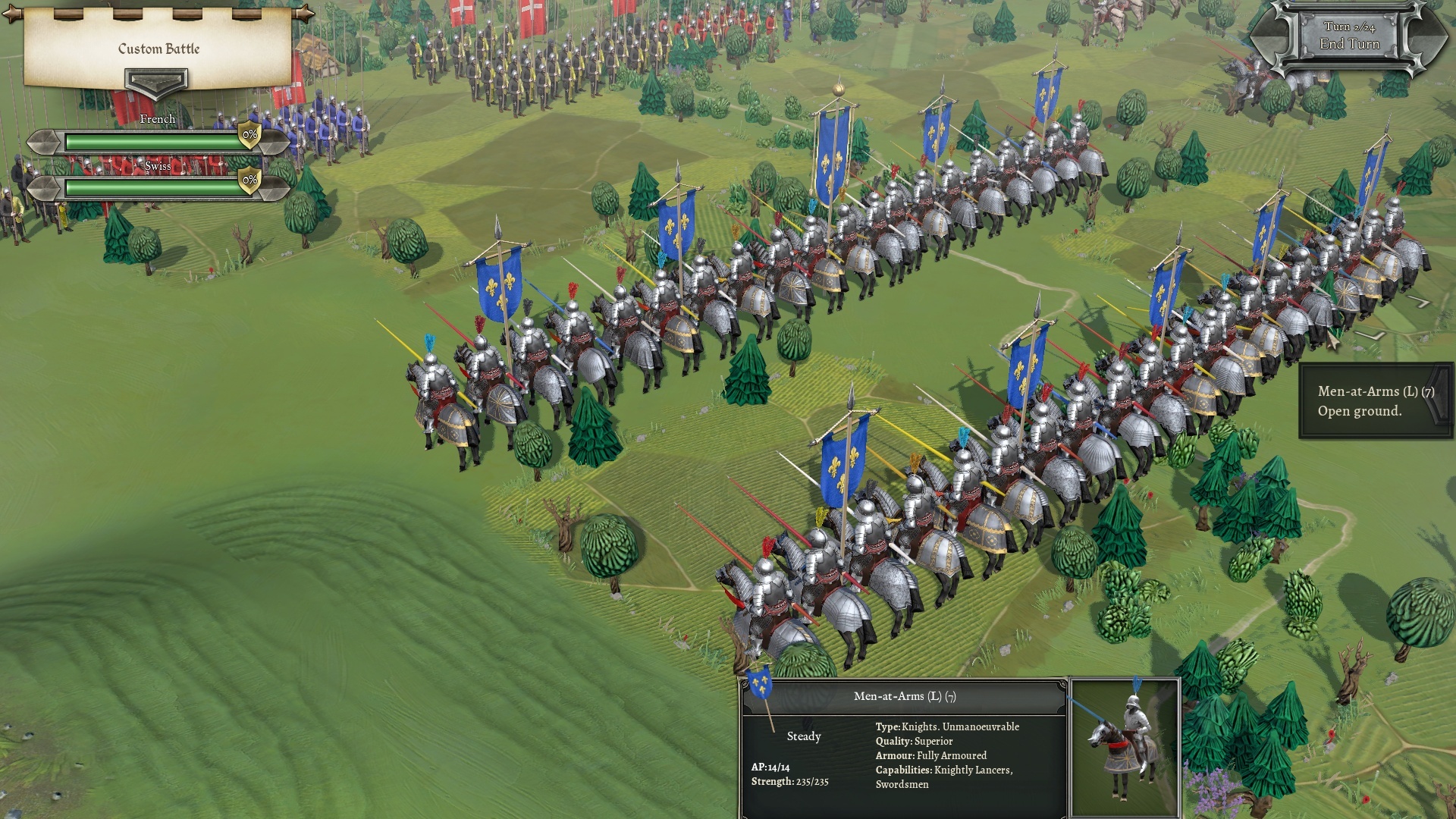
New late 15th century Men-at-Arms models
The free v1.5.6 Update adds new later 15th century men-at-arms models. (v1.5.6)
<*>These have texture sets for 1) Men-at-Arms, 2) Mercenary Men-at-Arms, 3) Polish MAA, 4) Hospitaller MAA, 5) Teutonic Order MAA, 6) Iberian Military Order MAA.
<*>These (and their dismounted versions where relevant) are classified in game exactly the same as the earlier versions. This is despite the full late 15th century panoply giving somewhat better protection than earlier armours, which is offset by the fact that a smaller proportion of the men in a unit could afford the full latest panoply. Also the vast majority of horse armours were in fact of cuir bouilli rather than steel, though we depict the Superior MAA with steel horse armour to help distinguish them from the Above Average Mercenary MAA. Keeping the classification unchanged also avoids distorting game balance.
<*>To allow them to be easily distinguished, the Superior Men-at-Arms have helmet plumes, coloured lances and unpainted decoratively-embossed steel plate horse armour, the Above Average MAA have no helmet plume, some painted helmets, unpainted lances, and painted cuir-bouilli horse armour. Men-at-Arms (prefer to fight on foot) use the Mercenary textures, but fight on foot as Superior with poleaxes.