EBOOK and printer-friendly versions of Manual updated for Sublime Porte.
Gameplay:
Stakes and Field Fortifications (if available) are now optional in non-Campaign Custom Battles. This is on an all or none basis for each. Either all longbowmen capable of using stakes will have (and pay for) them or none. Either FF can be placed (and will be paid for) for all non-light Infantry and Artillery, or none.
Allowed stakes to be placed by units on slopes, but only if facing downhill. (Otherwise the stakes get partly or completely buried in the hill).
The check for whether a Falling Back unit must take a Cohesion Test now ignores enemy 45 degree turns that would not prevent a charge. (Because charges can include a free 45 degree turn even for Unmanoeuvrable or out of command range troops).
Note also that the enemy unit does not actually have to be able to charge, just to be non-routing non-light troops, and in a position where it could charge if no other units were present. (Fall Back cohesion tests are intended to simulate irrational panic, not logical thought).
Mounted troops and elephants inside Heavy Fortifications (castle or city walls) now get 75% cover when shot at from outside the walls. (Same as infantry).
(Custom or Campaign battle Deployment phase:) Unit in tile with FF cannot redeploy without removing the FF first. This prevents the exploit of using 1 unit of Artillery to place a line of FF ahead of the main deployment area.
(Custom or Campaign battle Deployment phase:) Unit that cannot itself place FF cannot swap position with a unit in a tile with FF. This prevents various exploits.
Reduced the variability of casualties caused by artillery. It is still more variable than other troop types, however, and still skewed somewhat towards the lower end of the stated range.
Reduced the casualties caused by pre-gunpowder artillery by reducing their artillery capability to 80%. This is to compensate for their advantage (over gunpowder artillery) in being able to shoot overhead on level ground. Units costs therefore not changed.
UI:
Ammunition moved over to left hand panel in the unit UI panel (at the bottom of the screen). This was because in some resolutions (e.g. 1920 x 1080), the Ammunition line was disappearing off the bottom of the right hand panel for the new Hungarian and Polish Pavisier, Crossbow and Handgunner units.
Units:
Added Later 15th century Men-at-Arms models.
These have texture sets for 1) Men-at-Arms, 2) Mercenary Men-at-Arms, 3) Polish MAA, 4) Hospitaller MAA, 5) Teutonic Order MAA, 6) Iberian Military Order MAA. They are designated as (L) for (Later) after the unit name to make them easier to pick in the Editor.
These (and their dismounted versions where relevant) are classified in game exactly the same as the earlier versions. This is despite the full late 15th century panoply giving somewhat better protection than earlier armours, which is offset by the fact that a smaller proportion of the men in a unit could afford the full latest panoply. Also the vast majority of horse armours were in fact of cuir bouilli rather than steel, though we depict the Superior MAA with steel horse armour to help distinguish them from the Above Average Mercenary MAA. Keeping the classification unchanged also avoids distorting game balance.
To allow them to be easily distinguished, the Superior Men-at-Arms have helmet plumes, coloured lances and unpainted decoratively-embossed steel plate horse armour, the Above Average MAA have no helmet plume, some painted helmets, unpainted lances, and painted cuir-bouilli horse armour. Men-at-Arms (prefer to fight on foot) use the Mercenary textures, but fight on foot as Superior with poleaxes.
Added new Clipeati, Crossbowmen and Handgunners unit for late Hungarian armies, and Pavisiers, Crossbowmen and Handgunners unit for late Polish and Lithuanian armies. These each have their own textures, courtesy of Miguel Sales (toska). Many thanks, Miguel!
Disembarked War Wagon crew and Clipeati/Pavisier, Crossbowmen and Handgunners units now have gun smoke and sound effects coming from roughly where the handgunners would be, when shooting in Handgun range. (Note, before you ask, we cannot actually show the handgunners).
Best-Equipped Cavalry and Later Rus Cavalry can now dismount. (As bowmen).
Improved textures for Albanian cavalry and light horse, Turcoman cavalry and light horse, light longbowmen, later medieval massed and light archers.
Unit Costs:
Reduced cost of Swiss keils from 154 to 148.
Stakes and Field Fortifications (if available) are now optional in non-Campaign Custom Battles. This is on an all or none basis for each. Either all longbowmen capable of using stakes will have (and pay for) them or none. Either FF can be placed (and will be paid for) for all non-light Infantry and Artillery, or none.
If you turn FF or stakes back on again after using up all your build points, the game will automatically deselect and undeploy sufficient units to correct the overspend. You can then adjust your selections as you see fit.
Cost of stakes reduced from 9 to 6 per unit.
Cost of Field Fortifications reduced from 9 to 6.
Reduced cost of Average Longbowmen from 54 to 51.
Reduced cost of Average Longbowmen with stakes from 63 to 57.
Reduced cost of Pike and Longbowmen from 48 to 46.
Cost of Bill and longbowmen not reduced from 50 because it should in fact have been 52 before.
Corrected cost of Albanian LH to 28. (Was erroneously 32)
Time Warp (ancient) 100% pike units reduced in cost – Superior from 96 to 92, Average from 72 to 68, Raw from 48 to 45.
Army Lists:
Lists starting from 1440 (Italian), 1445 (French) or 1450 (most others) now have the new later 15th century Men-at-Arms models.
Split the following lists at 1450. The later part will have the new later 15th century MAA: Teutonic Order 1380-1500, Castilian 1400-1476, Portuguese 1400-1500, Scots 1438-1500, Anglo-Irish 1415-1500, Danish 1397-1487, Swedish 1397-1500, Free Canton 1420-1500, Hussite (Utraquist) 1419-1479, Cypriot 1415-1474, Wallachian 1430-1500, Berber (Marinid) 1320-1465, Berber (Hafsid) 1351-1500, Granadine 1320-1492.
The Portuguese 1450-1500 list has no pre-dismounted men-at-arms.
Compulsory pure longbow units removed from Wars of the Rose English lists, and mixed bow and bill unit maxima slightly increased.
Halberdiers, and new Clipeati, Crossbowmen and Handgunners units added to Hungarian 1441-1500 list. Number of available pure spearmen units slightly reduced. New intro for this list.
New Pavisiers, Crossbowmen and Handgunners units replace Pavisiers and Crossbowmen units in Polish 1455-1500 list.
Lithuanian 1386-1500 list split into 1386-1454 and 1455-1500 lists, to allow the evolution of the Polish army to be reflected in the Polish units in the later Lithuanian list. It gets the new Pavisier, Crossbow and Handgun units, and some Polish lancer banners.
Wallachian and Balkan (Serbian) light horse added to Polish 1386-1454 and 1455-1500 lists, and Hungarian 1441-1500 list.
Serbian lancers from 1040-1344 AD now have 50% bow.
New models with Byzantine-influenced armour added to appropriate lists from previous DLCs: Armoured Serbian Lancers (Serbian lists) and Armoured Noble Lancers (Bulgarian lists, also Armenian 1080-1099 list and Georgian 1008-1117 list).
New later Byzantine kite-shielded skutatoi models added to Byzantine lists from 1155 AD.
Catalan Company allies added to Latin Greece 1204-1319 list.
Cypriot 1320-1414 allies added to Armenian 1155-1375 army list.
Epic Battles:
Medieval Base Game:
New camp models added to some Epic battles: Tinchebrai and Otepaa
Szekler cavalry models swapped for Moldavian in Kalka Epic battle.
Some Armoured Noble Cavalry units swapped for Best Equipped Druzhina in the Kalka River, Otepaa, and Lake Peipus Epic battles.
Reconquista DLC:
New camp models added to some Epic battles: Civitate, Sagrajas, Las Navas de Tolosa, and Benevento.
Las Navas De Tolosa (MP): Swapped 2 Raw Almohad Spearmen for Average Almohad Spearmen. Removed the following units: 1 Castilian Knight, 1 Basque Light Horse, 1 Aragonese Spearmen, 1 Almughavar. Added the following units: 2 Berber Cavalry, 2 Berber Irregular Foot, and 2 Massed Muslim Archers.
Corrected Frozen Bridge bug on the Benevento maps.
Swords and Scimitars DLC:
New camp models added to some Epic battles: Dorylaeum, Ascalon, La Forbie, and Kili.
Old Armoured Noble Lancers models swapped for the new Balkan style Armoured Noble Lancers in Manzikert Epic battle.
Old Armoured Noble Lancers models swapped for the new Serbian Armoured Lancers, and Byzantine Skutatoi swapped for the new Late Byzantine Spearmen models in Sirmium Epic battle.
Morale drop scripting improved for the Manzikert scenarios.
Storm of Arrows DLC:
New camp models added to some Epic battles: Crecy, Castagnaro, Grunwald, and Kulikovo.
Courtrai (MP): Flemish foot quality decreased to Average.
Some Lithuanian LH models in the Grunwald Epic battle replaced with Balkan Light Horse and Wallachian LH as appropriate.
Rise of the Swiss DLC:
New camp models added to some Epic battles: Kuna Hora, Brunkeberg, Loja, and Dornach.
Men-at-arms models swapped for the new late 15th century models where appropriate.
Towton (Yorkist): More extra points, and Yorkist quality drop reduced for difficulty levels lower than Prince.
Corrected text error in Bosworth scenarios.
Fornovo (French): Made French Mounted Crossbowmen (0) uncontrollable on the first turn.
Campaigns:
The following campaigns have had their ArmyList.txt file updated, so that campaigns saved with previous builds will not work correctly.
Manuel Komnenos
Rise of the Swiss
Louis XI
Hotseat:
In Custom Battles, if you deploy the Side B army using hotseat mode prior to switching hotseat mode off and letting the AI control the Side B army, the game will now automatically reassign the units to the appropriate AI teams to allow the AI to work correctly.
Previously, if the player redeployed Side B units without re-assigning them to the teams expected by the AI, AI functioning could be significantly impaired.
Editor:
Added Western and Eastern Camp models to all of the regional terrain objects sets. The different regions have different textures – snow in Frozen, faded in Middle East, slightly faded in Southern Europe.
Note that they have not been given a “built-in” terrain type. This is to allow different terrain types (e.g. Enclosure, Rough, Difficult, Impassable – as required by the scenario) to be set using tile overlays.
Bug Fixes:
Fixed evade decision logic bug that took into account possible flank attacks by other enemy units, but not possible rear attacks.
Fixed bug that allowed Pikes to count Deep Pike POA vs War Wagons at Impact. (They shouldn’t because all combat against War Wagons counts as “not in open terrain”.)
Fixed bug that could occasionally cause double corner slope overlays to appear on the flat top of height 200 hills.
Fixed bug that prevented placement of FF if your army had allies and you placed an extra general before deploying your FF.
Fixed incorrect Spanish translation of Longbowmen in Rise of the Swiss epic battles.
Removed crossbow bolt bag from Halberdiers and Billmen.
Field of Glory II: Medieval - Sublime Porte is Out Now
Sublime Porte, the new DLC of Field of Glory II: Medieval is out now.
Historical background
At the end of the thirteenth century, with the Seljuk Sultanate of Rum in terminal decline, Anatolia was divided into several small independent Turkish principalities called beyliks.
At first, the Ottomans battled against the Byzantines for control of the local Anatolian cities, but in 1354 they seized their first European territory when they took Gallipoli. This brought them into conflict with the other Balkan Christian states, including Serbia, Bulgaria, Hungary, Wallachia, Moldavia, and Albania. The Ottomans were generally victorious in these wars for the next fifty years, becoming the dominant Balkan power.
This run of success was briefly interrupted in 1402 when the Turco-Mongol conqueror Timur defeated the Ottomans at the Battle of Ankara. With Sultan Bayezid I captured and dying in captivity the following year, the empire was thrown into a chaotic civil war between Bayezid's sons, with order only being restored in 1413 when Mehmed I became Sultan.
The conquests resumed, and another Crusade was defeated at Varna in 1444. Finally, the Turks conquered the great city of Constantinople in 1453, making it the Ottoman capital.
Timur was born in 1336 into a noble family in the Turco-Mongol Barlas confederation in Transoxiana (in modern-day Uzbekistan). Rising to control Transoxiana by 1370, he created the Timurid Empire in modern Central Asia, Afghanistan, and Iran. Never defeated in battle, he won victories against the Golden Horde, the Delhi Sultanate, the Ottomans, and the Mamluks, becoming the most powerful ruler in the Islamic world. His defeat of the Ottomans at Ankara in 1402 set back Ottoman expansion for several decades.
Features
Additional coverage for the following nations and factions from 1260 to 1500 AD: Albanians, Anatolians, Turcomans, Black Sheep Turcomans, Bulgarians, Byzantines (Central, Epiros, Trebizond, and Morea), Catalan Company, Chagatai Khanate, Kingdom of Cyprus, Georgians, Indians (Muslim, Rajput, Hindu and Vijayanagaran Empire), Islamic Persians, Jalayirid Sulktanate, Latin Greece, Mamluk Egyptians, Moldavians, Navarrese Company, Order of St John, Ottoman Turks, Serbians, Timurids, Venetians, Wallachians, and White Sheep Turcomans.
22 new units
62 more army lists allowing historically realistic armies for each of the above factions and their allies at different dates during the period and bringing the total number of Medieval army lists to 361. In addition, armies can include contingents from historical allies. This gives hundreds of thousands of permutations. You will never run out of new matchups to try.
8 more historical scenarios covering key engagements of the period on an epic scale: Apros 1305, Saint George 1320, Kosovo 1389, Ankara 1402, Varna 1444, Târgoviste 1462, Krujë 1467, Vaslui 1475.
63 more historical matchups added to Quick Battle mode, increasing the total to 302, most playable from either side.
5 more historically-based campaigns covering major leaders and conflicts of the era: Rise of the Ottomans Part 1, Rise of the Ottomans Part 2, Catalan Company, Timur, Matthias Corvinus.
Sandbox campaign expanded to include all the new army lists, allowing you to lead any nation (and their historical allies) against any other nation (and their allies) - giving over a hundred thousand permutations.
Time Warp modules expanded to include the new army lists
Field of Glory II: Medieval - Sublime Porte Tournament
Sublime Porte Tournament
We are pleased to announce another Field of Glory 2 Medieval public tournament. This will be played using the normal Field of Glory 2 Multiplayer system and our automated tournament system.
Anyone who has Field of Glory II Medieval can enter. You do not need to own any DLCs to enter.
The general tournament rules can be found here: Tournament Rules
The first round will commence on Thursday 22nd September 2022 at 10.00 am GMT. No further entries can be accepted after the tournament has begun.
Specific tournament rules:
This tournament will involve five rounds. Each round will last 14 days. The battles will be Medium sized custom battles:
1) Bithynia 1329 AD: Ottoman Turkish 1299-1361 vs Byzantine (Central) 1262-1399. Open Battle. Mediterranean Agricultural. 2) Bulgaria 1355 AD: Ottoman Turkish 1299-1361 vs Bulgarian 1320-1395. Open Battle. North European Agricultural. 3) Bulgaria 1396 AD: Ottoman Turkish 1362-1429 vs Crusade of Nicopolis 1396. Open Battle. North European Agricultural. 4) Anatolia 1402 AD: Ottoman Turkish 1362-1429 vs Timurid 1399-1469. Open Battle. Mediterranean Plain. 5) Bulgaria 1444 AD: Ottoman Turkish 1430-1500 vs Hungarian 1441-1500 with Polish 1386-1454 allies. Open Battle. North European Agricultural.
Games are paired, so each matchup will be played both ways. Each player will be able to choose his forces using the normal force selection system. In each round, all players will be playing on the same randomly generated map for both games.
First round pairings will be selected randomly, subsequent rounds using the Swiss Chess system. Nobody will play the same opponent in more than one round.
The scoring system is as follows:
• If a game runs to the turn limit, each side scores points equal to the enemy % routed at the turn limit. If the game times out, adjustments may be made, depending on how far the game has progressed and who took longer over their turns – see below. • If one army breaks, the victorious player scores 60 points plus the difference between the enemy % routed and his own % routed. The loser scores points equal to the winner's % routed.
Examples:
1) If Ben defeats Tamas's army, and has inflicted 45% routed on Tamas, and Tamas has inflicted 15% on Ben, Ben will score 60 + (45 – 15) = 90, Tamas will score 15.
2) However, if Ben defeated Tamas’s army by inflicting 62% routed on Tamas, and Tamas had inflicted 56% routed on Ben, Ben would get 60 + (62 – 56) = 66 points, and Tamas would get 56.
3) If the game is unfinished (or it reached the turn limit) with Ben inflicting 20% routed on Tamas, and Tamas inflicting 10% routed on Ben, Ben would score 20, and Tamas would score 10. (Provided that between them they have played at least 24 turns in all – see below).
Note that this system rewards aggressive play over desultory skirmishing. If you rout an enemy unit then hide for the rest of the game, both players will get extremely low scores - lower than if they played hard and lost.
Byes:
If an odd number of players sign up for the tournament, one player will get a bye in each round. In the first round this is random. In subsequent rounds it will be the player with the lowest score. The score for a BYE is 75 points for each game.
Round times and timing out:
Each round will last 14 days.
Any battles that are not completed by the end of the round will be timed out. The player who has had the game in his “My Turns” box the longest overall will be the one who is deemed to be timed out. This will not normally incur any penalties, unless insufficient turns have been played: If the timed-out player has played less than 18 turns, his score will be reduced proportionately, and his opponent will be granted (100 - the timed out player's adjusted score) if this value exceeds his current score. (This means he will get the full BYE score unless the timed out player's adjusted score is more than 25).
If the timed-out player has played less than 6 turns, he will not be included in the draw for the next round. This is to prevent someone else’s enjoyment being spoiled by being drawn against someone who has apparently dropped out of the tournament.
Field of Glory II: Medieval - Sublime Porte DLC is coming soon
Field of Glory II: Medieval returns with a new DLC named Sublime Porte and will be available on September 15th 2022.
Historical background
At the end of the thirteenth century, with the Seljuk Sultanate of Rum in terminal decline, Anatolia was divided into several small independent Turkish principalities called beyliks.
At first, the Ottomans battled against the Byzantines for control of the local Anatolian cities, but in 1354 they seized their first European territory when they took Gallipoli. This brought them into conflict with the other Balkan Christian states, including Serbia, Bulgaria, Hungary, Wallachia, Moldavia, and Albania. The Ottomans were generally victorious in these wars for the next fifty years, becoming the dominant Balkan power.
This run of success was briefly interrupted in 1402 when the Turco-Mongol conqueror Timur defeated the Ottomans at the Battle of Ankara. With Sultan Bayezid I captured and dying in captivity the following year, the empire was thrown into a chaotic civil war between Bayezid's sons, with order only being restored in 1413 when Mehmed I became Sultan.
The conquests resumed, and another Crusade was defeated at Varna in 1444. Finally, the Byzantines conquered the great city of Constantinople in 1453, making it the Ottoman capital.
Timur was born in 1336 into a noble family in the Turco-Mongol Barlas confederation in Transoxiana (in modern-day Uzbekistan). Rising to control Transoxiana by 1370, he created the Timurid Empire in modern Central Asia, Afghanistan, and Iran. Never defeated in battle, he won victories against the Golden Horde, the Delhi Sultanate, the Ottomans, and the Mamluks, becoming the most powerful ruler in the Islamic world. His defeat of the Ottomans at Ankara in 1402 set back Ottoman expansion for several decades.
Features
Additional coverage for the following nations and factions from 1260 to 1500 AD: Albanians, Anatolians, Turcomans, Black Sheep Turcomans, Bulgarians, Byzantines (Central, Epiros, Trebizond, and Morea), Catalan Company, Chagatai Khanate, Kingdom of Cyprus, Georgians, Indians (Muslim, Rajput, Hindu and Vijayanagaran Empire), Islamic Persians, Jalayirid Sulktanate, Latin Greece, Mamluk Egyptians, Moldavians, Navarrese Company, Order of St John, Ottoman Turks, Serbians, Timurids, Venetians, Wallachians, and White Sheep Turcomans.
22 new units
62 more army lists allowing historically realistic armies for each of the above factions and their allies at different dates during the period and bringing the total number of Medieval army lists to 361. In addition, armies can include contingents from historical allies. This gives hundreds of thousands of permutations. You will never run out of new matchups to try.
8 more historical scenarios covering key engagements of the period on an epic scale: Apros 1305, Saint George 1320, Kosovo 1389, Ankara 1402, Varna 1444, Târgoviste 1462, Krujë 1467, Vaslui 1475.
63 more historical matchups added to Quick Battle mode, increasing the total to 302, most playable from either side.
5 more historically-based campaigns covering major leaders and conflicts of the era: Rise of the Ottomans Part 1, Rise of the Ottomans Part 2, Catalan Company, Timur, Matthias Corvinus.
Sandbox campaign expanded to include all the new army lists, allowing you to lead any nation (and their historical allies) against any other nation (and their allies) - giving over a hundred thousand permutations.
Time Warp modules expanded to include the new army lists
Field of Glory II: Medieval - Summer Tournament Open for Sign-Ups
Summer Tournament
We are pleased to announce another Field of Glory 2 Medieval public tournament. This will be played using the normal Field of Glory 2 Multiplayer system and our automated tournament system.
Anyone who has Field of Glory II Medieval can enter. You do not need to own any DLCs to enter.
The first round will commence on Thursday 28th July 2022 at 10.00 am GMT. No further entries can be accepted after the tournament has begun.
Specific tournament rules:
This tournament will involve three rounds. Each round will last 14 days. The battles will be Medium sized custom battles:
Morocco 1415 AD: Portuguese 1400-1500 vs Berber (Marinid) 1320-1465. Open Battle. Mediterranean Agricultural.
Bohemia 1434 AD: Hussite (Taborite) 1419-1434 vs Hussite (Utraquist) 1419-1479. Open Battle. North European Agricultural.
Kingdom of Naples 1442: Aragonese 1400-1449 vs Neapolitan 1400-1442. Open Battle. Mediterranean Agricultural.
Games are paired, so each matchup will be played both ways. Each player will be able to choose his forces using the normal force selection system. In each round, all players will be playing on the same randomly generated map for both games.
First round pairings will be selected randomly, subsequent rounds using the Swiss Chess system. Nobody will play the same opponent in more than one round.
The scoring system is as follows:
If a game runs to the turn limit, each side scores points equal to the enemy % routed at the turn limit. If the game times out, adjustments may be made, depending on how far the game has progressed and who took longer over their turns – see below.
If one army breaks, the victorious player scores 60 points plus the difference between the enemy % routed and his own % routed. The loser scores points equal to the winner's % routed.
Examples:
1) If Ben defeats Tamas's army, and has inflicted 45% routed on Tamas, and Tamas has inflicted 15% on Ben, Ben will score 60 + (45 – 15) = 90, Tamas will score 15.
2) However, if Ben defeated Tamas’s army by inflicting 62% routed on Tamas, and Tamas had inflicted 56% routed on Ben, Ben would get 60 + (62 – 56) = 66 points, and Tamas would get 56.
3) If the game is unfinished (or it reached the turn limit) with Ben inflicting 20% routed on Tamas, and Tamas inflicting 10% routed on Ben, Ben would score 20, and Tamas would score 10. (Provided that between them they have played at least 24 turns in all – see below).
Note that this system rewards aggressive play over desultory skirmishing. If you rout an enemy unit then hide for the rest of the game, both players will get extremely low scores - lower than if they played hard and lost.
Byes:
If an odd number of players sign up for the tournament, one player will get a bye in each round. In the first round this is random. In subsequent rounds it will be the player with the lowest score. The score for a BYE is 75 points for each game.
Round times and timing out:
Each round will last 14 days.
Any battles that are not completed by the end of the round will be timed out. The player who has had the game in his “My Turns” box the longest overall will be the one who is deemed to be timed out. This will not normally incur any penalties, unless insufficient turns have been played: If the timed-out player has played less than 18 turns, his score will be reduced proportionately, and his opponent will be granted the BYE score if it exceeds his current score. If the timed-out player has played less than 6 turns, he will not be included in the draw for the next round. This is to prevent someone else’s enjoyment being spoiled by being drawn against someone who has apparently dropped out of the tournament.
Field of Glory II: Medieval - Rise of the Swiss is Out Now
Rise of the Swiss, the fourth DLC for Field of Glory II: Medieval, is finally out.
Field of Glory II: Medieval reaches the 1300s with a brand new DLC; it was the era in which Swiss troops started carrying long pikes, and that introduced the so called Pike formations to the battlefield, adopted in many western European countries, notably in Germany by the famous 'landsknechts'.
Field of Glory II: Medieval - Rise of the Swiss comes with 60 more army lists and 22 new units.
Relive 8 more historical scenarios covering key engagements of the period on an epic scale: Kutna Hora 1421, Towton 1461, Brunkeberg 1471, Grandson 1476, Loja 1482, Bosworth 1485, Fornovo 1495, Dornach 1499.
To celebrate the upcoming release of Rise of the Swiss, Field of glory II: Medieval and its DLCs are discounted up to 50%.
Field of Glory II: Medieval - Rise of the Swiss is coming soon
From the late 1300s some Swiss started to carry the long pike, at first as a minority weapon, but by the end of the fifteenth century it had become a dominant weapon.
The Swiss system proved an astounding success on the battlefield: victorious in the Burgundian Wars, defeating the Holy Roman Empire in the Swabian War, and as mercenaries they were a key component of French King Charles VIII's armies in Italy. Soon pike formations were adopted in many western European countries, notably in Germany by the famous 'landsknechts'.
This new DLC will include:
Additional coverage for the following nations and factions from the introduction of Swiss-style pike tactics or Hussite war wagons by themselves or their opponents until 1500 AD: Aragonese, Berber (Wattasid), Bohemian (Catholic), Burgundian, Castilian, Danish, English (Lancastrian, Yorkist and Tudor), Florentine, French, German (Imperial, Feudal and City armies), Granadine, Hungarian, Hussite (Taborite and Utraquist), Low Countries, Milanese, Neapolitan, Papal, Polish, Rus, Scots, Swiss, Venetian. Each of these has their own historically-based banner. (Several European nations are already covered up to 1500 AD by previous DLC).
22 new units.
60 more army lists.
8 more historical scenarios covering key engagements of the period on an epic scale: Kutna Hora 1421, Towton 1461, Brunkeberg 1471, Grandson 1476, Loja 1482, Bosworth 1485, Fornovo 1495, Dornach 1499.
41 more historical matchups added to Quick Battle mode, increasing the total to 239, most playable from either side.
4 more historically-based campaigns covering major leaders and conflicts of the era: Rise of the Swiss, Hussite Wars, Charles the Bold, Louis XI.
Sandbox campaign expanded to include all the new army lists.
Time Warp modules expanded to include the new army lists.
Field of Glory II: Medieval - Storm of Arrows is out now
Storm of Arrows the third DLC for Field of Glory II: Medieval is finally out.
The one and only tactical strategy game with “tin digital soldiers” set in Medieval age, reaches the golden era of the mighty heavy knight charge and the longbow with this brand new DLC.
Field of Glory II: Medieval - Storm of Arrows comes with 95 more army lists and 45 new 14th and 15th century units.
Relive 8 more historical scenarios covering key engagements of the period and 5 more historically-based campaigns covering major leaders and conflicts of the era: Hundred Years War (English), Hundred Years War (French), Sir John Hawkwood, Henry of Trastámara, Władysław II Jagiełło.
To celebrate the upcoming release of Storm of Arrows, Field of glory II: Medieval and related DLCs will be discounted up to 50%
Field of Glory II - World Team Championship - Finals Recap
Hello Everyone,
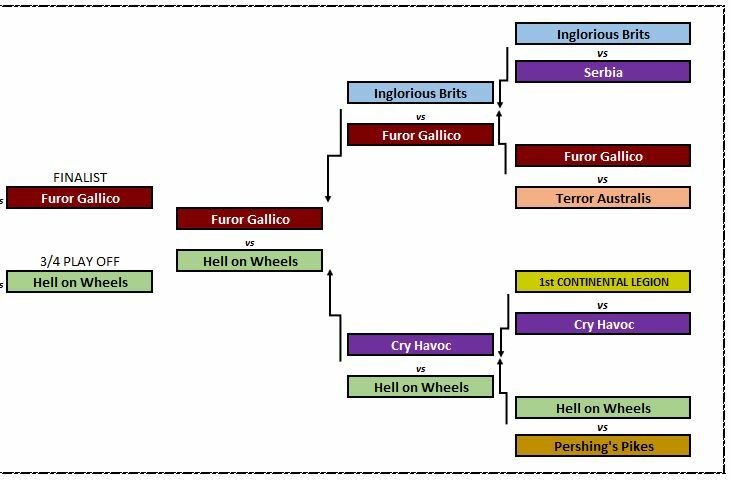
The World Team Championship is over and after many tough and balanced games, we have our first World Team Champion: Furor Gallico.
Furor Gallico consisted of four French members: dim30, Bodhran, Sennacherib and their team captain random27. It was an astonishing feat of skill and teamwork that took them to the peak of the world!
They played the final against another skilled and great team, the British Armchair Heroes. It is worth remembering the composition of the team: Stew101, Ericodoman1, lydianed and captain waltersavage.
The after action report written by random27, the last and decisive game of the challenge, makes for compelling reading when you consider it’s significance:
Period 2 : Furor Gallico losses 50 vs Armchair Heroes 51
“The battlefield was composed of a large plain in his middle, on the right a big hill and on the left near the viking deployment line, a forest bordered a middle hill next to a rough ground Arab army was a mixed force of infantry and cavalry, viking army was mostly only infantry with 3 superior cavs in support.
The arab plan was simple, a great force of cavalry followed by dailami and irregular rushed on the left whereas the arab foot lancers waited in the south east.
Thanks to great movements, the viking line managed to avoid the arabs cavs to take them by rear or flank, better than that, they pushed back their enemy and killed a lot of men. At the same time, the battle in the south began and after several turns, arab infantry, rejoined by the cavalry, destroyed the vikings.
Thanks to my opponent it was a great battle. I was under pressure, knowing the result of the other games, I knew I must not take a decisive defeat and I sometimes made moves for this purpose.
I have endured many feelings in the battle, because things didn't go like I wanted and it should have been the same for my opponent.
It seems that for this first edition, furor gallico is world team champion, like our motto says : IMPOSSIBLE NOT FOR (the) FRENCH”
The 3rd and 4th place playoff challenge, between the american team Hell on the wheels and chinese team Qin, was absolutely conditioned by the tactics and fear of losing. Just 2 games out of 4 finished in time and the organizers had to adjudicate 2 games.
In this case the Solomonic decision was to not consider the unfinished games for the final score.
The challenge was a perfect draw, 1 victory for each side and Hell of wheels won the match for 8% casualty difference.
Final ranking:
World Champion Furor Gallico, France Team composed by: random27 (cap.), dim30, Bodhran, Sennacherib, Sivispacem (reserve)
Second Position: Armchair Heroes, UK Team composed by: Captainwaltersavage (cap.), Ericdoman1, lydianed, Stew101, carpkem (reserve)
Third Position: Hell on the Wheels, USA Team composed by: Aetius39 (cap.), deeter, karvon, pbuck777, rpadilla1988 (reserve)
We hope you enjoyed the World Team Championship.
Don’t forget Slitherine’s Tea Time on our Twitch Channel Slitherine.tv planned on Thursday 27th February as the captains of the finalist teams will be our special guests.
See you in the next WTC edition planned for September 2022.
Take care and stay healthy!
World Team Championship - Semi Finals Recap
After the Christmas holidays, the moment to see what happened in the WTC semi-final has arrived. The plan was for there to be two very intense and interesting challenges:
Right-hand semi-final
Furor Gallico vs Hell on the wheels, France vs USA.
The Gallic warriors against the Americans, this match seemed to be very balanced and oriented towards being a tough battle to the last man. However, the blues with an extraordinary performance carried out a brilliant 3 to 1 victory! Their motto represents exactly the spirit of the french team, "Impossible, not for (the) french"!
The after action report written by the captain of the blues, random27 (Arab) who was playing against Kharvon (Navarrese), went as follows: “His sportsmanship is significant". “At the beginning of the day, the Arabs couldn't see all the Navareese army. A big hill overhung the middle of the battlefield. The Arabs sat on it and the irregular Navarrese awaited them in a big forest on the left and in hills on the right.” “In front of the forest, a big force of light troops scared the Arabs and stopped their advance. Once again the dailami wanted to fight and decided to attack troops in the forest in a maybe-too-optimistic charge. They saw that they were outnumbered too late and were taken from the flanks. Despite that, they managed to continue fighting for more than ten turns.
The second part of the Navareese army, consisting of unmounted horse lancers , launched their attack and tried to outflank the Arab army. They were repulsed and since the Arabs were too numerous on this side, Dailami knew then that they would die. Their sacrifice gave the victory to Gallico. Thanks for the great game, the win could have gone to either side".
Left-hand Semi final
Armchair Heroes vs Qin, UK vs China.
This battle was a dramatic and epic clash of arms. The result of the challenge was a perfect draw, with 2 victories for each side. This means the final result was decided by the percentage difference, which was just 6% in favour of the British team.
In this battle the hero was Ericdoman1, with a crushing victory (10% - 43%). This created a big gap that was impossible to fill. The second victory was won by Captainwaltersavage, here is the after action report written by the British player:
"A very strange battle. It was like fighting in a mirror. We brought very similar armies, though I brought more lights and cavalry and the other side brought more dismounted knights. The main feature of the battle was a deep stream that was dividing the battlefield. The most significant other terrain was a large tract of rough ground on my right on the other side of the river. I went right, as there was a slight bend in the river that gave me a chance to sneak into the rough ground. I felt I was going to get destroyed in the open and felt the battle came down to how well I could hide and battle in the rough ground whilst avoiding the mounted and dismounted knights.
The Chinese Germans came on in a very efficient formation that drove my left and centre back. My right had all the success and their greatest triumph was when 4 units surrounded a unit of dismounted knights and eventually dragged it down like a pack of hunting dogs on a lion. It was all down to the timing, and the battle ended just at the point that the heavy units of the Enemy were about to crush my centre." Regarding Qin, there is no doubt that the level and skills of the team and the talent of the Chinese players, was worthy of the finals with the british. There is a stone in the Egyptian desert and some very apt words were chiseled into the stone by 7th Bersaglieri Rgt, that represents very well the spirit of the Qin team: "Mancò la fortuna, non il valore" "it lacked luck, not valor".