

Ion Fury
Summer Sale is Here!
From now and until July 13th, Ion Fury is 60% off. But if you are looking for something even greater than this, you can get yourself the whole bundle that includes Ion Fury, GRAVEN and WRATH: Aeon of Ruin, and save even more on all titles!
WRATH AEON OF RUIN + ION FURY + GRAVEN COMPLETE YOUR SET BUNDLE
https://store.steampowered.com/bundle/12693/WRATH_Aeon_of_Ruin__Ion_Fury__GRAVEN_Complete_Your_Set/
Exploring the Game Design for Ion Fury - Part 2
Closing the Loop
In Part 1 I talked about how different gameplay elements were made with rules for consistency, but no one wants to experience it without engaging environments that feel cohesive, learnable, and fun to explore. Designers also need some freedom in order to express their creativity. To make both ideas possible, levels had a framework for style, structure, scale and more.
Color and Lighting
Besides the overall theming, each area of a zone had to decide on a general color palette. The mapper could decide which color should be most prominent/a base, then use different contrasting and complimentary colors in important areas. The only exception to this was space around keycard doors being colored like the key they require. Keeping this basic color structure lets places be more distinct, and visually clear. Mappers were able to easily pick out colors in a scene that would subconsciously draw attention. These cues quickly create a mental map for players.

Lighting a scene requires some forethought: in BUILD it’s all done by splitting up sectors into the right shapes with more and more walls, shading each surface by hand! We kept it high contrast, which meant it was easier to make out the “critical path” and also kept down the number of wall splits the level designers would have to create.

(Left: Regular high contrast. Right: Smooth shadows that take up lots of walls and time.)
Bright lights draw the eye’s attention and players will move toward them, so bright points of light and highlights were used to signal where to go next. Background objects and details were kept dim by comparison.

Doors and Windows
Presenting the Ion Fury Door Bible! Yes, it’s true - they’ve got their own guide courtesy of Max. Doors were an important early decision, as they cause changes to the environment when opening and closing. Things might get stuck on them or between them. Inconsistent door designs create confusion and frustration for the player, and frequently in the Build Engine also cause death!
To paraphrase a bit, doors need to be lit if they’re usable, including lighting up important doors as they unlock. No fake/false doors except if absolutely necessary for a convincing environment. Those doors must be dimly shaded and have a “perma-locked sound effect” trigger added. A sound effect when moving is a must - the sound tells you when something has happened, including an enemy coming in the room!

Keycard doors should be seen before the matching key (otherwise - did you really need a key instead of a puzzle/switch?), and as mentioned above are required to have a nearby color match to the key that unlocked them.
If a door is activated by a switch or puzzle, the switch should be next to the door or connected to it visually; whether by cables, pipes, lights, or otherwise. This connects them logically and mentally for the player as well, helping them feel less lost. In the few exceptions distant doors could be opened by an unconnected switch when there is a security monitor nearby to see what changed.

We were less strict with consistent window appearances, but because we had both breakable and unbreakable glass, plus some glass that enemies couldn’t see through, we still had to establish a few rules. Darker or more opaque glass blocks enemy line-of-sight and doesn’t break when hit, while clear/thin looking glass is something flimsy that could be smashed to pieces.
Objects
It was important to maintain consistency in all of the levels. I worked closely with Max and others to decide on things as mundane as general door size (576-1536 Build units), average hallway width (1024-2048), and the size and placement of objects. Sometimes as simple as “all electrical sockets should be 2048 above the floor or counter”, or as complicated as “fire extinguisher explosions should always leave wall damage”. These kinds of decisions not only make the levels feel more coherent and connected, they also affect the believability of the game environments and the gameplay itself.
An example of this is that switches and buttons for normal progression were placed at “eye level”, the height of a centered view, so they could be easily pressed without having to do small up and down micro-actions. While already frustrating with mouse input, it’s even more awkward when you’re using a gamepad or keyboard-only controls (which the game also technically supports).
Rooms couldn’t be random collections of objects. A bar should have bottles and glasses, an office should have desks and chairs, and so on. This gives a sense of place, and the impression that it’s truly lived in and not just an empty shell. And even though they look cool as extra detailing decals, since we had breakable walls the designers had to be careful not to use large Wall Crack sprites and suggest to players that a wall can be destroyed.


And since this game featured movable props we encouraged their use in little easter eggs and secrets, particularly our old friend The Chair:

Chairs were an early physics test object and became a running gag. Eventually it was decided that level designers should have at least one “Chair Secret” in their zone, sometimes more than one!
Secrets
Speaking of secrets! The usual rule of thumb was 5 per area, with some simple/obvious and a few more difficult. Though since secrets allowed a large element of freedom, the level designers had lots of fun and went nuts with them!
Ion Fury has 3 kinds of secrets:
- Unmarked/Easter Eggs. Sometimes these are things just off the beaten path, but they can also include fun extra hidden easter eggs that are hard to find or difficult to execute and don’t count toward your total percentage.
- Regular secrets. A Secret Stash! These are the five expected secrets, and can be of any style as long as enough normal experimentation would find it. Not everyone likes every type of secret, but every secret was tested with and without a hint guide to double check that it could be reasonably completed by someone really going for it! These are the only secrets that count toward your secret percentage.
- Mega Secrets. Extremely challenging secrets that every player might not find - only one allowed per zone!
By breaking things down this way we could give lots of freedom to the level design team, while also making sure players could find enough secrets during normal play to feel fun.

(Left: A secret item! Right: A Point Of No Return!)
It was also important to us not to have you locked out of backtracking to get 100%. Each area was marked with Points of No Return to warn you when you were about to pass the threshold to an area you can’t get back from, and to tell you how much progress you’ve made. As an extra visual cue a graffiti skull (the logo painted on GDF weapons) was always placed near the exits.
What’s in an Aftershock?
We had such a solid and balanced base from Ion Fury that for Aftershock we could be more playful. Players are expected to have already played the main campaign and so--
We thought c’mon, let’s get nuts.
Level Up
The long story arc in Ion Fury’s main campaign often left the player stuck in underground areas. This time we wanted to focus on more varied environments with lots of outdoor locations. One important early decision to help with this was to go with a more theme heavy approach that makes each map something you can describe in a few words.
Here are some of the thematic elements from our “art gallery map”.

One longtime dream of Build mapping was to have sloped sprites in the engine.
This is now a reality.
It does this by clever re-use of existing sloping code in the engine to pull this off and in a way that does it very faithfully as per Build standards (quirks, jank and limitations but it looks cool!)
Level designers are now using that to build unique areas and objects, even custom physics props. Even simple visuals like lasers and bullet trails benefit from this technology.
They’ve also got a suite of new effects like being able to flood areas by setting the water level, bunch of new palettes to work with and loads of tweaks to the existing roster of effects.


Get Messy
The pacing of combat difficulty in Ion Fury helped ease you into encounters with each enemy, but for Aftershock, players know what’s up! So the pacing was sped up, with more challenging enemies from Ion Fury appearing much sooner. New and alternate enemies have their own attacks and movements for players to learn, and most of them have quicker reaction times than the original ones.

We also added a new, and harder, fifth difficulty mode. This mode makes encounters even more intense, and creates a new layer of strategy as undestroyed enemy corpses will come back to life! Using the right moves and making enemies gib into pieces from your attacks becomes even more critical. Skill 5 is something we will also be including in the vanilla game as a bonus!

New boss encounters were a must, with distinct and interesting battles. In Ion Fury “bosses” could be hordes or puzzle-like, in addition to the occasional “boss fight”. We weren’t able to have as many of those boss fights as we, or players, wanted so for Aftershock we made it a must. Expanding the game gave us the time to create memorable encounters so bosses took a big step up with some cool surprises.
Maximum Power
Shelly has some really powerful attacks in Ion Fury, but most are balanced in some way to not be completely overpowering. However, since the bad guys up the ante in Aftershock, Shelly gets to respond in kind.
There are a few new instant Items, but we used the new pocket we introduced in Ion Fury 2.0 to introduce more PowerUps. Now Shelly can incinerate her enemies with flame traps, give every gun a spectacular boost with new attack modes, and slow things down to look cool while doing it. We also upgraded the regular arsenal! There’s some new ammo types for the Disperser, and also a new much fan-requested weapon that will really wreck Heskel’s day.

Highway Star
A key feature for Aftershock has been the bike. It’s something we’ve wanted since the early days of Ion Fury itself, and here we finally got to do it! It was one of the earliest things prototyped and done as a proof-of-concept for an expansion. It had to be fast, agile, weighty, and easy to handle with different inputs. It had to feel good to actually use, not the clunky mess people know from some other Build Engine games.
So we settled on a quad-copter hover bike with beefy armor and infinite rockets to pummel enemies with. Even some of the toughest dudes are no match for Shelly’s blistering power when she revs up that motor.

Keep Watching the Skiiiis…. Skies.
Of course this is just a taste of what you can expect from Aftershock. — What started as a simple map pack ended up adding a ton of new things to the game. Parts of Aftershock were already started soon after the release of 1.0, and parts of its development have already seen their way into the base game. Improved performance, minor game play tweaks such as the pocket inventory, and even some undocumented effects ;)
It’s been a long road and we’re really excited we can show everyone more of the expansion! There’s more reveals coming soon, so remember to follow us on social media to get the latest, and if you haven't done already, add Ion Fury: Aftershock to you Steam Wishlist! Thanks for reading and stay tuned!
I’ll see ya next time,
Jonathan “Mblackwell” Strander
Ion Fury Aftershock OST - Extensible Fury (Tracker Edition)
And the track is a banger.
Listen below.
Have you wishlisted Ion Fury Aftershock yet? If not, do that here. And make sure to follow us on twitter for the latest updates on our games.
3D Realms Live! Interview - Jonathan Strander Lead on Ion Fury/Aftershock
Recently, we had Jonathan "Mblackwell" Strander on our weekly livestream (every Friday at 2pm EST over on Twitch) talking about Ion Fury Aftershock!
Watch below for insights into Aftershock's development.
Don't forget to wishlist Ion Fury Aftershock!
Exploring the Game Design for Ion Fury - Part 1
For Fury I acted as the primary programmer, the “Lead Gameplay Engineer”, and the Designer who compiled everyone’s ideas into something cohesive. I really wanted to share with everyone some of the behind-the-scenes decisions we made along the way. We had to come up with a lot of rules and guidelines to make the game we wanted, and I hope you all have fun learning about it! For now we’re going to deal mostly with the most obvious thing: How levels were designed for the game’s layered “Combat Loop”.
First Ideas
Bombshell’s world consisted of alien landscapes, and we had been tasked with providing something much more “real world” and grounded. In 2016 3D Realms gave the team permission to reconceptualize the game world and character for the Ion Fury version of the universe, barring a few key appearance markers for Shelly.
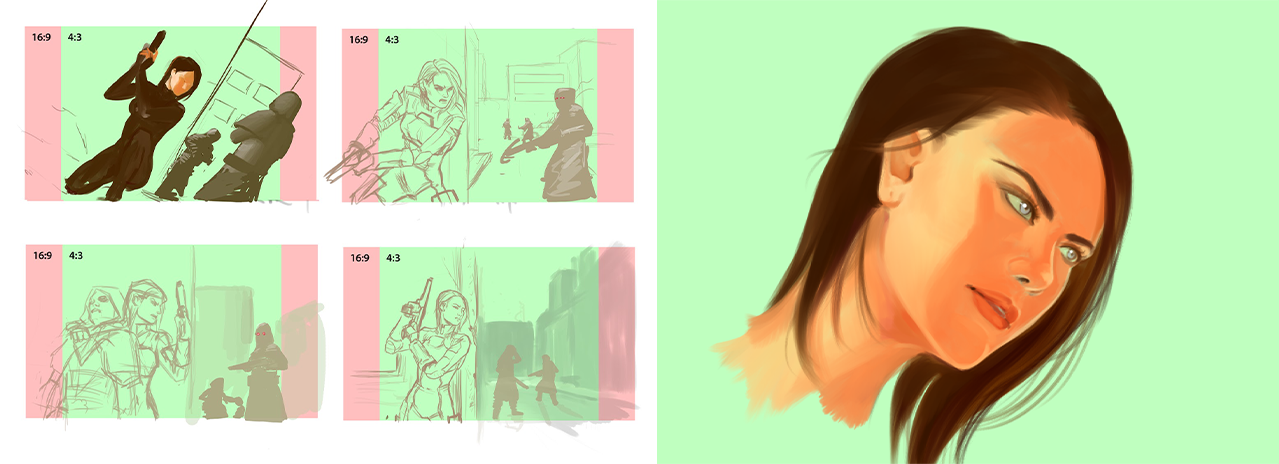
In our concepts Shelly would be not-too-young to be believable (around age 27), and grounded but snarky. Someone who may like to go out for a drink, but can get down to business with a “get shit done” attitude. She would be a reminder of the female protagonists we had grown up with like Ellen Ripley, Anne Lewis, Sarah Connor, Judge Hershey and countless others from action and science fiction.

The world would be Neo D.C.: a near-future dystopian cityscape with the world divided by financial and military strata. The player would travel from poorer districts to wealthier ones, climbing to different heights and construction quality. The background of how the world functioned wouldn’t be explicitly told in story, but instead experienced by the player through the broader design.

Game Loops Cereal
We worked tightly as a team to come up with the right balance of game systems. When designing the gameplay I placed a focus on consistency, believability, and multiple interacting learnable systems. This made things natural, flexible and fun for players, and gave mappers a clear way to communicate their intent.
Bullet Ballet
Since it’s a large part of the gameplay, first we had to determine the flow of combat. This went through tons of iterations. Originally enemies had more health, and more “smart” tactics (like flanking and circle strafing), and combat was closer to a game like F.E.A.R. After lots of testing and experimentation we settled on a different goal:
Shelly would be a “glass cannon”. Incredibly agile and powerful, but unable to take much direct damage. Players would need to actively avoid taking hits in order to win. To accommodate this, enemies were given distinct styles, attacks, sounds, and animation tells that make it easy to see a threat in advance. Each distinct cue gives a different warning, letting you know what kind of attack is coming to plan ahead for. Projectiles of all types could then be dodged and hits maneuvered around.

Instead of a few very tough and smart enemies we landed on large groups of “trash” enemies mingled with other types in order to turn combat into a dance of constantly shifting priorities. Mappers were directed to place enemies in groups with mixed types. Their differing weaknesses, movement patterns, and projectiles created the rock-paper-scissors-like ballet of picking targets and avoiding incoming fire.


Lots of testing was done to balance “Time to Kill” and “Time to Death”— that being how long it took the player to kill an enemy and vice versa. Each enemy was repeatedly timed to see how long it would take before Shelly was dead starting from full health, and had their attacks tweaked to hit specific time targets. Each enemy also had an encounter stop-watched in order to see how many times you would have to hit them to kill them – measured in seconds – with both their health and Shelly’s weapons adjusted accordingly.

Of course, we knew you can’t always avoid every hit so there’s…
Health Booster Boogie
To balance health we decided to have both instant use Medpaks and carriable Medkits. Mappers were told to restock the player in the next area after major combat (or long string of fights), and sparsely around the edges of those combat areas. Shelly’s health declines rapidly when not successfully dodging hits, so the combination makes players feel like they are living on a knife’s edge but still able to recover from mistakes. A late game addition was the occasionally spawning Emergency Syringe to help stay alive, as some players felt slightly too punished in close fights. To keep balance there’s an actual check for your current health, and the number and frequency spawned depends on difficulty.

As a bit of a boost to players and to build some lore, edible food pickups (Shelly’s fav is Pizza) were added after initial testing as a way for players to restore themselves and even gain more than 100% health! Similar to arcade games of old, we decided that such a small object should give a small but important temporary effect with a touch of additional ridiculousness. Not only do you get more health, but the more you eat the faster all of your movement gets.
Even with all of that help, Shelly is made of glass so you’ll still die quickly unless you have…
Shards, Shards Everywhere!
Armor became integral to balancing the gameplay. Keeping up your armor keeps you alive twice as long, so from the early days we included three sizes of armor suit (Light, Medium, Heavy). To make things feel more predictable, unlike games such as Duke Nukem 3D, there was no randomizer on armor’s usefulness — the same size hit will always give the same size protection letting you soak damage and survive impossible feats. The Hazard Suit was planned early on not just to give protection from environmental damage but against all kinds of acid, gas, or “nuke” attacks that enemies might fire your way, giving you a hidden advantage.

To keep a constant forward momentum we added Small Armor Shards to replenish your supply in small numbers along the way. Us designers especially pushed for them for dual purposes: First, they would rain from enemies during big hits that caused gibs, encouraging you to keep the combat flowing and take risks.

Second, since Armor Shards make players feel safer they would be used as breadcrumbs to guide you through the level. With a small nod to the designs from classic games like Super Mario Bros., major path points or important areas had them placed in distinct lines in order to push you in the next direction subconsciously. The more suggestions we made with shards, the more players were able to find the critical path without even trying.

Ammo/Weapon Placement
Weapons aren’t just for making things go boom. Where, when, and how you actually receive weapons is an important step in the game’s overarching design. Your arsenal is spread out over the entire game in stages to bring a stronger feeling of accomplishment, and to give the player time to become experienced with the new weapon they’ve just been given. The early zones feature Disperser (Shotgun) and Bowling Bombs alongside the occasional SMG. By the midpoint you start to see the Minigun and Ion Bow, and late-game focuses on giving a twist and a refresh to the game with things such as the Disperser Grenades. By this point you’ve also seen the Cluster Puck sprinkled throughout the entire campaign, meaning that the levels can act more as a test of the skills you’ve mastered.


Weapons which were meant as critical to progression were to be placed in obvious, well lit locations and positioned in a way that best attracts attention. Ammo for that weapon would appear near it so you could start to associate the two. Then a scenario where that weapon is useful would appear after, and players could learn a bit about how it works.
Slightly more than the bare minimum amount of ammo was placed along the main paths in order to balance the number of ammo restocks, with extra ammo placed off to the side and in secret areas. Secret areas could also be used to give the player less “important” weapons, and even the chance of seeing powerful weapons early on. Having the reward of extra bullets encourages players to explore the entire level, and gives less experienced players a chance to keep their weapons from being empty since being able to shoot with less accuracy means you’ll run out of bullets faster!
When level designers wanted to require a certain weapon such as explosives, or highlight a certain style of combat, they were asked to place the weapon and some ammunition for it beforehand. They were also asked to restock the player after every autosave point, in order to refresh themselves from the hard work of getting there. Level Designers were otherwise discouraged from forcing players to stick to only one weapon by not giving enough ammo variety. Every weapon is useful, with a unique set of advantages and disadvantages that can be twisted to fit different combat situations. Even the starting pistol, the Loverboy, and your baton–the Electrifryer–can be used with great effect throughout the entire game (fun fact: big enemies are weak to it!).

All of this subliminally tells the player to keep pushing through, and they feel a strong sense of accomplishment just from the act of getting and using the game’s weapons.
PowerUps
PowerUps were added as a fun extra. Max and I, especially, are huge arcade fans and wanted to bring in that sense of something over-the-top into the combat loop. These were left as timed abilities to create small Superhero moments. It’s a way to shift things to the player’s advantage for a moment without seriously affecting the wider game balance. The Hazard Suit can do extra duty as a breathing tank — also getting you through toxic sludge and protecting you from toxic attacks, Super Damage doubles your attack power, Blast Accelerator gives you infinite instant-Homing Bowling Bombs, and so on.
Having the Jump Boots, which gives you a Double-Jump, meant the mappers could include new kinds of hard-to-get-to areas and secrets, as well as spice up the combat in open rooms. Honestly, this also was the most difficult one for development; particularly after we added the Pocket Inventory it meant players could (and did) potentially get to all kinds of crazy places!
It Isn’t the End After All
Don’t worry, we’ll come back in Part 2 and talk about Secret Areas, Sounds, and much more! Oh, and don’t forget Aftershock — it’s an expansion after all so we’re expanding with new elements, and I’ll be able to talk more about them next time!
In the meantime don’t forget to Wishlist Aftershock, and follow Ion Fury on social media for more updates.
Happy trails,
Jonathan “Mblackwell” Strander
Arrange Mode
This time I’ll be writing a few more entries focusing on level design and some other bits related to it, starting with Arrange mode. While I started off as a mapper, I quickly found myself as the “lead level designer” on the project around 2016, doing a bit of everything on the side.
As a mapper, I’m the effects guy. Coming from Duke3D mapping I’ve always had the interest on trying to push maps to do cool things and create unique game play scenarios. It’s not that different with Fury where I always try to think on how the mechanics can be pushed a little further with the existing tools available. Experimentation with these resulted in things like “Bombardier challenge” and “Queen of the hill”.
This time I wanted to go back to something I already planned to include all the way in 2017 for the preview campaign, then called “B mode”.
When designing a game, it's always about finding a right balance between skill, enemy introduction pacing and other gameplay beats.
Even with the hardest skills intended for veteran players, you can’t just go full blast with all of the enemies, items and traps as you will want to gradually build up the intensity and roughly match the pacing of easier skills in terms of new elements. With Fury, on hardest skill you will get more enemies, more aggressive A.I. and a few key enemies get trickled in slightly earlier than the usual first encounters. However it’s all still designed to give you a mostly similar experience.
While I believe we struck a nice balance overall with the main campaign, in some cases we had few spots where we had to look back and agree that some puzzles might confuse new players. With puzzles, any neat world hazard/puzzle you add will exist as a shared level script/geometry bit, affecting ALL skill levels. Outside of puzzles, there were also some enemies we didn’t want to introduce very early on regardless of skill, resulting in some enemy types getting barely any proper screen time.
Many of these would work better during a replay.
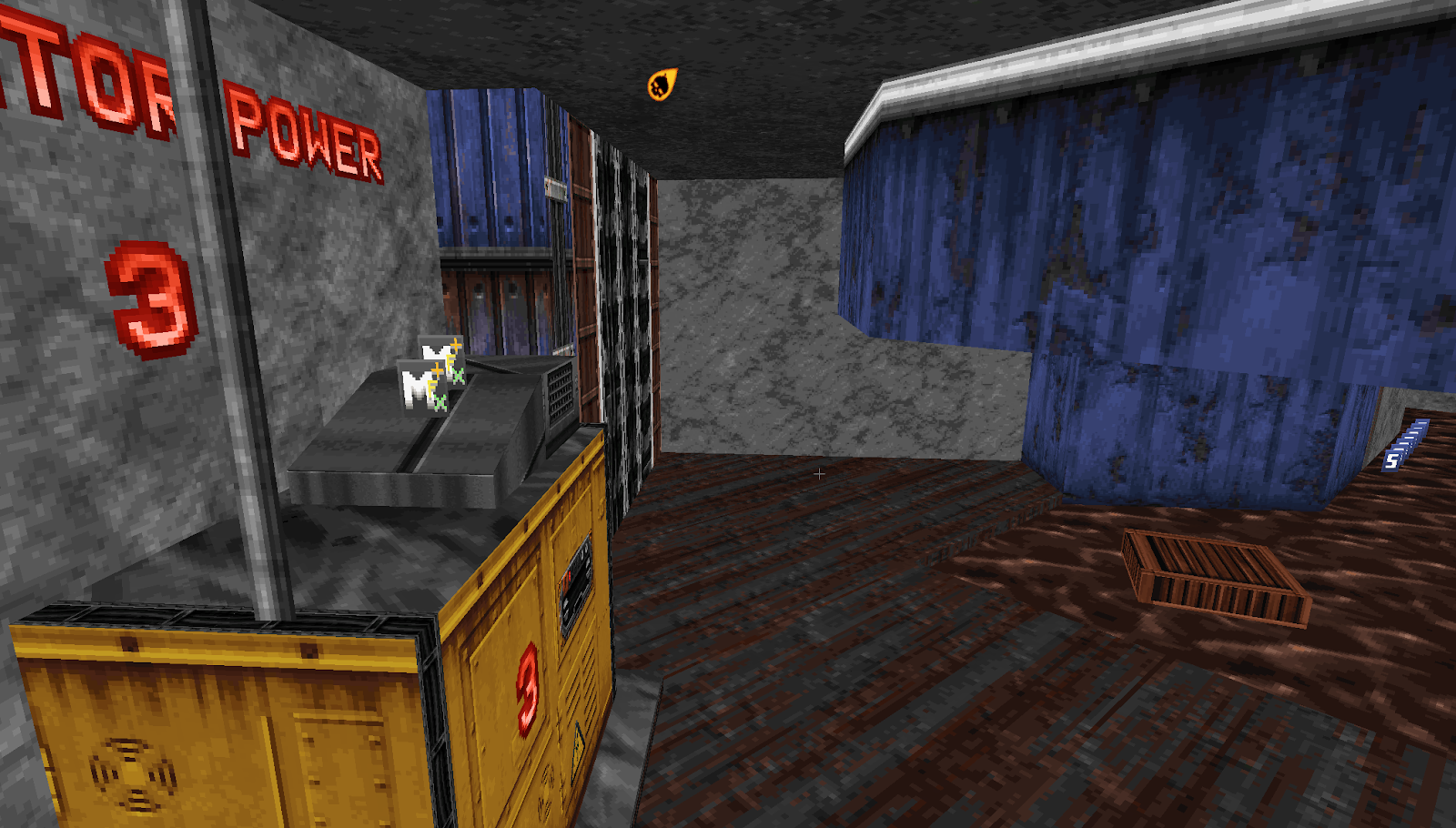
Early z1a4: generator puzzle used to be harder with underwater areas
How to tell a replay apart? We at one point thought about having higher skills locked behind a “beat the game” wall but it’s not really nice for replays. Not only that but it would limit us mostly to enemy placement changes and we wanted more.
It was time to dig up that “B mode” mentioned earlier…
Our inspiration comes from older games where you’d finally beat the game (God gamer you!) and be getting ready to enjoy the ending... However instead of a conclusive end, you might’ve even got a very blunt and rewarding “Try again with a harder game!” message and it would usually just kick you back to a title screen with perhaps some secret code. Undeterred, you start the game again and all of a sudden you’d notice that the game would have changes to make it harder, different and sometimes going as far as modifying actual levels of the game to essentially give you a whole new second quest. This was often known with names such as “B game” “Hard mode” or “Second quest” and can be seen as a natural evolution of even older arcade games where you’d typically have 3-5 stage layouts that would keep repeating with a few tweaks to increase the difficulty each loop, designed to make you lose eventually.

(Left) Legend of Zelda NES — (Right) Kirby’s Dream Land GB
Back when planning started, we dubbed ours "B-mode" and the game was to ship with just two skill levels and this alternate mode that was intended for replays, acting as a "medium+ & hard".
As the game's development was pretty turbulent back in 2016-2017, we didn't even know if the preview campaign would be our swansong. But when we finally went with the EA model and decided to push with the full game, we focused our efforts on making the existing stuff work as well as possible and revisit this idea for the full game... That didn't really happen either :)
I found some early planning sheets for the “end of level” screen that still included the 2 skills and A/B mode distinction. You can still recognize a few of these messages.

Now, “B mode”, let's try again..
The term “Arrange mode” was picked since it has a nice ring to it, playing homage to older Japanese games from the 80s and 90s where you’d often have arcade home ports that would try to replicate a vanilla experience but you’d in often have “ARRANGE” in the main menu that was essentially an added bonus mode could introduce changes to game play, graphics, music, stages and even story.
All of this could be minor game play rule tweaks to full on “second quest” type experiences.
These still spiritually live on in the form of DLCs and as various unlockable extras.
In this context, our goal set out to be to provide a “second quest” type of experience that lets the player re-experience the vanilla campaign with new unexpected twists and also adding new game play elements to the mix.
Four key points ended up being
- Increase challenge by remixing maps
- Mirror flip the maps (the slow way)
- Collectibles
- Spice things up with Aftershock content for extra variety
INCREASE CHALLENGE BY REMIXING MAPS
One great thing about a replay run is that we can expect the player to be familiar with some basic concepts like baton operated switches.
We can assume that once a player reaches an area, the player already mostly knows what to search for and we can already have an "increased difficulty" version of a puzzle or an area without having to teach the mechanic exactly.
Expect to see a few tweaks to puzzles or some key card locations and some new hazards like purple goo taking over familiar areas, requiring new ways to think! :)


Hmmm… someone has been moving generators again… Wait! what is this purple goo!?
MIRROR FLIP MAPS (the slow way)
All of the maps have been mirror flipped!
Now you'd think the process is just "translate X for map" and you'd be right, but I didn't want to just have everything 100% mirrored, I wanted the signs, text, etc.. to read properly as if the maps were always like this. This poses a few annoyances as build engine is rather primitive with walls/sprites store a simple "Flip X, Flip Y, Flip both" flag. Here are a few examples of manual fixes from the editor side:


A lot of the text actually consists of separate letter by letter sprites that are now all in wrong order. The solution was to code a custom script where I can pick a group of sprites and "de-flip" these with some rotate functions and math. After this you'd have to re-align sprite group that could get stuck inside walls due to Z fighting hacks or rounding errors.
Surprisingly, Build has no way of selecting multiple sprites in 3D so I ended up adding that as well.
[table noborder="1"]
[tr]
[th]
 [/th]
[/th][th]
 [/th]
[/th][/tr]
[tr]
[td]
 [/td]
[/td][td]
[/td][/tr]
[/table]
A de-flip script is applied against the selection which rotates it against an axis and flips the sprite’s cstat bit that controls if the texture is mirrored or not. However in many cases sprites are not 100% flat against the wall, any sprites sticking out will now end up inside so it needs careful repositioning to restore it…
Floor and ceiling texture alignment can either be world or sector relative. This means that when you move/rotate stuff around, the origin of texture panning will be bound to one edge (wall) of a sector. If sector aligned, it will always be parallel to the "first wall" of a sector. This is where things get a bit more complicated...
Walls in Build are actually points in the 2D map and don't contain the expected x1,y1 - x2,y2 references, instead a wall is considered a single point in 2D space and it stores the next point's ID based on clockwise direction of the sector's shape. Flipping the sectors will generally work but as the alignment has to be redone internally to be clockwise again (Reverse order), it might result in misalignments that need manual fixing and can't be automated or detected. These were fixed manually. Huge thanks to our testers for helping catch so many more of these!
[table noborder="1"]
[tr]
[th]
 [/th]
[/th][th]
 [/th]
[/th][/tr] [/table]

[center]A Few of the many examples where manual fixing is required[/center]
However toilets were done fully in code, with hardcoded alignments for any necessary texture swaps. Solution? Create more editor code and fix every single toilet in the game manually one by one by flipping the first wall to be one wall towards the other side...
I had a day where I was literally inspecting all the toilets in the game.
[table noborder="1"]
[tr]
[th]
 [/th]
[/th][th]
 [/th]
[/th][/tr] [/table]
Flipping the wall order changes the alignment of the floor texture. Fixed on the right one.
COLLECTIBLES
Something scrapped from the original game was a concept where you'd find bombs around the world that you'd defuse and gain a reward for. This was rather quickly scrapped but we always kind of liked the idea of having other "hidden in plain sight" stuff to find besides secrets.
Perhaps inspired by MGS2 Fatman defusal stuff and a bit of NOLF, you can now find collectible bomb pickups scattered around the world in challenging places, ticking away, waiting to be defused.
On 1.0 you had limited use for jump boots but expect to require them for some of the new stuff!
Areas which were previously unreachable might now have stuff to look out for, and you'll get to trade some for powerups/items between zones.
SPICE THINGS UP WITH AFTERSHOCK
And finally we have the whole library of new enemies, powerups, items and weapons from Aftershock.
You will have access to a ton of stuff from the get go but also expect a pushback from the enemies!
Action will be much more hectic due to the new tools we have at our disposal.
I won’t be spoiling the whole roster here but we do have a bunch more variety, including a rather ridiculous powerup.

While a lot of this could be done with run-time scripts, we wanted to make the experience feel more like a real game mode and also doing something cool for the fans to play around with.
It was an opportunity to make a few of the fanmade “unreachable area” rumors a reality ;)
Expect to see maps include a few of the new effects we’ve developed for aftershock.
I hope you got some idea on how arrange mode is shaping up and next time I’ll be shedding some light on how the zone3 boss ship was done.
If you haven’t bought Ion Fury yet then consider grabbing it from Steam and stay tuned for more Aftershock information!
Max ‘oasiz’ Ylitalo
Announcing Phantom Fury - the shooter starring Shelly “Bombshell” Harrison!
We are happy to announce Phantom Fury, a road movie-inspired first-person shooter starring Ion Fury’s Shelly “Bombshell” Harrison developed by Slipgate Ironworks and published by 3D Realms! Shelly embarks on her next action-packed adventure on PlayStation 5, Xbox Series X|S, Nintendo Switch, and PC in 2023.
Years after Shelly’s fight against Jadus Heskel, an old colleague rouses her from a coma. She awakens with a bionic arm capable of incredible feats and a new mission: track down the dangerous Demon Core, an artifact capable of unprecedented destruction before villains get their hands on it.
WISHLIST PHANTOM FURY NOW!
https://store.steampowered.com/app/1733240/Phantom_Fury/
Realms Deep 2022 starts today!
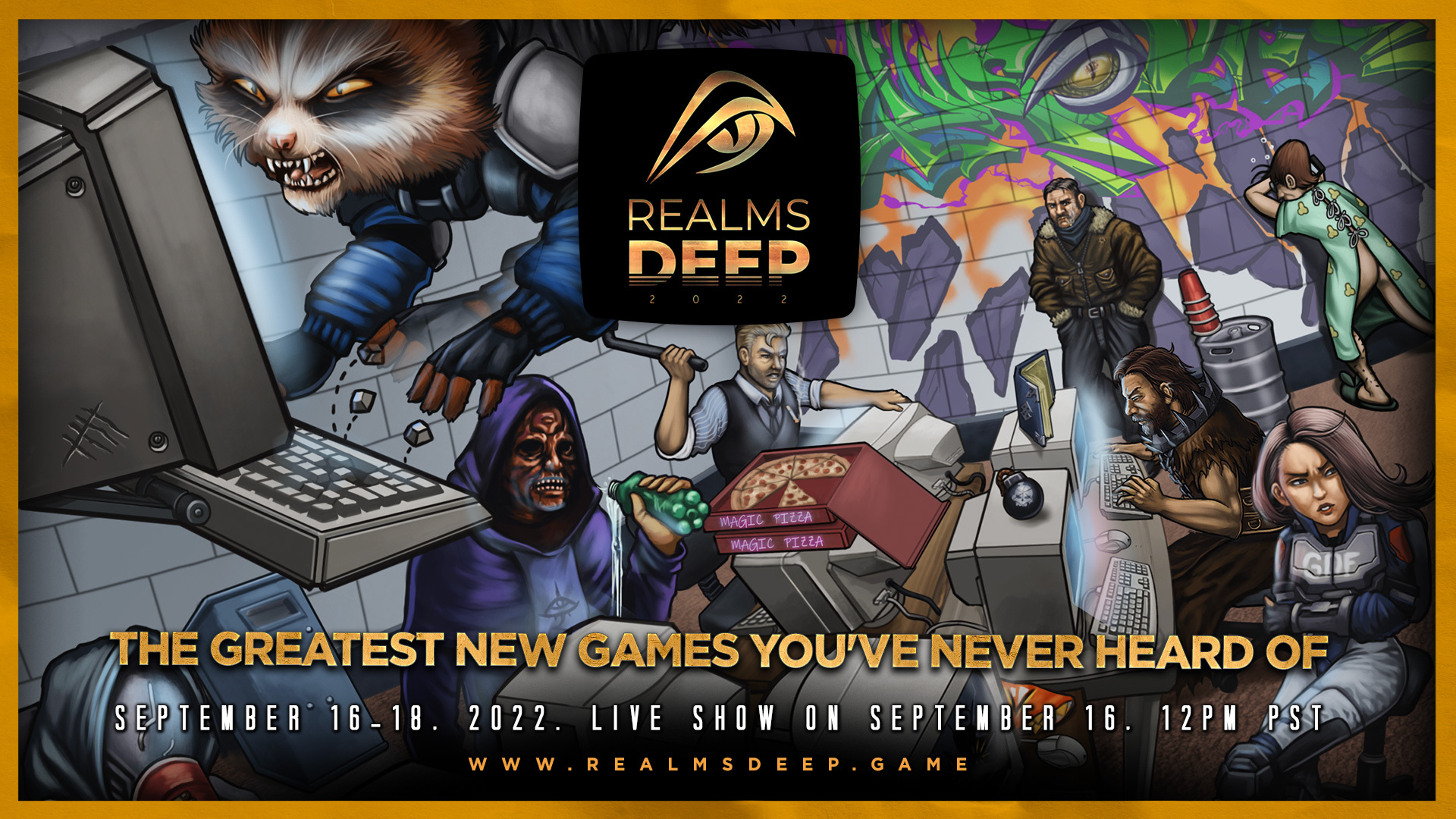
Realms Deep 2022, the annual digital showcase organized by 3D Realms and friends packed with world premieres and special guests, kicks off today at 12:00 PM PST / 09:00 PM CEST and continues over the weekend.
Watch it live on 3D Realms' official Twitch and YouTube channels!
And don't forget to check out the Realms Deep Steam Sale for exclusive discounts, demos, and just announced games!
Ion Fury is 65% off now!
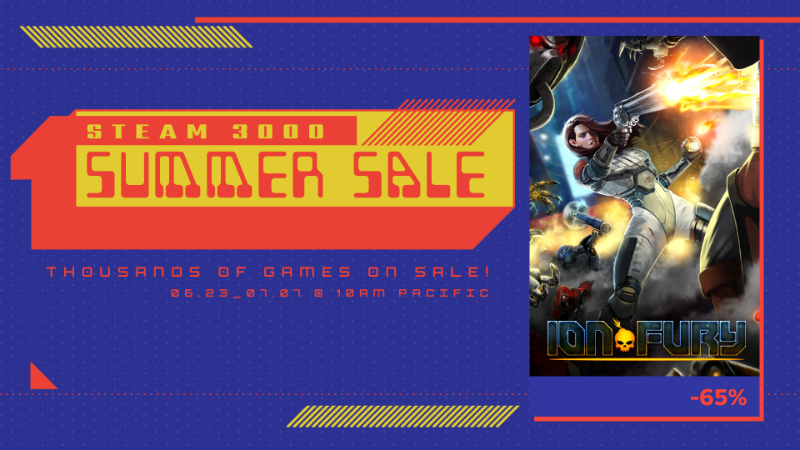
And if this is not enough, Ion Fury is part of the Bloody Nostalgia bundle that includes Project Warlock, Forgive Me Father and Hedon Bloodrite, where you can get these awesome old-school FPS games with an extra discount!
https://store.steampowered.com/bundle/26867/Bloody_Nostalgia/
Ion Fury: Aftershock - Developer Q&A livestream!

https://store.steampowered.com/app/1588720/Ion_Fury_Aftershock/