Welcome back! Today, we're diving deep into one of our core gameplay features—the groundbreaking environment shuffling mechanic. In this devlog, we'll give you an inside look at how it works and the intricate design decisions that make it truly unique.
Lost Twins 2's defining feature is the environment shuffling mechanic. We've divided the entire game world into interconnected pieces that can be manipulated in various ways. These pieces can be connected or disconnected from any side—left, right, top, or bottom—when their sides match perfectly. Players have the ability to switch between different zoom levels while playing. In the zoomed-in view, they can perform actions like moving, jumping, climbing, and manipulating objects. However, when faced with an impassable obstacle such as a closed door, players can shift to the zoomed-out view and rearrange the environment pieces to create a path in the zoomed-in view. It's a gameplay mechanic like no other.
Grid Complexity: For most levels in Lost Twins 2, we've opted for a 2x2 grid, featuring three environment pieces and one empty slot for moving pieces around. While we could extend this to a 2x3 grid with five pieces or even a 3x3 grid with eight pieces, the complexity of the game would grow exponentially. Therefore, we've maintained the 2x2 grid for most levels to strike the right balance of challenge and accessibility.
Zoomed-Out View Design: Creating the look of the zoomed-out view presented its own set of challenges. It needed to be simple, resembling a mini-map, allowing players to grasp the entire level without visual clutter. To achieve this, we've designed simplified icons for characters, interactable puzzle elements, collectibles, and environmental terrain. During zoom transitions, we smoothly shift from a zoomed-in 3D world to 2D icon-based assets while adjusting the camera field of view (FOV) from perspective to orthographic. This transition involved some trigonometric formulas to ensure a seamless shift.
Blending 3D and 2D Worlds: Blending the 3D and 2D worlds seamlessly was another puzzle to solve. We achieve this by having one world fade out while the other fades in, with both meeting at 50% opacity. This blending process involves the use of alpha textures, strategic placement of black foregrounds, object scaling, and precise object positioning. These elements work together to give players the illusion of a smooth transition between the two worlds.
As we conclude this devlog, we hope you've gained a deeper understanding of Lost Twins 2's innovative environment shuffling mechanic. It's a feature that challenges players to think creatively, strategize, and explore in ways they've never experienced before.
What are your thoughts on our environment shuffling mechanic? Let us know in the comments below!
Best regards, Playdew Team
Devlog #25 : Introducing puzzle element - Bouncy Football
Welcome to the latest installment of our development diary! In this devlog, we're diving deep into one of the most exciting puzzle elements we've introduced in our ToyZone—the Bouncy Football. If you're familiar with our Boulder element, you'll find some intriguing similarities and a few exciting differences. You can revisit our blog on the Boulder element here for a quick refresher. So, grab a seat, and let's bounce right into it!
Much like the Boulder, the Bouncy Football serves multiple purposes within our game world. Players can use it to block pathways, drag it around, and even use it as a platform for reaching higher places or activating buttons to advance in the game. However, the key distinction lies in its physics. Not only did we design the Bouncy Football to complement the ToyZone's aesthetics, but we also made sure it presented a unique challenge for both our players and us as developers.
The Bouncy Football lives up to its name with physics that keep you on your toes. It's lightweight and, well, bouncy, making it quite a challenge to control precisely. Players must act swiftly, timing their jumps just right to hop aboard before the ball rolls off or takes an unexpected tumble. This dynamic adds a thrilling fast-paced element to the gameplay that keeps everyone on their toes.
To achieve this bouncy behavior, we adjusted the physics material's 'Bounciness' parameter to 0.6, fine-tuning both dynamic and static friction to get the feel just right. However, creating this playful physics experience required more than simple parameter tweaks. We had to implement additional checks and constraints in our code to ensure the physics remained manageable. By carefully clamping the velocity and position of the Bouncy Football within certain bounds, we maintained control over its behavior, even with relatively low solver iterations to optimize performance.
The Bouncy Football has been an exciting addition to our ToyZone, and we can't wait for you to experience it firsthand. Stay tuned for more behind-the-scenes looks, exciting reveals, and game development insights as we continue to work on crafting an unforgettable gaming experience.
Thank you for being a part of our journey. Until next time, keep gaming and keep bouncing!
Best Regards, Playdew team
Devlog #24 : Introducing puzzle element - Airstream
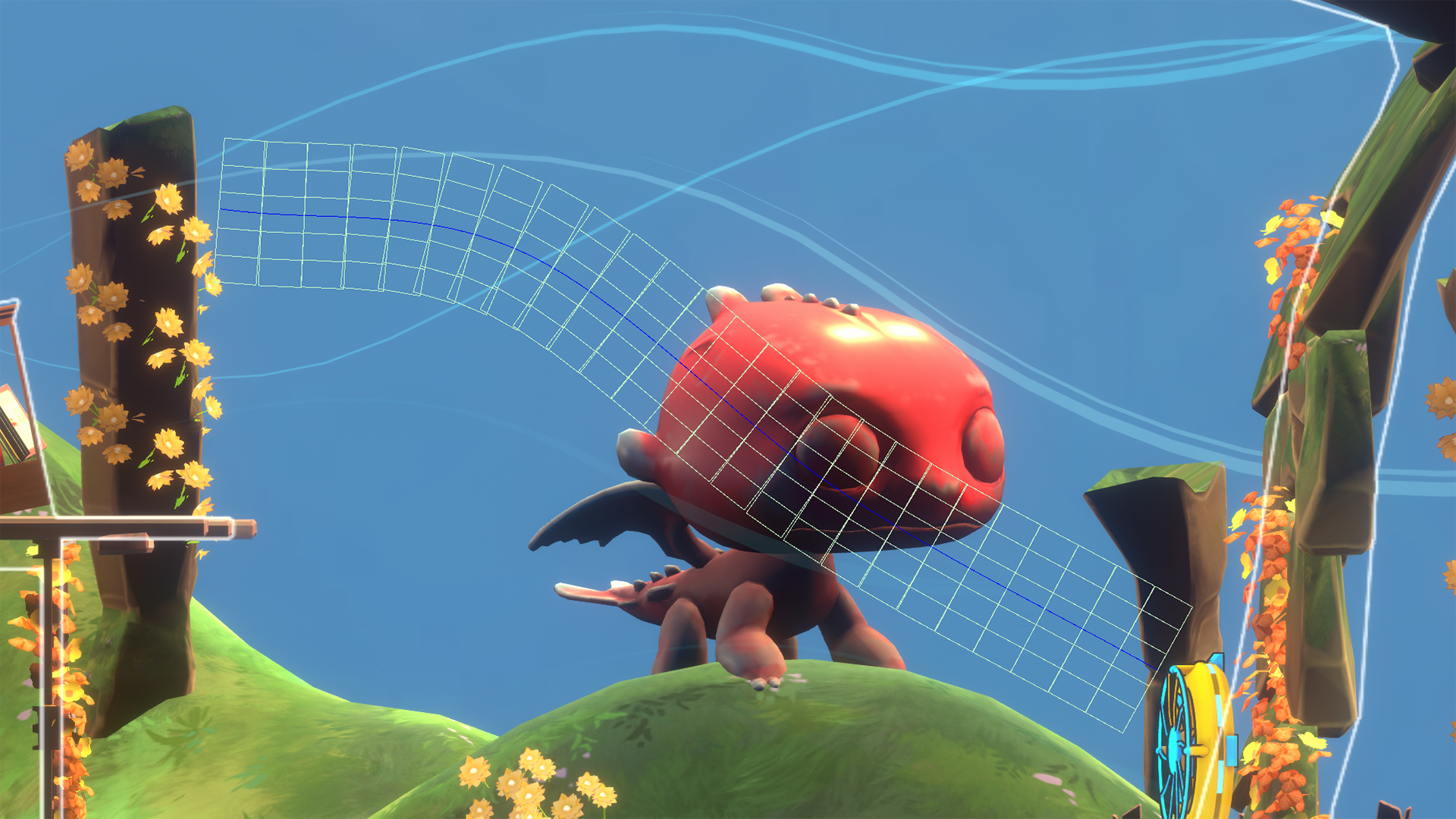
Let's dive into an exciting addition we've made to toyzone – the Airstream. As soon as a player steps into its captivating realm, they're whisked away, soaring through the air in the direction of a powerful airstream. These airstreams are conjured by none other than our trusty fans. However, activating these fans requires a bit of a scavenger hunt – players must hunt down scattered batteries and fit them into the fan's battery container. Once that's accomplished, it's a simple button press from any character to ignite the fan and set the airstream in motion. It's not just a mode of transportation; it's a thrilling way to reach previously unreachable areas within the game level.
Each level features a unique airstream shape. To achieve this, we harnessed the power of Catmull-Rom splines. First, we outlined the basic points in our editor to define the desired shape, and from there, we generated a mesh along that spline. Then came the meticulous task of mapping UVs to match the length of the curved mesh. The final touch involved manipulating these UVs along the path to create the illusion of a continuous gust of wind emerging from the fan.
When it comes to the physics behind the Airstream, we didn't cut any corners. Alongside the mesh generation, we meticulously placed small cube trigger colliders along the airstream's path. The moment a player makes contact with one of these triggers, they enter a unique "flying mode" within the airstream. We diligently track the current collider index and apply force to the player's rigidbody to propel them from one collider to the next, creating a seamless flying experience. This exhilarating journey continues until the player reaches the final collider, at which point we gracefully transition back to the normal physics engine, complete with gravity.
We hope you're as thrilled about this exciting addition as we are. The Airstream not only enriches gameplay but also showcases the attention to detail and innovation we're pouring into our toyzone. Get ready to take flight and explore new horizons in our world!
Thank you for your ongoing support, and stay tuned for more exciting updates.
Best regards, Playdew team
Devlog#23 - Audio FMOD implementation
Greetings, adventurers! Today, prepare to be enchanted as we delve deep into the mesmerizing realm of immersive Audio System Design, where magic meets technology in Lost Twins 2.
Our voyage into the realm of Audio Design commenced with a resolute vision: to craft an experience where users aren't just players, but explorers of distinct zones, each brimming with its own ambiance, music, and the resounding impact of every element woven into the fabric of the Environment.
Our first challenge materialized in the form of harmonizing melodies across various levels within a single zone. Our pursuit was to compose music that resonates uniquely with each level, yet harmoniously binds the essence of the entire zone together. Thus, emerged an intricate web of musical variations, tailored to evoke emotions aligned with the environment's spirit and the challenge presented by each level. The result? A symphony that dances through diversity while preserving the soul of the zone.
Yet, music was only the first brushstroke on our canvas of immersion. Ambiance emerged as our potent paint, vividly illustrating the very essence of each environment. Our goal was audacious: to craft ambient sound effects that ensnare the senses, transporting users from their reality into the heart of the game's universe. A conundrum arose as we sought to seamlessly transition users from one ambient masterpiece to another, mirroring the swift pace of their journey. Our alchemy brought forth a solution: a wondrous 3D audio system that bridges the gap between outdoor grandeur and indoor intimacy, allowing whispers of the outside world to caress the ears of those who dare to venture within.
In this mystical world, every element holds a story, and every interaction is a chapter waiting to be told. Our focus turned to the symphony of interaction sounds, where the caress of a falling box and the crescendo of a boulder meeting glass become the sonnets of gameplay. We yearned for users to not just witness but feel the resonance of these interactions, a goal that was met with a spatial audio masterpiece that orchestrates every tumble, every clatter, and every echo as if they were a part of the player's very being.
The tapestry of our world is woven with diverse surfaces, each whispering tales of their own as characters tread upon them, or interactions traverse their grains. To complete the immersive panorama, we harnessed the magic of sound to make footsteps feel real, to make each interaction tangible. The outcome? An auditory spectacle that transforms each movement into an orchestra of textures, enriching the user's engagement with every stride and every touch.
With deepest gratitude for your unwavering support, we stand at the threshold of another chapter, eager to unveil more enchantments. Join us again next week on our journey of creation and wonderment. Stay attuned to our chronicles on social media and be a part of our ever-growing saga!
Until then, let the echoes of our shared exploration resonate within you. Farewell, and may your every step be accompanied by the sweet melody of anticipation.
Best Regards, The Playdew Team
Devlog#22: Introducing Puzzle Element - Breakable Wall
Greetings! We're thrilled to unveil the creative process that birthed one of our most exhilarating features - a breakwall wall. We engaged in a brainstorming session to connect a feature with the electric car. As ideas sparkled and imagination flowed, we birthed a game-changing concept: crafting a wall that yielded to the electric car's might, breaking upon impact and unlocking new pathways for our characters, making traversing the obstacle-laden terrain an essential part of the adventure.
Key Features:
1. The breakable wall must only shatter upon the car's collision. The wall has been meticulously designed to shatter upon the exact point of impact with the electric car, granting players a satisfying and realistic experience.
2. Locate an electric car within the level and utilize it to demolish the wall. The player has to make their way through the level and bring the two objects together to solve this puzzle, maneuvering the electric car to orchestrate a collision that cracks the wall.
Visual:
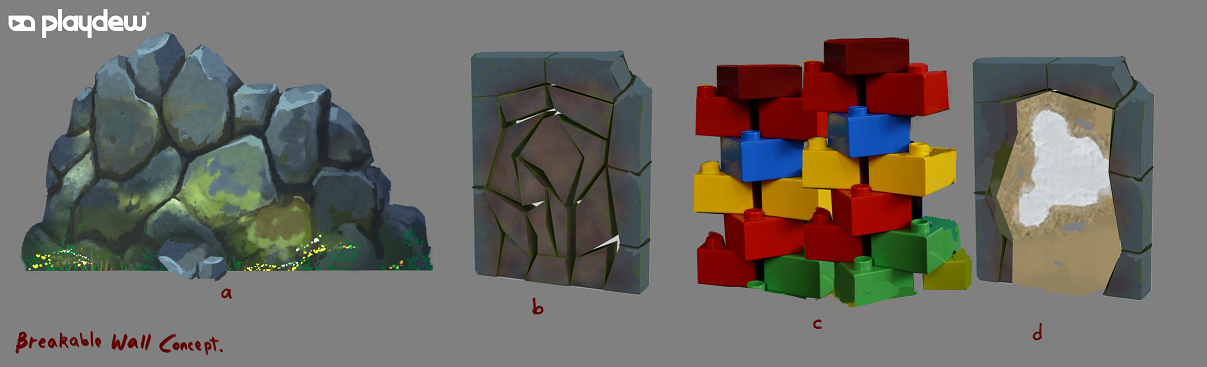
We went through a bunch of ideas to figure out exactly how this wall should look. In terms of visual presentation, our aim was to depict the idea using stone fragments that appear as a cohesive wall when assembled. Each individual stone mesh was given an outline to enhance its visual attractiveness.
Our team of artists constructed a wall using numerous stone meshes, skillfully combined to create the illusion of a wall that can be broken. To emphasize the impact upon collision with the car, we divided all meshes into three distinct sections. As the impact would originate from the center, we organized the meshes into a single parent for the central portion, while the left and right meshes were placed under separate parents.
Physics Mechanics:
For each stone mesh, we've affixed both a Unity built-in rigidbody and a mesh collider. Before the collision effect takes place, we've adjusted the isKinematic attribute to true. Additionally, a box collider corresponding to the wall's height has been created and properly positioned at its center.
To identify impacts, we've harnessed Unity's built-in OnCollisionEnter function. This function detects collisions and triggers our own functions for wall destruction if the colliding element is identified as an electric car, based on its layer assignment.
Wall Destruction:
Upon the wall's demolition, our initial action involves resetting the isKinematic attribute to false, thereby enabling the operation of all relevant physics principles. Subsequently, a force is applied to the stone meshes positioned at the center, aligned with the car's motion trajectory.
To make it more realistic, we've also applied torque on these stone meshes, introducing a randomized rotation effect. Following the collision, a gradual fading effect is applied to the stone meshes, culminating in the complete removal of the wall from the scene.
Feast your eyes on our captivating video that beautifully encapsulates this gameplay wonder in action.
Stay tuned for more updates
Best regards, Playdew team
Dev log #21 - Designing & Developing UI
Greetings, fellow adventurers! Today, we embark on an exhilarating expedition into the heart of UI/UX design and development, unearthing the treasures that await both in-game interactions and menu experiences within our forthcoming masterpiece.
Our journey into UI design began with a clear vision in mind – a harmonious convergence of functionality and elegance, all wrapped within the embrace of minimalistic aesthetics. A touch of innovation adds a delightful twist – instead of the customary Main Menu, we welcome you to our dynamic Home screen, a living nexus pulsating with uncharted possibilities and immersive engagements.
Accessibility has been a cornerstone of our design philosophy. We've painstakingly crafted an interface that's harmoniously navigable using a keyboard or controller, with the mouse taking a backseat. This choice empowers players to effortlessly immerse themselves in our world, regardless of their preferred input medium. But this is merely the beginning of our creative journey.
Consistency is the lifeblood of an exceptional UI, and our game is no exception. To seamlessly blend the UI with the gameplay experience, we've woven the concept of 'wisps' into our design language. These ethereal beings serve as both creators and concealers of our UI elements, further immersing players into the game's mystique.
Smooth animations are the secret ingredient that elevates our UI from functional to delightful. By striking a balance between fluidity and speed, we've ensured that interacting with UI elements is a seamless experience. No more waiting on tedious animations to finish before tweaking settings or interacting with the UI HUD – we're all about keeping the frustration at bay.
Transitioning to mobile devices required innovation. Each control was meticulously optimized for touch interaction, without compromising the immersive gameplay our users deserve. It was a brainstorming journey where every tap and swipe was scrutinized to harmonize with the mobile experience, maintaining the magic intact.
Thank you for your continued support, and we'll see you next week! Keep following us on social media! See you next week!
Best Regards, Playdew Team
Devlog#20: Introducing puzzle element - Piano
Hi guys! Get ready to step into the world of adventure with the twins as we embark on an exciting journey through the latest developments in our project! In this Devlog, we'll be unveiling one of the captivating features we created - a piano. We found it intriguing to include music puzzles where every key press orchestrates a symphony of moving Lego pieces, dancing in a mesmerizing wavy structure.
Upon pressing each key, corresponding music symbols are spawned, connecting them with symbol-based Legos, adding another puzzle element to the game. When the spawned music symbol matches the targeted music symbol, the connected Lego structure is then dragged to its final position.
The Toyzone Piano is a true visual delight, resembling a toy-like piano stretching out like a giant to cover nearly an entire piece. This magical instrument features a total of 17 keys, thoughtfully organized into octaves, just like a real piano
At the heart of this magical instrument is a sophisticated system we crafted from scratch. The process commences with a precise key detection mechanism, ensuring seamless interaction between the player and the piano. When you approach a key, our technology swiftly checks if your position aligns within its bounds, signaling the beginning of a harmonious interaction.
The true magic happens as you press a key—subtle yet intricate. Each key has been carefully designed to respond to your touch, allowing it to gracefully rotate in the y-direction, mirroring the force you apply. The result is a seamless and immersive experience, immersing you in the fantasy of playing a real-life piano.
But it doesn't end there. The piano understands the ephemeral nature of creativity, and as you move away from the key, it graciously returns to its original position, patiently awaiting your next virtuoso performance.
We hope you've been inspired and delighted by the magical piano, the enchanting music symbols, and the wondrous mechanics that have been meticulously crafted just for you. As we continue to push the boundaries of creativity and innovation, we couldn't be more excited to share even more thrilling adventures and surprises in the future. The fun has only just begun, and there's so much more in store for you!
Best regards, Playdew Team
Devlog#19: Introducing puzzle element - Toy Car
Greetings, fellow adventurers! Today’s devlog is about one of our most cherished elements: the Toy Car. Inspired by the boundless imagination of childhood play, we've crafted a feature that will not only ignite nostalgia but also provide an exhilarating experience for players of all ages. We explored different options to create a seamless fusion of fun and physics and to create the perfect balance between simplicity and excitement, allowing players to control the car effortlessly while still experiencing the thrill of speed and acrobatics. Ben or Abi could ride the car to break walls, push buttons or go to unreachable areas by speeding up the car & jumping off ramps.
Physics and Controls:
Creating the Toy Car's physics and controls was a fun challenge. Since our game isn't a racing genre, we decided to keep the car's physics relatively simple. The car would only move either left or right, so we designed compound colliders for its wheels and body. With a rigidbody added to the parent object, we could easily control the car using rigidbody.AddForce().
One interesting design decision was to make the car's visual rotate around its axis when changing direction. While it doesn't perfectly emulate real-life car behavior, this approach allowed us to navigate tight spots in some areas seamlessly. From the camera angle, the car's movements still looked natural and didn't detract from the gameplay experience.
Realistic Tire Rotation:
To add a touch of realism, we worked on achieving proper tire rotation. We used a simple circumference formula to calculate how much the tires should rotate while moving forward. Additionally, the rotation of the left or right wheels was synced with the car's direction, enhancing the immersion and giving players a sense of control.
Exciting Jumping Mechanics:
Jumping off ramps became a thrilling and dynamic part of the gameplay. We carefully scripted the jumping sequence by exposing variables in the ramp's script through the Inspector. This allowed us to control the car's trajectory while in mid-air, ensuring it would land perfectly on the other side of the jump. To add a cinematic feel, we also slowed down time during the jump, heightening the excitement for players.
Responsive Trigger Colliders:
We incorporated extra trigger colliders for various purposes. Firstly, to detect whether the car was in the air or not. When the car wasn't grounded, user keypresses wouldn't generate forward thrust, making the controls feel responsive and realistic. Additionally, a front trigger collider was used to detect when a wall was in front of the car. If the user still pressed forward, the car's wheels would rotate in place, the body would shake, and a cloud of ground dust particles would be generated, enhancing the immersive experience.
And there you have it, the captivating tale behind our beloved Toy Car adventure! We hope this devlog has given you a glimpse into the passion and creativity that went into crafting this unique and enchanting experience.
Thank you for joining us in this devlog. Stay tuned for more exciting updates and insights into the development of our game!
Best Regards, Playdew Team
Devlog#18: Introducing puzzle element - Fan
Welcome to the latest edition of our Toyzone devlogs. Today, we are delighted to introduce a captivating new feature: the Fan! This addition injects a breath of fresh air (quite literally) into the gameplay, enhancing the interactive elements and offering players exciting new challenges to conquer.
To enhance the gameplay mechanics, we have introduced a battery system to power the fan. Players now have the task of ensuring a reliable power supply in order to activate and control the fan's movement. By connecting the fan to a pressure button, players can easily activate it with a simple press, adding a satisfying tactile element to the gameplay.
From a visual standpoint, the Fan is designed to resemble a delightful toy-like pedestal fan. One of the standout visual features is a captivating ring-like element on its side view. When the battery is connected and the fan is powered, vibrant blue lines rotate within the ring, providing players with a clear visual cue of the fan's activation status. This subtle yet effective indicator enhances the overall immersion and engagement.
The mechanics behind the fan's movement were carefully developed, utilizing the concept of RPM (revolutions per minute) to accurately represent its circular motion. Through a meticulously crafted formula, we combine the RPM value with degrees per second, which indicates the extent of rotation within a second. Taking into account factors such as delta time and the fan's speed, we calculate the distance covered in revolutions per second. As players increase the speed of the fan, they will witness a greater rotational velocity, resulting in a more dynamic and captivating gameplay experience.
While the fan's introduction serves as a gentle introduction to the puzzle element in the initial levels, we have exciting challenges in store for subsequent levels. Our intention is to present players with intriguing scenarios that require not only activating the fan but also locating and properly positioning the battery within the container. This added complexity ensures that players must strategize and think critically to progress, offering a satisfying sense of achievement upon successfully overcoming each level.
Here’s a video to provide you with a comprehensive preview of the fan's mechanics and its impact on gameplay. Witness firsthand how the fan operates, from activation to varying speeds, and gain insight into the intriguing challenges it presents.
We hope you've enjoyed learning about the intricate mechanics, visual enhancements, and engaging challenges that the fan brings to the game. As we continue to refine and polish Toyzone, we are thrilled to have your support and enthusiasm.
Stay tuned for future devlogs, where we'll share more updates, behind-the-scenes insights, and thrilling features.
Best regards, Playdew Team
Devlog#17: Introducing puzzle element - Battery
Hi! Today, we will delve into the exciting mechanics we have developed for Toyzone. We explored countless ideas, seeking the perfect concept that seamlessly blends the whimsical world of toys with the challenge of solving intricate puzzles.Our focus was on finding a concept that would align with toys while also creating connections between elements. That's when we came up with the idea of using batteries and their containers.
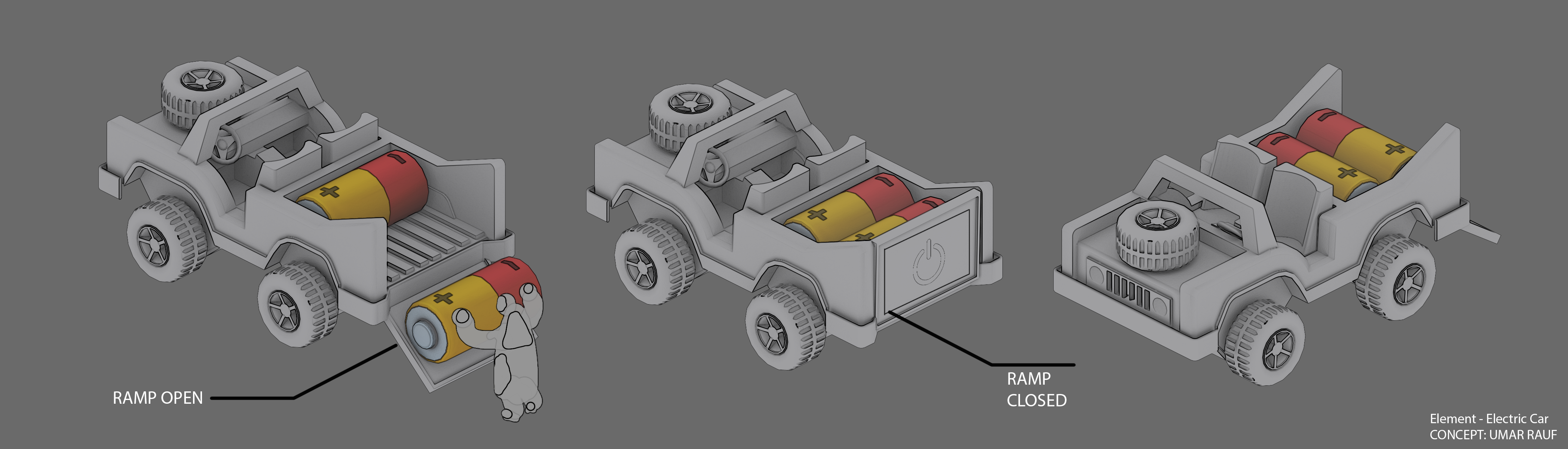
The battery container, specifically designed for our game, features two slots for batteries. The unique twist is that when a battery is missing from one of the slots, the container becomes unable to supply power to other connected devices. These devices could range from a fan to an electric car, each requiring a functional power supply to operate effectively.
To implement the mechanics for the batteries, we built upon the foundational functionalities of our existing orb/boulder, which we extensively discussed in our previous devlogs. Leveraging these functionalities allowed our character to interact with and push the battery effectively. Furthermore, we developed additional functionalities to facilitate the battery's connection with its container. When our character successfully rolls the battery into the designated container, the container activates, initiating the power supply to other connected devices.
To ensure a smooth learning curve, we designed the initial levels to introduce players to the puzzle element gradually. In these levels, we filled the battery container with both batteries, allowing users to familiarize themselves with the mechanics and understand the concept. However, as players progress to subsequent levels, we deliberately left both slots in the container empty, presenting them with a more challenging task of figuring out how to roll the battery into the designated container to restore power.
Here’s a visual demonstration of this exciting gameplay feature, showcasing the mechanics in action.
The incorporation of the battery and container puzzle elements adds an intriguing layer of complexity to Toyzone, offering players a unique and rewarding gameplay experience. Stay tuned for more updates as we continue to enhance the game with new and exciting features!