The last Mask of the Rose devlog of the year comes from our creative director, Emily Short.
Mask of the Rose doesn’t try to be true to the realities of Victorian London, and that’s not just because of the supernatural elements in the mix. The characters don’t speak in true Victorian diction: instead, they use language that sometimes suggests their setting, but is hopefully still familiar enough to players to feel comfortable. We didn’t want accuracy to come between players and a sense of connection.
And there are lots of things we left out of our world because they weren’t what the story is about. What happens if you move a city already suffering from severe sewage management issues into a dank, enclosed space? We probably don’t want to know.
Very often, what we were looking for was not rigorous accuracy or even plausibility. (This is a world full of Rubbery Men and talking crows. Plausibility departed long ago.)
Instead, we were looking for fitness and specificity. All these research materials, we used the way John McPhee is said to have used a Webster’s 1913 dictionary: as a treasury of images, incidents, and character observations more perfectly suited to the story we were telling than any we could think of on our own.
Here are a few of the more entertaining or surprising resources we found along the way.
Neathy Animals
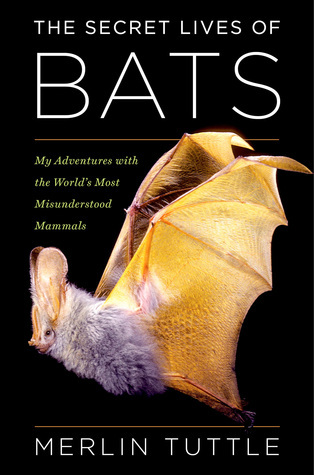
We knew that bats – of several kinds – were going to have a starring presence in Mask of the Rose. After all, they did steal London. It was fascinating to learn more about how bats smell; how they hunt; what they eat; and how they mate (often upside down). The Secret Lives of Bats, by Merlin Tuttle is loaded with stories, images, and pro-bat advocacy.
Meanwhile, when we wanted to know how a rat population might react to a sudden change in the circumstances of the city, we listened to this podcast on Urban Rodentology with Allie Ward and Bobby Corrigan. The discussion that covers how rats in New York City reacted to Covid lockdown fed straight into Ferret’s dialogue. Or, from the same podcast, we also recommend this piece on Corvid Thanatology, which is to say, crow funerals.
London Subcultures and Daily Life
There are reference materials we’ve used to establish Fallen London for many years: Henry Mayhew’s London Labour and the London Poor is a classic. For Mask, we wanted some fresh inspiration and, especially, to look for cues that would set London of the 1860s apart from London of 1890-1900. London and Londoners in the 1850s and 1860s is a memoir by Alfred Rosling Bennett, made up of scattered memories from his childhood. It is full of details from exactly the era we want, and often evocative in a way that other histories might not be:
The coffins were covered with black cloth… a very familiar street sound in those days was the tack tack tack of the undertaker’s hammer as he nailed on the cloth in his shop. He did it with a kind of rhythm that rendered the process unmistakable.
Novels have been an important source as well. One of our favourites was Amy Levy’s Reuben Sachs, a beautifully observed story of life in a reasonably well-off Jewish family. It’s the sort of book that’s well worth reading whether or not you’re writing a game on related subjects.
We also spent quite a bit of time with the records of criminal trials at the Old Bailey. This was often a depressing read: stories about real people committing murder are rarely as fun as a fictional mystery, and they often exposed poverty and desperation more than anything else.
But there are other surprises to be found in the recorded case testimony. One constable discovered a death in his neighbourhood because he habitually provided wake-up calls, knocking on the door at a time requested by the inhabitant – and he noticed when the person who lived in a house stopped putting a mark on his door indicating when he wanted to be woken. This sort of detail about how early constables interacted with the neighbourhood helped shape our concept of Harjit.
Of course, one can’t write a poisoning murder without some information on the relevant substances. There were a number of books that came in handy here, but especially The Arsenic Century: How Victorian Britain Was Poisoned At Home, Work, and Play. Read this, and you’ll wonder how any Londoners survived to become Edwardian.
Immigrants in London
Lady Login’s memoirs describe multiple places and situations with a bearing on Mask, from the voyage to India to details of childhood in early 19th century Scotland. They’re very much a product of their time, and the attitudes of their author come through in ways that don’t always flatter her – but the acute and specific observations were useful.
For Phoebe, the Irish housemaid, we drew quite a bit from Fin Dwyer’s Irish history podcast, which covers the great famine, the surrounding politics and culture, and the aftermath in detail.
This one isn’t a book or even a podcast, but Equiano Center’s map of Black Londoners shows the variety of Black stories in 19th century London. Horatia draws strands from several different historical figures, without being an exact match to any of them.
And though it isn’t a primary source or a piece of serious historical writing, Amitav Ghosh’s extensively-researched Sea of Poppies gave us a better sense of how the lascars of London’s docklands might act and speak.
How Characters Might Interpret the Neath
Lilith’s Cave: Jewish Tales of the Supernatural, by Howard Schwartz. We came to this book through the question “how would people steeped in Jewish traditions interpret the strange things they find in the Neath?” Fallen London for the most part labels things in the Neath based on a Christian cultural context. But would people with a different background see devils the same way? Understand death or ghosts in the same terms? Lilith’s Cave is a great book for dipping into, with stories that run just a few pages.
Meanwhile, our consultancy on Jewish Londoners suggested that we might want to learn more about Jewish messianic movements in order to understand how his contemporaries might have read David’s death and return. That led us to the Sabbatai Zevi series on the Seforimchatter podcast. Seforimchatter hosts long, academic discussions of books on Jewish thought and history, designed for a Jewish audience. There was far more here than we needed to know for Mask, but the conversations were so interesting that we found ourselves listening to further episodes in our spare time.
Models for Spoken Language
Not all research is setting research. When writing dialogue for a lot of characters, it can be helpful to look for speech models, just as an artist might use models and anatomical references even to draw an imaginary character.
For the different cadences of different speakers in Mask, we listened to samples from the BBC Voices project, a large collection of spoken dialects from around the British isles. And episodes of Rumpole of the Bailey helped us flesh out how characters would speak in a courtroom.
Writing Romance and Sex in Games
Writing for Mask also meant we needed to write a number of romantic and sexy scenes with our characters. This wasn’t new territory, but insight from other developers remains very useful.
Michelle Clough’s Passion and Play suggests a number of handy comparisons and examples from other games, and lays out a triad of approaches – sacred, mundane, profane – to describing physical intimacy as part of a relationship and character arc.
And quite a bit else.
Writing the characters and situations of Mask of the Rose took us through topics as varied as symptoms of agoraphobia; Anglican evensong liturgy, with particular attention to the assigned readings for early October of 1862; Sikh teachings on gender and sexuality; Parliamentary record-keeping; real-life personal accounts from people who had had family and loved ones go missing; Victorian Valentines; Georgian-era abolitionist movements; the identity and location of the oldest tree in London…
Character Reveal: The Clay Lodger
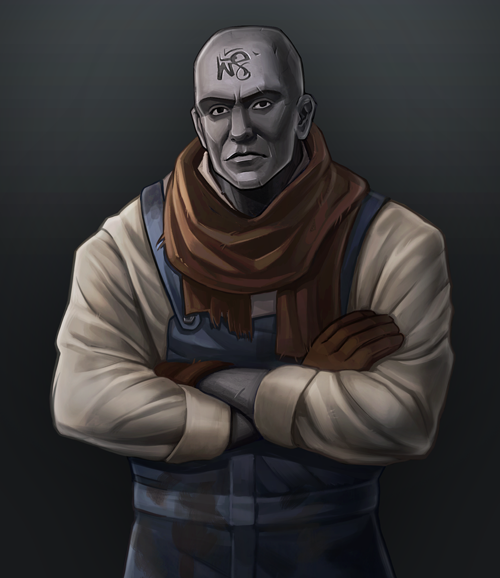
Today, I'd like to introduce another supporting player in Mask's cast - the Clay Lodger. Or, perhaps we should use his real name: Moss-on-Limestone.
The Clay Lodger was introduced as a stretch goal back in our Kickstarter campaign. For those familiar with our other titles, his introduction was intended to signal our inclusion of other Neathy characters in Mask, diversifying the range of characters within the cast.
For those unfamiliar with our wider setting, Moss is a Clay Man - which is very much what it sounds like. The Clay Men hail from the living city of Polythreme, an ancient power across the sea from London. In that city, all manner of things are said to be alive and speak with their own voices - including its statues.
Clay Men have appeared in several of our titles as recurring characters, ship officers, romance options, both as stalwart companions and bitter enemies. Clay Men have a particularly prominent role in Fallen London, where they've developed a long and complicated relationship with London following the Fall.
Mask, being set some thirty years before Fallen London, offered a space to explore the development of that relationship from its outset - to investigate what that initial encounter might have looked like, both in how Londoners might have reacted to the Clay Men, but also how the Clay Men adjusted to life in London.
All that said, we wanted Moss to have a unique perspective and a personal history specific to him, rather than to act as a stand-in for the entire body of Clay Men as a whole. We also knew from the Kickstarter that Moss carried with him a mystery of his own.
We took the opportunity to work out some of the more unexplored elements of Polythreme's relationship with London - and the cities that came before it. In doing so we were able to establish a timeline for Moss' involvement with the fallen cities - and to chart areas of pre-Fall history involving the Clay Men that we've not had a chance to explore before. There are, we hope, some fun connections with our established lore too, grounded in a new perspective; that of a Clay Man beginning to establish his identity outside of the familiar structures - and strictures - of his homeland.
Developing Moss' voice took some work - we wanted him to have a unique cadence, contrasting that of other characters. This has manifested in a number of ways. Chiefly, in his affect - his personality operates in a different register to many of the other characters. He is not perturbed by the events of the Fall, but like most of London, he is a fish out of water and struggles to keep up with the brave new world in which he finds himself.
The other way Moss presents differently from the rest of the cast is his use of 'Loamsprach,' the language of the Clay Men. We were, alas, unable to establish a complete and accurate English-to-Loamsprach dictionary, and instead have resorted to including a variety of phrases in the original language, which punctuate Moss' speech. Close observers may even be able to discern their meaning here and there.
Moss will appear around Yuletide to take up a room as a lodger in the boarding house. To say more about the circumstances surrounding his arrival at Horatia's would be to invite spoilers. Suffice to say he is likely to experience some turbulence fitting in - unless, of course, the player chooses to take an interest in this taciturn Clay Man and help him find his feet as he establishes himself in this new London.
Quality Assurance in Mask of the Rose
As we get closer to the end of a project like Mask of the Rose, we shift our focus from making new things to improving the quality of what’s already present. Some of that takes the form of subjective polish; for example, tweaking a character’s art a little to make them more expressive (or dreamy 😉). On the writing side, we might make changes such as altering the pacing of the game in response to a playtest.
However, a large (perhaps larger, by time spent) aspect of quality is less subjective; bugs! QA is particularly important when it comes to getting to grips with this latter category. During a project we test work continuously, typically performing testing of each new feature or chunk of writing, along with periodic regression testing (playing through the game to check if anything has broken). Normally some of the issues detected during development can be deferred (i.e. don’t have to be solved immediately) because they are dependent on other features that will be done later or because some functionality is intended as a placeholder. We still record everything, because we don’t want bugs to slip through the net; but later on in the project is when programmers tend to focus more and more on eliminating bugs, and spend less time on new features.
In Mask of the Rose, for example, all of our planned feature programming is complete. For example; all the UIs are in place; the game save system is implemented; and an audio system manages sounds and music.
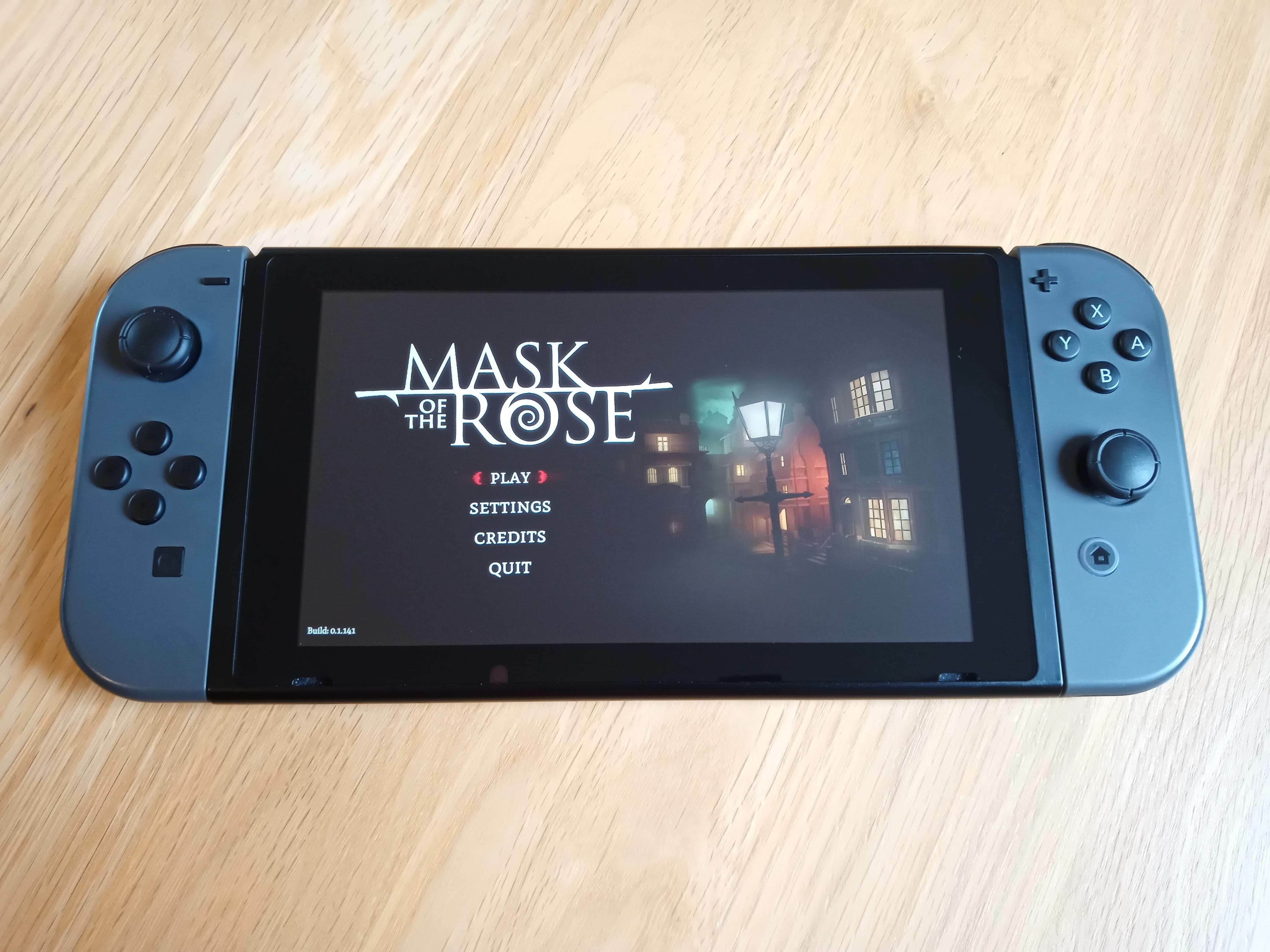
That does not mean the work is over! For the last couple of months our core Mask programmer, Séamus has been working closely with Lesleyann, our Principal QA Tester, to tackle bugs and improve performance. In fact, their work has been centred on a very specific purpose; Mask is the first Failbetter game that will launch simultaneously on PC/Mac and console (Switch).
It’s been important for us from early on in this project to always maintain a working build of the game for the Switch. There are a few reasons for this.
The Switch, being effectively a mobile platform, acts as a hardware baseline; even the more modestly specced PCs and Macs that Mask targets have more usable memory, hard drive capacity and CPU power than the Switch. This next point is oversimplified, but in essence; if we can get Mask running well on Switch, Mask will also run well on lower-end desktops and laptops. Therefore it “keeps us honest” about how complex features like graphical elements can be.
It also keeps us honest with regard to gamepad support. Historically, Failbetter titles have been primarily developed for mouse and keyboard control, with gamepad support either added later or not given the same level of focus. In Sunless Skies, we weren’t happy with how gamepad support turned out in the initial PC release, so when we set out to publish our own console ports (also a first for us) we were keen to take the improvements from console and make sure they made it back to PC and Mac in the Sovereign Edition. However, because we hadn’t given gamepads equal weighting from the start of Sunless Skies, there were technical compromises we did have to make to give gamepad and console players a better experience. In Mask, maintaining a build on Switch forces us to focus on the quality of both the gamepad and the M+KB experience.
A final reason to build on Switch early is because shipping a game on console is a unique challenge. Platform holders have extensive lists of technical requirements that games must fulfil. For example, most consoles limit the frequency to which we can write to the storage memory, to prevent physical wear to the drives. Another requirement might be to only use specific, authorised terminology to refer to the console’s controllers.
Before we can release the game we must check that it is compliant with these requirements, fix any issues, test everything, and then submit builds to the platform holder to perform their own testing. That means the release process on console must start earlier than on PC, and this is what Les and Séamus have been focusing on recently; getting to the point we can submit a build to Nintendo that gets the famous “Seal of Quality” from them!
Our other area of increased QA focus is writing. Here, also, Mask presents new challenges. In previous Failbetter titles, writing was very modular. In Sunless Skies, for example, a story can be tested as a stand-alone unit. This is because the player has lots of discrete, self-contained experiences as they visit different ports across the High-Wilderness. Stories tend to only act on each other indirectly; such as via the resource economy, or the completion state of an earlier story. It is also quite unlikely for a writer to accidentally trap the player in a dead end. Because of these properties, we know that bugs introduced by adding a new story will normally be confined to that one story, and the states of the playthrough that could affect the story are less numerous, making testing simpler.
But if Sunless Skies is like a short story collection, then Mask of the Rose is closer to a novel; every character and storyline is interwoven. Mask is also the first time we have used the Ink scripting language instead of our in-house content management system. The Ink script in Mask is fiendishly complex, reactive and programmatic; this is the most player-responsive title we’ve ever made.
Furthermore, with no way to “escape” faulty content (think about how you can simply leave a port in Skies if a desired option is unavailable), we have to work hard to spot the type of critical writing bug that can cause the game to “dead end”.
This has meant that we’ve had to rethink how we perform narrative testing, and are deploying automated narrative testing for the first time. Séamus has developed a tool that allows the writer to run a piece of content thousands of times outside the game engine before it’s integrated. This acts as a first line of defence against the dreaded dead ends, because we can tell if one of our randomised, automated runs gets stuck on a particular version of the script.
A graph illustrating the player’s routes through Mask of the Rose (simplified)
This approach isn’t bulletproof, because there can be differences between how the testing tool behaves and how the game engine behaves; there are often serious bugs at the interface between tech and writing. A purely stochastic tool will also make arbitrary decisions, which result in many runs that represent an atypical player experience. To bolster our approach we’re also performing extensive manual, in-game testing, and are working on a few ways to extend the capabilities of our autotest tool; for example, to allow writers to specify different “player profiles” that make the computer player focus on certain human-like behaviours such as pursuing a particular romance option.
Every game comes with its own set of challenges for the developers, not least in QA. However it’s easy to overlook this discipline from the outside, because QA work is invisible until something goes wrong. I hope this blog gave you a little peek under the mask! Thank you for coming on this journey with us as we extend the capabilities of our studio to tell a very different tale to the stories we’ve told before.
Smooching monsters in Mask of the Rose
We've been loving the Steam Next Fest, so we're coming back for another live stream!
Join Hannah from 2000 BST (1900 UTC) on the 8th of October.
The chat were pretty feral for flirting last time - this time, should the real treasure be the friends we make along the way?
Join us to find out!
Mask of the Rose Next Fest LIVE!
Join us as part of Steam Next Fest for a live stream featuring as yet unseen nooks and crannies of Mask of the Rose!
Hannah will be on hand to show you around, including a first peek at storycrafting in action.
Join us from 10am BST on the 4th of October and watch Hannah attempt to pronounce everything Mr Pages says without tripping over herself.
See you then!
A new trailer!
This month it’s me, Hannah, here to shout and jump up and down and wave my arms in the air because we have a new trailer for Mask of the Rose and I love it like I love - I was going to say my children, but today one of them punched me on the leg and told me I was bad, so. What I’m saying is I’m fond of the trailer. Here it is:
This trailer was made by Derek Lieu, game trailer maestro. His YouTube and Tiktok are masterclasses in what makes a good game trailer, fascinating even if it isn’t your job!
Here'd Derek talking about how the Mask of the Rose gameplay trailer came together.
Which parts of Mask of the Rose made you go, oh, that bit has to go in the trailer?
The line from Mr. Pages wanting to know about the taste of the hearts was one which immediately stood out. It made me laugh and inspired so many questions. The line “permanent murder” is also utterly fantastic. When searching for “good trailer dialogue” I look for something which says a lot about the world and the characters, in as few words as possible. “Permanent murder” is probably the shortest and most evocative two words I’ve ever had in a trailer. This is why I used both of these moments in the opening of the trailer to hopefully hook the audience.
I think Mask of the Rose is full of this sort of dialogue which feels like it could only belong to this world. I typically go for games with either spoken dialogue or action, but the writing drew me to the game despite the difficulty of making visual novel trailers.
When you're making a trailer for a narrative game, is there anything you approach differently than for eg a platformer?
For narrative games I always start with dialogue. I play as much of the game as I can and then I ask for either the voice files, screenplay, or more typically, a MASSIVE spreadsheet of dialogue. In this case it was the Ink files with their mix of code and text.
Then I delve into the dialogue, find the parts I think could work best, and try to create a story which illustrates a mix of the world, the characters’ situations, and the game mechanics. The dialogue I select and edit together is the backbone of the trailer which creates the dramatic structure.
I liken making a story trailer to being given a several thousand piece jigsaw puzzle, which I then have to select maybe a couple dozen pieces and make a picture which feels representative of the complete image. Or at the very least, representative of one section.
Aside from starting with dialogue there are still fundamentals of trailer structure which I always follow for every trailer I make. This is based on the information necessary to answer basic questions, and subsequent questions that come after. For example: What is this? What is happening? Why is that interesting? What makes this unique? How big is the scope?
What are the challenges of making a visual novel trailer?
The main challenge with visual novels is that text is the primary content, but using a video to deliver text can be terribly dull. Even though social media video and apps like TikTok show people are ok with reading a lot of text in videos, it’s still hard to make text engaging in a trailer.
Some visual novels’ strategy is to make trailers which use flashy motion graphics to add motion and visual flare to the game art. I understand this approach, but I feel like this focus on the visuals is to the detriment of the novel portion.
When relying on the words, the challenge of making a trailer is saying and showing a lot as quickly as possible. Thankfully, I had the Failbetter writers available to take my selections and tighten them up where necessary. It makes a huge difference if I can make a line shorter by even one word, while retaining the core message.
Something that I think would surprise people is the extent to which we've had to reconstitute bits of the game in different configurations to make them make sense in a trailer. Is this typical to your work across genres?
Yes, absolutely! I’m always looking for ways to make ideas and visuals clearer and easier to digest for the trailer audience. Whether this means removing HUD/UI elements in shots where they don’t contribute to the idea currently being shown or removing text which distracts from what I want the audience to read.
I’m always doing the “squint test” where you squint your eyes to blur your vision, and check whether or not the thing you want people to look at is the first thing you see. For example, if you’re in a room with a light source, with blurry vision, the light will be the first thing you see, the second thing will either be the next brightest, biggest, or most colorful thing, and so forth.
This means some of the shots have less text in them than you'll see in the finished game, but you're more likely to have finished reading any text I did show in the trailer.
For narratives I often have to put dialogue out of order to tell the story, because sometimes a line later in the story provides exposition which helps explain things at the beginning.
Is there a bit of the Mask trailer that you're particularly pleased with?
I love how the backgrounds blur out in the shots Paul [Arendt, art director for Mask of the Rose] created for the “sexy” montage. Combined with the music and the dialogue, I think that section creates a great feeling. If we did our job well, people should be reaching for those GIFs of sweaty people fanning themselves when they see it, haha.
I was especially satisfied when my wife laughed at the funny parts of the trailer. Seeing someone react with the emotions I intended to elicit is always very gratifying.
This was a fun one to work on! Most of my work is usually in capture and editing, so it was nice to play in such a richly realized world where the images are created mostly through text. I hope it pleases fans of the Fallen London games who might not play visual novels, and intrigues visual novel fans who aren't familiar with the series.
Production Update and UI Revamp
This month we have an update about Mask of the Rose’s user interface, but first, we have some news about the release date. Unfortunately, we’ve decided to delay release until April 2023.
Lately, we’ve been seeing signs of an over-tight schedule: mounting stress levels, team members becoming reluctant to take time off.
In this situation, there are three things we could do in principle. We could ask our team to put in significant overtime to meet the current schedule, but it’s important to us to provide a good workplace where everyone has time for personal and family life. We could cut features and parts of the story, releasing a game that didn’t fully meet our intentions and ambitions. Our sense, though, is that our players and backers would rather get the game later in its best state, rather than sooner in a worse form. So that leaves us with the third option, moving back the schedule.
We don't expect to move the release again, and we'll have a specific date for you in the next few months. We hope you'll bear with us for a little longer.
Now, here’s artist Tobias Cook with a look at Mask of the Rose’s improved UI.
UI is vitally important for a game like Mask of the Rose, where the player spends most of their time reading and any actions they take are via an interface. It’s important that the UI also has a character of its own that enhances the atmosphere of the wider game, as well as providing a pleasurable and effortless reading experience.
So, after the Kickstarter campaign was complete, we sat down and took a hard look at every part of the Mask UI. Was it doing everything it needed to do to support and enhance the rest of the game? How could we make it better?
The public demo released in February featured a work-in-progress version of the resulting UI revamp, and it has continued to improve since then.
Our first objective was to improve the way we present text. We consulted with Joseph Humfrey of Inkle as part of this process, and found his help invaluable when redesigning our narrative interface. This system delivers text in an intuitive and digestible manner even with multiple cast members present. It also has enough space to accommodate our many font options, as well as supporting the whole range of actions the player can take, such as making a choice unlocked by a clothing option or opening their notebook in order to interview a subject.
We also remade key interfaces such as the Wardrobe, Map and Character Creation, with the aim of aligning them with the game’s new look and promoting readability and atmosphere at every opportunity.
About that look: Mask of the Rose is a romance at its core. However, the world in which it takes place is in a state of upheaval. Much of London is still fractured by the Fall, with opulence and ruin sharing the stage. We wanted the UI to support and echo these themes. For us, this meant departing from Visual Novel staples like text boxes and bubbles; breaking text out of both containers and vertical alignment, giving a sense of both the risque and the grit in the decoration and colours, all whilst maintaining readability. Sort of like a high-contrast, post-apocalyptic boudoir.
Mask of the Rose features a broad range of font configuration options, from adjustable text speed to sans-serif and non-cursive text variants. We have three separate font sizes (including one large enough to make viewing on a Switch screen comfortable) and multiple font style options. This can be challenging: we have to leave enough space for everything that isn’t text, while making sure that any combination of font and size options (of which there are… lots) still looks good. Still, with reading at the centre of the game it’s vital that players can tailor text appearance to their needs and tastes, so it’s well worth the effort.
Ultimately, we feel that Mask of the Rose presents the most fully featured and mature UI presentation in any of our games to date. We look forward to you getting your hands on the finished version upon the full game’s release in April 2023.
Storycrafting: love stories and murder theories
This month's devlog is from Mask of the Rose developer Séamus Ó Buadhacháin.
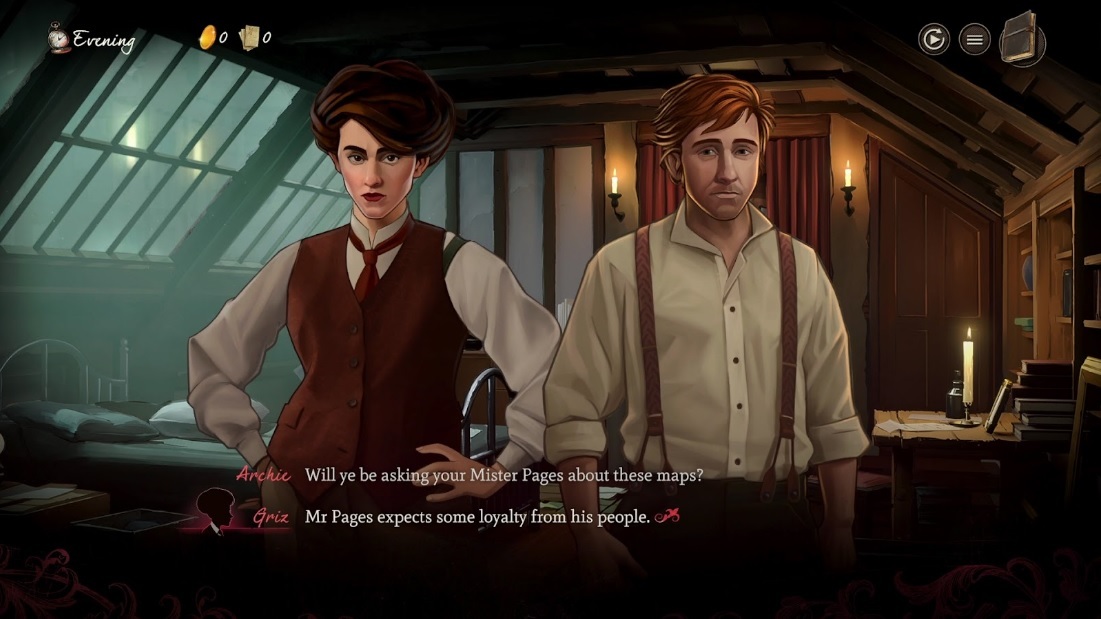
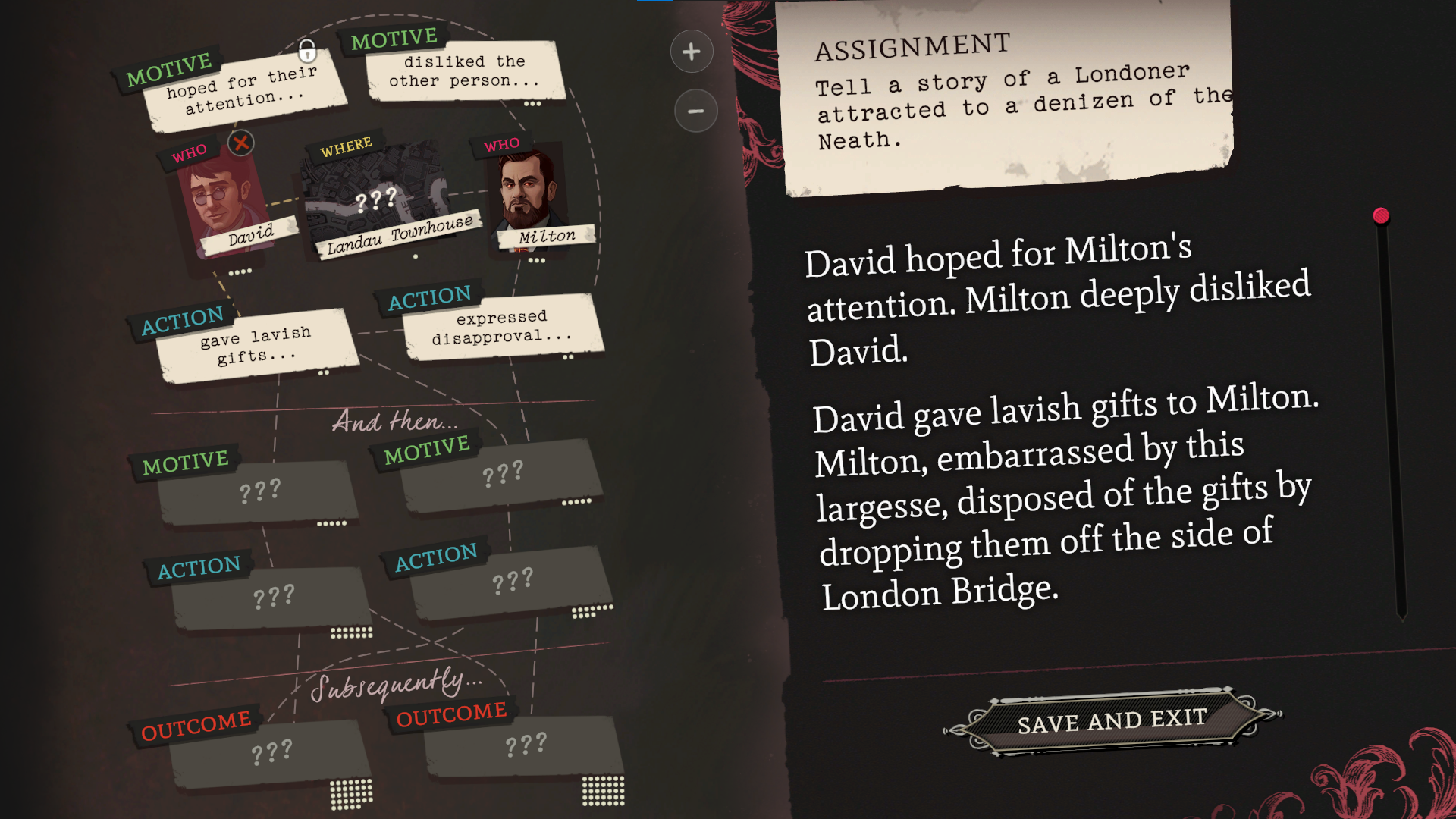
Griz hoped for Archie's attention. She gave him a diamond stick-pin, one of her few possessions of value left from home. Archie, embarrassed by this largesse, disposed of the gift by dropping it off the side of London Bridge.
At the behest of one of the mysterious hooded figures that run London these days, I'm trying to write a love story. It isn't going entirely to plan.
The value of stories — in creating or collecting them — crops up time and again in Failbetter games: from a side activity in the Fallen London early game to the career-spanning Ambitions in Sunless Sea and Sunless Skies. In Mask of the Rose, we've finally made it possible to read the stories that you write. As you play through Mask, other characters will come to you looking for help with stories of one sort or another: Harjit, the local constable, has crimes to solve; Rachel, a novelist, is struggling with a case of post-diluvian writer's block; other, stranger characters have other, stranger concerns. Taking on and fulfilling these commissions brings you into contact with storycrafting, Mask's innovative storytelling sandbox.
Storycrafting is a fairly simple idea (like many simple ideas, it conceals a great deal of complexity). Given a prompt — say, "Tell a story of a Londoner attracted to a denizen of the Neath" — and a set of empty slots arranged in a stylised version of the classic cork-and-red-string murderboard, your task is to fill those slots with characters, motivations, and actions that form the outline of a story that satisfies the prompt. The twist (of course there's a twist) is that, as you do so, your choices are fed into a vast expansion-grammar engine — similar in principle to the outfit-description system we blogged about back in March, but on a significantly grander scale — that takes your choices and weaves the story itself around them. As you make changes to the board on the left-hand side of the screen, the story you're creating updates itself on the right, in sometimes surprising ways.
The arrangement of slots on the board is constant between commissions: each story has a protagonist and a deuteragonist; each follows a kind of three-act structure. The people and ideas you can fit into these slots, though, vary both with the particular commission and your progress through Mask's storyline. You'll start with some available — you already know the residents of Horatia's boarding house, for example, and your chosen background may give you other insights — and learn others through gameplay. Discover a plausible motivation for a character and that motivation becomes available for use on the board.
Of course, not all motives and actions are plausible for every character. Anyone (almost) can fall in love, but not every character can scheme to steal your soul at the same time. Part of the challenge of storycrafting is finding a set of ideas that make internally consistent sense, and the game enforces this. Pick a motive that's inconsistent with a character you've already chosen, and the game will require you to choose another character (or another motive).
In this respect, storycrafting shares a lot of its DNA with solving a sudoku puzzle. Just as a sudoku solution is constrained by certain rules ("digits must not be repeated in a column"), so is a storycrafting commission ("Virginia cannot plausibly be motivated by a sense of simple decency"). At a sufficiently abstract remove, the task is the same: fill empty spaces in a way that satisfies a set of rules.
But where a (well-formed) sudoku has a single solution, storycrafting commissions are designed quite differently. We've gone to some lengths to ensure first that a given commission can be completed with a very large number of possible ideas, and then that the story generator can handle whatever combinations of character and motive you throw at it. A large part of the fun of storycrafting, we've found in internal testing, is throwing together unlikely combinations of ideas, and seeing how the story warps itself to accommodate them. A closer antecedent than sudoku — in fact, one of the reference points when we were designing the storycrafting systems — is something like Oskar Stålberg's wonderful Townscaper, where each block of the city you construct subtly changes its shape to respond to changes in neighbouring blocks.
[This isn't a technical blog, so I'll note in a very brief sidebar that all three of these things are still fundamentally the same thing: constraint networks at different points on a continuum of solution-space size. If you have a certain kind of computer-science background — in which case, my condolences — then this will likely have already jumped out at you as obvious.]
The fictional rewards for fulfilling a storycrafting commission vary. You (usually) get paid to do so, of course: always a strong motivation for writers in the Neath and otherwise. Helping other characters here can benefit you in other, less obvious ways, though: you may end up owed a favour in high places, or be able to use a particularly compelling story to influence events down the line. So it's not just an engaging mechanic in its own right; it's integrated into the broader story in a way that gives it some real stakes.
Storycrafting is quite a hefty feature in Mask — about a sixth of the codebase by weight, the last time we checked — because, in a way, it's doing two things at once. If yours is a puzzle-oriented kind of brain, you'll hopefully enjoy the process of teasing out the underlying rules that determine what makes a valid storycrafting commission. On the other hand, if what you've been looking for is a kind of interactive fanfic generator, we may have what you've been looking for. Either way, I hope you enjoy it!
Meet Ivy
This month's devlog comes from our Creative Director, Emily Short
There are a handful of characters in Mask of the Rose that we’ve not introduced, and who don’t appear in the demo. Today, let me introduce Ivy.
Most of our characters were defined before we ran the Kickstarter, but we left ourselves room to develop a few more, to address any requirements as we wrote the game.
By the time we came to developing Ivy, we had a few pieces of critical information about the role she plays in the story, which I won’t spoil here. Aside from those, we knew we needed to add a character who was:
A Wardrobe Source. We wanted to let the player purchase outfit items from multiple characters, both for variety and for narrative plausibility. Ferret might peddle questionable and used outfits, but it’s less likely that they’d be in a position to sell new or upscale garments.
Connected with Hallowmas. Mask touches on several nascent London festivals. Hallowmas is the first in the calendar, though we don’t see much about it in the truncated scope of the demo. Hallowmas is a feast of confessions and personal change – and while it hasn’t reached anything like its final form by the time of Mask of the Rose, there are plenty of people newly arrived in the Neath who have things they need to get off their consciences.
We also wanted to introduce a character to our roster who was female, and working class. The Kickstarter left some of our character list open to backer choice, and as it turned out, the selections were male or masculine-presenting – so we wanted to add some more femme to the mix.
Griz, Rachel, and Horatia have different histories and relationships to wealth, but none of them grew up in true poverty, and Horatia inherited the house where she now keeps lodgers. And while Phoebe is a servant, she’s still living in a comfortable household.
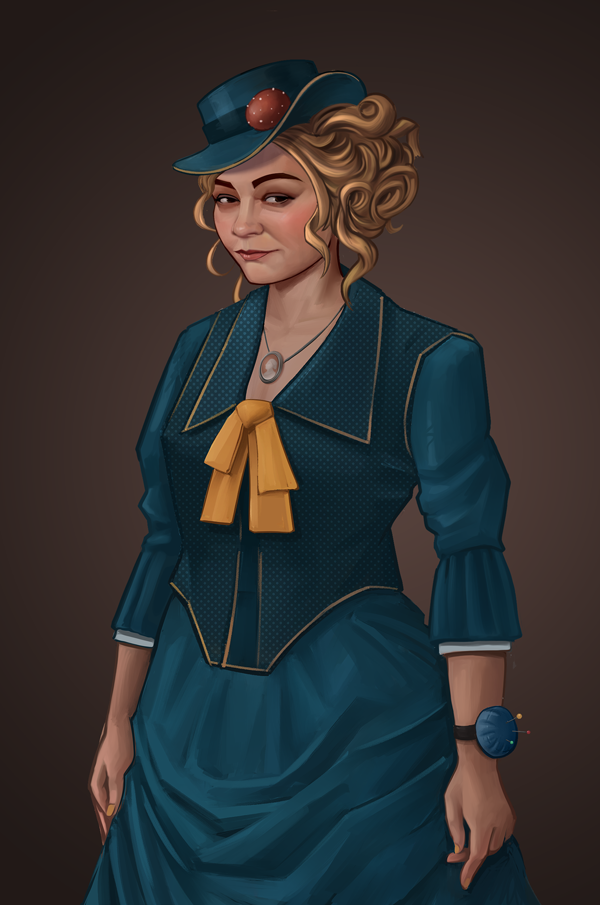
That combination of features suggested the idea of a bohemian seamstress – someone talented and crafty, but who had really had to scrabble up from the bottom, and who might not have done it in the most respectable way.
We also saw her as someone inspired by the Neath’s strangeness and terror, rather than overwhelmed. As I told Paul, our art director: of all the characters in the game, she’s the most likely other than the player to be wearing a mushroom in her hat.
That’s still a lot less information than we can usually offer in an art brief. When briefing characters who are already written into the story, the writers can often provide reference photos for people we think look similar; sample dialogue; suggestions about the character’s posture and physicality; and guidance about their most common moods.
For this character, we didn’t even have a name – but that’s where art stepped in. Here’s what Paul brought back:
I immediately fell for this character. Her saucy smirk suggests someone who knows more than she says – and someone at home in the place London has become. Not everyone enjoys the Neath. Ivy sees its possibilities, and they give her life.
Dear Reggie
When it came to deciding our cast for Mask of the Rose, we knew we wanted to include a range of characters both old and new from our long-running browser game, Fallen London.
We wanted our cast to offer a variety of perspectives and experiences on the events of Mask of the Rose, while keeping to our goal of a tightly focused and scoped game. Returning characters had to both add something unique to our cast while offering room for exploration and mysteries unfamiliar to players both familiar and unfamiliar with Fallen London. We therefore had to be parsimonious with our roster of characters and strict with ourselves when it came to including too many iconic characters from Fallen London, which features a cast of hundreds.
We offered a range of characters we were excited to explore further, in their pre Fallen London days, as offerings at our highest backer tier. The character selection answered our above criteria, and we were delighted thinking of the possibilities each could add to the game. In the end, two were chosen by our generous backers at the Minister Tier: the Tentacled Entrepreneur, and the subject of this blog, the Bishop of Southwark.
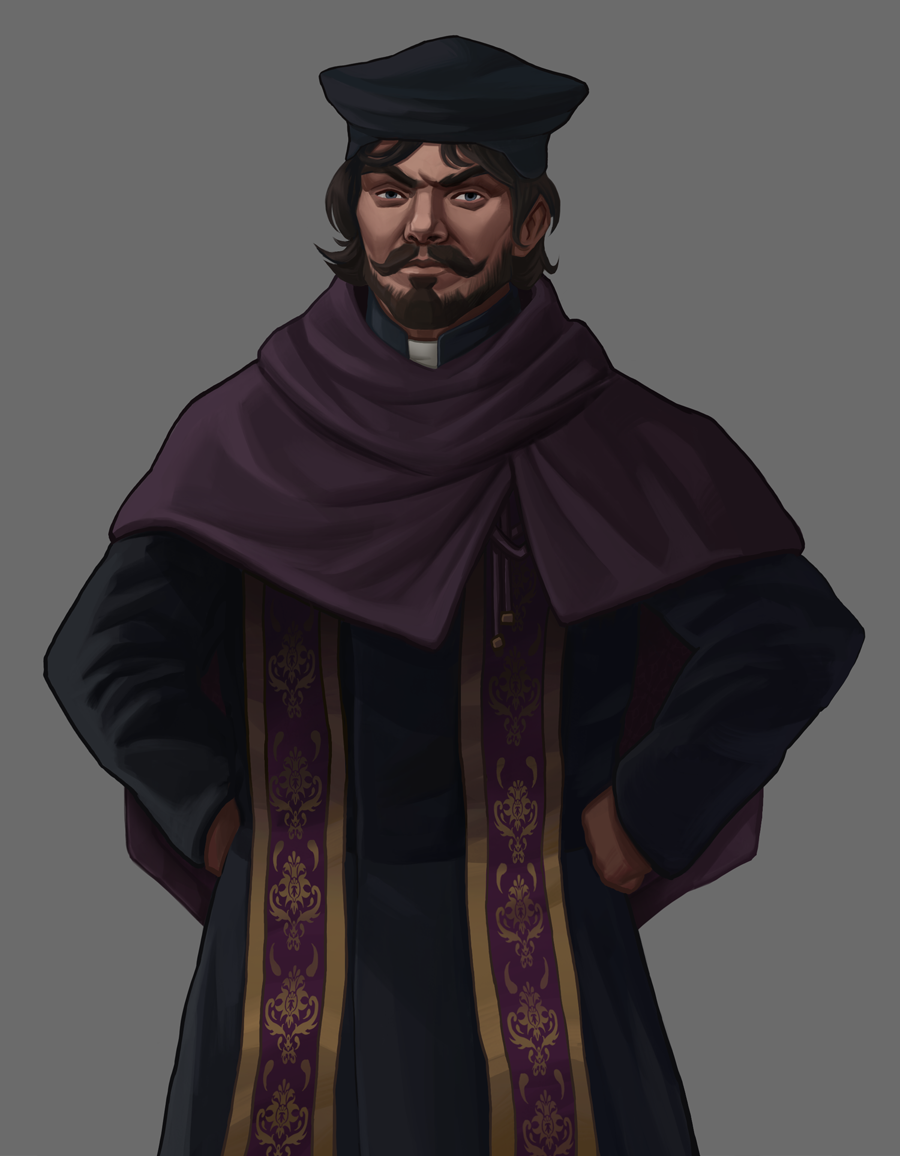
The Bishop has long been a favourite of ours at Failbetter and we were extremely pleased to learn he was going to be joining our roster of characters in Mask of the Rose. The thunderous, rambunctious Bishop of Southwark is a fiery, complicated character, both humorous and tragic. The Bishop, or Reginald, as he's known in Mask, is a long-time fan favourite in Fallen London. He blusters, he shouts, he's a champion pugilist and he plans to make war on Hell. The Bishop of Southwark is a pillar of the community and a force to be reckoned with, a shouting stentorian subversion of what we imagine a Victorian vicar to be. Over the years we've enjoyed exploring the story of this fan-favourite and complicating the narrative of this seemingly severe churchman.
We've delved into his backstory in Fallen London before, but we realised we didn't know much about Reginald's origins: where did he come from? Why did he join the Church to begin with? What motivated him to undergo such a drastic journey to reach the position he's in by the time Fallen London rolls around? We quickly realised we had a lot of story we wanted to tell with Reginald and many questions we'd yet to answer.
From there it was a case of working out where he fits into the narrative as a whole - we wanted to fit him seamlessly into the world when he appears in the second act. This meant understanding which characters he was likely to meet and which events he was likely to be present for. This also involved imagining his reactions to everything that has happened prior to his first appearance and everything that occurs from there in the game. Ultimately we wanted to ensure players who wished to spend time with our good friend Reggie would be rewarded for their investment in him.
We also wanted to use him as a point of contrast with our other, more established churchman, Theophilus. Theophilus is, initially, a steadier figure ensconced in St Alban's, where Reginald finds himself seconded as a young canon. The two quickly establish the dynamic of their relationship, grounded in their contrasting views on just about everything. The player will have plenty of opportunities to get involved in the conflict, as both men are invariably tangled up in each other's plots. We wanted to use this contrast to explore differing perspectives within the Church on the events of the Fall, and subsequent approaches to life in the Neath. Reginald's inclusion add another lens on our exploration of characters of various faiths responding to the calamity and opportunity of the Fall, to go alongside Theophilus, Harjit and the events at the Tentergrounds Synagogue.
Reginald is our vehicle to both delve into the origins of an iconic Fallen London character and show him in a whole new light while also providing a fresh angle on the people and circumstances of Mask of the Rose - including, of course, the player character. While we can't promise a fully fledged romance with Reginald (if nothing else he's not really at a stage in his life where such a thing would be anything other than disastrous), we can certainly say this hotblooded priest is full of surprises. And, of course, we can finally reveal the origin of Reginald's love of resolving disputes with wrestling…