We're joining LudoNarraCon with Mask of the Rose this year!
Come by our store page this weekend and you'll find a repeating stream of various videos designed to excite and intrigue:
A guided tour of the demo with Hannah (aka me, Communications Director at Failbetter Games)
An interview with Séamus (programming lead), looking at how Mask of the Rose remembers your choices
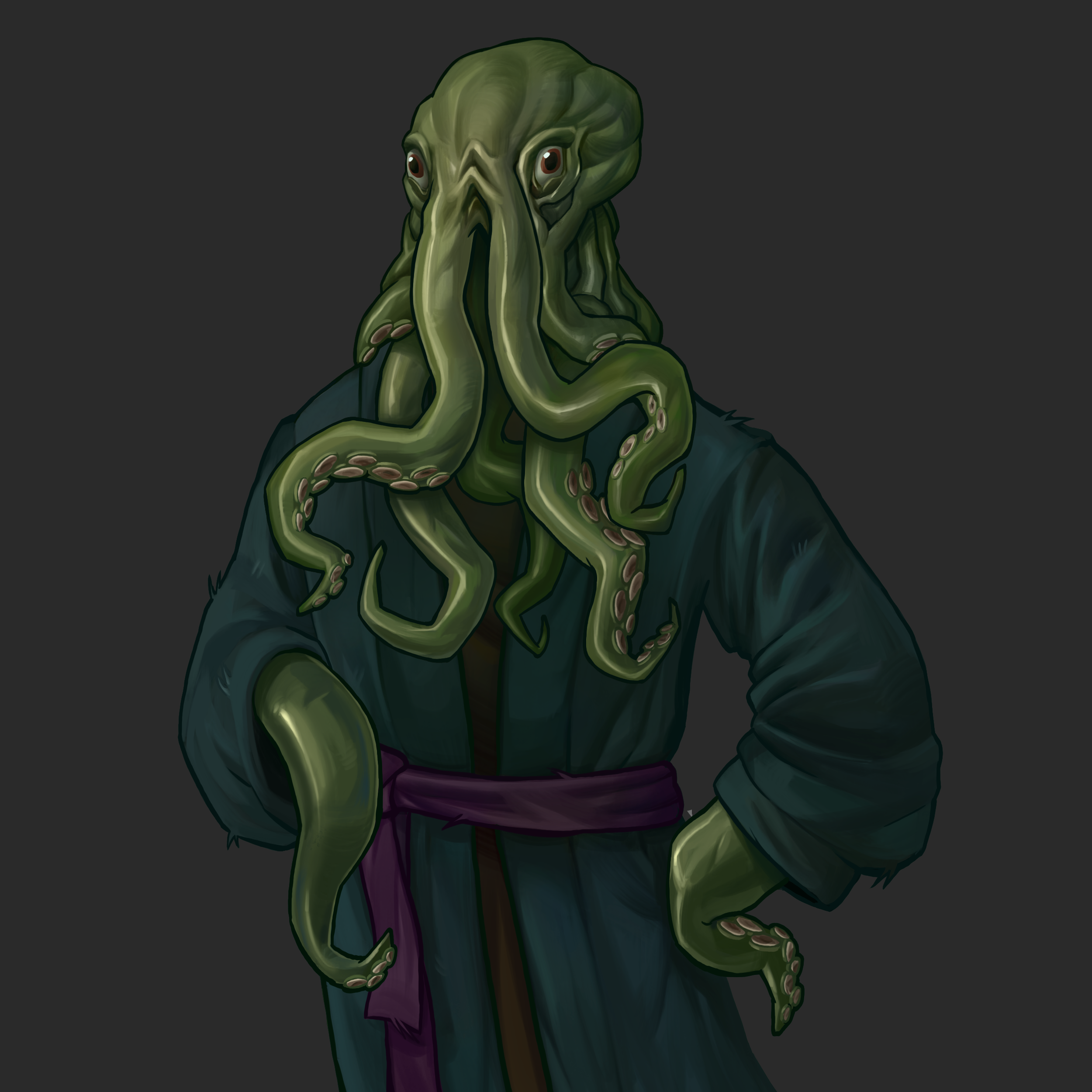
An interview with Paul (art director), talking about character design and sharing the process of developing an as-yet-unseen game location!
A new view on something rather exciting which Fallen London players will certainly recognise...
The video will be on a loop all weekend, so you can pop in and out as you like.
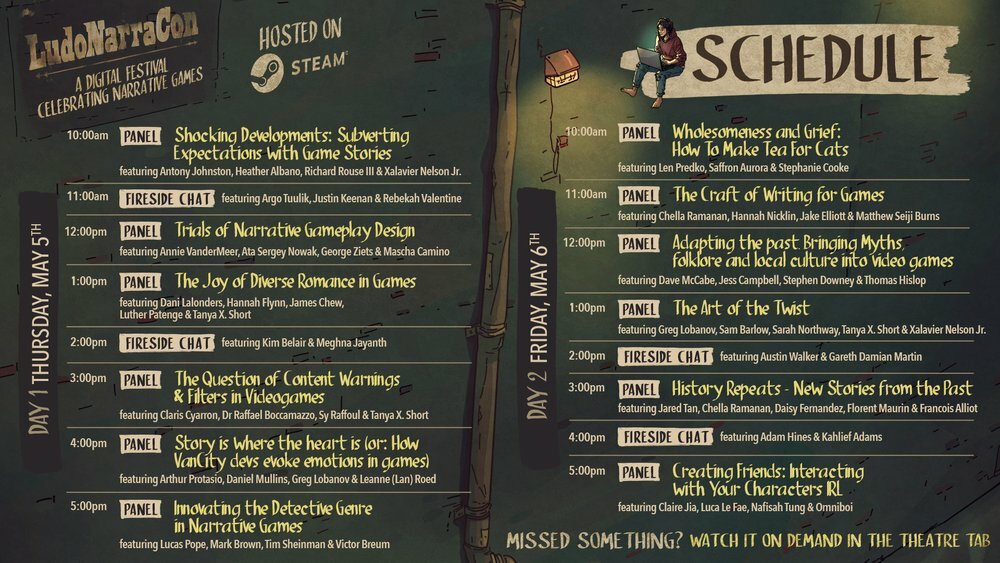
LudoNarraCon is a Steam festival celebrating narrative games. We're also appearing on a panel called The Joy of Diverse Romance in Games, alongside the teams behind Ambition: A Minuet in Power, Boyfriend Dungeon and ValiDate. Catch the panel live at 1pm PDT tomorrow, Thursday the 6th of May! Once it's been recorded, it'll be available on demand from the Theatre tab on the event page.
We hope you enjoy this glimpse of Mask of the Rose's development!
Production update: tentacles, codices and proto-Bishops
This month's update is from producer and sound designer Stuart
Greetings, Delicious Friends! This month, I’d like to update you with a general overview of the state of progress on Mask and let you in on some of the challenges we still face in the last few months of production.
Artwork
We’ve now finished artwork for all the characters in the game. You’ll have met most of the major players if you’ve played the Mask of the Rose Demo, but we have almost as many secondary characters to introduce in the full game, including some familiar faces included thanks to our backers.
Our other primary type of art in Mask is location art. Our pipeline for backgrounds uses three steps: render the basic geometry of the scene in 3D; add colour and detail with digital painting; then light and animate.
We now have all the backgrounds present in the game, but many still need bringing to life with this final stage; adding in animated elements such as fog and swarms of bats, and the character lighting that makes London appropriately atmospheric. This kind of work sounds minor, but it’s the difference between the game looking “just okay” (and a bit flat), or looking polished and inviting.
Writing
Mask is split into three seasons; Confessions, Yule, and Love. In the demo, you experience a (much truncated) version of the Season of Confessions (you’ll have more time to look around and introduce yourself to the cast in the full game). This is followed by the Season of Yule, which introduces the murder investigation and is the longest season in the game. The Season of Love is shorter, but arguably the most important; this is when the murder mystery concludes and tender feelings blossom amongst the characters.
Currently, writing has been done up to the end of the Season of Confessions and the end of the Season of Yule, although we’re still weaving some additional characters into the Season of Confessions. We’ve introduced a second writer to the project, James, to help Emily by writing the plotlines for specific characters. Those who enjoyed his work on the Church in Fallen London will appreciate what he’s done with the not-yet-Bishop-of-Southwark!
The remaining goals are to reach end-end playability and bring all the threads to satisfying conclusions in the Season of Love. This is what Emily and James will focus on finishing in the next few months.
Tech and Gameplay
All of the major user interfaces are now in the game. Séamus and Toby recently finished work on a nifty “codex” menu that stores all the player’s information, such as relationship events, murder clues, and a conversation log.
The biggest gameplay feature still in progress is Storycrafting, the player-driven storytelling mechanic we use in different ways to represent the player character taking “commissioned” work for NPCs and theorising about the murder. Storycrafting involves activities like crafting love stories for Pages, generating page-turning plots for Rachel, as well as a few “tails” you might not expect. Alongside tech and UI work, this feature also requires writer work to populate the features with story possibilities.
Sound
Composer Laurence Chapman has delivered versions of most of the pieces in the game, and we’ve signed off on them ready for recording. We still have a few left to hear and approve, which he’ll be delivering to us between now and May, with a final recording session organised in June.
As well as new tunes you didn’t hear in the demo, you’ll hear fresh versions of familiar themes in the full game. The music is being re-recorded with live instruments (the demo mainly used solo piano performances and sampled instruments). We’re very excited to share the soundtrack with the world and think backers who nabbed it will be happy with the final product. The soundtrack has become a “work music” mainstay for some of us at Failbetter already.
For my part, I’ve finished up on the ambient sound design which complements each unique location you visit.
“Just Ship It!”
All that sounds like we’re pretty close to done, right? Well, yes and no.
We normally prioritise the biggest and riskiest chunks of work first, to allow us to produce an end-end playable build as soon as possible. That leaves us with a long list of smaller tasks to mop up. Some examples:
Art: Icons for use in storycrafting and wardrobe choices for the player.
Writing: Content for achievements and backer rewards.
Tech and Gameplay: Audio and graphical options, such as support for letterboxing on ultra-wide screens.
Sound: Special sound effects to punctuate particularly dramatic moments.
The full list (it’s a spreadsheet, of course!) is a great deal longer. On their own, these tasks are small, but in aggregate they become time-consuming.
A second time-consuming activity is polish and bug fixing. Hemingway said “the only kind of writing is rewriting”; so applying the same logic, the only kind of game development is fixing bugs. (And because we’re making a narrative game, it’s rewriting as well.)
Finally, there’s significant work surrounding the release of the game, work which, if it is done well, is invisible to the player. Particularly notable is that we are planning to ship on Switch at launch; the first time we’ve done simultaneous release on console and computers. Developing for Switch is a bit like trying to make a mobile version at the same time as the PC version, and on top of that, there’s a rigorous process of console certification.
None of this should be read as a pessimistic assessment. We’re still on track for a fabulous romance this Autumn; but although the finish line seems tantalisingly close, the team and I know that the last mile is the hardest.
Dressing for Success in Mask of the Rose
This month's development blog is from Failbetter programmer and principal developer on Mask of the Rose, Séamus Ó Buadhacháin
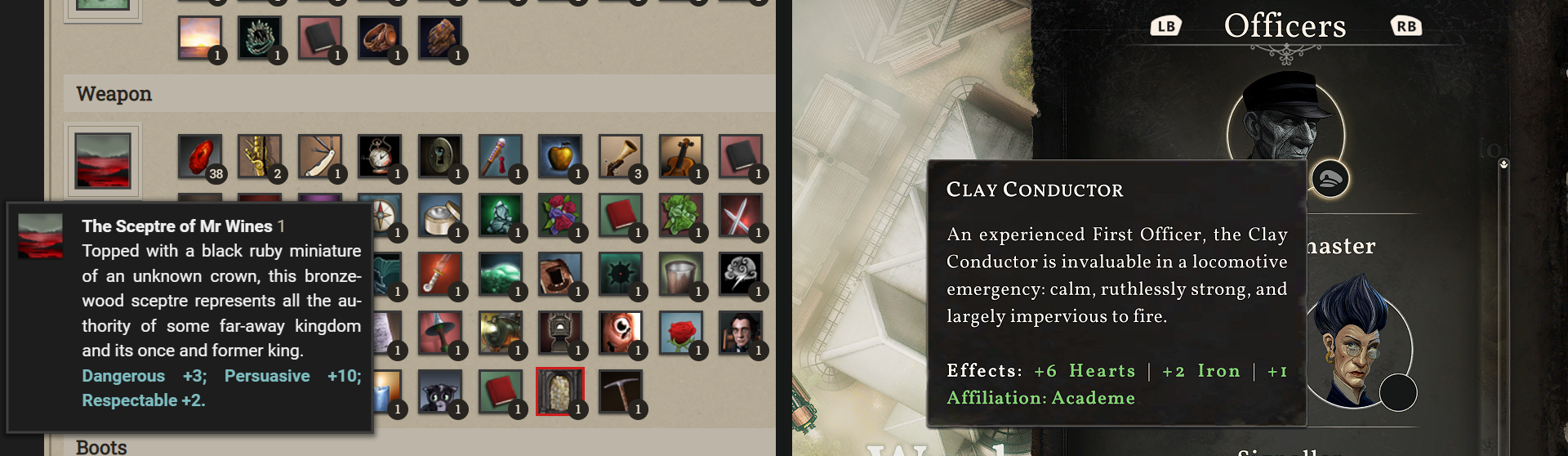
As our Creative Director Emily Short has written, Mask is deterministic in places where our previous games have used randomness: success in a given challenge depends not on a die roll but a combination of variables affected by the choices you've made. But your outfit certainly still matters: present yourself as an avatar of the law, for example, and prepare for difficulty ingratiating yourself with people on the other side of it.
Communicating this kind of effect to players is, of course, a pretty crucial part of any outfit system, and there are some fairly standard ways of doing so. We've presented the effect of your wardrobe in our previous games in traditional RPG fashion: if carrying around an unexploded mine helps you win arguments, or having an incognito princess aboard your locomotive makes it easier to get along with space-faring bohemians, this is explained to the player with visible changes to the underlying variables that are being modified: the relevant number goes up or down. It's a tried and true system and it's especially well suited to games with random challenges and a lot of stats to track.
Mask is designed as a chattier, intimate experience, and quite early on in development we decided that the wardrobe view should work towards this design goal too. There are still a dizzying number of variables at work driving any interaction, but baldly describing a given hat as +1 Coquettish didn't seem to fit the theme quite so well this time. So, as you'll have seen if you've played the demo, when you put on a set of outfit items, the wardrobe view talks back to you instead: your own player character telling you, in English, how you're likely to come across when you leave the attic room you call home.
This is something we could really only pull off with Mask's comparatively tight scope. (It would certainly be entirely out of the question in Fallen London, for example, where some back-of-the-envelope maths suggests there are around 120 billion outfit combinations.) Even in Mask, though, the number of potential outfit combinations is comfortably in the thousands, far beyond what's reasonable to ask a team of writers to describe one by one. Handling combinatorial explosions like this requires a certain amount of algorithmic deftness. Or, to put it another way, we have to cheat a bit.
Our particular style of cheating borrows from formal language theory. The underlying model for outfit descriptions is a grammar: a set of x → y rules for replacing something on the left-hand side of the rule (x) with something on the right-hand side (y). Suppose we just want to let the player pick a choice of hat, and to describe it. The rules for describing hats might look like this, with the hat in question on the left-hand side and its description on the right:
ordinary hat → "a perfectly fine hat"
fancy hat → "a fabulous choice of headwear"
hideous hat → "quite a… novel and fascinating hat"
no hat → "a very brave choice, not to wear a hat"
With a certain amount of care in how we frame it, we can embed this hat-description rule into a longer text in such a way that we will always generate a well-formed sentence if we replace it; a template, in other words:
"That's ! You're sure to make a splash."
When we want to talk back to the player, it's pretty straightforward: check what they're wearing; find a rule that matches what they're wearing; and substitute in the right-hand side of the rule. If the player's wearing an ordinary hat, for example, we can replace with the right-hand side of the rule for describing an ordinary hat:
"That's a perfectly fine hat! You're sure to make a splash."
This is a pretty basic system, certainly, but we're off to a decent start. If we now let the player change shoes, and add some rules for describing shoes…
fancy shoes → "What lovely shoes!"
ugly shoes → "Your shoes are quite… remarkable!"
no shoes → "I do hear bare feet are quite en vogue."
…we can update our top-level outfit description to embed a shoes-description rule as well:
"That's ! "
Let's say the player is wearing a hideous hat, and no shoes. Expanding this new outfit rule step by step — hat, then shoes — produces first (by finding a matching hat rule)
"That's quite a… novel and fascinating hat! "
and then (by finding a matching shoes rule)
"That's quite a… novel and fascinating hat! I do hear bare feet are quite en vogue."
We might not be being terribly candid, but we've managed to produce a coherent opinion. (The Mask PC's internal monologue is more honest.) Any combination of hat and shoes should work: find a matching hat-description; find a matching shoes-description; fill out the template. The results will tend to look suspiciously similar, tipping our hand to the algorithmic work going on behind the scenes, but we can do something about that later.
You may have already noticed a quietly important property of this approach: by writing 4 + 3 = 7 rules (plus a top-level outfit-description rule), we're able to describe 4 × 3 = 12 different outfit combinations. Another pair of shoes would increase this to 16, but we'd only need to write one more rule. This will continue to scale as we add more outfit items: strictly speaking, we only need a linearly-increasing number of rules to describe a geometrically-increasing set of combinations. This becomes especially handy when we go beyond just hats and shoes to describe, say, the player's coat or gloves, and the extra multiplicative terms cause the number of potential combinations to grow even more quickly.
This efficiency gives us some breathing room to finesse the system. One thing we can do to make our system fancier is add some rules for special cases: noteworthy combinations of particular items, for example. Let's add some shoe-description rules to apply when the player is wearing a particular kind of hat as well:
(ugly shoes, hideous hat) → "And the shoes match perfectly!"
(ugly shoes, fancy hat) → "And the shoes make a delightful contrast!"
If we agree, when looking for a rule, to always pick the rule that matches the largest number of items in the player's outfit, then we'll pick these if (and only if) the player is wearing both items, and our outfit description for (ugly shoes, hideous hat) will expand, step by step:
"That's ! "
"That's quite a… novel and fascinating hat! "
"That's quite a… novel and fascinating hat! And the shoes match perfectly!"
We can write some more specific hat-description rules, too; and, in fact, we can write some extremely specific top-level outfit rules, for outfit combinations that are so outré that the entire structure of the description template ought to change. It's a very effective way to start getting that sameness we observed earlier out of the system; with a few dozen such rules, we can produce good descriptions for thousands of combinations. (A number of unusual special cases are handled like this in the Mask demo, and it might be rewarding to revisit the wardrobe with this in mind.)
We're still not done in terms of what's possible, either: we can add multiple rules of equal specificity and choose randomly between them, to provide even more variation. And, while so far we've restricted ourselves to just using what the player is currently wearing, we don't strictly need to: we can also consider things that have previously happened. Any aspect of the game state that can be expressed in a similar way can be fed into our system, if we want. So there's really nothing stopping us from writing rules like this:
(hideous hat, player-has-met-the-aliens) → "a novel and fascinating hat, quite improved by the scorch marks from the aliens' death rays"
(Well, nothing but considerations of taste in narrative design, perhaps.)
In fact, this last idea — that you can take arbitrary bits of a game's state, pass it through a set of grammar rules, and produce coherent, meaningful textual content — is extremely powerful in the right hands. Once the technical pipework for describing outfits is in place, it's easy to generalise it and apply it wherever it's useful.
This has enabled us to give Mask's text some real dynamism. We've used it for a number of other gameplay systems in Mask, some of which are already at work in the demo and some of which are under development for launch. It's been extremely rewarding to work on and test internally; I hope you enjoy the finished product!
Play the Mask of the Rose Demo!
Today it’s been exactly a year since Mask of the Rose was funded on Kickstarter. We have a surprise for you, and some news about the release date.
First, the surprise. We have a demo of Mask of the Rose, available right now from the store page!
And look at the shiny new user interface!
Offering a condensed version of Act I of Mask of the Rose, you’ll be able to explore select locations across the city, introduce yourself to some key characters and encounter Mr Pages in its office at the Bazaar.
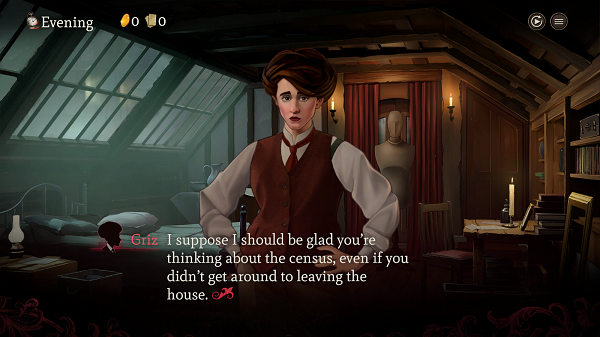
At the opening of Mask of the Rose, Mr Pages has employed your housemate, Griz, who has in turn found a few pennies’ work for you as census taker. The census goes some way beyond the expected (Surface census forms never did ask if anyone in the residence was in love), so you’ll need to approach conversations with care to find out all you need to know.
Demo Feedback
We are absolutely champing at the bit to see your reactions to the demo! Other than our Steam forums, the very best places to talk about it will be on Discord, our forums, and the Fallen London subreddit.
There are a few things it’ll be useful to know before you send feedback:
In the final game there will be a text log, so you can scroll back through conversations
There will also be audio sliders under Settings
And of course, there will be saving in the finished game (the final version of Act I will be fleshed out from this version, so carrying choices over wouldn’t be possible).
Spotted a bug?
The demo has been through our internal testing, but if you see any bugs or typos we missed, please let us know by emailing mask@failbettergames.com, attaching your player log. Here are some instructions to help you find your player log.
We will probably only update the demo if something pretty bad has slipped through, but this will let us fix everything before we release the full game. Thank you!
Release Date
Our other major piece of news is that Mask of the Rose now has a clear release window. We now plan to release it in late October or November this year. Unfortunately, this is four or five months later than we estimated for the Kickstarter.
The main reason is that as we moved through pre-production, we realised the game would benefit from adding or extending some features we hadn’t expected to when we ran the Kickstarter.
The most important of these is a flexible mechanic that allows the player to create stories about the other characters. These might be love stories (always a valuable commodity in Fallen London), or, hypothetically, stories about a certain murder and why it happened…
When we were putting together the Kickstarter, we knew there would be some way of crafting stories to hand in to Mr Pages, and we had some general ideas for the mechanic. Our prototype showed us that there was more potential in this concept than we'd initially allowed for, and therefore we wanted to make it richer. We decided against a couple of other minigame concepts we were less excited about, and instead committed to doing this one well and deeply. There’ll be a future blog post talking about this in more detail!
We've also expanded the expressive capacity of some of the game's other systems. For example, we always knew that characters would have poses and expressions to communicate their moods, but have moved from having a relatively small set of options for each character to one where head and body poses are separate, and there's now procedural work going on to place the characters in the scenes. These things let us communicate NPC emotional state with more fidelity, show more of the state of your relationship with that character outside of the immediate conversation, and add some visual liveliness to the longer conversations.
Character facial expressions and body poses can be hand-scripted to respond to particular moments in the story, but if the author hasn't specified, there's a whole set of default rules. Characters have emotions depending on what social interactions you've just had with them, or (failing that) will fall back to looking happy if you have a history being especially kind to them, or grumpy if you have a history of being especially unkind.
Body poses similarly can respond to the moment in various ways, but default back to having arms crossed if you have a history of being especially bossy and dominant towards them, or having a more spread/open pose if they themselves overall feel like they're in command of a situation.
In two-person scenes, there are a lot of rules controlling where characters stand, and again sometimes that's hand-authored, but the fall-backs there can express whether the characters get along or not -- positioning them closer together if they're in love, for example, which is something that can change from playthrough to playthrough…
Lastly, we initially imagined the effects of protagonist customisation being a bit lighter or more cosmetic, but we found some interesting potential there, and that's resulted in the ability to make player characters who have significantly different styles of social behaviour, whether joky or moody or something else.
These are all choices that have brought us to a sweet spot for the game’s design that will maximise a) how much you can express your character through storycrafting and roleplay and b) how clearly the other characters' feelings and states "read" to you, so that you can see the ways you're affecting someone and have a real sense of their responses to you.
We hope you’ll feel we made the right choice to pursue these enhancements – our sense is that our players usually care more about how good the game is than exactly when it’s done, so we’ve tried to honour that. We hope you enjoy the demo!
Festivals in Mask of the Rose
Merry Christmas; Yule; or the holiday you hold most dear! It seemed particularly advent-appropriate to talk a little more about the importance of seasons and festivities in Mask of the Rose.
The Mask of the Rose story is set in the earliest days of post-fall London. Many of you are Fallen London players, and you’ll be familiar with the typical festivals in the established calendar some thirty or forty years after London fell: the Feast of the Rose in February, Whitsun in June, The Fruits of the Zee festival in August, Hallowmas in October, and your typical Neathy Yule in December (HO. HO. HO.). But the freshly fallen city is still experiencing some cultural confusion, and their diaries are rather unpopulated while they figure out what this new world means for them.
This gave us the opportunity to explore London’s new traditions from their inception. You’ll experience some of these tentative festivals in Mask of the Rose.
We begin Mask of the Rose with the Season of Confessions. This is before Hallowmas has been established; we don’t want to hit the player up-front with more weirdness than what is around them already! We hope that, while veterans from Fallen London and the Sunless games will be more attuned to the mysteries of the world, newcomers won’t be confused or overwhelmed by our more outré details. The player character, and most people they meet, are also relative newcomers to the Neath. This helps us tell the player about the world naturally, as the cast deal with their new reality together.
The Season of Confessions is presented visually and in the narrative as straightforward(ish) Fallen London: there won’t be spooky decorations on people’s mantlepieces as you might expect with Hallowmas. Mask of the Rose’s story will take a turn to the confessional, after David is murdered and the investigation begins.
Then the “snow” begins to fall. It would be unthinkable for the Victorians not to celebrate Christmas of some variety, even if the snow is more suspicious than a piping hot cone of Rubbery Lumps. You’ll notice a few art flourishes in the environments in the Season of Yule - even in a crisis, the odd decoration might appear inside people’s homes and of course, lacre is falling.
In Mask of the Rose, we wanted to zoom in on Fallen London and tell a more intimate tale; and this dictates how we use our time. We’re going close and detailed on a smaller roster of locations and characters, rather than, for example, depicting lots of locations but with lower detail art. With a smaller range of locations, a great way of keeping the game visually fresh throughout is to make fairly simple to execute but impactful visual changes that occur with the passing of time. Small environmental changes give the world of the game a feeling of being alive and lived-in. From a production perspective, it’s “using every part of the animal”, which is a real win when you are trying to use time effectively.
It’s not the happiest yuletide for some of our characters, but there is still warmth and companionship. This atmosphere is fully realised in The Season of Love. Love is obviously resonant for a romance game. By this time, routine and tradition is becoming established in the Neath, and the player has an opportunity to experience the very first Feast of the Rose, from which the game draws its name. Our cast of characters will of course be enjoying the festivities, so expect their appearance – and their storylines – to reflect that.
As for us, we’re looking to 2022 and what’s next for Mask of the Rose. We are delighted that Mask of the Rose is already starting to find its audience on Steam, with more than 17,000 people wishlisting it so far. There are some exciting developments in the air, including the possibility of taking the game to some events (some of which might even be in-person, Covid-depending! Imagine!).
For your support and faith, we thank you, and we wish you the best possible wintery celebrations. We’ll see you next year.