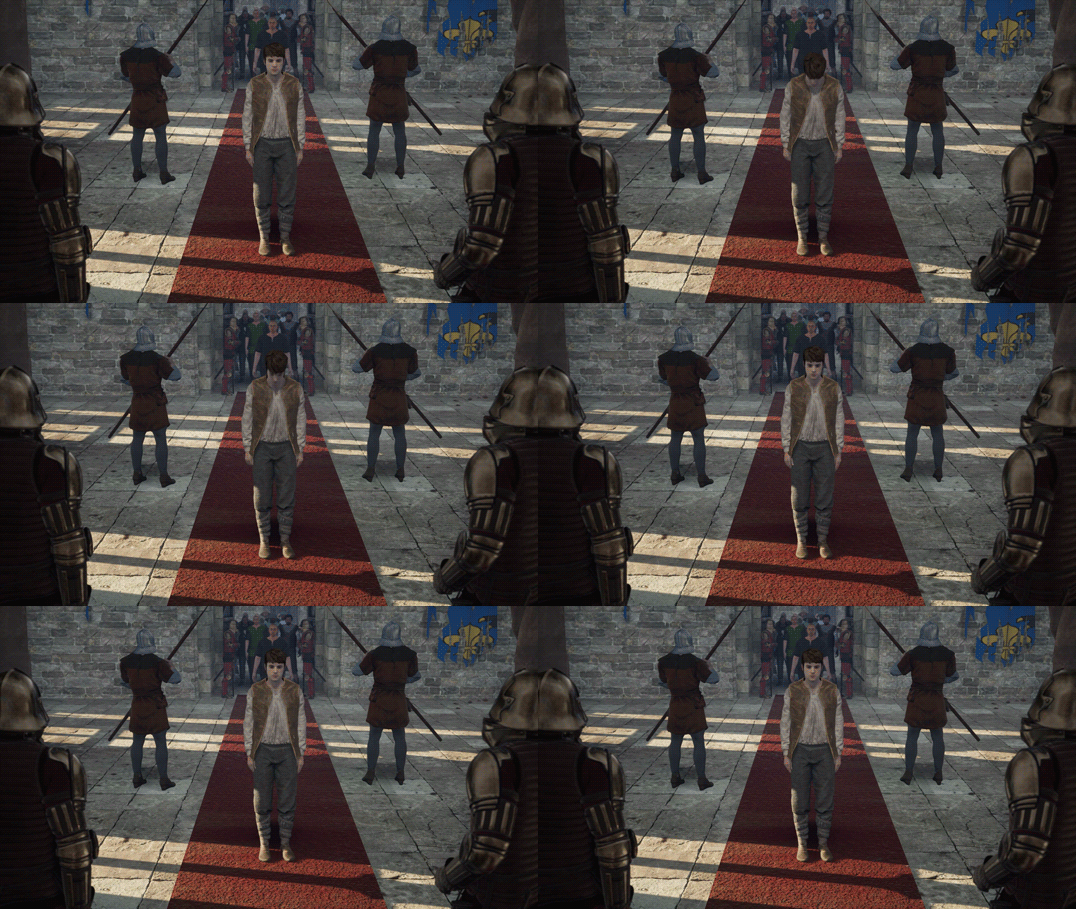
Last time we talked about character creation, which is what you’ll see right after starting a New Game from the main menu. Today we’re going to talk about what comes moments later, which is the starting point of the player’s character.
We will also answer questions such as what the player will find at the beginning of the game, in which region the game will start and we will mention another historical game changer.
Hundred Years’ War
The whole game will take place during the Hundred Year’s War, this is not new and we mentioned this time and time again. However, the player’s character, together with their armed retinue, takes part in it and at some point they receive information that their demesne has been invaded. Then, having received permission and a little support from their senior they rush back to their lands, and this is where the background of the story ends.
For the game begins when a noble created by the player approaches the capital of their small dominion. It quickly turns out that their demesne has been cruelly plundered, many of their subjects are dead, many villages have been burned down and the main town has suffered heavy losses.
What is a tragedy story-wise, mechanically is supposed to allow for a multitude of possibilities. Indeed, the first part of the game will be devoted to the rebirth of your own lands (hence the game’s subtitle). Through the vastness of destruction, the player will face many difficult choices, but will also have considerable freedom in imposing reconstruction priorities, determining the size and composition of their troops, shaping the structure of their, initially modest, court, establishing alliances, investments, engaging in trade, etc. This will also allow us to introduce, step by step, the numerous mechanics that we plan for the strategic part of the game.
Equally as important will be finding out what happened, who exactly is responsible, but also preparing for a possible next attack.
Place of action
We have been thinking long and hard about the place of action and considered many possibilities. Eventually we decided on south-eastern France, and to be more precise, terrain that is not far from the border with, at that time English, Gascony.
One of the main sources of inspiration for us is the county of Périgord, and not only because of the beautiful landscape. It was one of the main battlefields of the Hundred Years’ War, a place where the situation changed very dynamically, which gives us a wide range of possibilities.
I’m stressing said place is just an inspiration right now, because the lands of the player’s noble and their direct neighbors won’t be a strict replica of historically existing lands, but something designed specifically for the purpose of the game.
The main reason for this decision is simple - in order to maximize interesting events, choices and opportunities we need to have full control over the player’s immediate surroundings. This does not mean that the place will be unreal. Historical sources often serve us as a basis for designing buildings, rooms, costumes, but also the dilemmas that the nobility faced at that time.
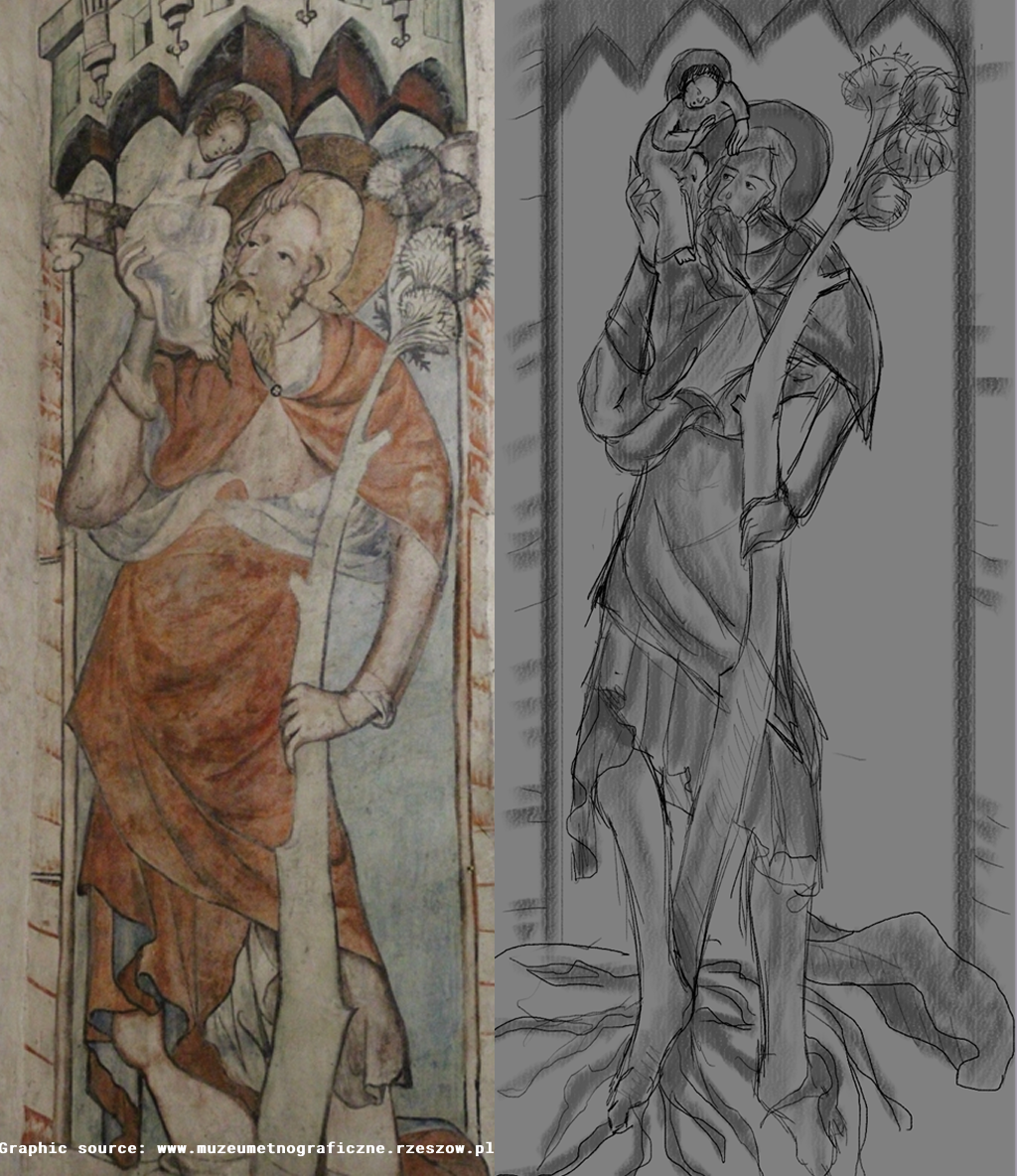
An example of what I’m writing about - polychromes we’re preparing for the interior of a city church. On the left inspiration, on the right our sketch. We’re trying to take care of such details to maintain the atmosphere of the era.
So in search of inspiration for interesting events, we reach for all sorts of local events from all over the European region from the late Middle Ages (also because the sources talk a lot about kings and much less about minor nobility). All this, of course, while taking care to make it plausible. For example, visitors from distant lands (like those described in Dev Diary #5 - Foreigners) may appear in the player’s demesne, but it will be something unusual and rare, rather than something that happens almost every month.
Big Picture
On the other hand, the local situation which will be the player’s focus most of the time, will be affected by national, international or even global events.
Just as there is no way that the Black Death, sooner or later, will spare the player’s lands (more about it in Dev Diary #1 - Black Death) other historical events of this type will, at times very significantly, change the gameplay. Sometimes they will even divide the game into parts.
For example, the truce of Malestroit, although not as well known in history, from the perspective of a noble who is controlled by the player will be an important event giving, on one hand a moment to breathe, and on the other more exploitative mechanics related to espionage and one more option, which we can’t talk about yet.
The region where the player will start the game. As you can see, a lot has happened here in a short time.
Next time, in April, we’ll revisit the mechanics and this time we will take a look at the player character’s manor. After all, a nobleman can’t do everything by themselves, so they should be able to choose specialists to assist them in ruling.
And if anyone is interested in what that is:
Then join our Discord server! In addition to being able to talk to us about Noble’s Life, games and history, we also put some special materials in there sometimes as well as varioust puzzles connected with the medieval times.
Dev Diary #7 - Character creation
Dear nobles,
We are finally back with Dev Diary!
It doesn't mean that we had such a long Christmas break; quite the contrary, we started working on Noble's Life with renewed energy and January flew by in a blink of an eye.
Today we are going to talk about character creation. Since we want to allow each player to find their own ruling style. we will also give you the tools to achieve it.
Therefore, we will tell you what sending the player's character to become a devoted to the Church can affect, what the cult classic "Inferno" by Dante Alighieri has to do with the protagonist's past at the university and whether using hedgehog, squirrel and chicken symbols as heraldic figures is a good idea.
Personalities and Coats of Arms
The player will be able to choose the name of his noble, but also the name of his demesne, which is the same as that of the family and something like a surname. You can also choose the name of your main city. Of course, each of these can also be drawn from a pool of historically accurate proposals.
The matter of identifying your character will be closed by the coat of arms. Here, as in many other games, you will be able to modify the shield and choose the charge. Among the available symbols, there will be only those figures which were historically present, but that does not mean that the choice will be small. Lions and eagles in various configurations were fairly common, as were towers and crosses, but there were also flowers (especially lilies) and other plants, unicorns, wild boars, hedgehogs, squirrels and chickens (roosters to be precise).
Why would anyone put such an animal on a coat of arms? Nowadays this may be unusual, but all of these animals were once used to represent certain virtues. Squirrels symbolized patience and perseverance, hedgehogs symbolized perseverance and cunning, and the roosters symbolized vigilance, manliness, and courage.
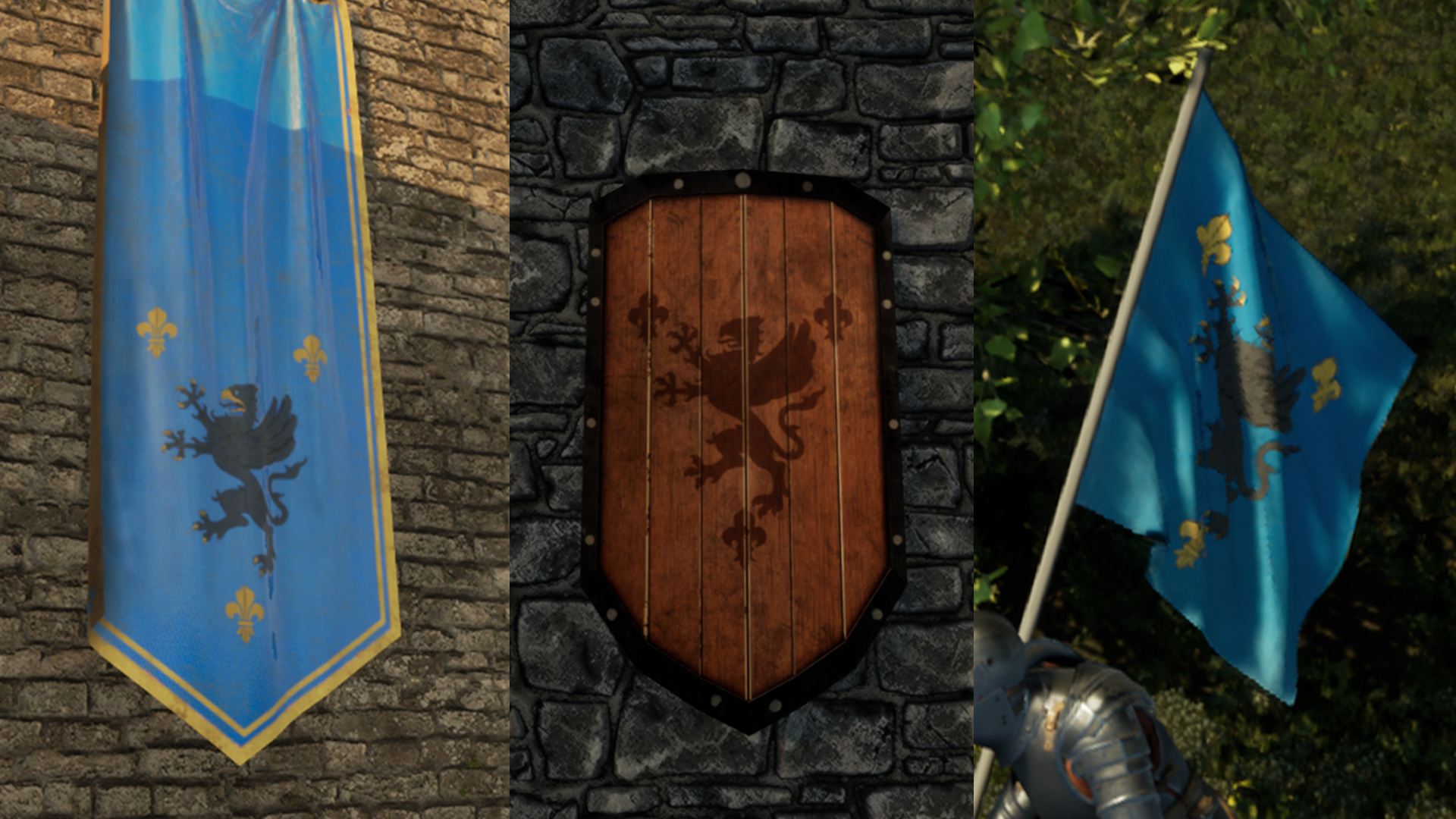
How will the chosen coat of arms translate into the game? Well, visually quite a lot. We are already planning many places where we will present the player character symbol.
These are just some examples of the different ways a player-created coat of arms can be presented.
Origins
The biggest influence on the gameplay itself will be the origin - defining the player character's past. We are initially planning four options, which will be further divided into two groups. The first one defines our character as the first son, the heir, who has known for years that he will be the one to rule after the death of his father. The second - the second son, who became heir only after the recent death of his older brother.
Each group will affect many story events, differentiating the gameplay and making it, in simple terms, a little easier for the first son. In his case, the player will be able to choose between The Overseer and the Knightly Traditions.
The Overseer is an origin recommended for those wanting an easier start of the game and focusing on economics. The player's character is liked and respected by the inhabitants of his domain, who over many years have gotten used to thinking of him as their future ruler. The protagonist with this past was also prepared for the role of a steward of his demesne. This includes gaining access to unique decisions when interacting with the peasantry.
The Knightly Traditions, on the other hand, reflect the focus of the character's education on military issues, as well as his youthful fascination with legends of the Knights of the Round Table. Hence, by choosing this background, the player will strengthen their initial military capabilities, as well as gain at least some additional opportunities while dealing with knights and soldiers.
This is the first version of the graphical representation of origins in the form of stained glass windows.
The other two available choices tied to being the second son, are Church Education and University Contacts.
Church Education establishes that the protagonist's father decided that his second child would make a career in the church. Hence, the player character with this background was trained for several years as a clergyman and even managed to take minor orders. Although the death of his brother forced a change of plans, such a past will still facilitate relations with church dignitaries or increase piety in his domain.
University Contacts, on the other hand, mean that the character has been sent to obtain higher education. We are tentatively planning for it to be the recently founded university in Cahors. The city itself is very interesting, and is mentioned in Dante Alighieri's famous "Inferno". And it's not in just any company, because it's next to the biblical Sodom. It is used there as a synonym for the sin of usury. It is said that even in the period prior to the Hundred Years' War, rich merchants-usurers living in Cahors were granting loans throughout Europe.
In such an environment, a player character with this background had the opportunity to learn a little bit about trade and finance, and on top of that has met some rich people. The latter will open up options for unique investments and loans. On the other hand, it may earn the lord a not-so-honorable reputation of a friend to the usurers.
That's all for today. In the next Dev Diary, which will be in March, we'll tell you more about the beginnning of the game’s story and explain why Kingdom Reborn is the game's second title.
What origin story do you like the most? Or maybe you would like to suggest another one?
Let us know! Be it on our Steam forum or on the Noble's Life Discord ( https://discord.gg/CwUvBu3d8q ).
We also invite everyone interested in the Hundred Years' War to our Twitter account ( https://twitter.com/Nobles_Life ), where as part of the On this day series we describe events of interest from the perspective of this great conflict.
Dev Diary #6 - Diplomacy
Dear nobles,
We’ve already written a few times about ruling subjects, over whom the player-controlled nobleman has great power. However, it should be noted that he’s just one of hundreds of landowners, and there are also much more powerful aristocrats. So today will be about how to deal with the upper classes.
So, what’s helpful in diplomacy? Certainly, text interpretation skills, a young, pretty, and polite daughter, a good cook, capons and partridges, some monkeys, as well as hemlock or arsenic, just in case.
Letters
Let's start with the first thing listed. There are two primary methods of communication with other nobles in Noble's Life. The rarer one is a visit from the representative of such a noble or, on a special occasion, from the noble himself. The former can be heard by the player in the audience room (we've written about this mechanic in Dev Diary #4 - Peasants and Villages), the latter is similar, although in this case, there’s a possibility for a private conversation or a ball (more on that later).
However, this is the first method. The second, much more frequent, is communication through letters.
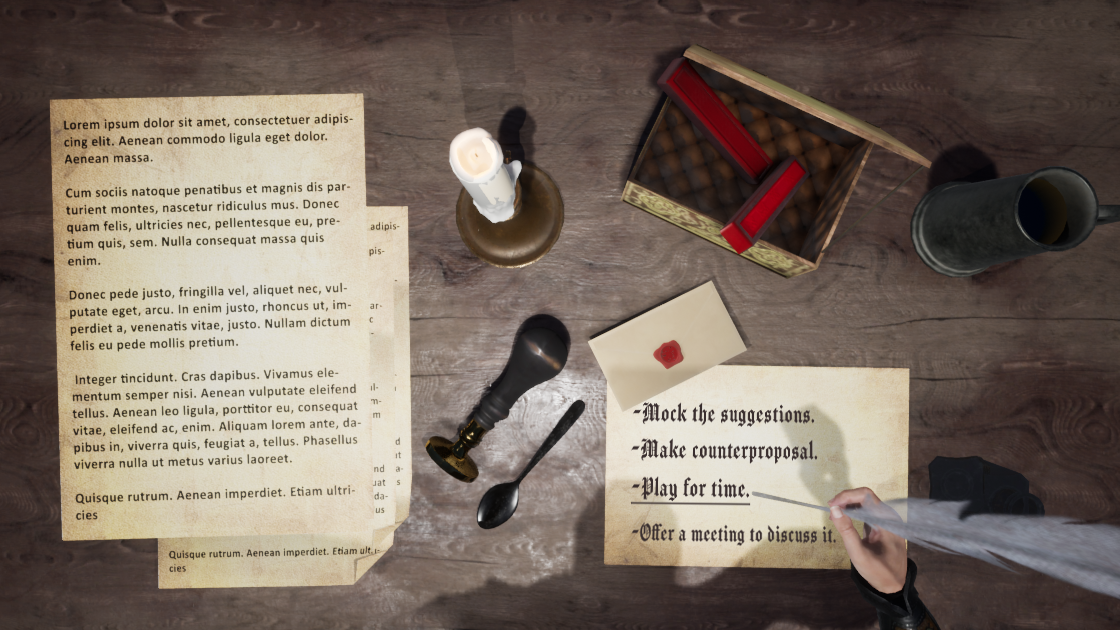
Screen showing letters writing mode. After reading the content of the message, the player selects one of the available options, which then turns into a reply sent to the recipient. That’s the basis of this mechanic, the development of which we’ll talk about in the future.
The letters can be about all sorts of things: requests for help, usually of a greater importance than the pleas of our subjects, warnings, land trade, offers of cooperation of various kinds, including matrimonial offers (our nobleman will have a family, which will be applicable to the game mechanics). Often, some matters require a longer exchange of letters, though balancing between not alienating the noble and being deceived by them in the process may be tricky. Of course, it's also useful to get to know the noble with whom the player is writing in order to determine, for example, whether it's worth it to play slightly unavailable or to not beat around the bush ;)
Often, some matters require a longer exchange of letters, though balancing between not alienating the noble and being deceived by them in the process may be tricky.
Gifts
Additionally, if the player character manages to acquire (e.g., buy from the merchants we wrote about in Dev Diary #5 - Visitors) or produce (by the hands of subjects) something valuable and impressive, he may consider using it as a gift.
Concept art showing examples of gifts that the player character can give to another aristocrat. It is inspired by gifts that, according to history, nobles actually gave to each other. Again, discernment may be necessary, because one ruler will be delighted with a new book for his collection, while the other... Well, he could prefer a hunting greyhound or some fancy sweets. A popular but expensive gift might also be... a monkey. These animals were favored by the aristocracy, even despite criticism from some of the clergy, and were considered a status symbol. On the other hand, we have many sources describing how dangerous it could be to keep a monkey as a pet.
A well-chosen gift can help calm an angry ally, convince an offended noble to us, or be a proof of great influence or wealth.
Of course, the player character will be able to receive gifts as well.
There will be an option to send gifts as an addition to the letter to strengthen its effect. Sometimes, however, it might be just as good or even better to give it to the recipient personally. However, in order to do this they’d have to come to visit. Balls When another noble decides to visit the player character's estate, they can be offered a guest room or could be even heard as a supplicant during the audience, but this may be badly received. Hence, it is a good idea to welcome him with a ball. Especially if the purpose of the meeting is the signing of an alliance, a marriage contract or some significant transaction.
Such an event requires proper preparation, luxurious liquors and other delicacies, maybe an artist to take care of the musical setting. A good chef can also help, as can appropriate decor. So this is something that can be a considerable drain on finances, but can also greatly enhance the effect of negotiations (or worsen it, if the noble skimps).
A party can be a way to get rid of a thorn in a noble's side. Note, however, that fatal poisoning of a guest during a ball may result in our noble not receiving the title of host of the year. What's worse, he may even face serious repercussions from the family of the deceased. But, you know, that wasn't us, it was those wicked Englishmen/heretics/another noble with whom the victim also had a quarrel! However, in order to make such a drastic move, you need to get the right specific beforehand, or have it prepared, if there is an alchemist at our disposal.
We'll return to diplomacy for sure, because this is just the first outline of some of the options, but that's enough for now. As we announced before, this is the last Dev Diary for this year. During the holidays our whole team is going to recuperate, and then return to the project with even more energy.
In 2022 we’re planning to continue reports of what’s happening with the game in the form of Dev Diaries, but since the build is going on intensively, we will also be showing the first gameplays! And we’re considering a few more surprises ^^
We would like to thank everyone who follows our project, speaks on forums, socials or Discord. Every comment, conversation or remark motivates us a lot to continue our work.
And finally we would like to wish everyone Merry Christmas and a Happy New Year!
Dev Diary #5 - Foreigners
Dear nobles,
this week we will tell you something about the guests from the other faraway lands, clarifying, for instance: Whether Arab merchants will bring a medieval superweapon? Or whether the mysterious alchemical miners will create great stained glass windows with the help of magic and goblins?
Merchants
Many connections, even despite great distances between far countries, were established through the trades. In addition to that, it could be the source of opulence (more about that in the next year ;)) and the merchants sometimes had to travel many miles to make a deal. So it's not a surprise they will come to the player's noble lands.
Referring to the topic of this particular Dev Diary, the guests that were mentioned and which will come to our city, will mostly consist of merchants. When we say "guest”, we mean both, people from the neighboring Kingdom of Aragon, HRE, and further parts of Europe like Poland, Hungary, Merchant Republics of Venice and Genoa. Of course, we won't forget about the "exotic" travellers from faraway lands, but they will be occurring less often. By saying faraway lands we understand regions like Bizantium or the Arab world (e.g. Granada or North Africa).
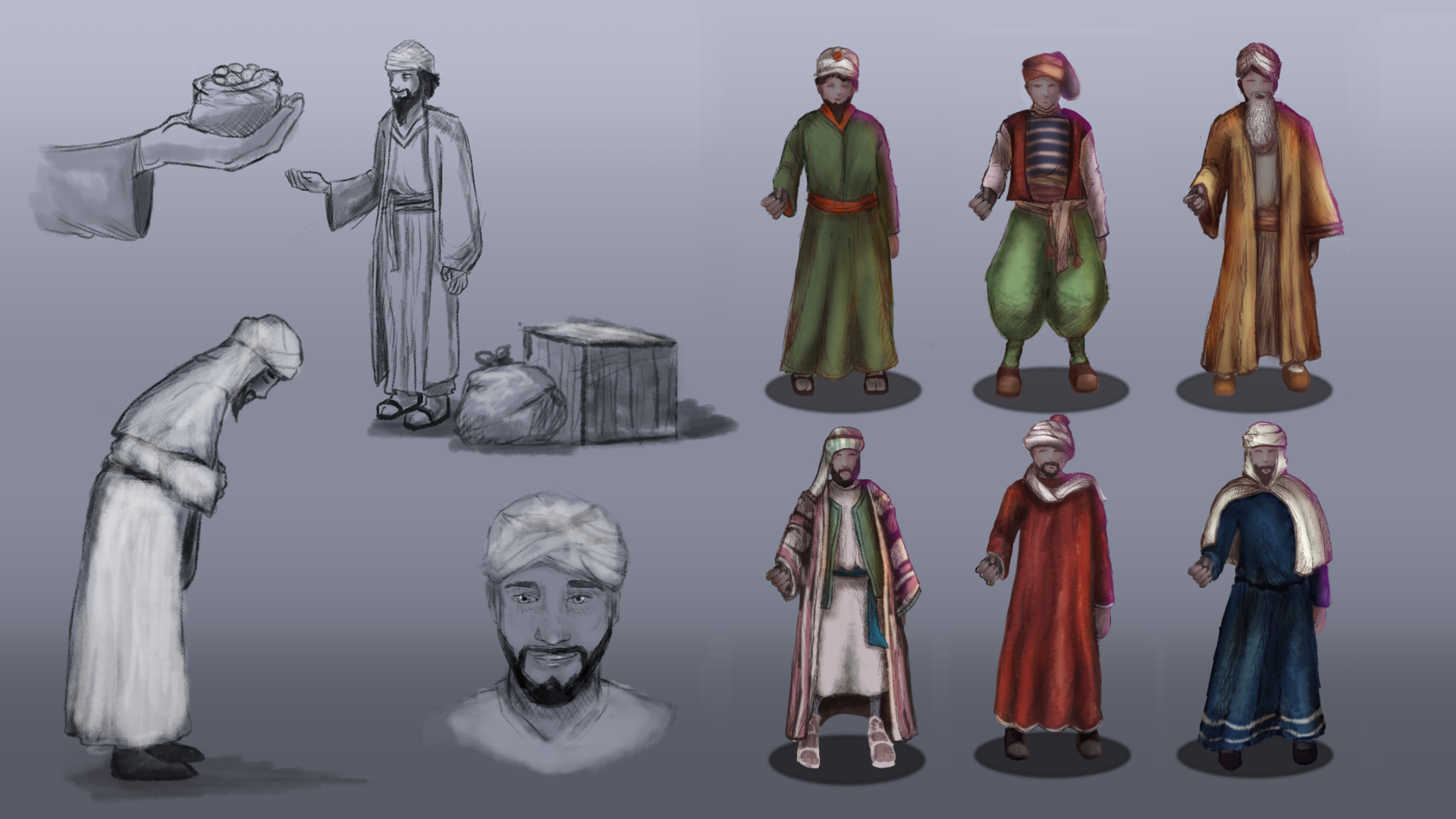
Early concept art of an Arab merchant and some of their different outfits from that era. These special guests can have on their hands some of the most unique weapons - damascus steel blades. Player's noble will be able to buy it from them, but these superweapons won't be as easy to obtain as one would think.
Although travellers from far away can be a source of problems, especially because of their custom's dissimilarity or townsfolk's natural aversion to new and sometimes exotic looking people, they can give a chance to get unique bonuses for the ruler.
Merchants, even without the wares, can be of use, e.g. they can gather valuable information that in the right hands can change a lot - that's how the player can build themselves an espionage. Inside their caravans could be found experts of some kind (craftsmen, recruits) who normally won't be in the vicinity, but could be coaxed to stay with some good hospitality.
Of course, where there is trade, there is merchandise. Foreign delicacies and spices like saffron or almonds can significantly raise the status of a planned ball, and the elaborated curiosity could also be a great present that would help in diplomacy or be used as decoration to further raise the prestige of the noble estate.
Walloons
These nomadic treasure hunters and motherlode searchers, miners, glaziers, and even alchemists, that were said could manipulate magic, were known as Walloons or Venetians. Most likely the big part of them were Romans, Celts' descendants that were living in different HRE countries in the south part of the Netherlands and also in France or the Republic of Venice. The facts, myths and legends about them are mixed with dozens of speculations into some kind of weird, hard to untangle knot of information.
They travelled through Europe in the 11th century and offered their services all around. That’s why they could be known in places like Germany, Hungary, Poland and France. In our opinion, they are all that we need as specialists and experts for our noble, that will sometimes show at the player's courtyard.
Their visit could be seen as a chance to aid the search for valuable metal ores and in consequence create a new mining village or develop an already existing one. More interested in magic and secret arts, nobles could try and gather alchemic knowledge from these special guests. And that splendid, enormous, cobalt stained glass window can say about the player's noble pious and benevolent heart like no other.
On the other hand, their strange, unusual way of living, the aura of mystery that keeps emanating from them and their supposed collaboration with unnatural beings - like goblins or kobolds, can be a source of some not-really-good events, which could be a pain to deal with. As we always say, in Noble's Life everything will have its consequences, and the bishop might want to have a word with you.
But hey, at least some of the Walloons can believe in their preternatural help when working on the player’s noble orders (e.g. mentioned earlier stained glass) ;)
As you can see in these concept arts, we are thinking about many different possibilities of Walloons outfits. That's because most of the images and texts about this group come from the 16th century. On the other hand, their characteristic hats with wide brims as well as red tunics could of course be their chosen style even earlier in history.
That's it for today. After the next two weeks, in our last Dev Diary this year, we will talk about diplomacy. In the end, our noble will have to deal with their own people on the daily basis (which we've mentioned in Dev Diary #4 - Peasants and villages), but in addition to that, there will be a whole new level - dealing with other nobles.
Dev Diary #4 - Peasants and villages
Welcome great nobles,
This week, for the second time in total, we will talk about the strategic and economic aspect of our game. Our main topic for today will refer to those who work (peasantry) and the basics of village's management.
But, first of all, we would like to say one thing.
Kingdom Reborn
At the beginning of Noble's Life, the player's character is in a bad position. Army of enemies just passed through his territory in a very brutal manner. In the trailer we are only showing you the destroyed city, but let's be clear, most of the villages and farms are burnt, slaughtered or the people run away. Whereas the few that stayed are hoping for some kind of help from their lord in these hard times.
What will the player do, it's up to them really. At the start they will have only a few villages under their control, but if they'll focus on expansion and progression, they would certainly have more of them.
There are three basic ways of managing the lands and peasants.
The Estate Map
It should be clarified here, that the player's character won't visit the villages most of the time. That's why they can manage the rural areas from the inside of their castle or city that's built near it. The basic tool for that is the estate map (which we've shown in the trailer before or on the graphic at the top of this Dev Diary). It can be used to establish the amount of existing taxes (in a currency and nature) and recruits (mainly for military needs - because war, that's why). In addition to that, it allows the player to make investments, but also helps to quickly find the actual status of the villages that's in their possession.
We've chosen this system simply because it hits the sweet spot as the quality of life feature, but most of all, it's immersive, because it allows the player to manipulate the figurines on the board rather than soulless sliders.
Every village on the map is described and contains information about them, among others, name, the number of villagers, happiness and religious level, and it's produced materials. About the statistics and their dependency, we will be talking more in the future Dev Diaries, because they have a big impact on the village's fate.
High level of happiness will positively influence the morale and the quality of recruits, the taxes and it will help avoid many potential problems. Low levels on the other hand... Even cheering each other up saying " jacques bonhomme a bon dos, il souffre tout " (peasant’s back will bear everything), well that wasn't really true. Peasants revolts were common, in which the french Jacquerie and the english Wat Tyler's Rebellion were very important events during the Hundred Years’ War and they deserve to have a whole separate topic about them in another Dev Diary, and when that happens, we will mention our ideas inspired by Dithmarschen ;)
Audiences
Yet another important thing to be aware of, are appeals and problems of the villagers. They will come to visit the player's castle, trying to get an audition before their noble. It's also the next core mechanic too.
Gif from our actual, very early build, where we present you the player's throne hall in which, if they want to, they can host their petitioners and listen to their wishes, problems and propositions.
It’s here, where the peasants can plead for lowering or cutting taxes or even try to convince our noble to discharge some men from the army duty - because there is no-one to work on the fields if they all go to war. All in all, it allows the people to try to convince the player to change their mind about the decisions that they made on the estate map. Of course, the player can consider the appeals and help the village, but they can also completely ignore that fact. They can even more brutally send the peasant to lynch for asking them about such a frivolous matter.
There can be other situations such as pledging for help in financing, e.g. burnt down tavern, mill or church, alerts about the bandits in forests near the villages, rumours about heretics, bursts of epidemics, discoveries of new sources of resources, and many, many more. The multitude of these events and situations will allow the game to have more diverse gameplay.
Advisers and specialists
One last thing that's also important when governing the villages is making use of the player's character court, where they can, e.g. send their knight (with or without an army) to check on the strange rumours that emerged about some of the villages, send a scholar to help the settlement develop, or hire an inquisitor to eradicate heresy. We will come back to this topic in the future Dev Diaries too, so don't fret.
Early initial concept (render) of recruits’ alternative usage. Player's noble sends out a big group of peasants with an expert - Lokator, in order to settle new desolate lands that belong to the player, or to rebuild and recover villages that were destroyed in war or some cataclysm. In the matter of mechanics, it means creating a new or restoring previous settlement. Although internal colonization in that period of time mostly happened in the Holy Roman Empire and in Central and Eastern Europe, it wasn't exclusive only to these regions.
That's all for today. Hope it shows more of how these things work in our game ^^
On the last note, a small explanation. We've tried to publish these Dev Diaries every week and at the start it was all going as planned, but in more recent times, we can hardly keep up. That's why we've decided, as for now, to make them bi-weekly. Doing so, we will hopefully have more researched and interesting topics to talk about and show it to you guys, which obviously takes time.
That's why the next time we will see you here is in two weeks. We will open up the topic of the medieval realities again, about which the discussion on our Discord ( https://discord.gg/2mZcY9f7 ) inspired us to - we will talk about the foreigners. We’ll focus mostly on two very interesting groups that are an inspiration for many events in Noble's Life.