

Sengoku Jidai: Shadow of the Shogun
Mandate of Heaven is out!
This expansion, larger in scope than Gempei Kassen, features China in the 16th and 17th centuries – the Middle Kingdom is in crisis and up for grabs. The Ming Emperor has lost the Mandate of Heaven, and his rule is weak. Peasant rebellions, disloyal governors and foreign invasions threaten to topple him. The time for talking is over – now weapons, strength of arm and clever strategies will decide the outcome of the war to come, and the winner might find himself at the head of the largest empire in Asia…
The Mandate of Heaven DLC brings players of Sengoku Jidai to another "country at war". The expansion contains four dynamic historical campaigns set in the 16th and 17th centuries. These chronicle the decline of China's Ming Dynasty and its conquest by the Manchu Qing Dynasty. It also includes the Mandate of Heaven sandbox campaign that enables players to freely choose the opposing forces fighting for supremacy over the Chinese mainland and Mongolian steppes. It also includes four new factions and many new units!
What are you waiting for? Get it now on Steam!
http://store.steampowered.com/app/502361/
Mandate of Heaven to be released tomorrow!
Don't miss it: it adds 4 new factions, 5 new campaigns, a brand new strategic map of China, and plenty new units!
This expansion, larger in scope than Gempei Kassen, features China in the 16th and 17th centuries – the Middle Kingdom is in crisis and up for grabs. The Ming Emperor has lost the Mandate of Heaven, and his rule is weak. Peasant rebellions, disloyal governors and foreign invasions threaten to topple him. The time for talking is over – now weapons, strength of arm and clever strategies will decide the outcome of the war to come, and the winner might find himself at the head of the largest empire in Asia…
The Mandate of Heaven DLC brings players of Sengoku Jidai to another "country at war". The expansion contains four dynamic historical campaigns set in the 16th and 17th centuries. These chronicle the decline of China's Ming Dynasty and its conquest by the Manchu Qing Dynasty. It also includes the Mandate of Heaven sandbox campaign that enables players to freely choose the opposing forces fighting for supremacy over the Chinese mainland and Mongolian steppes. It also includes four new factions and many new units!
Would you like to know more? Why don't you check this new faction preview?
Get it on Steam!
http://store.steampowered.com/app/502361/
The Snow Lion against the Dragon - A Mandate of Heaven AAR!
Background
In 1618, Manchu leader Nurhaci listed the Seven Grievances and declared war on the Ming. The Manchus then proceeded to capture several Chinese cities in the north eastern frontier. Nurhaci died in 1626 and was succeeded by his son, Hong Taiji. Hong Taiji continued the work of his father and was able to capture Beijing and most of northern China. This forced the Ming court to move south.
In 1635, Karma Tenkyong, leader of the dominant Tibetan dynasty of Tsangpa held a council with other Tibetan lords as advised by his spiritual leader. It was said that the Buddhist monks had visions of the kingdom being overrun by a foreign power. As the Ming had left Tibet autonomous in the past, they believed the visions were about the Manchus. In the end, they decided to set aside their differences and unite against a common foe. Armies were mustered and sent deep into western China. The helpless Ming governors just let them though.
In 1636, Hong Taiji proclaimed the Qing dynasty and claimed the Mandate of Heaven.
Late Spring 1636
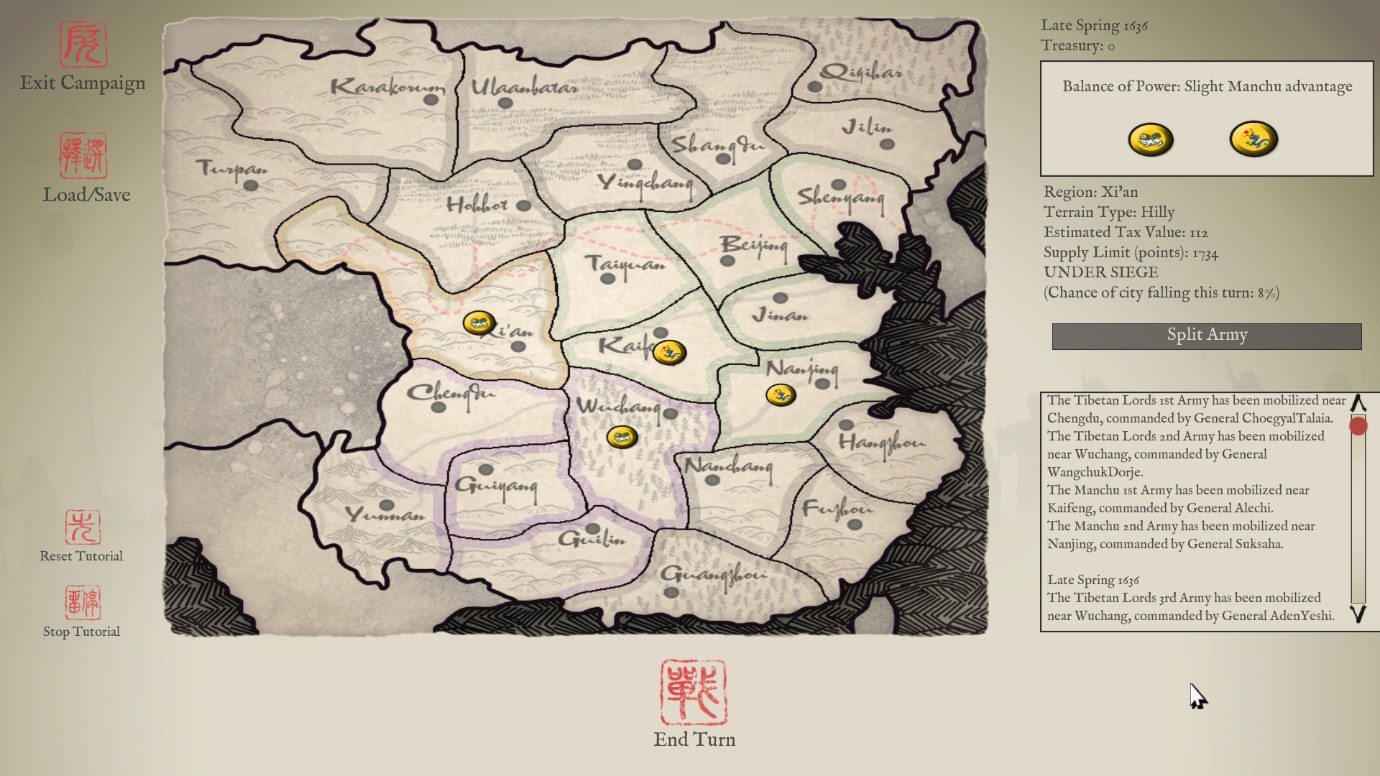
In the spring of 1636, Tibetan General Choegyal Talaia’s army was at Chengdu while Wangchuk Dorje’s army was at Wuchang. The Manchu 1st army was at Kaifeng, led by Alechi. The Manchu 2nd army was in Nanjing, led by Suksaha.
Choegyal moved from Chengdu to Xi’an and Alechi moved in to confront the Tibetans.
Battle of Xi’an
Tibet 39,000 vs. Qing 46,000
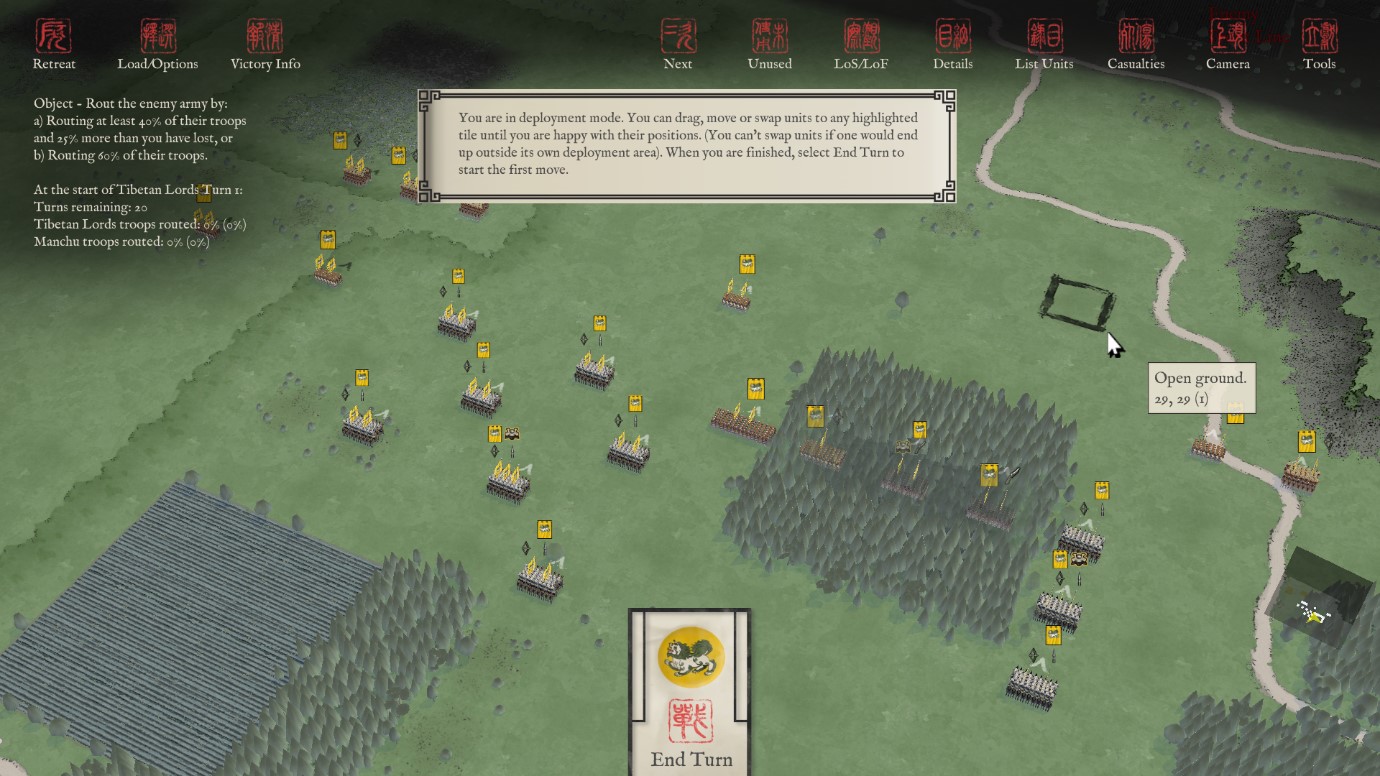
The commander in chief of the Tibetan army, Choegyal Talaia, commanded 14,000 warriors with bows, spears, and matchlocks positioned in the centre woods. Sangye Yontan commanded a large heavy cavalry division of 10,500 on left flank. Tenzin Phuntsok commanded 4,500 heavy cavalry on right flank. Mounted and dismounted skirmishers scattered all around the front.
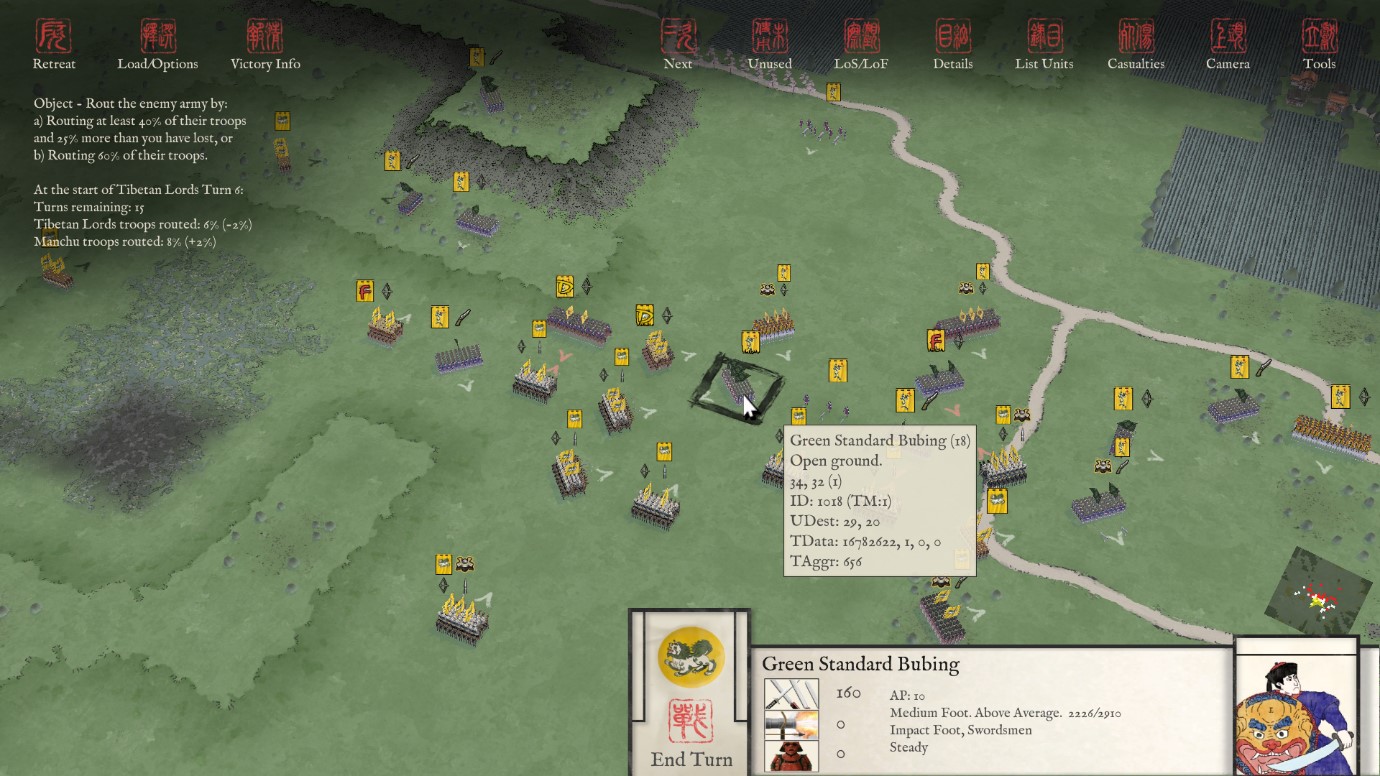
During the battle Tenzin Phuntsok’s cavalry units got into trouble. Qing general, Buyanggu broke the lines but got fragmented by Choegyal Talaia’s matchlockmen and archers in the rear. Songye Yontan’s cavalry were held back by superior Qing swordsmen and the Tibetan cavalry shot arrows at the swordsmen instead of charging.
Despite the early setback Tenzin Phuntsok cut through the Qing infantry with his remaining men and engaged the enemy commander-in-chief Alechi’s personal troops.
Qing General Jiamo suffered a punishing volley from Choegyal Talaia’s troops and was forced to retreat when attacked by Tibetan spearmen. Buyanggu retreated as well. Choegyal Talaia moved to the front line to command the spearmen personally against some Qing armoured Bannermen but his presence was not enough to save the unit from wavering. The general was lightly wounded during the fight.
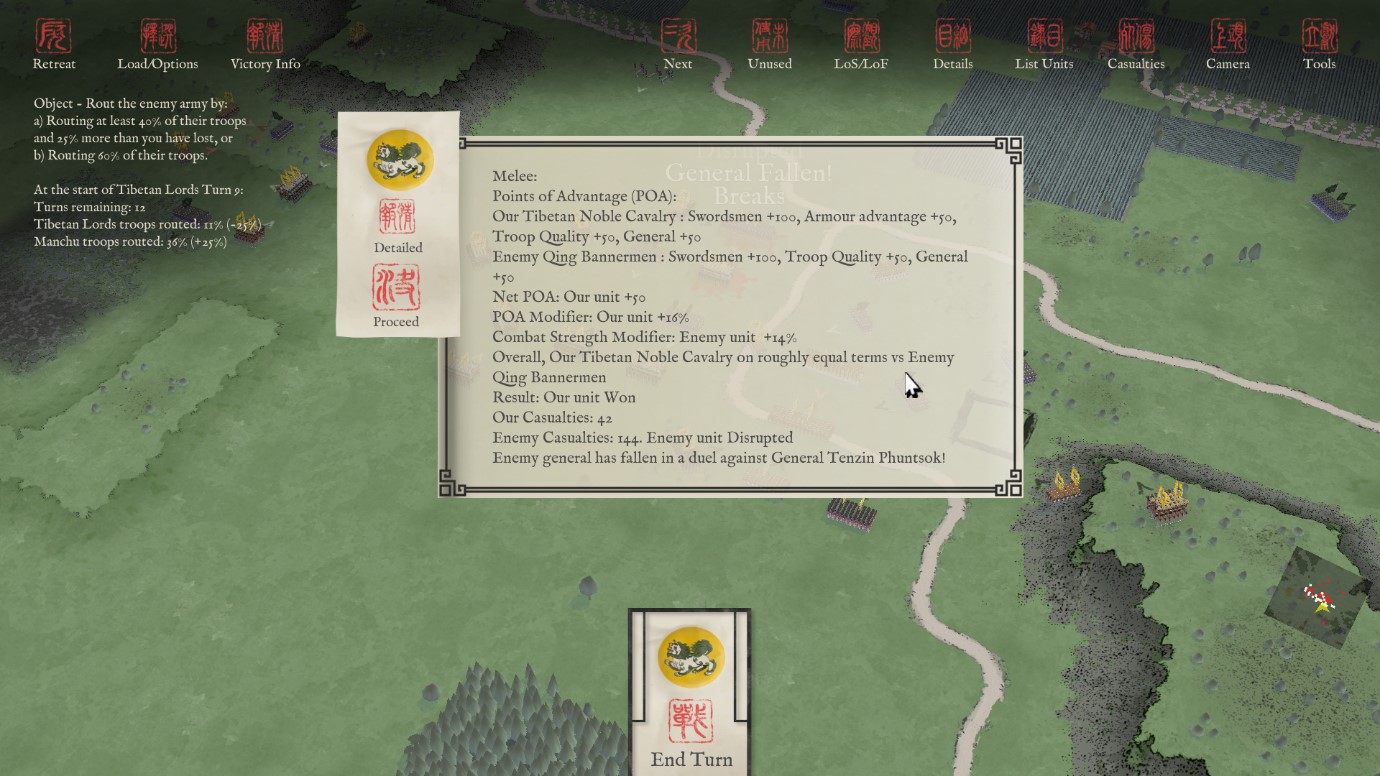
Alechi was wounded in a duel against Tenzin Phuntsok. His bodyguards were able to escort him out of the melee. Alechi then ordered a retreat into Kaifeng where they would meet with the Qing 2nd army.
Tibet lost 6,162 men. Manchu lost 26,322 men.
Continue to read the AAR here: http://www.slitherine.com/forum/viewtopic.php?f=58&t=74355
A new expansion for Sengoku Jidai: Mandate of Heaven!

As we said previously, our plans for Sengoku Jidai aren’t over with the release of Gempei Kassen. The developers from Byzantine Games are working on a new, bigger expansion: Mandate of Heaven!
This expansion, larger in scope than Gempei Kassen, features China in the 16th and 17th centuries – the Middle Kingdom is in crisis and up for grabs. The Ming Emperor has lost the Mandate of Heaven, and his rule is weak. Peasant rebellions, disloyal governors and foreign invasions threaten to topple him. The time for talking is over – now weapons, strength of arm and clever strategies will decide the outcome of the war to come, and the winner might find himself at the head of the largest empire in Asia…
The Mandate of Heaven DLC brings players of Sengoku Jidai to another "country at war". The expansion contains four dynamic historical campaigns set in the 16th and 17th centuries. These chronicle the decline of China's Ming Dynasty and its conquest by the Manchu Qing Dynasty. It also includes the Mandate of Heaven sandbox campaign that enables players to freely choose the opposing forces fighting for supremacy over the Chinese mainland and Mongolian steppes. It also includes four new factions and many new units!
Last but not least: the expansion is about to enter its beta testing phase. We need your help to find bugs and we’re interested in hearing your feedback, so please feel free to apply, all help will be greatly appreciated. Click here to apply for the Beta!
Thank you, and stay tuned for more news!
http://store.steampowered.com/app/502361/
Sengoku Jidai: Gempei Kassen is out!

You fought in the Sengoku period, and quarreled over Korea in the late 16th century, but now it’s time for an entire different era!
Gempei Kassen brings you an era 300 years before the Sengoku Jidai, featuring one of the biggest conflicts in medieval Japan which ended with the Shoguns into power.
Play through the new dynamic campaign representing the brutal struggle between the Tara and Minamoto clans. Experience a new era of warfare, and lead six new factions from the Late Hejan period. Command one of the several new army lists provided that include new units and new graphics!
http://store.steampowered.com/app/502360
Gempei Kassen is coming on September 8th!
It brings you to an era 300 years before the Sengoku Jidai period, covering one of the biggest conflicts in medieval Japan which ended with the Shoguns in power. It features a brand new dynamic campaign representing the brutal struggle between the Taira and Minamoto clans, set in an entirely different era!
The expansion to Sengoku Jidai also comes with six factions that are playable in skirmish mode and several improvements, such as a new model for the Raw Naginata unit, a brand new Ashigaru texture, and new army lists.
Don't miss this expansion and stay tuned, for our plans for Sengoku Jidai aren't over.
http://store.steampowered.com/app/502360/
Sengoku Jidai: Shadow of the Shogun 1.28 patch!
1.2.8 Changelog:
1. Added option to use green terrain tiles. (See Options > Advanced Options)
2. Corrected position of Battle of Chiksan on Imjin War maps.
3. AI improvements:
a. Made advancing AI cavalry and light troops on wings turn in against flank of enemy army sooner.
b. Made held-back cavalry wings advance closer to in line with infantry. (Stopped them from being held back too long or charging ahead too soon).
c. Made Japanese cavalry in centre less likely to rush ahead of infantry. However, they also will not stay so far back behind the infantry.
d. Made front line samurai less eager to outdistance their medium foot ashigaru.
e. Stopped light troops from charging ahead of rest of army inappropriately.
f. In campaign battles, an AI army which deems it unwise to advance will no longer do so after an arbitrary time delay if it is the defender. (Note, this does not necessarily mean the side that owns the province – it means the side whose field army was in the province first).
4. Corrected bug that could sometimes cause AI units to become stuck and not move at all when near terrain they don’t like.
Made combat capability icons show correctly for Japanese side in Genko campaign
Sengoku Jidai version 1.27
Changelog:
1. Added advanced option to show “moved” icons for units that have moved. (Default is off, so you need to turn it on in Options > Advanced Options).
2. Corrected army lists used in Sekigahara Campaign.
3. Corrected bug that allowed General to join gun limbers.
4. Corrected bug that might allow duplicate general names in campaign.
5. Corrected weaponry of Manchu Banner Chong skirmishers.
6. Corrected points cost of Above Average Manchu Banner and Green Standard Bubing.
7. Made Game Manual button work in Slitherine launcher.
8. Stopped Split Army from splitting off army (and leaving an empty army) if all units moved to right window in Split Army screen
Sengoku Jidai - The question of control
In the days when battles were decided by hand-to-hand combat it was largely impossible for a commander to successfully order a unit to disengage and go and do something else. In fact, in the rare cases where this was attempted, it often led to a mass panic as neighbouring units thought that the retreating unit was broken and themselves broke as a result.
Even the Romans, who reportedly had a system of line replacements (although nobody has yet figured out satisfactorily how this worked) only replaced one unit with the one immediately behind it (if indeed they did so). The replaced unit did not then go off and do something else.
Likewise it was normal for troops who routed their opponents in close combat to pursue the enemy at least for some distance before being brought back under control.
What led you to implement such a feature? Would you say you were inspired by any particular game or system?
I have been playing Ancient, Medieval and Renaissance tabletop minatures games since 1971. Loss of control of units in close combat is normal in such games, as is units pursuing routed enemy (except in some rather abstracted systems such as DBx). This is because those games are based as closely as possible on the history and this was normal behaviour for troops in the era before battles were decided almost entirely by shooting. Pike and Shot and Sengoku Jidai follow the tradition of tabletop miniatures games, without all the hassle of collecting and painting figurines.
Would you say that it adds to the realism of the game?
Certainly it does.
What notable examples from history are there of this occurring?
There are countless historical examples of pursuits getting out of hand and troops either not returning to the fray soon enough to influence the result of the battle, or themselves being routed in their turn by enemy reserves. To name a few: At the Battle of Magnesia in 190 BC, the victorious Seleucid right wing, under the command of King Antiochos in person, pursued the routed Roman left wing as far as the Roman camp, and failed to come back in time to save the rest of the Seleucid army, resulting in a decisive Seleucid defeat. During the Imjin War the Japanese used the Korean and Ming cavalry’s tendency to pursue in a disorganized fashion to lure them into a trap and destroy them at the Battles of the Imjin River and Byeokjegwan. In the English Civil War the Royalists lost several battles because their victorious cavalry pursued for several miles right off the battlefield and failed to return in time to influence the infantry fight. At the battle of Waterloo the Scots Greys completed their objective of routing the French 1st Corps, but then carried on without orders to Napoleon’s Grand battery, only to be counter charged by French cavalry and routed.
How does this feature affect the tactical depth of the game in your opinion? And how is the gameplay affected?
This feature increases the tactical depth of the game because it forces the player to act like a real general and allow for the fallibility of his own troops. It also increases the tension in the game play, because a local victory can soon turn into a reverse if troops pursue into danger. The player needs to take precautions to retrieve the situation if this occurs.
Are there times when the player can use it to their advantage?
Very definitely. A properly set up flank charge can roll up several units by routing one unit, pursuing into another, routing that and pursuing into another.

Example: The Samurai cavalry can charge the nearest Korean infantry unit in the flank. If they rout it, they will pursue into the next unit’s flank and so on. They may succeed in rolling up several units.
Are there ways a skilled player can mitigate the effects of this?
That too. In Sengoku Jidai, infantry who originally received a charge at the halt will seldom pursue enemy infantry and almost never pursue enemy cavalry.
Careful positioning prior to charging can result in units pursuing behind the enemy flank instead of off the table. This can then leave the pursuing unit in a good position to attack the rear of the enemy line in subsequent turns.
Charging disrupted enemy front line infantry with cavalry can lead to the cavalry routing their immediate enemy then pursuing into lower quality rear echelon units and routing them too.

Example: The samurai cavalry are not in a position to flank the Korean infantry, but if they charge the indicated unit and rout them, they will pursue behind the Korean line. The Koreans have no reserves, so once the cavalry come back under control they are likely to be in a position to charge the Korean infantry in the rear.
Why can’t your units always charge what you want?
The priority target system is there to enhance the realism of the game.
Firstly, it prevents units from charging one enemy unit while ignoring a more pressing threat from another unit. This helps to compensate for the IGOUGO system – in reality the other enemy units would not stand by idly while your unit attacked the unit of your choice. Because of this, no sane unit commander would order the attack against the non-priority target, and if he did, the troops might not obey. The player is supposed to represent the C-in-C, and although he gets to move all the units, he cannot override the tactical priorities of the unit commanders – in reality he would not have time to do so.
Secondly it prevents units facing a line or chequerboard of enemy units from ganging up on one unit while ignoring the enemy directly to their front. Allowing this would be very unrealistic.
Most infantry cannot charge cavalry. This is because their historical tactical doctrine would not allow them to do so. The normal behavior of infantry in the presence of enemy cavalry was to adopt a defensive posture to repel any attack. To avoid micromanagement, the game assumes this happens automatically, it does not require you to issue an “adopt defensive formation” order.
Even when the cavalry are already engaged in close combat, disciplined infantry would not normally charge them. This is because cavalry combats were not in reality the static affair that they appear to be on the map. In real life the cavalry would not be in one position long enough for the infantry to attack them, and if the infantry were foolish enough to break defensive formation to attack them they would be putting themselves at risk of a counterattack which they would not be able to repel because they would no longer be in the correct formation. Hence they would not risk it.
So you have little control of your units most of the time after the initial deployment?
This is not true at all.
In the early stages of the battle you have full control of all of your troops. As the battle develops and you commit units to hand-to-hand combat, you lose control of those units for a variable length of time while the combat continues, but you regain control of them once the combat and any pursuit that may occur is over.
This is part of the realism of the simulation and follows Motke’s famous dictum: “No plan survives contact with the enemy”.
However, you still have full control of all troops not in hand-to-hand combat or pursuing, and proper tactical use of those is what will usually decide the issue. In fact locking enemy units in hand-to-hand combat can keep them pinned long enough for you to set up and execute a flank attack on them.
It is a stark fact that skilled players will almost always beat less skilled players in Pike and Shot and Sengoku Jidai. This clearly demonstrates that they have enough control over their units to achieve this.
Sengoku Jidai: Shadow of the Shogun is OUT!
https://youtu.be/X_lUZQN4AhA
Sengoku Jidai: Shadow of the Shogun is developed in collaboration between Richard Bodley Scott, the mastermind behind Field of Glory and Pike & Shot, and Jayson Ng an active member of the community. It enhances the highly successful formula of Pike & Shot, enriching it with new features such as battlefield generals and a beautiful and unique art style! Sengoku Jidai features fourteen historical battles on Japanese and Korean soil, three historical campaigns, one sandbox campaign, and a skirmish mode that generates random encounters between more than a hundred army lists from Japan, Korea, China, Manchuria and Mongolia.
For the ultimate Sengoku Jidai experience, a Collector’s Edition is also available adding 2 exclusive campaigns, 4 extra army lists and 3 Field of Glory e-books.
A special 10% launch discount is available for a limited time period. We are going to offer a free Steam key to anyone who bought a copy from the Matrix Games or Slitherine store, once the game is available on this digital platform!
If you want to read more about the game, it has been covered extensively by the press on sites such as Rock, Paper, Shotgun, Digitally Downloaded, Brash Games and Final Boss Fight.
Last but not least, don’t miss tonight’s exciting release stream on our official Twitch channel at CEST 8 PM / UTC 6 PM / EDT 2 PM!
So what are you waiting for? Get Sengoku Jidai:Shadow of the Shogun now!
http://store.steampowered.com/app/397190/