Two Years Later: What We Got Right, What We Got Wrong, and What We Learned
When we started working on We. The Refugees: Ticket to Europe, we didn’t have a publisher, a studio, or even a real budget. Just an idea, a lot of questions, and more ambition than we probably should’ve had. Two years after release, the game has earned international awards, a dedicated niche following, and a respectable 83% positive rating on Steam — but financially, it hasn’t been the success we hoped for.
This post mortem is a look behind the curtain: how the game was born, how we pulled it off with limited resources, what mistakes we made (some of them big), and what we’d do differently next time. It’s part reflection, part open notebook — for fellow devs, curious players, and anyone wondering what it really takes to make a politically charged narrative game in 2020s Europe.
Let’s start at the beginning.
The Origins of the Game
The idea behind We. The Refugees goes back to 2014–2015, when news about the emerging refugee crisis began making global headlines. At the time, the two co-founders of Act Zero — Jędrzej Napiecek and Maciej Stańczyk — were QA testers working on The Witcher 3 at Testronic. During coffee breaks, they’d talk about their desire to create something of their own: a narrative-driven game with a message. They were particularly inspired by This War of Mine from 11 bit studios — one of the first widely recognized examples of a so-called "meaningful game." All of these ingredients became the base for the cocktail that would eventually become our first game.
At first, the project was just a modest side hustle — an attempt to create a game about refugees that could help players better understand a complex issue. Over the next few years, we researched the topic, built a small team, and searched for funding. Eventually, we secured a micro-budget from a little-known publisher (who soon disappeared from the industry). That collaboration didn’t last long, but it gave us enough momentum to build a very bad prototype and organize a research trip to refugee camps on the Greek island of Lesbos.
That trip changed everything. It made us realize how little we truly understood — even after years of preparation. The contrast between our secondhand knowledge and the reality on the ground was jarring. That confrontation became a defining theme of the game. We restructured the narrative around it: not as a refugee survival simulator, but as a story about someone trying — and often failing — to understand. In the new version, the player steps into the shoes of an amateur journalist at the start of his career. You can learn more about it in the documentary film showcasing our development and creative process.
But for a moment we have no money to continue the development of We. The Refugees. For the next year and a half, the studio kept itself afloat with contract work — mainly developing simulator games for companies in the PlayWay group — while we continued our hunt for funding. Finally, in 2019, we received an EU grant to build the game, along with a companion comic book and board game on the same subject. From the first conversation over coffee to actual financing, the road took about five years.
Budget and Production
The EU grant we received totaled 425,000 PLN — roughly $100,000. But that sum had to stretch across three different projects: a video game, a board game, and a comic book. While some costs overlapped — particularly in visual development — we estimate that the actual budget allocated to the We. The Refugees video game was somewhere in the range of $70,000–$80,000.
The production timeline stretched from May 2020 to May 2023 — three full years. That’s a long time for an indie game of this size, but the reasons were clear:
First, the script was enormous — around 300,000 words, or roughly two-thirds the length of The Witcher 3’s narrative. Writing alone took nearly 20 months.
Second, the budget didn’t allow for a full-time team. We relied on freelance contracts, which meant most contributors worked part-time, often on evenings and weekends. That slowed us down — but it also gave us access to talented professionals from major studios, who wouldn’t have been available under a traditional staffing model.
We built the game in the Godot engine, mainly because it’s open-source and produces lightweight builds — which we hoped would make future mobile ports easier (a plan that ultimately didn’t materialize). As our CTO and designer Maciej Stańczyk put it:
Technically speaking, Godot’s a solid tool — but porting is a pain. For this project, I’d still choose it. But if you’re thinking beyond PC, you need to plan carefully.
Over the course of production, around 15 people contributed in some capacity. Most worked on narrowly defined tasks — like creating a few specific animations. About 10 were involved intermittently, while the core team consisted of about five people who carried the project forward. Of those, only one — our CEO and lead writer Jędrzej Napiecek — worked on the game full-time. The rest balanced it with other jobs.
We ran the project entirely remotely. In hindsight, it was the only viable option. Renting a physical studio would’ve burned through our budget in a matter of months. And for a game like this — long on writing, short on gameplay mechanics — full-time roles weren’t always necessary. A full-time programmer, for instance, would’ve spent much of the project waiting for things to script. Given the constraints, we think the budget was spent as efficiently as possible.
Marketing and Wishlists
For the first leg of the marketing campaign, we handled everything ourselves — posting regularly on Reddit, Facebook, and Twitter. Between July and October 2022, those grassroots efforts brought in around 1,000 wishlists. Modest, but promising. During that period, we took part in Steam Next Fest — a decision we later came to regret. Sure, our wishlist count doubled, but we were starting from such a low base that the absolute numbers were underwhelming. In hindsight, we would’ve seen a much bigger impact if we had joined the event closer to launch, when our wishlist count was higher and the game had more visibility.
Then, in November 2022, our publisher came on board. Within just two days, our wishlist count jumped by 2,000. It looked impressive — at first. They told us the spike came from mailing list campaigns. But when we dug into the data, we found something odd: the vast majority of those wishlists came from Russia. Actual sales in that region? Just a few dozen copies... We still don’t know what really happened — whether it was a mailing list fluke, a bot issue, or something else entirely. But the numbers didn’t add up, and that initial spike never translated into meaningful engagement. You can see that spike here - it’s the biggest one:
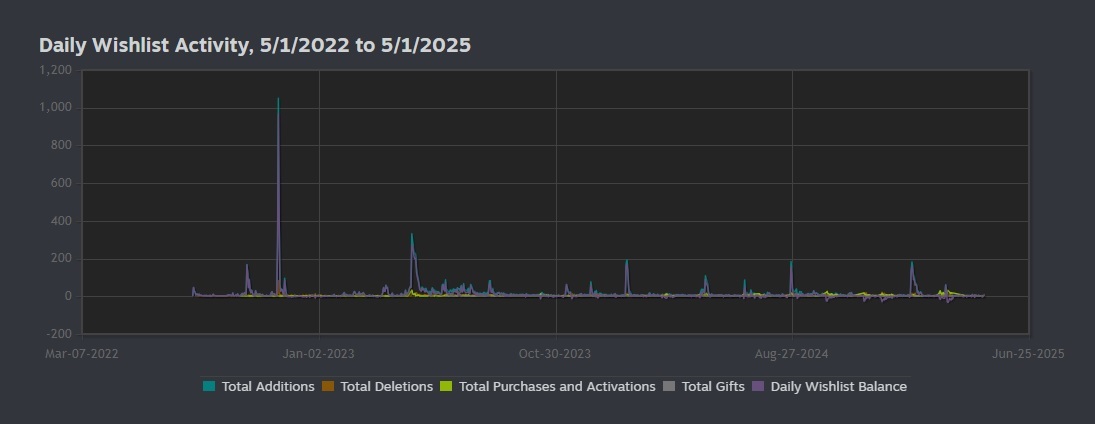
From there, wishlist growth slowed. Over the next six months — the lead-up to launch — we added about 1,000 more wishlists. To put it bluntly: in four months of DIY marketing, we’d done about as well as the publisher did over half a year. Not exactly a glowing endorsement.
That said, the launch itself went reasonably well. The publisher managed to generate some nice visibility, generating about 50K visits on our Steam Page on the day of the premiere.
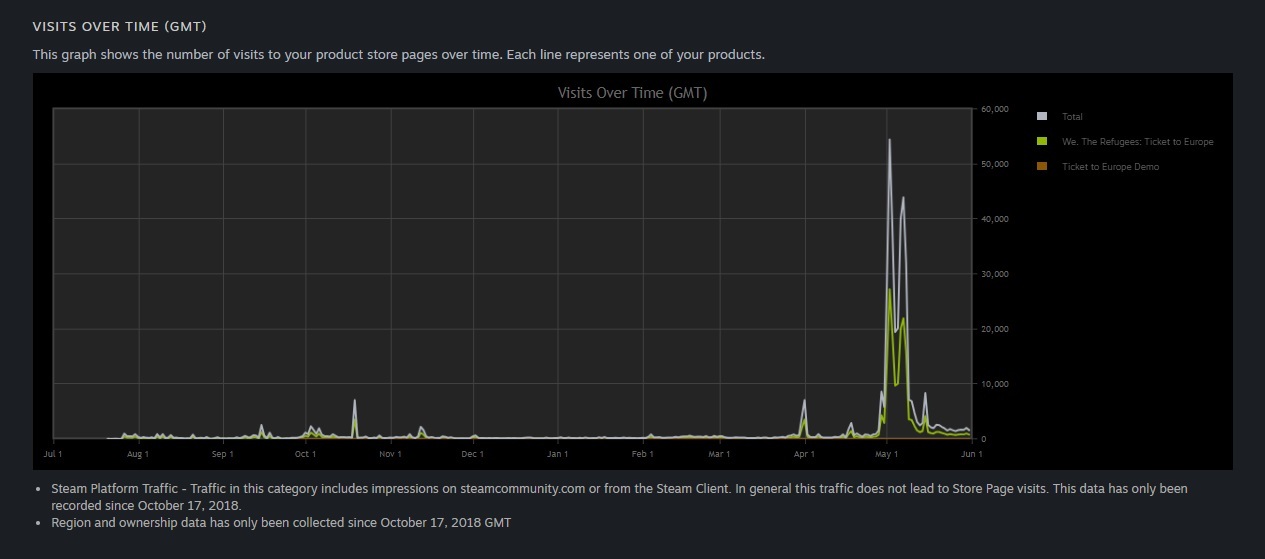
You can compare it to our lifetime results - we managed to gather 12.33 million impressions and 1,318,116 visits of our Steam Page during both marketing and sales phases:

It’s worth noting that nearly 50 titles launched on Steam the same day we did. Among them, we managed to climb to the #3 spot in terms of popularity. A small victory, sure — but one that highlights just how fierce the competition is on the platform.
Looking back, the launch may not have delivered blockbuster sales, but it did well enough to keep the game from vanishing into the depths of Steam’s archive. It’s still alive, still visible, and — to our mild surprise — still selling, if slowly.
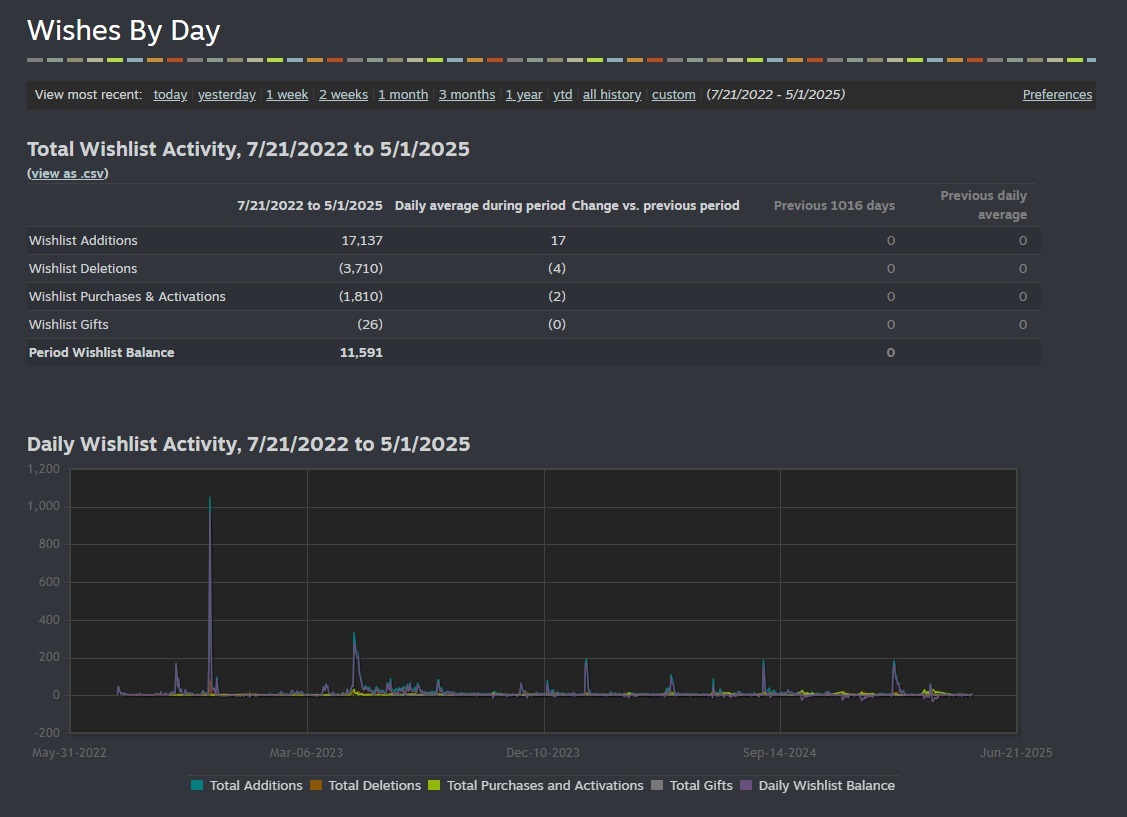
After the premiere we saw a healthy bump: roughly 2,500 new wishlists in the month following release. By early June 2023, our total had climbed to around 6,300. After that, growth was slower but steady. We crossed the 10,000-wishlist mark in May 2024, a full year after launch. Since then, things have tapered off. Over the past twelve months, we’ve added just 1,500 more wishlists. Here are our actual wishlist stats:
During the promotional period, we also visited many in-person events: EGX London, PAX East Boston, GDC San Francisco, BLON Klaipeda. We managed to obtain the budget for these trips - mostly - from additional grants for the international development of the company. And while these trips allowed us to establish interesting industry contacts, the impact on wish lists was negligible. In our experience - it is better to invest money in online marketing than to pay for expensive stands at fairs.
Sales
Two years post-launch, We. The Refugees has sold 3,653 copies — plus around 259 retail activations — with 211 refunds. That’s a 5.8% refund rate, and an average of about five sales per day since release.
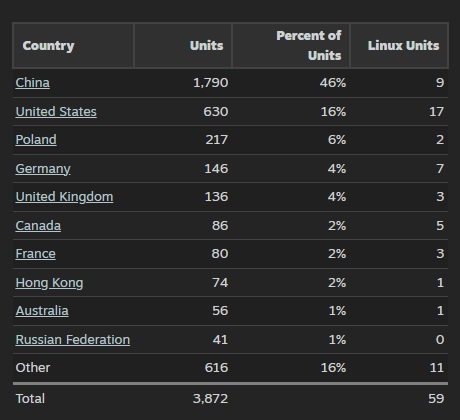
China turned out to be our biggest market by far, accounting for 46% of all sales. The credit goes entirely to our Chinese partner, Gamersky, who handled localization and regional distribution. They did outstanding work — not just on the numbers, but on communication, responsiveness, and professionalism. Partnering with them was, without question, one of our best decisions. Our second-largest market was the U.S. at 16%, followed by Poland at 6%. That last figure might seem surprising, but we need to highlight that Act Zero is a Polish studio and the game is fully localized in Polish.
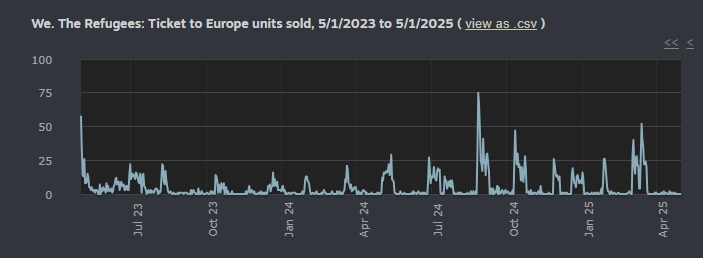
Looking at our daily sales chart, the pattern is clear: most purchases happen during Steam festivals or seasonal sales. Outside of those events, daily numbers drop sharply — often to near-zero. As of now, our lifetime conversion rate sits at 10.7%, slightly below the Steam average.
We haven’t yet tested ultra-deep discounts (like -90%), which may still offer some upside. But for now, the game’s long tail is exactly what you'd expect from a niche, dialogue-heavy title without a major marketing push.
Initially, we had higher hopes. We believed 10,000 copies in the first year was a realistic target. But a mix of limited marketing, creative risks, and production compromises made that goal harder to reach. In the next section, we’ll try to unpack what exactly went wrong — and what we’d do differently next time.
Mistakes & Lessons Learned
- No Map or True Exploration
We. The Refugees is a game about a journey from North Africa to Southern Europe — yet ironically, the game lacks the feeling of freedom and movement that such a journey should evoke. The player follows a mostly linear, pre-scripted route with some branches along the way. The main route of the journey is more or less the same, although there are different ways of exploring specific sections of the route. Even a simple map with optional detours could’ve dramatically improved immersion. Moving gameplay choices about the next destination onto such a map would also be highly recommended — it would definitely liven up interactions on the left side of the screen, where illustrations are displayed. Clicking on them would simply offer a refreshing change from the usual dialogue choices shown beneath the text on the right side of the screen. After all, the “journey” is a powerful narrative and gameplay topos — one that many players find inherently engaging. Unfortunately, our game didn’t reflect this in its systems or structure.
- Too Little Gameplay, Too Much Reading
Players didn’t feel like they were actively participating — and in a modern RPG or visual novel, interactivity is key. Introducing simple mechanics, like dice checks during major decisions or a basic quest log, would’ve helped structure the action and add dramatic tension. These are familiar tools that players have come to expect, and we shouldn't have overlooked them.
- Personality Traits with No Real Impact
The player character had a set of personality traits, but they were largely cosmetic. Occasionally, a trait would unlock a unique dialogue option, but in practice, these had little to no impact on how the story unfolded. We missed a major opportunity here. Traits could have formed the backbone of a dice-based gameplay system, where they meaningfully influenced outcomes by providing bonuses or penalties to specific checks — adding depth, variety, and replay value.
- Mispositioned Pitch
From the start, we positioned the game as a story about refugees — a highly politicized topic that immediately turned away many potential players. Some assumed we were pushing propaganda. But our actual intent was far more nuanced: we tried to show the refugee issue from multiple perspectives, without preaching or moralizing — trusting players to draw their own conclusions from the situations we presented.
Looking back, a better framing would’ve been: a young journalist’s first investigative assignment — which happens to deal with refugees. This would’ve made the game far more approachable. The refugee theme could remain central, but framed as part of a broader, more relatable fantasy of becoming a journalist.
- A Problematic Protagonist
We aimed to create a non-heroic protagonist — not a hardened war reporter, but an ordinary person, similar to the average player. Someone unprepared, naive, flawed. Our goal was to satirize the Western gaze, but many players found this portrayal alienating. It was hard to empathize with a character who often made dumb mistakes or revealed glaring ignorance.
The idea itself wasn’t bad — challenging the “cool protagonist” fantasy can be powerful — but we executed it clumsily. We gave the main character too many flaws, to the point where satire and immersion clashed. A better approach might’ve been to delegate those satirical traits to a companion character, letting the player avatar stay more neutral. As our CTO Maciej Stańczyk put it:
I still think a protagonist who’s unlikable at first isn’t necessarily a bad idea — but you have to spell it out clearly, because players are used to stepping into the shoes of someone cool right away.
- A Static, Uninviting Prologue
The game’s prologue begins with the protagonist sitting in his apartment, staring at a laptop (starting conditions exactly the same as the situation of our player right now!), moments before leaving for Africa. On paper, it seemed clever — metatextual, symbolic. In practice, it was static and uninvolving. Many players dropped the game during this segment.
Ironically, the very next scene — set in Africa — was widely praised as engaging and atmospheric. In hindsight, we should’ve opened in medias res, grabbing the player’s attention from the first few minutes. Again, Maciej Stańczyk summed it up well:
The prologue is well-written and nicely sets up the character, but players expect a hook in the first few minutes — like starting the story right in the middle of the action.
- No Saving Option
The decision to disable saving at any moment during gameplay turned out to be a mistake. Our intention was to emphasize the weight of each choice and discourage save scumming. However, in practice, it became a frustrating limitation—especially for our most dedicated and engaged players, who wanted to explore different narrative branches but were repeatedly forced to replay large portions of the game.
- Late and Weak Marketing
We started marketing way too late. We had no budget for professionals and little expertise ourselves. We tried to learn on the fly, but lacked time, resources, and experience. What we could have done better was involve the community much earlier. As Maciej Stańczyk notes:
Biggest lesson? Involve your community as early as possible. Traditional marketing only works if you’ve got at least a AA+ budget. Indies have to be loud and visible online from the earliest stages — like the guy behind Roadwarden, whose posts I saw years before launch.
Final Thoughts on Mistakes
If we were to start this project all over again, two priorities would guide our design: more interactive gameplay and freedom to explore the journey via a world map. Both would significantly increase immersion and player engagement.
Could we have achieved that with the budget we had? Probably not. But that doesn’t change the fact that now we know better — and we intend to apply those lessons to our next project.
Closing Thoughts
Two years after launch, we’re proud of how We. The Refugees has been received. The game holds an 83% positive rating on Steam and has earned nominations and awards at several international festivals. We won Games for Good Award at IndieX in Portugal, received a nomination to Best in Civics Award at Games for Change in New York, and another to Aware Game Awards at BLON in Lithuania. For a debut indie title built on a shoestring budget, that’s not nothing.
We’re also proud of the final product itself. Despite some narrative missteps, we believe the writing holds up — both in terms of quality and relevance. As the years go by, the game may even gain value as a historical snapshot of a particular state of mind. The story ends just as the COVID-19 lockdowns begin — a moment that, in hindsight, marked the end of a certain era. In the five years since, history has accelerated. The comfortable notion of the “End of History” (to borrow from Fukuyama) — so common in Western discourse — has given way to a harsher, more conflict-driven reality. In that context, our protagonist might be seen as a portrait of a fading worldview. A symbol of the mindset that once shaped liberal Western optimism, now slipping into obsolescence. And perhaps that alone is reason enough for the game to remain interesting in the years to come — as a kind of time capsule, a record of a specific cultural moment.
This reflection also marks the closing of a chapter for our studio. While we still have a few surprises in store for We. The Refugees, our attention has already shifted to what lies ahead. We’re now putting the finishing touches on the prototype for Venus Rave — a sci-fi RPG with a much stronger gameplay core (which, let’s be honest, wasn’t hard to improve given how minimal gameplay was in We. The Refugees). The next phase of development still lacks a secured budget, but thanks to everything we’ve learned on our first project, we’re walking into this one better prepared — and determined not to repeat the same mistakes.
Whether we get to make that next game depends on whether someone out there believes in us enough to invest. Because - being completely honest - the revenue from our first title won’t be enough to fund another one on its own.
So, here's our take on our debut title from a distance. And what do you think about We. The Refugees, two years after its release?