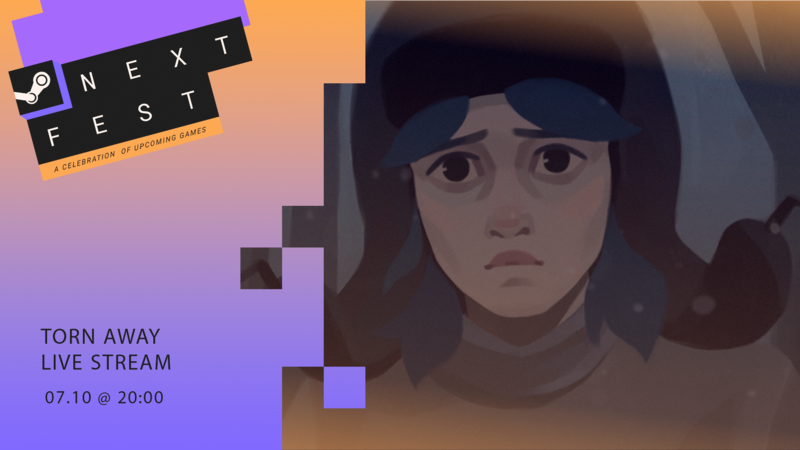
Join our stream with the developers of Torn Away this Friday 07.10 at 8:00 p.m. (GMT+3). We'll introduce Asya and her comrade Mittens to you and tell you about the features of Torn Away development and our future plans.
See you around!
Torn Away Demo
Dear Friends!
We're excited to present a demo of Torn Away at Steam Next Fest.
Demo version allows you to evaluate the key features of the game:
Platformer level
Level with a first-person view
Point-and-click levels and mini-games
As well as improved game graphics, the original soundtrack by Vasily Kashnikov (Pathologic 2) and the story itself.
We recommend playing with Russian voice-over and subtitles of your language.
We hope you enjoy the game! You'll support us by asking your friends to add Torn Away to their whishlist.
We'd also love to hear about your experiences via social media: Twitter or Instagram.
Have fun playing!
How Torn Away's tone has changed
For story-driven games is important not only the plot and dialogue, but the overall mood. It cannot be described in the terms of reference or tested with a simple prototype.
First playable demo of Torn Away was grim. In this version, Asya found a new friend, Zoya. Zoya died. The game was scary, but it wasn't the fun fear of the usual horror games.
We decided that a story about a child should have more inspirational episodes. And the playtests of the new version of Torn Away proved us right. Players experience stronger emotions if the game has a contrast of somber and touching episodes. We ourselves like to create games that help players believe that everything is going to be okay.
Homecoming Trailer + Why do indie game developers care about wishlists?
Hello there!
It's time for a new trailer. The old one was made a year ago, which is a long time for the small game.
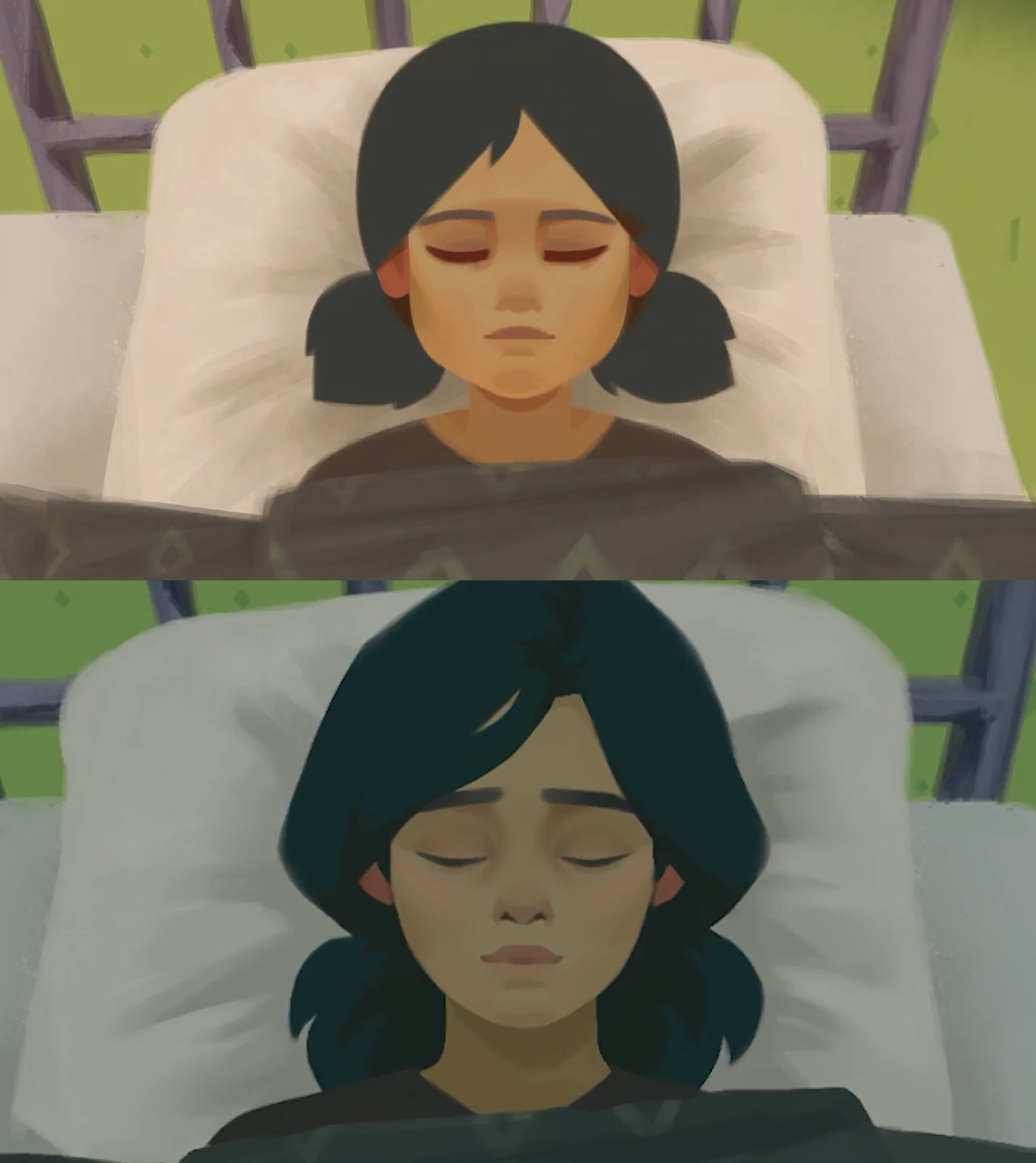
Look at how the visual style of Torn Away has changed over the past year:
By the way, have you added the game to your Wishlist yet?
Steam wishlists are more important to publishers and developers than to players. By the number of additions to the wishlists Steam understands how interesting the game is to the audience, and promotes it in Future Products and other sections. This directly affects the recognition of the game and sales. Studios that don't have large marketing budgets are forced to rely on free promotion methods.
Now we are publishing the game ourselves, and we need your support. Thanks!
Development log 4: Lightning and Animation
Hello, and welcome back, to our newest devlog!
Today we will talk about creating animations in our game. Animation in a broad sense is any dynamics on the scene. But here, we divide everything into several aspects: character animation, cutscenes animation and technical animation.
There is only one animator in our studio and Torn Away was a huge challenge for him. When we first started working on the game, no one could have imagined that the number of all animations would become so huge. Add here an almost complete restart — when we heavily redesigned the main character — and you will understand his pain!
Despite the fact that the animator's experience was mainly in frame-by-frame animation, we jointly decided that we would do skeletal 2d animation in the Spine software.
This made the whole process more flexible and customizable. For example, we can remove certain items of clothing without having to redraw all the frames again. This can be done on the engine side. The same works for the emotions on the girl's face. We can change them, regardless of the movement of the body.
Even though we're doing skeletal animation, the experience of frame-by-frame animation helped us create more lifelike motion. Here you can see how for the animation of running and falling, the linear version was first performed, and then the final one in Spine
Choosing the right tool and approach is a vital part of any development process. It is important to explore all the possibilities in order to understand which one will be the most optimal. For example, at a certain stage of development, we considered the possibility of transferring the character to 3D. Thus, it would be more convenient for us to build interactions with a three-dimensional environment.
But our animator had no experience in 3D animation, and the character himself turned out to be not as expressive as his 2D ancestor.
We share the first tests of 3D animation using the free Mixamo service, and trained Asya to fight, just for this one occurrence ;)
We also planned to make several different death screens using animation presets. But later we realized that we would not pull the production of truly diverse and interesting screens. The idea had to be abandoned.
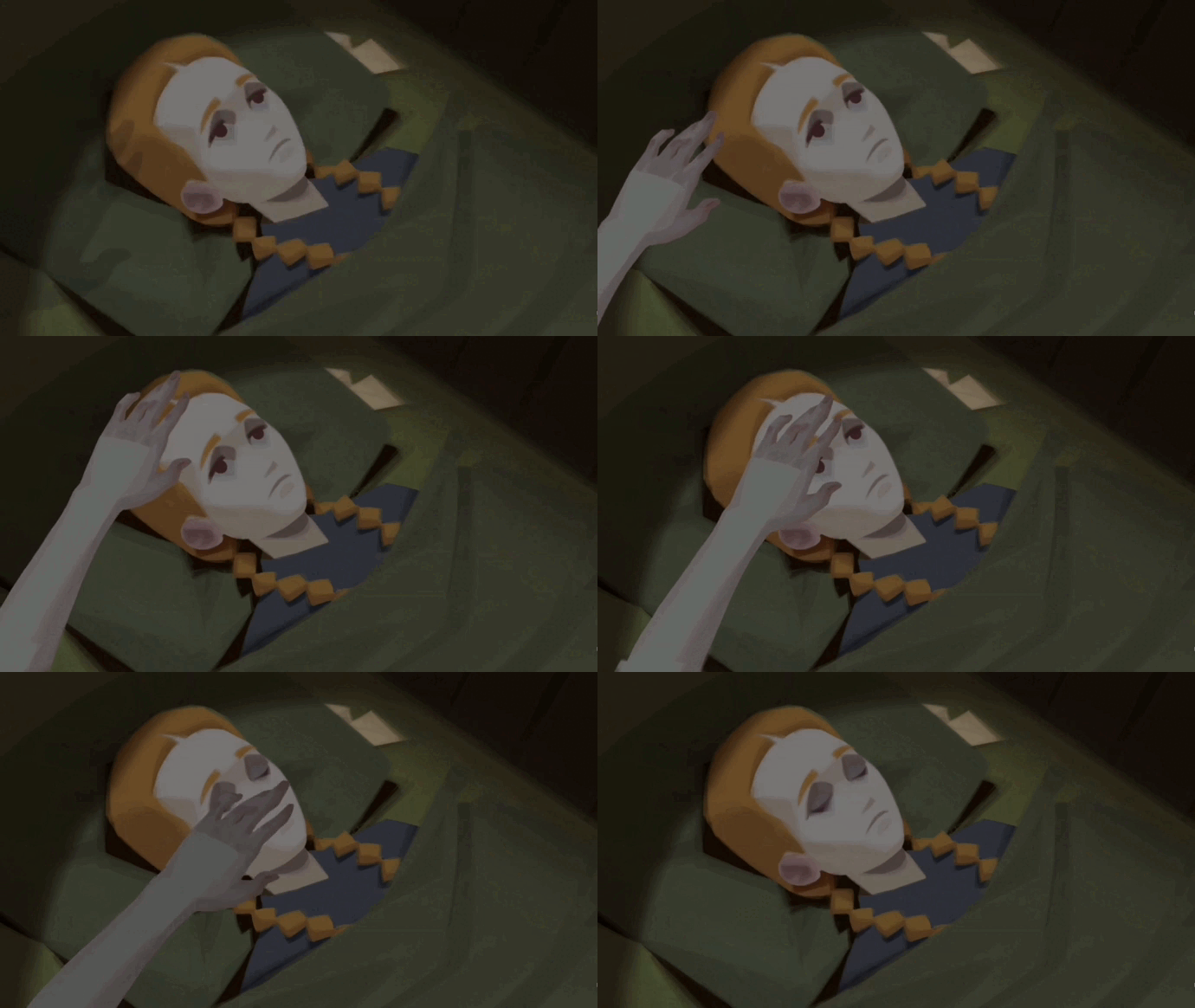
Speaking about other ideas that had to be abandoned, I would like to recall the animation of the hands when viewed from the first person. As planned, in all or most of the mini-games, we had to see the hands of the main character. Here is one of the first prototypes.
But doing them all in 3D would be really expensive, and the 2D animation wasn't that convincing.
I would like to say a few words about the iterative approach in creating dramatic moments in scenes. The main difficulty when working with them is that it is important for us to convey the idea using a visual language - graphics and animation. But at the same time, we want the player not to spoil the dramatic moment for themselves by doing something wrong. Therefore, we have to find a balance between interactivity and prepared animations.
The process usually starts with a script and a rough storyboard.
Then a concept that sets the mood.
Next, we block out and try to understand how it will look in dynamics.
Then in color.
After all of this, the finish line is a stone's throw away! In theory. In practicality, there were many more iterations, especially a lot of time is spent on character animation and coordination of all elements together.
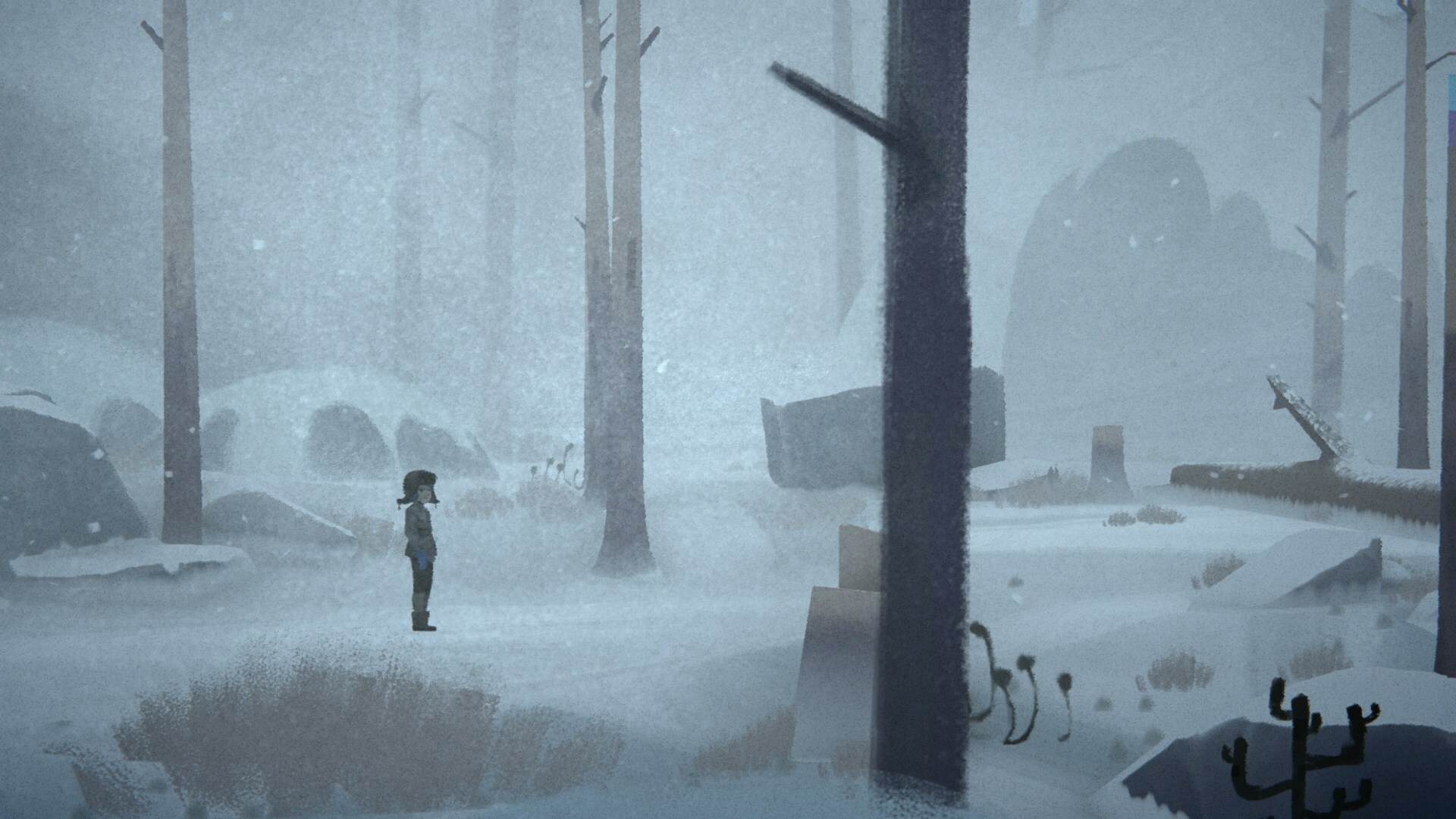
And if in scenes like the previous one, the emphasis is on beautiful graphics and character animation, then in first-person scenes, technical art (shaders, particle systems) and well-thought-out level design rule.
Here you can see some of the internals of the blizzard scene.
After a few experiments, our game designer and programmer managed to get the right feel for this scene. Cold and helplessness is what we strived for, so we keep pressing on!
Yes, for an unprepared viewer, it looks very sketchy, but our artists immediately see how to bring this scene to a finished look.
What this location looks like now you'll just have to find out for yourself, but for now I'm leaving you with a tiny teaser ;)
We often wondered: maybe we should have made a simple game, focusing only on 2D graphics? But doing different experiments with each scene, we understood that our path, however difficult, is worth it.
The possibilities that open up for setting up light, materials, angles are simply breathtaking.
Nevertheless, no matter how exciting our experiments with technical art are, we do not forget about the emotion evoked by hand-drawn graphics. Our story is filled with dozens of painstakingly drawn illustrations, which we brought to life with the help of the previously voiced Spine.
Here too, everything starts with rough storyboards.
Then comes the stage of preparing illustrations.
Well, in the end - the detailing of graphics and animation. The scene comes to life.
Here I also want to share a few sketches of frame-by-frame animation. Such sketches often help us find the right mood for a particular scene.
We hope you enjoyed today's story as much as the previous ones!
See you soon!
Join us in the Big Adventure Event Stream!
Join us in the Big Adventure Event Stream from 9 p.m to 10 p.m EST!
Torn Away Development Log #3: The World
When you look at the huge amount of work that has been accomplished in two and a half years, you would not believe that this was possible at the first place. But the point is that nothing happens right away - the creation of the game world, like any other complex aspect, is a long road of small steps. So, today we will tell you about how the style and visual language of Torn Away locations were formed. It all started with the first mood sketches. Even when the script and storylines weren't ready yet, we tried to find what kind of mood we wanted to convey.
The purpose of the thumbnail sketch is to establish composition and tone relationships at the level of several spots. For some locations, we made such a sketch right in 3d space using the grease pencil tool right in Blender. This allows us not only to establish tonal relationships and composition, but also to immediately understand how the parallax of our sprites will work.
In the process of searching, the graphic style of the game developed and changed beyond recognition. This happened for several reasons - for example, testing technologies: for our art director, it was important that the solutions conceived in graphic editors could be implemented in the engine. Character design also influenced the overall style. If at first it was cute and stylized, as we went on we came to more realistic proportions, leaving a certain amount of convention. This was necessary for the design to work well in conjunction with the content of the story and the emotion that we want to convey. The overall minimalism of the presentation was necessary so that the project, in principle, was feasible for our small team. We didn't have a huge budget like Ori, where each sprite was drawn for a long time and painstakingly by experienced artisans. Therefore, we chose such a presentation, where we could put together effective working compositions from simple fills and texture strokes without wasting a lot of time.
A clear evolution of style.
And more steps.
[previewyoutube="c7S6A6eaUfw;full"]
When the main style is set, an understandable, but at the same time no less difficult part of the work remains - thinking over each location and then gradually working out the graphics. The process for everyone is about the same - general sketching, blocking, object concepts - working out 2D and 3D assets, drawing textures and then final assembly of the level in the editor.
Even though Torn Away is a war game, we didn't want our scenes to feel drab and dark. Firstly, our heroine Asya is a child, and we wanted to show that even in the most terrible conditions, children do not lose their special view of the world. And secondly, the contrast allows us to evoke the most vivid emotions in the player.
Below is the process of working on the forest level.
[previewyoutube="DCriHLnQ3Lg;full"]
Now this level looks like this.
[previewyoutube="JT6S4CfrvLk;full"]
In addition to visual expressiveness, it was also very important for us to maintain historical accuracy. Yes, of course, we stylize images from references, but knowledgeable people will be able to find out what was the source of inspiration for this or that object. The location of the German city that Asya wanders into has become one of the most difficult for us. We did not take any particular city as a basis, but tried to convey the spirit of small German towns of that period.
[previewyoutube="hGOAcfR1vs8;full"]
You can see several propaganda posters here. Upon closer inspection, it becomes clear that we did not use real Nazi symbols. Some countries have laws that prohibit the use of such symbols even in historical works of art. We decided that it is more important for us to convey the spirit of that time than to portray real posters.
It was much easier for us to work on Soviet interiors. Since we ourselves are from Russia, we know where and how to find the necessary materials. There are many museums dedicated to this period that carefully collect items from the early and mid-20th centuries. Among other things, we know and love Soviet films, which also have enough historically correct sets. It's always a pleasure to look to your country's culture for inspiration.
Looking at archival materials and footage from old films, it is difficult to imagine that Asya's room could look like this - bright and cheerful. As if there is no and will not be any war.
Thank you for delving into this trip down our development ‘memory’ road with us. We have oh so much in store for you, so please, let us know your thoughts and stay tuned!