

Verdant Village
March News Update
As a quick aside for those that just want to hear about progress. This month has basically been a lot of sprite work and some stuff with combat. I definitely wasn’t at full capacity this month. What I’m sort of doing at this point is gearing up for world design which means importing tons of sprites so I have things to build the world with. So its been a lot of sprite importing and trimming…so much importing and trimming. But I’m making good progress on that front. Aside from that it isn’t super relevant yet, but basically all NPCs in the game are getting something of a visual overhaul. The idea is to make them look more unique so that will be something to look forward to. The rest of this is going to be more about the circumstances that have been discussed in the last few months. Feel free to skip if that sort of thing doesn’t interest you.
If you are still here, I’ll try to keep this short and sweet. Bar some very minor thoughts here and there I am mentally back on track, which is good. The dosage I’m on isn’t supposed to fully kick in till the end of this month though so that will probably rectify the last few bits of this.
Which brings us to the situation of development. I should start by saying that I still want to develop the game. I don’t predict that I’m going to give up on it. However, the last few months have caused quite a bit of thinking (anxiety does that, go figure). A lot of it was anxiety ridden bs, but there were some kernels of truth in there that I’ve been able to grasp as things have gotten better.
I won’t bore you all with the details, as I said these devlogs have already gone off the rails into non-game dev stuff in the last few months. The bit that’s relevant to anyone reading this would be related to time. As in the amount of time I work on Verdant Village.
I can’t really remember the timeline anymore but for the past few years. It might be 5 at this point. I’ve basically spent my weeknights working on this game. By which I mean if I can help it, I’d work all night. From after dinner to basically when I go to sleep. To be fair, I can’t deny that even I burn out and might break for bits of time during the evenings or on a rare occasion simply not work. But for the most part it was work my job all day, work on the game all night.
As you might imagine, that sort of takes up a lot of time. Also, I think I’ve been doing this long enough to say that its degraded the pace at which I work because its just a non-stop grind. I bring all this up to say that I think I might need to take a step back. Like I said I am still interested in finishing the game. I’m also not talking about just taking 6 months off or something. I think if I did that my motivation to return would probably be gone.
Instead, as I’ve been feeling better I’ve started working again, just, not all night. Rather than 4 or 5 hours its more like 2. This is all new to me so I’m not sure if that pace will stick. By which I mean it might go back up. At the moment I’m finding myself tired at the end of the day and just wanting to do something mindless. But there’s a descent chance that I’ll eventually get bored of just doing aimless stuff in the evenings.
I’m of course bringing all this up because obviously how much I work dictates how long this will all take. And as you’ve probably noticed, its been a long time already. As I’ve probably said before, if I could have seen the future I never would have done EA when I did.
In the interest of transparency, I should also say that I’m not sure exactly how things are going to go. My priorities have been shifting a bit. In the long term that might mean nothing, but it also means that this game might be put aside. As I said earlier, I don’t have any intention of doing that at the moment. But a year ago I never thought I’d be thinking the way I am right now, so, you know, transparency.
Which brings me to these devlogs. I’ve been doing one per month for, uh, a while? I decided on that because I figured that I’d probably always have something to discuss with month long intervals. With things currently being a bit more volatile I’m thinking I’m going to change that to making a devlog when I have something to report. For instance, when combat is fully operational I’d make a post about that. Or really any time I add a system or NPC or area etc. That way I can ensure that each time I post there will be something of substance. And it will hopefully keep those who want to follow progress in the know.
The caveat to that is that when the new version of the game goes live I’d probably be a bit more active, which was always the plan, but it feels like that needs to be said. Its just that right now I’m still basically in dev mode and there’s only so much to report.
I feel like this entire thing has been like a death knell for this game. I’m not sure that anyone will believe me, but that isn’t my intention at this point. If I were to end development personally, I don’t think there would be any reason to hide that. I’m pretty sure if that were my intention I’d likely just make a short post saying so and that would be it. I hope that gives you some faith that I still want to make this happen. I just feel the need to be up front with things. If you’ve already bought the game, you deserve that much at least. Not to mention, you know, a finished game that was promised.
So that is the current plan at the moment. Things are very much up in the air. I’m not sure how all this will shake out, but for my part I’ll keep you all informed on the dev related stuff. I think from here on out I’m going to limit the personal stuff far more. I don’t mind telling people these things, but this was never intended to be like a tumblr blog or something. I elaborated basically because I didn’t want to just disappear for a few months and then reappear like nothing happened. But at this point I think things are in a good place. The only uncertainty is how my time is going to be spent moving forward.
With any luck I’ll have another update in the near future. I’ll still be watching the forums and such so you can always make a post there to ask something if you are wondering how things are going. Thank you all again for your kind words and patience during all of this it really did mean a lot. Hopefully you’ll be hearing from me sooner rather than later.
February News Update
I won't bother repeating everything, but I've started a different medication and at the moment it is sort of working, emphasis on 'sort of'. Things aren't as bad as they were, but I'm still pretty wrung out and lacking motivation.
All this is to say that I haven't done much work on the game this month. There was some work on combat earlier in the month when I had a little more in the tank, but it's still very much in progress. I'm hoping that early March is going to see the end of this and a return to normalcy, but I unfortunately can't promise anything. Pray to the prozac gods and my doctor I suppose.
Admittedly, I haven't had many development related thoughts this month, however there is one thing I wanted to mention and get a read on if possible. It's mostly to do with side professions that involve refining materials in the game. By that I mean the more minor things you can do like drying meat, making cloth, etc. Not the major things like mining, farming, or fishing or even beekeeping.
In this newer version I had the plan to actually expand on a few of these things like instead of making just cloth in a loom you could take said cloth and make it into clothes which you could sell. Or instead of just making bars of metal you could forge it into weapons and armor, again probably just for selling purposes. The basic idea being to take these goods to their logical conclusion and turn them into more complete products if you wanted to do that.
What I've been thinking about is that there is already a lot going on in the game in terms of options the player can pursue. Adding even more machines that take up space and need to be manually paid attention to seems like it might be bordering on too much.
My idea was to take some of these systems and instead of having to manually create everything and manage all the buildings and UI menus I instead tack onto the shipping system where you can basically supply people in town with the materials they need to create goods and you get a cut of the profits. This would likely tie into some of the more end-game stuff planned that has to do with fulfilling orders for large numbers of goods for people outside of Amberglen.
It seems like a decent compromise in my mind. It could also probably have some sort of upgrade system involved like the more you give to an NPC (the blacksmith for instance) the more he levels up and then he can produce higher quality goods. It could also take the route where each NPC can only produce so much per day and as they level up that limit increases.
Stuff like that. I think it might help to keep the player as more of a supplier rather than a guy who owns a farm, who also smiths, tailors, makes jewelry, raises bees, fights monsters, etc, etc. Since this game doesn't really automate away a ton of tasks, keeping the list of things you can do manageable might be the better route. That way you don't end up just running around your farm clicking on each and every thing you walk by to collect and item or start a new task.
Anyway, let me know if you have an opinion on that, and don't be afraid to shoot it down (you won't hurt my feelings regardless of my current ailment). As I said before I'm hoping that by the end of March things will have improved. Apologies for the delay, and thank you all for the support, everyone's kind words really mean a lot. I'm sure I'll have an update at the end of March regardless just to keep everyone informed on progress.
January News Update
To dispel any potential mounting worry I’ll start by saying the game is still being worked on and work will continue. As most anyone reading this probably knows I develop this game by myself. I have a few artists I contract, but the coding is all me. I say this to basically explain that progress happens at the pace I can manage, so if I slow down not much happens.
Anyway, I don’t mind being open about this stuff so I’ll just bluntly say that I have general anxiety. I’ve had it for a very long time now. I take medication for it, and to be honest I don’t think I’ve had an issue in many years. This month though the medication I take decided it doesn’t want to work anymore. Or more accurately I grew a tolerance, which can happen and is apparently pretty normal.
Long story short, I’m in the midst of swapping to a different medication (actually picked it up today). I expect this will solve the problem and I’ll be back to normal. That said it takes time for this stuff to kick in as I’m sure anyone who takes this stuff is aware. Usually a few weeks at most. In the meantime, I’m somewhat indisposed. I’ll occasionally feel like doing some work, but I’m fairly unmotivated. Since this is all coming with no further context I feel I should also say there’s no need to worry about me personally or anything. Like I said, been here before, had this for a long time. Its funny after dealing with this several times throughout my life its honestly more annoying than it is terrifying. Just sort of waiting for my brain to shut up so I can go about my life lol.
To reiterate, the game will continue to be worked on, but I’m moving a bit slow at the moment and it might take a bit to get back on my feet. I don’t mean entangle my personal life with these sorts of posts I just wanted to give an explanation of things as they currently stand. Also, I don’t think its too common anymore, but I know subjects like this used to be hush hush. I think it helps to know that if you feel like this you aren’t really alone, its actually fairly common as far as I can tell. So if you also happen to have this sort of problem I hope you maybe find some solidarity in knowing that other people have these issues too. All things pass in time and this will too, so no worries.
In any case, that’s it for the personal stuff. Whew, that’s way too heavy for gaming talk lol. And you might think that I have nothing else to say, but I did actually get some things done this month so I have a bit to discuss. The first of the two things is combat. Its still in progress, but we are further along now.
A good chunk of work this month was doing some modifications to the data so that it can be used by the system. At this point I have a general combat algorithm in place. It still needs work, but a lot of the behind the scenes on how buffs and calculations play out is in place. Its sort of hard to put into words, but a lot of the combat system revolves around buffs and debuffs so having that logic in place is actually a large part of the system. Still plenty to do of course, but I think a fairly large portion of the system is functional.
Aside from that, there’s really just one other thing that is more conceptual. My determinations on this are still a bit up in the air due to the aforementioned issues, but I wanted to mention what I’m thinking about. And that thing specifically is the mines. Since I’m working on combat and the mines are a primary location for that I’ve been contemplating my plans for it.
If you’ve been following these devlogs I’ve been talking about turning the mines into something closer to several dungeon levels. Instead of hundreds of randomly generated floors you’d have just a few floors that are hand crafted. These floors would have a set layout that would weave back in on itself and create shortcuts. The floors themselves would have puzzles or challenges that you would complete once and doing so would unlock better mining areas on that floor. Sort of a dungeon like progression, but with the rewards being more available minerals each day.
I’ve been contemplating that in general and the things I would put into the levels. The problem I was starting to see as I fleshed out the idea more and more is that mining was rapidly becoming a secondary and even tertiary activity. It was getting to the point where going to the mines was more about clearing obstacles than just mining.
While this pain point would slowly fade as you completed the challenges on each floor it seemed sort of strange to have to bother with systems like that in the first place when you probably just want minerals. And then even once you finished the challenges you were left with a level which was only partially conducive to mining since it was made to be a dungeon.
All this is to say, I think the idea grew out of hand. I’m starting to think that the simpler approach would be the better one. There are enough systems going into this game that I think depth can be counterproductive in some situations. Mining should first and foremost be about mining.
So, I believe I’m going to simplify the design back down. Thankfully I hadn’t put any real work into the new version so no time has been lost. I haven’t decided exactly what I’ll do yet. My last thoughts on the matter were something like creating levels where there is always a place to mine by default but by bringing certain items or having higher level tools you can access bits of the floor with rarer (or just more abundant) resources. Sort of similar to how currently you can blast specific areas with dynamite and you’ll get a room full of stuff as a reward. Basically more elements like that.
My guess is that if I go this way, I’ll end up going back towards random level generation. I was considering still dropping the 100+ levels and instead still making 5 larger floors but they also re-randomize once per day. I’m not 100% yet, but that’s sort of what I’m considering for the moment. If you have an opinion on it I’d like to hear it, feedback is always appreciated positive or negative.
But I think that’s it for now. Hopefully you didn’t mind the personal stuff at the beginning of this log. With any luck by the time the next devlog comes around things will be very different. As I said before I hope you all are having a good start to your year. You’ll hear more from me in a month as usual.
December News Update
So, to get into it this month was about combat, as I believe I talked about last time. Good progress has been made, but there is still plenty to do. As a basic refresher the combat is going to be turn based. Below is an image of what the general battle screen will look like. As usual, you’ll have to ignore the temporary sprites. My drawing skills peak at using the fill tool to color in a box. Even the sprites that look completed may have another pass, so its all a work in progress.
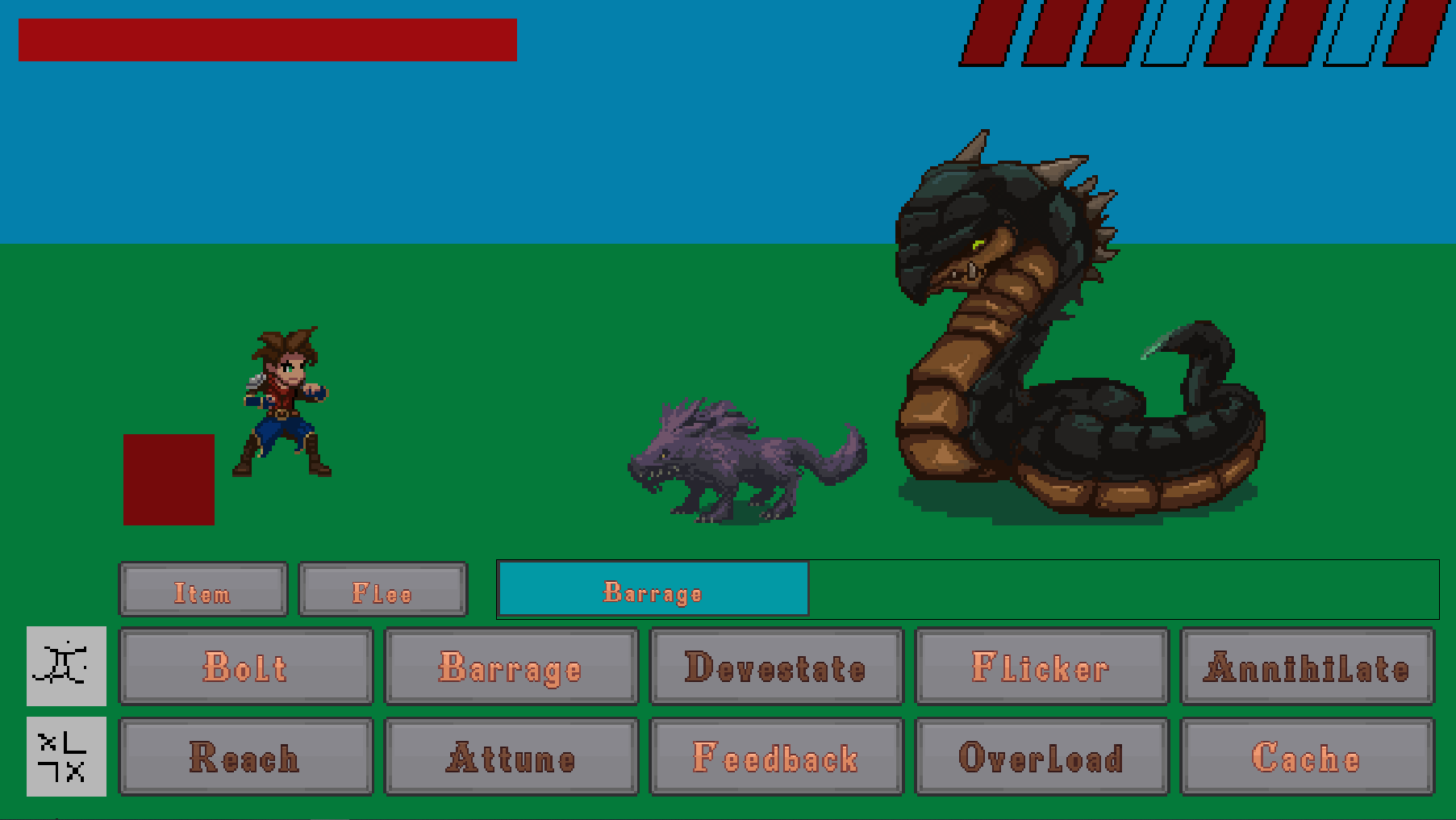
Each turn the player will have a few points (AP) to work with. You can have two active classes giving you a total of 10 spells (5 from each class). Each turn you select the spells you want to cast and then select a target. Enemies will always perform one action per turn in response. To account for enemy speed however there is also a round based system in play. If you look in the top right it shows the turn order for every combatant in the round. Depending on how fast a unit is they may only get one turn, or they may get several during the round. Bar buffs the player will likely always go once per round.
You also have your familiar (which currently looks like a red box) which you will also control. The familiar attunes elements and has a more simplified set of commands per element. In addition, you can flee obviously and use items.
To touch on items I think they will be restricted to alchemy items for the most part. The idea here is that using items will either have a cooldown rate or you’ll only be able to take so many into a fight. This is mostly just to prevent item spam. The general idea though is that alchemy will have some damage or status items as well as basic things like healing potions. So if you want to go hard into alchemy to boost your combat performance you can.
Outside of that the other thing, that maybe doesn’t need to be said given the temporary assets, I’d like for there to be more info at a glance than what you currently see. Currently all you see are spell names to pick from. If you hover them you get a description but I’d like to add things onto the buttons like AP cost at the very least and perhaps other things like what buffs/debuffs they apply, etc. As I believe I said last time, the less you have to dig through menus or hover buttons and read tooltips the better. Aside from buttons, status effects should be visible as well so you can easily look and see what you or an enemy has applied at any time. I’m debating on showing enemy HP at any given time, so that might show up as well.
So there is obviously still a lot to do. The end of this month has been overtaken by the holidays, but prior to that I was at the point of implementing combat calculations. Without going into detail that basically means the math that calculates damage or other effects when you cast a spell. That’s a very large task, but once an algorithm is set it should come together pretty fast. I already know how damage is calculated via a spreadsheet I just have to make the code actually handle various effects and modifiers so it calculates correctly.
At this point a good chunk of combat is actually implemented. All the UI that you see in that image is functioning properly. I’ve also already figured out enemy stats and balancing for the first segment of combat. To explain that combat is effectively split into 5 levels (or 6 for the player). Depending on where you are in the world enemies will be at a certain combat level. This means if you wander around at night you may run into dangerous enemies depending on where you are. Outside of the mines though you can only be attacked at night so if you want to avoid combat ideally, you’d just sleep at night. That said the overworld sticks mostly to low level enemies, the more dangerous ones are deep in the mines or locked to a few specific areas.
Aside from all that, loot still needs to be set. Fighting enemies will yield items that you can use. Mostly stuff for alchemy, but some of the items have wider uses as I recall. I think one example was tailoring. I don’t know if I’ve mentioned that, but where in the current version of the game you can just make cloth in the new version there will be a fairly simple tailoring system where you can turn cloth and other items into clothes which you can sell. Sort of just a way to flesh out those items and make them more profitable if you want to go that route. In terms of complexity it will likely be similar to something like smelting ore where you just click a button to craft the item assuming you have the materials.
That is mostly it for combat however. I’ve still got a ton of work to do, but once the holidays are done I should be able to focus more fully on it. I’m really hoping that by the end of January it is done or at least done in the capacity of the first combat tier. I’ll likely be adding combat in tiers as I add levels to the mine. The current plan is that the initial version of this that goes live will only have the first mine level. Which as a reminder there are only going to be 5 mine levels but they will be large and laid out more like dungeons to explore.
Aside from combat I’ve been working to get sprites added back into the game. I didn’t realize how many art assets there were until I had to start moving them all over. I’ve also been working on fleshing out characters and writing stories. I also just started working with my artists to look at the character portraits. Most if not all of them are getting a minor makeover. Something to make the characters more unique looking so they don’t all blend together as much.
I think that covers basically everything for now. Apologies that there isn’t really anything new to talk about. Combat was always going to be one of those big systems that was going to take some time to complete. I’m hoping that by the end of January I’ll have it basically done but we’ll see what happens. Anyway, thanks for sticking with me through this year. With any luck it will all be worth the wait. I hope you all had a good holiday if you celebrate. I wish you all a happy new year, and I’ll see you all in a month as usual.
November News Update
So as far as things added, there was work on the item quality system to work out a few kinks as well as assign quality to fish that you catch. In addition, the cooking UI was finished up. I believe all I really had left to do at the start of the month was finish up fish filleting. Its more precise than what is in the live version. Fish give one of two types of fillet and those fillet’s have quality levels. On top of that different fish give different amounts of fillets. You can also tell what you are filleting, because for some reason I don’t think you can in the live version.
Aside from that there was a fairly large backend change to object hierarchy to accommodate certain placed objects. The reason that came up is because the carpenter mallet got added in so you can actually pick up the things that you place.
The reason the carpenter mallet finally got added in was because I also coded the entirety of the irrigation system at the start of the month. That probably doesn’t sound like much but it’s one of those systems that is a lot more complex than it probably seems. It has to do with placing and picking up pipes, water sources, updating pipe flows, etc. It starts to get into recursive algorithms and things to keep it efficient. In any case, I won’t bore you with the math, it is now done and works.
A few details with the irrigation system though. First, I did some considering and decided that you won’t get irrigation right away in the game. In the live version you just sort of have the option from the start. This was because irrigation wasn’t planned originally so rather than make it a reward I just dropped it in. Problem is if you have it right away it just sort of overshadows the watering can upgrades. So, it will be something you get a bit later in the game this time around.
Aside from that, I’ve changed how irrigation works. Originally, I was intending for it to be the same as before where you connect it to a water source in the world. However, two things happened. One, water changed a bit, and two, I’m not sure if the farm will have a water source on it yet. It probably will but I’m toying with some ideas. I also don’t like the idea of being tied to a static bit of water on the map, it sort of forces all players to build similar layouts if the want irrigation. Instead, you’ll now unlock a small one tile building that acts as a water source so you can effectively irrigate anywhere. This was intended to be a later upgrade in the old system but I decided to just move the whole system back further in progression and give it all at once. However, that said, I’ve also added an upgrade for irrigation pipes that will unlock a bit later than the pipes themselves. I’ll leave that one a mystery but I’m sure if you think on it you can figure out what it might be.
So that was the actual programming work done. I also added in more sprites which is more of an ongoing project to transfer things over, but that’s mostly busy work. As I said at the start, most of my time was spent pondering. Well, pondering and using excel, who doesn’t love a good spreadsheet after all.
So, what did I have the joy of making spreadsheets about? In a word, combat. If you’ve been reading these for a while you probably remember me mentioning combat more than a few times. You might also remember me saying that its gone through like five iterations at this point. I’ll try to put all that into some concise detail and explain where I’m at.
To keep it somewhat simple the older combat systems were much too complicated. I want combat to be a system that feels like more than an afterthought. Because of this the systems I was designing tended to be on the complex side. There were a couple of iterations, a deck builder like Slay the Spire, something that played like a round based card game, a turn based battle system themed around auto battling and using abilities to give yourself stat buffs throughout the battle, etc.
I don’t think these were bad ideas but they all shared the same issues they just manifested at different points in the design. Those issues were, simply put, too complicated, and too long, as in battles would take forever.
Designing combat for Verdant Village has basically been a constant attempt to make something interesting, but also keep it simple and short. As I’m sure most would agree no one wants to be locked into a random battle that takes 10 minutes to finish. Fights should be, get in, get out, excluding boss encounters where I think it’s a bit more reasonable to have a long form fight.
So, with all that said I spent a good chunk of the month trying to think something up and fine tune it. I believe I’ve accomplished that. Keeping the fights short will just be a matter of tuning numbers. Keeping fights simple but interesting is something that’s harder to gauge, but I think this hits a descent balance for this type of game. I’m leaning towards the simple side as I’m guessing no one is coming to this game for dark souls tier combat difficulty.
So, what is the combat? A turn based battle system, okay that’s it next topic.
No, I of course will explain (maybe even overexplain). In terms of appearance, it would be easiest to imagine an old 2d final fantasy game. Your character and familiar on one side, the enemies on the other. The combat is turn based as stated before, turn order will always be you then the enemy. Having different speeds and turn rates was considered, but it ended up being just another complication that got trimmed. Speed is instead bundled into other aspects of each enemy.
Speaking of turns, what you are probably imagining is taking your turn, picking attack, or a spell, or an item, etc. This is where the complexity comes in. Unlike old JRPGs you will only have your character and your familiar (we’ll get to them eventually). Those old RPGs worked because a lot of it was about building a party of compatible classes and using them together to overcome various situations. Since you are just one person I’ve instead decided that you are the party.
To explain, first, in a turn you don’t take just one action. You effectively have a set amount of AP (action points) per turn. Every action you take in a turn uses AP, so in any given turn you can compile several actions together. Once set, all the actions will play out at once and that is your turn.
Now one of the things I wanted to avoid was menus. If you’ve played an old JRPG you might remember that some characters (usually mages with lots of spells) had entire lists of abilities to pick from. I don’t want people to have to dig through menus to find the spell they need. As I said at the start, fast and (relatively) simple is the goal.
As I said before the player is the party. The way this works is that the player has access to six classes. Each class has 5 abilities. At any given time in a turn you can set two classes to active, meaning during any turn you only have access to 10 abilities which will all be displayed on the screen, no menus involved.
Classes have been specifically made to be extremely niche. They basically all serve one particular purpose so keeping them straight should be easy enough. For instance, one class is focused on dealing damage. Another is defensive, another one buffs the player, etc. If you’ve ever played final fantasy 13 (maligned as it is) I looked at the paradigm system of that game when designing this one.
To summarize, the player can take multiple actions per turn. You will have 10 actions available at any time, 5 apiece from 2 active classes. You can swap classes freely and as often as you like and each class has a distinct theme so they are easy to tell apart.
But wait, there’s more! Enemies will be fairly simple in design. They will all have some sort of basic attack and then probably 1 (maybe 2) unique abilities they can use. Enemies are encountered in groups of up to 3 so some mixes of enemies will be harder than others. There is one thing about enemies that is worth mentioning however, it’s just a little added interaction to complicate battles a bit. While buffs and debuffs exist certain enemies will also have what I’m currently calling a status.
A status is a buff inherent to the enemy. These are very strong, but the key is that the player can counter them. Countering a status will negate it for the rest of the fight. The player has specific abilities that counter specific statuses, in fact an entire class is dedicated to it. As I said, the combat isn’t going to be wildly complex. I’m just hoping this will offer up some choice for the player in terms of target prioritization.
Now, finally, the familiar. From a gameplay perspective the familiar exists because going 3 on 1 can get a bit hard to balance in terms of health and damage output. You end up with weird situations where without a lot of on-the-fly adjustments enemies might either just destroy you or be useless. There are other ways around that sort of thing, but I thought this was an interesting solution.
For those unfamiliar with uh…familiars, a familiar in fantasy settings is usually something like a helper spirit for a magic user. In a lot of settings they take on an animal form like a crow or a cat for instance. In this situation your familiar is just that, and it helps you in battle. Familiars cannot be attacked so there’s no managing its hp. They have AP, and can take multiple actions per turn albeit fewer than the player.
The familiar is meant for two purposes really. The first is elemental advantage. Some enemies will have an inherent element. Elements work similar to something like Pokemon. Water beats fire, fire beats nature, etc. There are six in total and they all have an advantage and disadvantage against another element.
While your character has classes that determine your actions your familiar will always be channeling a single element. This element determines the type of damage it deals as well gives it a specific bit of utility. Elements can be swapped at will similar to the player swapping classes. Unlike the player classes the familiar only has 3 actions for each elemental form making it simpler to manage. These abilities also follow a pattern for each element. Each one effectively has a damage, utility, and counter ability.
As mentioned earlier familiars have two main purposes. The other purpose is that each elemental form has one of the three actions dedicated to a specific enemy status counter. So your familiar will be the only thing that can remove some enemy statuses, which means swapping to the appropriate element will be needed for both optimal damage and status control.
And that is the combat system, at least briefly put. There are a few odds and ends that will also exist like the use of items by the player or being able to escape a fight etc. Also, there is a whole external system to grow more powerful. I haven’t finalized the actual progression yet but I may tie it to items and your farm rather than just an xp number.
I’m guessing that all of this probably sounds like a lot. To put some of this in perspective you’ll likely be selecting only a few actions per round, maybe 3 or 4 by the time you have a larger AP pool. And I’m looking to have it so that enemies, if fought with reasonable skill, will die in 3 or 4 turns. So ideally a normal fight shouldn’t really last more than 12 or so turns at most unless you are just in an area where you are out of your league. That said the leveling system is also being tuned so that you will effectively end up stronger than anything you fight. So, bar bosses, which will probably scale differently you will (with enough combat) get to a point where you can quickly mow down enemies.
Hopefully that doesn’t sound like too much. I’d be curious to hear any feedback. I think this is probably hard to visualize from just text, but like I said at the start the goal is quick fights, not too complicated, and not too hard. As a final note I should also mention that animations are planned to be quick so you don’t get bogged down in visuals that you’ve seen 100 times. Basically, the opposite of, oh, I don’t know, Sephiroth in the original FF7 is a good example. Fun fact, Sephiroth, the final boss of FF7 has a move called supernova where you have to watch a literal 2 minute cutscene of him shooting a comet through several planets in the solar system, and then into the sun which then explodes and hits your party (somehow an exploding sun does not simply wipe you out of existence). Anyway, this combat system will be the opposite of that in terms of animation work.
Okay, onto the last topic, this is a long devlog already, but I’ve been talking about dialogue and lore a bit in the past so I wanted to address it just a bit. Perhaps its just because not much coding happened this month, but I partially want to justify the time spent on writing. I guess I’d specifically like to address the standard I’m trying to hold to for each character.
To preface, and I think I’ve talked about this before, I’ve never played a game similar to this where I said ‘these characters are interesting’. In my experience characters always basically come across as cardboard cutouts or walking, talking, shop windows. A certain amount of this is obviously just personal preference. My takeaway has basically always been that there just isn’t enough writing to make them interesting and the writing that is there is very (in my opinion at least) boilerplate. I don’t like to throw shade at other games as making a game is hard work and getting any sort of finished product out is tough and honestly something to be celebrated.
All that said, I think this is a gapping flaw in design. These games have long playtimes and the people you meet in them should be interesting. I guess in terms of importance I put characters at about the same level as I would for a normal RPG like Bauldur’s Gate or Dragon Age. The stories aren’t going to be as epic in scale of course but the people you meet should be interesting at the very least.
I did some research on this as I’ve never really critically analyzed these games I just played them. I looked at Harvest Moon FoMT, My Time at Portia, and Stardew Valley all games I’ve personally played through. I watched videos of effectively the heart event system for characters in each game.
Harvest Moon is very basic but I chalk that up to it being a GBA game, there probably wasn’t much space for huge dialogue threads. Portia certainly seemed to have the lengthiest system and some interesting mechanics like dates. In case you are familiar with the game I watched all of the events with Emily. I’m working under the assumption that the characters of each of these games are probably at parity when it comes to character design and dialogue.
Perhaps Emily was a bad example, but I think the best way I can put it is it felt lacking in personality. It seemed like you go through the entire buildup, but you never really learn much about the character outside of she’s a farmer, she has a grandma with memory problems, and there is a vegetable growing competition that she wants to win.
None of these are bad backdrop ideas for relationship building plotlines. The problem I remember is I came out the other end of the cutscenes feeling like I didn’t know the character, rather just their profession. I couldn’t attribute personality traits to her aside from ‘generically nice’.
Stardew seemed to have the same issue. I watched through the events with Leah as I’d romanced her while playing, but couldn’t remember anything outside of ‘she’s an artist’. After watching all the scenes again I came away with the opinion that there wasn’t really much else there. Spoilers on Stardew I guess? If you romance her most of the scenes involve talking about art, and her not being able to pay the bills with said art. There was a cute scene with getting fruit from a tree as I recall and another where you can punch her ex in the face because he’s a stalker.
All in all, as with Portia, by the time it got all the way to marrying her I was left with the same conclusion that the character seems to be generically nice and is an artist. Again, perhaps I picked the wrong person and the others are more interesting. The general issue I found is that the focus is too much on what the character does for a living rather than them as a person.
Ironically, the game with the least going on (Harvest Moon) had the character with the most personality. I watched the cutscenes for romancing Ann because she was the first on the alphabetical list (as you can tell this was very scientific). In any case, over the like 4 minimal cutscenes you actually get insight into her personality. She’s a barmaid and seems happy in that job. She gets embarrassed when romantic topics come up, she thinks her dad is overbearing when it comes to her getting married, she likes to eat, she sings to herself, she’s tidy, and she can have a temper if she gets flustered.
She seems to follow tropes you would see in anime and I’m not saying she’s the best written character ever, but there is at least something there. If you ask me to describe her personality I can list what I just did whereas with the others I wouldn’t have anything to say other than their profession and that they are nice.
So, at this point I’m probably running the risk of making people who like these games angry, for the record I like these games too. As I said before I don’t like to criticize. Its easy to sit on the side and point at something you don’t like when you aren’t the one doing the work to make it.
I bring all this up just to preface, yes, the last like 5 paragraphs were preface. I really go on forever don’t I? I should take up youtube video essays or something. In any case, all this is to say this is what I want to avoid. I want people to come away from this game remembering characters or thinking they are interesting, maybe have that story stick with you for a time.
The thing I wanted to bring up originally was a comparison I did. When I watched the Stardew cutscenes with Leah I copied down all the dialogue lines including player responses. The word count for everything together was around 600 words. To be clear, more words does not mean better writing. That said, 600 words to go from acquaintances to marriage is a lot of ground to cover in very few words. There is an argument to be made that a game has more ways to convey narrative than words as it is a visual and audial medium. In this case I’d say neither of those elements did a significant amount of heavy lifting to compensate.
The first character I’m writing is planned out at this point. I wrote the first event this month between other things and the word count for the first conversation is around 800 words. I say this not to brag or anything, like I said, word count doesn’t equal better. I bring this up because if you remember prior to me babbling for a full page I said I wanted to justify the time I’m spending on writing.
I hope these counts and some of my long winded explanation put into perspective the detail that I’ll be attempting to add to characters. I believe the first character has 7 ‘events’ if you will. They will likely vary in length, but if you generally extrapolate, 800 words multiplied by 7, is 5,600 words.
That said, each character tale is probably going to be about this length. However, the thing is, that’s just the tale. Every character will have one, and this could be considered just getting to be good friends with a character, these stories aren’t romantically inclined. For characters you can romance they’ll have an additional set of events focusing on an actual relationship that builds to marriage. So there is even more dialogue.
Since this devlog is already just going forever I’ll also briefly mention topics. In addition to tales there was planned to be a topic system where you can bring up various things with NPCs and have a short but unique conversation. This has been altered slightly because the original plan would have resulted in an insane amount of writing and a mess of programming. At this point the plan is that during the main tale or romance plots various things might get mentioned by the character. If you want you can go back afterwards and ask them about whatever relevant topic came up and have a short conversation to go a bit more in depth on that specific topic.
All this is to say there is a lot of writing that will need to happen and characters aren’t as simple as just dropping in an NPC and slapping on a few lines of dialogue. Now, if you are thinking to yourself ‘he’s never going to write that much’ I should also mention that I’ve written a few books in my life all sitting at about 160k words so I promise I am more than capable of writing a lot.
As a final disclaimer, I don’t want to come across like I’m some great novelist. It’s a hobby of mine, I enjoy it, but I didn’t go to college for it, or train in any real way. While I think I can do an alright job I just wanted to clarify that I’m not some amazing author or something. I can’t promise some fantastically written story but I want to try and make characters feel like real people that players want to actually talk to and see the story of. The unfortunate downside of that is that it will take time to write all this. I want to put forth the best game I can. I unfortunately picked the type of game that has 18 bazillion aspects to it so there’s a lot to do. In any case I hope this sounds like something you would find interesting to have in a game like this. I personally think of it as less of a ‘nice to have’ and more of a requirement.
I think that’s it for this month. This devlog is like the length of a chapter in a book for whatever that’s worth. I talked about a lot here, but a lot of this month was getting things in order rather than coding. Usually ruminating leads me to talking a lot. I think December will shift back towards programming though. Dialogue writing will continue to grind slowly. Combat needs to be sorted and planned some more, but I would think the systems will start to be setup next month.
Thank you all for bearing with me during this long process. I hope that at the end of this long tunnel there is a game you all find worth the wait. If you have read this far you are a true champion. If you live in the states happy belated Thanksgiving, I hope you found something on the Steam sale to play. And, since I won’t be writing another of these until the end of the year, Merry Christmas if you celebrate, or happy Hannukah, Quanza, Festivus or whatever you might choose to celebrate in December.
October News Update
This month was one of those ‘only one thing got worked on all month’ months. Suffice to say cooking is a fairly involved system. On top of that I was sick for a week which really didn’t help matters.
To start I should say that cooking is (basically) done. I have quite literally one final detail to write into the system to display some icons which I’ll be taking care of after this. So, I’m going to go ahead and call it done. Going into cooking I figured this was going to be fairly simple. After all its really just a couple of menus that search for ingredients and let you combine them into food.
Realistically, it’s a lot more than that. One of the big things was actually data. I kept a good deal of the recipes in the current game but some were added, others were modified, and some got deleted. That said there was still an extensive amount of data entry to do. The final count of recipes is 155 plus 16 ingredient recipes but I don’t really count those. Simply put, lots of data.
Once the data was setup the actual UI had to be put together. Much as it pains me to post unfinished art you’ll have to bear with the image. Just bear in mind that everything you see is temporary. I promise there won’t just be a giant number (in this case a zero) to indicate oven heat when the UI is done.
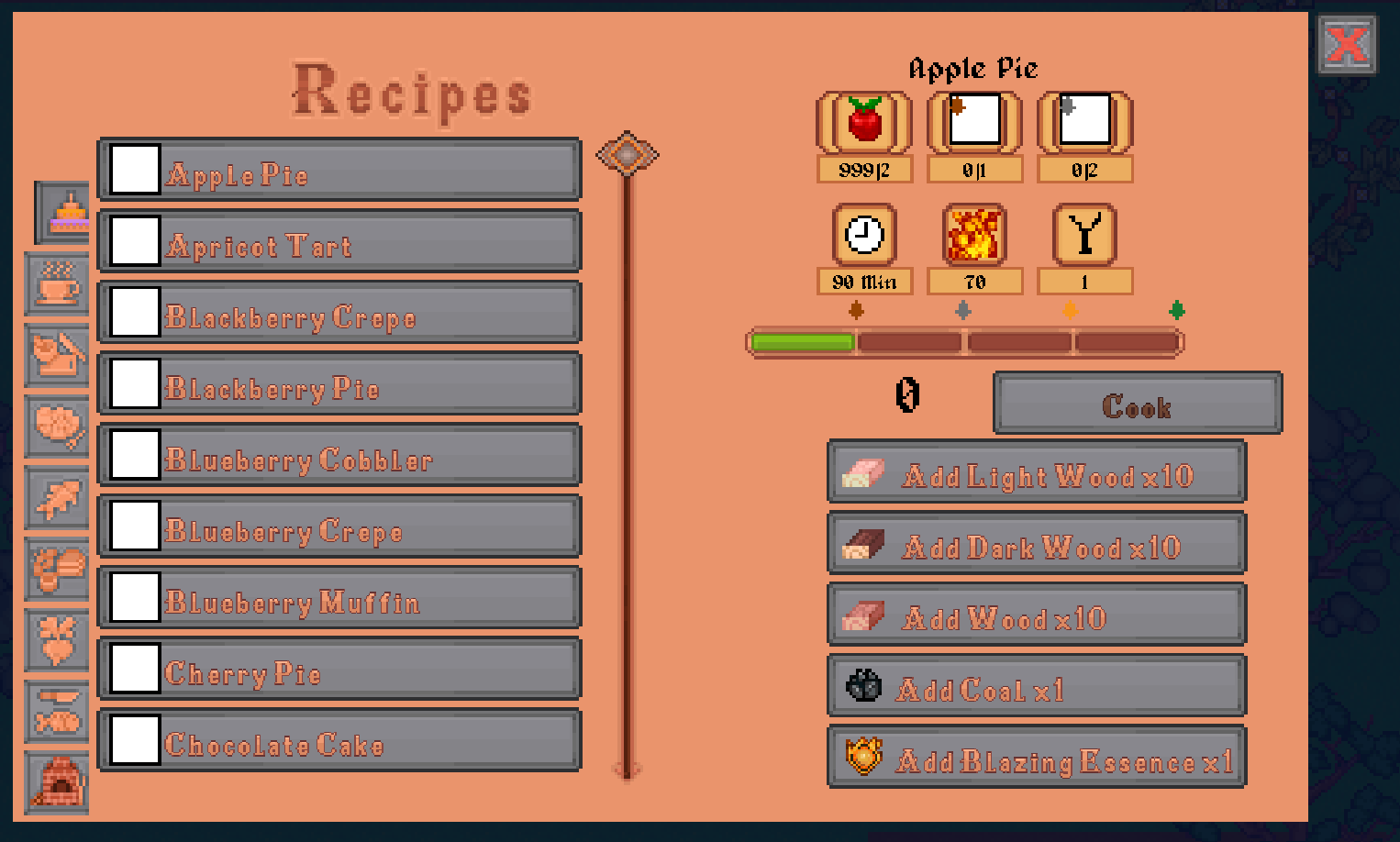
If you’ve played the game you are probably familiar with the UI. For the most part the changes mostly come from item quality, the oven, and the fish filleting process.
To start, item quality. I believe I’ve mentioned it before, but some items are going to gain a quality level in the game. If you’ve played Stardew Valley or Graveyard keeper its equivalent to items having bronze, silver, and gold stars. These quality levels aren’t attached to every item. The plan is to basically keep quality tied to items that you create, like food. Also, some materials that go into various recipes, for instance crops, or fish will also have quality.
As you can probably guess in the case of cooking the quality of your ingredients dictates the quality of the final product. This was the first UI system I’ve had to make that takes quality into account so there was some work to standup the UI systems. Now that the code has been made it can be reused for other systems thankfully.
To accommodate all of this the cooking UI shows as much data as possible when selecting a recipe. Once selected you can see the ingredients that are required for the recipe in the top right. These ingredients are shown to you per their quality. Selecting the buttons to the left and right of each item allows you to cycle the quality of the item and see how much you have of each item. As you adjust the quality of ingredients you’ll be able to see how likely you are to get a particular quality of product. If you don’t hit an exact threshold you basically get a percentage chance of getting the next quality level.
Below the ingredients you can add items to generate heat in the oven that you’ll need for cooking. Recipes are listed on the left. They are separated into categories and sorted alphabetically to hopefully make them a bit easier to search. Recipe categories are selected on the left side of the recipe menu via the line of buttons.
The oven UI is the next bit that is worth showing. The old oven UI operated on a set of slots you had for cooking. I’ve decided to get rid of this slot system. You can instead cook as many things as you want at the same time. Below is again a temporary UI but it gets the basic point across.
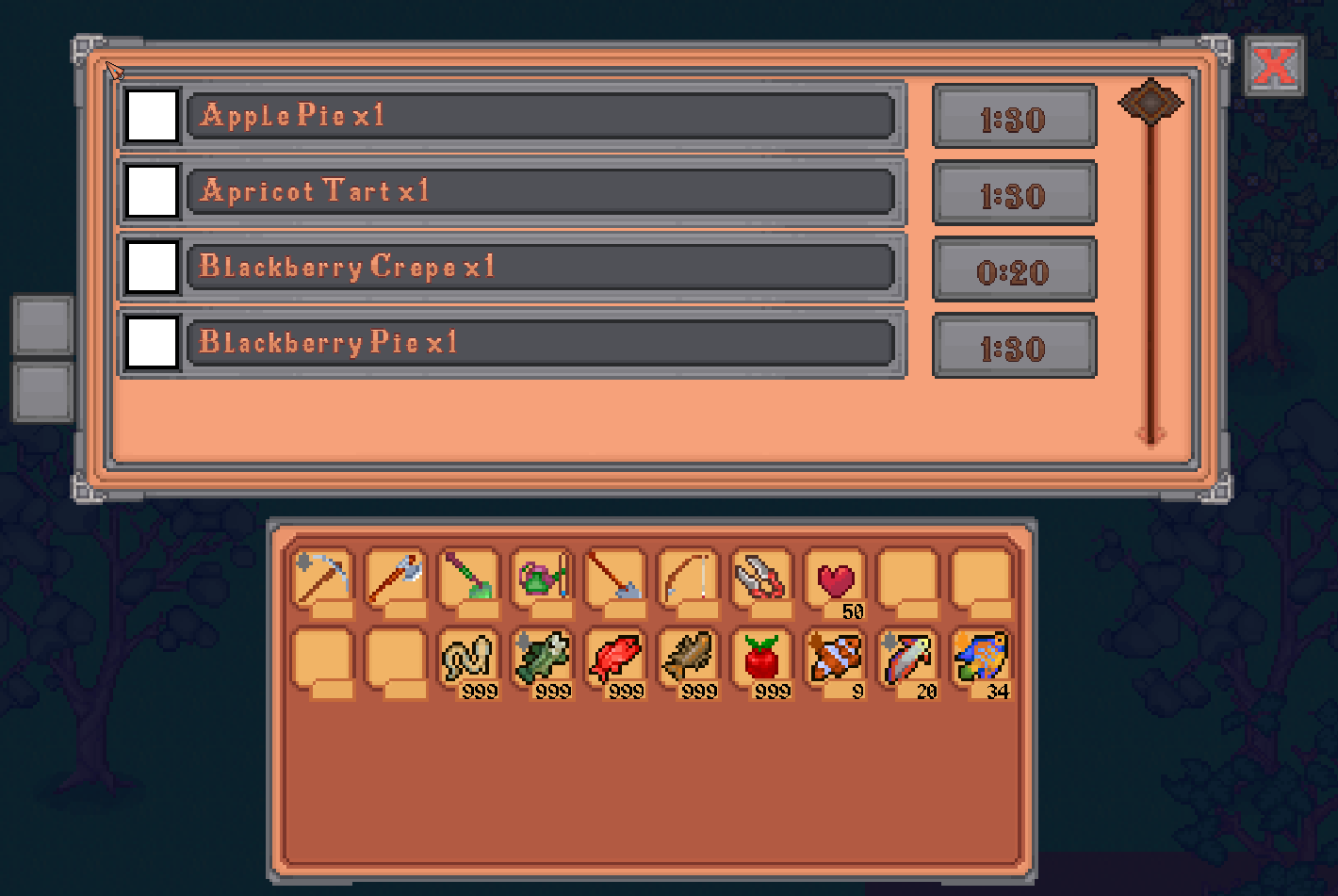
When you cook something it will be added to this list within the oven. In terms of game time 1 in game minute is 1 real life second. Once an item is done cooking you can retrieve it and add it to your inventory, simple as that.
Last is filleting fish. I didn’t bother uploading an image as it basically looks the same as the oven. To explain, you’ll have a similar looking list of all the fish you have in your inventory or chests. These entries are separated by breed of fish as well as by quality. So, if you have a bunch of bronze and silver bluegill you’ll have two listings to select from. The quality of a fish directly correlates to the quality of the fillet you get from it. Bronze fish gives bronze fillet, so on and so forth. In addition to this, different fish give a different number of fillets as well as different types which is all shown to you in the UI. To explain types I made two types of fillets for this version, normal and prime. The main difference is just that certain recipes use certain fillet types. I thought it might be a nice touch just to add some differentiation to fish that you catch without making things too complex.
Speaking of types of items, the other large change that came to recipes is meat. If you’ve played the current version of the game then you’ll know there are several different kinds of meat. All specifically named like pork, chicken, venison, rabbit, etc. I decided this was cumbersome. There are a lot of types and it ends up with each having just a few specific use cases.
The other obvious problem with meat is things like chicken, beef, and pork obviously come from farm animals. While I suppose I could build in the option to slaughter your farm animals for meat it hasn’t ever really sat well with me. I mean I know it’s a common thing on farms, but these kinds of games always felt a little too light hearted for that. Barring that option the only way to get these kinds of meat was to buy them which I didn’t really like.
The new plan is to tie hunting into cooking a lot more. In the current version hunting is basically off in its own world. All the meat you get from it can’t be used in recipes outside of a few outlying cases. In this new version meat has been simplified down to two types, which basically comes down to red and white. While you can just buy meat from stores like before hunted animals will now also drop this meat and will serve as the primary way to get it without having to pay for it. I suppose if people really thought that slaughtering farm animals was an interesting mechanic I could add it in at a later date as well.
In any case that should cover cooking for the most part. Most of the work came from data entry and setting up item quality UI interactions. As stated near the start, bar a small addition, the system is done, at least until I get the art assets which will involve a tiny bit of legwork to rearrange some assets.
Which leaves me with what’s next. To be honest, I still don’t really know what system to work on. The goal is to get this new version into a playable state sooner rather than later. However, I’m debating on what to call a playable state. The only thing I really know for sure is that I want combat to exist in the game before I go live with it. Alchemy might be another that’s sort of core and ties into a lot of things. Hunting is probably worth putting in as well given its new ties to cooking.
So while I might focus on one of those there is an equal chance that I take this next month to focus on odds and ends along with building the world a bit. There are a lot of systems that are effectively done but sprites or animations are missing or data needs to be entered. For the most part I’ve been operating in a style of building out systems but not necessarily putting in every piece of data that the system uses. A lot of this was because most systems tie into other systems so adding all the details for a system was impossible until all the parts were in place. At this point though a lot of framework is in place. So I may go back and clean up loose ends in various places.
Aside from that there is world design. I think I’ve mentioned before that the world is going to have something of a revamp. In a lot of ways, the main point is to condense the setting somewhat. I don’t plan to take areas out but some are entirely too big. The hope is to take the world and (as I said) condense it so that there is less walking and more doing whatever you want to do. All this is to say this next month might end up being a random assortment of things rather than a more concerted effort, time will tell I suppose.
Regardless, I’ll be back next month to share progress. I hope everyone is having a good fall. Happy Halloween if you celebrate that. I’ve eaten more than my share of candy this month so I’m doing my part. Thanks as always for your patience, hopefully I’ll have something interesting to report at the end of November.
September News Update
To start at the beginning, last month the dialogue system was implemented. While it was basically done I did have a few things to clean up at the start of this month. So, the first bit of time was spent fixing up a few UI issues, patching several bugs, and adding a little more functionality to the system. All of this was pretty minor and only took a few days, but I think the system in general has turned out nicely.
Next was the bit that took up the most of my time this month. I believe I’ve mentioned it before, but up until now there has been no save system for the new version of the game. As a consequence, there was also no load system obviously.
This system has now been fully implemented. I’m not sure if its worth getting into specifics here. I mean its basically what you would expect. Save the game. Load the game. Truly something the video game industry has never seen before.
Aside from the fact that you can save/load there are a few details though. First setting up this system involved setting up the entire load game UI screen, so that is also done. In the background of this project several pieces had to be reconfigured slightly to make saving/loading efficient and keep save files small.
At the moment, on my machine at least, saving is instant and loading only takes a few seconds. This time might grow slightly because as more systems are added more things need to be recorded or read from a save file. But I don’t predict any real increases to load times.
The other thing which may or may not be news is how you save. I honestly can’t quite remember if the live version of the game allows you to save anywhere. I think it might have been something I was working on, but realized that too much of the game was dependent on you saving at your bed.
In any case, the game will still save at midnight. However now you can save at any time in any place via a button in the settings menu. I know this was requested by several people in the past and I agree that it nice to be able to save when you want. The idea of only having the game save at midnight started way back with Harvest Moon. I’m not sure why that trend is still carried over in some games, even this one. Presumably Harvest Moon only did it due to some technical limitation.
Realistically, there isn’t any real reason to not allow people to save when they want in a game like this. The only other reasoning I can think of is to keep people from save scumming. For those unfamiliar with the term, that basically means to save right before you do something and if you mess up or want a different outcome you just quickly load the save. Sort of like quick saving constantly in Skyrim. That said, this isn’t really a high stakes kind of game. If people want to do that I don’t really see a problem.
Anyway, the last thing to mention with saving is patching. While a patching system isn’t in place yet the save system has been designed in such a way that when I do go to add it the process should be fairly straight forward.
For those unfamiliar with the term, patching is the process to update the game. This is mostly important for when I start doing regular updates again. People usually don’t like to have to start a new save each time a patch comes out. This system would allow you to transfer your save forward when the game updates. I did it in the previous version although there were more than a few issues during that process. That was partially due to the engine and partially due to my code and experience with such a system. Knowing what I know now I think it should be easier to tackle.
Moving on, because I’ve talked about saving more than probably anyone wanted, we come to sleep, the most exciting system. I added the entire sleep system this month. It functions the same as it does in the live version. You can sleep for up to 24 hours straight. Sleeping will restore your stamina and health, although health restores at a slower rate. The button to automatically sleep until your stamina is maxed is also still an option.
Most of the changes to sleep happened under the hood. A lot of it has to do with how the game actually runs at this point. To be brief, the old version of the game basically functioned as one giant level. The entire world was effectively partially loaded in at all times. An area would only fully load its assets when you entered that specific part of the world. This is a fairly common tactic in video games that is used to keep the required processing power for the game to a minimum.
The important part of this distinction is that in the old version the world and all its important assets like NPCs crops, processing buildings (like apiaries or fisheries) were always loaded into the world. Without going into a ton of detail (that I partially wrote and then deleted to save you all from boredom) the new version of the game does not operate as one giant level. Each time you enter an area you are specifically in that area and nothing else is loaded.
This can be done because everything is tied to higher level data structures rather than objects within the game world which are subject to loading in and out depending on if you are in the same area as them. All this is to say, things are much better now and sleeping which speeds up time, benefits greatly from these changes.
In addition, time functions a bit differently in the new code and It makes it much easier to manipulate things that depend on time, such as sleep.
I know that was a lot of technobabble but the TLDR is you can sleep, and from a backend perspective it functions much more nicely than it did in the previous version.
If you’ll remember way back before I started droning on about sleep, I said that making the sleep system took up, most of my time, but not all of it. I’m not particularly far yet, but I have started developing the cooking system. It will certainly be finished in October. For now, there are just a few basics in place for the UI and I’ve moved on to messing with recipe data.
Which does bring me to recipes. As I mentioned in the past, I’m going to change how you get them. Specifically, there won’t be any quests where you get a recipe as a reward. I think I mentioned this in the previous month’s devlog but in short I felt it wasn’t a particularly rewarding, uh…reward. Instead, there will be a separate system dedicated to learning recipes so those who want to focus on cooking can really do that and others can ignore it if they want.
That said, maybe you won’t want to ignore cooking because I’m planning to change some things a bit. To start, the actual process of cooking will likely remain the same. I might modify a few things but it will still involve having ingredients and the required heat to cook something. What I’m looking to modify is mostly what the various pieces of food do.
I think what I want to do is focus food more on stamina gain. In the past recipes gave all sorts of things. Anything you ate would regenerate stamina and health but some things would give you buffs as well. The issue with this in my mind is that it encroaches on alchemy as a system. From a design perspective if I had to pick something to give, let’s say, darkness resistance and my options where a plate of spaghetti or a shadeward potion I think I would pick the potion. It just makes more sense to have odd effects come from alchemical items rather than food.
This means food needs a bit of a rework in terms of what it does. My current plan, as stated before, is to focus on stamina. However, I think I’d like to add a bit more nuance. Food will obviously give you flat stamina. In addition, I’ll likely do things like stamina regeneration over time, or maybe reduced stamina usage on tools. All that is well trodden though. What I think I want to try is I guess basically a ‘well fed’ buff. Effectively this would allow you to eat and gain stamina over the normal limit. As long as you have more than the normal limit you would gain a buff. Maybe it makes your tools stronger, or you move faster, or something along those lines. This buff could also have tiers to some extent where the benefits gets larger the more well fed you are.
The hope is that something like this would allow food to have a unique place in the game’s systems. Then alchemy would take over things having to do more with combat buffs. Its all still in the beginning stages so things are subject to change but I think the idea is reasonable at least.
On top of this there are new recipes being added and some are being changed. My goal is to try and make it so that every ingredient has a few uses. For instance, cranberries have no recipes associated with them in the live game. I’ve added a few in the new version to take advantage of them.
I think that’s mostly it for cooking. There is just one more thing to briefly mention as I was thinking about it. I said forever ago that I was going to adjust the mines. Instead of 100 random floors there was going to be just a few but they would be much larger and more like a mini dungeon that players would have to navigate and then fight a boss to reach the next floor.
I still want to do this and while these areas will still having small areas to mine I was considering some things and I think I’m going to modify this a bit. What I’m currently thinking is to have the dungeon floors but between them you unlock basically just a big mining area with that level’s ores. This way once you get through the dungeon area you can just take the minecart back to a normal mining area instead of having to search the dungeon for ore veins. It’s a minor tweak but it popped into my head a week ago so I wanted to mention it.
I think that’s it for now. I’ll be back in a month as usual. I’m sorry there were no screenshots this time. The sleep and save system didn’t seem worth screenshotting as they both basically look the same. When cooking is finished I’ll probably grab screencaps of that. I’m admittedly not sure what comes after cooking. I haven’t thought about it too much but I’m sure I’ll figure it out soon. Thanks as always for your patience and reading this far.
August News Update
So, let’s jump into it because despite the loss of time there are a few updates to give. I believe at the end of the last update I mentioned that the dialogue system would be next in line. I’m happy to report that, bar a bit of UI tuning, that system is complete. This is another situation where that sounds like very little, but its actually a fair bit of progress.
Before we get to what’s new though I should preface with the old. If you’ve played the current version of the game you’ve probably talked to an NPC within it. I mean I really hope you’ve talked to at least one person. Even if you haven’t though you’ve seen the intro cutscene so you should be familiar with the dialogue system to a degree.
The dialogue system was created pretty early on in development and suffers from (like many other things) a lack of forward planning. At the time I made it I didn’t quite realize just how much was going to be steeped on top of the system. This resulted in a lot of bits being tacked on as time went on. So below is a basic image of the old system.

It serves its purpose although you might notice right off the bat that the clock is still visible which clutters the UI. Aside from that the major visual difference you’ll see is the large blank slot on the left side of the screen. This is used for buttons to navigate any menus within the dialogue system, except for when it isn’t. Below here you’ll see an image of a quest.

As mentioned above there are two buttons on the left one to show the list of quests, another to exit the conversation. Then, because I guess I was feeling experimental that day, you can also click on the text “Beginner Carpentry” to start the related quest. To my knowledge this is the only system in the game that requires you to click on text like it is a button.
If you’ve been reading these dev logs for the last few months you’ve likely heard me talk about UI consistency and the lack there of in this game. This was one of the major things I wanted to address in this system. Not to mention there would have eventually been a “Topics” button to navigate another set of choices. And the fact that the way you leave the UI is through a button that says “Exit” rather than the usual red X button.
Before we get into all that there are a few other things to mention however. As I said briefly the old dialogue system was made pretty early on and as systems were added in (quests, cutscenes, tale conversations) more and more was tacked onto the system, straining it greatly.
For instance, at the start of this I mentioned that if you’ve watched the opening cutscenes you are familiar with the dialogue system. That’s sort of true. It looks the same, but in reality there are two separate dialogue engines in the current game. The first handles regular conversations and then a second one had to be concocted specifically for cutscenes because the original was too convoluted to be applied in a cutscene. I don’t think I need to explain how bad that is in terms of design.
Another instance of bad design was related to the blacksmith. If you’ve ever upgraded a tool in the current version of the game you might remember that the blacksmith says a line of dialogue when you start an upgrade. He also has a unique line of dialogue when an upgrade is in progress and a specific line when the job is done and you pick up your tool. This is a simple interaction, but because of how the dialogue engine was written the whole thing effectively had to be uniquely dealt with.
Whenever you start a conversation in the game it checks to ensure the conversation isn’t one of those three specific blacksmith lines. If it is one of those lines the game basically shoves the entire dialogue system aside and has a hard coded set of instructions to handle the interaction. TLDR, not well made.
Aside from this there were smaller issues. As mentioned, things like quests weren’t originally considered so weird UI elements like the text buttons were made. There was originally a rumor system that was scrapped early on, but remnants still remain in the system. There were other conditions that dictated character dialogue which were dropped. Things like characters having multiple portraits for different emotions and switching through them during conversation wasn’t originally intended. And while tales would get that functionality regular dialogue never got it due to complications.
Speaking of tales, those were an idea that spawned much later. Tales for reference are the longer more character driven conversations that each character will have. A simple comparison would be the heart event conversations from Stardew Valley if you are familiar. Tales also involved player responses, another thing that wasn’t planned on.
Despite what you might think I don’t bring all this up to simply expose my own missteps. I hope that pointing these things out in some way helps people to understand why I decided to reconstruct this game from the ground up. Also, on the off chance that any other game developers are reading this I hope it serves as a cautionary tale. Plan your games out kids, take it from someone whose game plan was basically, “eh, how complicated can it really be?”.
So, I’ve spoken on what’s wrong with the current system, which is basically everything. So what has changed? Well, from a visual perspective not a ton although there are some noticeable differences. Most of the work is behind the scenes to make the system far more robust in general. So here is a simple image of dialogue to start.

As you can see, not a ton changed aside from the lack of button space on the left. Also the clock isn’t just weirdly still hanging in the background. One other minor change you might notice is the arrow in the bottom right. It will shift up and down slightly and basically just indicates that the line of dialogue is complete and can be advanced. For those unaware dialogue types itself out character by character instead of just appearing all at once. So onto other things, below an example of the new conversation menu.

The flow is a bit harder to understand with just still images. To explain, the player will initiate conversation with an NPC. Doing so results in a simple line of dialogue like you saw two images ago. Once you reach then end of that text you’ll be shown the resulting menu you see above. This allows you to pick further conversations via topics or quests.
The visuals likely speak for themselves, but at a basic level this UI is meant to be more inline with other UI in the game. Clicking any button will launch you into the respective topic or quest. Topics and quests are indicated by a specific icon, and as before quests will change their icon based on it being new, in progress, or ready to turn in. Finally, we have a response menu that you’ll see below.

This is where you’ll have to excuse the UI a bit. As mentioned near the start some adjustments to how it looks and button size still need to be done. This response menu allows the player to do things like accept quests or, in most cases, choose a response during a conversation.
So that is dialogue in a nutshell. To keep it brief all the things mentioned above have been addressed behind the scenes. There is now one unified dialogue system for in game and cutscene events. The UI is more inline with the game. There are allowances to alter portraits in dialogue, and you can pick dialogue responses in conversation.
Aside from that the dialogue system in general is implemented. Everything you have seen is working as intended. So you can talk to NPCs, accept, decline, and turn in quests. You can also start topics and pick responses within them.
The only thing that hasn’t been done, which is likely next is that there is no visual way to track quests at the moment. The quest log is likely my next project. However, this should just be a mostly simple matter of visualizing data.
Aside from dialogue there is one other thing to address from this month. That would be quests. If you’ve played Verdant Village for any length of time you’ve probably done some quests. In general these are basically just tasks to fetch particular items for NPCs. Quests usually unlock something for you, furniture schematics, new systems like archeology or alchemy, or sometimes new areas. And so we come to the point of interest, recipes, specifically of the cooking variety.
Cooking is sort of an oddball system. However, to put it simply, I personally find that getting a recipe isn’t that great of a reward. Cooking is such an optional thing in these games that I think there are large swaths of players (myself included usually) who never cook anything.
Having quests, honestly a large number of quests, give a recipe as a reward I think feels bad. As such I’ve decided to basically take these quests out. Instead, a new system will be put in place related to an NPC. Effectively this system will be you bringing him ingredients and that will reward you with the recipe and the cooked item. Ultimately, I think this will trim a lot of fat from the quest system and hopefully make quests more enticing.
That said, I know that’s a large chunk of quest content. I don’t think I’ve said too much about it, but I wanted to note here that there is something that will be added to supplement quests. I never got around to adding it in the current version, but I’ve always referred to this system as “secrets”. These secrets don’t involved dialogue with NPCs, but are effectively little quests you can find naturally in the world. Unlike actual quests they don’t involve collecting items on a list but rather solving puzzles (sometimes by bringing the right item) but generally they are a little more interesting than just a quest checklist to fill.
Hopefully that inspires a bit of hope in that regard. I don’t like to just take things out. In this case I’d say cooking quests are just being altered a bit instead of disappearing entirely, but I know it might not seem that way to everyone.
Anyway, I think that’s everything, thank you all for your patience and interest, it really does mean a lot to me. I will have more updates at the end of the month as usual.
July News Update
So, let’s start at the beginning. Last month I had most of the end of day recap in place. As a quick explanation when the clock hits midnight the game will pause for a moment and show you a variety of information about the day that just passed. You can check the previous post for details, but its generally things like money earned from shipping, animal and crop statuses, etc.
The start of this month was spent finishing up this system, or at least finishing it to the point that it can be done. At least one addition is guaranteed and others may be tackled if they seem worth it. As with last time you’ll have to ignore some of the art as it is currently temporary.
The first section that was added was the player stat section. There was no old equivalent to this so all I have to show is this version. Basically, the page will display how much xp you gained for various tools and professions as well as how far away you are from your next level.

The idea with this is sort of two-fold. First its nice to be able to just get a quick look to see how close you are to leveling up. Aside from that I find it can be nice in games like this to be shown small goals you can work towards. These games tend to be pretty open, letting the player pursue whatever they want. While I obviously don’t want to railroad anyone I think its sometimes nice to be shown something you can work towards if you need a direction to work in.
The other thing about player stats that you might have noticed me mention before is professions. If you’ve played the current version of the game you are probably familiar with perks. For those who aren’t, there are currently two things you can earn to improve your character. Tool skills, which you get by using your tools, and perks. Tool skills effectively just reduce the amount of stamina taken when using a tool.
Perks are more interesting in that they augment certain parts of the game. Things like gaining more resources from alchemy, a chance to cook double of something, instantly breaking rocks when mining, getting more honey from apiaries, etc.
When I was implementing the player stats section in the recap I looked back through these. I’m trying to give each system a once over as I put it in to make sure its up to par. My determination on perks was that the idea was alright, but the implementation was sort of scattered. Several of them were odd, some unexciting, and most importantly there were many systems that had no perks associated with them at all.
I decided that something of an overhaul was needed. So the perk system will be replaced with professions. The goal is to categorize things a bit better and give more of a sense of progression within a particular activity. Each profession has 5 levels with each level unlocking something or giving a benefit of some sort. I’m attempting to avoid spoilers here so I’ll give farming as an example. Without stating too much you’ll unlock fertilizers, a new type of thing to farm, upgrades, and automation throughout the five levels.
I don’t want to oversell this however. Some things you will unlock are slightly changed versions of some of the old perks. That said most of this is new and builds off the changes that are happening to systems in this new version.
In total there are 17 professions each with 5 levels so 85 unlocks (opposed to the 44 perks in the current version). Basically, if there is something you can do in the game its probably a profession. Examples would be Smith, Farmer, Rancher, Alchemist, etc. There are a few in there you might not expect as a couple of new systems are in and some things were expanded and I felt a profession was needed.
I should state that none of this is implemented yet. It is entirely planned out however much of it relies on interconnecting systems. Because of that it serves to get a base version of the system in and then build onto it afterwards.
That is it for that section. A lot of stuff happened but there is obviously still more to do. Now, after that massive tangent, we can move on to the second page that got added to the recap. This again has no counterpart in the current game but the recap will now display your current shipments. Again, UI isn’t finalized, but you should get the idea from the image below. This should serve as an easy reminder for what is ready to pick up and what isn’t.

Now, if the recap shows shipping objects you can probably figure out the next system that got added. Shipping is now back in the game. This probably doesn’t sound like a ton, but shipping is basically a huge database and UI task. So, while it might look like a simple screen there is a lot going on under the hood that made it a somewhat arduous task. Since the current version of the game has shipping I’ll start with pictures.
Old Version

New Version

As with the other UI changes I’ve been talking about, the idea is to bring things in line and homogenize the UI. The old UI is very button focused, something that can be annoying for controller players cause there’s just so much moving around through menus. Instead, much like the other UI, sliders have been put in. In addition to that I wanted to try and simplify this UI a bit. The old version is icon overload because you can see the required resources for every item that is visible.
The new version only displays the required resources when you click on one of the items you can order. There’s a slight change in the button UI for each orderable item to indicate if you have the resources or not as well so you won’t need to click on a button just to see if you have what you need.
In addition, once you do select an object you can see what is needed to order it. The required resources are listed along with how much of that resource you have. How much of a resource you have will appear in red or green depending on if you have enough. Hopefully all of this combined will show you what you need at a glance. Also, item icons can be hovered to see the name incase you don’t recognize it.
That is shipping in a nutshell. Of course if you can order items you also need to be able to receive them. This is also implemented and has been changed in terms of looks to something that I think is a bit more functional. Again, we’ll start with pictures.
Old Version

New Version

The old version effectively acted like a chest that you could only take items out of. Anything you ordered would eventually appear there and you could grab it. This had a few problems, the most obvious probably being that you could run out of space. Probably unlikely, but it could happen. The other issue was that it just didn’t look very nice.
On top of this the idea to show how long it would be until your item arrived wasn’t thought of until later. Because of that a UI was sort of just stapled onto the side. Its pretty basic and looks about as tacked on as it actually is.
The new version is more straight forward and combines all the info into a neater package. Basically, anything you order will appear in the list. The list can be scrolled and has infinite space so no problems can arise there. The gauge that you see on each item indicates how many days it will take for your item to arrive.
As stated before, there are some obvious pieces of UI that need to go in. Once those pieces get cleaned up I think it will look fairly nice though. If nothing else I think it is functionally a lot better than it used to be.
The last thing is something that I’m still working on although it is coming along quickly which is good. Especially considered how much of a nightmare the old code was. The system currently being made is the dialogue system. That probably doesn’t need to be explained, but basically anything involving talking to an NPC, giving a response, picking topics, starting quests, etc.
Currently you can walk up to an NPC talk to them and go through the conversation to the end. Nothing fancy, but like I said the old code was nightmarish compared to what currently exists. Its all organized much better and everything is a lot cleaner. The old dialogue system ended up being stitched together in many ways because the scope of what it needed to do grew as the game was developed. Since I know what is required from the outset this should be done a lot better.
The other things that got done this month were smaller. Some code was optimized between larger things. Lore for the world is still being written, so much lore. I’ve gotten to the point where the timeline is basically in place for larger world events so bar small things I’m basically on to detailing local lore. As I think I’ve mentioned before there is going to be something akin to a main story for this game. You can entirely ignore it ala Skyrim, but it involves a few hundred years of history in the region so some lore is required.
Lastly the battle system went through some more considerations. It has been fluctuating here and there and will likely continue to until I start development on it. Its too easy to change things when there is no code to prevent me from doing so. Still, I think the small changes and tweaks being made to it are a net positive. A system like that has the potential to really ruin or make a game so I want to do the best I can with it.
Alright, I think that’s it. As usual I’ve probably written too much based on the length of this doc. Thank you all for reading, I’ll have another update in a month as usual.
June News Update
Best to start at the beginning though. So, in order I first cleaned up the tool tip logic just a bit. There are a number of systems that are in place but might be missing a minor piece of code to polish it. I tend to program large swaths of a system and then make some notes before doing a second pass a little later to spruce things up. I find its better to give a system a little bit of time to breathe. Doing so lets me look at it with fresh eyes so I’m more likely to find things to polish up.
As for the tool tip logic it wasn’t much, just a simple subsystem so that the tool tip will never appear off the edge of the screen. Simply put, if you hover something that makes a tool tip close to the right edge of the screen the tool tip will appear to the left of your mouse and vice versa. Then apply that logic to the top and bottom of the screen too.
Next, was something far more important. When I got sidetracked on making custom house layouts I was actually going to start making the construction UI. Now that I’m finally done with custom housing, I moved back to the construction UI. For starters, below is a screenshot of the old UI.
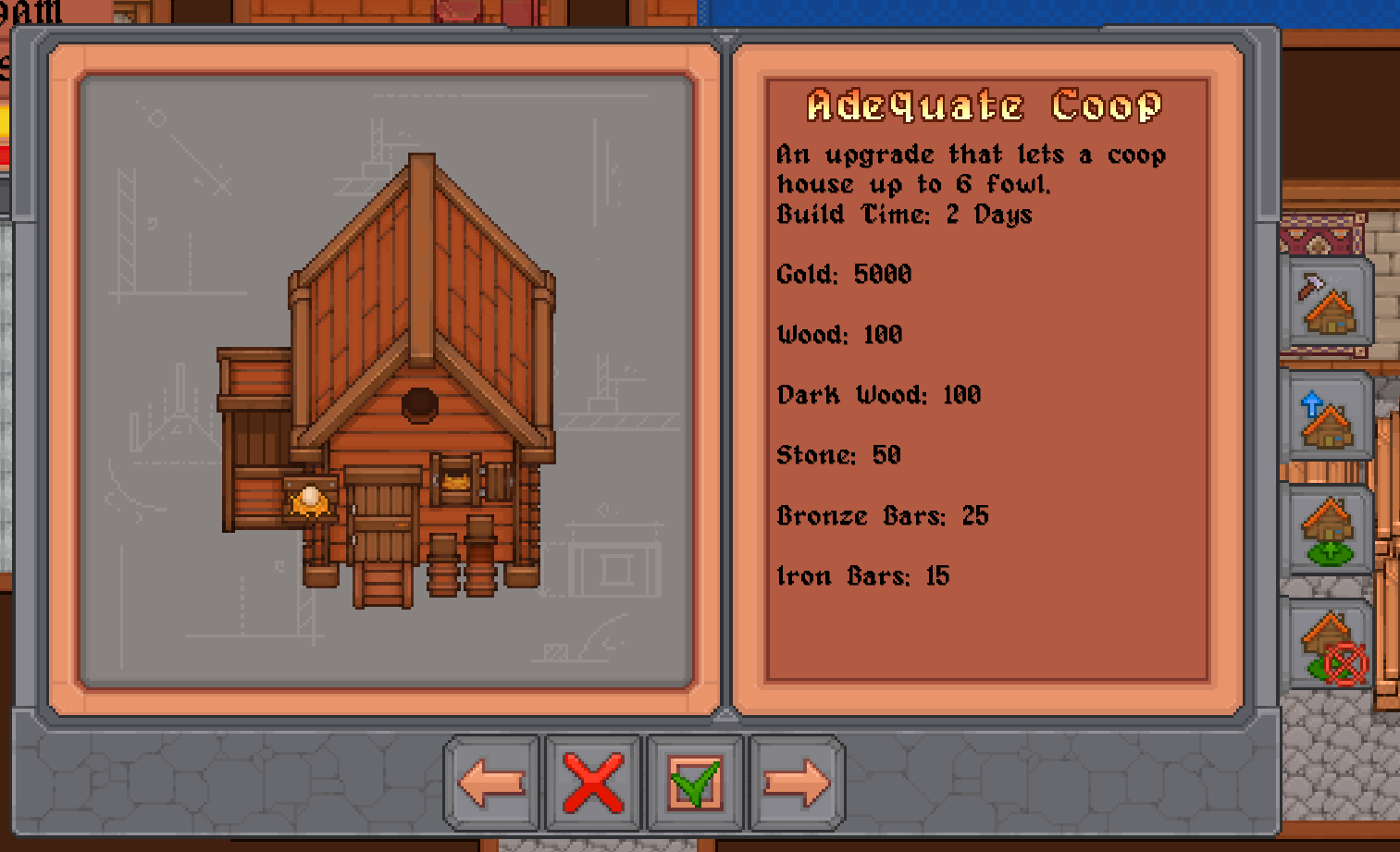
Now below this is an example of the new UI.

Sprite work on the new stuff is still in flux a bit. Anything you see could be tweaked, but the general layout is set. I think the best way to explain the changes is ‘streamlining’. The current live version of the game has a lot of buttons. I think I decided this because I play these sorts of games on mouse and keyboard (which based on what I seem to hear from others means I’m weird, but I already knew that). So when making UI I tailored it towards that sort of control scheme. The problem is, since the game will support controllers too, menus like this are really inconvenient. Having to navigate across even just four options is honestly not great and some UI is even worse than that. There are some pieces of UI like the inventory where streamlining might not be possible for a controller, but the problem should be alleviated where possible.
Even ignoring the controller issue the old UI wasn’t terribly great in my opinion anyway. In general, there are too many buttons and, in my opinion, too much text. This might sound strange but UI design should (I believe) always be concerned about new players. When you are familiar with a game you can connect the dots most times. Its when you are new that readability is most important. In the case of the old construction UI basically everything violates this, some bits more so than others.
To start, the buttons at the bottom to navigate the UI aren’t clear. The left and right arrows I would say are the only passable thing, although still a little unclear. The X button to close out the menu can probably also be understood, but it runs the risk of causing confusion because the live version of the game just throws UI close buttons in random places a lot of the time, so you can’t be sure what it does. A simple example of this concept is that in Windows the close button for a window is always in the top right. You’ll always know where to look for it and what it does. That kind of consistency is extremely important. Finally, the check button next to the X suffers from not having a clear purpose. Again, you can probably deduce what it does, but its left to interpretation.
The next issue is the text that displays what you need for construction. There’s too much text, and while everyone knows what wood, gold, stone, etc are, players may not know how to identify it in game. In game all items are icons, not text. Therefore, a purchase that requires these items should show the items, not a word describing the item.
In addition, the old UI only indicates when you have enough of the item with a green check. It doesn’t indicate when you don’t have enough of the material or gold. This leaves ambiguity which should really be avoided in every UI.
Finally, the buttons on the right. Not only do these add to the button count, but it also isn’t clear what each one does. The worst case being the difference between upgrading buildings and building new buildings. These buttons create two separate lists which unintentionally hides away options from players. Someone may just not notice the buttons and completely miss all the extra options.
Now, the new UI I think addresses most of, if not all, of these concerns. The name of the shop has been added which, while not that important, gives a bit of context for what you are looking at. Instead of having navigation at the bottom there is a simple list of options with a slider. This not only shows more options at once but also simplifies viewing and selecting. Instead of an ambiguous checkbox for starting construction there is a button clearly telling you what you are clicking on. The X button is also in the top right, which is where it will be on all UIs.
The buttons on the right of the UI have also been done away with. Upgrades are listed among the buildings getting rid of the need for two separate lists. Moving and deleting buildings has been condensed into one mode and therefore one button “modify buildings” which simplifies the process.
Lastly the required items for the building are displayed using the sprite rather than text. The amounts of each tint red or green based on if you have what you need to construct the building. The time to build is also given its own cost entry so that the detail doesn’t get lost in a paragraph of description text. Finally, something that can’t be seen in the screenshot is that if you hover any item sprite you’ll get a tool tip telling you what it is, so even if you haven’t seen the resource before you can at least get an idea of what you are looking for.
I’m sure it could still be done better, I’m hardly a game design expert, but I think this is a marked improvement over what was there before. This sort of make over is what can be expected for all the UI in the game. I don’t want to just remake what was already there in a new engine, that would be a waste of time when so much could be improved.
But enough about the construction UI. On top of all the changes all the code has been put in place to make it function appropriately so we are done there. The next thing to address was the actual buildings themselves. I’d already made coops and barns work because I’d implemented livestock a while back. Obviously, you can’t have animals without a place to put them. However, the other buildings hadn’t been setup. So I made wells and silk farms function. That still leaves fisheries and stables, but both are being put on hold for different reasons. The fishery UI needs to be completely altered, looking at the old UI I think I might have been in a fever dream when I okayed it. For stables the plan currently is to massively overhaul how horses work including things like stats, multiple horses, etc. So I didn’t want to jump into that before I was ready to tackle the whole thing.
During the process of setting up silk farms I had to account for them changing how they look during different seasons. This is in the live version of the game but it was really more of a tacked on feature because the engine was restrictive and I hadn’t setup buildings in a way to easily change their sprite during season change. This system is now actually appropriately implemented which means things like snow on the roofs of buildings in winter and other such things.
Finally, we come to shipping. This was the last thing I worked on this month and am still working on. Although that’s a bit deceptive because shipping really covers, selling items, ordering items, receiving items, and technically mail since its in the same UI. As expected, working on one system quickly spiraled into multiple systems.
To start, you can now sell items via the shipping chest. It functions in the same way a regular chest does but at the end of the day all the items in it will be sold. This is all in place and working. Of course this led me to what I call the ‘End of Day Recap’ screen. Part of selling your things is that the game will tell you what you sold at the end of the day and how much you made.
So as with every other system I took a look at what I already had. In the live version of the game you get a simple screen that breaks items up into categories, which I don’t think are ever explained to the player. I forget the reasoning for this but I think it was something to do with displaying too many items on screen that led to that implementation.
In any case, very basic, and honestly not that insightful unless you remembered what you put in the chest and could reason out what category it would fall under. Even still you’d be left with a lump sum of profit and not really know what sold for a lot and what didn’t.
Now, fair warning, the below screenshots are very much work in progress. The logic is all working, but the art will be changed in time. My artist is currently busy making furniture sprites, oh so many furniture sprites, but I’ll eventually get her onto this. The important thing is the functionality.

This screen in the recap will show you each item you sold, along with how many of it and how much money each item stack sold for. There will also be a total at the bottom but I didn’t get around to it quite yet.
However, that isn’t all. I did some thinking (as I’m prone to doing) and decided that this recap could really be a lot more useful. To tangent slightly, one of the bigger deviations in this game from other harvest moon type games is that you don’t have to sleep. You can just keep going through midnight if you want. As I recall there’s literally a perk called insomniac for staying awake 7 days straight. When I made the decision to make the game this way I didn’t really think about how it might change things. I’m not going to take this away and force players to sleep every night but changes need to be made to support this concept.
To put it simply forcing a player to sleep each night effectively forces a routine. Every day the player is going to start and end in the same spot. This, combined with repetitive daily tasks, creates an environment where it makes sense to have a list of things that you do each day. Good examples would be, watering crops, feeding animals, etc. Because a basic routine is so ideal most players have one. Because you have one it keeps you fairly tuned into everything going on.
However, if you aren’t forced to sleep each night the game can tick over to midnight and you could be on floor 37 of the mines looking for 5 more iron ore cause Sven is too lazy to provide materials for tool upgrades himself. Suddenly you’re in a completely different situation. A new day has started, you have things you need to do but you are in a strange starting situation.
The idea of this new recap is to give you a gauge of where things are at and help you get a snapshot of everything so you can plan a little bit more at that moment and formulate a plan for the day if you need to.
So, the recap now has tabs. The first being profits from shipping, as discussed above. The second is crops. Shown below, as I said above none of the sprite work is final.

The crops tab will show you the current status of every crop you have planted. How much water does it have, and how long till it is fully grown. This way you know if you’ve missed watering something, or maybe you need to run back to harvest. This may get more in depth if other things are added to crops as well. There are things like fertilizer and growth powders. If I decide to add more stats to crops you can expect them to be shown here. Next is a far more complicated one, animals.

As you may remember, animals got a lot of changes. Mostly, they were made far more complicated as a way to combat them being basically just an easy infinite money source. They produce goods of varying quality based on their happiness. Happiness is dictated by what they eat, if they have a pasture, grooming, immunity, diseases, etc. While all these things can be seen in a coop or barn you can now see them in the recap. The big green gauges are fairly self-explanatory, just an indicator of where that stat is. You might also notice the little green and red circles next to each icon. These indicate other bits of information such as, is the animal fully grown or not, what tier of pasture can they access if any, are they pregnant, do they have a disease, what food did they eat last, etc.
I understand that this is a lot of stuff to keep up with so I’m hoping this will serve as a simply way to condense all the info and make it a bit more digestible.
There is one final tab at the moment which is player stats. I don’t think this is exactly needed but I thought it would be a nice little page of information to see how you progressed that day. The plan is that it will track progress in tool proficiencies, perks, challenges, etc. Similar to what you see with crops and animals you’ll have indicators of how much XP or progress you gained in each particular thing that day. Again, probably not needed but I think it might help if a player is looking for a direction they can look at their stats and maybe see that they are close to getting a perk or stat increase and then focus on it.
I think it might also be a good idea to expand on this sort of thing in the player pause menu as well. Basically have this information available to the player anytime they pause and obviously have it update in real time. This way if you have a ton of stuff to keep track of you can sort of check your work as you do it. I feel like with all the systems it could get overwhelming if you choose to dabble in a lot of stuff and having a way to track it will help.
Okay. I think that’s it. I went on for a while here but I like to explain the choices I’m making here. Any feedback is obviously appreciated. Things I think are good ideas can obviously turn out to be poor ones as clearly evidenced by things like the old construction UI.
One other minor thing that I don’t think will be a big deal but I thought it worth mentioning. I’m still writing lore for the world on the weekends, or dear so much lore, so much lore that is probably irrelevant to a farming game lol. I’m thinking of using this world as a setting for games in the future so it wouldn’t all be wasted, but that’s beside the point. I just wanted to mention that some characters may be getting reworked a bit to fit into the lore. As the world gets fleshed out I’m finding that the characters will need to be altered a bit to match. I don’t think any of the characters that exist are particularly well characterized at the moment but I thought I’d make a broad statement saying that they are all subject to change. Realistically I see this as a good thing. The whole point of making lore was to make the world feel more natural. If I’m feeling characters need to be changed that means there is lore that can color each of them in a more interesting way. So just a heads up there.
I’m not exactly sure what this month holds. I’ll be finishing the recap, and then shipping first. After that I’m not sure what I’ll turn to next. There is plenty to do of course, it might be NPCs or it may be something more mundane like setting up saving and loading. Time will tell. Anyway if you made it all the way down here thanks for reading and sticking with me through this very long process. I hope you all are having a good summer, I’ll be back in a month to ramble on about other game design things.